Based on routine Bayesian theory, updating Bayesian error function of mechanical constants of thin-walled box girder was derived. Combined with automatic search scheme of polynomial interpolation series of optimal step length, the Powell optimization theory was utilized to implement the stochastic detection of mechanical constants of thin-walled box girder. Then, the Powell detection steps were presented in detail, and the Powell detection procedure of mechanical constants of thin-walled box girder was compiled, in which the mechanical analysis of thin-walled box girder was completed based on finite strip element method. Through some classic examples, it is obtained that Powell detection of mechanical constants has numerical stability and convergence, which proves that the present method and the compiled procedure are correct and reliable. During constants’ iterative processes, the Powell theory is irrelevant with the calculation of partial differentiation in finite strip element method, which indicates high computation efficiency of the studied method. The stochastic performances of systematic constants and systematic responses are simultaneously included in updating Bayesian error function. The optimal step length is solved by search method of polynomial interpolation; without the need of predetermining the interval, the optimal step length locates.
With the development of engineering technology and the maturity of box girder theory, thin-walled box girder is more and more widely adopted.1,2 For the existing scientific and technological achievements and the research literature of box girders, most of them concentrate on the complex and exact mechanical analysis of the structure.3,4 For examples according to different finite element algorithm, some special mechanical models are established or derived to explore structural mechanical behavior of the box girder structures. By now, some computational software tools, such as Midas, Bangladesh, which belong to specific technology domain, have emerged. There are some other pursuers who have contrived some special elements for the box girder structure.5,6 For this kind of structure, it is sometimes complicated to carry out spatial structural analysis precisely while the finite straight strip element method becomes the efficient analytical tool for the box girder structure because the finite straight strip element (FSSE) divisions are comparably simple, the necessary mechanical constants are relatively fewer, and both the computational stability and precision can satisfy general engineering requirements.7,8 Whereas, before the structural mechanical behaviors are probed into, the necessary mechanical constants must be held. Otherwise, this task cannot be efficiently performed. But, accurately grasping the mechanical constants is not always an easy thing. Methods of field or laboratory tests are often used to determine structural constants, which cannot take the influence of random disturbance factors into consideration without the ability of reflecting the factual circumstance. The mechanical constants are occasionally ascertained even only depending on experiences. Thus, if mechanical constants can be detected in time according to the some necessary measured data, evaluating and forecasting performances of the box girder more precisely become more believable.9,10 Although the gradient theory and the Kalman filtering theory have been successfully used in the constant detection in the study of Wu11 and Zhang et al.,12,13 it is unfortunately an deficiency that the partial derivatives of the systematic responses to the constants must be repeatedly computed in iterative processes in the two theories. It will consequentially lead to lower computational efficiency and error accumulation. As an improvement, the Powell optimizing method is irrelevant with the perplexing partial derivatives. How to solve this problem is worthy of being explored.
For the thin-walled box girder structures and with routine Bayesian theory, updating Bayesian error function of mechanical constants of the structure is derived. In order to study the stochastic detection method of mechanical constants of the structure, the Powell optimization theory together with automatic search method of polynomial interpolation series are both derived and analyzed in detail. Through classic examples, some problems of updating Bayesian detection of mechanical constants are probed into, and some important conclusions are obtained.
Updating Bayesian error function of mechanical constants of thin-walled box girder
During the process of updating Bayesian stochastic detection of mechanical constants of thin-walled box girder, elastic modulus of different positions are treated as random variables, which are written into random vector (m is the dimension of the vector ) to carry out the detection of poly constants. From Bayesian theory,14,15 the following expression can be obtained as
where is the prior distribution, is the conditional distribution of the measured information, is the measured information distribution, and is the posterior distribution. With the assumption that mechanical constants obey normal distribution, the expression of the prior distribution is
where is the mean vector, and is the covariance matrix of mechanical constants .
In practical engineering, the displacements at the measuring nodes must be measured many times, and the measured displacement data of each time are all samples of . If the routine Bayesian error function is set up to identify constants, there is much work repeated.16–20 Thus, the updating Bayesian error function of mechanical constants of thin-walled box girder is deduced. The united density function of is , where n is the times of measured displacements. From Bayesian approach theory,21–24 we have
where is the displacement vector from the computational results by the following FSSE method. Substituting equations (2) and (3) into equation (1), the updating Bayesian error function J is derived as
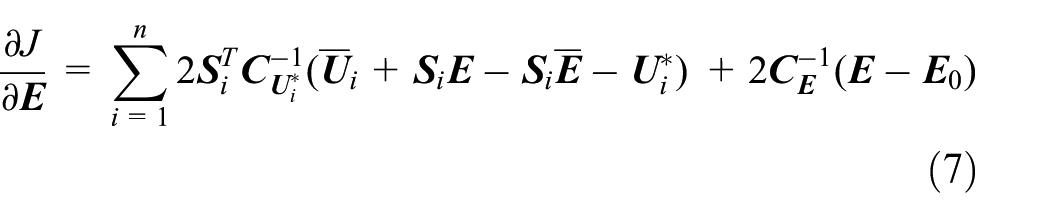
In order to obtain the variance detection result of mechanical constants and from equation (4), the partial differentiation of dynamic error function J to mechanical constants is expressed as
Expanding into the form of Taylor’s formula at the expectation point and selecting both the zero-order and the first-order terms, it can be achieved as
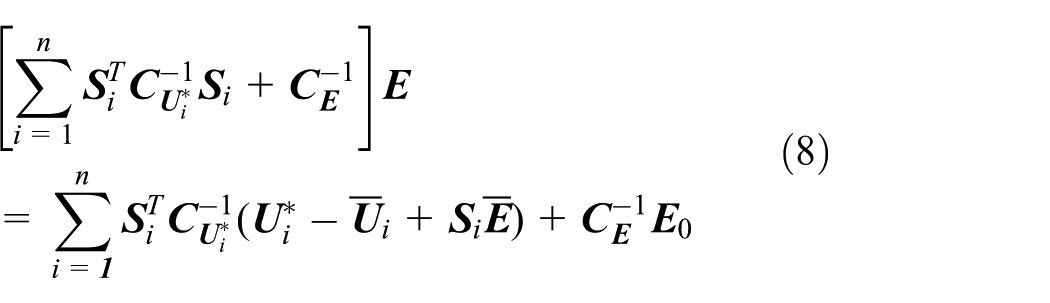
where . When the error function J reaches the minimum, which means that equation (7) equals zero, then
Supposing
From equations (8)–(10), the estimation value of mechanical constants of thin-walled box girder can be written as
where is a unit matrix. , where is the ith measured displacement vector. , where is the ith computational displacement vector at the mean point . , where is the ith sensitivity matrix of measured displacements. Supposing the foreknown information of mechanical constants of thin-walled box girder is irrelative with the measured displacement vector , from equation (11) the variance of can be written as
where and is the ith covariance matrix of measured displacement vector. With the non-singularity property of and , equation (12) can be expressed as
Equation (13) can be rewritten into the series form as
Finite element governing equation for thin-walled box girder
In the updating error function, equation (4) of mechanical constants of thin-walled box girder, is the displacement vector from the computational results. The FSSE method presented in Zhang et al.12 is herein applied to the mechanical analysis of the thin-walled box girder. The relationship expressions between the strain and displacement in rectangular coordinate system are listed as follows
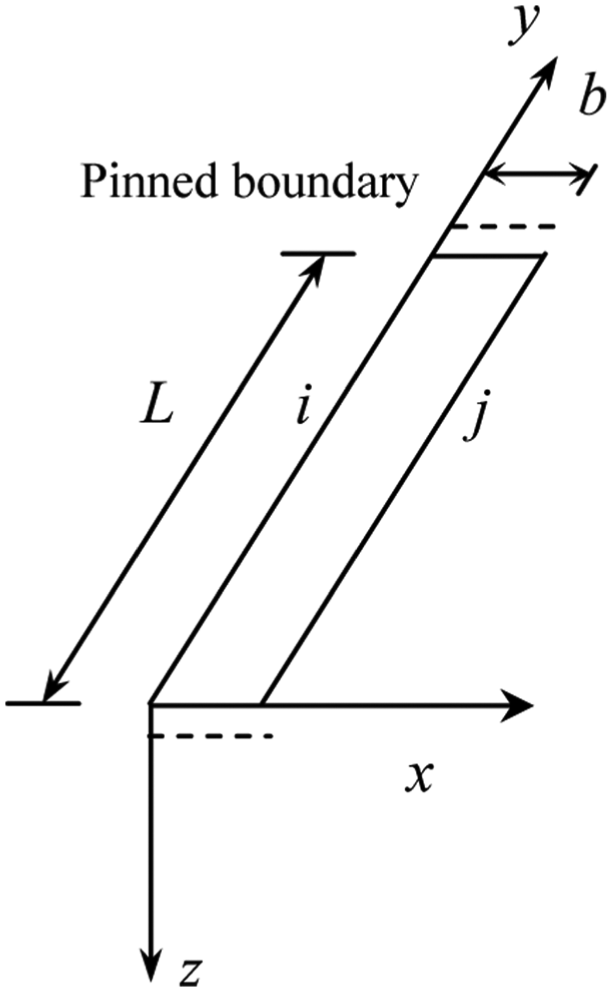
As for the box structure, displacement interposition function of FSSE in Figure 1 is
where is the total displacement vector, and is the mth displacement vector in the total coordinate system. is the peak displacement vector of the line in FSSE. is the shape function which is determined by the harmonic function . L is the longitudinal length, and b is the width of the strip element.
FSSE of thin-walled box girder.
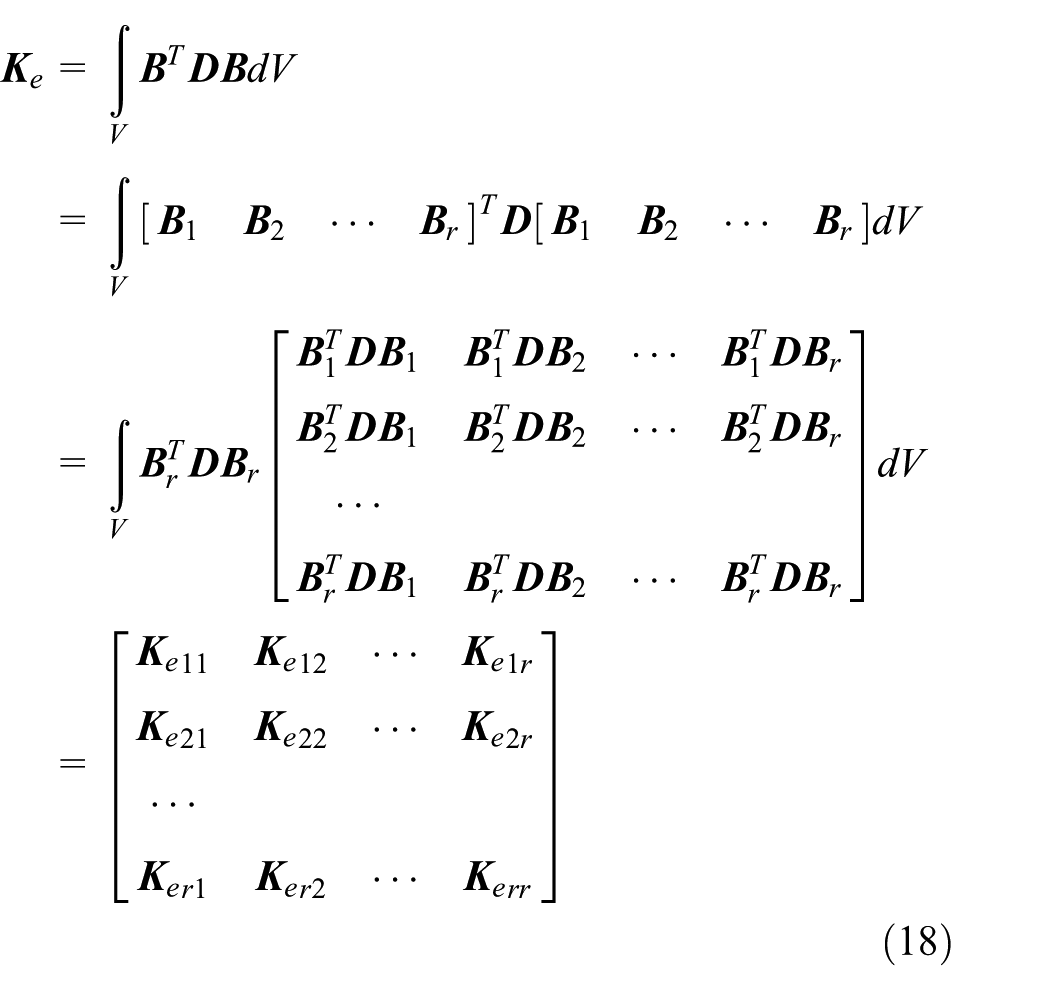
The stiff matrix of FSSE can be derived as follows
Where is the elastic matrix. The strain matrix can be determined by substituting equation (17) into equations (15) and (16). In equation (18), the block matrix can be obtained as
According to the orthogonality of the harmonic function , equation (18) can be rewritten into the diagonal block matrix as
The mth item of FSSE governing equation for the pinned box girder is gained as
where . is the rotation matrix from the whole coordinate system to the local coordinate system. and are, respectively, the mth item of the peak displacement vector and the peak load vector in the whole coordinate.25–29 After summation of all the peak displacement vector when the variable m alters from 1 to r, the displacement vector of the box girder is
where is the mth item of displacement interpolation matrix which is connected with harmonic functions of and .
Stochastic detection method of mechanical constants of thin-walled box girder
Powell method
The available optimization methods can be chiefly divided into two categories: direct search method (Powell method, simplex method, etc) and gradient search method (one-order gradient method, conjugate gradient method, etc). Gradient search method keeps changing the spatial scale (matrix) to engender new search directions in the optimization processes. The gradient search method cannot avoid the partial differentiations of error function to systematic constants in finite element method which leads to extra error accumulation. The direct search method only needs the information of the error function, which is particularly proper for the kind of error functions which have no analytical expressions.9,10 The Powell method is an effective method in the existing direct optimization methods, and it uses one-dimensional search method to produce the optimal orientations from different starting search points.
Combined with Powell theory, the flowchart of the updating Bayesian detection of mechanical constants of the thin-walled box girder is shown in Figure 2, and the detection steps are expressed as follows:
1. Select the initial values of mechanical constants and the initial search direction , and let , where is the unit coordinate vector, and m is the dimension of mechanical constants and the variable . Set the iterative variable and the convergence criteria and ;
2. With mechanical constants , carry out one-dimensional search in turn along the search direction where , which means that
And then, the displacement constant series is obtained. From error function equation (4), we have
3. Begin with mechanical constants and take one-dimensional search into action along the search direction , which means that
The flowchart of the updating Bayesian detection of mechanical constants of the thin-walled box girder.
And then, the mechanical constants are gained. If one of the two convergence criteria can be satisfied, it is that
Then, Powell iteration is convergent, and the detection results of mechanical constants are . The iteration is stopped. Otherwise, continue the next step;
4. This step is the judgment computation whether the search direction is collected. Assumed that , the following equations are gained
If , it is useless or helpless to collect the search direction . Thus, keep the available search direction and turn to step (6). Otherwise, proceed to the next step;
5. If , the available search direction set is unchanged and proceed to step (6). Otherwise, the calculation called collecting the search direction is finished, in which the search direction in the available search directions is ignored and the search direction is collected to become the mth search direction
Let , , and turn back to step (2) to keep iterating.
6. Let , and turn back to step (2) to keep iterating.
Search method for step length
The search for the optimal step length in the above steps (2–3) is a complex problem in updating Bayesian detection of mechanical constants of thin-walled box girder. The golden section method and Fibonacci series search method are the most widely used one-dimensional search methods, and the two methods can ensure simplicity of compiling procedure. But, the range where the optimal step length lies must be known in advance. However, correctly determining the range where the optimal step length lies in is not quite easy (usually determined by trying many times) and especially as for the problem of poly-constants’ detection, correctly determining the range becomes much more difficult. Consequently, the one-dimensional polynomial interpolation series search method is accomplished to optimize the step length which can automatically determine the range of the optimal step length and carry on optimization.12 The method successfully solves the problem of automatically optimizing the step length and the basic steps include the following:
1. Determination of the range where the optimal step length lies. Suppose the initial step length and a step length increment and let
If , the step length increment expression
where is calculated. The calculation is not ceased until . If , the other step length increment expression
where is calculated. Similarly, the calculation is not ceased until . When the iterative calculation is completed, the range where the optimal step length lies is achieved and defined as .
2. Interpolation of the optimal step length . Based on the extremum property of the Bayesian error function and through pertinent mathematical derivations, the expression of the optimal step length is obtained
where and are, respectively, the initial value and the final value of the range where the optimal step length lies. and are both the general variables. is the half point of the range .
Development of the procedure and analysis of the examples
The updating Bayesian detection of mechanical constants of thin-walled box girder is researched (, , and are, respectively, the elastic modulus of the top board, web board, and bottom board) in Figure 3. The numbers of the strip element and strip line are shown in Figure 4. The longitude length is L = 120 cm. The true values of mechanical constants and Poisson’s ratio , and the widths of the top board, web board, and bottom board described as , , and are listed in Table 1, and the constant variation coefficient is 0.1, which is used to depict the uncertainty of the mechanical constants. The vertical uniform loads p1 = 3.8 N/cm and p2 = 7.8 N/cm are, respectively, applied to the line of No. 2 and No. 5 of the box girder, and the series item is given m = 40. In order to complete updating Bayesian detection of mechanical constants of thin-walled box girder, the procedure named PLLSBG.FOR is developed, in which the mechanical analytical procedure of thin-walled box girder is employed. The corresponding validation of the mechanical analytical procedure is confirmed in Zhang et al.12 Select the six points (No. 1–No. 6, shown in Figure 4) in half-span section plane as the measurement points and measure the displacement of every measurement point for five times. The means and standard deviations of displacement of the measurement points are listed in Table 2.
Sketch of thin-walled box girder.
Number of strip element and strip line (cm).
True values of mechanical constants and Poisson’s ratio and the widths of the box.
Constant’s name
Unit
104 N/cm2
104 N/cm2
104 N/cm2
cm
cm
cm
Value
300
200
350
0.17
0.50
0.45
0.50
Means, U, and standard variances, , of the measured displacements (cm).
Selected points
Displacement means U
Displacement standard variances
1
0.046
0.048
0.043
0.044
0.049
0.062
0.066
0.065
0.067
0.059
2
0.043
0.047
0.045
0.045
0.048
0.073
0.077
0.078
0.074
0.071
3
0.044
0.049
0.042
0.043
0.045
0.054
0.052
0.058
0.051
0.056
4
0.043
0.042
0.047
0.045
0.047
0.051
0.053
0.054
0.057
0.053
5
0.052
0.055
0.056
0.051
0.055
0.07
0.064
0.066
0.062
0.067
6
0.043
0.046
0.044
0.048
0.047
0.074
0.079
0.078
0.073
0.076
Loadcase 1
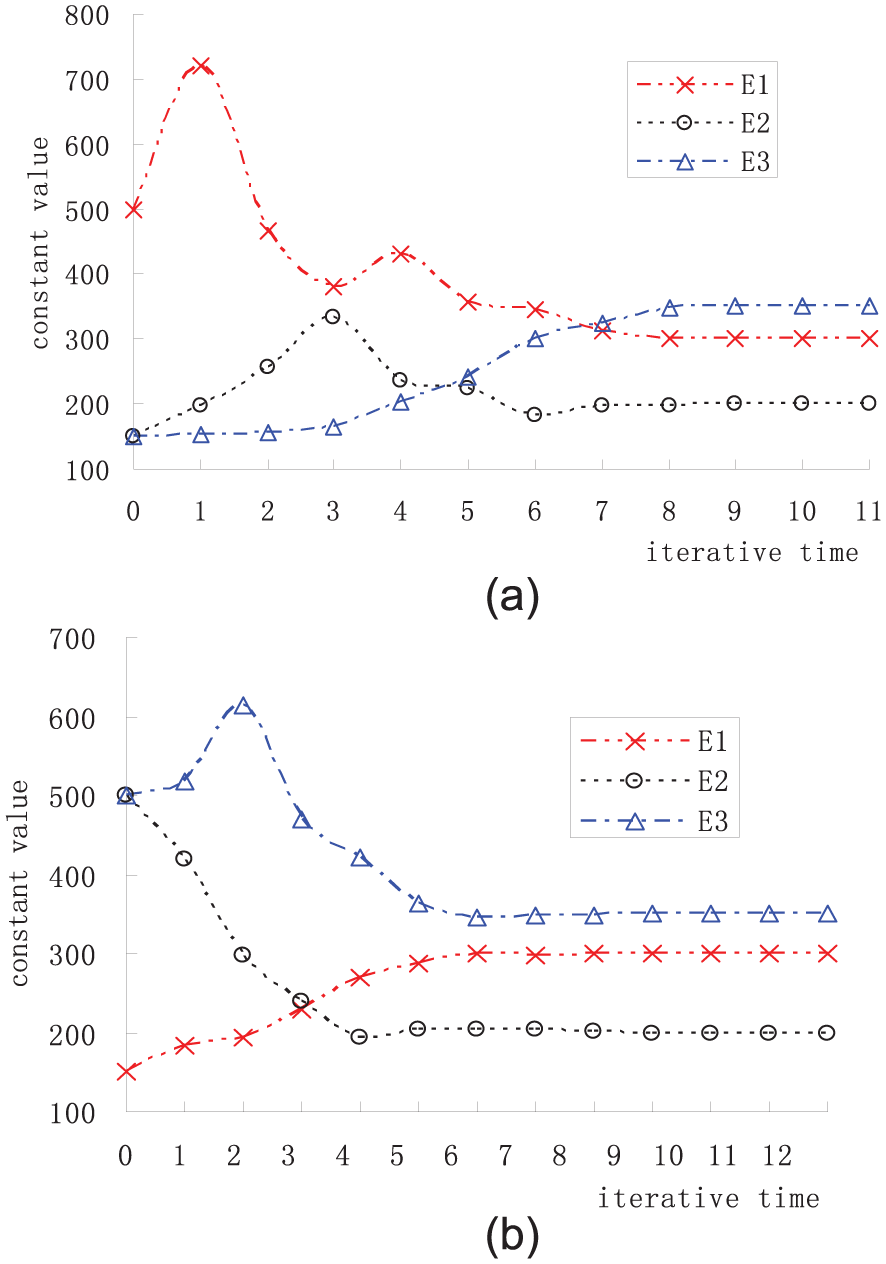
The updating Bayesian detection of mechanical constants of thin-walled box girder when the foreknown information is precise means that the foreknown information of the box structure is . In order to carry out the iterative processes, set the Group 1 of the initial values of mechanical constants and the Group 2 . Suppose the convergence criteria , , which are input to the Powell detection procedure of PLLSBG.FOR together with the data in Table 2, and the iterative results of mechanical constants are shown in Table 3 and Figure 5. The iterative results of logarithm of updating Bayesian error function is shown in Figure 6.
Results of Powell detection of mechanical constants of thin-walled box in loadcase 1 (104 N/cm2).
Mechanical constants
Initial value
500.0
500.0
500.0
150.0
150.0
150.0
Final value
299.92
200.08
350.47
300.82
199.72
348.83
Iterative times
10
10
10
10
10
10
Relative error (%)
0.03
0.04
0.14
0.27
0.14
0.33
Convergence criterion
Iterative results of mechanical constants in loadcase 1 (104 N/cm2): (a) iterative results when is set and (b) iterative results when is set.
Iterative results of logarithm of updating Bayesian error function in loadcase 1.
From Table 3 and Figure 5, it is indicated that when the foreknown information is precise, the iterative process of updating Bayesian detection of mechanical constants of thin-walled box girder is steadily convergent to the true constant values, which means that the convergence is independent of the initial constant values. Iterative results of logarithm of updating Bayesian error function in Figure 6 are steadily decreased. The results indicate that the derived detection model including Powell theory is exact and the developed PLLSBG.FOR detection procedure is correct. When the foreknown information is accurate, the iterative process can converge conformed to both convergence criteria and when different initial constant values are appointed, which shows the robustness of the solution strategy. The detection efficiency is primarily determined by calculative times the FSSE procedure is called. Based on a large number of numerical calculations and comparisons with achievements in Zhang et al.,12 the Powell method is independent of the partial derivative calculation of the finite element method, and with conjugate gradient theory, the times of calling the finite element procedure are significantly reduced. Thus, the cost time with Powell theory is obviously shortened, which naturally proves high computational efficiency of the derived method.
Loadcase 2
In order to obtain some other regularities of Powell detection of mechanical constants of thin-walled box girder when the foreknown information is precise, the Group 3 of the initial values of mechanical constants and the Group 4 are, respectively, selected. Obviously, is farther from the true value compared with , and is nearer to it compared with . The other data are the same as loadcase 1. From the PLLSBG.FOR procedure, the iterative results of mechanical constants are shown in Table 4 and Figure 7. The iterative results of logarithm of updating Bayesian error function is shown in Figure 8.
Results of Powell detection of mechanical constants of thin-walled box in loadcase 2 (104 N/cm2).
Mechanical constants
Initial value
500.0
150.0
150.0
150.0
500.0
500.0
Final value
300.01
199.72
350.55
300.12
199.95
349.99
Iterative times
11
11
11
12
12
12
Relative error (%)
0.003
0.14
0.16
0.04
0.02
0.001
Convergence criterion
Iterative results of mechanical constants in loadcase 2 (104 N/cm2): (a) iterative results when is set and (b) iterative results when is set.
Iterative results of logarithm of updating Bayesian error function in loadcase 2.
It is known from Table 4 and Figure 7 that in the poly-constants’ detection, when the initial constant values deviate closer from the true values, the number of iterations is not reduced, and the convergence precision is not improved either. For example, compared with , deviates closer from the true value ; however, the final iterative times of and are, respectively, 10 times and 12 times. The convergence precisions are both very high because the relative error is less than 0.5%, which are indistinctly improved when the initial constant values deviate closer from the true ones. The reason for this result is that during the detection processes of poly constants, there exist the interactions and constraints between the constants.
Loadcase 3
The updating Bayesian detection of mechanical constants of thin-walled box girder when the foreknown information is imprecise: suppose the foreknown information . For the sake of convenient comparison, set initial constant values and , and the other data are the same as loadcase 1. The iterative results of updating Bayesian detection of mechanical constants are listed in Table 5.
Results of updating Bayesian detection of mechanical constants of thin-walled box in loadcase 3 (104 N/cm2).
Mechanical constants
Initial value
500.0
500.0
500.0
150.0
150.0
150.0
Final value
322.36
243.71
368.02
319.28
236.56
324.22
Iterative times
21
21
21
32
32
32
Relative error (%)
7.45
21.85
5.15
6.42
18.28
7.37
Convergence criterion
From Table 5, it is found that when the foreknown information is inaccurate, the iterative processes of mechanical constants converge only conformed to the criterion . Unfortunately, the iterative results do not converge to the true values because the relative errors are more than 5%. From the updating Bayesian iterations when different groups of initial constant values are appointed, it is validated that if the foreknown information is imprecise and the iterative processes can converge, the convergence can only conform to the criterion .
Besides, from a great deal of research as in Table 6, the other regularity can be concluded and gained as follows: whether foreknown information is set precise can be judged from the relative fluctuating degree of constant iterative result.
Relative fluctuating degree of constant iterative results by different groups of foreknown constant values (104 N/cm2).
Mechanical constants
Foreknown value
300.0
200.0
350.0
400.0
400.0
400.0
Final value,
299.92
200.08
350.47
322.36
243.71
368.02
Final value,
300.82
199.72
348.83
319.28
236.56
324.22
0.90
0.36
1.64
3.08
7.15
43.8
300.37
199.90
349.65
320.82
240.13
346.12
Relative fluctuating degree (%)
0.29
0.18
0.47
0.96
2.97
12.65
From Table 6, it is indicated that when the foreknown information dissatisfies the precise condition, the relative fluctuating degrees of constant iterative results are times larger than that when the foreknown information is set precise. Doubtlessly, if the iterative process diverges, the foreknown information is imprecise.
Conclusion
From updating Bayesian detection of mechanical constants of thin-walled box girders based on Powell theory, some conclusions can be drawn subsequently. (1) The stochastic performances of systematic constants and systematic responses are simultaneously included in updating Bayesian error function. (2) During iterative processes of constant detection, the Powell method is independent of the partial derivative calculation of the finite element method, which proves high computational efficiency of the detection method. The partial differentiations of error function to systematic constants in finite element method must be carried out for extra times when the gradient method is utilized, which will inevitably lead to extra error accumulation. (3) The polynomial interpolation series method can automatically search and achieve the optimal step length and improve the detection efficiency without the need of predetermining the region the optimal step length locates.
Footnotes
Academic Editor: Jose Ramon Serrano
Declaration of conflicting interests
The author(s) declared no potential conflicts of interest with respect to the research, authorship, and/or publication of this article.
Funding
The author(s) disclosed receipt of the following financial support for the research, authorship, and/or publication of this article: This paper is financially supported by the Key Project of the National Natural Science Foundation of China (No. 11232007), Natural Science Foundation of Jiangsu Province (BK20130787), State Key Laboratory of Mechanics and Control of Mechanical Structures (MCMS-0213G01), and the Fundamental Research Funds for the Central Universities (NS2014003).
References
1.
KurianBMenonD.Correction of errors in simplified transverse bending analysis of concrete box-girder bridges. J Bridge Eng2005; 10: 650–657.
2.
CuryACremonaCDumoulinJ.Long-term monitoring of a PSC box girder bridge: operational modal analysis, data normalization and structural modification assessment. Mech Syst Signal Pr2012; 33: 13–37.
3.
ZhangJYeJSZhaoXM.Dynamic Bayesian estimation of displacement parameters of thin-walled box girder based on Novozhilov theory. Engineer Mechan2007; 24: 71–77.
4.
JwoDJChoTS.Critical remarks on the linearised and extended Kalman filters with geodetic navigation examples. Measurement2010; 43: 1077–1089.
SahaNRoyD.Extended Kalman filters using explicit and derivative-free local linearizations. Appl Math Model2009; 33: 2545–2563.
7.
ChiSYChernJCLinCC.Optimized back-analysis for tunneling-induced ground movement using equivalent ground loss model. Tunn Undergr Sp Tech2001; 16: 159–165.
8.
ModakSVKundraTKNakraBC.Prediction of dynamic characteristics using updated finite element models. J Sound Vib2002; 254: 447–467.
9.
DowellRKJohnsonTP.Closed-form shear flow solution for box–girder bridges under torsion. Eng Struct2012; 34: 383–390.
10.
SennahKMKennedyJB.Literature review in analysis of box-girder bridges. J Bridge Eng2002; 7: 134–143.
11.
WuGJ.Research on finite element model updating of reinforced continuous concrete box girder. Master’s Dissertation, Southeast University, Nanjing, China, 2010.
12.
ZhangJYeJSWangCQ.Dynamic Bayesian estimation of displacement parameters of continuous thin-walled straight box with segregating slab based on CG method. Chinese J Comput Mech2008; 25: 574–580.
13.
ZhangJYeJSTangXS.Kalman filtering identification of Winkler foundation’s parameter based on Mindlin theory. Rock Soil Mech2008; 29: 425–430.
14.
ZhangJLanWGYuB.Stochastic Gaussian optimized inversion of mechanical parameters of reinforced concrete single T-shaped beam. Adv Mat Res2011; 163–167: 1874–1878.
15.
LuoQZLiQSTangJ.Shear lag in box girder bridges. J Bridge Eng2002; 7: 308–313.
16.
HeXHShengXWScanlonAet al. Skewed concrete box girder bridge static and dynamic testing and analysis. Eng Struct2012; 39: 38–49.
17.
AsheboDBChanTHTYuL.Evaluation of dynamic loads on a skew box girder continuous bridge part I: field test and modal analysis. Eng Struct2007; 29: 1052–1063.
BennounMHouariMSATounsiA.A novel five-variable refined plate theory for vibration analysis of functionally graded sandwich plates. Mech Adv Mater Struc2016; 23: 423–431.
20.
HamidiAHouariMSAHassanSet al. A sinusoidal plate theory with 5-unknowns and stretching effect for thermomechanical bending of functionally graded sandwich plates. Steel Compos Struct2015; 18: 235–253.
21.
BeckJL.Bayesian system identification based on probability logic. Struct Control Hlth2010; 17: 825–847.
22.
YuenKVBeckJLKatafygiotisLS.Efficient model updating and health monitoring methodology using incomplete modal data without mode matching. Struct Control Hlth2006; 13: 91–107.
23.
BeckJLKatafygiotisLS.Updating models and their uncertainties. I: Bayesian statistical framework. J Eng Mech: ASCE1998; 124: 455–461.
24.
KatafygiotisLSBeckJL.Updating models and their uncertainties. II: model identifiability. J Eng Mech: ASCE1998; 124: 463–467.
25.
BouradaMKaciAHouariMSAet al. A new simple shear and normal deformations theory for functionally graded beams. Steel Compos Struct2015; 18: 409–423.
26.
BelabedZHouariMSATounsiAet al. An efficient and simple higher order shear and normal deformation theory for functionally graded material (FGM) plates. Compos Part B: Eng2014; 60: 274–283.
27.
HebaliHTounsiAHouariMSAet al. New quasi-3D hyperbolic shear deformation theory for the static and free vibration analysis of functionally graded plates. J Eng Mech: ASCE2014; 140: 374–383.
28.
YahiaSAHassenAAHouariMSAet al. Wave propagation in functionally graded plates with porosities using various higher-order shear deformation plate theories. Struct Eng Mech2015; 53: 1143–1165.
29.
ZhangJZhouCWLanWGet al. Nonlinear dynamical identification of displacement parameters of multi-cell curve box based on Markov error theory. Chinese J Appl Mech2010; 27: 746–750.