



Abstract
This study establishes the improved element stiffness and mass matrices of the thin-walled box girder, using a cubic Hermite polynomial shape function and based on an improved displacement function for shear-lag warping meeting the axial equilibrium condition of shear-lag warping stress and the consistency requirements of the displacement function. The improved thin-walled box girder element comprehensively considers multiple influencing factors, such as the thin-walled box girder shear-lag effect, shear deformation, and rotational inertia. The element shape function has first-order continuity at the element interface and satisfies the calculation precision with relatively few degrees of freedom. A finite beam element method program that can be used to calculate the natural vibration frequencies of thin-walled box girders was compiled based on the improved thin-walled box girder element. This program was used to calculate the natural vibration frequencies of many thin-walled box girder samples with different span-width ratios, span-height ratios, and boundary conditions. After comprehensively considering the influencing factors, the calculation results obtained from finite beam element method are in good agreement with those obtained from an ANSYS finite element calculation, thus demonstrating the rationality and validity of the improved thin-walled box girder element stiffness matrix and mass matrix proposed in this study. Finally, factors influencing the thin-walled box girder shear-lag effect and shear deformation were analyzed, providing relevant reference for project designers.
Introduction
Because shear strain exists in the top, cantilever, and bottom slabs of thin-walled box girders (TWBGs), the longitudinal strain of the portion of these slabs far from the web is less than that of the portion near the web. This phenomenon is known as the shear-lag effect and results in a nonuniform strain distribution across the transverse direction of the top, cantilever, and bottom slabs of a TWBG.1–8 Additionally, neglecting shear deformation, as in Euler–Bernoulli beams (i.e. beams with infinite shear stiffness), might be inappropriate in some cases, for example, for TWBGs with a reduced span-to-depth ratio.9–16 Therefore, the natural vibration characteristics of TWBGs suffer from the coupled effects of shear lag and shear deformation.
Shear-lag and shear-deformation effects in TWBGs have been popular research topics for decades. Reissner 17 first analyzed the shear-lag effect in TWBGs based on the principle of minimum potential energy. The TWBGs in his paper had a single-cell cross-section without side cantilever slabs, and a quadratic parabola was adopted as the displacement function for shear-lag warping. Reissner’s method was later extended to analyze the shear lag of TWBGs with cantilever slabs by Kuzmanovic and Graham, 18 Chang and Zheng, 19 and Chang and Yun, 20 among whom Kuzmanovic and Graham 18 and Chang and Yun 20 adopted quadratic and quartic parabolas, respectively. However, in most of these papers, the warping displacement functions for shear lag of the TWBG with cantilever slabs have some deficiencies because the corresponding warping stresses cannot satisfy the axial equilibrium condition. Moreover, in existing analytical methods, the shear-lag deformation state is analyzed together with the flexural deformation state of the corresponding elementary beam, which complicates shear-lag analysis. Additionally, it is inconvenient to distinguish between the shear-lag warping stress and the flexural stress of the corresponding elementary beam. Zhang and colleagues2,3,7 established an improved displacement function for shear-lag warping in a box girder with cantilever slabs through the axial equilibrium condition for shear-lag warping stress. However, these models failed to consider shear deformation. Xu and Wu developed a new plane-stress model using the state space method for composite beams with flexible shear connections. The results show that the one-dimensional (1D) theory neglecting shear deformation underestimates the deflection of composite beams. 21 Berczyński and Wróblewski9,10 formulated three analytical models describing the dynamic behavior of the composite beams: two based on Euler beam theory and one on Timoshenko beam theory. It was found out that the results obtained based on the Timoshenko beam theory model achieved the highest conformity with experimental results, both for higher and lower modes of flexural vibrations of the beam. Dilena and Morassi22–24 further presented a refined model of composite beams considering the shear deformation and compared the results of experimental tests with those of Euler–Bernoulli and Timoshenko models. They found that the percentage errors of the Timoshenko model were less than half of those corresponding to the Euler–Bernoulli model.
In the numerical analysis of natural vibration in TWBGs, many scholars preferred to apply the finite beam element method (FBEM).25–33 However, few scholars have comprehensively considered shear lag and shear deformation of TWBGs. In this article, the additional deflection induced by the shear-lag effect is adopted as the generalized displacement to describe the shear-lag deformation state of a TWBG and the shear-lag deformation state is analyzed as an independent fundamental deformation state. Based on the concept of generalized force corresponding to the generalized displacement for shear lag and the consistency requirements of displacement functions, improved TWBG element stiffness and mass matrices with a cubic Hermite polynomial shape function were derived. The improved TWBG element comprehensively considered multiple influencing factors, such as the shear-lag effect, shear deformation, and rotational inertia, and satisfied the calculation precision with a relatively small number of degrees of freedom, providing a foundation to improve the computational efficiency of thin-walled beam structures. Second, an FBEM program that can be used to calculate the natural vibration frequencies of TWBGs commonly used in engineering was compiled based on the improved TWBG element proposed in the study. Finally, the natural vibration frequencies of many TWBG samples with different span-width ratios, span-height ratios, and boundary conditions were calculated, and factors influencing the TWBG shear-lag effect and shear deformation were analyzed.
Displacement and strain model of TWBG
Displacement and strain models of TWBGs
Set

where

Dimensions of TWBG sections.
According to the displacement compatibility at the intersection of the web and top flange, the following equations are obtained

where
Although most scholars preferred the cubic parabola,34–37 Zhang and colleagues2,3,7 demonstrated that a quadratic parabola was reasonable as the displacement function for shear-lag warping by investigating the in-plane shear deformation of flanges. Based on the previously mentioned boundary conditions, the displacement function for shear-lag warping of the top slab, cantilever slab, bottom slab, and web can be approximated by four quadratic parabolic equations as


where the y of
The longitudinal displacement of the web is composited by cross-section rotation and warping. According to the beam theories in open literature, the nonlinear warping of the box girder is concentrated on top slab, bottom slab, and the cantilever slab, while the nonlinear warping of the web is insignificant. Thereby, the warping of the web can be assumed to be constant. The

where
Per the axial equilibrium condition, the displacement function for shear-lag warping should meet the following equation

Substituting equation (4) into equation (6) leads to

where
The longitudinal displacement at any point of the cross-section of the TWBG can be expressed as 38

where
Strain model of TWBG
Based on these displacement models, the strain at any point of the TWBG’s cross-section follows


where
Given these strain models, the stresses at any point of the cross-section of the TWBG can be given by


where
FBEM of TWBGs
TWBG element stiffness and mass matrices considering shear deformation and shear lag
According to the consistency requirements of displacement functions, the contributions of different displacement functions to the same strain function should have the same polynomial degree after finite element approximation; otherwise, false geometrical constraints will be introduced, thereby reducing the accuracy of the element and even causing shear locking. By investigating the highest derivatives of the different displacement functions in equations (9) and (10), it was found that the highest derivatives of

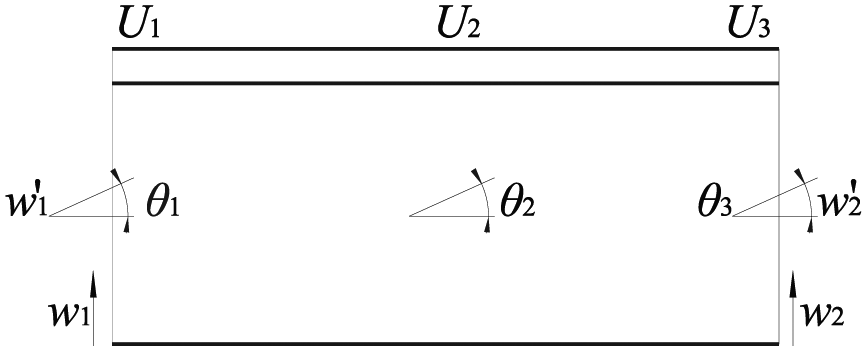
Nodal degrees of freedom of the TWBG element.
The Hermite polynomial shape function that realizes the element-edge


where

Substituting equation (16) into equations (9) and (10) leads to


Substituting equation (16) into equations (11) and (12) leads to


The kinetic energy of the TWBG can be given by

where L denotes effective length of the TWBG.
The strain energy of the TWBG can be expressed as

where
According to equations (21) and (22), the first-order variations of the strain energy and kinetic energy can, respectively, be expressed as
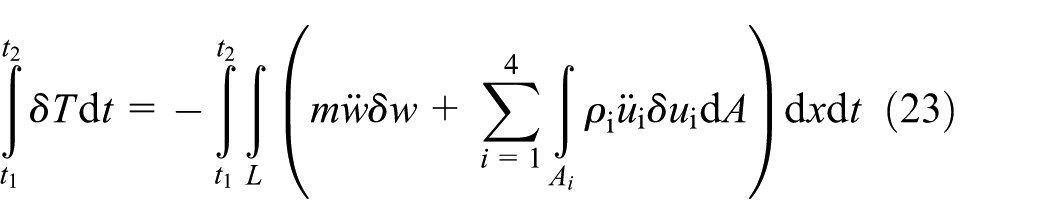

Substituting equation (16) into equation (23) leads to the TWBG element mass matrix 25


Substituting equations (17)–(20) into equation (24) leads to the TWBG element stiffness matrix


Calculation of the natural vibration frequency of a TWBG
Based on the TWBG element stiffness matrix
Boundary conditions of the clamped beam

Boundary conditions of the simply supported beam

The
Supposing the transformational relation between the TWBG total freedom vector before and after the boundary constraint as

where
The free vibration equation with multiple degrees of freedom can be expressed as

Assuming that

where
Substituting equation (38) into equation (37) leads to

Substituting equation (36) into equation (39) leads to

where

As indicated by equation (40), the TWBG frequency equation can be given as

MATLAB was used to compile the above FBEM program for TWBGs; thus, the TWBG natural vibration frequency could be comprehensively obtained accounting for shear lag and shear deformation.
Degradation of the TWBG element stiffness matrix
1. When the shear-lag effect was not taken into consideration

After the rows and columns related to the warping displacement vector


2. When shear deformation was not taken into consideration


As indicated by equations (46)–(49), the following could be obtained

As indicated by equation (50), the element stiffness matrix

where
After obtaining the TWBG element stiffness and mass matrices not considering the shear-lag effect and shear deformation, the method described in section “Calculation of the natural vibration frequency of a TWBG” was used to calculate the TWBG natural vibration frequency without considering shear lag or shear deformation.
Analysis of calculation examples
The finite element method (FEM) was carried out by utilizing the finite element program, ANSYS, which was used to verify the FBEM’s results. The top slab, bottom slab, and web of the box beam were simulated by employing SHELL43 shell elements. The boundary conditions of the end of the finite element models were simulated by constraining the degrees of freedom in both the vertical and transverse directions if the ends were simply supported, and in the vertical, transverse, and longitudinal directions if the ends were clamp-supported.
In the first place, a numerical example by applying Carrera Unified Formulation (CUF)
39
was quoted to compare with the FBEM’s result. This study focuses on a particular class of CUF models that makes use of Lagrange polynomials to discretize cross-sectional displacement variables. This class of models is referred to as component-wise (CW) in recent works. According to the CW approach, each structural component (e.g. columns, walls, frame members, and floors) can be modeled by means of the same 1D formulation. In this study, the hollow-square section beam was investigated. The dimension of the sides were
Comparison of calculation results between the FBEM and CW.
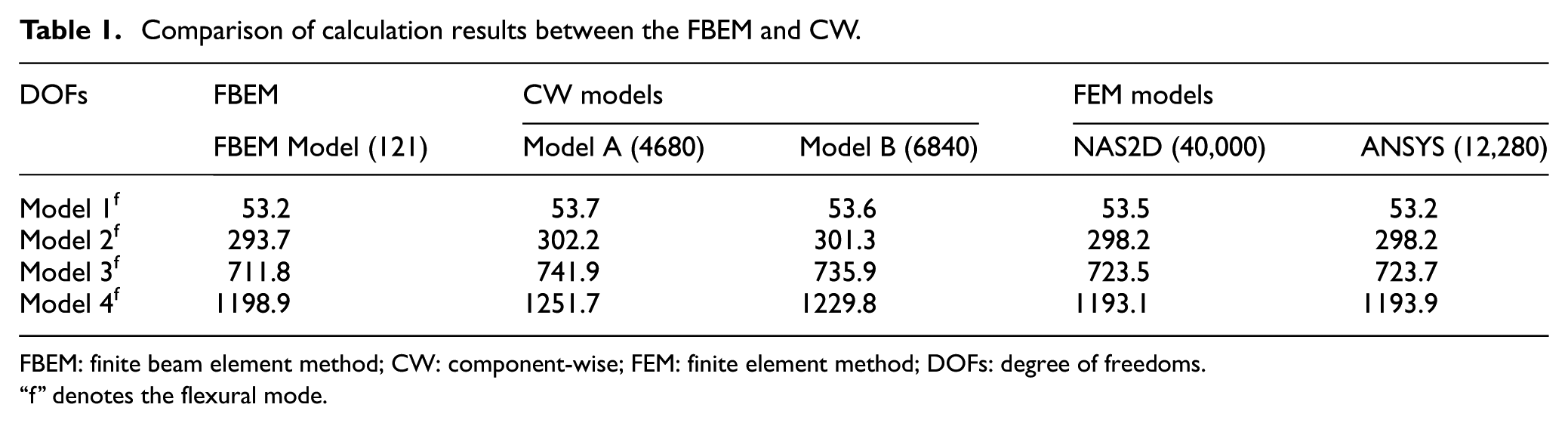
FBEM: finite beam element method; CW: component-wise; FEM: finite element method; DOFs: degree of freedoms.
“f” denotes the flexural mode.
Table 1 shows that the FBEM’s first four flexural natural frequencies were in good agreement with the CW’s results and FEM programs’ results. Meanwhile, the FBEM’s numerical cost is relatively small to compute the box beam’s flexural natural frequencies.
Furthermore, in order to verify the accuracy of the FBEM in section “FBEM of TWBGs,” the natural frequencies of two groups of simply supported TWBGs (TWBG-1 and TWBG-2) and two groups of clamp-supported TWBGs (TWBG-3 and TWBG-4) were calculated using both the FEM and FBEM. Five span-width ratios and five span-height ratios were selected for each group of TWBGs. The mechanical and geometrical parameters of the TWBG samples were as follows:
Tables 2–5 contain comparisons of the calculation results for natural frequencies using the FBEM and ANSYS models.
Comparison of calculation results between the FBEM and ANSYS models (TWBG-1).

FBEM: finite beam element method; TWBG-1: thin-walled box girder 1.
Comparison of calculation results between the FBEM and ANSYS models (TWBG-2).

FBEM: finite beam element method; TWBG-2: thin-walled box girder 2.
Comparison of calculation results between the FBEM and ANSYS models (TWBG-3).

FBEM: finite beam element method; TWBG-3: thin-walled box girder 3.
Comparison of calculation results between the FBEM and ANSYS models (TWBG-4).

FBEM: finite beam element method; TWBG-4: thin-walled box girder 4.
The shear-deformation and shear-lag effects of TWBG were studied by analyzing the first five orders of the natural frequencies. Tables 2–5 and Figures 3–5 show that:
After considering influencing factors, such as shear deformation, shear lag, and rotational inertia, the calculation results obtained from FBEM are in good agreement with those obtained from ANSYS finite element calculation, with a calculation error
Both the shear-lag effect and shear deformation increase as the order of the natural vibration frequency of the TWBG rises. The shear-lag and shear-deformation effects of clamp-supported TWBGs at low-order frequencies are relatively small, indicating that the low-order natural vibration in clamp-supported TWBGs is mainly flexural deflection caused by the cross-section’s rotation.
The shear-lag effect significantly increases as the span-width ratio of the TWBG decreases. When the span-width ratio of the TWBG decreases from 12 to 4, the shear-lag effect is increased fourfold. When the span-width ratio is 4.0, the maximum shear-lag effect reaches 26.6%, indicating that the shear-lag effect of TWBGs with a relatively small span-width ratio cannot be ignored.
The shear-lag effect increases slightly as the span-height ratio of the TWBG increases; meanwhile, the shear-lag effect is not significant. This indicates that with a relatively small span-height ratio, the shear-lag effect is not a major concern.
The shear-deformation effect significantly increases as the span-height ratio of the TWBG decreases. When the span-height ratio of the TWBG decreases from 12 to 4, the shear-deformation effect is increased by 2.5 times. When the span-height ratio is 4.0, the shear-deformation effect reaches 103.15%, indicating that the shear-deformation effect of TWBG with a relatively small span-height ratio cannot be ignored.
While the span-width ratio varies, the shear-deformation effect increases when the mode order of natural frequency increases, indicating that the shear-deformation effect cannot be ignored with a higher mode.

Relationship between the calculation errors
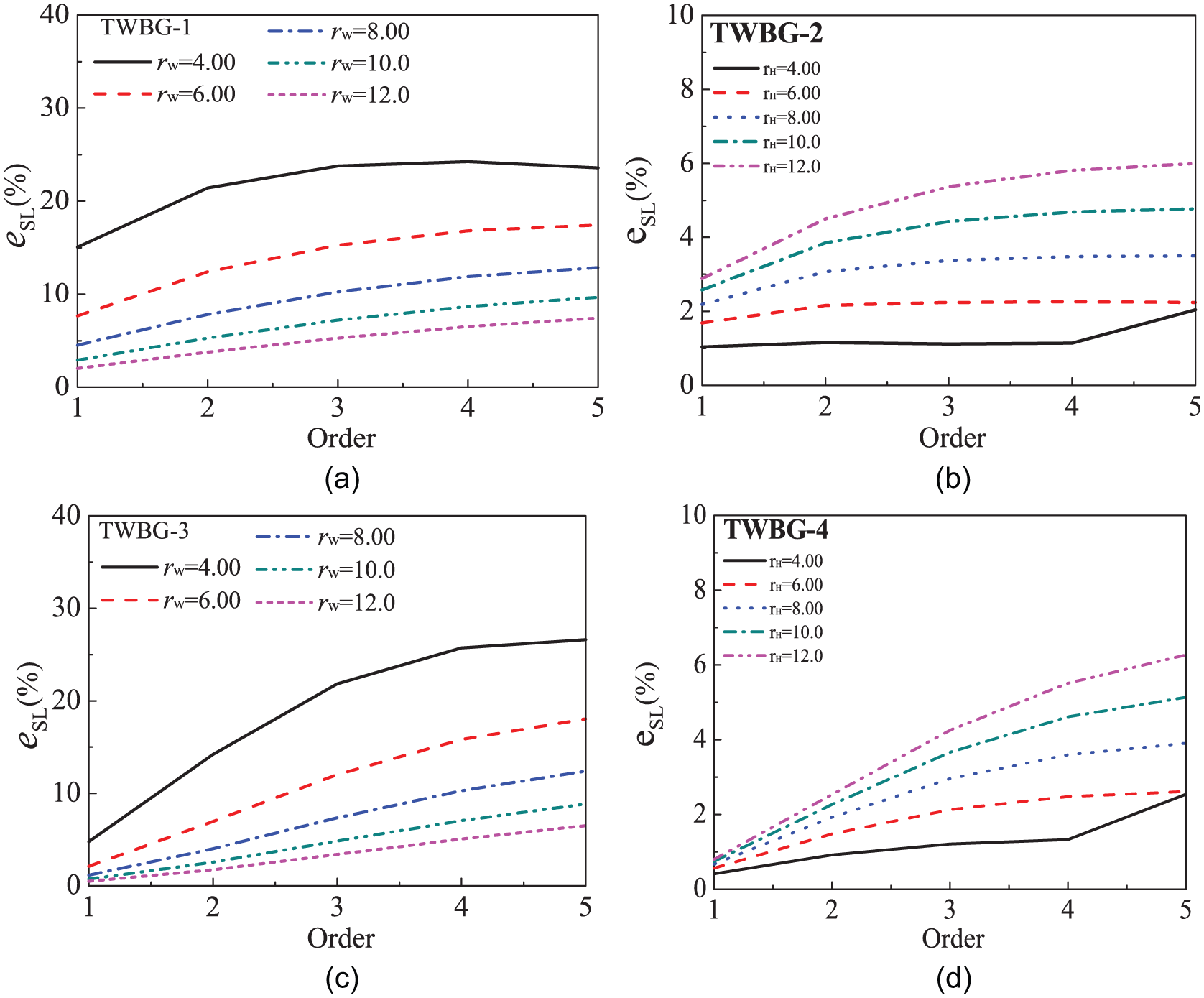
Relationship between the shear-lag effect

Relationship between the shear-deformation effect
Conclusion
After considering many influencing factors, such as shear deformation, shear lag, and rotational inertia, an improved TWBG’s element mass and stiffness matrices were derived using Hamilton’s principle with a cubic Hermite polynomial shape function. An FBEM program was implemented employing the proposed TWBG element and can be used to calculate the natural vibration frequencies of TWBGs. The natural vibration frequencies of many TWBG samples with different span-width ratios, span-height ratios, and boundary conditions were calculated, leading to the following conclusions:
The FBEM calculation results are in good agreement with the ANSYS results, thus demonstrating the rationality and validity of the improved TWBG element mass and stiffness matrices proposed in this study and providing the basis for further application of the FBEM in dynamic calculation for TWBGs.
Adopting the additional deflection as the generalized displacement for shear lag has very clear, physically significant meaning and is especially easy for engineers to accept in practice.
The shear-lag effect increases with the order of the natural vibration frequency of the TWBG and increases as the span-width ratio decreases. The influence of the shear-lag effect on high-order natural vibration frequencies of TWBGs with relatively small span-width ratios cannot be ignored.
The shear-deformation effect increases as the order of the natural vibration frequency of the TWBG increases and as the span-height ratio decreases. The influence of the shear-deformation effect on high-order natural vibration frequencies of TWBGs with relatively small span-height ratios cannot be ignored.
The shear-lag effect and shear deformation of clamp-supported TWBGs at low-order frequencies are relatively small, indicating that the low-order vibration in clamp-supported TWBGs is mainly flexural deflection caused by the cross-section’s rotation.
Footnotes
Acknowledgements
We sincerely thank Dr Xilin Chai (Central South University) for his hard work in the revision of this manuscript.
Academic Editor: Mario L Ferrari
Declaration of conflicting interests
The author(s) declared no potential conflicts of interest with respect to the research, authorship, and/or publication of this article.
Funding
The author(s) disclosed receipt of the following financial support for the research, authorship, and/or publication of this article: The research described in this paper was financially supported by the National Natural Science Foundation of China (51408449, 51378502), the Innovation-driven Plan in Central South University (2015CX006), the Fundamental Research Funds for the Central Universities of Central South University (2016zzts078), and the Special Fund of Strategic Leader in Central South University (2016CSU001).