




Abstract
Driving characteristics of lane departure can provide design principles for lane departure warning system and lane keeping assist system. In this article, based on driving simulator experiments of unintentional lane departure, the operation performances of human drivers, the motion characteristics of vehicles, and the relative motion between the vehicle and lane line are synthetically studied. First, unintentional lane departure is classified into lane departure by fatigue and lane departure by secondary task. Subsequently, two simulator experiments of fatigue-based lane departure and secondary task–based are designed and performed to collect the synchronous driver–vehicle–road data. The data of steering angle, steering angle velocity, steering angle entropy, lateral acceleration, lateral velocity, and yaw velocity, under fatigue-based and secondary task–based lane departure are collected and compared with those gathered under normal lane changing. Results show that the characteristics of unintentional lane departures differ from that of normal lane departure changing. Furthermore, the characteristics of fatigue-based lane departures are shown some differences with that of secondary task–based ones.
Keywords
Introduction
Drivers need to focus on more information when changing lanes than when staying in a lane.1,2 High cognitive load should be maintained when changing lanes to avoid accidents that result in casualties and property damage.3,4 Fatigue and distraction in driving often lead to unexpected deviation from a driving lane, potentially causing a dangerous situation or an accident. To ensure driving safety during lane departure, lane departure warning systems (LDWS) have been developed. These systems detect the lane position through an on-board camera. By calculating the relative position of a vehicle and the current lane, the likelihood of a lane departure event is recognized. When the vehicle demonstrates a tendency to depart from the current lane and a turn signal is not recognized, an abnormal lane departure is confirmed. Upon confirmation, the LDWS will warn the driver. If a lane departure event occurs with a turn signal on, the LDWS will not be triggered. However, under realistic on-road conditions, the operation rate of the drivers’ turn signals is below 50% at the initiation of lane departure. 5 The relatively low rate affects the warning accuracy rate and reliability of the LDWS. The motion characteristics of vehicles and operation characteristics of drivers during lane departure can be used to infer the operation intentions of drivers and provide design principles for LDWS. Thus, it is important to study driving characteristics of lane departure systematically.
Lane changing is commonly classified into active and non-active lane changing. The vehicle lateral departure caused by lane changing or overtaking is an active operating behavior implemented by a driver to satisfy the need for speed and driving space. The driver realizes the need to achieve a certain goal and method and prepares intentionally, indicating intentional or normal lane departure. By contrast, non-active lane changing is an unintentional behavior of a driver. This unexpected departure is caused by the distraction of the driver when his/her attention weakens or shifts. The vehicle lateral departure caused by fatigue, distraction, and other acts of negligence is considered an inactive operating behavior of a driver. In this study, active lane changing is defined as normal lane departure, whereas non-active lane changing is referred to as unintentional lane departure.
To improve the performance of the LDWS, researchers have attempted to identify the operation intentions of drivers through their behaviors and the motion characteristics of vehicles. Lethaus et al. 6 collected the eye movement data and analyzed that the drivers’ gaze behavior prior to the execution of different driving maneuvers performed in real traffic. Salvucci et al. 7 suggested that before lane changing occurs, a driver always shift his/her attention from the current lane to the target lane. Doshi and colleagues8,9 demonstrated that head movements can be applied to recognize drivers’ intention of lane departure and developed a real-time on-road prediction system to detect drivers’ intention. Kuge 10 collected steering angles and rotation speeds to establish a model that can identify lane departure behavior based on hidden Markov theory. Peng et al. 11 made several contributions regarding the lane-changing behavior of drivers. They constructed a prediction index system for lane departure by considering visual search and vehicle operation behaviors of drivers, vehicle motion states, and driving conditions. They also used a backpropagation neural network model to predict lane-changing behavior.
Most studies in the literature focus on the intentional lane-changing behavior and the detection of drivers’ operation intention. Regarding unintentional lane departure, numerous achievements can be found in the studies on driver fatigue detection and analysis of secondary task in driving. In these studies, the drivers’ operating characteristics and the vehicles’ motion characteristics are employed as the main evaluation parameters. According to the report from the Driving Center of the US National Highway Traffic Safety Administration issued in April 2010, 12 two main factors induce unintentional lane departure, namely, inattention and distraction. Inattention indicates that a driver cannot concentrate under the conditions of driving fatigue and tiredness caused by taking medicine. Distraction implies the distracted behavior of a driver under a secondary task interference of visual distraction, auditory distraction, or cognitive distraction. Considering these two factors, unintentional lane departures are classified into fatigue-based and secondary task–based lane departure.13,14 What is the difference in drivers’ behavior under intentional and unintentional lane departure? Furthermore, what is the difference between fatigue-based and secondary task–based lane departure? These questions are not discussed in detail in relevant research fields. To enhance the performance of the LDWS trigger strategy, a detailed comparison of drivers’ operating characteristics during normal, fatigue-based, and secondary task–based lane departure is investigated in this study.
Methods
Participants
In all, 12 young adult volunteers of 8 males and 4 females were recruited. Their ages are between 25 and 35 years with an average age of around about 30 years. All volunteers have more than 3-year car driving experiments. To avoid affecting the experiment’s accuracy, all the volunteers must be in good health, should not drink alcohol, and should not take any drugs before the driving test. All participants were instructed on the simulated driving test procedure, and they signed an informed consent form before the test.
Experimental simulator and scenario
Because lane departure with high potential risks cannot be performed in a field test environment, a simulated scenario was constructed in a driving simulator. The driving simulator was mounted on a Stewart platform in which the yaw, pitch, and roll motion could be performed. The simulator was used to resemble the driver–vehicle–road environment, and data were synchronously collected from the accelerator, brake pedal, steering wheel, and steering lamp. A realistic operation system, a force feedback steering wheel, and a brake with power-assisted feel was equipped. The host car was surrounded by a semicircular screen providing the driving environment and a stereo sound system mimicking the driving noise. The driving simulator and the simulated traffic scene are presented in Figure 1. To test the lane-changing behavior of drivers, a traffic scene of a two-way rural road with four lanes was constructed based on CarSim RT. The road is a closed-loop way including 20,000 m straight way and 5000 m curve way with a radius of 800 m totally. A few obstacle vehicles with a speed of 70 km/h are set in the driving lane for collecting the data under normal lane departure. In order to obtain the driving behavior of lane departure caused by inattention and distraction, lane departure tests of fatigue based and secondary task based are designed, respectively.
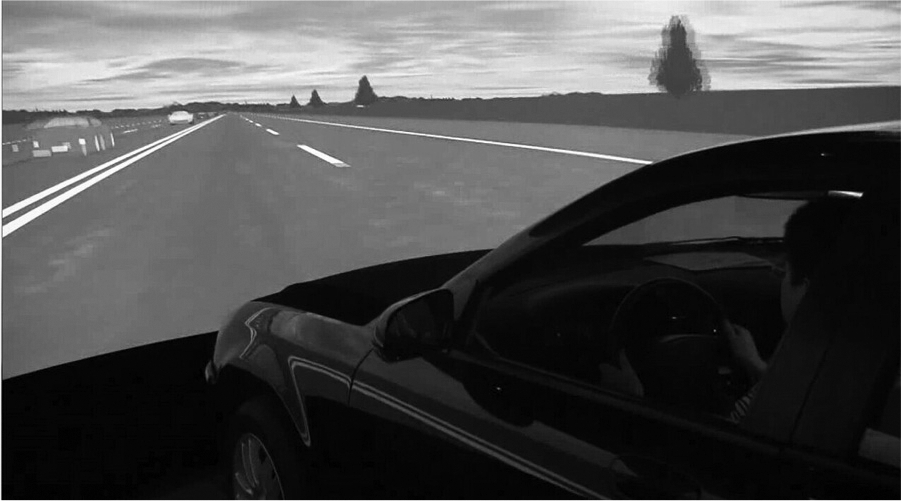
Driving simulator and the simulated traffic scene.
Fatigue-based lane departure test
To collect the test data of a driver under fatigue, the test was implemented with three following periods: breakfast (8:00–9:00 a.m.), lunch (1:00–2:00 p.m.), and midnight (9:00–10:00 p.m.). Each test lasted for 1 h. The cumulative driving time was approximately 40 h. For each subject, before the first test, there is a 5 min prep-test to introduce the test content and allow the subject to adapt to the driving simulator environment. The subjects were asked to maintain a relatively stable vehicle speed of 70 ± 10 km/h and keep the car in a given lane as far as possible in the test. The test interprets the operating behavior of lane departure by fatigue and collects the data under the condition that the driver is sober and implements a single driving task. To accurately calibrate driver fatigue and not interrupt the driver while driving, an objective evaluation method was used. This method is based on a video recording the driver’s facial expression. According to the driver’s facial expression and driving status captured by the camera, the driver’s state was classified into awake or fatigue state. If a lane-changing behavior was observed under fatigue state, it was considered as a fatigue-based lane departure.
Secondary task–based lane departure test
The secondary task–based lane departure test includes two phases. The first phase is the 5 min prep-test, which is same to that of fatigue-based test. The second phase is the 30 min formal test. The formal test includes three steps. The first step is the text messaging 2-back test. 15 MIT AgeLab utilize 2-back test to assess the driver’s cognitive under multiple tasks. The results show that 2-back test can detect the activity degree of the driver’s cognitive under 2-back while driving. A tester sends WeChat information to the cellular phone of the driver, designs a retroactive topic to communicate with the driver, stimulates the driver to send WeChat information while driving, and collects the lane departure data when the driver experiences visual distraction. The second step is a 10-min 2-back test. The test assesses whether the driver has an unintentional lane departure under the 2-back task in which one figure from 0 to 9 is randomly broadcast to the driver through voice playback every 2 s. This test also lasts for 10 min. The third phase involves the 10 min manual operating test, which requires the driver to operate the radio at the center console while driving, tune to the specified channel according to order, repeat the same procedures after the vehicle returns to stable status, and then enter the free-driving phase. Figure 2 illustrates the test flowchart.

Flowchart of the secondary task–based lane departure test.
Data selection for statistical analysis
Lane changing is a procedure in temporal with driver’s perception, decision, and controlling. From previous works, we know that the statistical analysis and recognition results of lane-changing behavior are relied heavily on the data selection. A “true” lane departure event occurring should be confirmed, that is, when does it begin, end, etc. The time when the vehicle center crosses the lane boundary line is defined logically as the end of a lane departure event. However, it is unclear how far in advance of this time we should consider as the beginning of a complete lane departure data sample. Herein, the time length from the beginning to the end of a lane departure event is denoted as the time window. Therefore, in order to obtain the complete data from unintentional lane departure and analyze the drivers’ behavior accurately, the time window of lane departure 16 should be confirmed. At first, two data sets of unintentional lane departure and intentional lane changing are constructed, which are selected throughout the complete recording data of the experiments by manual. And then, a sparse Bayesian learning methodology is used for evaluating the intentional lane-changing recognition results with different time windows. Sample data from different time windows (i.e. 1, 2, 3, 4, and 5 s) before lane boundary line pressing are selected as input data and assess the classification results of the data. The results are 0.7235, 0.7503, 0.8467, 0.7922, and 0.6077 under 1, 2, 3, 4, and 5 s time windows, respectively. The best classification performance is shown with the 3 s time window. For an effective statistical analysis of driver’s lane departure characteristics, the time window is confirmed as 3 s in this article.
Following the data selection principle, 320 unintentional lane departure samples are selected. Among them, 160 are fatigue-based and 160 are secondary task–based; 160 intentional lane-changing samples are also selected. In the following, the data of steering angle, steering angle velocity, steering angle entropy, lateral acceleration, lateral velocity, and yaw velocity will be detailed compared and analyzed under fatigue-based and secondary task–based lane departure as well as intentional lane changing.
Results
Steering angle
When a driver changes a lane, the most direct input is the steering manipulation. Vehicle control capability may be influenced if the driver is fatigued or answering his/her cellular phone while driving. If the driver turns the steering wheel passively during these circumstances, an unintentional lane departure occurs. Therefore, the driving intention can be predicted according to steering wheel operation.
Figure 3 outlines the variety curves of the steering angle in temporal under normal, fatigue-based, and secondary task–based lane departure situations. The x-axis is the sampling time and the y-axis is the steering angle degree.

Curves of steering angle of three lane departures.
Based on the curves of 300 continuous sampling points before crossing the line, the steering rotation rates of normal and secondary task–based lane departure are significantly higher than that of fatigue-based lane departure. Fatigue-based lane departure is produced by the small differences in the steering torque. Thus, the range ability of the steering angle is limited. Moreover, the steering angle variation of the secondary task–based lane departure is higher than that of normal lane departure.
The steering angles of the two types of unintentional lane departure typically range between 5° and 25°, whereas the steering angle of normal lane departure usually ranges between 0° and 15°. The average value of standard deviation (SD) of the steering angle is approximately 3.53°, roughly 4.06°, and 2.12° for normal, secondary task–based, and fatigue-based lane departure, respectively.
Usually, a driver slightly adjusts the steering wheel to ensure that the vehicle is traveling in a uniform motion and in a straight line before reading a text message. The driver then shifts his/her attention from the road to the phone screen and concentrate on reading the text message. At this time, the driver subconsciously adjusts the steering wheel to ensure that the vehicle is traveling in a straight line. The driver redirects all of his/her attention to the driving task after reading the text message. While performing a secondary task, the driver constantly adjusts the vehicle state through the steering wheel. Accordingly, the steering angle fluctuates constantly and the SD of the steering angle increases.
A statistical analysis on the SD of the steering angle is conducted, which can reflect the fluctuations and the degree of dispersion over a period. The SD of the steering angle of normal lane departure is greater than that of fatigue-based lane departure and less than that of secondary task–based lane departure. The results are shown in Figure 4.

SD distributions of the steering angle of three lane departures.
The quarter quintile, median, and three-quarter quintile of the SD of the steering angle of normal lane departure are greater than that of the fatigue-based lane departure and less than that of the secondary task–based lane departure. T-tests are conducted for the SD of the steering angle of normal and fatigue-based lane departure as well as that of the normal and secondary task–based lane departure. The corresponding result of t-test for the normal and fatigue-based lane departure is p 1 = 0.0001, which is obviously lower than 0.05. The result of t-test for the normal and secondary task–based is p 2 = 0.045, lower than 0.05. A significant difference exists between the three lane departure states. Such difference can be used as a feature parameter to differentiate lane departure states.
Steering angle velocity
The SD distribution of the steering angle velocity is shown in Figure 5. The average SD of the steering angle velocity of fatigue-based lane departure is approximately 6.39°s−1. It is significantly smaller than that of normal lane departure and secondary task–based lane departure. Moreover, the average SD of the steering angle velocity of secondary task–based lane departure is significantly larger than that of normal lane departure. The frequency of adjusting the steering wheel is increasing. The drivers cannot accurately adjust the steering wheel according to the current road conditions because of the interference of other tasks. The exemplification in objective value is that the steering angle velocity fluctuates constantly and even exceeds that of normal lane departure.

SD distributions of steering angle velocity of three lane departures.
The SD of the steering angle velocity is used to analyze stability when drivers turn the steering wheel. A large SD implies increased fluctuation of steering angle velocity and reduced driving stability. Overall, the SD of the steering angle velocity of secondary task–based lane departure is higher than that of normal lane departure, whereas that of fatigue-based lane departure is lower than that of normal lane departure.
The t-test is utilized for the SD of the steering angle velocity of fatigue-based and normal lane departure. The result is p = 0.002, which indicates that the SD of the steering angle velocity of these two lane departure states is significantly different. An independent samples t-test was also conducted for the SD of the steering angle velocity of secondary task–based and normal lane departure. The result is p = 0.047, which also indicates that these two lane departures have difference. In conclusion, steering angle velocity can be used to distinguish normal lane departure from fatigue-based and secondary task–based lane departure.
Steering angle entropy
Steering entropy 17 can be adopted in speculating the steering wheel operating stability of drivers and assessing their mental load. The higher the entropy, the more severe the operating stability and the higher the mental load are. The steering entropy is calculated according to the predicted deviation of steering angle. The test uses the statistical data of all steering entropies collected from normal and unintentional lane departure. The results are shown in Figure 6.

SD distributions of steering angle entropy of three lane departures.
The average steering entropies of normal, secondary task–based, and fatigue-based lane departure is approximately 0.44, 0.43, and 0.39, respectively. The steering entropy of secondary task–based lane departure remains unchanged although it is close to that of normal lane departure. The cognitive load of drivers is large during both normal and secondary task–based lane departure. The steering entropy of fatigue-based lane departure is less than that of normal and secondary task–based lane departure. The t-test is used for the steering entropies of fatigue-based and normal lane departure. The result is p = 0.0001, which indicates that the statistical characteristic of steering entropy of fatigue-based lane departure is significantly different from that of normal lane departure. However, the fluctuation of steering entropy of normal lane departure is close to that of secondary task–based lane departure.
Lateral velocity
Lateral velocity can reflect whether a vehicle is quickly or slowly approaching the lane line. Figure 7 illustrates the statistical analysis for average lateral velocity in all samples of the three different lane departure states. After implementing a t-test on the fatigue lane departure and secondary task–based lane departure, the p value equals 0, which indicates a significant difference in the lateral average velocity during these lane departure states. Furthermore, after implementing a t-test on the normal and secondary task–based lane departure, the p value equals 0.17, which indicates that no significant difference exists between these two lane departure states. In conclusion, lateral velocity can be used to distinguish normal and fatigue-based lane departure. But it is not suitable to distinguish normal lane departure from secondary task–based lane departure.

SD distributions of lateral velocity of three lane departures.
Lateral acceleration
Figure 8 shows the SD distributions of lateral acceleration of the three lane departures. The SD of the lateral acceleration of fatigue-based lane departure is mainly distributed between 0.008 and 0.02 g and is considerably different from that of normal lane departure. The main reason for such difference is probably due to the sober state of drivers during normal lane departure. Drivers must adjust the vehicle driving state in time according to the changes in the traffic environment when changing lanes. The SD of the lateral acceleration of secondary task–based lane departure is not significantly different from that of normal lane departure. In the two states, the lateral acceleration ranges between 0.015 and 0.045 g.

SD distributions of lateral acceleration of three lane departures.
Yaw velocity
The steering behavior of a driver changes the lateral acceleration of the vehicle and affects the yaw velocity directly. The yaw velocity indicates the rotation of a vehicle around its vertical axis. The vehicle is at risk of spinning or drifting when the angle velocity goes over a certain range. From our experiment, the results show that the variation range of yaw velocity is relatively small and is approximately from 0 to −1 s−1 on fatigue-based lane departure. The range is slightly large and changes between −2 and −0 s−1 on normal lane departure. The variation range is the largest on secondary task–based lane departure, changing between −4 and −0.5 s−1. Compared with the vehicle swing of normal lane departure, that of fatigue-based lane departure is smaller, whereas that of secondary task–based lane departure is larger. SD of yaw velocity can reflect the dispersion of the yaw velocities. A large SD implies increase in the frequency of vehicle adjustment. The results are shown in Figure 9.

SD distributions of yaw velocity of three lane departures.
The SD of yaw velocity of fatigue-based lane departure is significantly different from that of normal lane departure. Based on t-test, the p value equals 0.013 which indicates that they have significant differences. The distribution area of the SD of the yaw velocity of secondary task–based lane departure is slightly larger than that of normal lane departure, and the area contains all of the SD distributions of normal lane departure. These two lane departure states do not have significant differences. Thus, yaw velocity can be used as a basic parameter to distinguish fatigue-based lane departure. However, the distinction between normal and secondary task–based lane departure is unclear.
Conclusion
This article proposes an experimental driving simulator study of unintentional lane departure. In all, 12 drivers were asked to test their driving behaviors of fatigue-based and secondary task–based lane departures as well as intentional lane changing. The data of steering angle, steering angle velocity, steering angle entropy, lateral acceleration, lateral velocity, and yaw velocity of the three lane departures are synthetically analyzed. Regarding the operating characteristics of drivers, the SD of the steering angle of secondary task–based lane departure is larger than that of normal lane departure. The SD of the steering angle of fatigue-based lane departure is the smallest. The characteristic of steering angle velocity is similar with that of steering angle. The steering entropy of fatigue-based lane departure is significantly different from that of normal lane departure. However, the steering entropy of secondary task–based lane departure is similar to that of normal lane departure. The lateral velocity and lateral acceleration as well as the yaw velocity of fatigue-based lane departure are significantly different with those of lane changing. But the characteristics of the secondary task–based lane departure are less different from those of normal lane departure. Through this study, the driving characteristics of lane departure are discussed in detail. It will play an important role in research and development of LDWS.
Footnotes
Academic Editor: Yongjun Shen
Declaration of conflicting interests
The author(s) declared no potential conflicts of interest with respect to the research, authorship, and/or publication of this article.
Funding
The author(s) disclosed receipt of the following financial support for the research, authorship, and/or publication of this article: This work is supported by the National Science Foundation of China (nos U1564214 and 51675224) and Industrial Innovation Special Fund Project of Jilin Province (2017C045-1).