




Abstract
The article presents comparative experiments by the examination of conditions of the increase of the accuracy of geometric forms of surfaces ground by the grinding wheel with various grain sizes of a new construction and a standard grinding wheel. In comparison with the standard grinding wheel, it is given that the accuracy of the geometric form basically increases by grinding with the wheel of various grain sizes. It is explained by the fact that the concentration on the working surface of the grinding wheel of various grain sizes with four grain sizes, from the coarse one to the finest one, enables the connection of elements of the coarse and fine grinding in one technological transition. The acquired empirical dependencies allow us to set the high efficiency of the grinding wheel of various grain sizes and to determine the rational sum of elements of the grinding mode in order to find out the basic conditions of their application.
Keywords
Introduction
In grinding of flat surfaces the periphery of the circle has the places for characteristic errors of geometrical forms in the shape of non-flatness. Forming of errors occurs in the area of input of grinding circular in contact with cutting surface and output from it. Forming of errors is explained with the change of current square of contact, after each horizontal submission from the area of input till the process of operated grinding occurs unequal rise of cutting force. The reverse occurrence after each working course occurs with the input of circular from the contact; according to the operated grinding, the cutting force unequally reduces; it is documented in the study of Kountanya 1 and Gusseinov and Mamedov. 2
In the elaboration (equation (1)) it is theoretically proved that grinding with standard circular process occurring in the area of input and output is significantly differed from each other. In this case, the first stripe of grinding circular with the width equal to horizontal submission fulfills mainly the cutting function. The following stripes depending on their meetings with the already repeated cutting surface are coming out. In this case, between the changes of current significance of cutting force and the square of the contact in the area of input and output, appropriate disproportion can occur.
The result of unequal distribution of the lot force to the unit of square contact occurs in unequal abrasive influence on cutting surface. It brings to appropriate deflection from the correct geometrical form.
It is given that, by grinding with the standard grinding wheel, processes in the input and output zones considerably differ, as the first band of the grinding wheel with the width equal to the transversal feed performs the cutting function, and the following bands, depending on their encounter with already repeatedly cut off surface, are considered to be treated so, as demonstrated in the research of Baragetti and Tordini. 3
Also between the changes of the current value of the cutting force and contact surfaces, in the input area as well as in the output area, there are corresponding disproportions. In consequence of an uneven distribution of the specific force on the unit of contact surfaces, it comes to uneven abrasive effect on the treated surface, what causes deviations from the correct geometric shape so as confirmed by the research of Childs and Arola 4 and Fan and Chang. 5
Theoretical requisites
The increase of the cutting ability of the working surface of the grinding wheel is possible by the decrease of the grain size of each hypothetical band, depending on their repeated contacts with the cut off surface. In accordance with the methods presented,6,7 highly granular abrasive are selected for the frontal cutting band, and according to the distance from it, the grain size decreases by the corresponding increase of the number of actually working grains for each hypothetical band so as demonstrated in the research of Huseynov and Bagirov 8 and Hloch and Valicek. 9 This is how even abrasive effect is provided on the treated surface, as well as high grinding efficiency by the reduction of the work of the inner abrasion of grains and the binder with the metal surface as well as the action of temperature on the treated surface.
The comparison of cutting capacities of hypothetical bands is accomplished by the reduction of the grain size of each hypothetical band depending on the number of their repeated contacts with the already cut off surface. With the reduction of the grains’ size of the abrasive also the average size of the grinding powder grain decreases, and their number on the grinding wheel surface increases within the corresponding hypothetical bands so as documented in the study of Behzad et al. 10 and Gusseinov. 11
For the determination of the patterns of the distribution of grains of the abrasive according to bands of the working surface of the grinding wheel, we have to start from the state of uniform abrasive action. The solution of the task is as follows: the required number of abrasive grains for each hypothetical band, which uniformly acts by accounting the drop into cut grooves, is determined. For each hypothetical band with the width
Also the number of the cutting grains needs to change with the growing geometric progression, in which the denominator must be more than one. By the acceptation of this progression, where the denominator equals 1/q, on each hypothetical band there is possible compensation of the drop-in (in percents) of grains into already cut grooves due to the increase of the number of active grains of the given band.
This is how the even abrasive action on the treated surface can be provided by a new grinding wheel with a new construction which comprises bands of various grain sizes with the width of the transversal feed, which is set by the relation of the height H of the grinding wheel to the transversal feed
The increase of cutting ability of working surface of grinding circular can occur with the reduction of grain of each conditioned stripe. The changes of grains occur depending on the number of their repeated contacts with already cutting surface. In accordance with the suggested method for cutting the frontal stripe, the higher grain abrasives are selected. In the case of deleting, grains are deleted with appropriate increase in the number of working grains for each conditioned stripe. In this case, equal abrasive influence on cutting surface is provided. Consequently, the higher efficiency of grinding is provided with the reduction of work external friction of grains and bundles on the metal surface. And also, the temperature influence is also reduced on cutting surface.
Equality of cutting abilities of conditioned stripes with the use of different grains of grinding circular reduce of grains of each conditioned stripes are provided. The operation of grainy of each conditioned stripe is produced depending on the number of their repeated contacts with already cutting surface. When there is reduction of grains of abrasive, the medium size of grains of grinding powder is decreased, and their number in the limit of appropriate of conditioned stripe is increased. In the elaboration abrasive, circular prototype of suggested grinding circular with different grainy is also discussed. The given circular has direct profile and certain stripes, equipped with layings—from the glass or other substances. In this case, grainy of abrasive substance in all stripes equals to ГOCT P 52381-2005.
It is installed that the less is the grainy of grinding circular, the less than is the roughness of cutting surface (equation (4)). For determination of legality of distribution of grainy abrasive on conditioned stripes of working surface of grinding circular, it is necessary to refer to the equal abrasive influence condition. The given task is solved in the following way:
The necessary number of abrasive grains for each conditioned stripes is distributed, providing equal abrasive influence.
For each conditioned stripe with the width
The number of actually working abrasive grains is set under the condition of an even abrasive action

The total number of active grains is formularized as follows
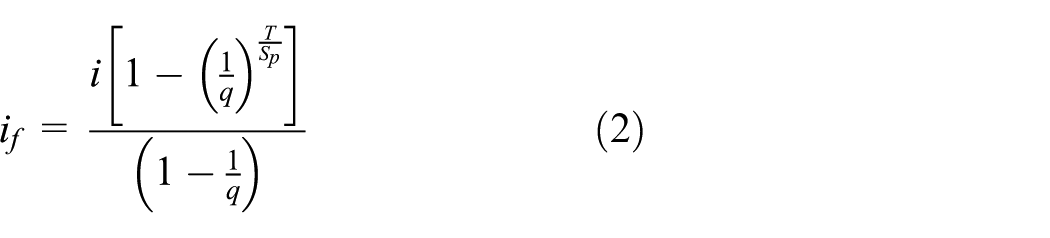
Under the even abrasive action, the number of actually working grains and the width of conditioned bands are equal by various grain size of the abrasive. From the condition of equality of numbers of actually working grains on each conditioned band by the consideration of the drop-in into already cut grooves, the average grain size of each band shall be determined, that is, granulation too. The equality is achieved by the reduction of the average grain size, that is, by their increase in accordance with the ordinal number of the current band in view of the front side.
The condition of equality of numbers of actually working grains on each conditioned band is

where
If we consider the formula of number of active grains on 1 mm2 of the wheel surface, 12 we will get

where
Conditions of the even abrasive action require changes in parameters
We will introduce the notation

And by adding some simplifications we will get

From the condition of the even abrasive action, the average size of abrasive grains of each band is determined

where




By such determination of the average size of the frontal side of the band of the grinding wheel we can, using formula (7), determine the average grain size for each following band. Then, if we know the parameter
For the check of reliability of the acquired analytical formulas, we determine the average grain size and granulation of each band of the grinding wheel of various grain sizes, from the condition of the even abrasive action. Initial data: granulation of the frontal side of the band 250/200, average grain size



According to the work data, 14 we determine the granulations which correspond with the average grain size on each band

In compliance with the method presented, highly granulated abrasives are selected for the cutting frontal side of the band, and according to the distance from it, the granulation of the grinding powder decreases by the corresponding increase of the actually working grains for each conditioned band (Figure 1). This is how the even abrasive action on the treated surface is provided, as well as high efficiency of the grinding by decreasing the work of the inner friction of grains and the binder with the metal surface, as well as the action of the temperature on the treated surface.
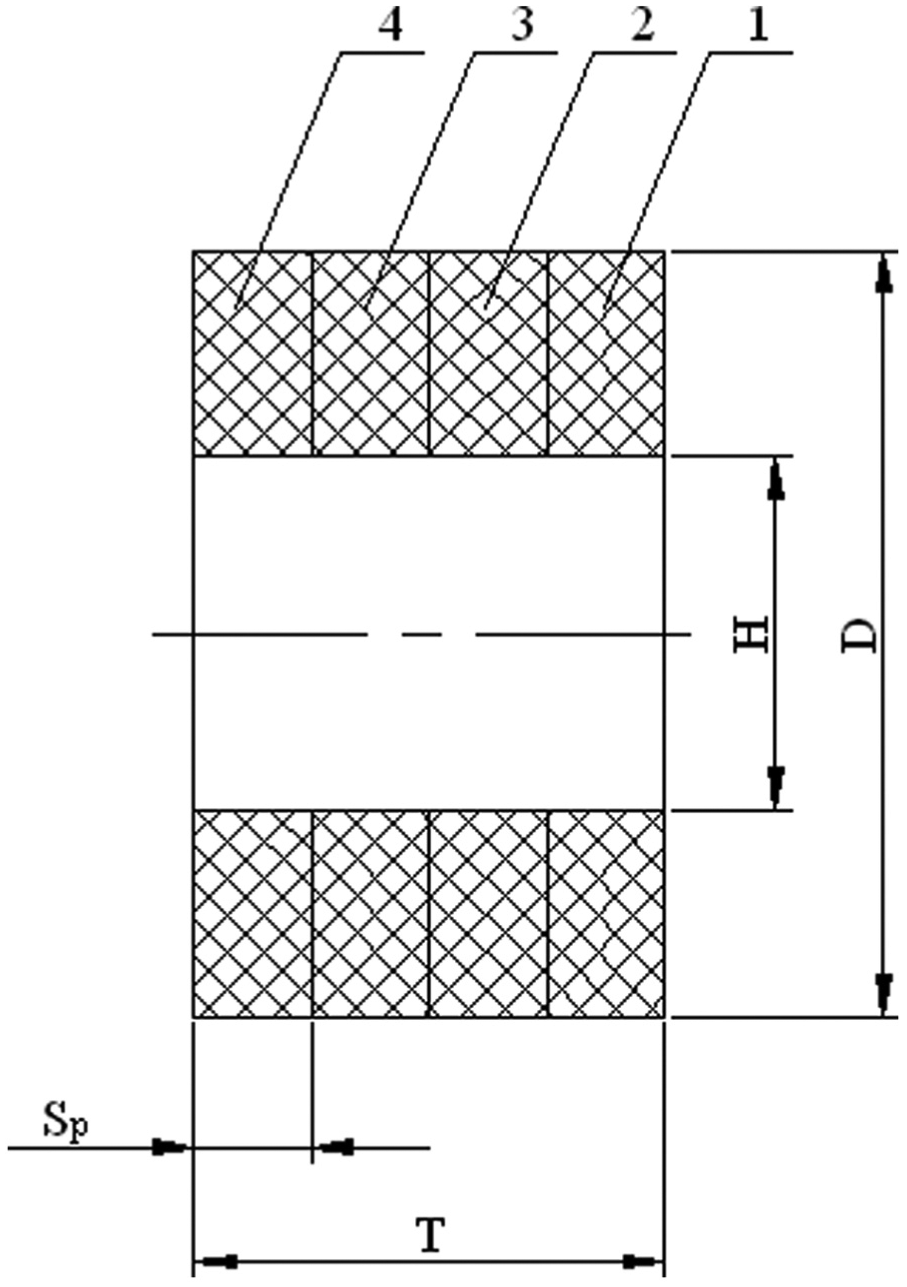
Diversity granular grinding wheel: (1) F46, (2) F54, (3) F60, and (4) F90.
High grainy abrasive is selected in accordance with the suggested method for cutting the frontal stripe. With the deletion of grainy grinding powder in accordance with the increase of factual working grains for each conditioned stripe is decreased. In this case, equal abrasive influence is provided on the cutting surface. Consequently, the high efficiency of grinding is also provided by means of decrease of work of the external friction of grains and bundles to metal surface. The temperature influence on cutting surface is also decreased.
Method
For the accomplishment of experimental researches, an orthogonal plan of the second order (Table 2) has been selected, which enables the construction of quadratic models (equation (8)).15,16 The experiments have been carried out on the longitudinal flat grinding machine tool model 3B722. Standard GOST-P52381-2005 has been selected as the abrasive instrument and grinding wheels of various granulation of a direct profile type 1, 300 × 76 × 40, with the characteristics 14A (F46, F54, F60, F90) K7V. The working surface of the grinding wheel of various granulations comprises four bands with the width up to 10 mm. The granulation of the front side of the band corresponds to number F46 on the following according to F54, F60, F90. The research has been carried out by grinding of hardened parts from steel 40X (AISI 5135) with the hardness of 32–35 HRC. On the base of data stated, the basic levels of factors and changing intervals have been determined (Table 1).
Levels of factors and changing intervals.

The provision of the stationarity of the macro profile of the ground surface breadthwise of the machining can be achieved by the compensation of the presumed decrease of actually working grinding grains in the view of the drop-in of their parts into already cut grooves by repeated contacts. The grinding wheel of various grain sizes contributes to the renewal of the cutting ability of the working surface by an adequate decrease of the granulation and the increase of the cutting grains, which corresponds to the conditioned bands, depending on the number of their repeated encounters of the already cut off surface.
The purposes of carried experimental researches are as follows:
Operation of identity of theoretical groundwork;
Operation of superiority of different grainy grinding circular on the standard one;
Getting empirical models of process of equal abrasive influence on cutting surface, which are more useful for project calculation;
The determination of more rational conditions using different grainy grinding circles.
The objective of these experiments is the check of theoretical presumptions mentioned above and the determination of the empirical dependency between the accuracy of the geometric shape of flat even surfaces of highly precise details, ground by the grinding wheel of various granulation and by the standard grinding wheel and parameters of the process mode of flat grinding by the peripheral side of the grinding wheel. To compare the accuracy of the geometric shape of the ground surfaces, the experiments have been carried out by a grinding wheel of various granulations and a standard grinding wheel under the same grinding conditions.
The provision of stationary microprofile of cutting surface with the width of cutting can be gained by means of compensation of supposed decrease of number of factual working abrasive grains for hitting the parts and already cutting ditches in repeated contacts. Different grainy grinding circle provides the restore of cutting ability of working surface circle. It occurs by means of adequate decrease of grains and increase of cutting grains number according to the conditioned stripes depending on the number of their repeated meeting of already cutting surface. The installed experimental researches give us the chances to operate adequately above given theoretical prerequisite and to determine empirical dependence between the accuracy of geometrical forms of flat surfaces with highly skilled details and mode parameters of process of the flat grinding periphery of the circle. For comparison of geometrical form accuracy of grinding surfaces, experiments were held using standard and different grainy grinding circles under the same grinding conditions.
Arrangement of the task
The matrix of the orthogonal plane of the second order for the determination of the empirical dependency between the accuracy of the geometric shape and parameters of the mode of the process of flat grinding by the peripheral part of the grinding wheel (Table 2).
The matrix of the orthogonal plane of the second order.

The measurement of geometric parameters has been carried out according to methods and measuring procedures presented below:
Roughness—medium arithmetic deviation of the profile—
Corrugation—height of waves
Geometric shape errors—deviation on the device (Self-recorder-260).
The deflection of surfaces has been measured in three longitudinal and three transversal sections. According to the highest quantity of deflection, the unflatness of surfaces has been evaluated. The measuring of the deviations has been carried out until and after the grinding. The scanner of the device Self-recorder-260 has been mounted on the base set into a stand. The measuring of deflections of surface grinding has been carried out toward the longitudinal feed of the table without parts of the magnetic plate to be taken out, which enabled the elimination of the influence of errors of the device on measurement results.
Considering the fact that the rate of dirt of the working surface of the grinding wheel and the blunting of the cutting grains increased the required output on the grinding (what is accompanied by the increase of vibrations of the technological system and quality deterioration of the surface treated), the output according to data from ammeter, installed on the base of a stand, has been checked.
Mathematic model of the second order is presented in the form 17

where
The coding of factor values is carried out by means of the converse formula (17)

The evaluation of regression coefficient is carried out according to formula (17) regarding the numeric value of moments and auxiliary coefficients
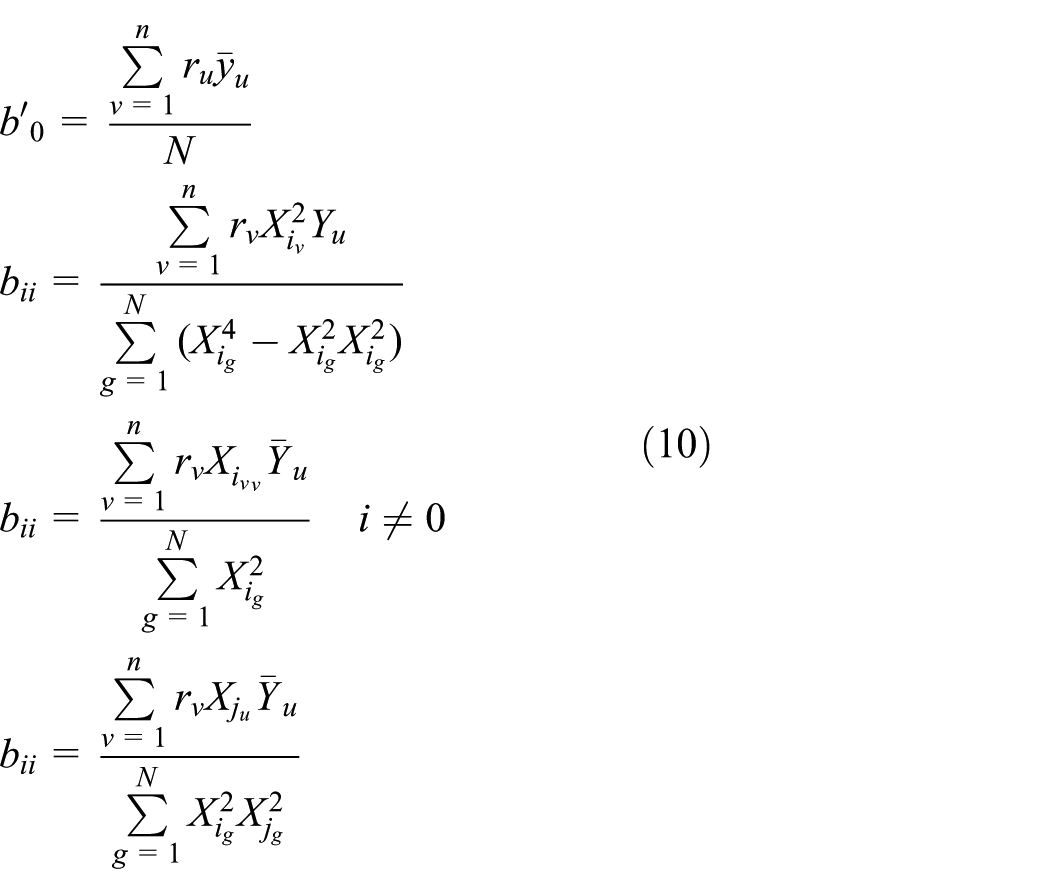
The evaluation of the coefficient

where

where
Progressive dispersion is calculated according to the formula

common dispersion of the optimization parameter according to the formula

Dispersion of the progressive coefficient

Adequacy dispersion

where
The value of regressive coefficients according to formula (10) regarding the results of test from Table 1 and auxiliary coefficient are determined, regarding experiment conditions, by grinding:
With the grinding wheel of various grain sizes


With the standard grinding wheel


The value of the coefficient

By the grinding wheel of various grain sizes

By the standard grinding wheel

The mathematical model of dependencies of errors of the geometric shape of surface on cutting mode parameters in changed variables
By the grinding wheel of various grain sizes
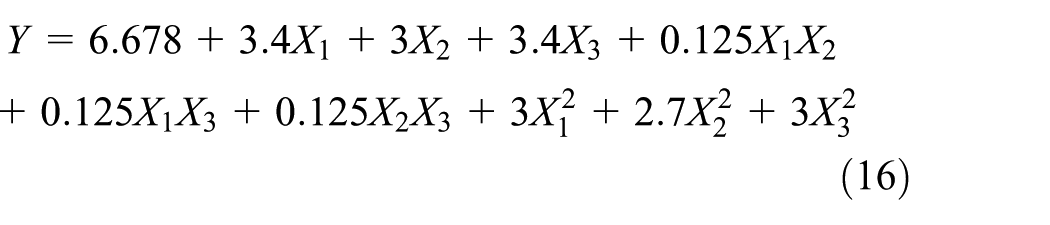
By the standard grinding wheel
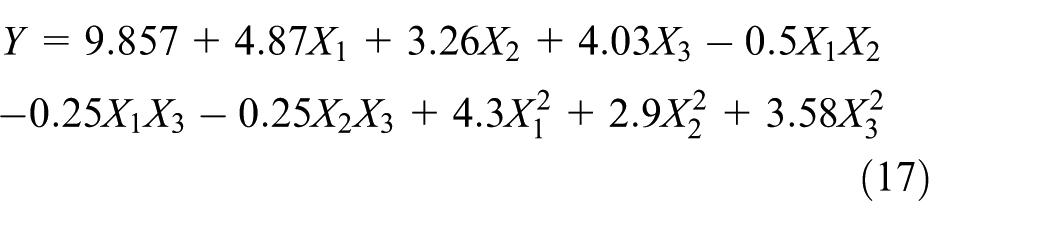
For the reliability check of the acquired models, a statistic analysis has been carried out. The objective was to carry out a few hypotheses: about homogeneous dispersion, about the value of regression coefficients, and about the adequacy of the model.
The true–false test of the numeration has been done according to formula (17):
For the grinding wheel of various grain sizes

For the standard grinding wheel

The homogeneity of dispersion, which characterizes the experiment errors according to particular points, has been verified by means of Cochran test. The dispersions were homogeneous on the value level of 5%. The acquired value of dispersions, which are connected with a clear error, is calculated according to formula (17):
For the grinding wheel of various grain sizes

For the standard grinding wheel

According to formula (15), the dispersion is calculated which characterizes the inadequacy of the model:
For the grinding wheel of various grain sizes

For the standard grinding wheel

The determined dispersion characterizes the test error.
Progressive dispersions are calculated according to formula (12) and presented in charts (3) and (4). The dispersion of the optimization parameter
For the grinding wheel of various grain sizes

For the standard grinding wheel

It is taken into consideration that the number of repeated tests in all matrix points of the experimental plan and also the homogeneity check is done by means of the Cochran test, that is, by the determination of the relation of maximum dispersion to all dispersions (Tables 3 and 4)

Where G is the Kokhren’s criterion. Check of uniformity of dispersions of repeated experiences is made by means of Kokhren’s criterion.
Statistical figures of tests by means of the grinding wheel of various grain sizes.

Statistical figures of tests by means of the standard grinding wheel.

Grinding: by the grinding wheel of various grain sizes G = 0.1, by the standard grinding wheel G = 0.144.
According to the chart in the thesis,
18
for

that is, 0.144 < 0.61 and 0.1 < 0.61.
The value check of each coefficient has been done according to Student’s t-test. By even doubling of experiment according to points with the number of repeated tests
By the grinding wheel of various grain sizes

By the standard grinding wheel

The determined values of t-test according to the formula

For the grinding wheel of various grain sizes

For the standard grinding wheel

The critical value
Statistical irrelevance of coefficients
The step of factors variation of the product speed and depth feed is small and selected on the base of the technical capacity of flat ground stand of the surface grinding machine of the model 3B722;
Because of the presence of uncontrollable parameters by tests and measurement of errors of the geometric shape;
In the studied example, the irrelevance of coefficients, evaluating the mutual action of the transversal feed, detail speed and depth speed, and weakness of these effects.
The interval of length reliability

For the grinding wheel of various grain sizes

For the standard grinding wheel

We evaluate the coefficient if its absolute value is higher than one half of the reliability of the interval length.
Mathematical models of the examined tasks are put in the forms of equations of the input parameter and variables, which only include coefficients with a value.
By grinding:
By the grinding wheel of various grain sizes

By the standard grinding wheel

To get equations (18) and (19) in natural values of grinding parameters
For the grinding wheel of various grain sizes

By the standard grinding wheel

The acquired models have been subjected to the adequacy test. Also, the deviation of geometric shape errors has been evaluated, which have been acquired on the base of calculations according to formulas (20) and (21) from results acquired by experiments in various points of the factor space (Table 2). The calculated values of geometric shape errors are defined according to the acquired mathematical model (equations (20) and (21)) by grinding with the grinding wheel of various grain sizes and a standard grinding wheel for various points of the plan matrix. The acquired values
Check of the hypothesis on the model adequacy has been carried out by means of Fisher’s F-test. The relation between adequacy dispersion and reproduction dispersion has been determined, by grinding:
With the grinding wheel of various grain sizes

With the standard grinding wheel

The chart value of Fisher’s F-test for the number of freedom levels

Graphics dependence of precision geometric shapes depending on the parameter mode of grinding: (a) transverse feed grinding, (b) longitudinal speed grinding wheel, and (c) depth of cut.
The analysis of the acquired models and the graphic dependency refers to the fact that the initial technological presumptions of the influence of grinding mode parameters on the accuracy of the geometric shapes of the ground surfaces by means of the grinding wheel of various grain sizes and the standard grinding wheel have been confirmed by experimental testing. It follows from these dependencies that the increase in accuracy of the geometric form can be achieved by a proper selection of the rational sum of grinding mode elements. In samples ground by the standard grinding wheel is the increase in the accuracy of the geometric forms examined by minimum values of the grinding mode elements. By grinding with the grinding wheel of various grain sizes, in comparison with the standard grinding wheel, the accuracy of the geometric shape increases considerably. In grinding with the usage of grinding wheel of various grain sizes, the cycle of the form 1.3–1.6 increases in comparison with the standard grinding wheel. The higher efficiency of different grainy circular can be explained by that the equality of the lot force distribution on the unit of the contact square leads to the equal abrasive effect on the cutting surface in the area of input of grinding circle into the contact and output of it. In this case, the efficiency of metal detachment increases, the working of external grain friction and bundles on the metal surface, and at the same time the temperature influence on the cutting surface, decreases.
The focus on the working surface of different grainy grinding circular of different grains, starting from rough and finishing with thin, allows to replace the elements of dirty and clean grinding in one technological passage. As a result, roughness and wave of the surface decreases and increases the accuracy of geometrical form of the grinding surface.
According to the level of action on the accuracy of the geometric shape of the ground surfaces, the mode parameters are distributed as follows

Thus, acquired empirical dependencies enable us to determine high efficiency of the grinding wheel of various grain sizes and to determine the rational sum of grinding mode elements on the expression of the basic conditions of the application.
Conclusion
Experiments of the orthogonal plan of the second order have been carried out in order to determine the empirical relations between the accuracy of the geometric shape, ground by a standard grinding wheel and a grinding wheel of various grain size and elements of the grinding mode. The acquired empirical dependencies allow us to determine the high efficiency of the grinding wheel of various grain sizes and to determine the rational sum of elements of the grinding mode for the expression of the basic conditions of their application 1.3–1.6 times higher in 40%–45% cases.
The analysis of the acquired models and graphic dependencies based on their schema refers to the fact that errors in the surface form, ground by the grinding wheel of various grain sizes, are considerably smaller than those ground by the standard grinding wheel. This is explained by the fact that the concentration on the working surface of the grinding wheel of various grain sizes of four grain sizes, from the coarse one to the finest one, enables to join elements of the coarse and clean grinding in one technological transition. According to the degree of influence in the accuracy of geometrical form, the parameters of cutting mode are located in the following form:
By the grinding with the grinding wheel of various grain sizes, in comparison with the standard grinding wheel, the accuracy of the geometric form is considerably higher. According to the level of action on the accuracy of the geometric form of the ground surfaces, the parameters of the treatment mode are distributed in the following form: detail speed, depth of cutting, and the transversal feed. Dependencies of the accuracy of the geometric form of the ground surface on the transversal feed, grinding wheel speed, and the depth of cutting is described by curves of the second order.
Footnotes
Academic Editor: Kang Cheung Chan
Declaration of conflicting interests
The author(s) declared no potential conflicts of interest with respect to the research, authorship, and/or publication of this article.
Funding
The author(s) disclosed receipt of the following financial support for the research, authorship, and/or publication of this article: This project is cofinanced by funds from the European Union, ITMS Project Code 26220220125. IMAP; European Regional Development Fund, The European Union; Agency of the Ministry of Education, Science, Research and Sport of the Slovak Republic for the EU Structural Funds; and Operational Programme Research and Development support research activities in Slovakia.