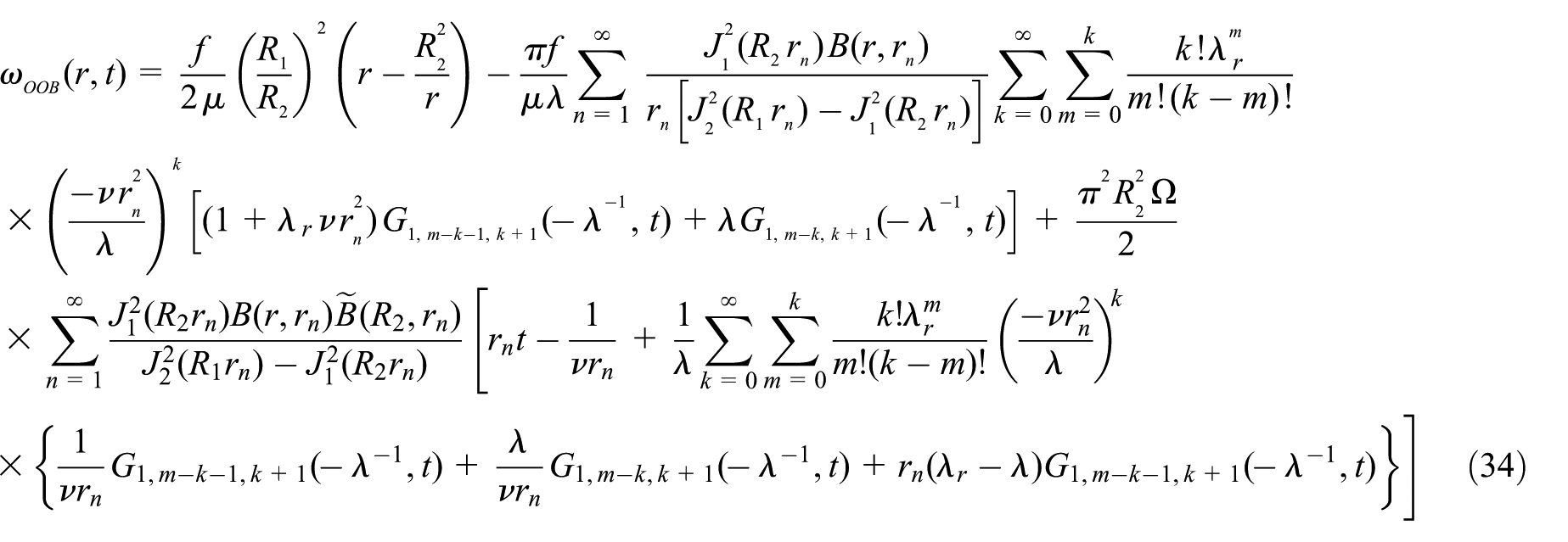
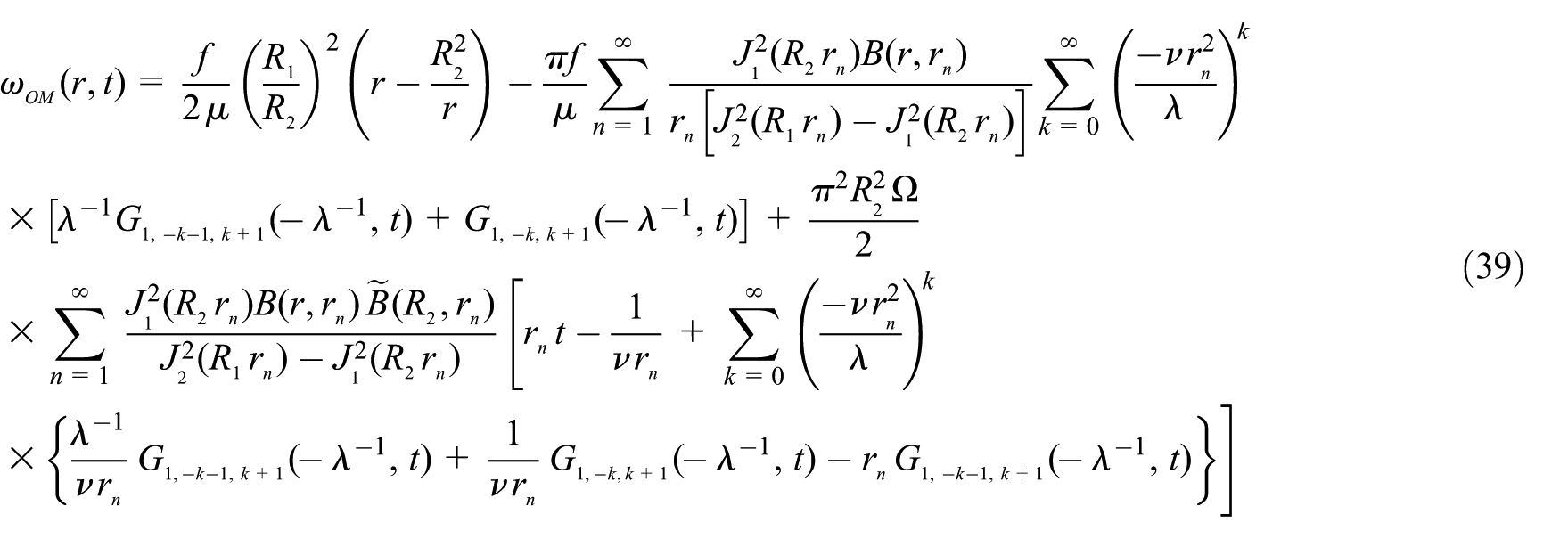
In this article, an effort has been made to compute and inspect the rotational flow of Oldroyd-B fluid between two co-axial circular cylinders. As novelty, the rotation of both cylinders produces motion of the fluid. The velocity field and tangential stress corresponding to the motion of an Oldroyd-B fluid with fractional derivatives have been obtained using Laplace and Hankel integral transforms. The velocity profiles of the respective model are graphically presented and deliberated for the pertinent parameters. Corresponding solutions are also obtained for ordinary Oldroyd-B fluid, ordinary and fractional Maxwell fluids, ordinary and fractional second-grade fluids, and Newtonian fluid as limiting cases of our general solutions.
Non-Newtonian fluids serve to be of substantial significance due to their widespread applications in technological industries, such as polymer extrusion, exotic lubricants, colloidal and suspension solutions, slurry fuels, and food stuffs. The rheology of non-Newtonian fluids cannot be easily described by linear stress and strain relationship, as it has more complex structure and suitable best to describe and examine various viscoelastic, viscoplastic, and biological fluids. Since no single model can describe all the complex properties of non-Newtonian fluids, a variety of models are presented in the literature for investigating various properties and behaviors of non-Newtonian fluids.1–7 Among them, viscoelastic Oldroyd-B fluid models, which can foresee stress relaxation, have obtained much consideration. Many researchers are paying attention toward this model as it best describes the fluid with viscoelastic properties. Hayat et al. considered the magnetohydrodynamics (MHD) flow of Oldroyd-B fluid with Cattaneo–Christov heat flux and homogeneous–heterogeneous reactions,8 velocity and shear stress for an Oldroyd-B fluid within two cylinders have been discussed by Kang et al.,9 withdrawal and drainage of thin film flow of a generalized Oldroyd-B fluid on non-isothermal cylindrical surfaces have been discussed by S Ullah et al.,10 Fetecau and Fetecau11 investigated the unsteady flows of Oldroyd-B fluids in a channel of rectangular cross-section, and translational flows of an Oldroyd-B fluid with fractional derivatives have been discussed by Jamil et al.12
The motion of a fluid in a rotating or translating cylinder is of interest to both theoretical and practical domains. It is of crucial significance to study the mechanism of viscoelastic fluids flow within the circular cylinder domains as it has applications in many industrial fields, such as oil exploitation, chemical and food industry, and bio-engineering. The academic workers and engineers are very much interested in the geometry of such types of fluids flow. Some exact solutions corresponding to non-Newtonian fluids flow between the cylindrical and translating region can be found in the literature.13–22 Fractional calculus has come across much importance in elaboration of the complex dynamics; it became an important tool to deal with viscoelastic properties. Many experimental data emphasized that the state of a physical system depends not only on its current state but also on its history. Because the integer order differential operator is a local operator, the classical fluid models cannot give the best description of the fluid behavior. Since the fractional derivative operators have non-local properties, the fractional calculus has been successfully used in the description of several physical phenomena. So, the results with ordinary derivative models have marginal scientific value and definitely insufficient to warrant suitable correlation with the experimental data. For the accurate modeling of physical and engineering processes, the fractional order derivative models and techniques are found to be the best and reliable to the experimental results. Generally, the constitutive equations for non-Newtonian fluids with fractional derivatives are extended from the well-known fluid models by replacing the time derivative of an integer order with the so-called Riemann–Liouville fractional calculus operators.23 With the research advancement, the fractional derivative models are considered by reputed scientists.24–27
The rotational flow of Oldroyd-B fluid between two circular cylinders has not been given much attention in the past; though such flows have several industrial applications, such as oil exploration and bio-engineering. The main objective of this article is to analyze the rotational flow of fractional Oldroyd-B fluid between two infinite co-axial circular cylinders. There is no motion in the fluid at time . The inner cylinder goes on rotating around its axis due to a time-dependent rotational tangential stress and the outer cylinder is rotating around its axis, with the angular velocity at time . The solutions that have been obtained, presented under series form in terms of the generalized functions, satisfy all imposed initial and boundary conditions.28 Some previous solutions can be obtained as special and limiting cases of our general solutions. Finally, the influence of pertinent parameters on the fluid motion, as well as a comparison between models, is shown by graphical illustrations.
Governing equations
Let us consider the flow of Oldroyd-B fluid having velocity and the extra-stress of the form20,28
where represents the unit vector in the direction of cylindrical coordinates. Also the constraint of incompressibility is automatically satisfied for such flows. Moreover, when the fluid is at rest, we have
When the body forces are neglected, the governing equations related to such motions of Oldroyd-B fluids are given by Rajagopal and Bhatnagar29
where the non-trivial tangential stress is represented by , the kinematic viscosity is represented by , the constant density of the fluid is represented by , is the relaxation time, and is the retardation time.28
The governing equations corresponding to an Oldroyd-B fluid with fractional derivatives under the same motion are attained from equations (3) and (4) by replacing the inner time derivatives with the Riemann–Liouville fractional operators and
where the fractional operators are defined as in Waters and King,21 Podlubny,23 and Kamran et al.28
where is the Gamma function.
Problem formulation and solution
Consider an incompressible Oldroyd-B fluid with fractional derivatives under the assumption to be at rest in an annular region between two co-axial circular cylinders of radii and . At time , a tangential stress has been applied on the boundary of inner cylinder28
where is a constant, and the generalized function is defined by Lorenzo and Hartley30
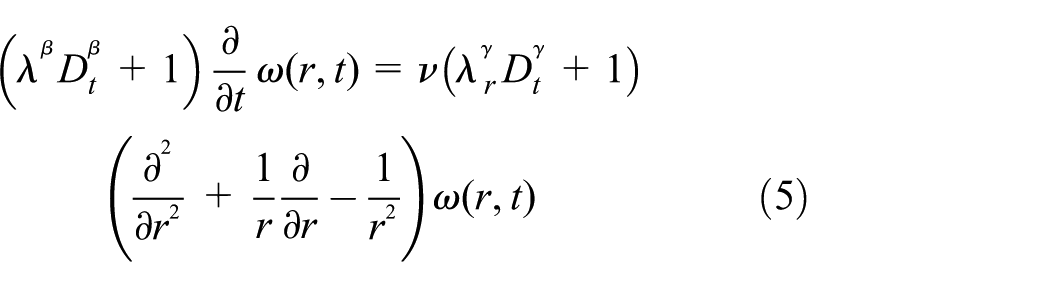
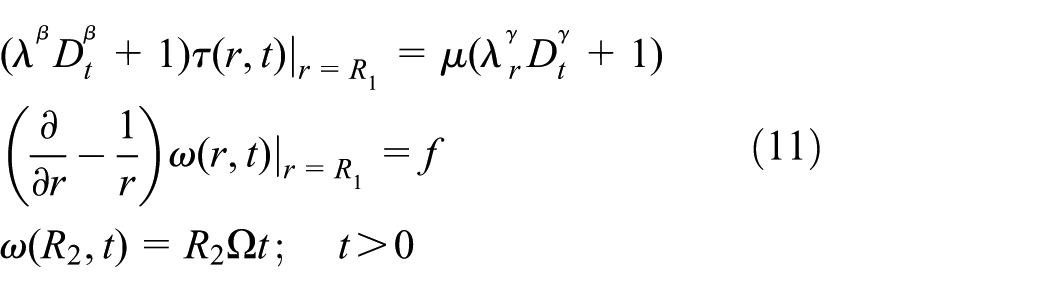
The outer cylinder is also rotating around its own axis with the velocity . The fluid gradually starts moving due to the tangential stress, and the velocity of the fluid is given by equation (1). Equations (5) and (6) represent the corresponding governing equations of the problem. The initial and boundary conditions are
and
where is the angular acceleration of outer cylinder. Equation (11) with initial conditions given in equation (10) has the solution given by equation (8), as stated in Kamran et al.28
The linear partial differential equations (5) and (6) with appropriate initial and boundary conditions can be solved in principle using Laplace and Hankel integral transforms. The Laplace transform can be applied to eliminate the time variable, while the finite Hankel transform can be employed to eliminate the spatial variable.
Flow geometry.
Velocity field of the flow
By applying Laplace transform to equation (5), and taking initial and boundary conditions given in equations (10) and (11), we get
where
satisfies the given conditions
The Hankel transformation of given in Tong and Liu16 as
where
The transcendental equation has the positive roots . The Bessel functions of the first and second kinds of order are denoted by and .28
The inverse Hankel transformation of defined in Tong and Liu16 as
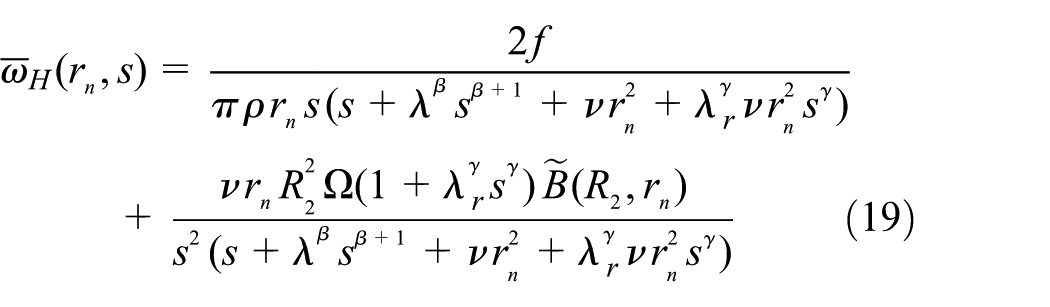
Now multiplying both sides of equation (12) by , and integrating with respect to from to , using the condition given in equation (13) and the equality
where
we have
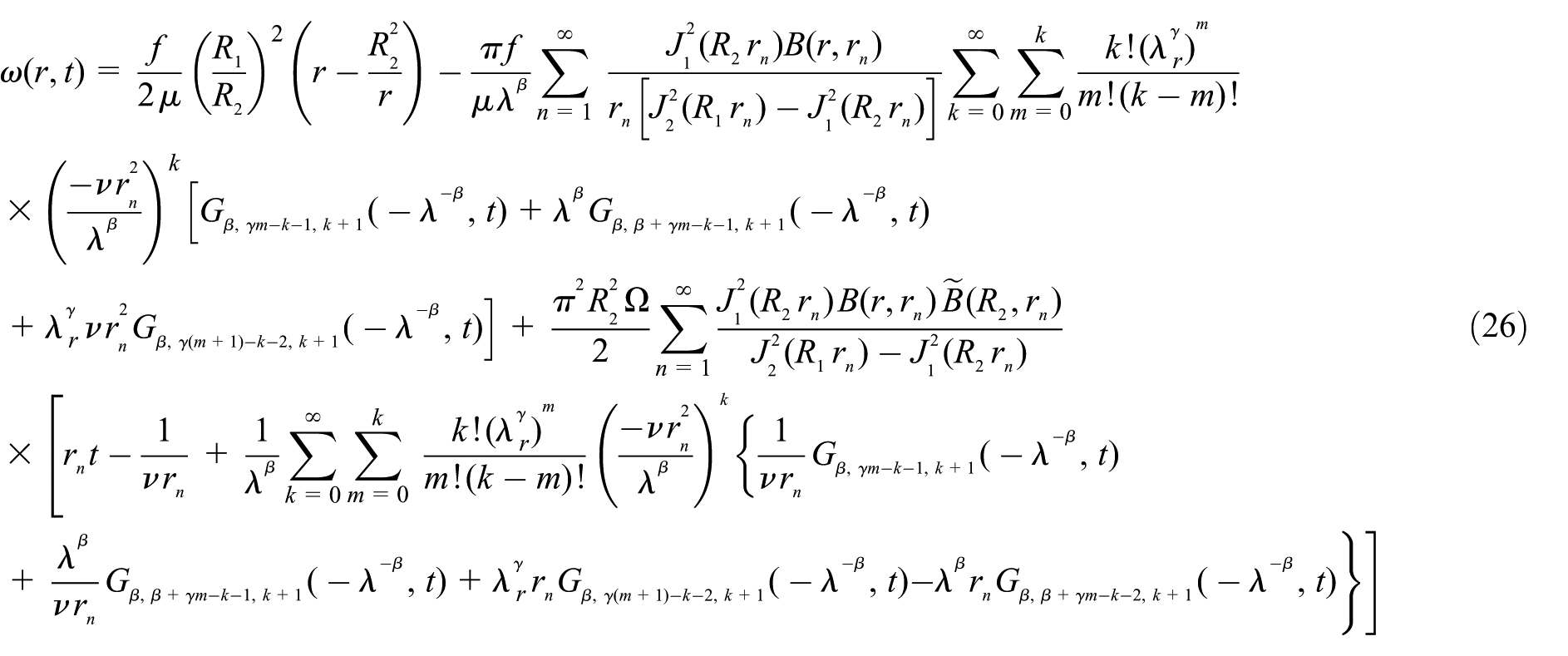
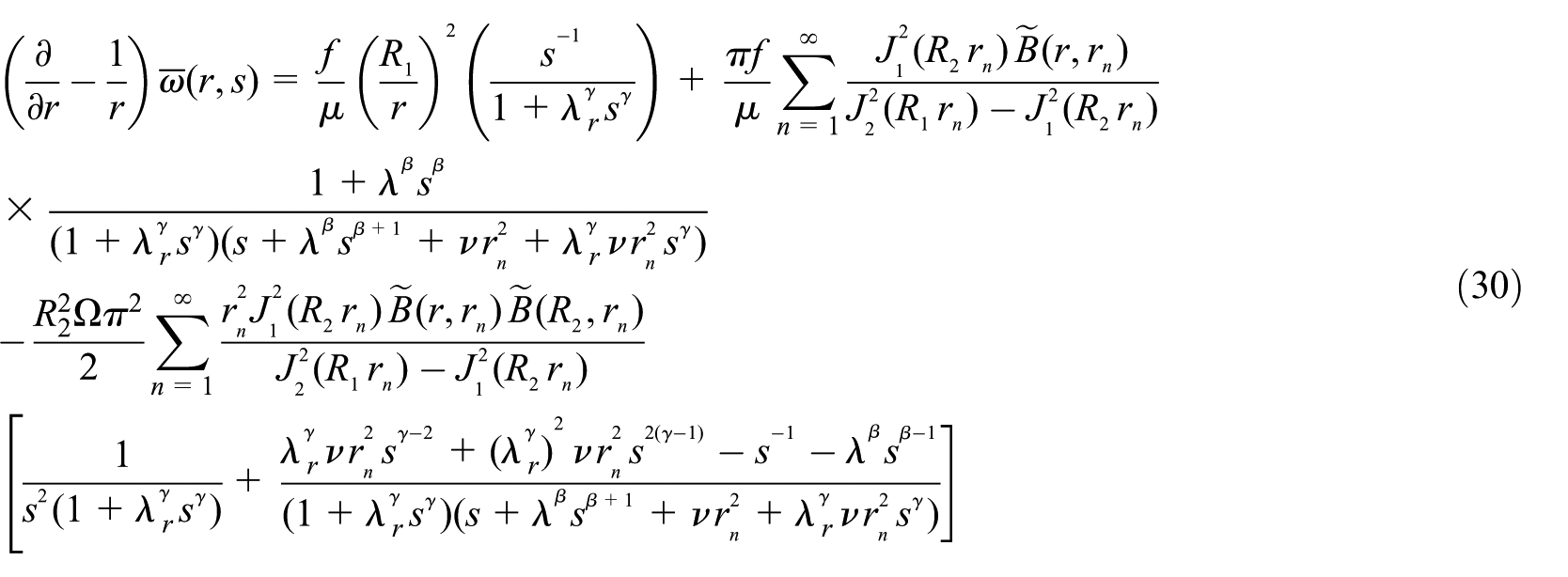
For a suitable representation of velocity field , we rewrite equation (19) in a more appropriate equivalent form as
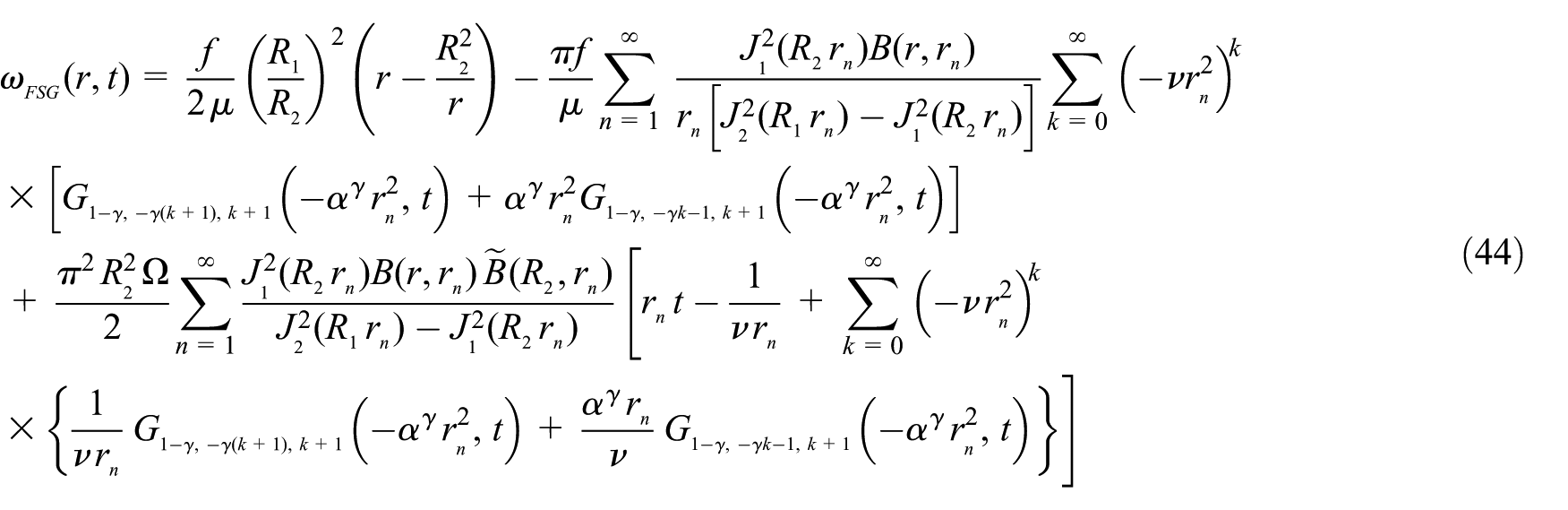
Now applying inverse Hankel transformation to equation (20) and using the following result
We can write the above equation in a more simpler form as
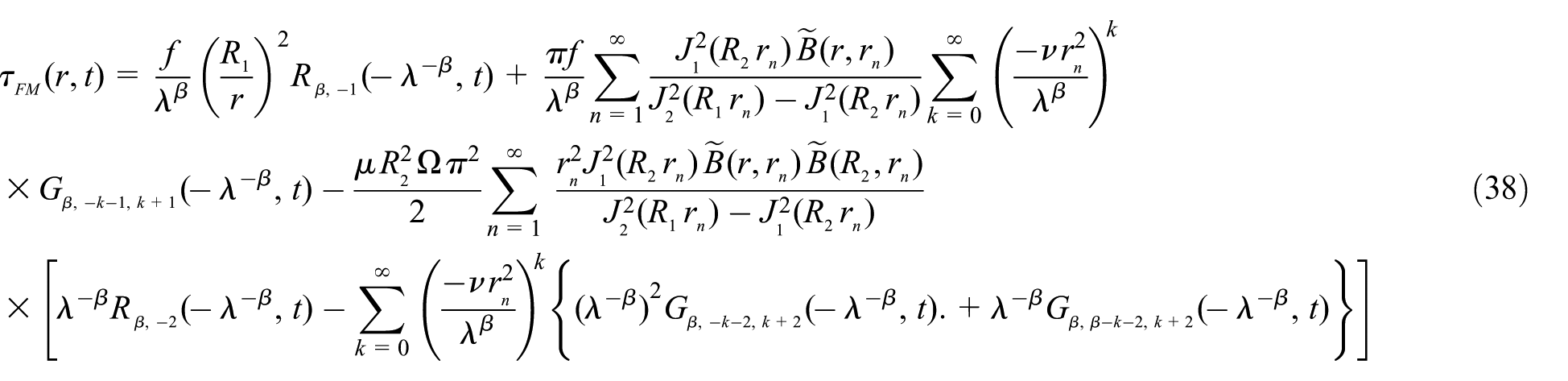
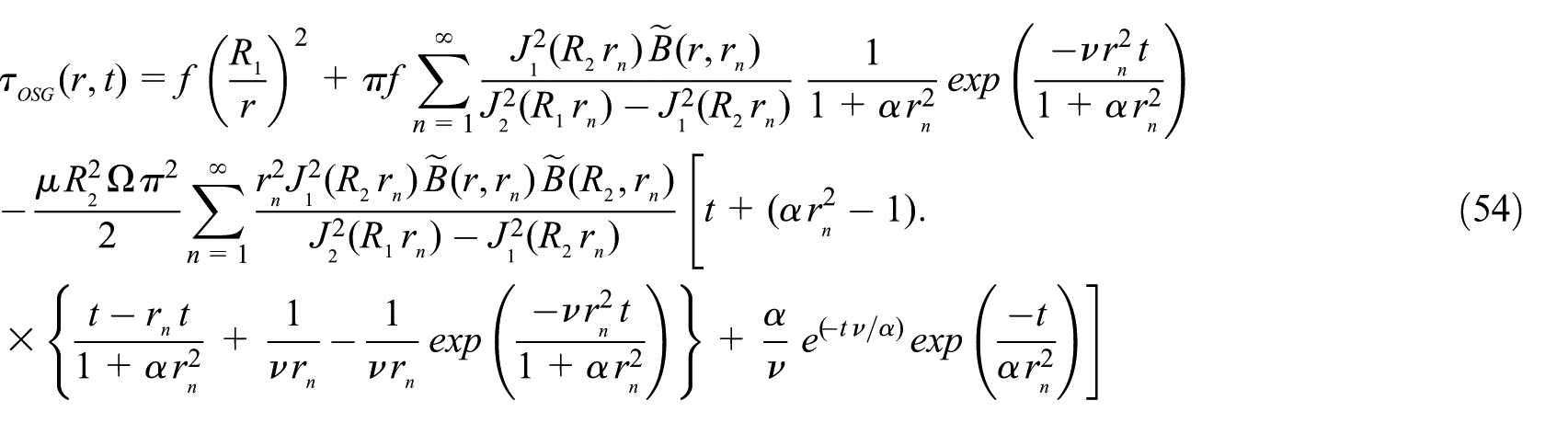
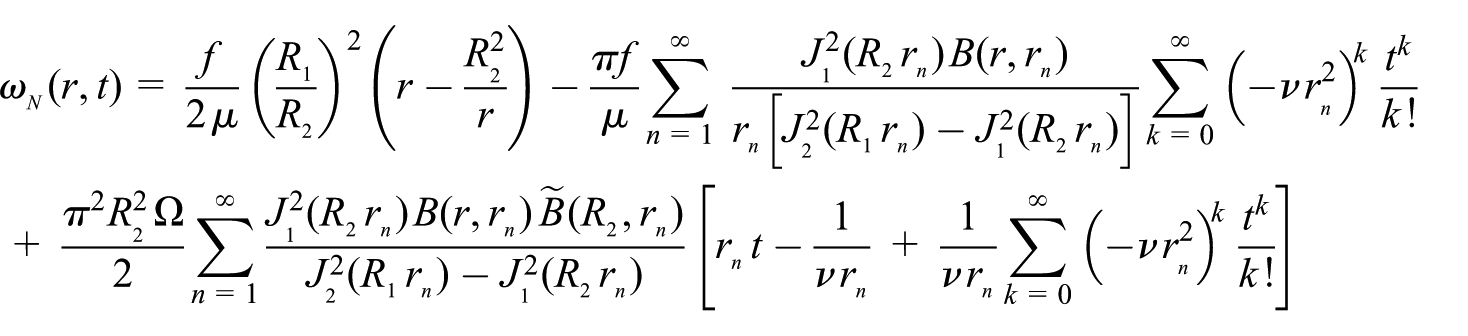
Now using equations (41) and (45), the associated shear stress for Newtonian fluid is
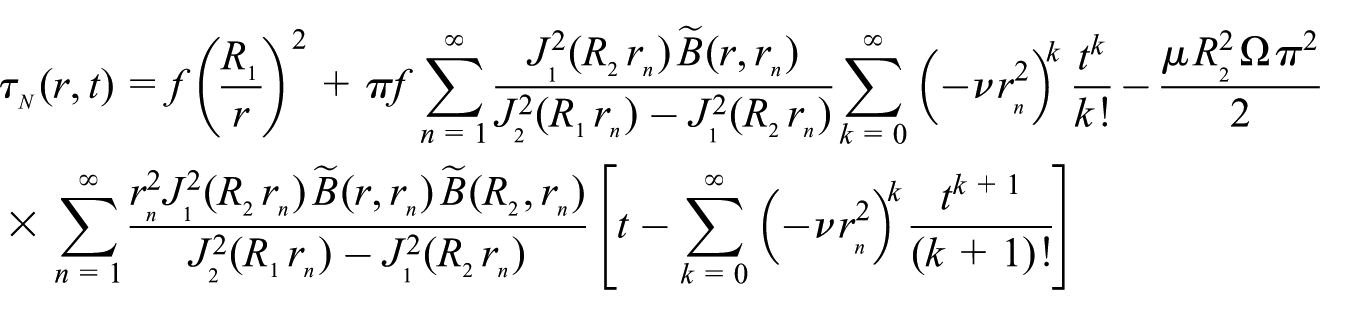
The above equation can be written in a more simpler form as
Special case
Taking in our solutions, the corresponding solutions obtained in Kamran et al.28 are recovered as special case of our general solutions for the rotational flow of Oldroyd-B fluid with fractional derivatives.
Graphical illustrations and discussion
In this section, the obtained results are presented graphically in order to show the influences of fractional orders of derivatives and on the fluid velocity. All numerical simulations are considered for , , , , , and .
The influence of fractional parameter on the fluid velocity is shown by curves from Figure 2. These curves are sketched versus the radial coordinate , for several values of fractional parameter and of the time . For other material parameters, we used values: , , and . It is observed from Figure 2 that, in considered cases, absolute values of fluid velocity increase with the decreasing of fractional parameter . If the values of time increase, the influence of fractional parameter becomes insignificant.
Influence of fractional parameter on velocity field against the radial coordinate at: (a) t = 0.01, (b) t = 0.1, and (c) t = 0.15.
Figure 3 shows the influence of fractional parameter on the fluid velocity. In this figure , , and . For the variation of parameter, the fluid behavior is similar as in the previous case, namely, the absolute values of velocity increase if the values of fractional parameter are decreasing.
Influence of fractional parameter on velocity field against the radial coordinate at : (a) t = 0.1, (b) t = 0.2, and (c) t = 0.3.
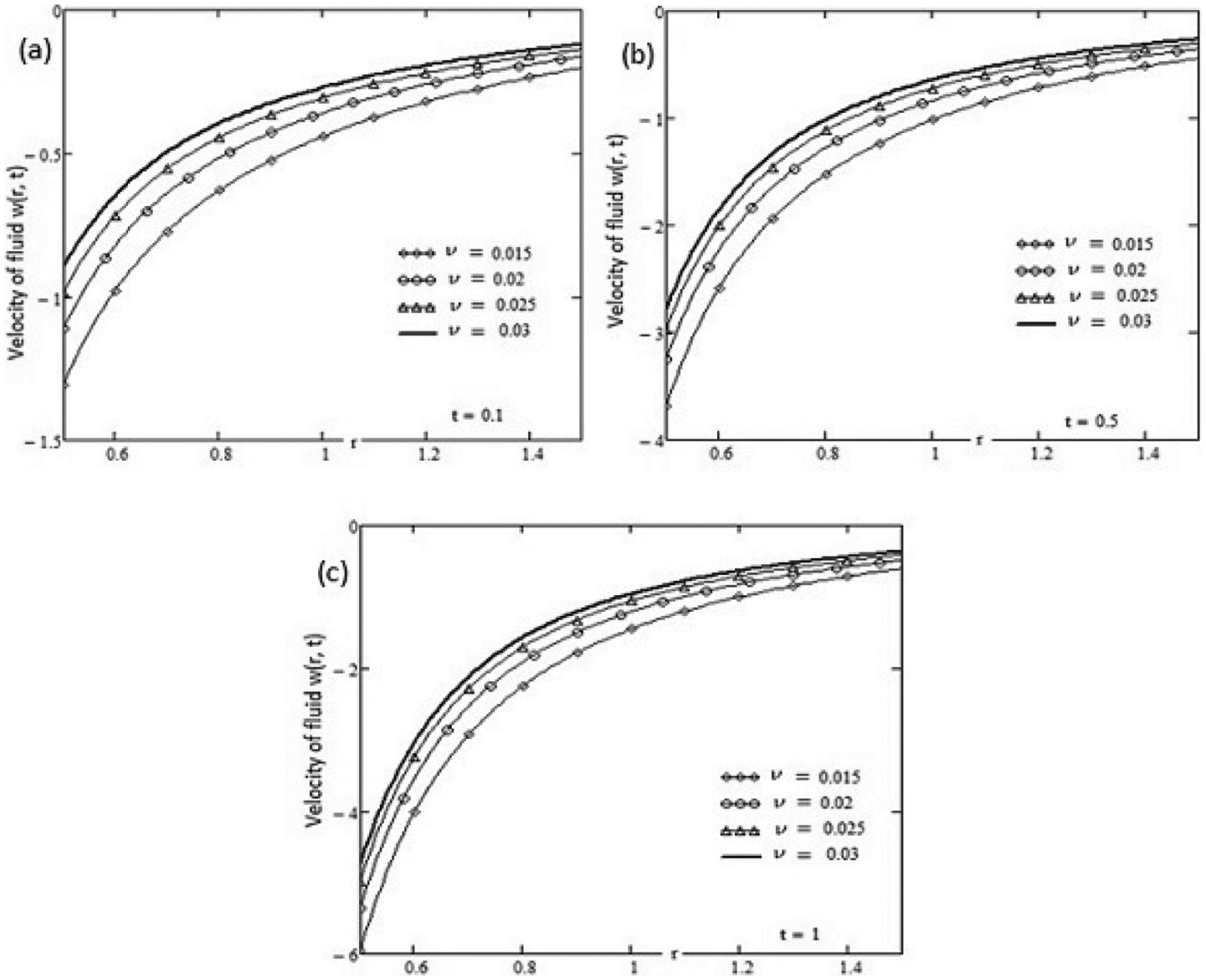
In Figure 4, the influence of kinematic viscosity on the fluid velocity is studied, and it can be seen that for large values of this parameter, the fluid flows more slowly.
Influence of kinematic viscosity on velocity field against the radial coordinate at: (a) t = 0.1, (b) t = 0.5, and (c) t = 1.
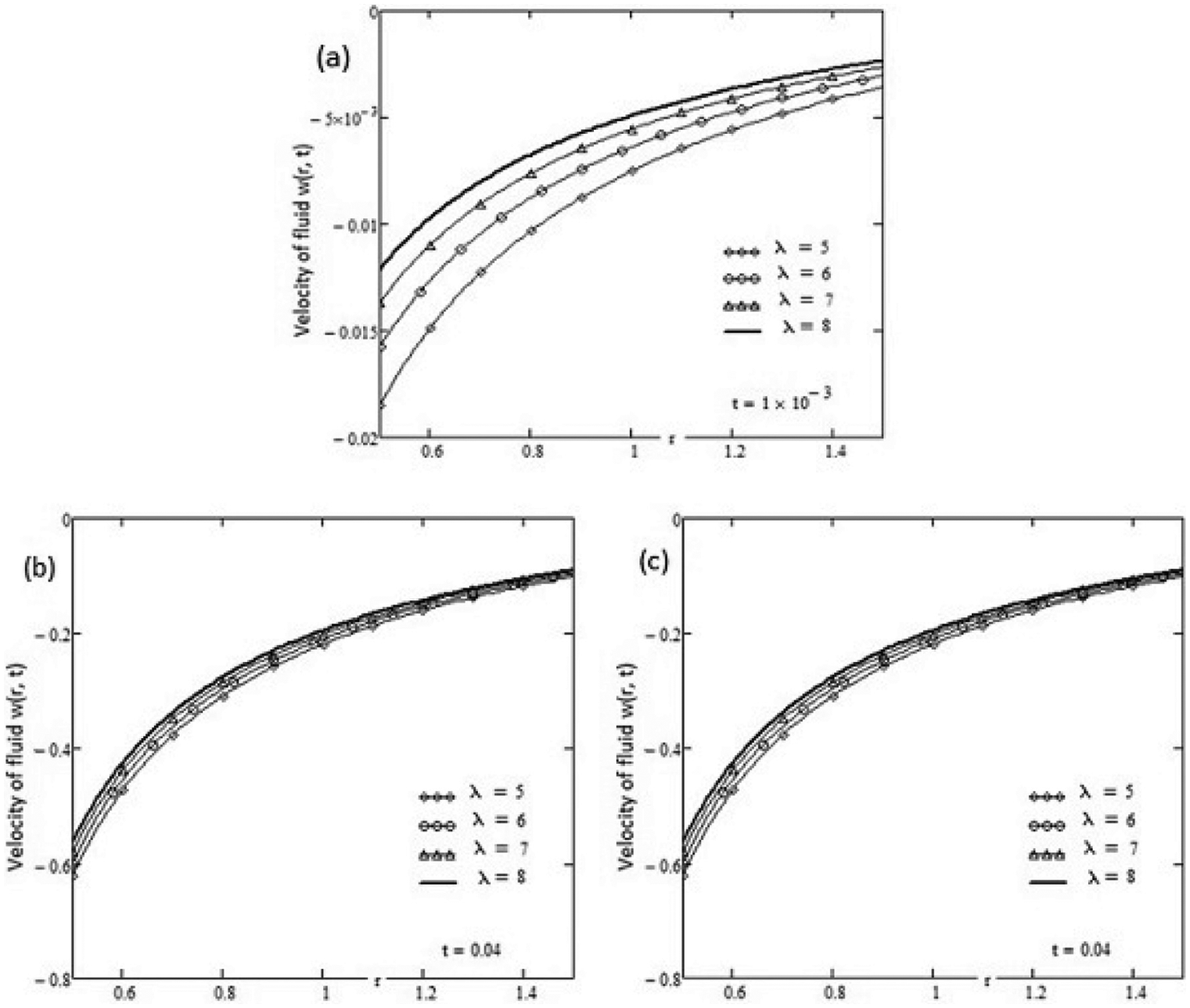
The curves from Figures 5 and 6 are plotted to study the influence of the relaxation time and of the retardation time on the fluid velocity, respectively. For these figures, we used , , and for Figure 5, respectively, for Figure 6. It is observed from Figures 5 and 6 that absolute values of fluid velocity decrease for increasing values of the relaxation/retardation time.
Influence of relaxation parameter on velocity field against the radial coordinate at: (a) t = 0.001, (b) t = 0.04, and(c) t = 0.04.
Influence of retardation parameter on velocity field against the radial coordinate at: (a) t = 0.1, (b) t = 0.5, and(c) t = 1.
Figure 7 is drawn in order to compare four models with fractional time derivatives, namely, Oldroyd-B, second grade, Maxwell and Newtonian fluids. Numerical calculations are carried out for , , , and . Absolute values of velocity for the fluids of Newtonian and Maxwell types are the largest, while the fluid of Oldroyd-B type has the smallest velocity, in absolute value.
Comparison of various fluid models for different time-fractional derivatives at: (a) t = 1, (b) t = 2, and (c) t = 3.
Conclusion
In this article, the effects of the orders of time-fractional derivatives on the rotational flow of an Oldroyd-B fluid between two circular cylinders have been considered. The governing fractional partial differential equations, subjected to the appropriate initial and boundary conditions, have been solved analytically using Laplace and Hankel transformations. Exact solutions for the velocity field and tangential stress are presented under series form in terms of the generalized functions. These solutions are more natural and appropriate tool to describe the complex behavior of non-Newtonian fluids and are important due to their practical applications in scientific and engineering experimentations. Moreover, the obtained solutions, which are new in the literature, can easily be transformed to provide similar solutions for ordinary Oldroyd-B, ordinary and fractional Maxwell, ordinary and fractional second grade, and Newtonian fluids. By making angular acceleration of the outer cylinder in our solutions, the results obtained in Kamran et al.28 are recovered as special case of our work. Furthermore, the effects of different material parameters, such as fractional parameter , fractional parameter , kinematic viscosity , relaxation parameter , and retardation parameter on the velocity profile are also examined and discussed.
Footnotes
Acknowledgements
The authors are thankful to the editor and anonymous reviewers for their careful assessment and valuable suggestions, which significantly improved the initial version of this paper. The authors are also very grateful to Prof. Dr Vieru Dumitru (Romania) for productive scientific discussions and valuable suggestions.
Academic Editor: Roslinda Nazar
Declaration of conflicting interests
The author(s) declared no potential conflicts of interest with respect to the research, authorship, and/or publication of this article.
Funding
The author(s) received no financial support for the research, authorship, and/or publication of this article.
References
1.
JamilM. Non-Newtonian fluids flows: exact analytical solutions and numerical results. PhD Thesis, Abdus Salam School of Mathematical Sciences, Government College University, Lahore, Pakistan, 2011.
2.
RajagopalKRSrinivasaA. A thermodynamic framework for rate type fluid models. J Non-Newton Fluid2000; 88: 207–228.
3.
ErsoyHV. Flow of a Maxwell fluid between two porous disks rotating about non-coincident axes. Adv Mech Eng2014; 2014: 347196.
4.
WuY-HLiuK-F. Start-up flow of a Bingham fluid between two coaxial cylinders under a constant wall shear stress. J Non-Newton Fluid2015; 223: 116–121.
5.
YaoD. A non-Newtonian fluid model with finite stretch and rotational recovery. J Non-Newton Fluid2016; 230: 12–18.
6.
ThakurPMittalSTiwariNet al. The motion of rotating circular cylinder in a stream of Bingham plastic fluid. J Non-Newton Fluid2016; 235: 29–46.
7.
ErsoyHV. Periodic flow due to oscillations of eccentric rotating porous disks. Adv Mech Eng2015; 7: 1–8.
8.
HayatTImtiazMAlsaediAet al. On Cattaneo-Christov heat flux in MHD flow of Oldroyd-B fluid with homogeneous-heterogeneous reactions. J Magn Magn Mater2016; 401: 296–303.
9.
KangSMNazeerWAtharMet al. Velocity and shear stress for an Oldroyd-B fluid within two cylinders. Bound Value Probl2016; 2016: 40.
10.
UllahSUllahAIqbalM. Withdrawal and drainage of thin film flow of a generalized Oldroyd-B fluid on non-isothermal cylindrical surfaces. AIP Adv2015; 5: 127242.
11.
FetecauCFetecauC. Unsteady flows of Oldroyd-B fluids in a channel of rectangular cross-section. Int J Nonlin Mech2005; 40: 1214–1219.
12.
JamilMKhanNAZafarAA. Translational flows of an Oldroyd-B fluid with fractional derivatives. Comput Math Appl2011; 62: 1540–1553.
13.
JamilMFetecauC. Helical flows of Maxwell fluid between coaxial cylinders with given shear stresses on the boundary. Nonlinear Anal Real2010; 11: 4302–4311.
14.
JamilMFetecauC. Some exact solutions for rotating flows of a generalized Burgers’ fluid in cylindrical domains. J Non-Newton Fluid2010; 165: 1700–1712.
15.
MahmoodAUllahSBolatG. Some exact solutions for the rotating flow of a generalized second-grade fluid between two circular cylinders. Arch Mech2008; 60: 385–401.
16.
TongDLiuY. Exact solutions for the unsteady rotational flow of non-Newtonian fluid in an annular pipe. Int J Eng Sci2005; 43: 281–289.
17.
JamilMFetecauCRanaM. Some exact solutions for Oldroyd-B fluid due to time dependent prescribed shear stress. J Theor Appl Mech2012; 50: 549–562.
18.
MathurVKhandelwalK. Exact solution for the flow of Oldroyd-B fluid between coaxial cylinders. Int J Eng Res Technol2014; 3: 949–954.
19.
FerrasLLAfonsoAMAlvesMAet al. Annular flow of viscoelastic fluids: analytic and numerical solutions. J Non-Newton Fluid2014; 212: 80–91.
20.
SrivastavaPN. Non-steady helical flow of a visco-elastic liquid. Arch Mech1966; 18: 145–150.
21.
WatersNDKingMJ. The unsteady flow of an elastico-viscous liquid in a straight pipe of circular cross section. J Phys D Appl Phys1971; 4: 204.
22.
FetecauCImranMFetecauCet al. Helical flow of an Oldroyd-B fluid due to a circular cylinder subject to time-dependent shear stresses. Z Angew Math Phys2010; 61: 959–969.
23.
PodlubnyI. Fractional differential equations. San Diego, CA: Academic Press, 1999.
24.
JamilMKhanNAShahidN. Fractional magnetohydrodynamics Oldroyd-B fluid over an oscillating plate. Therm Sci2013; 17: 997–1011.
25.
ZhengLLiuYZhangX. Slip effects on MHD flow of a generalized Oldroyd-B fluid with fractional derivative. Nonlinear Anal Real2012; 13: 513–523.
26.
MainardiF. Fractional calculus and waves in viscoelasticity: an introduction to mathematical models. London: Imperial College Press, 2010.
27.
TanWCWenxiaoPXuMY. A note on unsteady flows of a viscoelastic fluid with the fractional Maxwell model between two parallel plates. Int J Nonlinear Mech2003; 38: 645–650.
28.
KamranMImranMAtharMet al. On the unsteady rotational flow of fractional Oldroyd-B fluid in cylindrical domains. Meccanica2012; 47: 573–584.
29.
RajagopalKRBhatnagarRK. Exact solutions for some simple flows of an Oldroyd-B fluid. Acta Mech1995; 113: 233–239.
30.
LorenzoCFHartleyTT. Generalized functions for the fractional calculus. NASA technical paper, Glenn Research Center, National Aeronautics and Space Administration, Washington, DC, 1999.
31.
FetecauCMocanuCSamiulhaqet al. Exact solutions for motions of second grade fluids induced by an infinite cylinder that applies arbitrary shear stresses to fluid. Adv Sci Lett2012; 17: 266–290.