



Abstract
The huge space shield is a space tethers system which is placed between the earth and the sun. This system can alleviate global warming in certain length. It has the advantage of small side effects and is even no need to carry out space assembly. The huge space shield is a space system which is made up of the shielding surface and the control mechanism connecting through a number of cables. On the basis of the preliminary scheme, this article mainly analyzes the feasibility of the huge space shield, including the structure feasibility and the orbital stability. The ability of the folded and deployment is considered in the analysis of the structural feasibility. In view of the existing and predictable rocket carrying capacity, the maximum system is designed and a scale model is established in the laboratory to verify the feasibility of the practical one. Using the basic theory and the simulation method, the system is proved to be stable when working in orbit. During this process, the multibody system dynamics is used for proof and a “spring-particle” model is proposed for the tethered system. Through the above analysis, it shows that the scheme has practical feasibility in practice.
Introduction
In recent years and the future, global warming is becoming increasingly serious, not only in the deterioration of the environment but also in the present climate of economic global recovery, where geoengineering will become increasingly demanding. Historically, a variety of previous work1–5 have led to the energy efficiency or reduced the greenhouse gas emissions to cope with the increasingly serious global warming.
Some new schemes for geoengineering have been proposed. 6 The first category of geoengineering method is solar radiation management, which controls the solar radiation. And the second is carbon dioxide removal, which reduces the greenhouse gas emissions. 7 Among them, several representative programs are as follows. Sulfur acid rain drops, which release sulfur with a space elevator in earth’s stratosphere, could effectively scatter sunshine in space. Environmental scientist Robock 8 called it “A Case against Climate Engineering.” Spraying a lot of water to the sky would be in a position to increase the reflectivity of atmospheric clouds.9,10 Enhancing the reflectivity of atmospheric clouds by 3% could offset the global warming affected by human activity. The deliberate injection of sulfate aerosol precursors into the stratosphere could substantially offset future warming. Moreover, this action could provide additional time to reduce human dependence on fossil fuels and stabilize CO2 concentrations cost-effectively at an acceptable level.11,12 These methods can recover from the global warming. However, the regional climate is changing significantly at the same time. The impact of such changes could not be expected and may be greater than the one of containing global warming. So the device is setting up in space, which is considered to decrease the exposure of astronomical solar radiation.
“Sunshade” is supposed to install on the huge sunshade nearly Lagrange point. 13 It is composed of many small pieces of mirror and the sun rays are reflected back into space. The method is considered to be feasible 14 and the orbital optimization is carried out. 15 However, in order to reach the desired results, there are two ways: increasing the number or the area of this device. The former one is unpredictable and the latter is involved in space assembly. Both of the ways are difficult to actualize in a short period.
Considering the above problems, Zheng et al. 16 improved this scheme, and then put forward a kind of deployable huge space shield (HSS). The HSS is placed between the earth and the sun. This system can prevent part of sunlight into the earth, thus reducing the astronomical solar radiation of the coverage area. Based on the mature theory of gravity gradient, self-balancing tethered system is used. The shielding surface can directly reflect the sun rays, so this scheme does not need to consider the protection of the atmosphere. And because the shielding surface is generally composed of thin films, the payload weight of the HSS is cut down. It can be transported to the space by the rockets and does not need to be assembled on arrival. Although the shielded area is finite, it still plays a great role in impairing the seriously influenced area. This study aims to produce a system for reducing the global warming. Based on this primary proposition, this article discusses the feasibility of the HSS. On one hand, the structure of the HSS can achieve either to be folded or deployment. On the other hand, the HSS in orbit is successful and stable using simulation and theoretical calculation.
Structure feasibility of the HSS
The HSS is a space system which is made up of the shielding surface and the control mechanism connecting through a number of cables. The system works in the space. Therefore, the structure feasibility of the system should be made in two aspects. One aspect is the folded demand of the structure which must satisfy carrying conditions. The other is the deployment demand of the structure which must satisfy working conditions.
Folded demand
The larger the shielding surface of the system, the more the radiation will be shielded. And the system will become more effective. But the size of the surface cannot be unlimited. It is restricted by the loading requirements of the human carrying rocket. And the folded demand is mainly to meet the loading requirements of the carrying rocket. The Long March 5 series launch vehicle is one of the most advanced rockets in China. It has a carrying capacity of 25,000 kg in LEO and 14,000 kg in GTO. The diameter of fairing is 5.2 m and the length of that is between 13 and 20.5 m 17 where the system is packaged. And in this article according to the emission parameters of the Long March 5, the folded demand of the HSS is considered.
The folded of the HSS is the inverse process of the deployment. Here, this article mainly analyzes whether the system could meet the requirements of loading and transportation after folded. First, the diameter of the shielding surface is set to D. The number of rods is n that is also the number of polygon’s sides.
According to Figure 1, the length of the regular polygon is


Sketch of folded state.
Solve

The number of robs must be an integer, so it is equal to the smallest positive integer in equation (2). The length of the rod could be obtained

When the system is folded, the orthogonal projection of it is a regular n-sided polygon. To meet the folded diameter smaller than the furling’s diameter, the maximum circumscribed circle diameter of the regular n-sided polygon is equivalent to the furling’s diameter. The diameter of shielding surface is 1.4 km. The furling’s diameter of the carrying rocket is 5.2 m. So the n is selected as 240 and the circumscribed circle diameter is chosen as 5 m. The diameter of rod could be obtained

Considering the place in the folded, the diameter of rob is chosen as 0.06 m. In summary, the length of rod is 18.3254 m and the diameter of it is 0.06 m. It could be calculated that the diameter of the system is 5 m and the height of it is 18.3254 m when folded. Therefore, according to the above calculation, this HSS could be completely folded in a predetermined Long March 5.
Deployment demand
The deployed state is the working state of the HSS, and the structure of folding ring has been mentioned. 18 In this article, the joint is improved. Compared with the former structure, each joint of the new one adopts pulling cable and tension springs which would make the process of deployment more reliable and simple. And the feasibility of the new structure is verified by the scaled model.
Spatial tethers system utilizes gravitational gradient effects’ self-expansion and self-balancing in space. The HSS consists of three parts. The structure is shown in Figure 2. The large shielding surface labeled A, which is the working part and is used to shield solar radiation. Several cables labeled B, which are connected to the other two parts. The control mechanism labeled C, which controls the elongation rate of cables and prevents large vibrations caused by rapid elongation rate. As a result, the structure feasibility of the system is built on the feasibility of three parts.

Structure of the huge space shield.
First of all, the feasibility of the shielding surface is analyzed. The extensibility of the shielding surface in space is mainly considered. Carbon fibers constitute the outer rigid ring through connection joints, and then a layer of reflection film is bound on the rigid ring. Because of the big diameter, the soft rib is needed to ensure the smoothness of surface.
The outer rigid ring of the shielding surface is composed of carbon fibers and connection joints. The connection joint is made up of a pair of cone gears and a pair of ply-woods. Each cone gear is equipped with guide groove, which fixed with a pair of splints by gear shaft. Screwed conduit is installed in the arm cavity of ends of cone gear, and the carbon fiber is connected with cone gear through it.
For the optimization, there is a pulling cable and a tension spring equipped in the cavity of the carbon fiber. The pulling cable is connected with the tension spring using encased knot as is shown in Figure 3. When the tension spring is released, the pulling cable would be moved and the connection joint will run at the same time.

The connection between the pulling cable and the tension spring.
When the system is folded, the tension spring is stretched. The tension spring is parallel to the connection joint in the vertical direction. The length of the pulling cable around the tension spring is equivalent to the distance of two gears plus 1/2 circumference of the addendum circle, as shown in Figure 4.

The folded.
When the system is being deployed, the tension spring is contracted. The pulling cable is moved by the near tension spring, while a pair of gears is driven to rotate. When the gears turn 90°, the length of the pulling cable around the pair of gears shortens to the center distance of the two gears as shown in Figure 5.

The deployed.
Shielding surface is the working part of the HSS and the function of the system could be completely achieved by it. Furthermore, the deployment of the structure and the fluency for the process of deployment should be simulated. In order to prove that the scheme is workable, the structure of the shielding surface is simulated. Figure 6 shows the state of the folding for simulation. And Figure 7 shows the process of the intermediate for simulation.

The state of the folding.

The process of the intermediate.
For further validation, on the basis of the software, the experimental mechanism is established in the laboratory for physical experiments. Figure 8 shows the process of the folding for experimental mechanism. Figure 9 shows the process of the intermediate for experimental mechanics.

Folding for experimental mechanics.
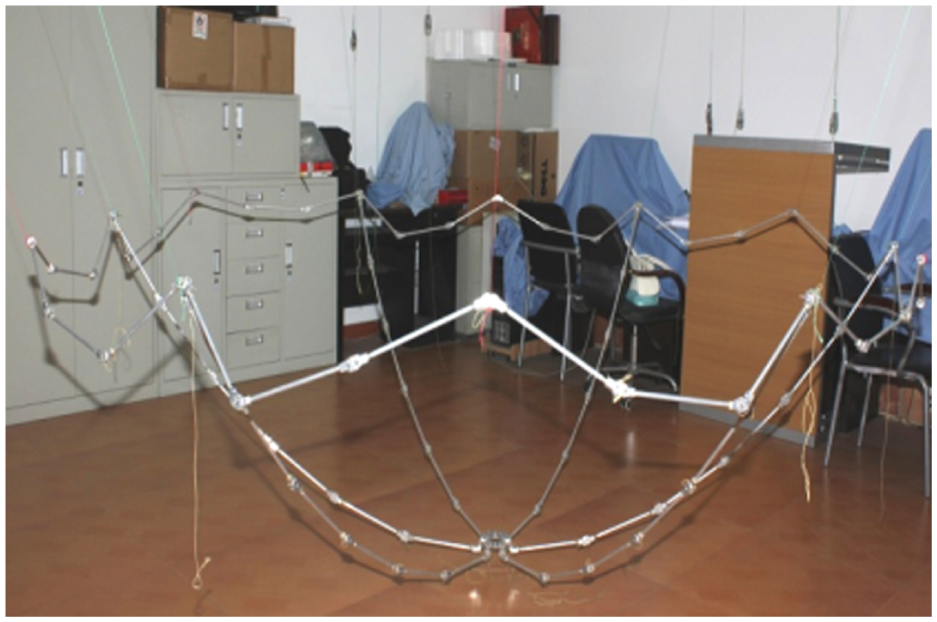
Intermediate for experimental mechanics.
According to the physical experiment, it can be seen that the shielding surface in this article is practicable.
Second, the main function of the cable is to connect the shielding surface with the control mechanism in the space. And it can also absorb forces. The Kevlar has many properties such as high intension, high modulus, low density, and excellent heat resistance. 19 Therefore, it is especially suitable for the HSS.
Finally, the expansion rate of the cables is controlled by the control mechanism which makes the HSS folded or deployed. The control mechanism is mainly composed of the motor and turntable. Each turntable is convolved by one cable. Each tethers stretch through the rotation direction of the turntable which is controlled by motor.
Orbital stability of the HSS
Different aircraft in the space have different purposes. And in the light of application they run on different orbits, so is the HSS. After the structure feasibility is verified, it is necessary to analyze the orbit feasibility of the HSS. Because the high elliptical orbit can cover the northern and southern polar regions and the satellite operating on it can cover more than 12 h at the apogee, high elliptical orbit is optimal. First, the dynamic equations are built by multibody system dynamics. Based on these equations, a “spring-particle” is established and simulated. The HSS works in an elliptic orbit. The orbit parameters are selected which could be ensure that the system can shelter the same place on the earth from the sun at the same time of the day. Then, the stability of the system on this orbit is analyzed.
Dynamic equations of the system
The HSS is located on the orbit, composed of the control mechanism, the cables, and the shielding surface. The connecting line of the three parts is always pointing to the sun to achieve function better. Due to the large size of the shielding surface, it needs three cables to fix. And to simplify the model, one cable is used to replace three ones, and it is assumed that the cable is flexible but cannot rotate.
Figure 10 shows that
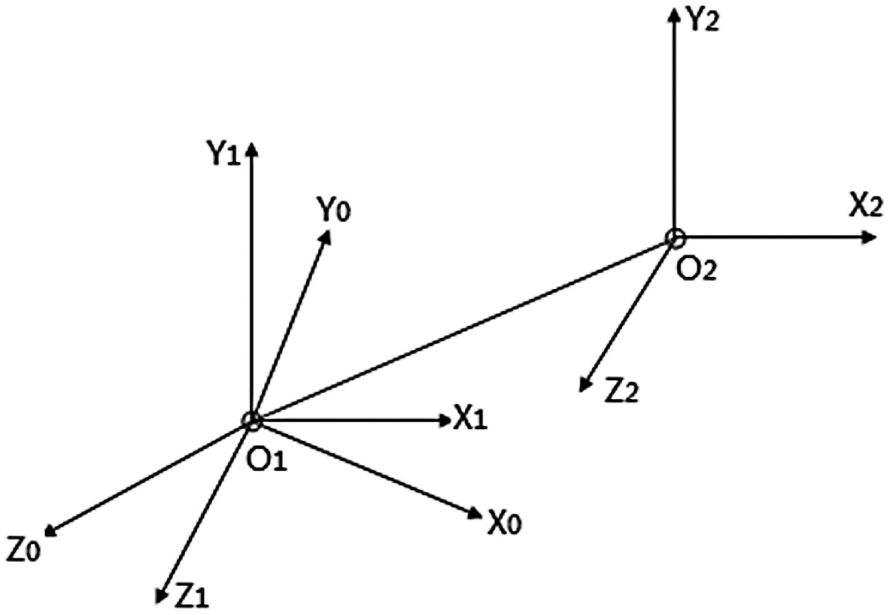
Coordinate systems.
The main body of the HSS is stable in the orbit coordinate system.
The direction cosine of the connecting base for the reference base is

The matrix of the direction cosine between each rotation is

Because the Euler angles are small, there are

1. The kinetic energy of the system

where



where r is the vector of any point of the cable. R is the vector of the centroid of the shielding surface in the inertial coordinate system.
2. The potential energy of the system
Because the HSS works in space where there is no gravitational potential, the potential energy of the system is only the elastic deformation of the cable. When the system makes adjustments, the potential energy is mainly generated by the transverse vibration deformation of Y1- and Z1-axes because X1-direction deformation of the rope is very small. Its expression equation is

3. The Lagrange function of the system


The
Stability of the system
In the above theoretical analysis, the shielding surface and control mechanism are assumed to be a particle. And the mass of the cables is ignored. So the “spring-particle” model is built in simulation. According to the above analysis, one simulation is operated for the HSS on an elliptical orbit. Since the initial velocity and the force are related to the mass and the operating orbit, it must be assumed that the mass of the HSS and the operating orbit firstly.
In this model, the mass of the shielding surface is 16,000 kg and the mass of control mechanism is 7000 kg. The length of the cables is 30 km. We choose the elliptical orbit of the model which is called “Molniya” orbit because the launch window and running environment of the carrying rocket are known for this orbit. 21 The success rate of the lunch and the operational control of the satellite could be improved by this option. The HSS is considered on the orbit with the following initial values of the parameters (all the analyses in this article are based on those mass and orbit):
Apogee altitude: 27,676.166 km;
Apogee radius: 34,054.303 km;
Perigee altitude: 108.396 km;
Perigee radius: 6486.533 km;
Inclination: 50°;
Argument of perigee: 60°;
RAAN: 0°;
Semi-major axis: 20,270.418 km;
Eccentricity: 0.68;
Period: 28,721.363 s.
Based on these parameters, the dynamics simulation is performed to observe the operation of the HSS in the elliptical orbit. And the results of the dynamics simulation are shown in Figure 11. Those are the system in orbit for five periods.

The results of the dynamics simulation: (a) attitude angle of the system, (b) position of the shielding surface, and (c) length of the cables.
The attitude angle which is referred in Figure 11(a) is the angle among the control mechanism, the earth, and the shielding surface. The control mechanism always stays below the shielding surface. The simulation results accord with this theory and it can be seen that the attitude angle also changes periodically. Figure 11(b) shows that the position of the shielding surface keeps in the orbit and the model remains stable. The length of the cable is stretching in the space in Figure 11(c). The Kevlar strings which are stretchable are generally selected as the cable of the system. So the stretch of the cables would not lead to the failure of the whole system. Although the cables in tensile state on orbit, the expansion of the cables are not considered in this case and the expansion rate of it need only to be controlled.
Conclusion
According to the above analysis, it is proved that the structure of the HSS is feasible. The HSS runs steadily in an elliptical orbit. The reliability of the structure is verified by the experimental mechanics in the laboratory. And depending on the method in this article, the HSS also meets the requirements of loading and transportation when it is folded. All of the analyses and the simulation tell us that the idea of the HSS is feasible.
The earth diameter is 13 million meters. If the shielding surface diameter is 1400 m, the area ratio is 0.000000012. Thus, to achieve a 1.2% reductions in solar input, 1 million shields would need to be deployed involving 1 million launches of a Long March 5 rockets or similar. These costs are worth comparing to the dangers of global warming. Moreover, with the continuous improvement of manufacturing technology, the cost would be reduced. It is possible to reduce this amount by optimizing the trajectory to maximize the effectiveness of each system. So it could be applied in practical for mitigating global warming.
At the same time, some other studies focusing on climate modeling have highlighted several risks and aspects associated with geoengineering and shielding techniques. They are scared that the decrease in sunshine hours would reduce the precipitation as reducing the temperature.22,23 However, in this article, the system proposed would be placed in the space without any changes to the earth’s ecosystem, so the risk is reduced to a minimum.
In this area of study, future research could focus on the efficiency. At present, the theoretical analysis has been completed. Theoretically, the long-term effect of the HSS on temperature is 0.2°C between before and after shielding. Practice is the sole criterion for testing truth, so the experiments are under way.
Footnotes
Acknowledgements
We thank the editors and two anonymous reviewers for insightful suggestions on earlier drafts.
Handling Editor: Chuanzeng Zhang
Declaration of conflicting interests
The author(s) declared no potential conflicts of interest with respect to the research, authorship, and/or publication of this article.
Funding
The author(s) received no financial support for the research, authorship, and/or publication of this article.