




Abstract
The numerical simulation of shear localization under high strain rates can be modeled by a system of four partial differential equations including conservation of momentum, conservation of energy, elastic, and inelastic constitutive relations. This article introduces the gradient terms of the equivalent plastic strain to the inelastic equation based on the implicit gradient theory of plasticity to preserve the ellipticity for the shear band modeling. The model is constructed by the mixed finite element formulation with B-bar to reduce shear locking effects considering displacement, stress, equivalent plastic strain, and temperature as the solution field and thereafter solving the entire nonlinear governing system simultaneously. The performance of the gradient plasticity model is verified by two benchmark shear band problems, and the obtained numerical results are tested with the high-rate experimental results.
Introduction
Shear band is a dynamic failure, common to be observed in metallic materials as a highly localized zone of intense plastic deformation when subjected to the high strain rates.1,2 As the fact that shear band is considered as a material instability propagating at the time scale of microseconds and its width is on the order of tens of microns, 3 modeling shear band problems can be a hard core in these aspects. Molinari and Clifton 4 proposed an analytical model based on the thermal perturbation concerning the competition between strain rate hardening and thermal softening. During the dynamic loading, different mechanisms such as strain hardening, strain rate hardening, and thermal softening are competing which results in three distinct stages in the process of shear band formation.5,6 For numerical modeling, plastic flow models derived from experimental results dependent on strain rate, strain rate hardening, and temperature are recommended to describe the formation of shear localization.7,8
Mesh sensitivity is another problem for numerical modeling of shear localization which leads to different results with respect to the mesh size as the absence of convergence. Since the shear band formation is extremely fast, on the order of microseconds, 3 while heat conduction is a relatively slow process, the adiabatic condition is widely assumed in many models7,9,10 with the terminology of “adiabatic shear bands.” It is accepted that there is not enough time for the heat to be conducted away 11 when applied with high strain rates, whereas this assumption has shown to lead to mesh-dependent results.
From the physical standpoint and considering the effect of thermal diffusion, the problem is revealed by the inclusion of the intrinsic length scale created by the competition between heat conduction and heating.12–14 Moreover, as explained in the works by McAuliffe and Waisman,15,16 the diffusive term and the heat source are of the same order of magnitude. Strain gradient theories are other regularization techniques to alleviate the mesh sensitivity for strain softening materials.17,18 Higher order gradients of strain were first introduced into the plastic constitutive equations by Aifantis 19 and Coleman and Hodgdon 20 for rigid plastic materials accompanied with a gradient parameter called length scale. A phenomenological strain gradient plasticity model is proposed 21 and supported by the size effect in the torsion experiments of thin copper wires with micrometer diameters.22,23 The length scale acts as a material property connecting the microstructure of the metallic material such as the grain size, dislocation density, and microstresses to the continuum10,24,25 and shows the ability of the microstructure to transfer information with neighboring points in a certain distance. Shi et al. 26 used the theory of mechanism-based strain gradient (MSG) plasticity to study plastic flow localization problems in ductile materials and determined the thickness analytically based on a bifurcation analysis. Similarly, Chen et al. 27 studied the plastic flow localization in ductile materials using the couple stress (CS) strain gradient theory and the strain gradient hardening (softening) law (C-W) and showed that the strain rate was non-uniform within the band and reached a maximum at the center of the shear band. Voyiadjis et al. 28 proposed a higher order thermodynamically strain gradient plasticity model which accounts for the thermomechanical behavior of the microstructure and examined the numerical results with experimental data.
In this work, four partial differential equations (PDEs) describing conservation of momentum, conservation of energy, elastic constitutive relation, and inelastic constitutive relation are used to model shear band problems. We first demonstrate the theory of gradient plasticity on the theoretical basis of nonlocal theories and then based on the implicit gradient theory of plasticity, and we introduce the gradient term of equivalent plastic strain (EQPS) to the PDE’s system in shear band modeling. Furthermore, we detail the weak form of the governing system and solve the entire nonlinear PDEs simultaneously using the mixed finite element 29 taking displacement, stress, EQPS, and temperature as the solution field. Finally, we investigate the performance of the gradient plasticity model on a benchmark shear band problem using the mixed finite element formulation with B-bar to reduce the shear locking effects.
The article is organized as follows. Section “Problem statement and mechanical model” presents the gradient plasticity theory and the mechanical model. In this section, higher order gradients of the EQPS are considered in the inelastic constitutive relation which preserve the ellipticity for the simulation of shear band problems.
30
The weak form of the governing equations is discussed as well in this section. In section “Numerical results,” a two-dimensional (2D) benchmark shear band problem where a shear band is formed at
Problem statement and mechanical model
Gradient plasticity theory
Shear band width is usually on the order of tens of micrometers which is a macroscopic phenomenon,3,31 but its evolution lies in the material microstructure. When the deformation is homogeneous in space, its gradient terms are small and negligible. But when it comes to the highly localized plastic deformation or the observed plasticity phenomenon which endures a size effect, the gradient terms play a dominant role. 22
The gradient plasticity theory introduces the higher order plasticity terms into the conventional governing differential equations together with the intrinsic length scales to characterize the microstructure behavior.
In the nonlocal regime, the nonlocal plastic strain

where
With the assumption of isotropy and neglecting the fourth and higher order terms, the local plastic strain is expanded into a Taylor series

Plugging equation (2) into equation (1), the following relation is obtained

where
Equation (3) inevitably leads to a fourth-order derivative of the displacement fields and a C1-continuity requirement of displacement. 32 In order to avoid this problem, equation (3) is differentiated twice and then substituted into equation (3) again; also, neglecting fourth-order terms yields

The aforementioned “implicit gradient theory of plasticity” formulation results in
Problem statement
The shear band problem can be described by a system of four PDEs including two balance equations, momentum and energy, elastic, and inelastic constitutive equations. The momentum equation which ignores the body force is written as follows

where
The elastic constitutive relation in rate form can be given as follows

where

The rate of thermal deformation is defined as follows

where
The rate of plastic deformation is defined using a

where
The local EQPS rate is expressed as follows

Based on the aforementioned gradient theory (see equation (4)), the inelastic constitutive relation is derived as follows

where

The effective stress is given as follows

The energy balance equation is written as follows

where
Considering the following relation

the energy equation can be simplified as follows

Finally, the four governing equations which describe four unknown fields of velocity, EQPS, stress, and temperature, over the problem domain

The boundary conditions are as follows

where
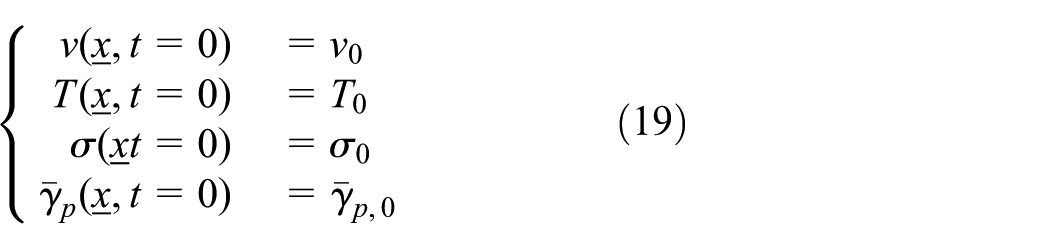
Note that when the gradient term of plastic strain is ignored, equation (17) comes to the adiabatic assumption of shear band simulation.
Discretization of the gradient model
The weak form of the system in equation (17) is obtained by multiplying the momentum equation, inelastic constitutive relation, energy equation, and elastic constitutive equation by the corresponding weight functions:




In this model, the weak form contains spatial derivatives of velocity and EQPS; therefore, these two fields must be discretized with bilinear
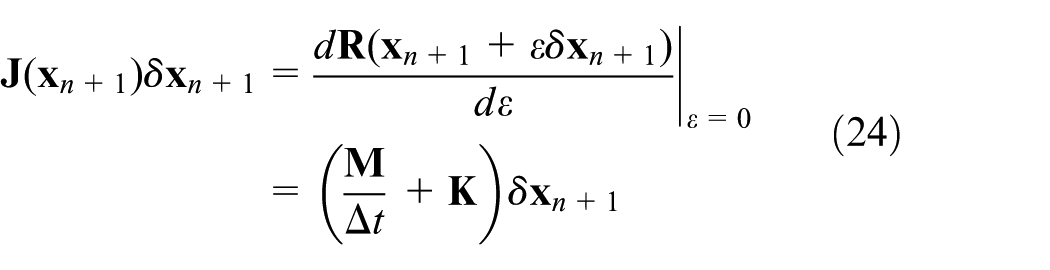
This model is discretized in time using the backward Euler method and the Galerkin approximation is assumed in each element. Hence, the linearization of the nonlinear system is required to solve the nonlinear problem at every time step. The Jacobian matrix with respect to the four variable fields is calculated analytically and defined by the Gâteaux derivative
where





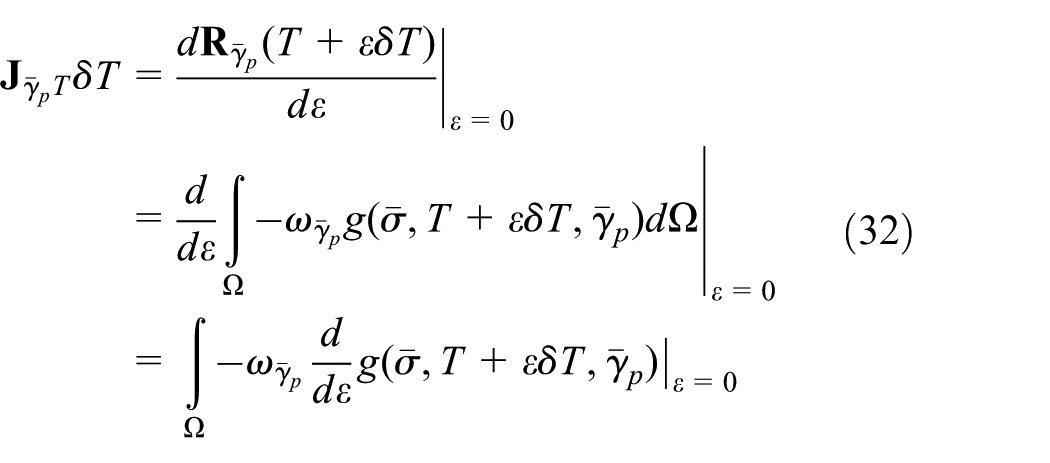
Here, the derivatives of the flow law with respect to

where
Numerical results
In this section, we verify the role of the second-order gradient term of the EQPS in the inelastic constitutive equation which justified the PDEs for shear band problems being solved. The introduced intrinsic length scale in the model produces a material nonlocality acting as a localization limiter and hence regularizing the problem. We study the behavior of this gradient plasticity model on two shear band benchmark problems including a pure shear problem and a
The PDE model is implemented using the finite element analysis program (FEAP). 35 The linearized systems of equations are solved with PETSc’s 36 LU factorization algorithm using a quotient minimum degree ordering.37,38 The postprocessing and graphics are generated using ParaView 39 and Matplotlib. 40
shear band under uniform tension
In this section, a square plate is considered with uniform tension impact at its top and bottom edges. An imperfection is assumed at the center of the plate in order to generate X-shaped shear bands. Considering the symmetry to both the x-axis and the y-axis, only the top-right quarter of the plate is studied in the analysis. The geometry of the square plate with the edge dimension of

The geometry of the square plate under tension and the applied velocity profile. The imperfection is represented as a red dashed circle.
A hyperbolic secant type of imperfection is considered during the shear band simulation. Hence, the values of the yield stress and yield strain are reduced by



Here,
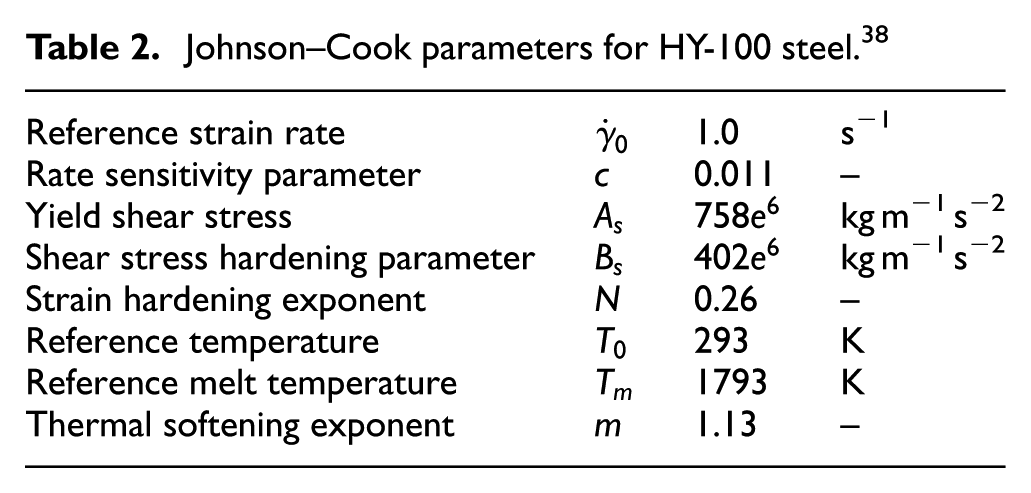
The material used for the analysis is HY-100 steel with a Johnson–Cook flow law 41 shown as follows

where
Material properties for HY-100 steel. 38

Johnson–Cook parameters for HY-100 steel. 38
The top-right quarter plate is discretized into
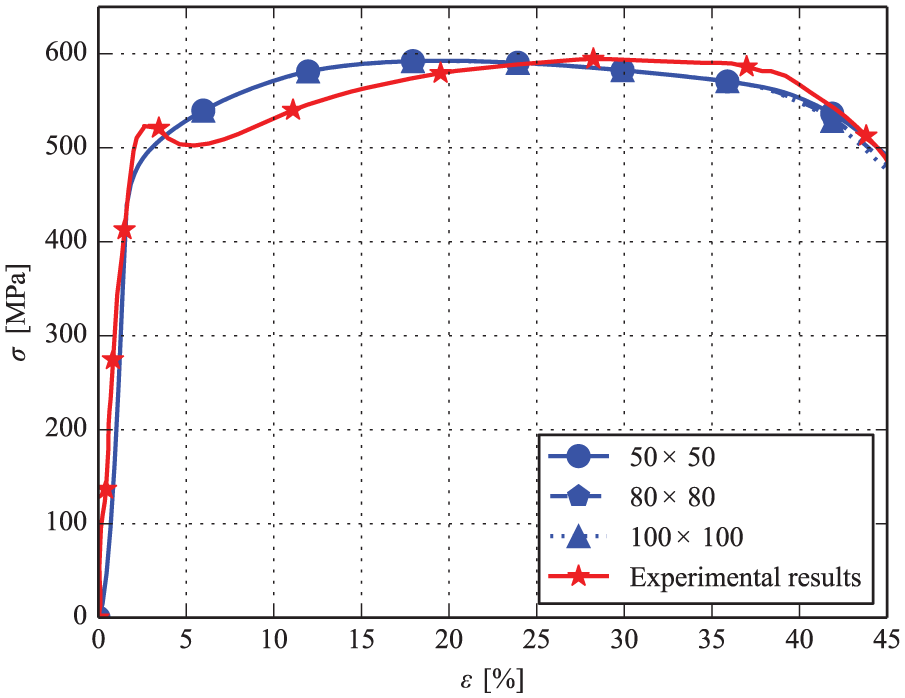
The average stress–strain curves along the diagonal line of the quarter plate for three different meshes compared with the experimental results. 5
The EQPS and the temperature distribution along the diagonal line of the quarter plate (orange dashed line in Figure 1) for three different meshes at the final time are detailed in Figure 3.

The equivalent plastic strain and temperature distribution along the diagonal line of the quarter plate plotted at the final time for mesh
These plots indicate that the EQPS and temperature within the shear band are much higher than that outside the band zone, and the width of the plasticity zone is not broadened with respect to the mesh size. Moreover, with the shear band simulation based on the irreducible mixed finite element formulation, the maximum local temperature variation is almost over 800 K. According to the experimental results conducted by Marchand and Duffy, 5 the surface temperature changes are at least 428°C (802.4°K) measured by a high-speed infrared radiometer. Hence, this gradient plasticity model captures the trend that is observed in the experiments subjected to high strain rates.
Plane strain shearing
The plane strain shearing problem is modeled in this section. The geometry of the plate is shown in Figure 4 with
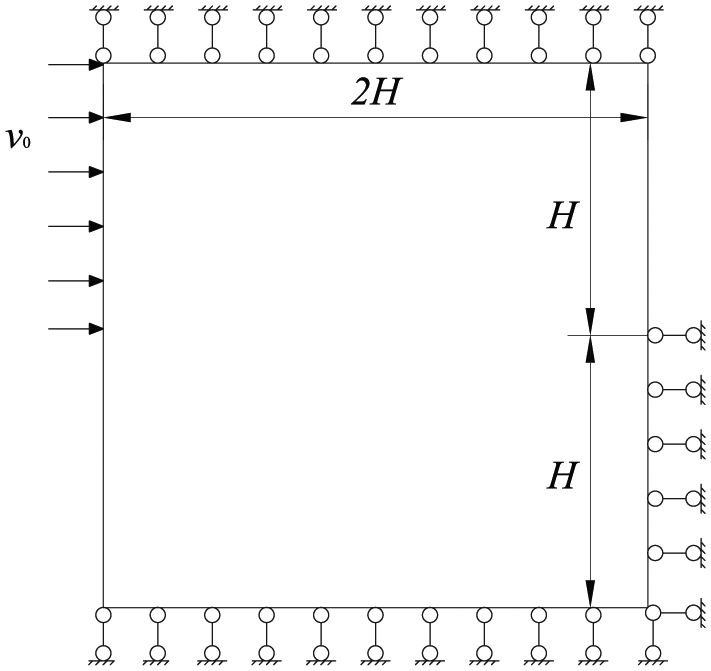
The geometry of the shear plate with the impact loading. No imperfection is required.

The mesh of the shear plate.
Figure 6 elaborates the EQPS distribution along the vertical line at the center of the plate plotted at three different times

The EQPS evolution along vertical line at the center of the plate.
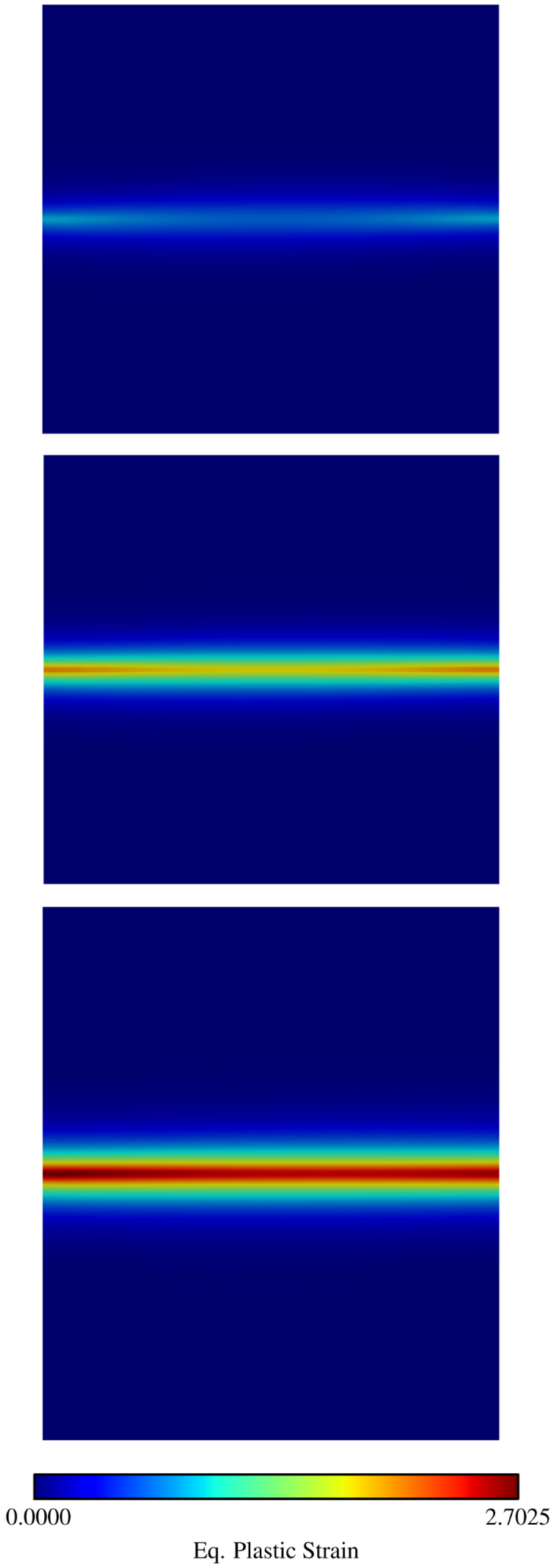
Plots of the equivalent plastic strain at three different times for plane strain shearing problem.
Conclusion
This article developed an implicit gradient plasticity model considering the second-order gradient term of equivalent plastic strain in the PDE system for dynamic shear localization simulation. This model solves the entire PDEs simultaneously using the mixed finite element method with B-bar to reduce shear locking effects. Herein, the EQPS and temperature are interpreted as additional degree of freedoms and they are regarded as the unknown field together with displacement and stress. The residual of the nonlinear system is discretized with the Galerkin approximation spatially and with a backward Euler method in time. The Jacobian matrix is calculated analytically as the Gâteaux derivative of the residual avoiding the process of numerical differentiation. This implicit gradient plasticity model is tested by simulating two benchmark shear band problems. One is the
Footnotes
Acknowledgements
The authors would also like to acknowledge Professor Haim Waisman and his group from Columbia University for their assistance in shear band formulation.
Academic Editor: Jiin-Yuh Jang
Declaration of conflicting interests
The author(s) declared no potential conflicts of interest with respect to the research, authorship, and/or publication of this article.
Funding
The author(s) disclosed receipt of the following financial support for the research, authorship, and/or publication of this article: This work is supported by The General Program of National Natural Science Foundation of China (grant nos 11372098 and 51579084) and the Fundamental Research Funds for the Central Universities (no. 2015B37514).