In this study, the cilia-induced flow is discussed for fractional generalized Burgers’ fluid in an inclined tube. The mathematical model of fractional generalized Burgers’ fluid flow is obtained under the long-wavelength approximation. It is found that thickness of flow region increases with the increase in relaxation time; thus, a large amount of pressure gradient is required for fluid flow, whereas the retardation time assists to decrease the thickness of the flow region, and therefore, less amount of pressure gradient is required for the fluid flow during the recovery stroke. The presence of fractional order derivatives in the generalized Burgers’ model provides the large amount of frictional force when compared with generalized Burgers’ fluid in the presence of parameters . Fractional Adomian decomposition method is used to calculate the pressure gradient. Results for stream function, axial velocity, pressure gradient, pressure rise, and frictional force are constructed and then plotted graphically to note the effects of various interesting parameters.
Cilia were first discovered by Dutch light microscopist Antoni Van Leeuwenhoek during the year 1675. However, Sharpey discussed the cilia in English language for the first time in 1835 by giving a detailed description of ciliary motion in respiratory and reproductive systems of a wide variety of mammals having small hair on their skin. In 19th century, ciliary structures have been discussed in detail. It is important to note that the flagella and eukaryotic cilia are rigidly different.1 Cilia and flagella move in a wavelike fashion during their motion to transport fluids and propel cells.2 Cilia motion plays an important role in biological process such as alimentation, circulation, respiration, locomotion, and reproduction.3 Examples of cells and bacteria having cilia or flagella on their surface with the help of which they move are sperm cells, having one flagellum, and green algae Chlamydomonas, having two flagella. Ciliated cells can also be found in many human organs, for example, ependymal cells in brain that create cerebrospinal flow, photoreceptor connective cells in retina, epithelial cells in the respiratory tract, in hair bundles on ear, and in fallopian tube or in kidney.4 Cilia motion is also known to play a diverse role in human physiology, and defects in it may lead to severe diseases. Although much literature is available on the role of cilia motion, yet many questions are still awaiting answers on the motion, structure, and functioning of ciliary activity with respect to humans and other animals’ life.
Cilia motion has been examined by a number of experimental techniques, to name a few, Resnick5 investigated the mechanical properties of primary cilium with an optical trap to study the resonant oscillations during cilia motion. Resnick further observed that mechano-transduction signaling occurs as the result of physical bending of cilium. Gueron and Gurvich6 collected the forces which generate the cilia beating into a simple functional form and called it as “Engine.” This internal mechanism of cilia called “Engine” is found to be fit into the hydrodynamic model that takes into account the interactions between the neighboring cilia, between the cilia and their anchoring surfaces. The “Engine” cilia motion model is found sensitive in response with respect to viscosity and configurations which may be in the forms of two-dimensional arrays of cilia. According to geometry, different beating patterns are shown by cilia in literature.7,8 Generally, single cilium shows the two stroke motions, namely, effective and recovery strokes. The recovery (backward) stroke starts when the single cilium moves toward neighboring boundary and itself, whereas the single cilium moves forward into the fluid during the forward stroke. Different researchers in their studies of cilia motion have considered the two stroke motions.9,10 During the combined motion of cilia, upper layer of cilia is seemed to be a metachronal wave, which appears due to a small angular difference between neighboring cilia. The hydrodynamics of collective motion of cilia has been investigated in detail by Dauptain et al.11 Various types of metachronal waves are classified according to the dynamics and forward stroke of motile cilia. Symplectic beat pattern is formed if the direction of propagative metachronal wave and direction of the forward stroke is same, whereas antiplection pattern is formed if both directions are opposite to each other.12–15
Recently, Siddiqui et al.16 described the magnetohydrodynamic flow of a viscous fluid in a ciliated tube under the long-wavelength approximation. Since many biofluids are characterized as non-Newtonian fluids instead of being Newtonian (see, for example, the works by Siddiqui et al.17 and Smith et al.18), they are subjected to number of biochemical reactions which enhance/decrease their viscosity, elasticity, and shear thickening/thinning characteristics. Smith et al.18 in their work on mucociliary clearance (MCC) showed that the most complex models considered in MCC are Maxwell and Oldroyd-B viscoelastic models. Inspired by the investigations of Siddiqui et al.16 and Smith et al.,18 in this study, we have examined the cilia-induced flow of fractional generalized Burgers’ fluid (representing the mucous) in an inclined tube. Generalized Burgers’ fluid model is one of the generalized and extensively used models for rheological fluid transports.19–21 Consideration of cilia-induced flow of generalized Burgers’ fluid might be helpful in considering a more advanced and complex model with respect to MCC and also in medical studies relevant to removal of dangerous substances trapped in the mucous which are transported out of the lungs and along the airways by the activity of small dense mat of cilia.18 The fractional generalized Burgers’ fluid model is valid for small shear rates and its motion is produced by the linear pressure generated by the tips of motile cilia.
Fractional calculus has found its applications in almost all branches of modern science and technology, and its areas of application still continue to broaden. To name a few, its applications in fluid mechanics can be found in the literature.22–25 The first exclusive book on fractional calculus is of Oldham and Spanier.26 Although the idea of fractional order (non-integer) differential and integral operators is as old as the late part of 17th century, yet it is very popular among the scientific community because of the fact that fractional order operators are non-local; that is, the next state of system does depend not only on its present state but also on its historical states which is a more realistic approach. Since cilia is a microscopic structure and we can analyze the various ciliary effects at micro and even at nanoscales, fractional order derivatives are preferred over ordinary derivatives, that is, the fractional parameters and attain fractional values between zero and unity. A recent practical application of fractional calculus may be found in the work by Al Saadi et al.27
Therefore, the purpose of this investigation is to consider a more general fractional generalized Burgers’ model to study the phenomenon of MCC in tracheobronchial tract and lungs. Such a motion of microscopic cilia through a fluid having relatively high viscosity can be estimated under the long-wavelength and low Reynolds number assumption.28 Several graphs showing the effects of various parameters of interest are plotted and discussed.
Basic definitions
The Riemann–Liouville derivative is defined as follows29,30
and the Riemann–Liouville integral is defined as follows29,30
Mathematical model
Consider the fluid transport characteristics of incompressible fractional generalized Burgers’ fluid in a ciliated tube inclined at an angle . An inclined tube having large ciliated wall and a metachronal wave (symplectic) move with the same speed to the right side (Figure 1).
Schematic diagram of the mathematical model.
The cilia tips follow the elliptical path that can be represented in the following manner10,31–33
where equations (3) and (4) are the parametric equations representing the cilia motion, is a non-dimensional parameter, is the mean radius of tube, is the wave speed, is the wavelength of metachronal waves, is the reference position of cilia, and is the eccentricity of ellipse. No slip condition suggests that the cilia tips and fluid adjacent to cilia tips have same velocity, so the axial and radial velocities are given as follows
where is the axial component of velocity and is the radial component of velocity. The transformations relating the wave frame and fixed frame are given as follows
and
where is the pressure, is the radius, and is the axis in fixed frame and is the pressure, is the radius, and is the axis in wave frame. The constitutive equation for fractional generalized Burgers’ fluid is as follows
where is the time, is the shear stress, is the rate of strain, is the viscosity, are material constants, and and are the fractional derivatives such that . This model reduces to fractional Burgers’ model if , and fractional Oldroyd-B model is obtained for . We get classical Navier–Stokes model if .
The governing equations of motion of fractional generalized Burgers’ fluid model for inclined tubular flow in a wave frame can be specified as follows
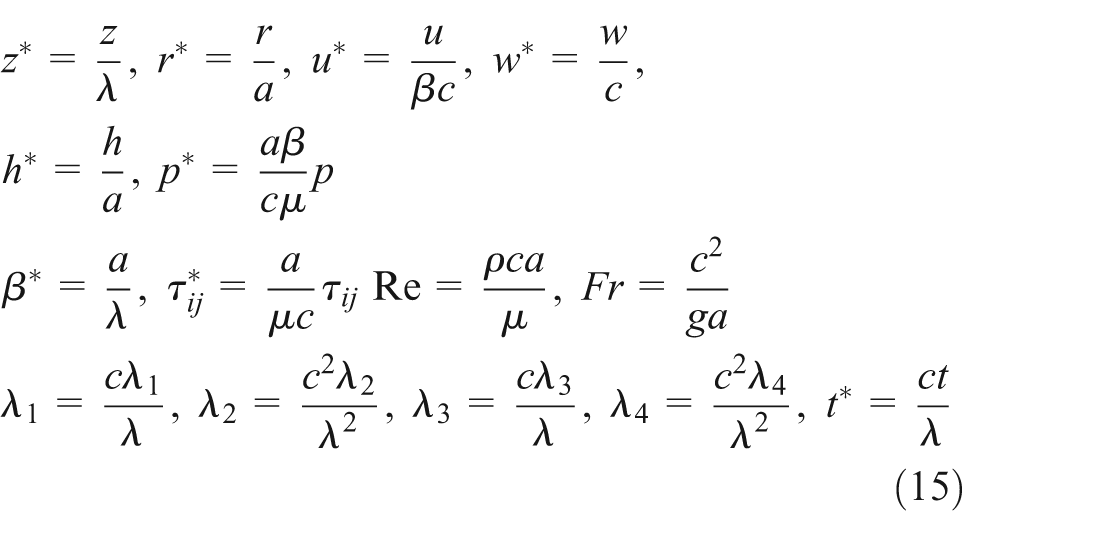
where is the density of the fluid, is the radial and is the axial velocity, is the pressure distribution, and is the gravitational constant. The following non-dimensional parameters can be introduced for further analysis
where and are the Reynolds number and fractional parameter, respectively. Incorporating the low Reynolds number and long-wavelength approximation,28equations (10) and (14) take the following non-dimensional form
which implies that and boundary and initial conditions are given as follows
where
and
where is the ratio of mean tube radius to the wavelength as defined in equation (15). Integrating equation (16) with respect to and using the condition (18), we get
Furthermore, integrating equation (23) and using the boundary condition (19) we have
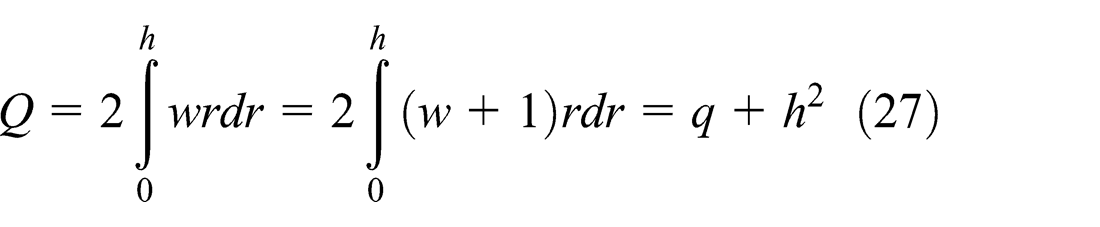
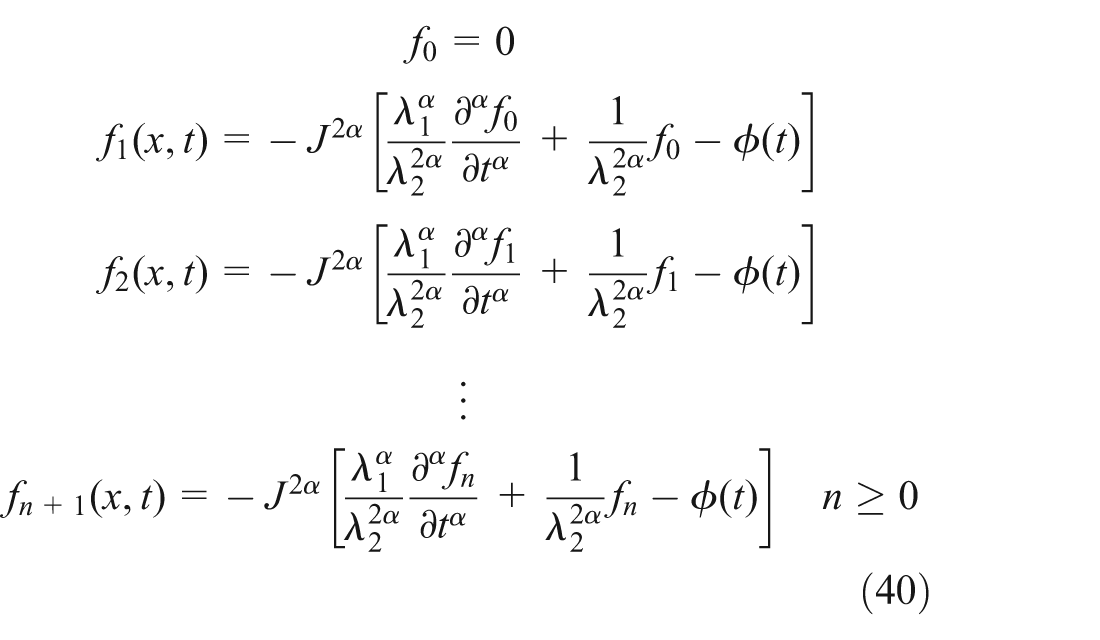
The Adomian decomposition method34,35 assumes the solution for in the following form
where are usually determined as follows
Thus, we obtain
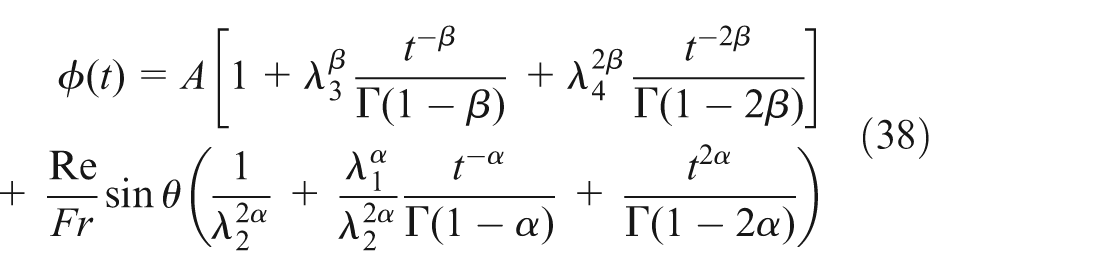
The other components can be obtained in a similar manner. Finally, the approximate solution of equation (39) can be calculated as follows
where
The pressure difference and the friction force are given as follows
Numerical results and discussion
The dynamics of the fluid flow in an inclined ciliated tube can be controlled by fractional parameters and ; cilia length ; material parameters , , , ; angle of inclination ; Reynolds number ; Froude number ; and time . The graphical representations of the results obtained for the pressure rise , pressure gradient , frictional force , and stream functions are observed in this section. Table 1 shows that the flow of fractional generalized Burgers’ fluid model requires the maximum frictional force as compared to the other fluid model, whereas minimum frictional force is observed in the fractional Oldroyd-B fluid flow. The magnitude of the pressure gradient is maximum in the Generalized Burgers’ fluid flow and least amount of pressure gradient is required in the fractional Oldroyd-B fluid model. The magnitude of the pressure difference in the Oldroyd-B fluid model is maximum, whereas the pressure difference is minimum in the generalized Burgers’ fluid flow.
Solutions of pressure rise, pressure gradient, and frictional force for different types of fluids.
Type of fluid model
Rheological properties
Pressure rise
Pressure gradient
Frictional force (F)
Fractional generalized Burgers’ fluid
−7.1268
−7.68644
12.2244
Generalized Burgers’ fluid
1.04579
−14.0676
9.91017
Fractional Burgers’ fluid
3.62293
−1.9542
3.46156
Burgers’ fluid
7.90151
−0.624569
0.209561
Fractional Oldroyd-B fluid
7.75994
0.251982
0.0889968
Oldroyd-B fluid
8.62497
0.794008
−0.814099
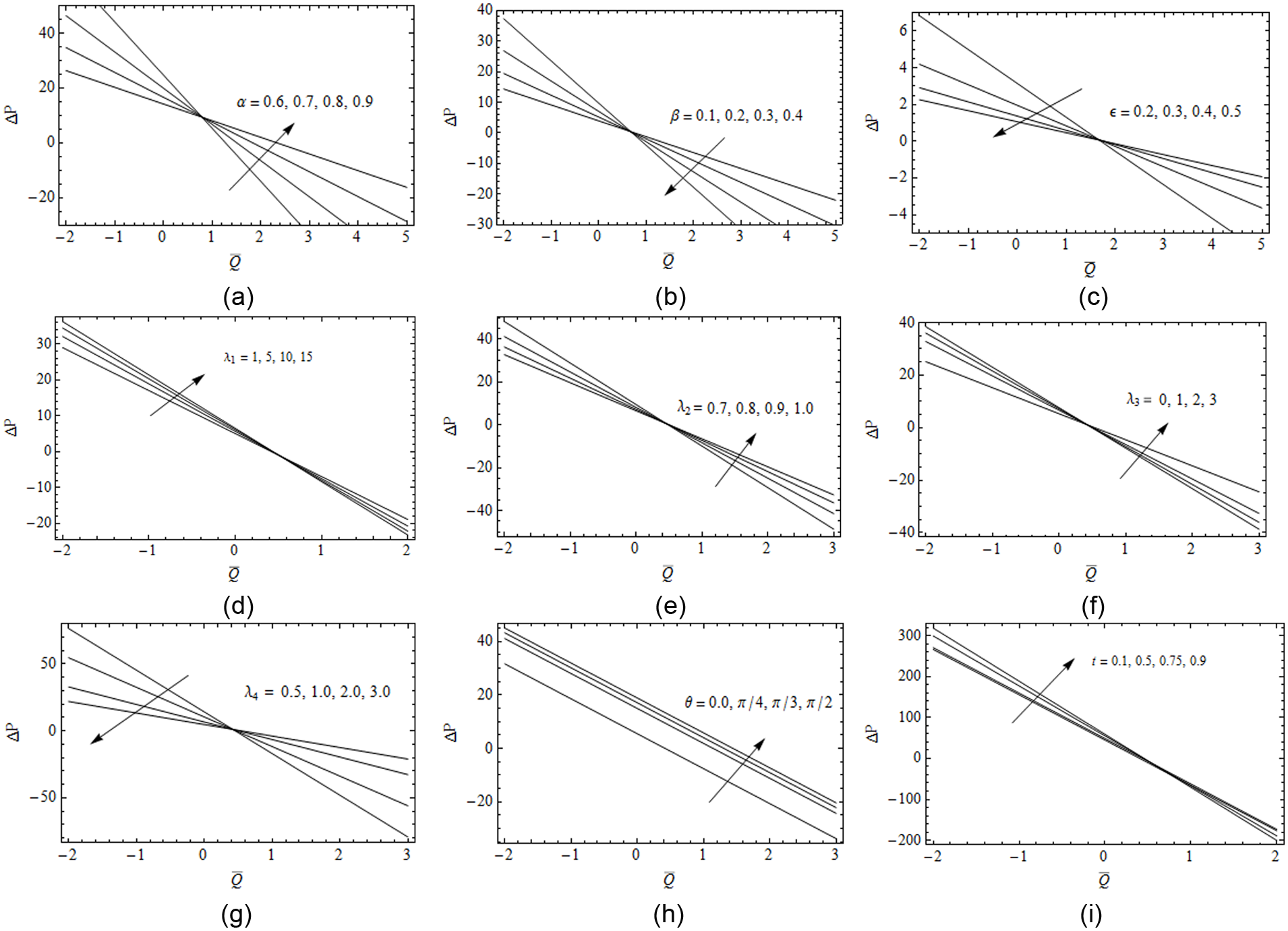
The variation of versus for different values of fractional parameters and ; cilia length ; Generalized Burgers Model (GBM) parameters , , , ; angle of inclination ; and time is examined in Figure 2(a)–(i). Keeping the other parameters fixed, that is, , , , , , , , , and , it is noted that pressure rise decreases with an increase in fractional parameters , cilia length parameter , and GBM parameters , , in the pumping region and a reverse behavior is observed in the copumping region , whereas in pumping region, pressure rise increases and in copumping region it decreases with the increase in fractional parameter , relaxation time , and local time . From Figure 2(h), it is observed that the pressure rise increases with increasing in the pumping region, but a reverse trend is noted in the copumping region. It is obvious that the increase in the orientation of tube from small inclination to the large inclination and finally to the right angle contributes for significantly large amount of the pressure difference. For the small values of Reynolds and Froude numbers, we refer to the work by Tripathi.36
Variation of versus for .
The variation in the pressure gradient for different values of fractional parameters and ; cilia length ; GBM parameters , , , ; angle of inclination ; and time is examined in Figure 3(a)–(i). It can be depicted that in the regions and , pressure gradient is small and fluid can flow easily without applying a large pressure gradient, but in the region , to maintain the same flux, a large amount of pressure gradient is required. It can also be seen that magnitude of pressure gradient increases with increasing fractional parameter ; cilia length ; retardation time , ; angle of inclination ; and time . It is noticed that the parameters , , , , , and provide the resistive force for the flow, therefore, large amount of pressure gradient is required for the fluid flow, whereas the parameters , , and provide the accelerating force for the flow, therefore, less amount of the pressure gradient is required for the fluid flow.
Variation of versus for .
It can be seen through Figure 4(a)–(h) that the frictional force varies linearly with increasing , , , , , , , and . It is noticed that frictional force tends to increase in magnitude with the increasing value of , , , , and , but the resistive force decreases in magnitude with increasing in the region . Also, the emerging parameter shows the opposite effects on the frictional force in the region . The frictional force increases in magnitude in the region with increasing tube inclination , but the reverse trend of frictional force is observed in the region , that is, the orientation of the tube provides the large amount of the friction force to resist the flow.
Variation of versus for .
Comparison of the generalized Burgers’ and fractional generalized Burgers’ model for the pressure difference, pressure gradient, and frictional force is presented in Figure 5(a)–(c). It is observed that the pressure difference is larger in fractional generalized Burgers’ model as compared with the generalized Burgers’ model for , and reverse behavior is observed for . Figure 5(b) shows that the large amount of pressure gradient is required to the fluid flow in the fractional generalized Burgers’ fluid as compared with the generalized Burgers’ fluid. From Figure 5(c), it is illustrated that the fractional generalized Burgers’ fluid provides the large amount of frictional force as compared with the generalized Burgers’ fluid. It is noted that the fractional generalized Burgers’ model is more viscous than the generalized Burgers’ model, and therefore, the resistive force increases in fractional generalized Burgers’ model.
Comparison of fractional generalized Burgers’ model and generalized Burgers’ model for (a) pressure rise , (b) pressure gradient , and (c) frictional force .
Figure 6(a)–(c) visualizes the pattern of streamline and trapping of average flow rate with the incremental increase in cilia length parameter . In these graphs, transformed radial component is in the vertical direction and transformed axial component is in the horizontal direction. The centerline symmetry divides the boluses of fluid particles circulating along closed streamlines. These boluses are trapped by the metachronal wave and move with the speed of metachronal wave. In Figure 6(a)–(c), keeping all quantities invariant, the effect of cilia length shows that the number and size of boluses increase with the increase in . Thus, the cilia length significantly affects the transport phenomena in bolus generation in an inclined tube.
Streamlines for different values of : (a) , (b) , and (c) .
Conclusion
In this article, ciliary motion of fractional generalized Burgers’ fluid in an inclined tube is studied. Analytic solution of the problem is obtained using the long-wavelength approximation. Pressure rise, pressure gradient, and streamlines are plotted for various values of emerging parameters, and the important findings of this study can be summarized as follows:
Pressure rise decreases with an increase in , , relaxation time , and retardation time , , whereas it increases by increasing in the pumping region and a reverse behavior is observed in the copumping region .
Pressure gradient is small in the regions and , but in the region , to maintain the same flux, a large amount of pressure gradient is required.
It is noticed that the parameters , , , , , and provide the large amount of pressure gradient, whereas the parameters , , and provide the less amount of the pressure gradient to the fluid flow.
The magnitude of frictional force increases in the region by increasing tube inclination , but the reverse trend is observed in the region .
The fractional generalized Burgers’ fluid provides the large amount of frictional force as compared with the generalized Burgers’ fluid.
Footnotes
Academic Editor: Kun Huang
Declaration of conflicting interests
The author(s) declared no potential conflicts of interest with respect to the research, authorship, and/or publication of this article.
Funding
The author(s) received no financial support for the research, authorship, and/or publication of this article.
References
1.
SleighMABlakeJRLironN. The propulsion of mucus by cilia. Am Rev Respir Dis1988; 137: 726–741.
2.
RodrigoJCorderoVLaugaE. Waving transport and propulsion in a generalized Newtonian fluid. J Non-Newton Fluid2013; 199: 37–50.
3.
MaitiSPandeySK. Rheological fluid motion in tube by metachronal wave of cilia. ArXiv:1308.3608 [physics.flu-dyn], 2013, https://arxiv.org/abs/1308.3608
4.
GuiraoBJoannYJF. Spontaneous creation of macroscopic flow and metachronal waves in an array of cilia. Bio Phy J2007; 92: 1900–1917.
5.
ResnickA. Mechanical properties of a primary cilium as measured by resonant oscillation. Bio Phy J2015; 109: 18–25.
6.
GueronSGurevichKL. Computation of the internal forces in cilia: application to ciliary motion: the effects of viscosity, and cilia interactions. Bio Phy J1998; 74: 1658–1676.
7.
LindemannCBLesichKA. Flagellar and ciliary beating: the proven and the possible. J Cell Sci2010; 123: 519–528.
8.
TallonIIHeintzNOmranH. To beat or not to beat: roles of cilia in development and disease. Hum Mol Genet2003; 12: R27.
9.
BrennenCWinetH. Fluid mechanics of propulsion by cilia and flagella. Ann Rev Fluid Mech1977; 9: 339–398.
10.
LardnerTJShackWJ. Cilia transport. Bull Math Biol1972; 34: 325–335.
11.
DauptainAFavierJBottaroA. Hydrodynamics of ciliary propulsion. J Fluid Struct2008; 24: 1156–1165.
12.
BlakeJR. A model for the micro-structure in ciliated organisms. J Fluid Mech1972; 55: 1–23.
13.
MillerCE. Streamlines, streaklines and particle path lines associated with a mechanically induced flow holomorphic with the mammalian mucociliary system. Biorheology1969; 6: 127–135.
14.
BartonCRaynorS. Analytical investigation of cilia-induced mucous flow. B Math Biophys1967; 29: 419–428.
15.
MaqboolKShaheenSMannAB. Exact solution of cilia induced flow of a Jeffrey fluid in an inclined tube. SpringerPlus2016; 5: 1379.
16.
SiddiquiAMFarooqAARanaMA. Study of MHD effects on the cilia-induced flow of a Newtonian fluid through a cylindrical tube. MHD2014; 50: 249–261.
17.
SiddiquiAMFarooqAARanaMA. An investigation of non-Newtonian fluid flow due to metachronal beating of cilia in a tube. Int J Biomath2015; 8: 1550016 (23 pp.).
TripathiDPandeySKDasS. Peristaltic transport of a generalized Burgers’ fluid: application to the movement of chyme in small intestine. Acta Astronaut2011; 69: 30–38.
20.
TripathiDBégOA. Peristaltic propulsion of generalized Burgers’ fluids through a non-uniform porous medium: a study of chyme dynamics through the diseased intestine. Math Biosci2014; 248: 67–77.
21.
TripathiD. Numerical study on creeping flow of Burgers’ fluids through a peristaltic tube. J Fluid Eng: T ASME2011; 133: 121104 (9 pp.).
22.
TanWPanWXuM. A note on unsteady flows of a viscoelastic fluid with the fractional Maxwell model between two parallel plates. Int J Nonlin Mech2003; 38: 645–650.
23.
ArshadSSohailAMaqboolK. Nonlinear shallow water waves: a fractional order approach. Alex Eng J2016; 55: 525–532.
24.
YangDIZhuKQ. Start-up flow of a viscoelastic fluid in a pipe with fractional Maxwell’s model. Comput Math Appl2010; 60: 2231–2238.
25.
MaqboolKBegOASohailA. Analytical solutions for wall slip effects on magnetohydrodynamic oscillatory rotating plate and channel flows in porous media using a fractional Burgers’ viscoelastic model. Eur Phys J Plus2016; 131: 140.
26.
OldhamKBSpanierJ. The fractional calculus. New York: Academic Press, 1974.
27.
Al SaadiMMHabibSSAl MuqhemBAet al. Significance of fractional exhaled nitric oxide measurements in detecting primary ciliary dyskinesia in Saudi children. Saudi Med J2013; 34: 24–28.
28.
ShapiroAHJaffrinMYWeinbergSL. Peristaltic pumping with long wavelength at low Reynolds number. J Fluid Mech1969; 37: 799–825.
29.
HilferR. Applications of fractional calculus in physics. River Edge, NJ: World Scientific Publishing, 2000.
30.
DebnathLBhattaD. Integral transforms and their applications. 3rd ed.Boca Raton, FL: CRC Press, 2014.
31.
SleighMA. Patterns of ciliary beating, in aspects of cell motility. In: Proceedings of the 22nd symposium of the society for experimental biology, San Diego, CA, 1968, pp.131–150. New York: Academic Press.
32.
SiddiquiAMHaroonTRaniMet al. An analysis of the flow of a power law fluid due to ciliary motion in an infinite channel. J Biorheo2010; 24: 56–69.
33.
AkbarNSKhanZHNadeemS. Influence of magnetic field and slip on Jeffrey fluid in a ciliated symmetric channel with metachronal wave pattern. J Appl Fluid Mech2016; 9: 565–572.
34.
AdomianG. Solving frontier problems of physics: the decomposition method. Dordrecht: Kluwer Academic Publishers, 1994.
35.
BabolianEBiazarJ. Solution of nonlinear equations by modified Adomian decomposition method. Appl Math Comput2002; 132: 167–172.
36.
TripathiD. A mathematical model for the peristaltic flow of chyme movement in small intestine. Math Biosci2011; 233: 90–97.