




Abstract
The implementation of green logistics can reduce increasingly serious environmental damage while improving the operating efficiency of logistics enterprises. In this article, through quantitative calculation of logistics negative external costs, including traffic accidents, atmospheric pollution, noise pollution, and pollution caused by packaging, we build accounting standards to calculate the negative external costs of logistics enterprises that generate pollution mainly from transportation and packaging. Then, assuming the impetus provided by the government implementing incentive mechanisms in a free market economy, we establish a “Logistics Negative External Cost Internalization” model. This model quantitatively analyzes the relationships among freight rate, freight volume, investment of enterprise for implementing green logistics, and the subsidies given by government, under the comparison of the two modes “enterprise operates first” and “government subsidizes first.” The results show that the introduction of the “government subsidizes first” incentive mechanism and increasing freight rate are helpful in promoting the process of logistics market greening.
Keywords
Introduction
The value created by logistics occupies an important position in China’s national economy. From 2000 to 2015, the average annual growth rate of China’s social logistics was about 20%, far greater than the growth of the national economy. As the natural environmental destruction caused by logistics is worsening, China and other countries around the world have developed corresponding cost accounting standards and analysis patterns for their own logistics industries. However, the damage to the ecological environment and natural resources produced in logistics activities has not been included in these logistics cost accounting systems. Researchers have carried out a great deal of work on the negative external impacts of logistics, basing much of this research on studies of the negative impacts on the environment. Research into the external cost of logistics is mainly focused on transportation, and the mechanism of internalizing external cost is mainly focused on the implementation of taxation.
Currently, scholars are demonstrating the necessity of internalizing the negative external cost of logistics from various aspects. The vast majority of them either theoretically or qualitatively analyze the issue of negative external cost internalization of logistics.
The author has analyzed the externality cost of traffic congestion and constructed a congestion tax model after analyzing and calculating the social net income of various road users. 1 Van Woensel et al. 2 quantified the dynamic impact of road vehicles on the environment and suggested that a model built at a constant speed on a particular road could allow for an assessment of emissions and a more effective measure of cost and negative impacts. Kawase et al. 3 have pointed out that Japan has enacted a new environmental tax plan in 2004 in which it is regulated that residents of every household in Japan will be subject to annual environmental taxes of 3000 yen. Jakob noticed that although negative external costs are taken into account, they are difficult to calculate. He used New Zealand as an example to calculate the total cost of private transport and public transport and evaluated the externalities and internalities of the transportation costs. 4 Lemp and Kockelman 5 analyzed and estimated the source of the negative external cost in transport, the results showing that the external cost of light trucks is much higher than that of passenger cars. Lee et al. 6 taking the Large-Scale Network in the Asia-Pacific Region as a case study have proposed the design of a sustainable logistics network based on stochastic programming in an uncertain environment, but only minimized the total cost of logistics. To incorporate environmental management into everyday decision-making, Ubeda et al. 7 introduced variables in the vehicle minimization path that satisfy green criteria while also meeting efficiency goals. Scholars such as Marchet have researched and compiled a number of related articles in which the significance of sustainable development in logistics enterprise decision-making is discussed. However, most of the research in Marchet’s compendium was mainly based on case analysis and investigation and rarely involved simulation analysis and modeling research. 8 Lui 9 analyzed the necessity of calculating and including negative externalities into total costs and established a distribution network design model with consideration of negative externalities produced by distribution transportation. Mesa-Arango and Ukkusuri 10 researched the benefits of in-vehicle consolidation in increasing truck payload utilization, as well as reducing the negative externalities caused by freight transportation. Africa’s externality costs were included in a logistics measurement system, when Havenga discussed this issue and found that transport costs suffer a great pressure from the oil price and the internalization of externality costs. Havenga also established a logistics costs model incorporating externality costs based on a gravity-oriented freight flow model, where it was found that national logistics costs can be reduced more easily as compared to company-level logistics on the condition of good coordination of company-level transport. 11 Lera-Lopez et al. 12 adopted both double-hurdle and Moulton’s models to evaluate the willingness of populations who live next to roads to pay for the negative externality costs generated by logistics activities. Fumasoli et al. 13 established an impact model to determine the effects of the characteristics of freight trains on capacity consumption in mixed traffic railway networks, and the result shows that the use of freight trains can reduce the relative capacity consumption of freight trains and can reduce freight transport negative externalities. Meersman et al. 14 analyzed how to mitigate negative externalities associated with land-based transport by taking a micro-research approach and proved that road pricing has a potential impact on the cost function of logistics.
Table 1 provides a summary of representative papers on reducing negative external costs to society that most related to our work, which implies that there is no study considering both logistics negative costs calculation and internalization even though it is necessary and inevitable.
A summary of reducing negative external costs most related to our work.

The cost consumptions of logistics activities can be truly reflected, as we figure the damage caused by logistics activities on the environment and natural resources into the logistics cost accounting system. Nevertheless, logistics negative externalities have not been quantitatively accounted for, since there are a variety of factors contributing to them and the statistics are hard to come by. Therefore, there are a significant number of enterprises operating with high pollution and high emissions despite repeated prohibitions, complicating the process of environmental governance.
Approaches to reducing logistics externalities mainly include laws, regulations, taxation, finance, fiscal subsidies, and logistics technology standards, with their rich theory and lesser amount of quantitative analysis. Thus, in this article, taking logistics enterprises as a case, we quantitatively calculate the negative external costs and analyze the incentive mechanism quantifiably. In the case of government incentive mechanisms, we establish a model with two modes, including “enterprise operates first” and “government subsidizes first,” and account for the negative externalities of logistics enterprises in which freight is the main business.
The remainder of the article is arranged as follows. Section “Negative external costs accounting” presents accounting standards to calculate negative external costs of logistics enterprises. Section “Models” builds a model for internalizing logistics negative external cost. Next, section “Proposed research framework” gives the framework of the proposed research. Combined with logistics enterprises of ChangChun, section “Model verification and discussion” verifies and discusses the proposed research. Research conclusions along with limitations and scope for future work are presented in section “Conclusion.”
Negative external costs accounting
Marshall and Pigou put forward the concept of externality in the early 20th century. As applied in the field of logistics, “externality” mainly refers to the fact that logistics activities additionally have negative impacts on other individuals’ interests. The negative externalities of transportation and distribution generally include varied damage, such as pollution emissions produced by conveyances, noise, traffic jams, and accidents. The negative externalities of warehousing mainly embody the environmental pollution arising from bad warehouse management, including toxic and harmful gases leaking and the damage or rot of cargoes. Negative externalities of handling and hauling that are caused by the operation of related machineries include noise, dust, and waste. Packaging negative externalities usually refer to white pollution caused by packaging materials and resources wasted because of excessive packaging. But due to the imperfection of current statistical accounting systems, enterprises have usually not taken the responsibility for these non-market costs, and thus, it is extremely difficult for logistics markets to optimize resource allocation.
According to negative external logistics cost quantitative calculations, enterprises can set freight rate reasonably, and the government can formulate appropriate environmental policies as well. This can impel enterprises to take on their corresponding social responsibilities. In this article, the negative external logistics cost accounting is divided into air pollution cost accounting, traffic accident cost accounting, traffic congestion cost accounting, noise pollution cost accounting, and negative external cost accounting of packaging.
Air pollution cost accounting
This article selected the freight transport enterprise and only considered freight vehicle emissions. By improving X Baoqiang’s 15 calculation formula of road transport emissions, the freight vehicle emissions calculation formula can be obtained

where k represents the different pollutant categories (k = 1, 2, 3, these pollutants being CO, NOX, and CH), i for the vehicle type (i = 1, 2, …, n),
Different types of vehicle emission factors.

We use the atmospheric pollution discharge standards in regulation of discharge pollutant standards of China for reference; 16 the air pollution negative external cost calculation formula is

where
Traffic accident cost accounting
The current measurements of traffic accident cost include the “traffic accident model” and “accident comprehensive economic loss measurement model.” 17 This article comprehensively considered the research achievements of predecessors and data availability and then adopted the improved method of “willingness to pay.” The traffic accident cost calculation formula is

where

where
Noise pollution cost accounting
The impact of traffic noise is extensive and difficult to calculate; thus, it is hard to calculate the loss caused by noise pollution. With reference to the European average noise pollution cost, the calculation formula for the average noise pollution cost of China is 20

where
Traffic congestion cost accounting
Now traffic congestion cost accounting is usually concentrated on urban road passenger transport, but we focus on highway freight transportation. Therefore, traffic congestion loss in urban distribution is ignored in this article.
Negative external cost accounting of packaging
As the materials of logistics packaging mainly consist of plastics, wood packing, and polyfoam, this article employs defensive expenditures to calculate the processing cost of the discarded packaging materials. 21 The calculation formula is

where
To sum up, this article takes C to represent the logistics negative external costs of freight transport enterprise, the calculation formula for C being

Models
Enterprises prefer lower costs, a fact that hinders the implementation of high-cost green logistics. Only when the government regulates the economy, we can solve the question of market failure in developing green logistics. To encourage enterprises to adopt green logistics, we internalize the cost of logistics negative external cost and then analyze the incentive mechanism under government intervention.
Problem description
Assumptions of the model
There are two kinds of full-scale enterprises, enterprises x and enterprises y, of which enterprises x are green logistics enterprises and enterprises y are traditional logistics enterprises, both in the condition of a perfectly competitive market. The amounts of environmental taxation and government subsidies are calculated according to the logistics negative external cost. Also, government administration costs are ignored, which means all environmental taxations from enterprises y collected by the government are subsidies going to enterprises x for implementing green logistics. The production of freight transportation satisfies the production function of “Cobb-Douglas,” under the circumstance that pursuing maximum economic benefit is the target of all enterprises.
Parameter specification
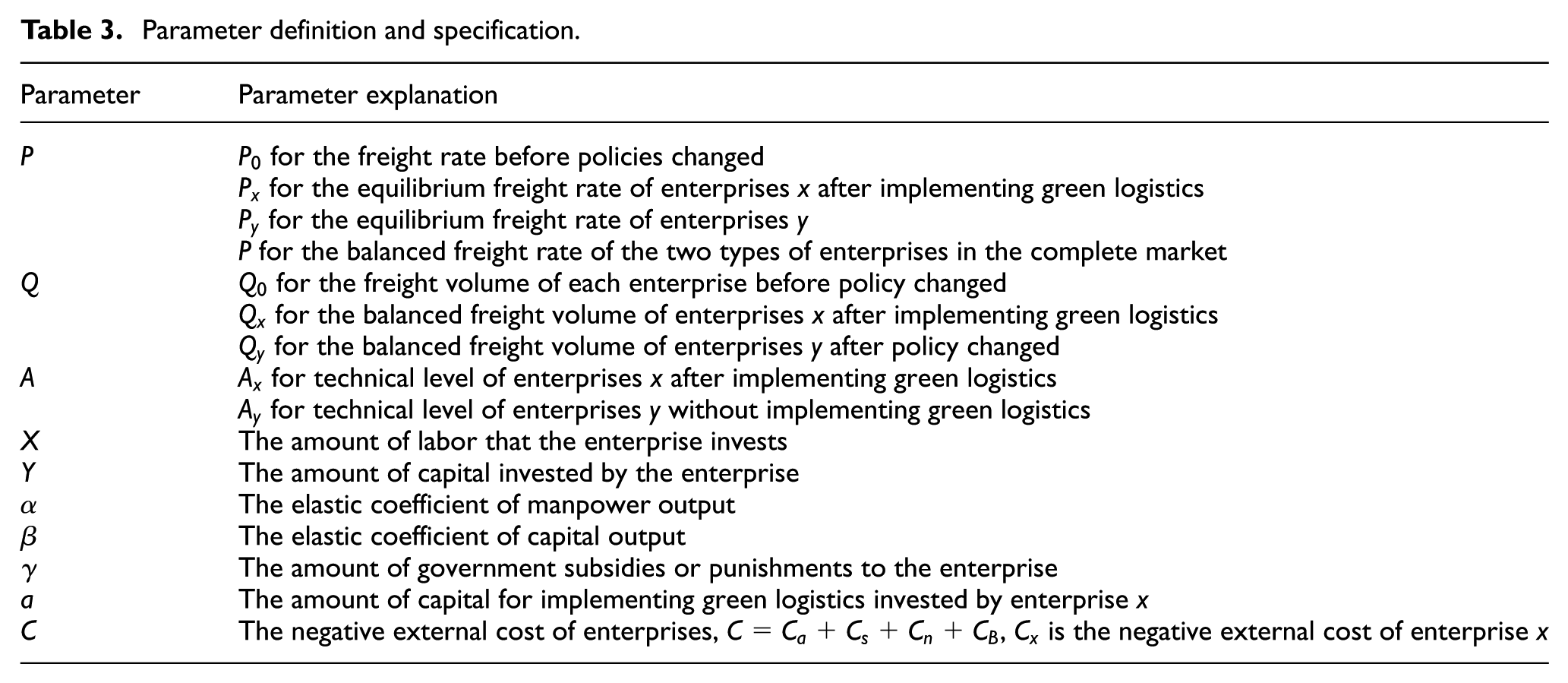
All parameters of the model refer to Table 3.
Parameter definition and specification.
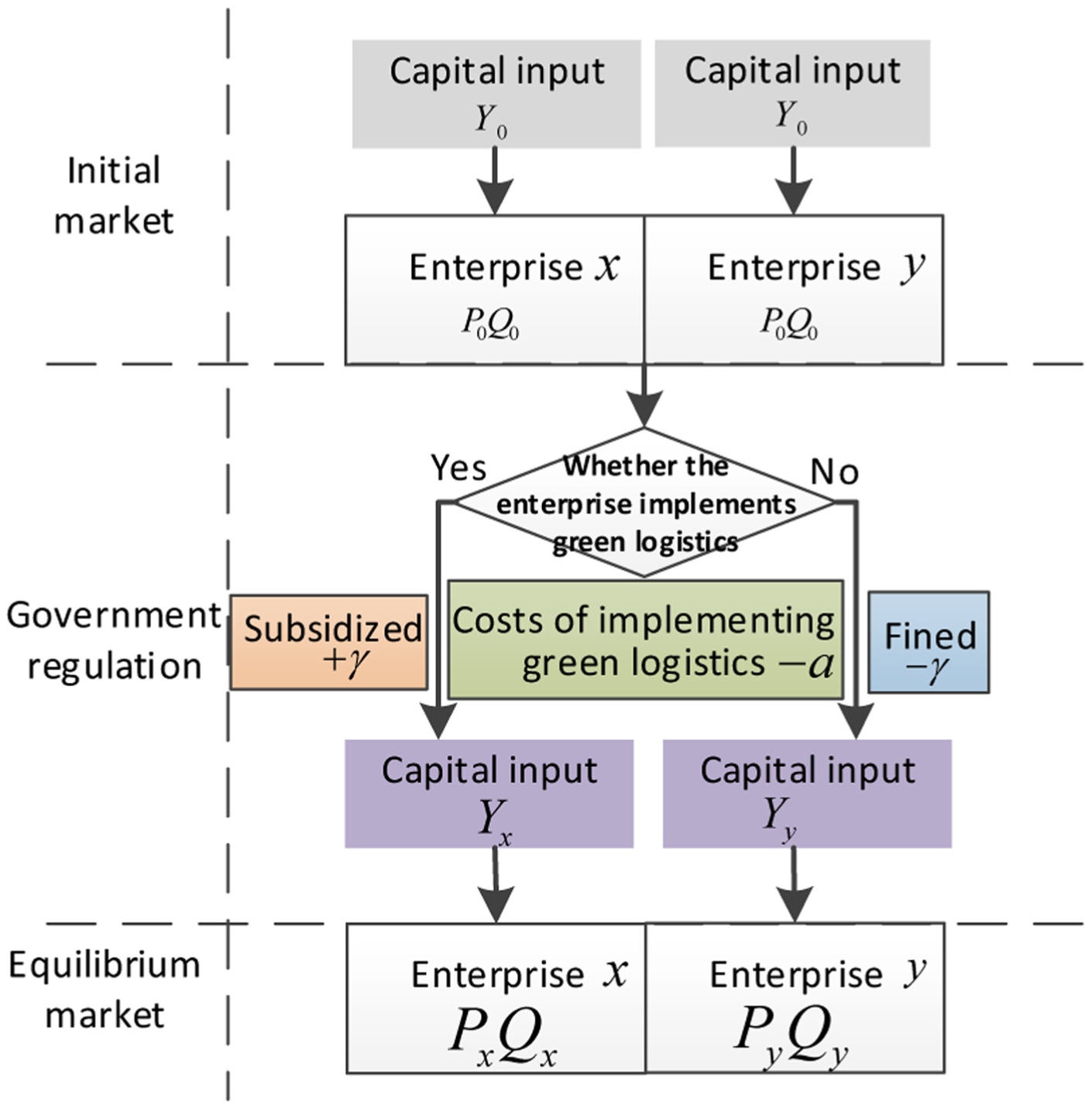
Scheme of model establishment
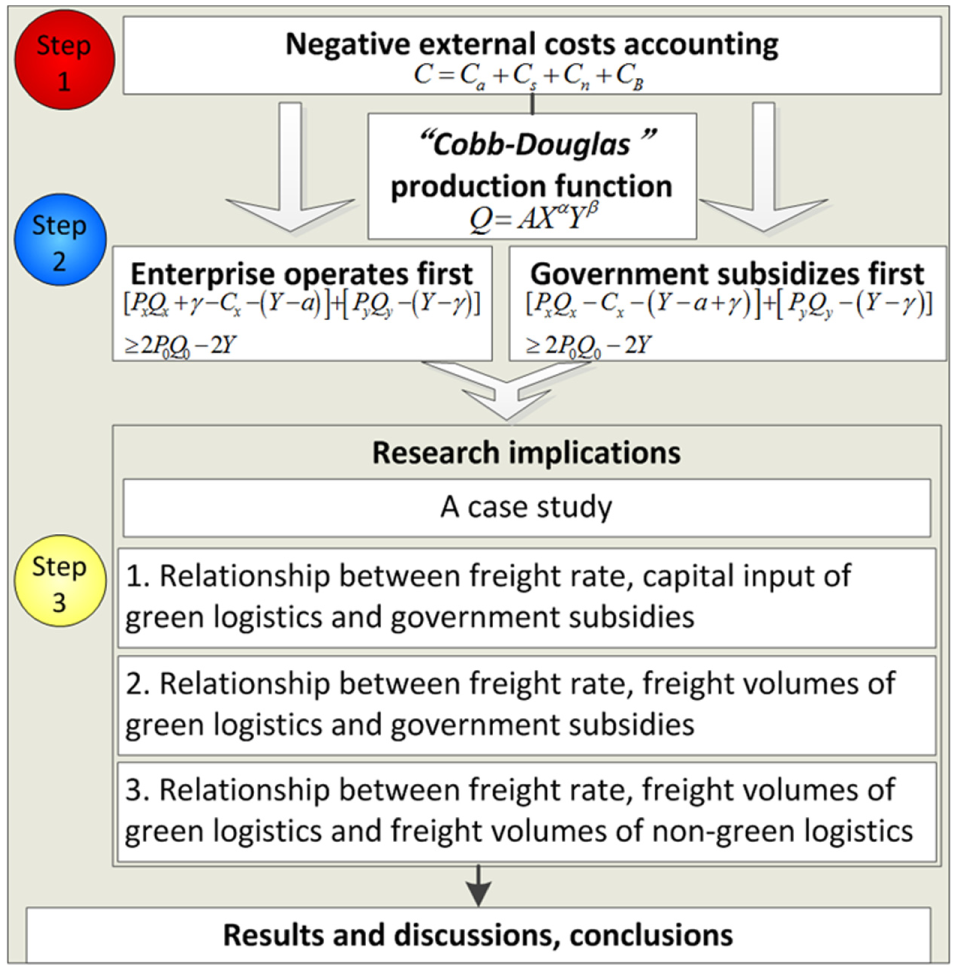
Figure 1 shows the framework of this article: how to construct the internalization of the external cost model. According to the assumptions and under the regulation of government, the two types of enterprises x and enterprises y maneuver in a perfect competitive environment, finally leading to an equilibrium freight rate.
Model specification of negative external costs internalization.
Model establishment
The priority that government assigns in the distribution of subsidies to enterprises determines the two modes of the logistics negative external cost internalizing model: “enterprise operates first” and “government subsidizes first.”
Enterprise operates first
In this mode, enterprise x invests a yuan into implementing green logistics, so that the capital for enterprise operation is

After compilation and transition, the critical function is given by

Freight volume Q meets the “Cobb-Douglas” production function, that is,
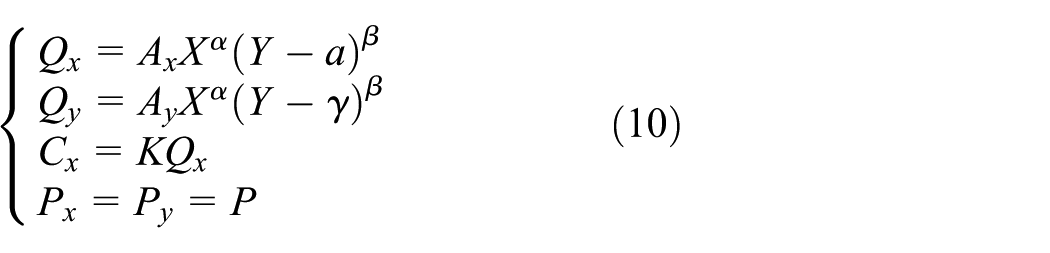
By combining equations (9) and (10), the relationship among P, a, and

Reforming the formula

Then, according to equations (9), (10), and (12), the relationship among P,

Reforming the formula

Then, according to equations (9), (13), and (14), the relationship among P,

Government subsidizes first
In this mode, when enterprise x invests a yuan in implementing green logistics, and gain government subsidies of

After compilation and transition, the critical function is given by

The relationship between freight volume and freight rate can be expressed by

Combining equations (17) and (18), the relationship among P, a, and

Just as in equation (13), the relationship among P,

Also, as in equation (15), the relationship among P,
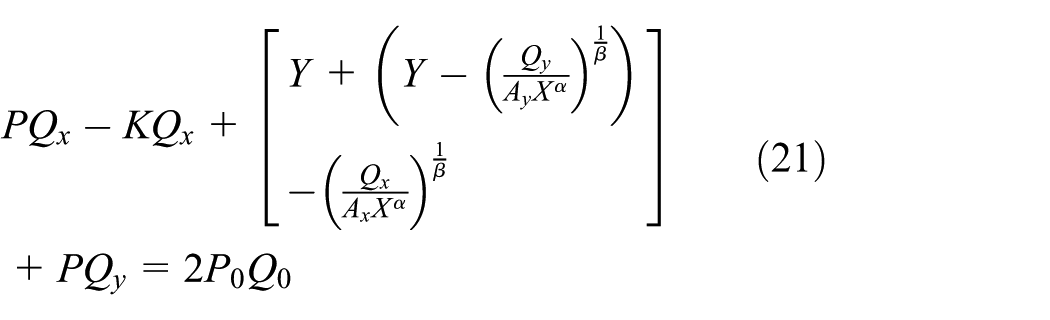
Based on the model established above, we can analyze the mutual influencing relationships among P, a,
Proposed research framework
The research framework for internalizing the negative external cost of green logistics and incentive mechanism is based on accounting all costs of logistics enterprises and analyzing the relationship between variables. A general methodology is shown in Figure 2.
Proposed research framework.
Model verification and discussion
Case introduction
A certain logistics enterprise of ChangChun provides distribution services, the main business being to transport headlights of cars for car factories. The enterprise has a staff of 200, with 2 million yuan operating investment, and the annual freight volume is 46 million t km. According to vehicle type, the operating fees are shown in Table 4.
Operating costs of the logistics enterprise.
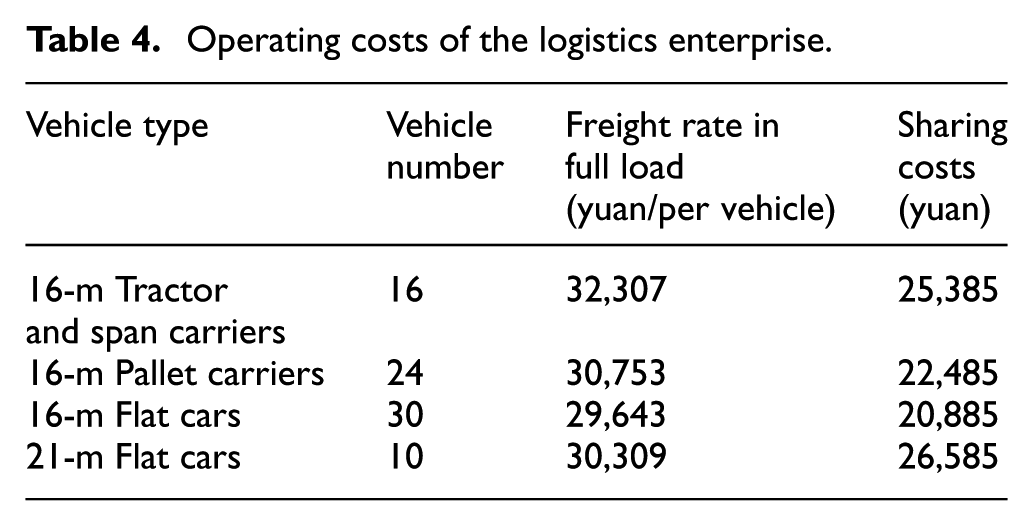
In this article, we take the average freight rate of the different type of trucks; the average freight rate is 0.59 yuan per t km. The distance between area 1 and area 2 is 3000 km, and a full load is carried from area 1 to area 2. The packaging material, which is removed in area 2, is returned to area 1. The transport mode is truck-load, with vehicles and transportation details as shown in Table 5.
Operation expenses of the enterprise.

Negative external costs accounting
After computation, the air pollution cost is 1.2 × 10⁻² Q yuan, the traffic accident cost is 1.96 × 10⁻² Q yuan, the noise pollution cost is 16.29 Q yuan, and the traffic congestion cost is 1.78 × 10⁻² Q yuan. Eventually, according to equation (7), the total external cost of the enterprise is 16.33 Q yuan.
Analyzing the model
According to the data of operation and benefits of the enterprise, we fitted out the production function of the enterprise

we assumed that the technical level of the enterprise can be improved by 5% after implementing green logistics; then, the value of
Based on the negative external costs internalization model, corresponding functions are deduced and then discussed.
The initial Q is 46 million t km, and the freight rate is 0.59 yuan per t km. Assuming that the market demand is always greater than the supply, with given a and
Situation under different investments in green logistics and government subsidies.
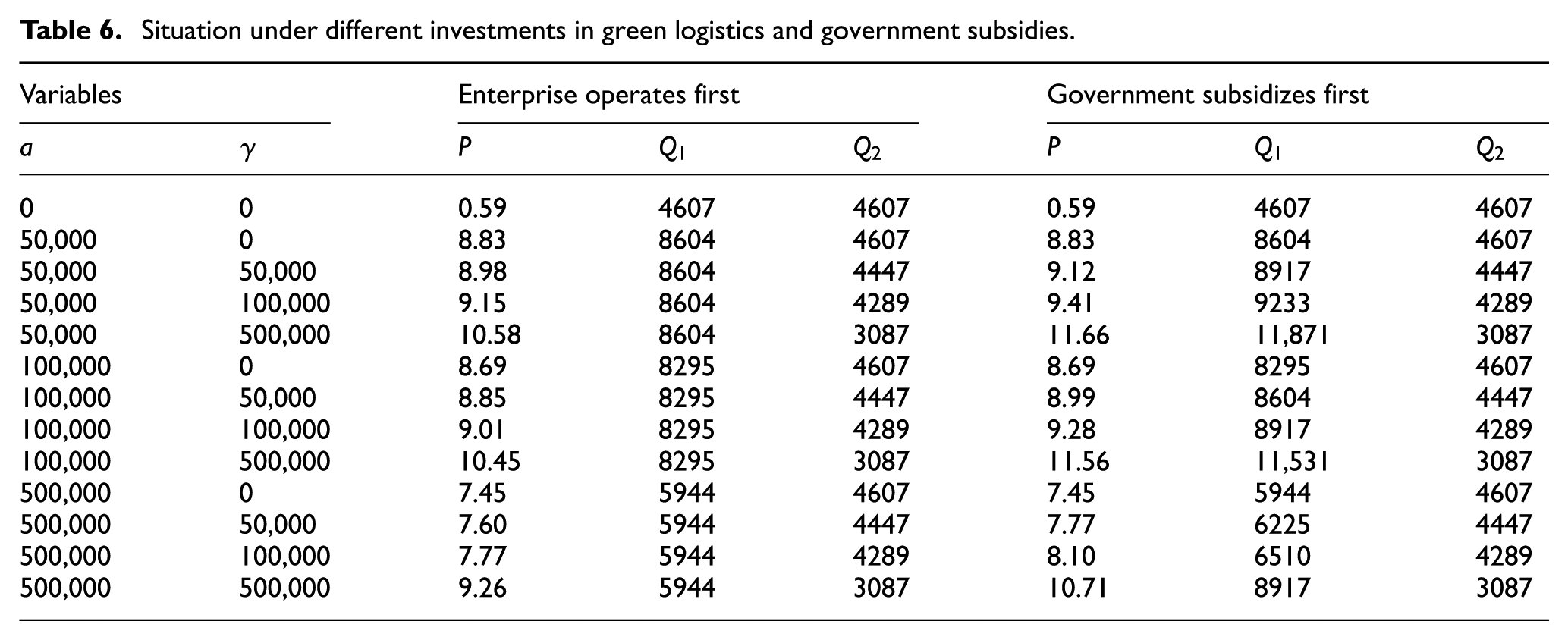
From Table 6, when we internalize the negative external costs, to ensure that the total profit is bigger than 0, the freight rate has increased from 0.59 to 8.83, and green volume has increased as well. The reason is that the total external cost is huge and investment in green logistics promotes the production of the green freight volume. With the increase of investments in green logistics, freight rate has a remarkable reduction. But when subsidies or punishment increased, the freight rate is increased. For the sake of implementing green logistics, here, we recommend higher subsidies and investments in green logistics, although the costs are a higher freight rate and lower freight volume.
Compared to “enterprise operates first” and “government subsidizes first,” we should weigh the freight rate and the freight volume. With comprehensive consideration in this article, the solution is 500,000 subsidies and 500,000 investments in green logistics in the “government subsidies first” mode.
To further research the changes above, this article mainly employs graphs to analyze the relationships among investments in green logistics, government subsidies, freight rate, and the freight volume of enterprises. In the graph, the full line represents “government subsidizes first,” and the dotted line represents “enterprise operates first.”
Analysis of the relationships among freight rate P, capital input of green logistics a, and government subsidies
When the freight rate P stays the same, for an enterprise bearing relatively high external costs and to ensure the actual meaning of the function, we set the freight rate P to be 17, 19, and 21 in the situation “government subsidizes first” and take 5, 17, 19, and 21 as P in the situation “enterprise operates first.” Then, the relationship between the investment in green logistics and government subsidies is shown in Figure 3.
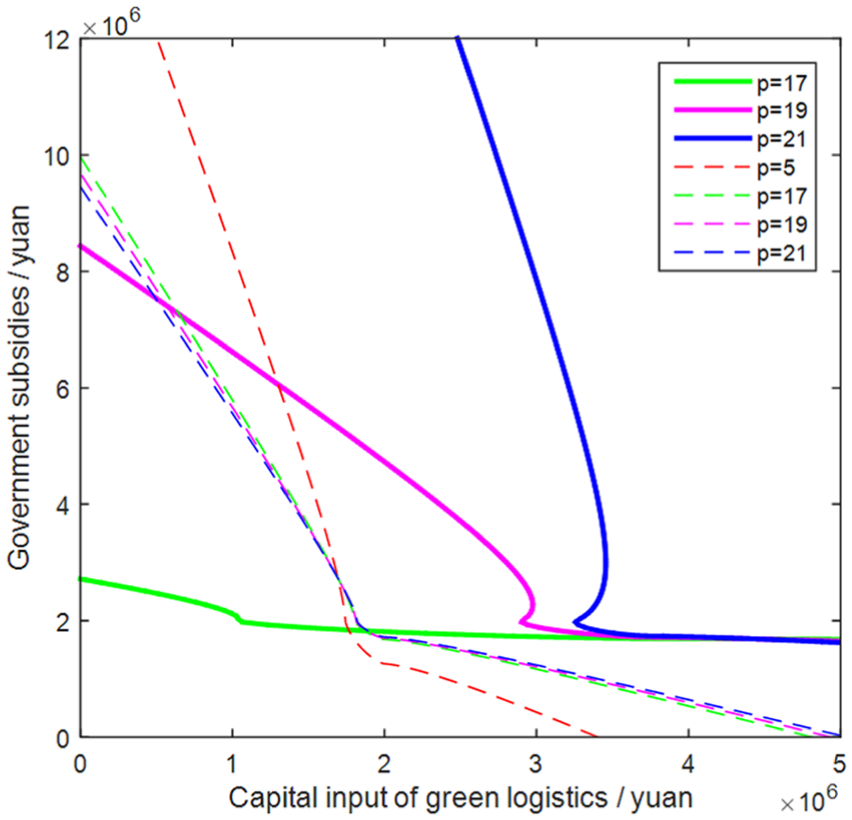
Relationship between a and
From the curve tendencies for the two modes in Figure 3, we know that market equilibrium can be achieved more quickly in the “government subsidizes first” mode with lower freight rate. At the initial stage of achieving market equilibrium, enterprises have to bear all the negative external cost after the implementation of green logistics. This means the total cost of an enterprise is higher; thus, the enterprise needs plenty of subsidies from government. But with the increase of capital invested in implementing green logistics, enterprise negative external costs are cut. And when the investment amount is reduced to the inflection point in the graph at a constant rate, the government subsidy rate will gradually slow with the increase in green logistics investment amounts. The result is that finally all enterprises in the market will implement green logistics and the government does not need to give subsidies or impose fines.
According to Figure 4, under the mode “government subsidizes first,” the freight rate changes faster in an early-stage market and tends to stabilize around 17, and the high freight rate is because of the high negative external costs. With the increase of government subsidies, the freight rate changes rapidly under the mode “enterprise operates first,” and if the government subsidies are low, the freight rate in the market will rise and stay higher. Otherwise, if the government subsidies increase to a certain point, then the freight rate in the market will start to move down.

Relationship between
Figure 5 shows that when the government subsidies stay the same, the freight rate of the mode “enterprise operates first” is lower on the occasion of the same investment in green logistics. In the mode “government subsidizes first,” there is more investment in green logistics when the freight rate stays the same. The figure can be explained in this way: when the government subsidies stay the same, enterprises need to implement green logistics, so the freight rate in the market will rise to a higher level in a short time. With the improvement of green logistics investment, the technology of the enterprise is improved as well, so the negative external cost of the enterprise and the freight rate are gradually reduced too.
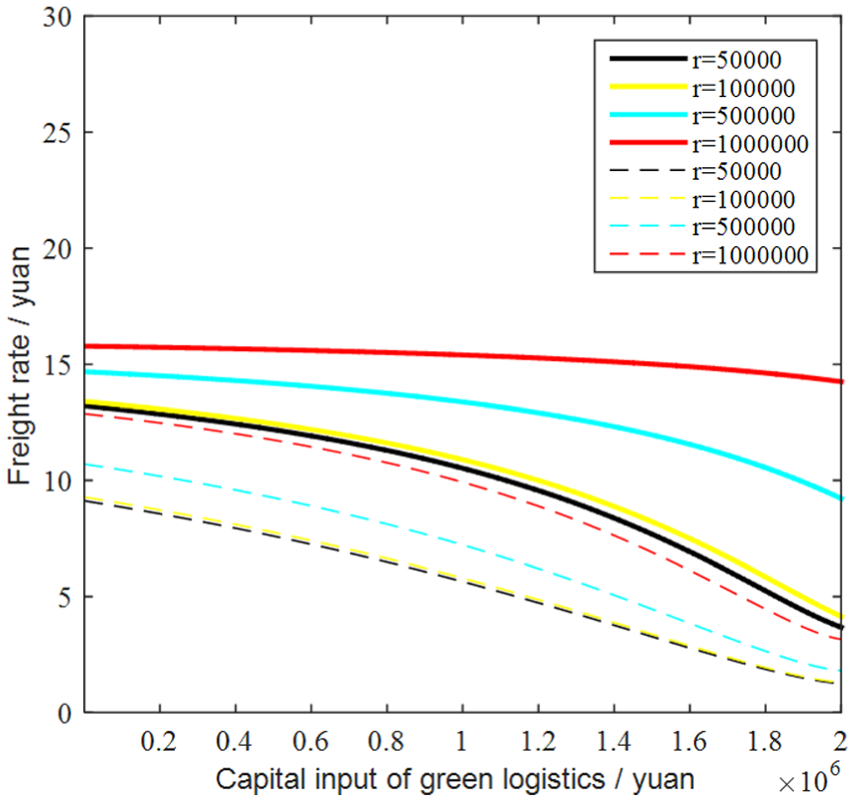
Relationship between a and P under certain
Analysis of relationships among freight rate P, freight volume of green logistics
, and government subsidies
According to Figures 6–8, the fact that almost the same curve results in the two modes means that the relationships among freight rate, freight volume, and government subsidies are nearly the same. The curve’s trend can be explained thus: as the negative external costs increase with the increase of transport freight volume, increased freight volume and high green logistics, costs will lead to a higher freight rate and require more government subsidies.
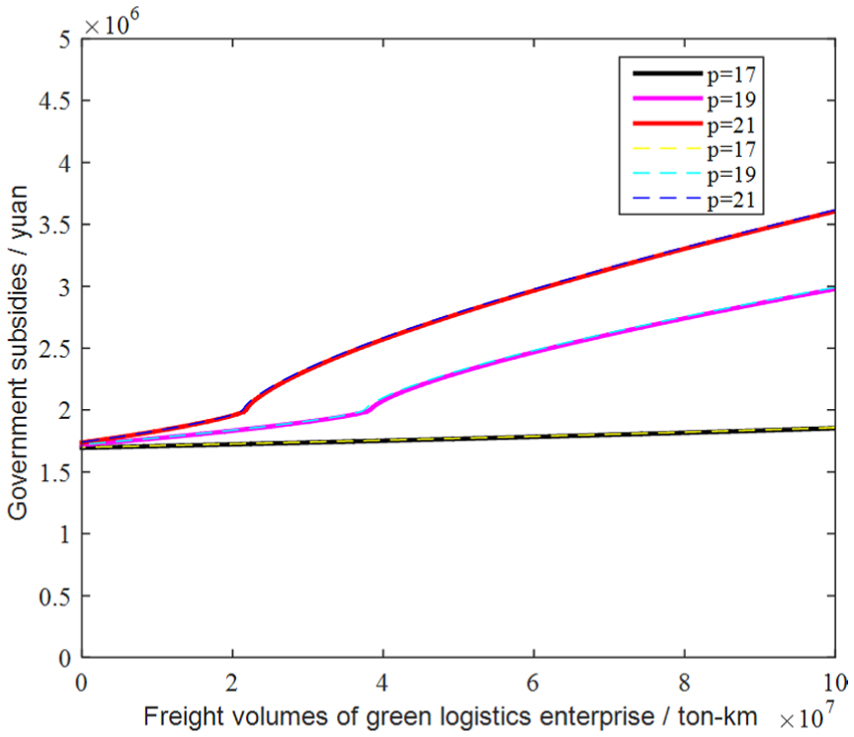
Relationship between

Relationship between

Relationship between
Analysis of the relationships between freight rate P, freight volume of green logistics
, and freight volume of non-green logistics
According to Figure 9, the changing trend of freight volume of the two modes is the same, but the total freight volume of the mode “government subsidizes first” is larger. With the freight volume of green logistics enterprises increasing, the freight volume of non-green logistics enterprises is reduced. This means that if we expect more enterprises to implement green logistics, the government should subsidize more, so that the total freight volume of green logistics enterprises can be improved.

Relationship between
Conclusion
The internalization of the negative external cost model, taking transport enterprises as an example, compares many aspects, such as transport freight rate, the total amount of traffic, the cost of green logistics, and the rewards and punishment of government, and uses functions and graphics to analyze the interaction of all these factors clearly and intuitively. Combining the information of a logistics transport enterprise, this article calculates the negative external cost of the enterprise’s logistics activities. Through the comparison of two incentive models “enterprise operates first” and “government subsidizes first,” the model “government subsidizes first” will have a more positive effect in promoting green logistics and will be beneficial to the stability of the market freight rate. However, in this mode, the government’s rewards and punishments cannot lower the transport freight rate enough, and finally, the market freight rate will remain at a high level. As for the effect of improving the green logistics enterprise’s competitiveness, “government subsidizes first” is better than “enterprise operates first” because the negative external cost of logistics will be higher along with the freight volume, so that a large amount of money is needed to eliminate the negative externalities. With high government subsidies in the mode “government subsidizes first,” a green logistics enterprise will gain a higher return on investment because of higher overall investment. Last but not least, as the logistics negative externalities are difficult to eliminate thoroughly, green logistics enterprises can efficiently reduce their negative externalities by improving freight rate properly.
The model we established follows market economic patterns by calculating the negative external cost of logistics enterprises and clearly analyzing the relationships of the variables through graphs. Despite limitations, it still can provide an excellent basis for decision-making, both for enterprises and governments, when it comes to developing green logistics. As for the limitations, this article has focused on transport enterprises, an approach that is representative, but has its limits. Because there exist a multitude of enterprises of different sizes, scales, and business forms in the real market, it appears quite difficult to construct a model that fits all situations. More complex scenarios would require further research. Besides this, we can further consider the operational costs of the government in the process of regulation.
Footnotes
Academic Editor: ZhiWu Li
Declaration of conflicting interests
The author(s) declared no potential conflicts of interest with respect to the research, authorship, and/or publication of this article.
Funding
The author(s) received no financial support for the research, authorship, and/or publication of this article.