




Abstract
The location problem of logistics park is the basis of logistics network planning. The establishment of conventional logistics park location planning model requires consideration of multiple factors, including position relationships between site selection points and demand points, economic cost, service efficiency, and consumer satisfaction. “Green development concept” gradually leads the trend of social and economic development in the contemporary world. The green logistics park emerges as the requirement of era. There are obvious differences between the site selection rules and the location demand of the green logistics park with the conventional logistics park. On the basis of analyzing the evaluation indexes of green logistics park and the factors affecting the site selection, this article builds a single-objective decision model based on the comprehensive cost. The model sets transportation cost and environment cost as the objective function. In addition, according to the constraints of location and quantity of the proposed logistics park, the model is divided into four parts to refine, and the solving process based on hybrid particle algorithm and alternate location allocation heuristic algorithm is given. The model and algorithm are feasible by analyzing the numerical example. Finally, the green logistics park site selection scheme is designed. The location model that considers the single comprehensive cost target provides a simple and feasible decision method for the green logistics park location.
Introduction
Logistics park is a product of a logistics center with its development. It is the space gathering carrier of numerous logistics centers and therefore it covers a large area. It is usually used as a space of warehousing, transportation, processing (industrial processing and circulation processing), and others. Meanwhile, it includes some facility lands for matching information, consulting, maintenance, and combination services.1–3 Logistics park is a new logistics carrier with a certain scale and a variety of services, centralizing a variety of modern logistics facilities and multiple logistics organizations. During the rapid development of economic and technology, in the 21st century, the construction of conventional logistics park has been unable to meet the requirements of society. It is unfriendly to environment while only focusing on economic rather than environmental benefits. The construction of green logistics park will lead a trend of the park construction and development. 4
Based on advanced ideas, technology, and management measures, green logistics park makes its way to increase the efficiency of using resources and dealing with pollution during the whole process to plan, build, operate, and manage the logistics park. In the meantime, green logistics park can raise the proportion of new resource and renewable energy, and decrease the emission of carbon dioxide and pollution. Therefore, contaminants and resource consumption will be reduced. The operation exhibits high energy efficiency, low energy consumption, low pollution, and low emission. Logistics and transport are an important part of human activities, and the annual carbon emission is 2800 trillion tons, ranking fifth in energy supply. Logistics park is the most important component of the logistics node system and also an important basis for developing low-carbon and green logistics park; thus, promoting an energy conservation and emission reduction logistics park is of significance to developing a low-carbon economy. The green logistics park is the development direction of the logistics park in the future.
In the aspect of logistics network planning, the location problem of the facility is the basis of the logistics network planning. 5 It determines the location of the important nodes of the logistics network, the node capacity, and the basic topology of the whole network. In addition, the construction of logistics network facilities will produce a lot of construction and operating costs, which will bring about environmental pollution during the process of construction and operation, thus affecting the transport environment of the facility land. 6 The site selection of logistics park is the research problem of logistics management strategy layer and may significantly affect the actual operation efficiency and cost, as well as the future scale of the expansion and development. Reasonable program of logistics park site selection can effectively reduce costs, optimize the transport network, 7 and coordinate the flow produced by production and consumption, to ensure the balanced development of logistics systems. 8 In the aspect of construction, the park should be in the convenient transportation as far as possible and close to the market area, in order to reduce the distance and transportation costs, which is conducive to the realization of environmental transport. In addition, the smooth traffic within the park and reasonable layout functional zoning are conducive to the environmental development of the park.
In view of the importance of site selection in logistics facilities planning, a series of site selection models and related algorithms are proposed in this field, and the common location selection algorithms include the method based on the comprehensive score, such as analytic hierarchy process (AHP), 9 fuzzy comprehensive evaluation method (FCV), 10 the model algorithm based on theoretical optimization, such as the center of gravity method 11 and multi-objective programming method 12 , or the location methods based on the intelligent model, such as genetic algorithms. 13
Although the above location models, to some extent, take into account the park costs, service levels, and consumer satisfaction, in the establishment of the model the development of low-carbon environmental concept and the establishment of related indicators are ignored, and thus they do not meet the logistics park development trend. Green logistics park site selection is a social and policy-oriented work and its location program involves the natural conditions, demand distribution, social benefits, cost, and other factors, so it is necessary not only to take into account the park service coverage and service levels, but also to reflect the low-carbon environmental development concept during the model establishment. The location of the logistics park is a typical multi-attribute decision-making problem. The contradiction and non-co-occurrence of the sub-targets in the site selection scheme make it difficult to establish the appropriate function and get the optimal solution. Therefore, based on the analysis of the green logistics park evaluation index 14 and the factors affecting the site selection, 15 this article proposes a single-objective decision model based on the comprehensive cost, which expresses the service efficiency of the park with the park transportation cost and service level, and environmental cost as the park low-carbon environmental construction indicators.
According to the constraints of the location and quantity of the proposed logistics park, the single-target location model is applied to four cases and analyzed one by one, and the solving process based on the hybrid particle algorithm and the alternative location-based heuristic algorithm is proposed. Heuristic algorithm is proposed relative to the optimization algorithm. The algorithm can be defined as an intuitive or empirically constructed algorithm that gives a feasible solution for each instance of combinatorial optimization problem at an acceptable cost (computation time and space). The deviation of the feasible solution from the optimal solution can not generally be estimated. At this stage, the heuristic algorithm is based on the imitative natural body algorithm, which mainly includes ant colony algorithm, 16 particle swarm optimization (PSO), 17 simulated annealing, 18 and neural network. 19 In the solving process of the model, the hybrid PSO algorithm is introduced to solve the problem of location selection of logistics park with the coordinates of the park to be selected being known. Different from the traditional single logistics park location method based on the least squares principle, hybrid particle swarm algorithm takes the practical application of the park’s joint distribution problems into account, using MATLAB programming software to find the coordinate point corresponding to the shortest path as the location of the proposed park location. In the case where the coordinates of the location of the park are unknown, the heuristics for alternative site allocation proposed in this article can greatly reduce the number of iterations when the quantity and demand of the proposed park are large, and provide the optimal solution of the site selection scheme. The site selection model of the green logistics park is provided by a single integrated cost target, which provides a simple and feasible decision method for the green logistics park site selection.
In this article, the analysis on the location of green logistics park can be roughly divided into six parts; the rest of the article is organized as follows. The second part analyzes the evaluation index of green logistics park and the factors that influence the site selection of the park. Combining with the principle of site selection of logistics park, the attribute conditions of green logistics park are given as the theoretical foundation and constraints of the model construction. The third part introduces the location model of green logistics park, proposes the single-objective decision-making model based on the comprehensive cost, and establishes the objective function consisting of transportation costs and environmental costs of the logistics system. The fourth part introduces the process of solving the location model, according to the constraints of location and quantity of the proposed logistics park; the model is divided into four parts to refine, and the solving process based on hybrid particle algorithm and alternate location allocation heuristic algorithm is proposed. The fifth part introduces the example analysis of the logistics park location, according to the existing data and algorithms to solve the objective function, verifies the effectiveness of the model in the green logistics park location problem, and finally gives the site selection scheme. The last part of the article briefly summarizes the analysis on the location of green logistics park and points out that the site selection model of the green logistics park is provided by a single integrated cost target, which provides a simple and feasible decision method for green logistics park site selection.
Problem analysis
Evaluation index of green logistics park
At present, some developed countries in the world are already self-established in green assessment standards and generally consider site selection, sustainable development, ecological balance, energy consumption, economic development, and other aspects. The LEED V4.0 proposed in the United States adds the content of the warehousing logistics, hospitals, and other functional buildings, and shows more macroscopic requirements in the project, such as the selection of the sustainable site, the specific provisions of the park coverage ratio (the ratio of the floor area to the floor area of the site), water resource utilization, and energy regeneration. Based on the evaluation method of LEED V4 and the research of China’s logistics parks and buildings, the evaluation nodes of the following aspects are put forward in the construction of green logistics park.
The layout planning of the traffic in the park is mainly reflected in the connection between site selection and external transportation and the layout of internal transportation. In terms of logistics park layout planning and site selection, it should choose the area of convenient transportation, close to market or demand concentration node, so as to shorten the distance, to reduce the transportation cost, and to reduce the urban traffic pressure and vehicle emissions, to achieve green, low-carbon development concept. On the other hand, the smooth internal transportation of the park can improve the efficiency of the operation and reduce energy consumption, which is conducive to the realization of green transportation.
Layout and building coverage of the park. The logistics park should make the best use of the existing topography without destroying the original vegetation and soil. Under the premise of ensuring smooth traffic, the construction coverage of certain indexes can reflect the efficient utilization and environmental protection of the land.
Resource utilization and emission control. On the whole, the projects that can be considered in the whole life cycle of the project include geothermal field, rainwater utilization, renewable resources, and new energy utilization. The emission control of cold chain logistics, self-use vehicles, air, and noise in the park is of universal green significance.
Influencing factors of site selection
The factors influencing the location of logistics park can be divided into two categories: external factors and internal factors. External factors mainly include political and economic factors, infrastructure and the environment, competitors, and others; internal factors mainly include the development strategy of the enterprise, products, technology, or service characteristics. 20 Combined with the evaluation index of the green logistics park, in the process of establishing the model of the green logistics park location, we defined the main influence factors of the green logistics park location as economic factors and environmental factors, and mainly reflect these two factors in the plan of location. The plan of location can not only reduce logistics cost to maximize social benefits, but also conform to the development trend of the green and low-carbon logistics park, to ensure the balanced development of the logistics system.
In the process of location decision making in the logistics park, environmental measures involving economic factors and environmental factors include the following parts:
Reasonable planning and layout of transportation routes to shorten the distance and improve vehicle loading rate; 21
Reasonable layout of warehouse site to save transportation cost and reduce warehousing costs;
Integrate existing resources and optimize resource allocation to improve resource utilization and reduce waste of resources;
On the scale of land use, the total size of the site matches the demand, and the scale of the facilities matches the demand.
Location criteria
In order to enable the park of logistics to play its role, it is important to make sure that the location will follow the following principles:
The principle of economic rationality. A favorable space can be provided by the selected logistics park for industry of logistics which meets the overall development of the logistics industry. By this precondition, it can reduce the cost of transportation and storage, and improve the process of logistics industry, as far as possible to meet the demand.
The principle of environmental rationality. We should try to control the impact of site selection on urban traffic and reduce the adverse impact of logistics activities on the surrounding environment and the city as a whole. For the large-scale, serious noise pollution, the destruction of the urban landscape of the logistics park should be located away from the traffic congestion, densely populated, commercial activities–concentrated urban center area, to meet sustainable development requirements of the city and the logistics park itself.
The use of existing infrastructure principles. Logistics park is the main infrastructure of the logistics infrastructure, and due to huge investment and difficulties of recycling and removal, the new logistics industrial park should make full use of the existing logistics infrastructure, such as warehouses and job shops. The advantages of the right location can guarantee capital structure, the original logistics facilities making the right role of logistics industry park.
The principle of gradual and orderly progress. The logistics park location is advanced at the same time combining the actual situation in the region. It should be in line with the development of urban logistics industry and objective trends.
The principle of coordination with the local master plan. The location of the logistics industrial park should be adapted to the economic development policy of the country, adapted to the distribution of the logistics demand in the region. It should take the overall planning and layout of the city as the guidance, conform to the adjustment of the urban industrial structure and the change of the spatial distribution, and highly conform to the goal of the city function orientation and the prospect of development.
The above five principles are the constraints and guidelines for the location model of the green logistics park, and it is an extension of the evaluation index and its main influencing factors of green logistics park, which influences the process of establishing and solving the model. Among them, the economic rationality principle and the economic factors affecting site selection are interlinked to ensure that the cost of the site selection scheme of the logistics system is minimal. As one of the constraints of the site selection plan, the principle of environmental rationality is to adjust and amend the site selection plan. For example, in solving the model, the optimal solution obtained does not meet the principle of environmental rationality, and the corresponding suboptimal solution is more in line with the principle of the location of green logistics park; then we think of the corresponding suboptimal solution coordinate position as the final location program of the park. Utilizing the principle of the existing infrastructure and the principle of environmental rationality, both of them highlight the important role of environmental factors in the site selection and construction and it is in line with the concept of green logistics park construction.
The location model
Logistics park site selection is the basis of logistics network planning. Reasonable site selection program can effectively reduce the cost, optimize the transport network, and promote the balanced development of logistics systems. 22 Many domestic and foreign scholars have given a series of models and algorithms about site selection, but these models mostly have neglected the low-carbon life development concept and related indexes, and do not accord with the development trend of logistics park. Based on the analysis of the green logistics park evaluation index and the influencing factors of site selection, this article proposes a single-objective decision model based on the comprehensive cost, which provides a simple and feasible decision method for the green logistics park location.
Assumptions
According to the evaluation index of the green logistics park, the economy and environment are the most important factors in the site selection of the park. Therefore, this article introduces the comprehensive cost of the logistics system, which includes the transportation cost and the environment cost. The transportation cost of the park system is used to represent the service efficiency and service level of the park. Lower transportation cost reflects shorter transportation distance and less automobile exhaust emission to a certain extent, and reflects the low-carbon life development concept. As a park low-carbon green construction indicator, environment cost is another important factor that impacts the park site selection program.
In this paper, the problem of Green Park site selection is in a limited space area, the demand and location of each demand node is known, and one or more distribution nodes are selected as the logistics park, which makes the system comprehensive cost minimum when the logistics park distributes the product to its demand point. To facilitate the mathematical model set-up, making the model with complexity, however, certain assumptions need to be made. We assume that the system meets the following conditions: 23
A distribution node only supplies one demand point.
The demand of each demand point is known.
The system total cost includes only the transportation and delivery costs and environmental costs, but not delivery outside of picking, goods collection, and storage costs.
There was no difference in the different product unit transportation costs, and it is constant and known.
Transportation cost is proportional to the volume and distance.
The demand of each demand node can be completed through one transportation.
The transportation speed of all distribution nodes is constant.
Different park candidates’ quality costs are different because of their different geological features and the surrounding environment.
Formulations
The notations for the symbols in the model are as follows:
The logistics system of comprehensive cost is the objective function of the single target location model, which is expressed as shown in formula (1)

where
In the objective function, the system transportation cost is determined by the demand of each demand point and the distance, and is proportional to the volume and distance. Environment cost is the green construction quality cost, 24 decided by the green construction cost control and environmental damages. The specific expression is as follows

where


where
In construction projects, it is generally considered that the basic production cost is a fixed value. Therefore, when calculating the environmental costs in the park, the difference in basic production costs can be neglected. At this point, the system environmental costs can be replaced approximately by the green construction quality costs

At this point, the function can be expressed as shown in formula (6)


where
When
Decision variables in the optimization model include
The relationship curve between the total environmental cost of the system and each cost is shown in Figure 1.

The cost characteristic curve.
Parameters A and B determine the proportion of logistics system transportation cost and logistics system environmental cost in the objective function, their numerical values are not unique and depend on each region development policy. In the process of the model, we adopted a more subjective expert evaluation method 25 which is used to determine the numerical size of these two parameters and the numerical change with the change of the logistics system background conditions.
The function of the environmental cost is an important influencing factor of the green logistics park location and is divided into internal environment cost and environmental compensation, 26 of which the internal environment cost includes discharge safety civilized construction costs, engineering cost, and environmental compensation, including water pollution, noise pollution, and air pollution. Green and low-carbon development idea should not only consider the enterprise benefit, but also the environmental control engineering cost within a reasonable range in the park site construction process, to ensure the green logistics park construction. 27 Green logistics park location model for the enterprise economic benefit and social benefit fully embodies the concept of green low-carbon development. System transportation cost not only said park service efficiency and service level, lower transportation cost also reflects the shorter transport distance and fewer car emissions to some extent, it is also conforming to the development of green concept of low carbon.
Algorithm
The assumptions made before the model was established did not guarantee that the single target location model could only be applied in a particular context. Based on the assumptions of the model, according to the distribution of the logistics park to be selected, the application background is divided into two large categories and four small categories, which are given below.
The location coordinates of m alternative logistics distribution nodes are known (m ≥ 1)
In this kind of logistics system, the coordinates of logistics distribution nodes and demand nodes are known, and the demand of each demand node is also known; at this point, the proportion coefficient and the number of green logistics park planning in this system only need to be confirmed, then the optimal solution can be calculated. Under the condition of this kind of background, through to the 60 experts’ score statistics, the parameters A and B (A = 0.7, B = 0.3) are rounded. It is seen that in the process of selecting green logistics park location, transportation costs still play an important role. When the location coordinates of the logistics distribution node are known, the solution analysis is carried out on whether the planning quantity of logistics park is single or two.
The number of logistics park planning is unique. The number of logistics plans is unique, which means selecting one of the known m candidate nodes to minimize the overall system cost. One type of the solution process is to replace each candidate node to be substituted into the objective function (formula (1)), and comparing the results of the comprehensive cost, the logistics node with the smallest integrated cost is the location of the green logistics park. The node is shown in Figure 2, where the nodes
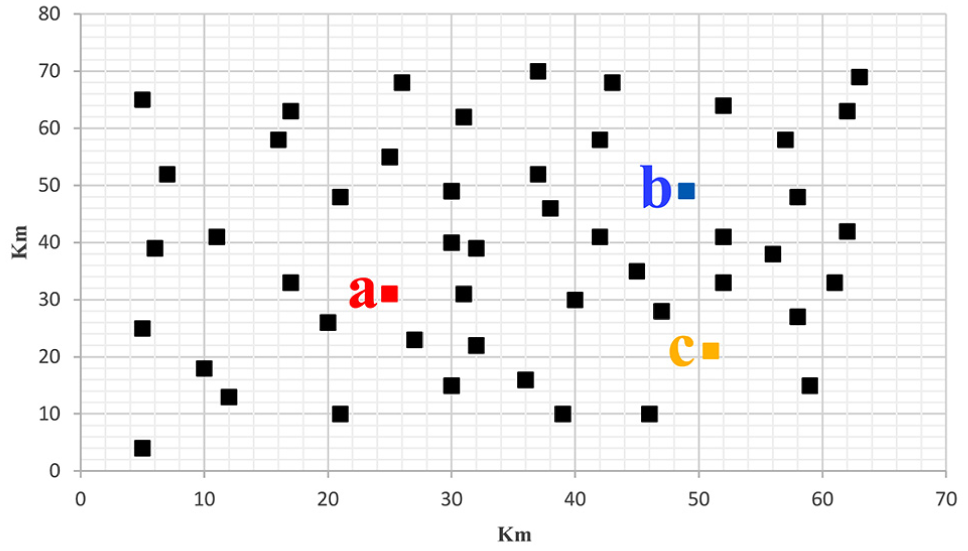
Location coordinates of parks.
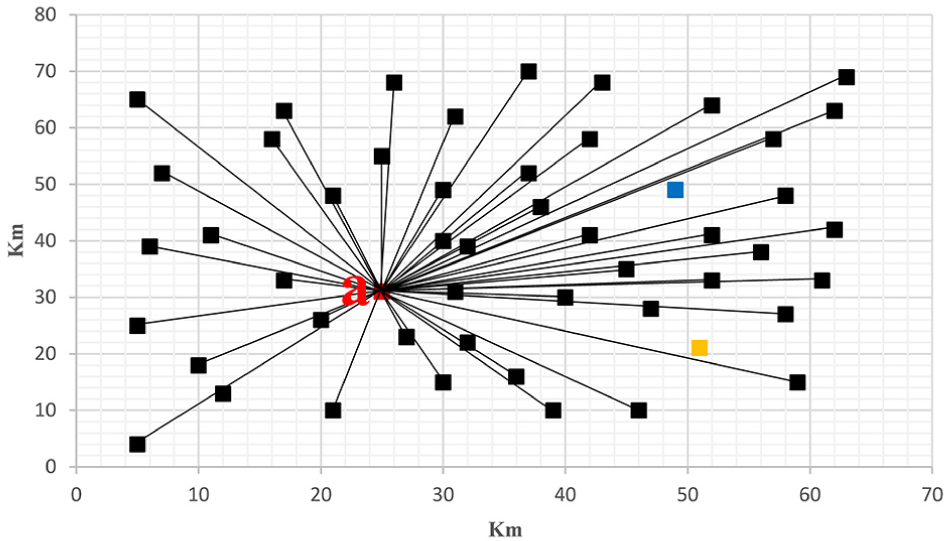
Solving process of the algorithm.
The second solution is to use the TSP modeling method. The TSP algorithm solves the minimum cost path of the single traveler, from the starting node, through all of the requirements of a given node, and back to the starting node. The TSP algorithm based on hybrid particle swarm algorithm flow chart is shown in Figure 4.

Flow chart of the algorithm.
The algorithm process is divided into four parts: individual encoding, fitness value, crossover operation, and mutation operation. Fitness values leveled off after iteration to some extent, at which point the path is the shortest path and the corresponding transportation cost is the minimum for the system, and location decisions were made combined with the environmental costs of each alternative node. Note that the objective function of the distance should be redefined as the shortest distance of transportation for the system. Figure 5 illustrates the algorithm operation process, where the horizontal coordinates represent “iteration” and the vertical coordinates represent the “fitness value.”Figure 6 shows the final transportation path, which corresponds to the minimum transportation cost

where
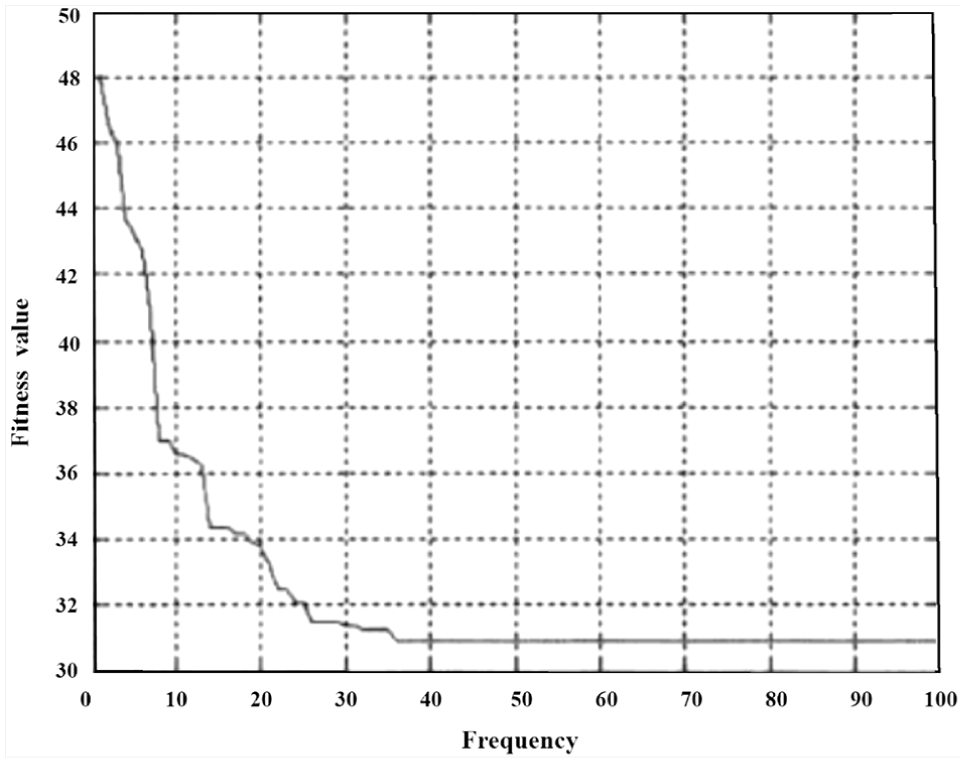
Operation process of the algorithm.
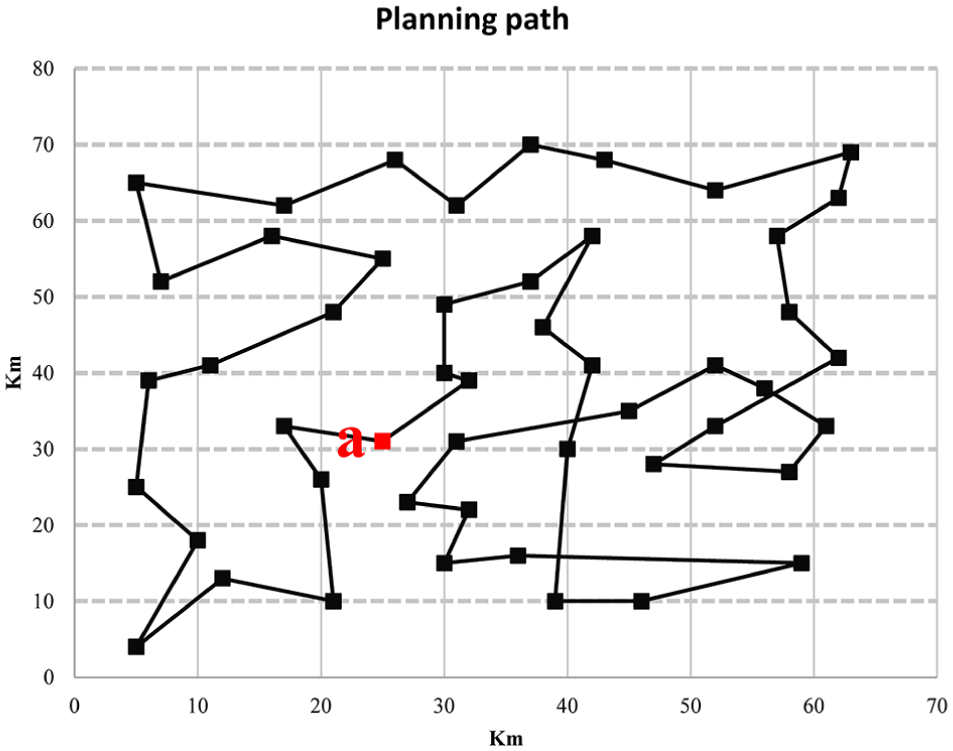
Planning path.
Even if the planning number of the logistics park is unique, the optimal solutions obtained through these two methods may be different. As shown in Figure 7, the red points represent the distribution nodes and the black points indicate the demand nodes, under the same conditions; we choose one from the two selected parks and there are four demand points in the system. Obviously, the transportation cost (distance) of joint distribution is less than the cost (distance) of one-by-one distribution. The TSP algorithm is applied to solve the model. The optimal solution can not only give the best location plan, but also solve the problem of path selection during operation.
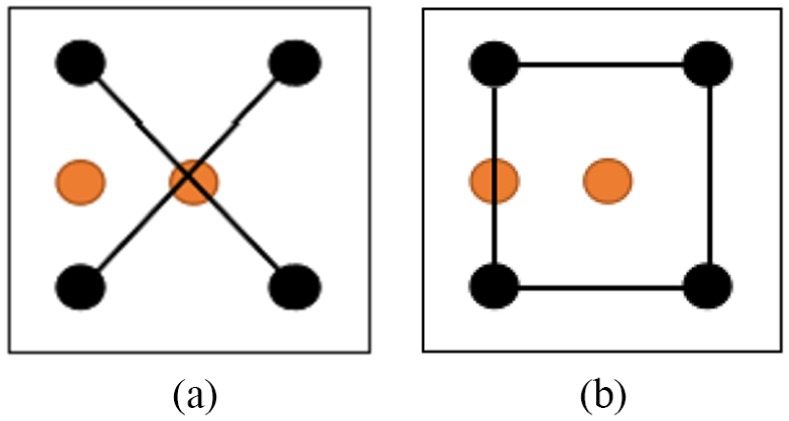
Illustrations demonstrate.
The number of logistics parks is k (1 < k ≤ m). According to the existing assumptions, the coordinates and the number of the selected distribution nodes are known under the conditions of the known demand node coordinates and the demand of each node. The location of the park is determined by the single target location model, that is, from the m (m > 1) selected nodes k (1 < k ≤ m) were selected as the target park nodes, in order to achieve the logistics system with the smallest integrated costs.
This problem is solved using the improved standard particle swarm algorithm and the hybrid particle algorithm to introduce the crossover and mutation operations in the genetic algorithm. The optimal solution is explored by the intersection of the particle extremum and the population extremum and the variation of the particle itself to determine the shortest or optimal path scheme in the system. However, in the model of green logistics park location, by establishing a new objective function, the solution of the hybrid particle swarm algorithm is constrained and the optimal location scheme of the logistics system is obtained. Considering that the efficiency of the exhaustive search will decrease when the number of candidates increases, the service allocation matrix of this logistics system is established before solving the model, dividing the logistics system into k independent logistic systems, and thus calculating each system by TSP algorithm which is based on hybrid PSO algorithm. On the basis of the optimal solution with analyzing, integrating the environmental costs of each alternative points to generate all the comprehensive cost of the plan of site selection sorting table?and then we select the location plan corresponding to the minimum comprehensive cost. Finally, we can obtain the optimal scheme of the green logistics park. The algorithm implementation steps are briefly described here.
Individual coding
Assuming that there are 10 demand nodes in the logistics system and the demand and location coordinates of each demand node are known, there are three nodes in the park area, the environmental cost of each park can be estimated by the survey, and the number of target parks is two. That is, through the algorithm from the existing three park nodes to select two optimal campus nodes. The 10 demand nodes are numbered 1–10 and the three nodes to be selected are denoted
Logistics system cost
The cost of the logistics system is the combined cost of the system transportation cost and the system environment cost. In the calculation of the solution, it should be noted that the system environment cost here becomes the sum of the environmental costs of the k alternative sites, and the comprehensive cost calculation formula is an objective function of the single target location model, which can be expressed as follows
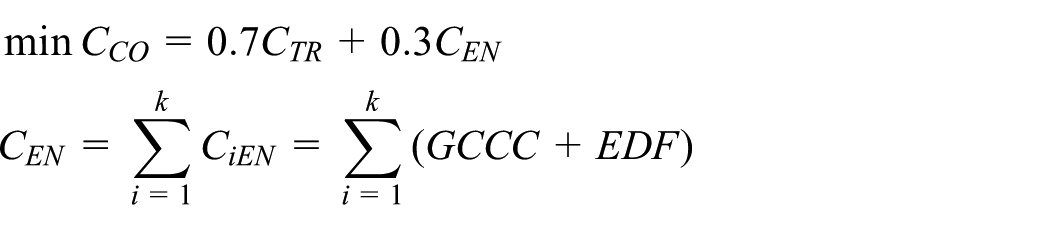
Service allocation matrix
In order to describe the service allocation scheme, we definite the binary
Cross-mutation operation
Before starting this step, you need to initialize the system distribution nodes and demand nodes. That is, node
With the increase of the number of iterations, when the change of the combined cost gap for each combination tends to be stable, the optimal location scheme is obtained and the solution is finished. The result of the algorithm is shown in Figure 8.

The curve of comprehensive cost.
The location coordinates of m alternative logistics distribution nodes are unknown (m ≥ 1)
In the single target location model, the environmental cost of the system is determined by the environmental cost of each alternative, which is determined according to the actual construction facilities. In case of uncertain location information, it is difficult to predict the approximate position and calculate the environmental cost based on the type of land. So, in this context, we modify the scaling factor of the target function. The system transportation cost coefficient is 1. The system environmental cost coefficient is 0. The model is transformed into a single constraint. The optimal solution is the location coordinate of green logistics park. If the coordinates of the distribution node are unknown, the analysis can be divided into two scenarios.
In the case where the number of unknown proposed distribution nodes is m, multiple distribution site selection and service distribution must consider the impact of delivery cost of delivery node, depreciation expense, and administrative expense on location allocation problem.
28
For the solution, we divide the total logistics cost of the distribution nodes
It is necessary to determine the distribution plan of logistics service. So it is also called location allocation. To describe the service assignment scheme, we define binary

The iterative formula can be derived using the least square method
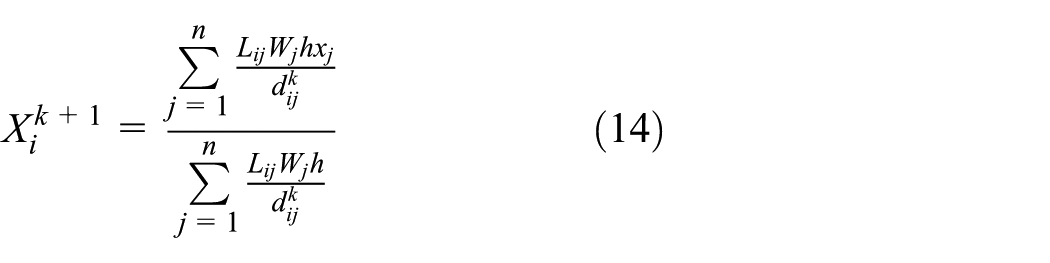


In an iterative operation similar to a single distribution site selection, the iterative arithmetic starts from one until

When m and n are small, the optimal site selection can be made by calculation. But when m and n are larger, formulas (14)–(16) are not feasible. In this article, we propose an alternative heuristic algorithm 22 to obtain the optimal solution. Perform the following steps:
Initial grouping: we are going to divide the n nodes arbitrarily into m groups, each group has a delivery node for delivery. Thus, the initial allocation matrix
Site selection calculation: we perform iterative operations by formulas (14)–(16), find the location of each distribution node, and calculate the total delivery cost of the distribution nodes.
Adjust the grouping formula
Repeat the first two steps until all customers arrive at the lowest cost of delivery for their service delivery nodes. At this node, the logistics service distribution scheme is the optimal allocation scheme. The address of the distribution node is the optimal address, and the system transportation cost is the lowest.
The example analysis
In the single objective decision location model, we regard the comprehensive cost of the logistics system as the objective function. While maximizing the economic and social benefits of the park, the logistics park is also developing towards green and low carbon. Depending on the logistics distribution, the station planning situation puts the model under the condition of four different considerations. An intelligent heuristic algorithm for alternative location allocation is proposed, that is, implementation of the single target location model to determine the optimal location plan of green logistics park. In this article, an example is given to analyze the distribution of multiple distribution nodes of the known target.
For example, two logistics parks are to be established in one place and 10 demand nodes to be delivered. The address of each demand node is shown in Table 1. The demand of the goods is
Location coordinates of retail stores.

The intelligent heuristic algorithm is calculated using alternate location allocation. The solution is as follows:
Divide the 10 requirement nodes preliminarily into two groups: {1, 2, 3, 4, 5} and {6, 7, 8, 9, 10}. Each group has a distribution node responsible for the distribution of goods and the service assignment matrix is

According to formulas (5)–(7), the address coordinate of the two distribution nodes is

Calculate the transportation cost to two distribution nodes of each demand node. The results are shown in Table 2. As you can see, the demand node 1 was originally allocated to

Relocating the new logistics allocation matrix

The first iteration of site allocation scheme and transportation costs.

The transportation costs are shown in Table 3. You can see that the demand node {2, 3, 5, 8, 10} to the distribution node
Second iteration site allocation scheme and transportation costs.

Therefore, the logistics service distribution scheme is the optimal scheme. The distribution plan is shown in Figure 9, where red points represent the distribution nodes and black points represent the demand nodes. At this point, the minimum system transportation cost is 236.734 and the site location of the two sites is 5.

The location program and distribution plan.
The example in the case is based on the analysis of the logistics park to be selected, where the coordinates of the location are unknown. The article considers two basic conditions of the site selection: whether the location of the proposed park is known or not. However, the conditions for the proposed park location are only one of them. It exists in real life. Therefore, we cannot ignore this situation in the related research. For the case of the proposed park location, the coordinates of which are known, the optimization model is fully applicable, but the following problems arise when the coordinates of the proposed park are unknown: The environmental cost of the system is determined by the environmental cost of each alternative point, which in turn is determined according to the actual construction facilities. When the location information of the park is uncertain, it is difficult to predict the approximate location and calculate the cost of the environment according to the type of land and other factors. Therefore, we make its coefficient to a certain degree flexible in establishing the objective function. Moreover, the article also mentioned that not only the system transportation cost characterizes the service efficiency and service level of the park, but the lower transportation cost also reflects shorter transportation distance and less vehicle exhaust emissions to a certain extent, which is in line with the concept of green low-carbon development. In addition, the case analysis is based on the unknown location of the proposed park location, which is highlights the validity of the alternative heuristic algorithm. Given that such a decision may bias the focus of the article to the latter, we add some simple examples to demonstrate its validity where the information on the proposed park location is known.
In future studies, we are committed to improving the optimization model, adding constraints such as “road rank” to make it suitable for all possible purposes. In addition, the content of program evaluation will be added in the study. Based on the selection principles and various green indicators during construction and operation, we will evaluate the site selection plan and give the site selection system of green logistics park.
Conclusion
Based on advanced ideas, technology, and management measures, green logistics park makes its way to increase the efficiency of using resources and dealing with pollution during the whole process to plan, build, operate, and manage the logistics park. In the meantime, green logistics park can raise the proportion of new resource and renewable energy, and decrease the intensity of the emission of carbon dioxide and pollution. Therefore, the pollution and the consumption of resources will be reduced, and green logistics park realizes its operation with high energy efficiency, low energy consumption, low pollution, and low emission. Researching its location problem, the first consideration is the impact of the logistics park site selection of various factors, combined with the green logistics park assessment indicators, to obtain the main influencing factors of green logistics park site selection. Then it is regarded as the starting point for the establishment of the model, the objective function of the model is determined, and the algorithm to complete the solution process is designed, thus giving the location plan.
Based on the analysis of the evaluation indexes of green logistics park and the factors affecting site selection, this article puts forward a single target decision model based on comprehensive cost. The objective function of transportation cost and environmental cost of the logistics system is established. The transportation cost of the park system is used to represent the service efficiency and service level of the park. Lower transportation cost reflects shorter transportation distance and less automobile exhaust emission to a certain extent, and reflects the low-carbon life development concept. Based on the differences in the location and quantity of the proposed logistics park, the model background is divided into four cases. The solving process of heuristic algorithm based on hybrid alternative location allocation and hybrid PSO is presented. The validity of the model and the algorithm in the site selection of green logistics park is analyzed, and the site selection scheme is finally given. The location model that obtains the optimal solution through the single comprehensive cost target provides a simple and feasible decision method for the green logistics park location.
Footnotes
Handling Editor: Gang Chen
Declaration of conflicting interests
The author(s) declared no potential conflicts of interest with respect to the research, authorship, and/or publication of this article.
Funding
The author(s) disclosed receipt of the following financial support for the research, authorship, and/or publication of this article: This research was supported by the National Natural Science Foundation of China (Grant Nos. 51278221 and 51378076), Science Technology Development Project of Jilin Province, China (Grant Nos. 20140204027SF and 20170101155JC), and Postdoctoral Science Foundation of China (Grant No. 2014M551193).