




Abstract
The designation of ship emission control areas in China evidenced increased attention to ship emissions. Ships calling ports along inland waterways are of particular concern as their emissions exacerbate air pollution in nearby cities. Adapting the Ship Traffic Emission Assessment Model to the local context, this study combines data from Automatic Identification System, vessel profile database, and field investigation results to build a “bottom-up” activity-based inventory of ship emissions. The Nanjing Longtan Container Port was taken as a case study. Results show that total ship emissions for PM10, PM2.5, NOx, SOx, CO, HC, and CO2 in 2014 are 3.45, 2.76, 196.00, 2.90, 20.62, 8.13, and 12,554.29 t, respectively. Accordingly, ship emission reduction measures were proposed based on the analysis of emission characteristics. The methods and conclusions of the study provide a scientific basis for the inventory and control of the ship emissions in China.
Keywords
China is home to seven of the world’s top 10 container ports, and about 7.84 billion tons of cargos pass through China’s coastal ports in 2015. However, with every ship and truck entering these ports come not only cargo but also air pollution. According to estimate of the Natural Resources Defense Council (NRDC), 1 a large-size container ship running at 70% maximum power for 1 day using bunker fuel with 35,000 ppm (3.5%) sulfur emits as much PM2.5 as the average of half a million new trucks in China during that same day. China’s prominent role in global shipping means it must control ship emissions. Ship pollution emissions affect not only coastal regions but also areas near inland waterways. Port operations bring a range of environmental problems, and green port development is crucial. 2 The Ministry of Transport of China issued two key documents in 2015, describing the Implementation Plan for the Ship and Port Pollution Control Initiative (2015–2020) and the Implementation Plan for Ship Emissions Control Areas of the Pearl River Delta, the Yangtze River Delta, and the Coastal Bohai Region (Beijing–Tianjin–Hebei). These directives aim to control the emissions of sulfur oxides (SOx), nitrogen oxides (NOx), and particulate matters (PM) from ships through establishing the emission control areas (ECA), to improve the air quality of the coastal regions and areas near inland waterways, especially port cities.
Ship emissions and their influence on atmospheric environment are of growing concern. 3 Corbett and Fischbeck 4 first calculated the global ship emissions based on the ship’s activity information using top-down approach. Jalkanen et al. 5 presented a method for estimating ship traffic exhaust emissions based on the messages provided by the Automatic Identification System (AIS), which enable the identification and location determination of ships, and calculated the emissions of NOx, SOx, carbon dioxide (CO2), PM, and carbon monoxide (CO) originating from ships in the Baltic Sea. This is the first attempt to use the AIS to establish ship emission models, named Ship Traffic Emission Assessment Model (STEAM). Tichavska and Tovar 6 established a port-city ship emissions model and analyzed the ship emissions of Las Palmas Port using AIS data. In China, the first ship emissions inventory was developed by the Shanghai Environmental Monitoring Center for the Port of Shanghai for the year of 2003. 7 The Shanghai port inventory was subsequently updated in 2011, 8 which showed that ships were the largest contributor of all port-related sources to SO2, NOx, and PM2.5 emissions. SKW Ng et al. 9 developed a ship emissions inventory of Hong Kong using AIS in 2007 and showed spatial distribution patterns of ship emissions. Jin et al. 10 estimated NOx, HC, CO, and PM10 emissions from commercial ships at the Port of Tianjin in 2006, using the method based on top-down fuel consumption calculation method. Liu et al. 11 applied the multiple source atmospheric diffusion model with EnviMan software to estimate emission inventory, and based on Geographic Information System (GIS), results show that Qingdao port and shipping lines contribute about 8.0% of the total urban discharges of SO2 and about 12.9% of NOx. Beijing Institute of Technology 12 conducted research on diesel engine exhaust emissions from inland ships, with field test in the Jiangsu and Guangdong Provinces on inland river ships using the Portable Emission Measurement System (PEMS), and obtained emission factors for inland river ships. Xing et al. 13 employed a ship activity-based approach and established a model which was used to calculate the exhaust emissions from sea-going ships based on AIS data.
Overall, the study of vessel emissions inventory in China mainly focuses on sea-going ships, and the methods used mainly include the “top-down” method based on fuel consumption statistics and the “bottom-up” method based on ship activity. The former neglects various activity data of different kinds of engine power, using hours, deterioration rate, and effects of different fuels, which leads to ambiguous emission characteristics and non-targeted measures to emission reduction. What’s worse, inaccurate fuel consumption statistics and emission factors prevent this method from achieving high accuracy. However, the latter that associates with ship engine power, activity data, and so on is more versatile. Some of the western countries have set local emission factor databases to build emission inventory of vessel emission, which can overcome the weaknesses of the top-down approaches. In theory, we can use AIS data to calculate emissions directly. This approach avoids collection of fuel consumption data and spatial activity data, which has been proved an efficient way to solve environmental problems. However, the reasons why the method has not been popularized in China are (1) the acquisition of AIS data is much more expensive; (2) AIS data in China are incomplete, especially in inland port; and (3) China’s domestic emissions inventory study lacks theoretical foundation. Utilizing AIS data and applying the “bottom-up” method to develop ship emissions inventory in China require adapting existing models to local conditions.
In this article, we modify and simplify the STEAM by neglecting the effects of wave in an inland port and presents a localized “bottom-up” activity-based method of developing vessel emissions inventory using AIS database, port call registration database, and field investigation. The Nanjing Longtan Container Port (NLCP) was taken as a case study. Based on ship emissions inventory and comparison with emissions from other port sources, ship emissions reduction measures were proposed. The methods and conclusions of the study provide a suitable basis for the inventory and control of the ship emissions at inland ports.
Methodology of developing ship emissions inventory based on STEAM-AIS
The STEAM and its main components
This article adopts the STEAM developed by Jalkanen et al.,5,14 which utilized AIS data. We revised the model by neglecting the effects of the friction from wave because study object of this article is an inland port. Accuracy of STEAM depends on the accuracy of information such as the shipping activity provided by AIS. Localized model components are presented in Figure 1. Input data and output results are presented in the top and bottom rows of the diagram. Dashed arrows describe the information flow of the model, and solid arrows describe the dependency between parameters.
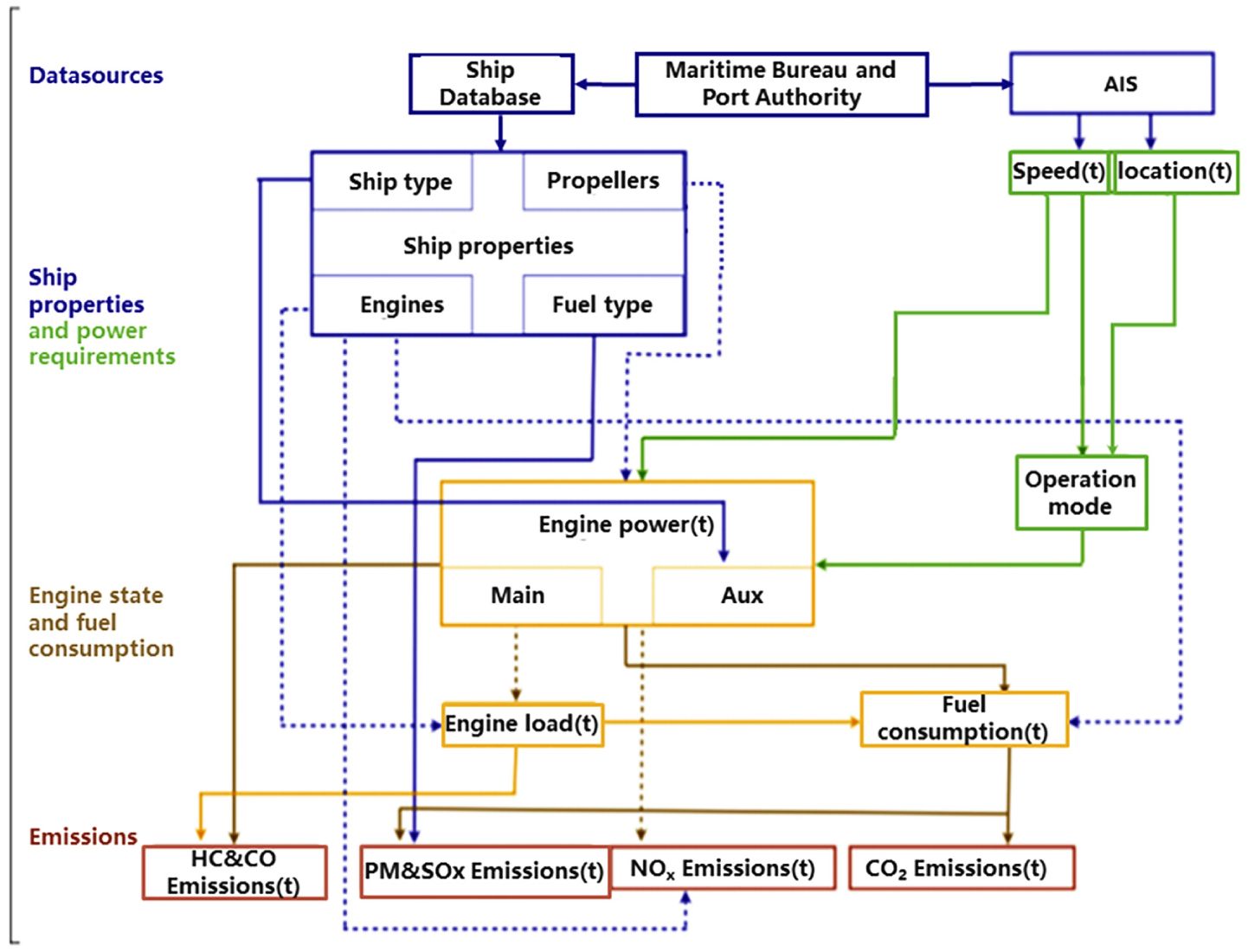
A schematic diagram of the main components of the STEAM model and their inter-relations.
In STEAM, PM, SOx, and CO2 emissions mainly depend on the ship’s fuel consumption, and NOx emissions mainly depend on the temperature of the engine combustion cycle and duration. HC and CO emissions depend on the engine load and engine power. And the fuel consumption is closely related to the engine load.
The calculation method of emission inventory based on STEAM
In general, under given conditions, vessels’ main engines and auxiliary engines operate at a certain load level. Accordingly, emissions are estimated as of the product of energy required to power the vessel and an emission factor. Emission factor adjustments are then applied to account for the type of fuel used in the engines and control factors are applied to account for any emissions reduction measures and technologies. Equations (1)–(3) are the basic equations used in estimating emissions by mode from vessels for propulsion engines and auxiliary engines



where
E = emissions, g;
Load = engine power, kW;
MCR = maximum continuous rating, kW;
LF = load factor, dimensionless;
Vactual = actual speed, knots;
Vmaximum = maximum speed, knots;
Activity = ship activity time, h;
EF = emission factor, g/kWh;
FCF = fuel correction factor, dimensionless;
CF = control factors for emission reduction measures, dimensionless.
In equation (1), Load and Activity are determined by engine load and speed, location in Figure 1, respectively. In equation (3), the load factor is estimated using the Propeller Law, which states that the propulsion engine load varies with the cube of the vessel speed. Sometimes, ships operating within a speed range are said to be operating under a mode (e.g. Cruising, Maneuvering, or Berthing) and a mode-specific load factor is obtained through field survey of ships. As the objects of this study are the ships that call an inland port, we conducted field survey at the port and found that it is more convenient to make operating mode designations based on positions of ships as they approach or leave the berthing area.
The acquisition of shipping activity and related parameters based on AIS
AIS provides highly accurate and frequent updates on ships’ current location and instantaneous speed, enabling tracking of ships’ activities. However, only a portion of ships on inland waterways are equipped with properly functioning AIS. In this article, AIS data are analyzed using Web GIS to obtain static and dynamic information of ships which are suitable for reading. Finally, we use the database software SQL Server for data filtration and processing. When AIS does not work properly, ships’ activities and related data will be obtained by port call registration database and field investigation.
If a ship’s trajectories are obtained through AIS data, and information on the ship’s engine configuration and design speed is obtained from a ship profile database, the STEAM model can be used to calculate the ship’s emissions and associated spatial-temporal distributions. This research aims to develop emissions inventory for all ships calling the port. Field survey facilitated by maritime authorities and port operators (Table 1) provides us with detailed calling records of all ships, engine configuration and specifications on typical ships, and information on fuel quality (e.g. sulfur content). We chose a group of ships with AIS data as a sample of the ship population, use STEAM to obtain activity-based sample statistics on emissions, and subsequently develop emission statistics for all ships.
Ways of acquiring ship activities and related data.

STEAM uses a variety of information regarding the ship (Table 2), and the majority of which can be obtained from the ship profile database, for example, type of ship, engine MCR. Rules for designating ship operating mode according to the ship’s position are developed from field survey. Applying these rules to ship trajectories will provide time spent by each type of ships under each operating mode. Load factor under each mode, as well as emission factors, is obtained from the literature.
The properties of ships based on the STEAM model.

STEAM: Ship Traffic Emission Assessment Model; IMO: International Maritime Organization; MMSI: Maritime Mobile Service Identify.
Case study
The scope and object of the study
NLCP located on the downstream part of Nanjing section of the Yangtze River is the largest and most modern dedicated container port along the Yangtze River and is the only port for international container import and export in Nanjing. NLCP is representative of container ports along the Yangtze River of Jiangsu province. The Transport Department of Jiangsu Province and the City of Nanjing frequently chooses it for pilot projects on energy saving and emission reduction. The port has a comprehensive information system that not only tracks activities at the port but also reports on energy consumption associated with these activities. Under a commissioned project, we compiled an activity-based emissions inventory from major mobile sources, including ships at the port. To calculate emissions from ships, this study took NLCP as the center. For ships calling the port, their emissions within the section from 10 km upstream to 10 km downstream are included, as shown in Figure 2.

Research scope of ship emissions in NLCP.
Acquisition of ship calling records and analysis of ship types
Typical ships
This article used ship calling records from NLCP port call registration database and put those key data into database software SQL Server. The analysis result showed that there are 8975 ships berthing in NLCP in 2014. Distribution of ship deadweight tonnage (DWT) and calling number for 2014 is shown in the following histogram (Figure 3). Ships’ DWT are from 500 to 10,267 t and the number of ships within 1500–3500 t is the majority. Moreover, some ships call the port a few times, some hundreds of times. To simplify data collection and processing, 16 typical ships according to the tonnage and the calling number were selected as shown in Table 3.

Tonnage distribution histogram of vessels in NLCP in 2014.
Typical ship information in NLCP.
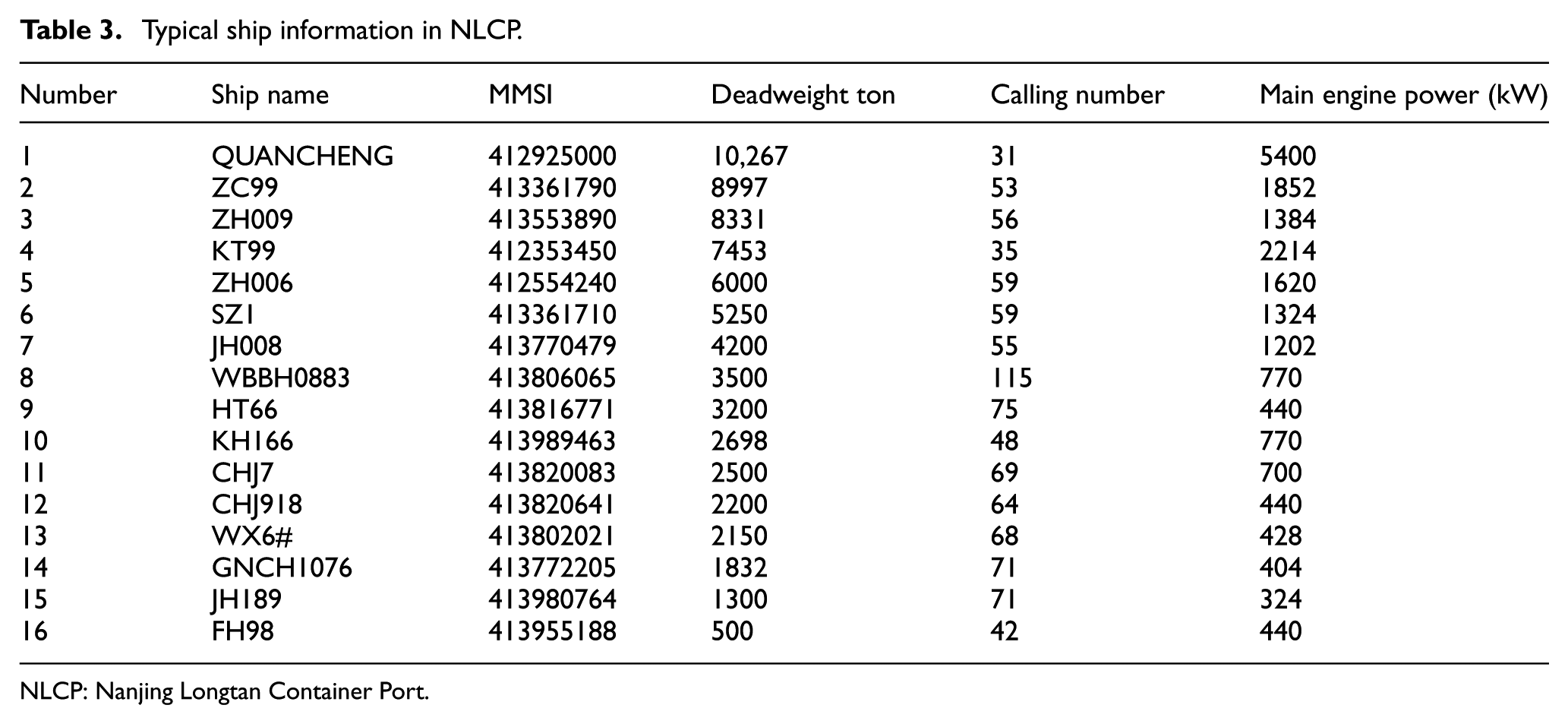
NLCP: Nanjing Longtan Container Port.
Classification of operation condition and main/auxiliary engine condition
Through field survey, the ship operation mode is classified as follows: for port entry, ships more than 5500 t will change from cruising mode to deceleration mode at 10 km upstream the berth. Then from 1 km upstream the berth, ships will switch to maneuvering. Eventually, ships will berth and the speed decreases to zero. Ships under 5500 t will keep cruising at 10 km upstream the berth and switch to deceleration from 2 km upstream the berth. Then, from 1 km away from the berth, ships will switch to maneuvering and eventually berth and vice versa while leaving the port. Under different modes, the state of main and auxiliary engines is given in Table 4. The state of auxiliary engines could be different for smaller and larger ships (based on DWT).
The state of the main and auxiliary engine.

Activities
Typical actual trajectory (Figure 4) and time spent at each location can be obtained through AIS database. Operating mode at each location is classified according to Table 4. Then, the running time of the main and auxiliary engines under each mode can be calculated accordingly.

Trajectory chart of Ship ZC99 in 2014.
Parameter selection
The parameters necessary for calculating emissions from the main engine and the auxiliary engine include the rated power and relevant load factor, emission factor, fuel correction factor, and emissions control factor.
Engine load
Main engine rated power is obtained from ship profile database. Auxiliary engine rated power is obtained by survey, including interview of shipmasters and literature investigation. 15 Rated power times load factor (Table 5) under different modes is the engine load.
Load factor under different working conditions of ship at NLCP.

NLCP: Nanjing Longtan Container Port.
Main engine is turned off while berthing, and load factor is 0.
Emission factor and fuel correction factor
Typical ship’s engines in this article are medium-speed diesel engine, produced between 2010 and 2014. The emission factor of main and auxiliary engines with 2.7% sulfur content is adopted from United States Environmental Protection Agency recommended emission factors, 16 as shown in Table 6. The port uses Chinese No. 0 diesel with 0.035% sulfur content, and fuel correction factors are shown in Table 7.
Emission factors of the main and auxiliary engine (g/kWh).

Fuel correction factors of engine.

Emission control factor
Shore power is just at the testing stage in NLCP in 2014, thus emission control will not be considered and emission control factor is 1.0 in this article.
The establishment of NLCP emission inventory
Following the methods presented in this article, total ship emission in NLCP in 2014 was calculated. PM10, PM2.5, NOx, SOx, CO, HC, and CO2 are estimated to be 3.45, 2.76, 196.00, 2.90, 20.62, 8.13, and 12554.29 t, respectively, and the breakdown by main and auxiliary engines is shown in Table 8.
Marine vessel emissions inventory in NLCP in 2014 (tons).

PM: particulate matter; NLCP: Nanjing Longtan Container Port.
Related research 17 on NLCP produced emission inventory in 2014 for major mobile sources, including ships, cargo handling equipment, heavy-duty vehicles, and harbor crafts. The shares of each source are shown in Figure 5. Ships’ shares of SOx, NOx, PM10, PM2.5, CO, and HC emissions in the port are 71%, 58%, 42%, 58%, 36%, and 29%, respectively.

Ship emissions share in NLCP in 2014.
Analysis of ship emission reduction path
According to the results of NLCP ships emission inventory in 2014, NOx emission from ships accounts for 58% of mobile source emissions. NOx is mainly related to engine combustion temperature and air concentration. The suggestion to reduce engine exhaust is stricter emissions standards for vessels. Technologies which can effectively reduce NOx emissions of the ship to meet a stricter standard include selective catalytic reduction (SCR) and exhaust gas recirculation (EGR).
The emission of SOx in the port, including from ships, is relatively few. The main reason is that ships arriving at NLCP use diesel with 0.035% sulfur content, which is only 1/100 of sulfur content of fuel used by oceangoing ships (3.5%). NLCP’s situation is better than the policy of ECA standard (which will be issued in 2017 in the area of NLCP), and its practice proves that if the policy of ECA is strictly carried out, sulfur emissions could be significantly reduced.
It can be found that auxiliary engine emission is larger through comparing the ship’s main and auxiliary engine emission data (Figure 6) because this study focuses on port emissions on a 20 km stretch of the Yangtze River. Much emission is produced during berthing, when the auxiliary engine is turned on until leaving. If a ship connects to a shore power supply instead, there should be no emissions from the ship’s auxiliary engines in berthing condition.
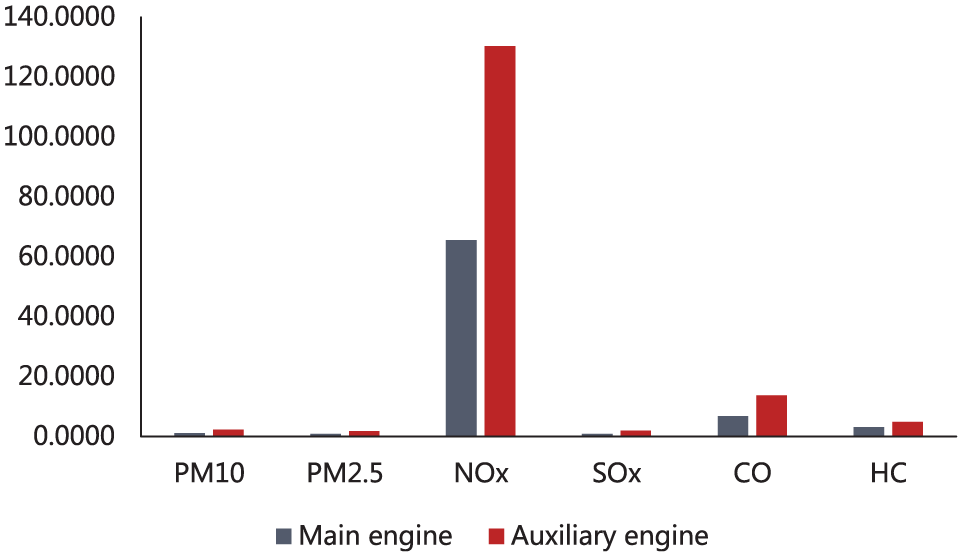
Ship emissions contrast figure between the main and auxiliary engine in NLCP in 2014.
From the investigation at NLCP, there are 11 vessels preparing to connect to shore power as a pilot program in 2015. To analyze the effect of shore power, this article assumes the 11 vessels use shore power at present. The ship exhaust emission reduction rate after using shore power in NLCP in 2014 is shown in Table 9. The results show that if all 11 vessels which account for 3.7% of total vessels connect to shore power, the exhaust emission can be reduced by approximately 6% of all kinds of pollution.
The reduction rate after using shore power in NLCP in 2014.

PM: particulate matter.
Based on the analysis of ship emission share in Figure 5, ships are the primary emission source of SOx and NOx in NLCP. Vessel engines can operate on liquefied natural gas (LNG), which contains little sulfur. Using LNG instead of diesel in suitable engines can cut NOx and PM emissions by 80% or more and can virtually eliminate SOx emissions. 1 Technology development for LNG-powered ships and the construction of LNG stations can provide a new path for reduction of ship and port air emissions in China.
Conclusion
Adapting the STEAM to the local context, this study combines data from AIS database, port call registration database, and field investigation to build a “bottom-up” activity-based inventory of ship emissions. Inventory for NLCP is developed, and emissions are characterized.
Based on the analysis of ships’ share of port emissions, ships are the primary emission source of SOx and NOx in NLCP, accounting for 71% and 58%, respectively, which shows the importance of ship emission reduction for port.
Based on the analysis of NLCP emission characteristics, measures for reducing ship emissions are proposed as follows: (1) introducing advanced exhaust treatment technology to meet stricter emission standards, (2) enforcing ECA policies, (3) connecting to shore power when berthing, and (4) exploring use of LNG.
This article uses AIS to ensure the accuracy of ship activity data. Uncertainty in inventory results mainly comes from the applicability of emission factors and second from the limited number of sample ships. The article adopted updated foreign emission factors instead of conducting emissions test. As emission factors are an important component of the emissions inventory, and emissions test should be carried out in the future to obtain emission factors for Chinese vessel engines.
Footnotes
Academic Editor: Yongjun Shen
Declaration of conflicting interests
The author(s) declared no potential conflicts of interest with respect to the research, authorship, and/or publication of this article.
Funding
The author(s) disclosed receipt of the following financial support for the research, authorship, and/or publication of this article: Research for this paper was funded by the National Natural Science Foundation of China (Nos 41401120, 51009060, and 50909042) and Social Science Foundation of Jiangsu Province (No. 14JD014). The authors thank reviewers and faculties for their comments and suggestions.