




Abstract
Phase change material cold storage system could improve the efficiency and stability of the solar-powered air-conditioning system and the building thermal environment. This article is a novel investigation of the phase change materials’ usage in cold storage system and the phase change material cold storage working principles and features that are applied in the different solar-powered air-conditioning systems as cited in the recent publications. This involves phase change material cold storage system, solar-powered air-conditioning system, and the commercial market evaluation. To reduce the intermittent solar energy operation, the energy storage system is quite essential. Currently, the popular method is advanced phase change material cold storage. Using phase change materials in the energy storage systems, the heat exchangers and thermal control systems are the potential techniques. This article also reviewed the phase change material cold storage when applied in the solar-powered air-conditioning system based on the previous study. This article could benefit further research in the solar-powered air-conditioning field as integrated to the phase change material cold storage system and help to understand the commercial market development trend. For further studies, it was suggested that the optimal design of solar-powered cooling system could be employed by phase change material storage/release cooling dynamical control to improve the building thermal environment.
Keywords
Introduction
The comfortable, modern living conditions are attained by vast energy consumption. 1 The air-conditioning system takes up over half the electricity usage in the building services systems. The traditional air-conditioning system usage is based on the non-renewable energy sources. In contrast, the application of the clean energy can avoid the problem of the environmental pollution and energy consumption. So the application of the solar-powered air-conditioning system has been chosen as a privileged refrigeration system. 2 Because the solar energy is intermittent and has low energy density, it is efficient to use the excess solar energy from daytime and save the energy for the night, or store the solar energy during summer, and apply for winter, which is not synchronized between the energy generation and consumption. 3 The solar energy storage system is proposed. To solve the serious problems, some studies conducted theoretical analysis and experimental studies. The cold storage system is found to store the cold energy using a storage medium and release energy as needed, which is widely used in building air-conditioning system. The cold storage system in the air-conditioning applications is classified by the different storage mediums. In the recent developments, the common methods to achieve a cold storage are water and ice and latent heat storage systems (phase change materials (PCMs)).4,5 The latent heat storage uses the latent heat of PCM when the phase changes to energy storage. For a solar-powered cooling system, the cold energy produced by solar air-conditioning during sunny days is stored to be used during cloudy days. Based on the advantages of PCMs’ energy storage, it is widely used in the different applications in solar energy storage system and building efficiency field. 6 Also, PCM cold storage system helps to reduce the mismatch between the energy supply and demand. At the same time, the system has higher energy storage density, a smaller size, and a relatively narrower temperature range during the melting and freezing processes.7,8
This review seeks to analyze the solar-powered air-conditioning system when integrated with the PCM cold storage system, not only regarding the developments, classification, and application of the PCM materials in the cold storage system with current cited literatures but also the different kinds of solar-powered air-conditioning working principles, also with the cold storage system, and the mainstream commercial market conditions is concluded. First, the review introduced the air-conditioning system with cold storage system, introduced how to combine the cold storage system with air-conditioning system, and emphasized the significance and importance about cold storage system and then emphasized the advancement of PCM in cold storage system, concretely introduced the developments, classification, and application in the air-conditioning system. Also, the article reviewed different types of solar-powered air-conditioning systems, the advantages of the solar energy, and then summarized the current research progress on application of cold storage system with different types of solar-powered air-conditioning.
Solar-powered air-conditioning system with PCM cold storage technology
Under conventional air-conditioning system, there exist two subsystems: the refrigeration cycle system and the cooling cycle system. The refrigeration cycle subsystem includes evaporator, condenser, throttle valve, and compressor. While the cooling cycle system only contains refrigerant, which flows inside the refrigeration cycle. The refrigerant in the cooling pipe should be cooled water or other refrigerants.
For the common air-conditioning design, it usually considers the different using occasions of time and seasons. The chiller, which is the combination of evaporator, condenser, throttle valve, and compressor, is selected based on the maximum air-conditioning load during the using time. So the problem comes with the situation that the efficiency of the machine is very low and the standby machine is idle, when the refrigerant is not working at full load, while the machine charges with a lot of electricity consumption and power grid pressure during air-conditioning load peak period.
The solar-powered air-conditioning system with cold storage technology uses solar energy, which is environment friendly and the cold storage system can be operated under the low air-conditioning load period such as the night. Also, the energy will be stored in the cold storage tank and then release the energy to air-conditioning system when in the air-conditioning load peak period. Therefore, solar energy storage air-conditioning can reduce the air-conditioning load and energy consumption, and improve the efficiency of the machine and the entire air-conditioning system.
A typical solar-powered air-conditioning system integrated with PCM cooling system is shown in Figure 1.

Solar-driven refrigeration system integrated with PCM cold storage system.
In the air-conditioning systems, PCM slurries can be pumped directly as a secondary cooling medium into air handling units or stored for load shifting. The slurry flows like conventional chilled water while providing larger cooling capacity. The high energy content of the slurry allows significant reductions in the size of the pipes, pumps, and storage tanks, as well as air handling and chilling costs compared with the conventional chilled water systems. In Figure 2, there are three cold storage forms of PCM cooled in the evaporator water used as cooling fluid in the air handler. Each of the possible configurations of the cold circuit has some disadvantages, so the choice of the variant is a matter of compromise.9,10

PCM cold storage: (a) PCM used as cold storage, water used as cooling fluid in evaporator and air handler; (b) PCM pumped into air handler, water cooled in the evaporator; and (c) PCM cooled in the evaporator water used as cooling fluid in air handler.
A lot of experiments and researches have been completed to design and operate the air-conditioning system integrated with PCM cold storage. But the study of PCM cold storage system is not in depth, especially in improving the stability of the energy storage system.
PCM cold storage system
The cold thermal energy storage (TES) is a relatively new technology with growing interest for a huge number of thermal applications. 11 This helps to reduce a mismatch between the energy’s supply and demand. The energy storage media are classified as chilled water, ice-making types, and PCMs. 12 The chilled water storage is based on maintaining the cooling charged water and warm returned water. Many studies have presented cold water storage system. The use of ice, as a cooling thermal storage, includes the ice balls’ use, ice harvesting, and ice-on-coil, and ice slurries. The ice slurry is a mixture of water (ice and liquid water) and a glycol. 13 In the popular ways of cold storage nowadays, PCM has obvious advantages, using PCMs is interesting due to the advantage of a high ratio between the amount of heat stored and temperature variation.14,15 In the current researches, in order to better use the PCM in the cold storage system, it is necessary to solve several problems such as leaking, phase separation, and corrosion of PCM, and a novel method PCM microencapsulation (MEPCM) has been realized.16–18
Development of PCMs in cold storage field
The use of PCMs has been integrated in the energy storage system in the buildings since 1980. Their first applications were used in the heating and cooling by Nagano et al. 19 Today, the different PCM application utilizations are developed. A research into energy storage system for cooling and heating remains and is being considered for waste heat recovery, energy generation, building energy conservation, and air-conditioning. 20
Literature review shows that several studies have been carried out in the field of energy storage and PCM. Kenisarin and Mahkamov 21 focus on the assessment of thermal properties of PCM, methods of energy transfer enhancement, and design configurations of cold storage facilities in solar energy utilizing building. Based on the assessment of the thermal properties of PCM, the cost of PCM is quite high, which is very important for development, when developing commercial latent heat storage products at acceptable, stability of thermal properties of these substances should be tested for at least 1000 thermal cycles. Sharma et al. 22 summarize the investigation and analysis of the available TES systems incorporating PCM for use in different applications. C Tzivanidis et al. 23 simulated the phase change process using the effective thermal capacity function, and the results showed that the main parameters of the system are pipe spacing, PCM layer thickness, pipe depth within the ceiling, cooling water inlet temperature, night cooling duration, and PCM properties (thermal conductivity, phase change heat and ends of phase change temperature range), which is determined experimentally for PCM suitable for air-conditioning applications.
Liu 24 studied a novel composite PCM of lauric–myristic–stearic acid ternary eutectic mixture/expanded graphite (LA–MA–SA/EG) (12/1, W/W). It was described by scanning electron microscopy (SEM), Fourier transform infrared (FT-IR) spectroscopy, and differential scanning calorimetry (DSC). The results showed that LA–MA–SA coincidentally distributed in the porous network structure of EG, the prepared LA–MA–SA/EG composite with PCM has suitable thermal properties for the energy storage applications in energy buildings.
Xia et al. 25 developed a novel and suitable phase change composite material for cold storage condensation heat recovery system, which has good potential application on cold storage system in building air-conditioning system. The heat storage applications presented are as a part of solar water-heating systems, solar greenhouse system.
Y Li et al. 26 put a concept of energy-saving building envelope, which is used to guide the building envelope material selection and thermal performance design. The study researches lightweight building integrated with PCM, and the EnergyPlus software with building model validated by experiment data is used to research the indoor thermal environment improvement with PCM under typical weather conditions of five climates zones in China. The results show that PCM can control the indoor temperature rises and temperature fluctuations effectively, which is very correlative to the air-conditioning system design, and indirectly reduces the energy consumption.
MEPCM slurries have large apparent specific heats during the phase change interval, which enhances the heat transfer rate between the fluid and the tube wall. The key question to study MEPCM is whether a competitive charging/discharging rate could be achieved. Zhang and Niu 27 studied two performance indices of TES system apparatus. They compared MEPCM slurry and stratified water storage tank, newly defined the volumetric thermal storage capacity at a given temperature difference, and the charging/discharging rate variation over time. The results showed that overall charging/discharging rate of the MEPCM storage tank was much lower than stratified water storage tank.
When designing the cold storage system using the MEPCM slurry, the thermal conductivity of the slurry is essential. To measure the thermal conductivity of a liquid, one of the most reliable and well-known methods is a transient line heat source technique. X Wang et al. 28 researched on temperature-dependent effective thermal conductivity of PCMs wall based on steady-state method in a thermal chamber. In the research, two walls with 1.5 m × 1.5 m dimension composed of stabilized PCMs Bricks and Portland vitrified bricks, respectively, were built and tested by a steady-state way in a thermal chamber. The results showed a positive linear relationship of ƛ with increase in wall surface temperature for ordinary vitrified brick wall as well as the PCMs wall in solid and liquid states.
Wang et al. 29 studied a novel type SA/poly(methyl methacrylate) (PMMA) composite MEPCM with a shell structure by adopting ultraviolet curing dispersion polymerization. This kind of MEPCM technology has a single phase surface, regular spherical structures, a grain size of 2–3 µm, and a smooth surface, and there is no chemical reaction between the PMMA and palmitic acid (PA) which indicates that this kind of MEPCM is more stable.
Özonur et al. 30 used coco fatty acid mixture as the core material to prepare MEPCM, the shell material was gelatin-Arabic gum, and a grain diameter of 1 mm via the coagulation technique. The study showed that the MEPCM could decrease the heat absorption rate and heat release rate and increased phase change temperature compared with the coco fatty acid.
Zhang 31 analyzed the stearic acid/polycarbonate MEPCM with SA through the solution casting method. There was no chemical reaction between the SA and PA. The study found that the rate of heat storage and release was increased by 23% by adding the 3 wt% iron powder, which improved the phase change rate of the composite materials.
Currently, the inorganic high polymer as the shell material of the MEPCM has drawn people’s attention. It has potential and critical application in the areas of heating, ventilation and air-conditioning, refrigeration, and heat exchange.
Classification of PCMs
PCMs are classified into three groups based on their composition: organic, inorganic, and eutectic compounds, as shown in Figure 3. The phase change temperature range and the enthalpy change are the key thermal properties of phase change slurries. Such parameters identify the heat storage capacity and their potential applications. Compared to the conventional fluids, a PCM exhibits high values of the apparent specific heat capacity during the phase change process. Within the potential PCMs, paraffin has the advantage of representing small density variation between the solid and liquid phases.32,33

Classification of PCMs.
The paraffin is widely used as PCM but tend to have poor thermal conductivities. This can be improved by microencapsulation as this produces a high surface area. To maximize the PCM performance, the thermal heat transfer needs to be matched to the flow of heat to it, for example, to the air flow in an air-conditioning system. In the case of heat transfer systems, where slurries of PCMs in fluids are used, the thermal conductivity of the fluid influences the system performance in absorbing the thermal kinetic energy at the point of heat input and releasing it for heat output.6,34
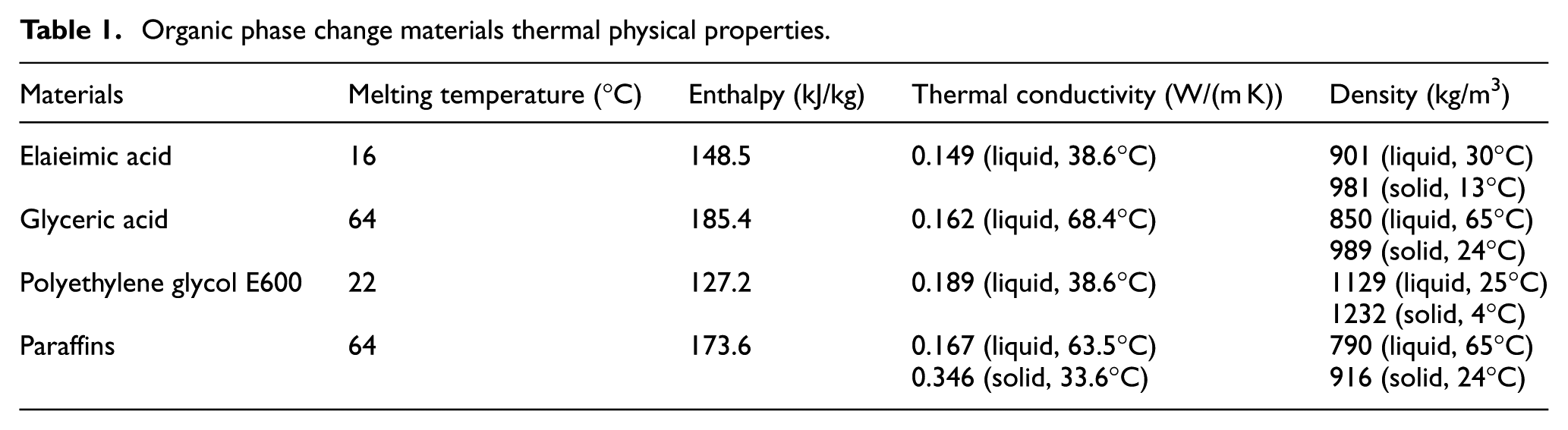
This article summarizes the thermal physical properties of some typical PCMs in three different types of PCMs as shown in Tables 1 and 2. 35
Organic phase change materials thermal physical properties.
Inorganic phase change materials thermal physical properties.
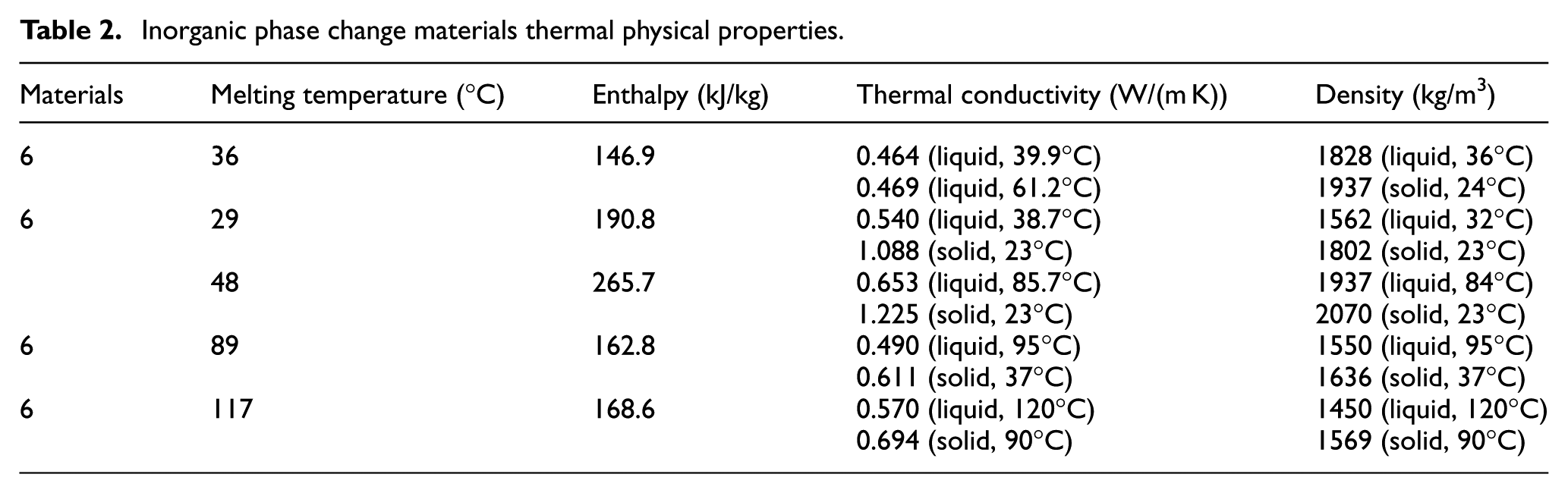
The commercial paraffin is cheap with moderate heat storage density (200 kJ/kg), a wide range of melting temperature, stable chemical parameter, no phase separation phenomenon, and little or no supercooling effect. But their low thermal conductivity limits the application. Also, the hydrate salt crystals are commonly used as PCMs, mainly because of its high thermal storage density, high thermal conductivity, high enthalpy, and the cost is affordable. The melting temperature of the fatty acids and fatty acid esters is between 30°C and 65°C. Compared with the other organic PCMs, the fatty acids and fatty acid esters have relatively high enthalpy, which indicates that they have high heat capacity. Based on the proper melting temperature range, high enthalpy, and little or no supercooling during the phase change transition, the fatty acids and fatty acid esters are good for energy storage applications.
Table 3 36 shows the comparison of the sensible heat storage capacity between a rock bed water tank and the latent heat storage using organic and inorganic compounds. The advantages about latent heat is clearly from the comparison, and the result also showed that the inorganic compounds such as hydrated salt have a volumetric thermal storage density, which is higher than most of the organic compounds because of their higher latent heat and density.
Comparison between the different ways of heat storage.

PCM: phase change material.
At present, many researchers have analyzed the fatty acids as PCMs. The results showed that fatty acids are suitable PCMs for the phase change heat storage systems. In particular, in the recent studies, the fatty acids have been a hot issue in the PCM field.8,22,37 Because the fatty acids have many superior properties, such as proper melting temperature range and high heat capacity, the supercooling effect can be neglected during the transition, with good chemical and thermal stability, low cost, or small volume change (Table 4).37–39
The physical and thermal conductivity of fatty acids as PCM. 39

Also, the thermal conductivity can be raised by adding graphite, which improves the rate of thermal storage and release. Based on the features, it is effective to apply them to the thermal storage system, solar energy storage, and other fields. Also, compared with the fatty acids, the fatty acid esters have a lower phase change temperature, so it is more effectively used in TES at low, especially in solar-powered air-conditioning systems.
Different solar-powered air-conditioning systems integrated with PCM cold storage
Air-conditioning is defined as the temperature, humidity, purification, and distribution of air current to meet the needs of the space. It can achieve a lot of functions, reduce the room temperature in the hot weather, achieve desiccant, increase the indoor temperature in the cold weather, air-conditioning can also extract the essence of air, and improve air quality. The conventional air-conditioning system is based on the non-renewable sources of the energy, and the solar-powered air-conditioning system not only uses clean energy (solar energy) but also converts low-grade energy (solar energy) into high-grade energy.40–42 What’s more, it is important for the energy storage and environmental protection. Due to the support from governmental policies in many countries, renewable energies (especially solar and wind energies) are expanding their primary energy use share of electricity generation. The positive thing is that more and more people pay attention to renewable energy usages.43–45 Hwang et al. 46 provided reviews of various solar cooling technologies based on publications published until 2007 and classified them into three groups as shown in Figure 4. Based on the figure, there are two ways to achieve solar air-conditioning, one is solar-electrical cooling then use electricity to drive conventional compression chillers for refrigeration, and another one is the solar thermal cooling system, heat utilization of solar-powered refrigeration. However, the solar photovoltaic systems are 4–5 times more expensive than solar-powered thermal cooling systems. 47 Thus, most of the solar-powered air-conditioning systems nowadays are solar absorption systems and other solar-related systems like solar ejector systems based on solar thermal utilization. 48 And the heating and cooling demand is more realistic compared to the electricity demand. Therefore, solar-powered air-conditioning technology refers to solar thermal cooling system generally. 49 The technology has a large potential market; the solar cooling systems are still not competitive compared to the traditional electricity-powered or gas-fired air-conditioning systems. 50

Classification of solar cooling technology options.
The main problems of the solar-powered air-conditioning systems are its high primary cost, low system performance, and seasonal matching for the solar energy usage, which can be improved by cold storage system. Different solar-powered air-conditioning systems have different types of cooling medium, here are mainly four types: absorption refrigeration system, adsorption refrigeration system, ejector refrigeration system, and desiccant cooling system.44,51
Solar-powered absorption air-conditioning system
Absorption air-conditioning system is one of ordinary refrigeration technologies. It has similar principle with vapor compression system, that is, using liquid refrigerant evaporate and vaporize, absorb heat load from cooling medium, and produce cooling effect.52,53 The compressor consists of an absorber, generator, and pump. Figure 5 shows the principle of the absorption. The energy system and the working fluid are different.

The principle of the solar-driven absorption air-conditioning system.
There are many different researches about the absorption cycles combined with solar collector system. Escriva et al. 54 combined the absorption cycle with solar collector system directly. It was shown that there was a balance in regeneration temperature for the whole cycles. This temperature is mainly depending on the solar collector and the machine size. They also gave an example of how to use parameters for a quick pre-sizing for Spain climates.
Said et al. 55 made an experiment to design a solar-powered absorption cooling technology with energy storage system for a continuous operation, 24 h. The design has two parts, one is continuous and another is intermittent operation. The results show that the continuous cycle combined with heat storage system has the highest coefficient of performance (COP). The COP reflects the cooling capacity of air conditioning. The higher COP value represents the better air-conditioning refrigeration capacity.
Xu et al. 56 used advance energy storage technology to simulate the performance of a solar-powered absorption cycle by building dynamic models. They used storage technology and the variable mass cold storage system to store the solar energy. And the solar collector was used as a regenerator and stores the refrigerant after condensation.
Agyenim et al. 3 design a solar-powered absorption cooling system combined with a cold storage system. A 12 m2 vacuum tube collectors were used to drive a 4.5-kW chiller unit. The refrigerant is O/LiBr. The minimum temperature is 80°C to active the chiller. The temperature of chiller water was in the range of 7°C–16°C. The experimental system was tested in Cardiff, United Kingdom. It was found that the daily average electrical and thermal COPs were 0.58 and 3.6, respectively. To better use this kind of system, it is necessary to integrate with the cold storage system. The major energy consumption was from the chiller because it would consume electrical even though the system stop to produce any cooling effect.
Al-Dadah et al. 57 did an experiment about PCM applied in the solar-powered air-conditioning system, and the experiment uses propane as a refrigerant with different lubrication oils in the energy storage system. It was indicated that propane is the most miscible in alkylated benzene AB300. After they experimentally investigated the performance of a 1.3 kWc single-stage absorption cycle with propane and AB300, the results showed that the cycle equipped with heat pipes between the absorber and the generator could increase the system COP.
In the aspect of the simulation, Balghouthi et al. 58 used the TRNSYS and EES programs to simulate the system and the conditions. They found the effect of the heat transfer coefficient and generator inlet temperature on the COP and the cooling capacity. A large number of TRNSYS simulations were executed to analyze a suitable collector area, slope angle, and the size of the energy storage tank. The design of cold storage tank will have an effect on the application of PCM.
Zhai et al. 59 experimentally studied the solar-powered absorption air-conditioning with cold storage system. A 24-story building was built in Jiangmen, China, which consisted of hotels, business centers, entertainment places, and an education center. The solar system was installed on the roof of the building. The system supplied hot water to the building for daily use throughout the year and provided air-conditioning for the education center, which was located on the 22nd floor. The schematic diagram of the cooling system is shown in Figure 6. 59

The schematic diagram of the solar absorption cooling system of the experiment building. 59
At present, the most widely used is the lithium-bromide absorption chiller group. But its design and operation are quite complex, and after a period of working time, the chemical stability of the refrigerant is decreased, so it is difficult to maintain a high vacuum system, leading to a decline in the efficiency of the system. 60
At the same time, the initial investment of absorption refrigeration is relatively large, which limits its development. These are the features of solar-powered LiBr absorption air-conditioning system. The advantages about solar-powered absorption air-conditioning system are long maintenance cycle, the pump is the only power component, combined with solar collectors system without the need for expensive photovoltaic panels. But there are some disadvantages which limit its development, refrigeration performance of the absorption system is lower than other cycles, and the system structure is complex.61,62
Solar-powered adsorption air-conditioning system
Using solar energy or other heat sources, adsorption and desorption agent mixture and adsorbate formation occur in the adsorption bed, releasing refrigerant with high temperature and high pressure into the condenser and the condenser refrigeration liquid into the evaporator through the throttle valve.63,64 The adsorption cooling system powered by low-grade thermal energy has attracted much attention of the researchers. As it is shown, the cycle includes two sorption chambers, a condenser and evaporator. The refrigerant produces the cooling effect when it is evaporated and the evaporation of refrigerant gas into the adsorption process of generator. After being adsorbed, the refrigerant was mixed to form new compounds. 65 Figure 7 shows the principle of the adsorption. The adsorption cycle can achieve a COP up to 0.3–0.7 depending on the driving heat temperature. The working fluids are generally carbon and silica gel. This systems heat source temperature requirement is lower than the similar cycles, so that it is more appropriate to solar energy.66,67

The principle of the solar-driven adsorption air-conditioning system.
Nowadays, there have been lots of researches about the solar-powered adsorption cycle. Solmuş et al. 68 experimentally investigated the balance adsorption capacity of natural zeolite/water adsorption. Jribi et al. 69 simulated the behavior of a four-bed adsorption cycle. The cycle was activated by carbon and R1234ze. The result shows that to install the compact adsorbent bed heat exchanger could improve the system performance.
In terms of improving the cycle performance, Voyiatzis et al. 70 did a contemporary one-dimensional model to find the optimum switching frequency. It was found that the optimization based on the COP has a lower switching frequency than based on the cooling capacity. The feasibility about decreasing either the thermofluid’s Fourier number or the bed’s Biot number to improve the system performance is also shown.
Miyazaki and Akisawa 71 proposed a new cycle for silica gel-water adsorption chillers. The research aims to optimum the heat exchanger design and operating conditionings to maximize the specific cooling capacity of the silica gel/water adsorption chiller. The results showed that the system performance could be optimized by improving the heat exchanger design. Niazmand and Dabzadeh 72 found that the COP of the cycle depends on the fin’s height. In their system, the optimum particle diameter was 0.1–0.25 mm. Zhai et al. 73 did an experimental study on optimization of a solar-powered adsorption air-conditioning system. They chose two adsorption chillers to analysis. The results show that the solar-powered adsorption could operate steadily, especially in the summer typically conditions, the system can work 8 h continuously. The COP of the system is 0.35. It indicated that the system can save the energy directly.
Integrated with PCM cold storage system, AE Fadar et al. 74 developed the process based only on sensible heat storage system and improved the system performance. They suggested in this study the integration of a latent heat storage unit containing PCM into the system. A control and command system composed mainly of a temperature regulator is shown in Figure 8. 75

The schematic diagram of the solar-powered continuous adsorption refrigeration system with latent heat storage unit. 75
There are the features and product manufacturers of solar-powered adsorption air-conditioning system. The adsorption system powered by solar energy is greatly used because it has advantages of renewability, without pollution, and flexibility. This cycle does not need cooling tower and low noise, low operation cost, and long service life, it is also environment friendly. But the system can provide a limited amount of cooling, and the machine bed is prone to aging, the cycle is intermittent, difficult to operate at night. 76
Solar-powered ejector air-conditioning system
Figure 9 shows the principle of the solar-powered ejector air-conditioning system. Compared with the conventional vapor compression refrigeration, in solar-powered ejector air-conditioning system, generator and ejector replace the compressor, refrigerant in the generator could produce the high temperature and high pressure steam by the external heat source heating, the steam enters into the ejector nozzle, velocity is called supersonic, pressure and temperature were decreased, thereby ejecting the refrigerant steam from an evaporator, the two steam mixtures through the compression tube in the diffuser, then the condensing pressure rises, condensed into liquid at the outlet of the condenser, refrigerant is divided into two parts, one way through the pump pressure return generator, another way through throttling after entering the evaporator, so the refrigeration produced the refrigerant in the evaporator, the ejector refrigeration cycle has been completed.77–80
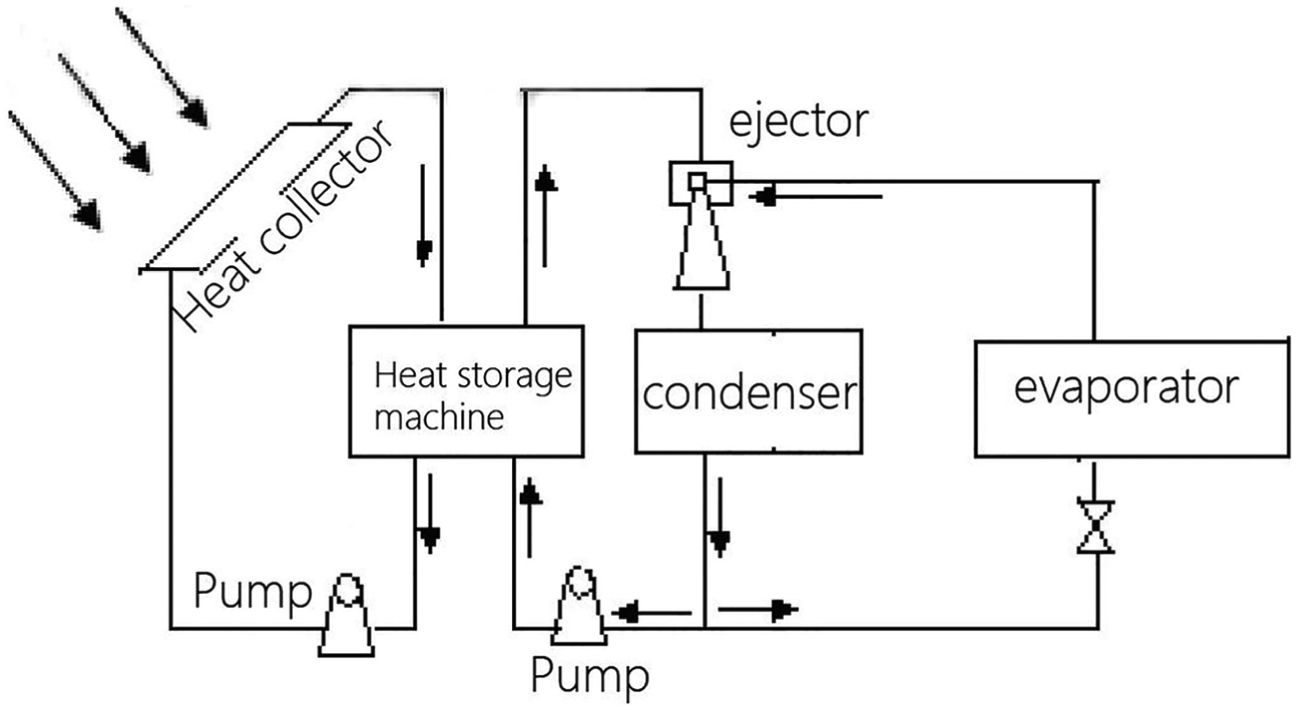
The principle of the solar-driven ejector air-conditioning system.
A lot of studies had been done to investigate the performance of the ejector cycles. Researchers used different refrigerants in the simulation and experimental, the investigation about the size of the ejector and the optimum collector to the solar-powered ejector system. Jia and Wenjian 81 did a search for the optimum area ratios for a 2 kW air cooled ejector cycle using R134a. They made a one-dimensional model to design the ejector cycle and studied the six different ejector throat areas by adjusting the position of the spindle. The results show that the cycle system cooling capacity was relevant with area ratios and nozzle diameters, and the system COP was linked to area ratios only.
X Ma et al. 82 modified the ejector with a spindle to control the primary flow. The results showed that when the spindle moved toward the nozzle, the primary distance was decreased, it decreased the system cooling capacity. They founded that an optimum area ratio could make an optimum entrainment ratio and COP. The special conclusion was that the increase in the generator temperature would not always increase the system efficiency.
W Zhang et al. 83 compared the performance of three different solar collectors when powered the solar ejector cycle for Mediterranean climate. The results showed that the heat pipe collector covered with the double glass would offer the best efficiency. Dennis and Garzoli 84 used TRNSYS to model a solar ejector cycle with different geometry ejector and cold storage system. They concluded that the cold storage system could reduce the bad effect of intermittent solar energy.
An experimental schematic diagram about an ejector cooling system with PCM cold storage system is shown in Figure 10. 85 X Chen et al. 85 experimentally investigated a PCM cold storage system integrated with ejector cooling system. The PCM storage tank was analyzed as a heat exchanger, and the effectiveness of the PCM storage tank was calculated at various mass flow rates. The experiment results indicated that the increase in the mass flow rate could lead to the decrease in the storage effectiveness. The system uses finned tube filled inside a PCM vessel. The whole system includes ejector cooling cycle and PCM cold storage charging and discharging cycle.

An ejector cooling system with PCM cold storage system. 85
The PCM cold storage charging system is coupled with the evaporator of the ejector cooling cycle. The PCM tank with finned copper tube is shown in Figure 11. The ejector cycles are simple to achieve and it is inexpensive compared to other cycles. The market share of the solar-powered ejector cooling system is not very high. The disadvantages limit the development. However, it is difficult to design the ejector. And the performance coefficient of the system needs to be improved. But the solar-powered ejector air-conditioning system has lower installation, operating costs and more stability operation.86,87

The PCM tank with finned copper tube in solar-powered ejector cooling system.
Solar-powered dehumidification air-conditioning system
Figure 12 88 shows the principle of the solar-powered dehumidification air-conditioning system. This system includes solid and liquid desiccant dehumidification system; this system mainly relies on desiccant dehumidification and evaporative cooling principle, and it can realize the latent heat load and sensible heat load rate separately. First, the fresh air is dried by the solid wheels. The temperature will be increased by the sensible heat exchange device. To keep the temperature being balance and reduce the air humidity, the low humidity of the air will enter the evaporative cooler firstly, then enter the room. Therefore the temperature and humidity can be controlled and regulated. And the regeneration temperature from the indoor air was returned of solar collector outstanding heating. The advantage of this system is no pollution and using low-grade energy. 89

The principle of the solar-driven dehumidification air-conditioning system. 88
Fong et al. 90 used TRNSYS to investigate six different configurations of solar desiccant cooling systems, direct current powered vapor compression cycle powered by photovoltaic panels or thermal panels, and an absorption cycle. In the end, this whole system saved the energy up to 35.2% compared to conventional air-conditioning system. Li et al. 91 studied the two-stage rotary desiccant air-condition of 169 m2 electronic plant in China. It was found that the system improves the indoor comfort directly in hot and humid climate conditions.
Beccali et al. 92 used TRNSYS to show the energy and economic analysis of different desiccant cooling systems. Three kinds of desiccant cooling systems were analyzed. The results showed that the system with heat pump had the best primary energy-saving effect. A solar-powered desiccant air-conditioning system with PCM was constructed at Tohoku University, Japan. An experimental schematic diagram of the system is shown in Figure 13. 93 During night, the cold storage system can store energy for daytime operation which makes the system effective using relatively lower price of electricity, which prevents total reliance on solar energy. The system was tested in winter season and was concluded that it can be operated both in day and night economically.

An experimental schematic diagram of a solar energy and electric-driven desiccant cooling system.
The solar-powered dehumidification cooling system are environmental friendly, using air as ventilation, doesn’t need to deal with the chemical solution. However, this system is not suitable for dry area. It is difficult to control the system in the dry area. This system requires maintenance due to moving parts in the rotor wheel of the solid desiccant system. The crystallization generally occurs in liquid desiccant systems due to poor process control. 94
Comparison of different solar-powered air-conditioning systems
In Table 1, the important characteristics of different types of solar-powered refrigeration systems are summarized. It reviews thermally powered cycles include absorption, adsorption, desiccant cooling, and ejector cycles. The comparison of advantages, disadvantages, cop, and application of different solar-powered air-conditioning systems are shown in Table 5.
Comparison of different solar-powered air-conditioning systems (reference to Pridasawas and Lundqvist). 95

According to the comparisons of solar-powered air-conditioning system, the ejector refrigeration is one of the most promising technologies because of its relative simplicity and low capital cost when compared to absorption refrigeration. Ejector refrigeration seems to be the most appropriate system for large-scale refrigeration. An ejector refrigeration system has a simple construction, few parts, and it is not subjected to chemical corrosion. It uses low-grade waste heat from power plants, incinerators, and industrial processes to generate useful refrigeration.96,97
Commercial market situation of solar air-condition system
Based on the report, Solar Thermal Utilization Market by Solar Heating & Cooling (SHC) Program, the report collected from 60 countries and covered 95% of the global market, the solar air-conditioning system has promising developments worldwide. China and the European markets have the largest solar energy utilization system. The vacuum tube collector with 71.1% of the market share is the leader in the heat collector technology. But as the owner of second largest solar energy utilization market, the most commonly collector is flat collector in the European market.
Regarding solar energy storage system, according to the report from Energy Trend, in 2013, Germany implemented a new subsidy bill, which used the solar air-conditioning system to be integrated with the energy storage system. Also, Japan cited to build the largest solar energy storage system in the world.
With regard to the observation of the global market research from the institution Energy Trend, to raise the durability and reliability of the renewable energy, the combination of the energy generation and storage will become the mainstream of the solar energy industry development.
In 2016, two companies from China and Denmark have established a new firm to specialize in cross-seasonal solar energy storage technologies. Thus, the solar air-condition system with the energy storage system is the development trend of the solar energy utilization technology. Taking European countries, as an example, Table 6 shows the market research of solar-powered air-conditioning system in European countries. 98
Market research of solar-powered air-conditioning system in European countries. 98

As noted in the reports, the current solar energy storage system is not widely applied, and the main considerations are the primary system cost, the capacity of the energy storage system, and the size of the whole system. Based on the PCM cold storage system’s features, it has advantages in the commercial market application.
Discussion and conclusion
The PCM cold storage working principles and features, as applied in the solar-powered air-conditioning system based on the preliminary study, were reviewed, including the PCM cold storage system, solar air-conditioning system, and the commercial market evaluation. The most common system is the solar energy absorption refrigeration that is integrated with the PCM storage system. With the current development, the solar-driven ejector system also has a bright potential with its relative simplicity and low capital cost.
In the air-conditioning systems, PCM slurries can be pumped directly as a secondary cooling medium into the air handling units or stored for load shifting. The high energy content of the slurry provides the significant reductions in the sizes of the pipes, pumps, and storage tanks, including the air handling and chilling costs compared with the conventional chilled water systems.
Research into TES for both cooling and heating continues, which has also been considered for waste heat recovery, energy generation, building energy conservation, and air-conditioning. Using PCM in the energy storage systems, heat exchangers and thermal control systems are potential techniques. A novel composite PCM has suitable thermal properties for the TES applications in energy buildings and condensation heat recovery. Applying forced convection (pumping) would be beneficial to the PCM cold storage system. The concept of energy-saving building envelope, which is used to guide the building envelope material selection and thermal performance, was designed.
A novel method, MEPCM, has been established. The coco fatty acid mixture, as the core material to prepare MEPCM, is a hot issue to study in the PCM field. It is more effective to be used in TES at low, especially in the solar-driven air-conditioning systems. The key question when analyzing PCM is charging/discharging rate and thermal conductivity. The inorganic high polymer as the shell material of the MEPCM has drawn people’s attention. It has potential essential applications in the areas of heating, ventilation and air-conditioning, refrigeration, and heat exchange.
For the absorption cycles, there exists a balance temperature in the regeneration for the whole cycles, which mainly depend on the solar collector and the machine size. The continuous cooling cycle combined with heat storage system has the highest COP compared with the traditional cooling cycles. The cycle equipped with heat pipes between the absorber and the generator could increase the system COP.
The adsorption cycle system heat source temperature requirement is lower than the similar cycle, so it is more appropriate to the solar energy. The compact adsorbent bed heat exchanger could improve the system performance. The optimization based on the COP has a lower switching frequency than the cooling capacity.
The ejector cycle system cooling capacity is relevant with the area ratios and nozzle diameters, and the system COP is linked to the area ratios only. The spindle moves toward the nozzle, as the primary spindle decreases. It causes the decline in the system cooling capacity. The heat pipe collector covered with the double glass would offer the best efficiency.
The dehumidification cycle with the heat pump has the best primary energy-saving effect. The system improves the indoor comfort directly in hot and humid climate conditions. The regeneration temperature from the indoor air is returned from the solar collector outstanding heating.
The combination of the energy generation and storage will become the mainstream of the solar energy industry development to increase the durability and reliability of the renewable energy. The current solar energy storage system is not widely applied based on the commercial analysis, where the main considerations are the primary system cost, the energy storage system capacity, and the whole system size.
For future research, it was proposed that the optimal design of solar-driven cooling system was influenced on the indoor space by PCM storage/release cooling dynamical control to improve the building thermal environment. The article could contribute in the exploration of the PCM R&D and solar-powered air-conditioning to improve the comfortable building thermal environment.
Footnotes
Academic Editor: Shuli Liu
Declaration of conflicting interests
The author(s) declared no potential conflicts of interest with respect to the research, authorship, and/or publication of this article.
Funding
The author(s) disclosed receipt of the following financial support for the research, authorship, and/or publication of this article: This project was funded by the National Natural Science Foundation of China (No. 51508352), Science & Technology Department Foundation of Sichuan Province, China (No. 2014GZ0052), and Science & Technology Department Foundation of Chengdu City, China (No. 2015-HM01-00244-SF).