




Abstract
In the past several decades, many literatures have emerged on the topic of phase change material and latent heat storage techniques used in building. Accordingly, it is essential to review previous work to know about phase change material application in building better. This article presents a review on phase change material application situations in building, and several aspects are discussed: phase change material major applications in building, phase change material application areas, phase change material application types, phase change material thermal–physical properties, and phase change material application effects. The results of this research show that phase change material application areas are mainly concentrated into four parts of north latitude from 25° to 60° and south latitude from 25° to 40°. No matter in which region, the use of paraffin is the broadest (the maximum use frequency is up to 87.5%). For organic phase change material, the melting temperature and the heat of fusion vary from 19°C to 29°C and from 120 kJ/kg to 280 kJ/kg, respectively. The best phase change material application effect found is a reduction of 4.2°C for air temperature in room. This study has important and directive significance for the practical application of phase change material in building.
Introduction
With the rapid economic growth worldwide, the supply of the overall energy consumption becomes tense gradually. 1 And the building sector’s energy consumption also rises with people’s higher demands in the indoor thermal comfort, accounting for a 30% share of the overall energy consumption. 2 Energy saving level of building depends on the pros and cons of envelop thermal performance. Therefore, it’s exceedingly necessary to improve the thermal performance of building envelop in order to achieve the goal of energy saving, and thermal energy storage (TES) is one of the best ways to improve thermal performance of building envelop. 3
Phase change materials (PCMs) are a series of functional materials taking advantage of high-energy storage density in a narrow temperature interval. Many literatures on PCM application in building have been published, but the articles are all focused on one point, such as materials’ study,4–6 performance strength,7–9 position optimization,10–12 PCM-based building heat recovery,13–16 and energy saving effects. Nevertheless, the main climatic regions and latitude ranges of PCM application in building and the PCM application types and major physical properties in different climatic regions cannot be found in a certain literature from previous research. Besides, PCM application effects in building (room thermal performance improvement, energy saving, and CO2 emission reduction) and the maximum improvement potential cannot be given systematically. Therefore, this article is intended to do an analysis and research on PCM application in building worldwide, including PCM major applications in building, PCM application areas, PCM application types in different climatic regions, PCM thermal–physical properties suitable for building, application effects of PCM integrated in building, and so on.
Source and categories of articles
Source of articles
According to the published articles on PCM integrated in building by 2016,3–157 a figure that shows the distribution of the publications from 2003 to 2016 is given in Figure 1. It can be seen that the interest of researchers in PCM is rising rapidly in recent years (articles in 2016 are not counted totally). The number of published articles from 2012 to 2015 is much more compared with the years 2003, 2005, 2006, and 2007 where less than three articles are published.

Distribution of the publications per year.
Figure 2 shows the distribution of the publications per journal. According to it, articles on PCM application in building can be found in 15 journals up to now, but most of the articles come from 7 journals mainly (the article number is greater than 5). Furthermore, the maximum number of articles has been published by the journal Energy and Buildings.

Distribution of the publications per journal.
Figure 3 presents the distribution of countries on PCM research around the world, The number of articles reviewed is approximately 114 and half of the articles are derived from China, the United States, and Italy. Additionally, nearly half of the countries studying PCM application in building are located in Mediterranean climate region.

Distribution of the countries on PCM research worldwide.
Categories of articles
The distribution of article categories concerning the publications is given in Figure 4. According to the figure, first, we can see that the review articles represent about 13% of the total amount of articles;17–29 it should be noted that the 13 review articles aim at the general problem of TES using PCM. Additionally, experiment studies, which account for the largest proportion, mainly deal with the development and evaluation of PCM in laboratory, and studies in real outdoor conditions are relatively less. Furthermore, 37% of the articles are defined as numerical simulation and 10% articles deal with both experiment and numerical modeling. Finally, it is worth mentioning here that scarcely any study, experimental or numerical, verifies the evaluation of PCM in real outdoor conditions.
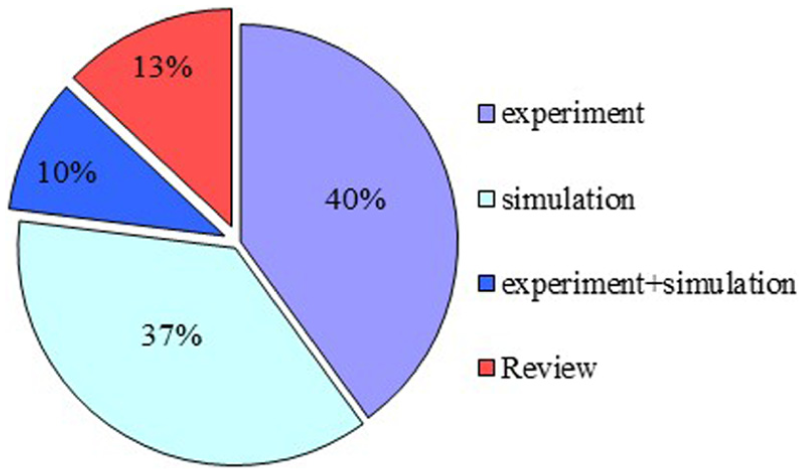
Distribution of the article categories.
PCM major and common applications in building
PCM applications in building are prevailingly divided into two large classes—passive and active systems. Passive system achieves the functions of collecting, storing, and releasing heat by building structure itself. However, active system needs to rely on pumps or fans to convey heat transfer medium.
Basically, three different ways to use PCMs for heating and cooling of building are as follows: 25
PCMs in building walls;
PCMs in building components other than walls, such as floor and ceiling;
PCMs in heat and cold storage units located in building interior instead of envelope, such as storage heat/ice tank.
PCM major applications for latent heat thermal energy storage (LHTES) in building are as follows.
PCM walls
First, it should be pointed out that “PCM walls” here is generalized. Among the articles published on PCM integrated in building, the authors include PCM trombe walls, PCM wallboards, and PCM building blocks together which are collectively called as PCM walls. In fact, the principle is to make PCM or PCM building blocks become a part of wall structure, resulting in building walls with a large thermal inertia without the large mass associated with it. Ghoneim et al. 30 and Chandra et al. 31 studied south-facing trombe wall and its PCM was sodium sulfate decahydrate (melting point of 32°C). The results show that trombe wall with PCM of smaller thickness was more desirable in comparison to an ordinary masonry wall for providing efficient TES. Shapiro et al. 32 investigated methods for impregnating gypsum wallboard and other architectural materials with PCM, and several workers investigated methods for impregnating gypsum and other PCMs.33–35
Floor heating system
Floor is also an important part of a building, and heating and cooling of a building are tried using it. The principle of floor heating system is roughly to adopt PCMs to gain the effects of high energy storage density with constant temperature. When the electric demand is low at night, PCMs charge. However, PCMs discharge in peak at day. Thus, the floor heating system can avoid on-peak electric demand, meanwhile, it has the following advantages: small indoor temperature fluctuation and high indoor comfort.
K Lin et al.,36–38 Tsinghua University, Beijing, China, analyzed the thermal performance of a room applying a new kind of under-floor electric heating system with shape-stabilized PCM plates. A prototype room with this system was set up in Beijing to testify the feasibility of this heating mode. A kind of shape-stabilized PCM plates were used, which consist of 75 wt% paraffin as a dispersed PCM and 25 wt% polyethylene as a supporting material. The paraffin’s phase transition temperature is 52°C and its heat of fusion is about 200 kJ/kg. The results show that for the test room, 3.3 kW h electric heat energy was shifted from the peak period to the off-peak period every day, which was 54% of the total heat consumption. The schematic of electric floor heating system with shape-stabilized PCM plates is given in Figure 5.

Ceiling boards
Ceiling boards are important part of the roof, which are utilized for heating and cooling in a building and can be used in either passive storage system or active storage system. In passive storage system, generally, the considered physical systems are panels filled with PCM and placed in between the roof top slab and the bottom concrete slab.39,40 However, there are also building roof with conical holes containing PCM which can allow the PCM to expand during the melting process without affecting the roof structure. EM Alawadhi and HJ Alqallaf, 41 Kuwait University, studied a building roof with conical holes containing PCM to reduce the cooling load by absorbing the incoming energy through the melting process in the roof before the energy reaches the indoor space. The results indicate that the heat flux at the indoor surface of the roof can be reduced up to 39% when the PCM is introduced in the roof.
In active storage system, Kodo and Ibamoto 42 researched the effects of a peak shaving control of air conditioning systems using PCM for ceiling boards in an office building. A micro-capsulate PCM, with a melting point of about 25°C, is used. Figure 6 shows the outline of the system, during nighttime, the cool air from the air handling unit (AHU) flows into the ceiling chamber space and chills the PCM ceiling board, thus, coolness is stored in PCM using cut-rate electricity (Figure 6(a)). During normal cooling time, the cool air from the AHU flows directly into the room (Figure 6(b)). During peak shaving time, when the thermal load peaks, the air from the room returns to the AHU via the ceiling chamber space. As a result of passing through the cooled-down PCM ceiling board, the warm air returning from the room is precooled on its way back to the AHU (Figure 6(c)).

Schematic diagram showing outline of ceiling board system having PCM: (a) overnight thermal storage time, (b) normal cooling time, and (c) peak shaving control time. 42
Air-based heating system
Morrision and Abdel Khalik 43 and Jurinak and Abdel Khalik 44 studied the performance of air-based solar heating systems adopting phase change energy storage unit. The main objectives of their work were as follows: (1) to determine the effect of the latent heat and melting temperature of PCM on the air-based solar heating system and (2) to develop empirical model of significant phase change energy storage units. Air-based heating system is the active storage system and adopts air as heat transfer medium. The thermal storage unit usually consists of several layers of PCM slabs placed parallel to each other. Air flows through the passages between PCM slabs. The schematic of thermal storage unit is given in Figure 7.45,46

The air-based heating system generally utilizes the existing roof as a solar collector/absorber and incorporates a PCM thermal storage unit to store heat during the day and releases it to the living space during the night or when there is no sunshine. What is more, an auxiliary heater is very necessary in this system. Then a schematic of standard solar air-based heating system is shown in Figure 8. 25

Schematic of a standard solar air-based heating system. 25
Free-cooling system
Using PCMs to store coolness has been developed for air conditioning applications. Free-cooling system, in short, is a combination of mechanical ventilation system and latent heat thermal energy storage system. Its basic principle is that coldness is collected and stored from ambient air during the night and is relieved to the room during the day. At night, the cool outside air is drawn in and passed over the heat pipe using the ceiling fan blowing downward. The warm air is let out through the exit vent. During the daytime, vents are closed and ceiling fan blows air downward to cool the room. Even if some different system forms appear in the past research on free cooling, they are all based on the same principle. 17 Then a schematic of free-cooling system proposed by Yanbing et al. 47 is presented in Figure 9.

Schematic of free-cooling system proposed by Yanbing et al. 47
PCM shutter
Based on the fact that windows play an important role in heat loss in building, the concept of PCM shutter is raised to reduce the heat loss caused by windows. Because of the weak insulation property of glass, large amount of heat gets into the room through the glass during the day in summer. Similarly, windows become the main source of heat loss during the night in winter.
The PCM shutter usually adopts multilayer glazing system with the cavity filled with PCM and makes full use of the functions of absorbing heat and releasing heat of PCM to adjust the heat flow.48,49 F Goia 48 studied thermo-physical behavior and energy performance assessment of PCM glazing system configurations. Various triple glazing configurations, where one of the two cavities is filled with PCM, are simulated, and PCM melting temperatures are investigated. The result shows that the location of the PCM layer and the nominal melting temperature of the PCM have a relevant influence on the thermo-physical behavior of the PCM glazing system
PCM application situations in different climatic regions
PCM application areas
To reach the best effects of energy saving, some important factors must be considered in the process of applying PCM in building, such as building structure, climate, environment, and the purpose of using. There are different climatic features in different climatic regions, so application effects of PCM in building are not the same. According to many articles on PCM applied in building, the application areas of PCM across the world are summarized and surveyed, and then a world map with different climatic subareas, which describes the PCMs used in different cities of different countries worldwide, is shown in Figure 10. It can be seen clearly that the application areas are mainly concentrated into four parts of north latitude from 25° to 60° and south latitude from 25° to 40°: some cities of European Union major member countries, some coastal cities of East Asian countries, some cities of south-eastern Australia, and some cities of Southeast of North America, respectively. Moreover, it should be noted that the cities located in European Union major member countries and East Asian countries are listed from north to south instead of being marked individually owing to the number of cities is very large. That is to say, the city numbered 1 indicates that its latitude (north latitude) is maximum in this centralized application area.

The application area of PCMs across the world.
PCM application types
Several main PCMs—paraffin, fatty acid, hydrated salt, eutectic, integrated in building envelope—are described in the world map with different climatic regions. Figure 11 indicates the use frequency of different types of PCMs in different areas worldwide. First, it can be seen that the use of paraffin is the most frequent no matter in which regions, and the maximum use frequency is up to 87.5%. It may be based on the reason that paraffin mixtures in different mass proportions have a wider phase change temperature range and higher phase change latent heat. So paraffin mixtures can be used in different thermal storage fields by adjusting the mixed proportion. Furthermore, in the surrounding area of the United States/Canada, fatty acid is also a kind of important PCM and can reach a proportion of 27%. Finally, it should be noted that eutectic is used least. Although there are some limitations, it also has some representativeness.

The use frequency of different kinds of PCMs in different areas worldwide.
PCM thermal–physical properties suitable for building
As heat storage materials in building, PCMs must possess certain desirable thermo-physical, kinetic, chemical, technical, and economic characteristics. But it must be noted that there are scarcely any PCMs that can meet all desirable criteria. 50 In a practical application, thermo-physical properties such as melting temperature, latent heat of fusion, thermal conductivity, and density of solid and liquid are the prior considered factors. And then additional measurements will be taken to make up for relatively poor properties of picked materials, for example, introducing a nucleating agent to avoid super-cooling and using fin designs or graphite to increase thermal conductivity of PCMs.28,51,52 When selecting PCMs integrated into building, melting temperature should be matched to the desired operating temperature like indoor design temperature and human comfort temperature range. The latent heat of fusion per unit mass should be as high as possible, so that less amount of material could store the required amount of energy and a smaller material container can be used. The heat transfer during fusion or solidification depends on the thermal conductivity of the solid and liquid PCM, thus, high thermal conductivity is beneficial and assists the rate of heat charge and discharge. High specific heat is also needed to provide additional sensible heat, since PCMs change temperature during operation. The density of PCMs is important, and high density is desirable so that less volume will be occupied by materials. Congruent melting of PCMs is required. The materials should melt completely, so that the liquid and solid phases are homogeneous. What is more, small volume changes during phase transition and a low vapor pressure at the operational temperature are also the selection criteria to avoid containment problems. The thermal properties of main PCM suitable for building discovered in the literature are listed in Tables 1–3.
Thermal properties of paraffin suitable for building.
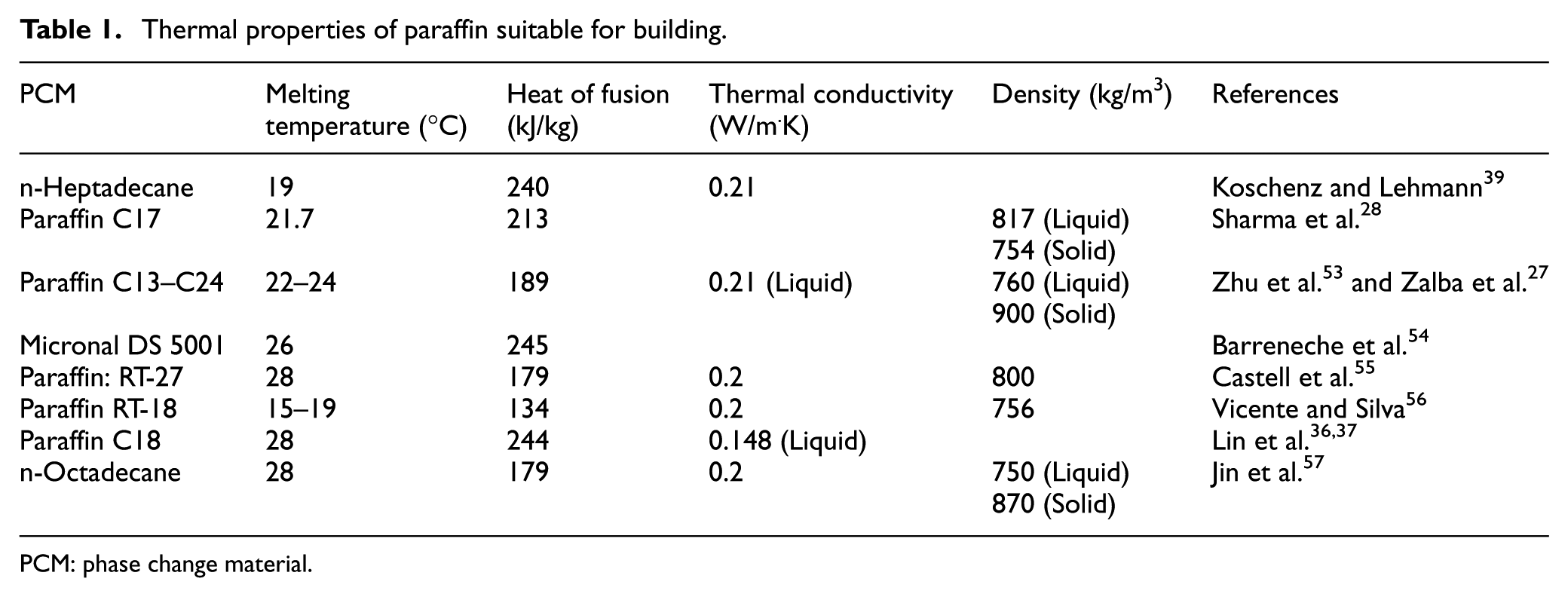
PCM: phase change material.
Thermal properties of fatty acids suitable for building.

PCM: phase change material; CA: capric acid; CADE: capric acid and 1-dodecanol; MA: myristic acid; SA: stearic acid; LA: lauric acid; EG: expanded graphite; PA: palmitic acid.
Thermal properties of hydrated salts suitable for building.

PCM: phase change material.
Application effects of PCM integrated in building
The search for a reasonable balance about comfort level, energy consumption, and environment is a constant theme in architectural design and building energy saving field. The integration of PCM and solar energy provides an effective method to improve thermal comfort and reduce energy consumption and negative effects to environment.
In building application, PCM composite enhances the human thermal comfort according to three main reasons as follows: 79
The PCM included in the walls strongly reduces the overheating effect (and the energy stored is released to the air room when the temperature is minimum).
The wall surface temperature is lower when using PCM wallboard, and then the thermal comfort is enhanced by radiant heat transfer.
The natural convection mixing of the air is also enhanced by PCM, avoiding uncomfortable thermal stratifications.
After applying PCM to building, the application effects are reflected in room thermal performance improvement, energy saving, CO2 emission reduction, and so on. The improvements of room thermal performance include thermal amplitude reduction and a delay or reduction in the peak heat flux mainly. The synthesis of the results found in the literature concerning energy savings and peak load reduction resulting from PCM integrated in building is given in Table 4. From it, we can see that the best PCM application effect for air temperature in room is a reduction of 4.2°C. For average peak heat flux, a reduction of more than 20% has already been achieved by most researches. What is more, the maximum time delay of the peak heat flux/temperature found in the literature is about 6 h.
Energy savings and peak load reduction in the literature.

PCM: phase change material. PCMOM: PCM panels on the outer surface of walls and roofs; PCMIM: PCM panels on the inside surface of walls and roofs.
Conclusion
This article is focused on PCM application situations in building all over the world, including PCM major applications in building, PCM application areas, PCM application types in different climatic regions, PCM thermal–physical properties suitable for building, and application effects of PCM integrated in building. According to the several main aspects, some new findings can be obtained as follows:
The number of articles reviewed is approximately 114, and half of the articles are derived from China, the United States, and Italy. Additionally, nearly half of the countries studying the PCM application in building are located in Mediterranean climate region.
There is scarcely any study, experimental or numerical, that verifies the evaluation of PCM in real outdoor conditions. Therefore, more studies focusing on real full-scale buildings and real operation conditions should be carried out to prove the authenticity and reliability of current research.
PCM application areas are mainly concentrated into four parts of north latitude from 25° to 60° and south latitude from 25° to 40°: some cities of European Union major member countries, some coastal cities of East Asian countries, some cities of south-eastern Australia, and some cities of Southeast of North America, respectively.
For PCM application types in different climatic regions: the use of paraffin is the broadest no matter in which region and the maximum use frequency is up to 87.5%. In addition, in the surrounding area of the United States/Canada, fatty acid is also a kind of important PCM and can reach a proportion of 27%.
For PCM thermal–physical properties suitable for building: the range of melting temperature varies from 19°C to 29°C for organic PCM and from 25°C to 35°C for inorganic PCM approximately, the heat of fusion is almost within the scope of 120–280 kJ/kg no matter which kind of PCM, the thermal conductivity is close to 0.2 W/m·K for organic PCM and 0.6 W/m·K for inorganic PCM, and the range of density is from 700 kg/m3 to 900 kg/m3 for organic PCM and from 1300 kg/m3 to 1800 kg/m3 for inorganic PCM.
The best PCM application found for air temperature in room is a reduction of 4.2°C. For average peak heat flux, a reduction of more than 20% has already been achieved by most researches. What is more, the maximum time delay of the peak heat flux/temperature found in the literature is about 6 h.
A series of research results can have important and directive significance for the practical application of PCM in building.
Footnotes
Academic Editor: Shuli Liu
Declaration of conflicting interests
The author(s) declared no potential conflicts of interest with respect to the research, authorship, and/or publication of this article.
Funding
The author(s) disclosed receipt of the following financial support for the research, authorship, and/or publication of this article: This study was supported by National Natural Science Foundation of China (Major Program; no. 51590912), National Natural Science Foundation of China (General Program; no. 51378025), and the Ningbo Enrich People Project (2016C10035), funded by Ningbo Science and Technology Bureau.