




Abstract
As an economical, efficient, and safe material transmission method, pipeline has an irreplaceable role in the petroleum chemical and natural gas industry. There will be a variety of mechanical damage in pipelines due to unknown or known factors, and the dent is the most typical form of mechanical damage. According to the service oil and gas pipeline with type I dent, a simplified calculation model of shell and tube was chosen. The rings and generators in the model were analyzed in the equilibrium state, and the internal pressure was taken into account. Finally, the analytical expression between external force and the indention depth of type I dent was concluded, which can be used to analyze the response of the pressure pipe to the external force, and provides a theoretical guidance for maintaining pipeline in service.
Introduction
Oil and gas are important components of the entire industrial system and the state’s strategic resources, and the safety of their storage and transportation process must be reliably protected. The consequences of failure of oil and natural gas pipelines are very serious, leading to pay more attention to the safety of pipelines by researchers worldwide. Defects on the pipeline are one of the most main causes of pipeline accidents, and the dent is one of the common types of defects on the pipeline.1–3 According to the US Department of Transportation report, 4 pipeline mechanical damage is one of the most important causes of pipeline accidents. Therefore, it is important to study the extent of pipeline damage under external forces.
Dent defect in pipeline is a complex research topic, which involves the geometry and material science. Pipeline mechanical damage has been the focus of the pipeline industry since the mid-twentieth century. Mechanical damage to the pipeline in service was mainly caused by third-party construction. Mechanical damage includes wear, spalling, dents, and chisel marks.5,6 The dents are considered to be one of the most important damages due to the fact that the external forces such as sharp rock or excavation equipment produce a concentrated load or the distributed load on the outer wall of the pipe to produce plastic deformation, leading to a localized stress concentration.7–9 Dents on the pipeline in service will provide conditions for the formation of cracks. In addition, dents on the pipeline under the action of pressure will appear as cracks. The cracks will be further extended over time, and the dent will be tired. This process will bring great harm to the safe operation of the pipeline further. At present, some researchers for dent on pipeline have been conducted using different methods such as experiment, theoretical derivation, and numerical simulation. Wierzbicki and Suh 10 indicated that most of the strength of pipeline was related to the deformation mode of the ring by carrying out experiment on buckling in pipelines. Wierzbicki and Suh 10 have presented a simplified calculation model of shell and tube. The model consisted of a series of discontinuous rings and a group of trusses. However, it is necessary to obtain a relatively complete theoretical and analytical solution by some simplifying assumptions. Therefore, based on the simplified models, in our article, the rings and generators in the model of in-service pipeline have been analyzed in the equilibrium state, by taking the internal pressure into account. The analytical expression between external force and the indention depth of type I dent has been concluded.
Establishing the pipeline model with type I dent
Model establishment
It is assumed that the type I dent is formed by pressing the pipe by vertical pipe axis of the major axis of round stick, as shown in Figure 1. So the type I dent is defined as the dents formed by the long axis of the round stick and the angle of the pipe axis at 90°.

The dent shape with type I.
The deformation of dent in pipeline is shown in Figure 2. As a result of local deformation of the pipeline to release the energy absorbed by the pipeline shell, the global deformation can be neglected for pipelines laid in their trench. 11

Deformation detail of the pipeline with type I dent: (a) plan of deformation zone, (b) the profile of AB, (c) profile of the whole deformation, and (d) profile of the deformation section.
The actual deformation analysis shows that the local deformation region is composed of three regions: the middle of the dent area and the both sides of the triangle area as shown in Figure 2(a), where R is the radius of pipeline. Figure 2(b) and (c) shows the AB profile and the overall deformation profile, respectively.
The length of the dent area
Simplified shell model
To obtain a simplified shell model, we make the following hypothesis:
The local deformation region is composed of three regions: the middle of the dent area and the both sides of the triangle area as shown in Figure 2(a).
The cross-section of the shell deformation zone is regarded as a combination of plane and circular. There is no distortion and the pipeline is not oval beyond the dent-affected zone. 10
All the cross-sections will undergo rigid translation and torsion except for the crushing.
The shell calculation model is established according to the above assumptions, as shown in Figure 3(a) and (b). The rings and generators are loosely connected as shown in Figure 3(c). 10

The shell calculation model: 10 (a) a series of unconnected rings, (b) a bundle of unconnected generators, and (c) the connection of rings and generators.
It is required that the lateral displacements of the two one-dimensional model structures are the same to ensuring the coordinated deformation of the rings and generators. So the lateral deformation is coordinated, but the shear stress cannot be resisted.
10
The rings are inextensible,

where

where the first term on the right-hand side is the crushing energy of the two triangular deformations outside the indentation, the second term on the right-hand side is the crushing energy of the central dented zone, and
The hinges were regarded as rigid-plastic beams in the model which can bend and the tensile deformation increases with the dent depth. By assembling the dissipation energy of all generators, we can get an expression for the total tube axial deformation energy

where
The analysis of the pipeline with type I dent
Crushing of rings
According to the previous hypothesis, the ring is not stretched so that the sum of the half length of the smoothing zone and the two arcs length are constant and equal to the one half of the initial circumference of the ring, as shown in equation (4)

where
The rotational speed of two hinges can be known from equation (3)

where

As the hinges will move along the ring, the curvature of the two arcs

where

Assuming that the position of the hinge in the present is

where

The product of the crushing energy can be regarded as instantaneous crushing force

where
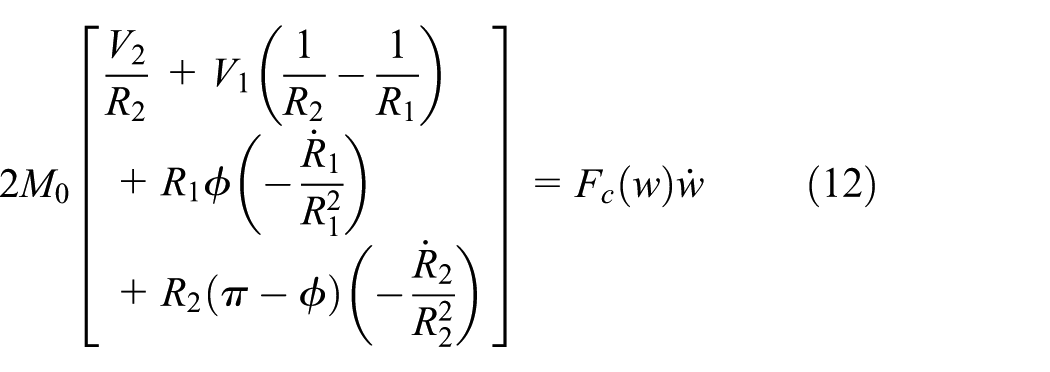
It appears that the asymmetric deformation mode of the ring is more in line with the actual situation when

The displacement of the main generator of AB plane is shown in Figure 2(b). According to the large deformation analysis of the rigid-plastic beam, we assume that the velocity of the main generator varies linearly with


We will move the origin to the junction area between the dented zone and the deformation zone in order to calculate simply. The range of
The total crushing energy of ring in the entire deformation zone is

where the first term on the right-hand side is the crushing energy of the deformation zone outside the dented zone, and the second term on the right-hand side is the crushing energy of the deformation zone of the dented zone. According to the previous analysis, the crushing energy can be drawn as

where
Deformation of generators
The global strain rate is decomposed into three parts

The first term on the right side of equation (18) represents the strain rate of the deformation zone outside the dented zone, and the second term represents the strain rate of the dimple zone. The strain rate

The strain rate

The contribution of the single generator to the dissipated power during the application of the load is given by the linear velocity field described by equation (14) and the first term in equation (18)

where

where
It is worth noting that the ring in the deformation is outside the dent, and the change of the generator curvature and circumferential curvature of the ring are very small. Therefore, we can ignore the pipe axial bending energy rate. The dissipated energy of the generator due to local loading is equal to the energy generated by the stretching of the pipeline deformation zone. According to the beam-like theory, the pure axial strain rate can be obtained as

where
The total dissipated energy of the generator is

where
Analysis of internal pressure in pipeline
Oil and gas pipeline will withstand a variety of different magnitudes of operating pressure in operation that it is internal pressure. When the round stick pushes the pipe shell down, the pressure, p, will resist the pipe shell downward movement and try to push the shell up. The energy rate of resistance work by the internal pressure, p, is 11

where

And according to the previous analysis, the following expression is obtained

Force–deformation relationship
According to the principle of virtual work, the rate of external work can be balanced by the rate of internal energy dissipation 10

where
In the absence of torque, the power of the external energy change is expressed as follows

where
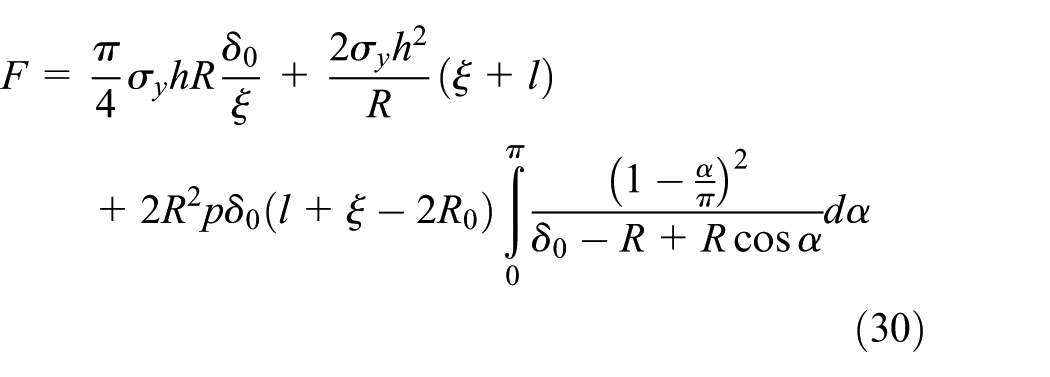
When the pipe radius R, wall thickness h, yield stress

Substituting equation (31) into equation (30), we can obtain the expression of
Results and discussion
Smith 12 reported on carefully executed indentation tests on full scale and model tubes with almost identical length-to-diameter and diameter-to-thickness ratios. Wierzbicki and Suh 10 compared the theoretical solutions, theoretical profile, and experimental data based on the results of these experiments, as shown in Figure 4.

Theoretical and experimental profile of the leading generator in the damaged zone.
The circle in Figure 4 represents the measured value of the leading generator, the solid line represents the present theoretical solution, and the triangle represents the corrected actual profile. From Figure 4, we can see that the three results are more consistent. Therefore, the hypothesis of the computational model of the tube is basically correct.
According to the analysis result of pipeline with type I dent, theoretical results from equations (30) and (31) are plotted in Figures 5 and 6 for two pipes. The pipe radius R and shell thickness h are

Indenting force–dent depth relationship for X52 pipes with 800-mm diameter and 10-mm thickness.

Indenting force–dent depth relationship for X60 pipes with 800-mm diameter and 10-mm thickness.
It can be seen from Figures 5 and 6 that the indenting force increases with the increase in dent depth. The pressure has a large influence on the pipeline resistance to the external forces. The indenting force increases with the increase in pressure under the same dent depth.
Conclusion
Through the theoretical analysis of pipeline with type I dent under the external force, the main conclusions are as follows:
According to the classical theory and pipeline simplified calculation model, the theoretical analysis and calculation model of type I dent was established.
An analytical expression between F and the indention depth
Footnotes
Appendix 1
Acknowledgements
Y.W. and P.Z. carried out the dent of pipeline studies and drafted the manuscript. P.J. has deduced the theoretical model. All authors read and approved the final manuscript.
Academic Editor: Filippo Berto
Declaration of conflicting interests
The author(s) declared no potential conflicts of interest with respect to the research, authorship, and/or publication of this article.
Funding
The author(s) disclosed receipt of the following financial support for the research, authorship, and/or publication of this article: This research was supported by grants from the National Natural Science Foundation of China (No. 50974105), Scientific research starting project of SWPU (No. 2015QHZ024), and State Administration of Work Safety (Sichuan-0016-2016AQ).