




Abstract
This article investigates the dynamics of a Cournot triopoly game whose demand function is characterized by log-concavity. The game is formed using the bounded rationality approach. The existence and local stability of steady states of the game are analyzed. We find that an increase in the game parameters out of the stability region destabilizes the Cournot–Nash steady state. We confirm our obtained results using some numerical simulation. The simulation shows the consistence with the theoretical analysis and displays new and interesting dynamic behaviors, including bifurcation diagrams, phase portraits, maximal Lyapunov exponent, and sensitive dependence on initial conditions. Finally, a feedback control scheme is adopted to overcome the uncontrollable behavior of the game’s system occurred due to chaos.
Introduction
Mathematical models which describe the oligopoly dynamics of firms’ competition have got much attention of researchers due to their important characteristics in analyzing competition patterns and market control for a long time.1–10 Oligopoly games are now widely used by different sectors of mathematicians and economists in order to extract more information and understanding of market structure using dynamic modeling. In the last three decades, many reports have been appeared to discuss such competition among firms within market. The convergence to the equilibrium position is a significant target to all those games and is sought from microeconomics practices by which economic relationships among competed firms are reduced to straight lines. Handling nonlinear duopoly and triopoly models using numerical simulations has leaded to some important features about market structure. These features have shown that there are two active economic forces by which market is influenced. The first kind is that the intersection of reaction functions is the main aspect by which the game’s system goes to the equilibrium position and hence it can be determined. The second one is due to chaos appeared because of the sensitive dependence on initial conditions. To the reader’s information, the later is negligible by economists. 10 The dependence on initial conditions moves the game’s system to the Cournot–Nash equilibrium and after that the system deviates from that point and enters the region of chaos due to bifurcation. All the above kinds discussed are obtained because of the desire of producers to make their profit maximized. Maximization of profit is the basis for competition games. Stability and instability in oligopoly have been investigated by Furth. 11 The stability of best reply and gradient systems with applications to imperfectly competitive models has been discussed in the work by Corchon and Mas-Colell. 12 Bischi and Naimzada 13 studied the dynamic properties of bounded rationality duopoly game. Agiza and Elsadany14,15 have presented duopoly games with heterogeneous players, and in particular they analyzed the nonlinear dynamics emerging in these kinds of games. Nonlinear oligopolies have been surveyed by Bischi et al. 16 Dubiel-Teleszynski 17 analyzed a heterogeneous duopoly game with adjusting players and diseconomies of scale. Further studies assume that games have different demand or price function,18–20 number of firms,21–25 and behavioral assumptions.26–30 In the work by Cavalli and Naimzada, 31 a model of monopolistic firm is presented and studied on different time scales based on a piecewise continuous differential equation. An investigation of the elasticity effect on the local stability of the equilibrium position has been handled by Cavalli and Naimzada. 32 The corresponding continuous case of a discrete monopoly game has been studied in the work by Matsumoto and Szidarovszky. 33 In the work by Matsumoto and Szidarovszky, 34 some static and dynamic characteristics of a monopoly model have been examined.
The main contribution of the article is to study the effect of log-concave demand function structures in a triopoly quantity setting game. Our aim in this article is to investigate the dynamics of bounded rationality triopoly game with a log-concave demand function. In addition, the other objective of the article is to analyze the stability/instability of the proposed game in order to detect the regions where chaos can be detected. We present state variables feedback and parameter variation methods to control chaos in the game.
The general scheme of this article is as follows. In section “Model,” we introduce a bounded rational dynamic system of a Cournot triopoly game. In section “Stability of the model’s steady states,” we investigate the local stability of the steady states of the proposed game. In section “Dynamic analysis of game (5),” we confirm the obtained results with numerical simulations. In section “Chaos control,” a chaos control scheme is used to control the game’s system. Finally, some concluding remarks are highlighted.
Model
In this article, we handle a model of an economic market whose competition is between three firms. Let the price and the quantity are given by

where

where the positive parameter

In triopoly game, each firm wants to maximize its profit. So, the marginal profit of firm

So, as to get the maximum profit, every firm carries out the output decision-making. In this work, we consider that three firms are bounded rational to adjust their output of production which depends on a local estimate of the marginal profit

where the parameters
Stability of the model’s steady states
This section calculates the steady state points of the system (5) and studies the asymptotic stability of them. From an economic perspective, we are only interested in studying the local stability properties of the non-negative steady states which are determined by setting

One can obtain the following seven steady states of dynamic system (5)

where

Obviously, the steady states
We note that the steady states

To study the local stability of steady states of the game (5), we calculate the Jacobian matrix of the three-dimensional map (5). The Jacobian matrix is given by

where

A steady state of game (5) is locally stable if all eigenvalues
Stability analysis of the boundary steady states
Theorem 1
If the steady states
Proof
At the boundary steady state
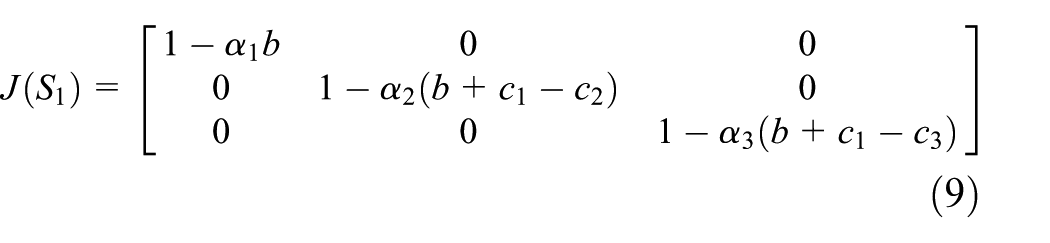
The eigenvalues of

Since the parameters
Theorem 2
The steady states
Proof
The Jacobian matrix evaluated at the steady state

where
Stability of Cournot–Nash steady state
Now, we investigate the stability of Cournot–Nash steady state
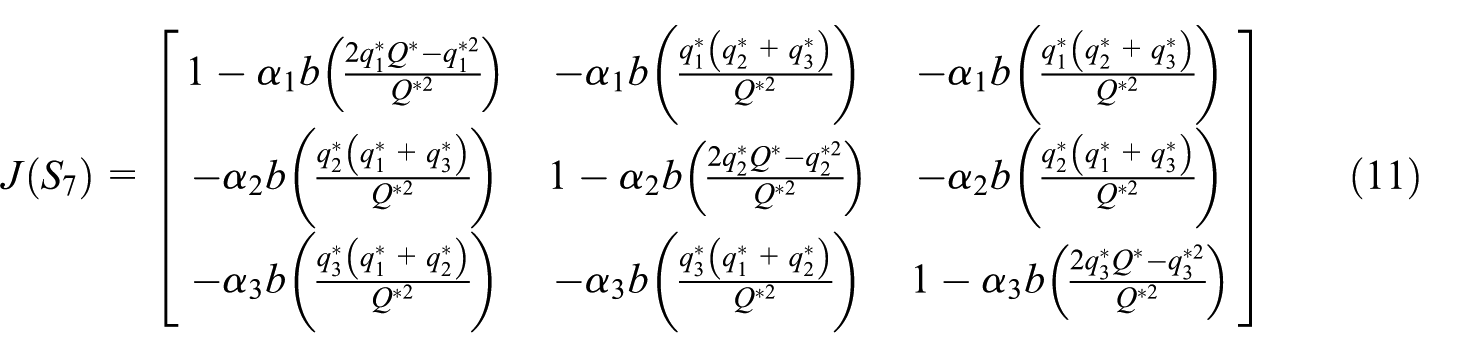
where

with the coefficients
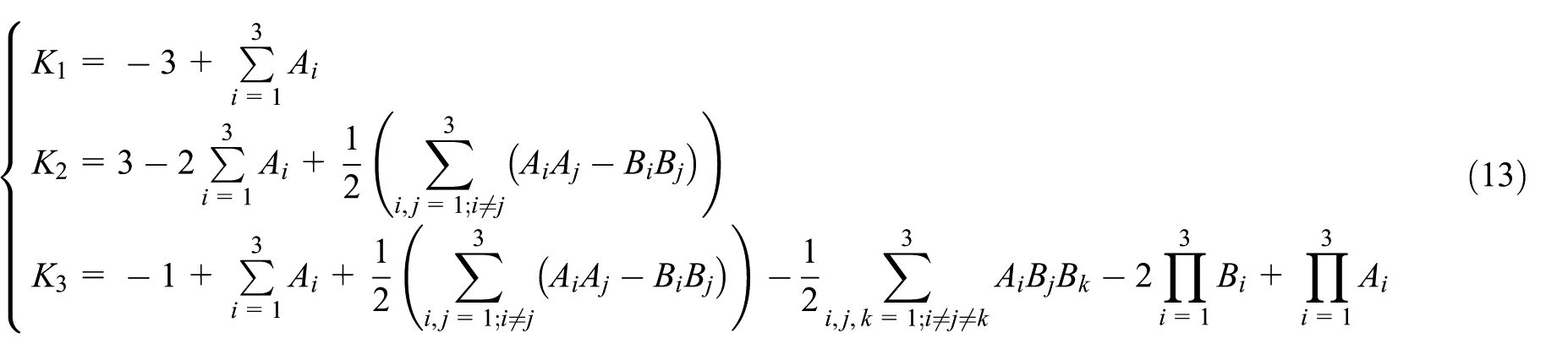
where

According the Jury’s criteria,
35
the interior Cournot–Nash steady state

We have proved that the positivity of the Cournot–Nash steady state implies that the others boundary steady states are locally unstable. Obviously, the interior Cournot–Nash steady state is stable in the regions defined by equation (15), otherwise unstable.
Dynamic analysis of game (5)
In this section, we show some simulations of the qualitative behavior of the solutions of the proposed triopoly game which is described by the dynamic system (5). We present various numerical results here to confirm the complex dynamics including its bifurcation diagrams, maximal Lyapunov exponent, and sensitive dependence on initial conditions. We give the bifurcation diagrams, phase portraits, and maximal Lyapunov exponents of game (5) to approve the previous analytical results and show some new interesting complex dynamic behaviors existing in game (5). The complex dynamic system is characterized by the possibility of order and chaos, which can exist either separately or simultaneously. One fundamental characteristic of an ordered dynamic system is that for arbitrary initial conditions, after going through a transient period, the system approaches a periodic behavior with a predictable periodicity. The chaotic dynamics is characterized by exhibit behavior that depends sensitively on the initial conditions, also long-term prediction is impossible. The fundamental characteristic of chaotic dynamics is its sensitivity to initial conditions. Its measure is the maximal Lyapunov exponent, which is the exponential rate of divergence of nearby orbits in phase space. Theoretically, the Lyapunov exponent is negative for systems with stable fixed points or stable cycles and positive for chaotic dynamics.
Figure 1 shows a bifurcation diagram of the output evolution of triopoly game (5) with
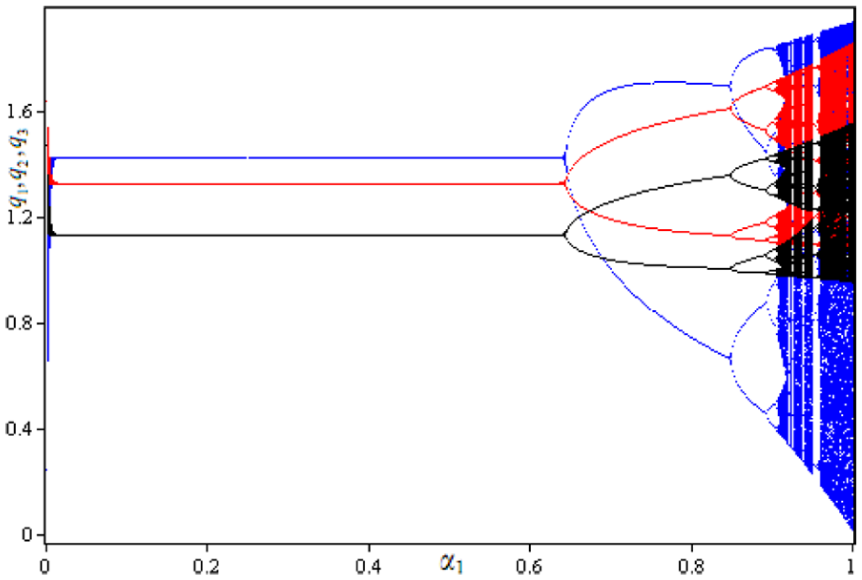
The bifurcation diagram of game (5) with respect to

Phase portraits of the game (5) in the two-dimensional plane.

Maximal Lyapunov exponent for the solution of Figure 1.
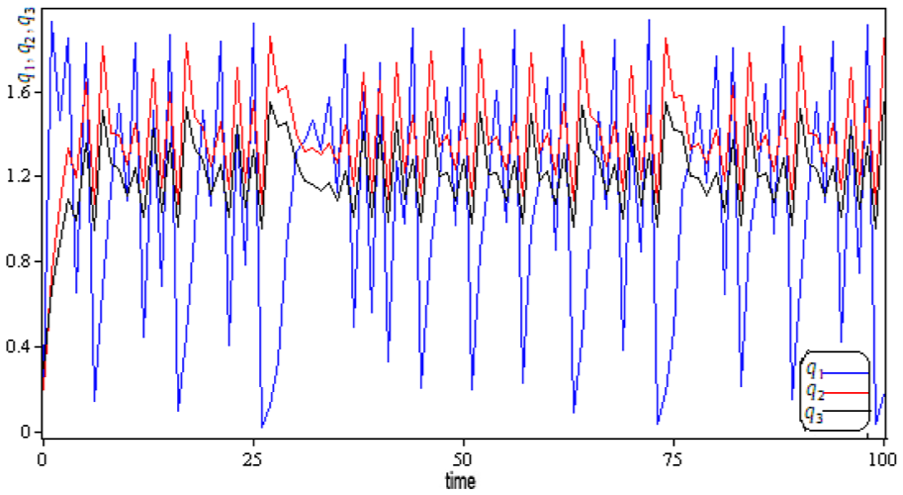
Time series solutions of the game (5).

The sensitive dependence on initial conditions, the two orbits for q1 coordinates.
Chaos control
The occurrence of chaotic dynamics in the Cournot game is unacceptable and harmful. So, the companies are hoping to find some methods to control chaos in Cournot game to avoid the complexity in the game. Many methods have been used to control chaos in oligopoly games. For example, chaos controlling with Ott, Gebogi and Yorke (OGY) method in the Kopel–Cournot game was achieved in the work by Agiza. 36 Du et al. 37 studied chaos control with modified straight-line stabilization method in a Cournot duopoly game. Chaos control with time-delayed feedback method in an economical model has been applied by Holyst and Urbanowicz. 38 Adaptive control of a duopoly advertising game with heterogeneous firms has been investigated by Ding et al. 39 Elabbasy et al. 40 have considered a feedback control in their triopoly with heterogeneous players. In the work by Ding et al., 41 the authors have achieved chaos control in their multi-team Bertrand model. Recently, many methods are used to control chaos and bifurcations in oligopoly games.42–44
Chaos in Cournot game means that if one firm changes its output even slightly, then, in the long run, large unpredictable changes will occur in the outputs of all firms. This is not a favorable situation. Therefore, all firms try to control chaos. Pu and Ma 45 have applied the state variables feedback and parameter variation method in their quadropoly game. From the above analysis, we can see that game (5) will become unstable and eventually fall into chaos with the output adjustment speed increasing. If the parameters fail to locate in the stable region, the dynamic behaviors of the game will be much complex dynamics. In this section, we will apply this method to control chaos in our game (5). We change three-dimensional discrete dynamic system (5) as follows

Figure 6 is the bifurcation diagram of controlled system (16) with respect to control parameter
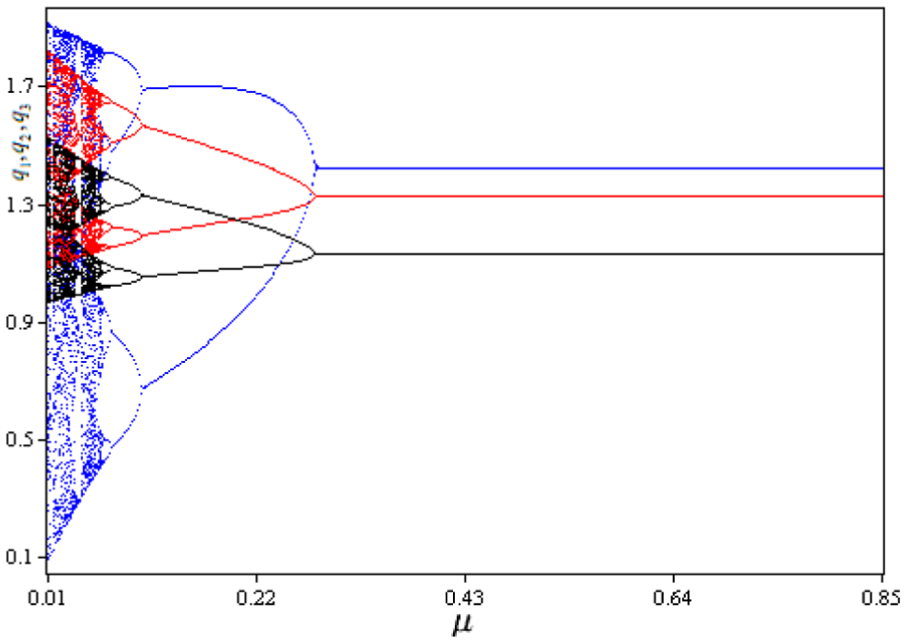
Bifurcation diagram of controlled system (16) with respect to the controlling parameter.
Conclusion
In this article, we have studied the complex dynamics and control of a Cournot triopoly competition game with a log-concave demand function and under bounded rationality. The steady states have been computed and complete analytical studies of the stability conditions have been obtained. By investigating the dynamic behaviors around the Cournot–Nash steady state, we have found that the dynamics may become periodic, quasiperiodic, or chaotic. Numerical simulations of the game have been analyzed by means of period-doubling bifurcations, strange attractors, maximal Lyapunov exponent, and sensitive dependence on initial conditions. We have demonstrated that the fast increasing of the parameters game out the stability region the Cournot-Nash steady state becomes unstable through period doubling bifurcations. We have stabilized the chaotic dynamics of the game using state variables feedback and parameter variation methods.
Footnotes
Academic Editor: Francesco Massi
Declaration of conflicting interests
The author(s) declared no potential conflicts of interest with respect to the research, authorship, and/or publication of this article.
Funding
The author(s) disclosed receipt of the following financial support for the research, authorship, and/or publication of this article: This work was funded by the Deanship of Scientific Research at King Saud University (Research group no. RGP-1436-040).