




Abstract
An urban public transportation super-network model is established in this article. Compared with three existing complicated urban public transportation network models (the C-space network, L-space network, and P-space network), our urban public transportation super-network model first incorporated both station networks and bus line networks explicitly, which connects two non-homogeneous nodes (station and line nodes) through the notion of super networks. The proposed model reflects the interaction and mutual influences between the internal features and internal structures of the urban public transportation super network. And then the function projective synchronization of the dynamic public transportation super-network model is proven, and the high stability of the public transportation super network is confirmed by the Lyapunov stability theorem. Finally, the classical Lorenz chaotic system is applied in a numerical example to illustrate the proposed model and algorithm. The impact of departure frequency, line crowdedness, passenger transport density, and station dwell time on synchronous ability of the urban public transportation super-network model is analyzed. So, this study is a discussion on the urban public transportation super-network balance in order to offer theoretical basis for people to research bus dispatching and bus lines optimization.
Keywords
Introduction
The most complicated systems can be described by networks; a complicated network is typically used to describe complicated systems. Common complicated networks comprise many nodes and connecting lines. These nodes are homogeneous and involve connecting lines that represent connections between nodes. Areal complicated network includes connections between connecting lines and between nodes and connecting lines apart from the connections between nodes. A common complicated network cannot fully depict the internal features of a real network. For example, one method to describe an urban public transportation network that adopts a complicated network uses bus lines as nodes. If two bus lines involve a common station, then these two nodes are connected. This method reflects the relationship of transferring between two bus lines. However, one bus line covers many stations. Several stations comprise a neighborhood, whereas several do not comprise a neighborhood but can be reached through transfer. Therefore, relations between nodes as well as between nodes and bus lines cannot be simultaneously described in this network. In the past, problems between two systems of different natures could be solved by bipartite graph, which expresses stations with a group of independent node sets and bus lines with another group of independent node sets. Nevertheless, these two groups of node sets hold dissimilar values and lose node homogeneity. That is, the nodes between these two groups cannot be connected and thus lack information. These problems cannot be solved by bipartite graph, and multi-part graphs can be addressed by a super graph. The graph considers individuals as nodes, and related nodes are connected through a line; one line that covers several nodes is called a super graph. Berge1,2 proposed the theoretical concept and basic properties of a super graph in 1970. Nagurney and Dong, 3 an American scientist, called networks with attributes beyond those of existing networks, “super networks,” when processing such interlaced networks. This description provided an explicit definition to the super network. Academician Z-T Wang and Professor Z-P 4 Wang further suggested the features of a super network. Existing research on super networks is mainly based on variational inequality.5,6 They mentioned studies have mainly converted hierarchical and multi-standard super-network equilibrium models into an optimization problem that was solved using evolved variation inequality. Studies based on science system7–11 investigated the super network from global and local perspectives. These works include studies on the relationship between networks, the relationship between the outside world and the network, and on the overall performance of super networks.
In recent years, with the emergence of super-network research, the application of super network in all fields has been given much attention, such as electricity network, 12 social network,13,14 the knowledge structure network, 15 and supply chain network. In the field of transportation, the super-network research mainly focused on the optimization study of the equilibrium model of transportation supply chain network; Xu and Gao 16 proposed a new and efficient algorithm for solving supply chain network equilibrium and equivalent super network–based traffic network equilibrium. The new method was called semi-smooth Levenberg–Marquardt-type method which was verified more efficient than the Quasi Newton method and the modified projection method to solve the problem. Kang and Kurtz 17 presented a discrete network design problem for optimally designing freight transport network in terms of the efficiency of supply chain. Modeling was undertaken within the framework of mathematical programs, with equilibrium constraints, which first incorporated both supply chain and transport networks explicitly. Using urban traffic system as a giant complex system, the method of super network has provided a new perspective for researching its complexity and internal dynamic structure. B Si et al., 18 proposed a super-network model to describe such a multi-mode urban transport system. By considering analysis of travelers’ combined choices and the interferences between different modes on the same road segments, they presented a variation inequality model to describe equilibrium assignment for multi-mode urban transport system. Nevertheless, the research on super network in the urban traffic system is still little at home and abroad.
This article combined the super network concept and the traditional modeling method for complicated urban public transportation networks and established an urban public transportation super-network model. This generated super-network model fully considers the relationships between stations, between stations and lines, and between lines. Unlike the traditional complicated public transportation network model, the proposed super-network model depicts the internal structural characteristics of public transportation networks. The new model describes the relationships between lines and between stations as well as the relationships between stations and lines. Both stations and lines are nodes in this super-network model. Line nodes with transferrable common stations are connected, and all lines belong to a line set
Establishment of the urban public transportation super-network model
Three types of complicated urban public transportation networks exist, namely, C-space, P-space, and L-space networks. The first two types regard stations as nodes, whereas the third type uses lines as nodes. The nodes in these three networks are homogeneous. Specifically, only a station node set or line node set is present in one network. This article establishes an urban public transportation super network based on the C- and L-space networks. The method proposed in this article utilizes both stations and lines in the urban public transportation network as nodes. All line nodes belong to the line set
L–L sub-network model
Lines are obtained as nodes. If two lines hold a common station, then they are connected. In this regard, a line-to-line network called an “L–L sub-network” can be established as follows

where
S–S sub-network model
The S–S sub-network takes stations as nodes. If two adjacent stations have the same line, then they are connected. In this way, a station-to-station network is established and called “S–S sub-network” as follows

where
Urban public transportation super-network model
The mapping relationships between the L–L and S–S sub-networks are listed below:
1. Mapping from an L–L sub-network to an S–S sub-network: This relationship reflects the stations on one bus line. We call such super network as a “line–station super network (L(S)SN).”
If station

2. Mapping from an S–S sub-network to an L–L sub-network: This relationship reflects the bus lines that cover the same station. We call such super network as “station–line super network (S(L)SN).”
Correspondingly, the set of lines in L related to

where
L(S)SN and S(L)SN are dual networks. The above-mentioned mapping relationships suggest that two urban public transportation super networks can be established. A public transportation super network that involves three lines and nine stations is shown in Figure 1. The line layer and station layer are topologies of L(S)SN and S(L)SN, respectively. The super-network relation is given by the following equation


Topology map of public transport super networks.
Conversion of public transportation super-network model
The nodes in the S–S and L–L sub-networks are non-homogeneous and shall thus be treated differently. Therefore, we convert proposed urban public transportation super network that involves these two node types. According to the definition and division of super-network factions, one line node and all stations on this line in L(S)SN can be viewed as one faction (Figure 2). Hence, the proposed super network can be divided into three factions (Figure 3(a)). Obviously, all stations in every faction belong to corresponding line nodes, and the common station of two lines can be expressed by a virtual station on the other line. In this way, L(S)SN can be converted into a new public transportation super network (Figure 3(b)) called new super network (NSN).
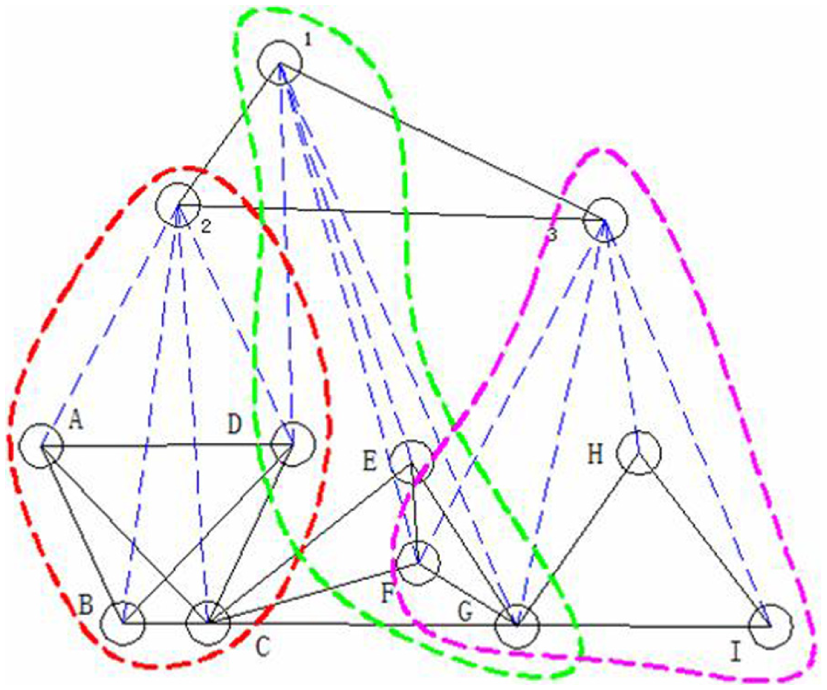
Division of line factions in the super network.
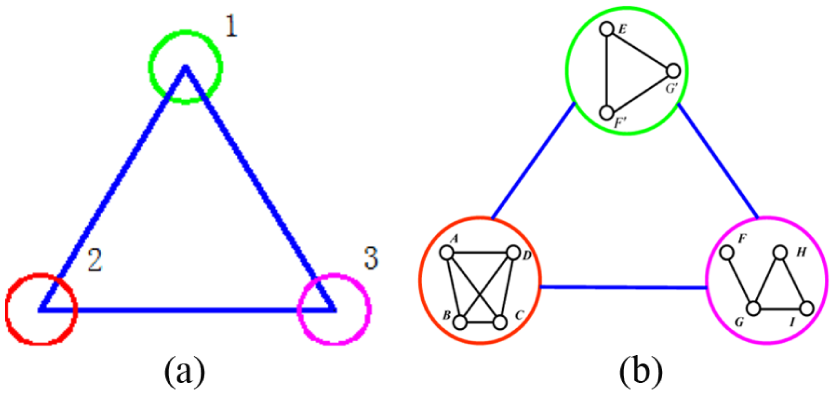
New public transportation super network: (a) line network and (b) conversion of super network.
Description of the urban public transportation super-network model
NSN is a nested network with both stations and lines (Figure 3). The station network is the inner network, whereas the line network is the outer network. Therefore, this article employs the drive–response-complicated dynamic network model12,13 to study the projective synchronization of NSN. If the station network is viewed as the drive network, then the line network is the response network.
The following equation shows a network that involves time-varying delays and comprises sub-networks with N same nodes
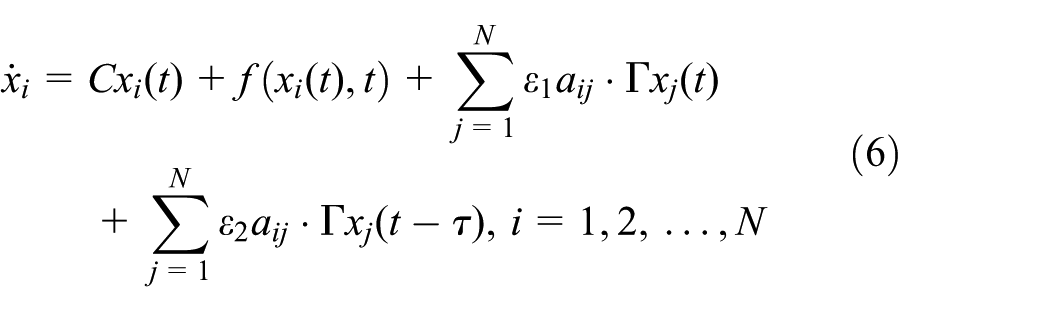
where
Matrix

Constant
If system (5) is regarded as the drive network, the response network is as follows
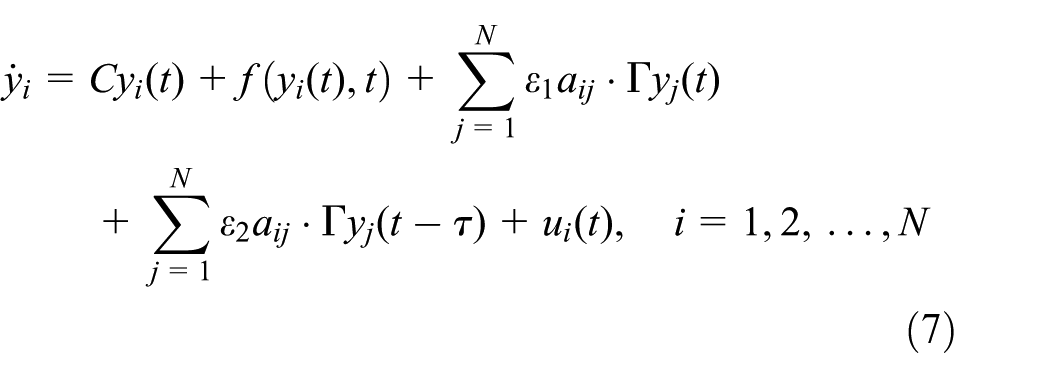
where
Stability analysis of the urban public transportation super-network model
Definition 1
The complex network system (5) achieves projective synchronization if it satisfies the following relation

where
Definition 2
Let
Given Definition 2, the error system equation is written as follows

where

Lemma
Any
Hypothesis 1
If a non-negative constant


Theorem 1
If Hypothesis 1 is true, then the following adaptive controller and parameter updating rules are used


Then, the drive network (5) and the response network (6) reach function projective synchronization.
Proof
The Lyapunov stability equation is constructed as follows

where
Equation (11) is then derived, and equations (9) and (10) are substituted into equation (11) as follows
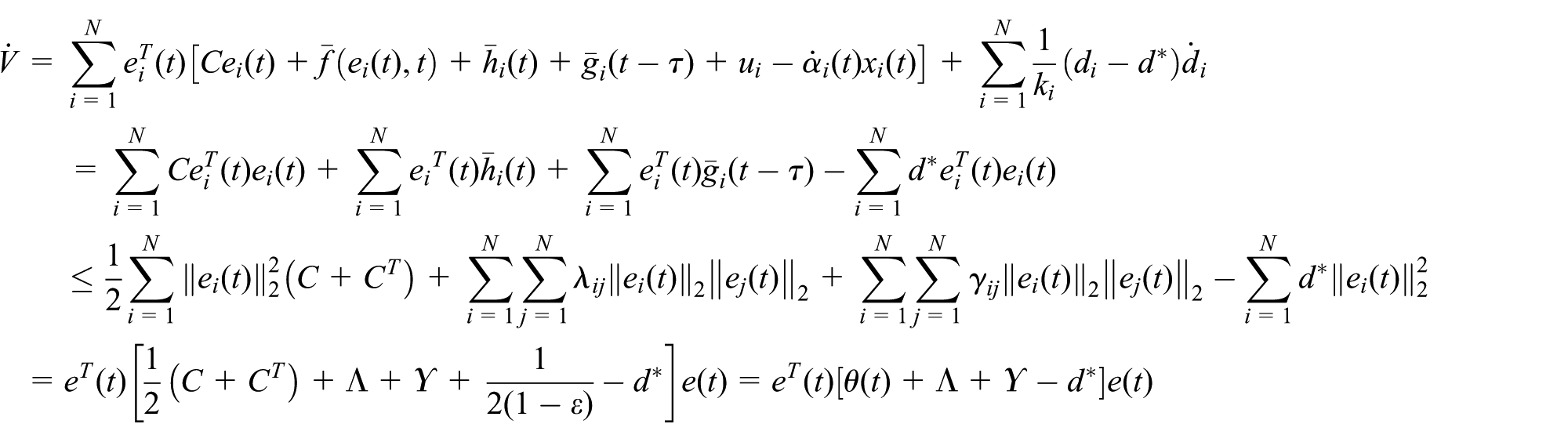
Let
Then

According to the Lyapunov theorem, equation (12) is negatively definite. In other words, the error system (8) achieves global asymptotic stability under equations (9) and (10).
Numerical simulation
We conducted a dynamic simulation of the proposed urban public transportation super network.

Node changes in this super network meet nonlinear characteristics. Suppose they meet a nonlinear Lorenz system, and let the Lorenz chaotic system be the kinetic equation of nodes. The controller and parameter updating rule are chosen as follows

When i = 1
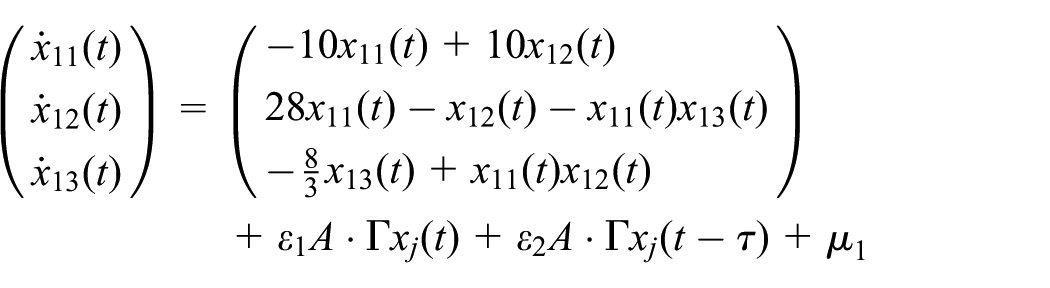
where

When i = 2
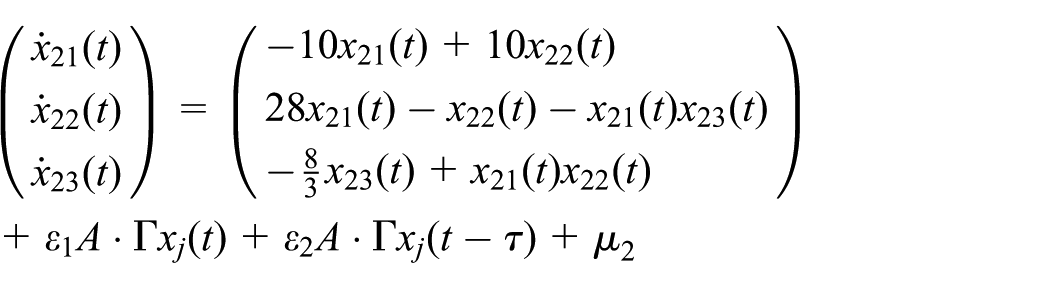
where

When
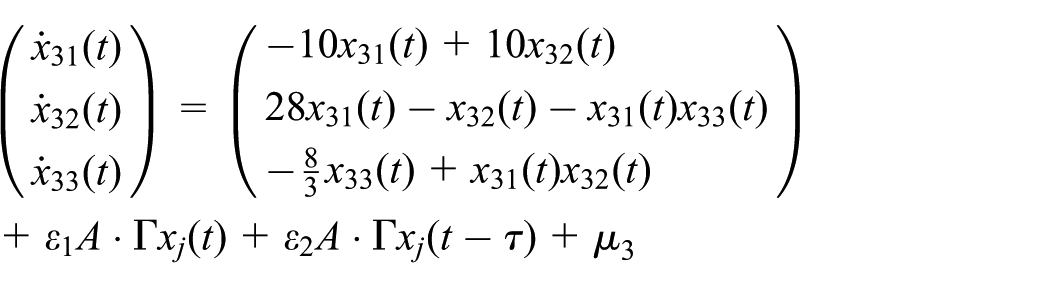
where

The numerical simulation is accomplished with MATLAB software7.0. Results are shown in Figure 4, where the x-axis corresponds to time and the y-axis corresponds to the coupling error between the drive network and the response network. If error = 0, then the super network tends to be stable.

Synchronization errors of the public transport super networks when
In this article, network stability refers to the dynamic equilibrium between passengers in the queue at stations, the degree of crowdedness, and the departure frequency in the urban public transportation super network. All passengers waiting in every station can board a bus in the shortest possible time. When the lag between lines is 0.3 and the coupling strength of the nodes is 0.3, at least six unit times are required for the super network to stabilize.
This article explores the effects of departure frequency, line crowdedness, passenger transport density, and station dwell time on super network stability. The simulation results under

Synchronization errors of the public transport super networks when
The time for the network to achieve stability is shortened by two unit times (Figure 5). This finding implies that higher departure frequencies and shorter station dwell times shorten the time for the super network to achieve stability. Therefore, passenger waiting time and heavy passenger stranding can be relieved effectively by adjusting vehicle scheduling, reducing station dwell time during passenger-flow rush hours or in large junction stations, and increasing bus quantity.
Conclusion
This article establishes an urban public transportation super-network model. Unlike the traditional public transportation network model, the proposed super-network model depicts two non-homogeneous station nodes and line nodes simultaneously through reasonable connections. This strategy more effectively conforms to the practical public transportation network and more completely reflects the internal structural characteristics of nodes and lines in the network than the traditional model. Next, the proposed super network is converted into a nested public transportation super network based on the division theory of super-network factions, which will aid in future study. The stabilities of the drive network (S–S sub-network) and response network (L–L sub-network) are validated by the classical Lyapunov stability theorem. Furthermore, sufficient conditions for function projective synchronization between the drive–response networks under time-varying delays are obtained. Finally, the stability of the proposed super network is confirmed based on the Lorenz chaotic system. The effects of departure frequency, line crowdedness, passenger transport density, and station dwell time on super network stability are analyzed.
Footnotes
Acknowledgements
The authors thank the referees and the editor for their comments and suggestions.
Academic Editor: Hai Xiang Lin
Declaration of conflicting interests
The author(s) declared no potential conflicts of interest with respect to the research, authorship, and/or publication of this article.
Funding
The author(s) disclosed receipt of the following financial support for the research, authorship, and/or publication of this article: This work was supported by the National Natural Science Foundation of China (Nos 51408288, 61563029, and 61164003).