



Abstract
The thermal performance of a building refers to the process of modeling the energy transfer between a building and its surroundings. The objective of this work is to develop a new correlation to estimate the number of Nusselt predictions, to facilitate the design of the walls of buildings based on a numerical simulation with a computational fluid dynamics software which can be coupled after with the Lagrange polynomial interpolation method for high Rayleigh number. For this purpose, a building is modeled as a collection of basic elements (walls, rooms, etc.). Moreover, we developed a FORTRAN program to control the equation of high order. This method is for predicting exchange coefficient and estimating Nusselt number of convection to optimize the design of walls in buildings. This method was performed via the simulation and theoretical case.
Keywords
Introduction
The thermophysical properties of the building envelope have been identified as key parameters in the determination and explanation of the energy performance of buildings and are widely used in models to predict the energy demand of the built stock.1–4 The thermal building is a real problem in Algeria. In the world, 40% is the amount of energy consumed in the construction5,6 and, in turn, supports 23%–40% of the world’s greenhouse gas emission, particularly CO2. 7 Several works have been published in this direction and in several newspapers and journals such as Building Engineering Building and Environment, 8 Building and Environment,9–11Energy Storage,12–16 and Energy and Buildings.17–29 In most situations, the mechanical cooling devices offer solutions that are neither environment friendly nor energy sustainable. The mechanical devices are non-functional and cannot offer thermal comfort without energy input. Hence, utilization of advanced building materials and passive technologies in buildings may offer the solution for thermal comfort demands, substantially reduce the energy demand, and impact on the environment and carbon footprint of building stock worldwide. 30 Also, numerous studies across the world have shown the impacts of hot working environments on the working population.31–39 Furthermore, over the last few decades, the interest around phase change materials (PCM) was regarded as a possible solution into building structures. Even though the use of PCM in the envelope can minimize heating and cooling loads, the good design of the walls of the houses remains the most important keys to conserve energy, especially with the recent turmoil in the global oil markets. First, in this article, computational fluid dynamics (CFD) software is used as a technique to modeling the behavior of fluid and the thermal convection in the external wall of the house with different Rayleigh numbers. Second, the fundamental idea in this work is to vary the thickness of the building material of the outer wall four times and calculate the Nusselt number and exchange coefficient of heat transfer to find a cloud point, respectively, for the thicknesses e = 0, L/40, L/20, and L/10. Afterward, we developed a relationship that helps us to know the exchange ratio for each thickness e belongs to the interval [0, L/10] by the Lagrange polynomial interpolation method and then we developed a FORTRAN program to control this equation. This method is for predicting exchange coefficient of convection to optimize the design of walls in buildings before starting the wall construction for Rayleigh number equal to 105.
Geometric configuration
To solve this problem, the fluid is considered Newtonian and incompressible and the approximation of Boussinesq is presented. In addition, viscous friction is neglected. The dimensions of the design are as follows: H = 1, L = 1 Tc = 1, Tf = 0, and the aspect ratio A = 1. We consider the concrete wall with the following properties:
Density (ρ): 2200 kg/m3;
Thermal conductivity (λ): 1.75 W/(m K);
Specific heat (Cp): 878 J/(kg K).
Objectives
The most important point in this work is to present the prediction of the wall design through numerical evaluation of the convection in buildings by the Lagrange polynomial interpolation method, as well as to present the modeling study of the conduction convection coupling.
Mathematical modeling
The governing equations can be given by:
Continuity equation

X-momentum equation

Y-momentum equation

Energy equation

The derived equation (2) over Y and the equation (3) over X after subtracting the two equations are obtained. The equations dimensionless variables in writing Helmotz in terms of vorticity and stream function formulation are given by



Using the dimensionless variables in the equations above are defined by

For the concrete, the energy equation is given by

Procedure of simulation
First, the GAMBIT and FLUENT softwares are used for this numerical simulation. For the convection terms, a first order of Apwind scheme, also simple algorithm, 40 is used to couple momentum and continuity equations. The convergence between two successive times is not less than 1e4. With an aim of following well any variation of the thermal and hydrodynamic fields, we used a uniform grid of 14,480 elements and 14,241 nodes in non-stationary mode. Second, we developed a FORTRAN program to control the linear equation of order three. We assume that the flow and heat transfer are two-dimensional and the physical properties of air are constant and the Boussinesq approximation is validated. The boundary condition and physical parameters are defined as follows: H = 1, L = 1 Tc = 1, Tf = 0, and the aspect ratio A = 1. We consider concrete wall.
Validation
For the validation of the model, we compared our results with those obtained by De Vahl Davis 41 (see Table 1).
Comparisons of the results of validation.
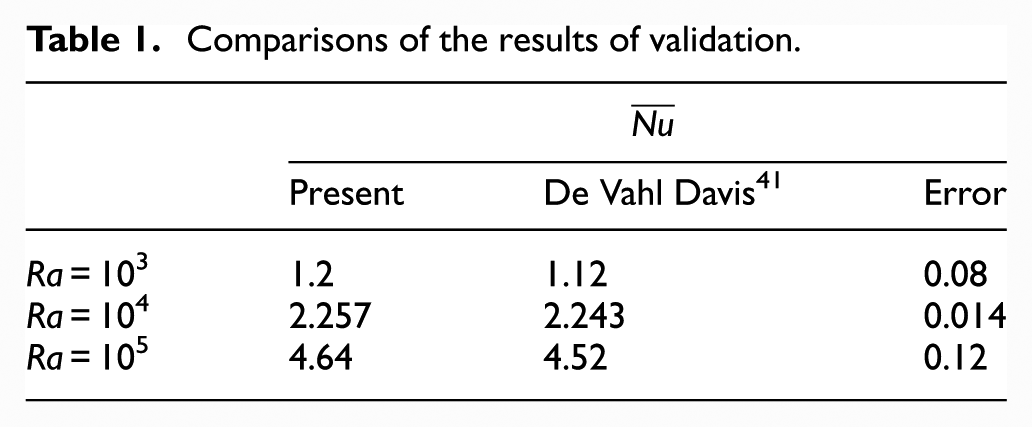
First, the natural convection model is validated against a benchmark: a differentially heated square cavity with adiabatic horizontal walls and constant temperature vertical walls, as described by De Val Devis, 41 the case that is adapted to our proposition, where the wall thickness is equal to e = 0.
Mathematical model for the Lagrange polynomial interpolation method
The Lagrange interpolating polynomial is the polynomial of degree ≤(N − 1) that passes through the n points (x1, y1), (x2, y2), …, (xn, yn), and the interpolation polynomial in the Lagrange form is a linear combination and is given by

For Lagrange basis polynomials
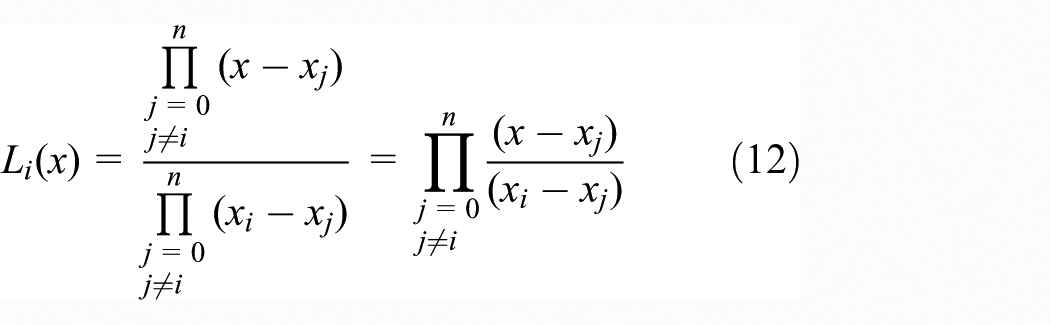
where

The polynomial interpolation points
We wish to find the polynomial interpolating the points (Table 2).
The sets of polynomial interpolation points.

The points of Nu(e) are obtained by numerical simulation of the FLUENT software, for the Rayleigh number equal to 105.
The error estimates
The question that we consider here is: how accurately does the polynomial pn(x) approximate the function f(x) at any point x?
So, let f∈C[a; b], (n + 1) differentiable on (a; b) and let x0; x1; x2; …; xn be (n + 1) distinct points in [a; b]. If pn(x) is such that pn(xi) = f(xi); i = 0; 1; …; n, then for each x∈[a; b] there exists ε(x) ∈ [a; b] such that

where EN(x) is the error in the approximation of f(x).
Results and discussion
The boundary conditions have been established to simulate a geometric configuration used frequently in two-dimensional approximation (Figure 1).

The geometry considered.
Isotherms
The isotherms are presented in Figure 2. Gradually, as the Rayleigh number increases, the isotherms become increasingly wavy and heat transfer increases, so the flow intensifies and natural convection is expanding and predominates.

The isotherms for wall thickness e = L/20 and for different Rayleigh numbers, Pr = 0.71.
Lagrange polynomials
The points of Nu(e) are obtained by numerical simulation of the FLUENT software, for the Rayleigh number equal to 105 (see Table 3).
Nusselt number for different values of thickness and for Ra = 105.

If (0, 4.50), (L/40, 3.77), (L/20, 3.12), and (L/10, 2.20) are given data points, then the cubic polynomial passing through these points can be expressed as

We would have the four basis polynomials

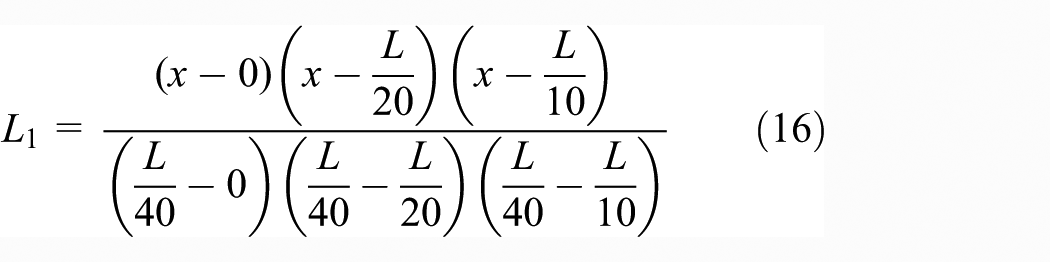


The polynomial P(x) given by the above formula is called Lagrange’s interpolating polynomial and the functions (15)–(18) are called Lagrange’s interpolating basis functions.
Nusselt number correlations
It should be noted that the numerical result is given by equation (21). Remarkably, similar to the estimate of the average Nusselt number by the Lagrange interpolation method for each wall thickness between [0, L/10] but only for Ra = 105



Therefore, we can write

where
Also, we can write

where B: e/L.
In heat transfer, the average Nusselt number is given by

where H is the characteristic length, λ is the thermal conductivity of the fluid, and
Average Nusselt numbers
The decrease in Nusselt number is more as shown in Figure 3 with increase in the wall thickness, and the heat transfer also decreases because the inertia and the thermal resistance of the wall increase. Also, the increase in Nusselt number is more as shown in Figure 4. Broadly, advection becomes stronger and thus heat transfer increases.
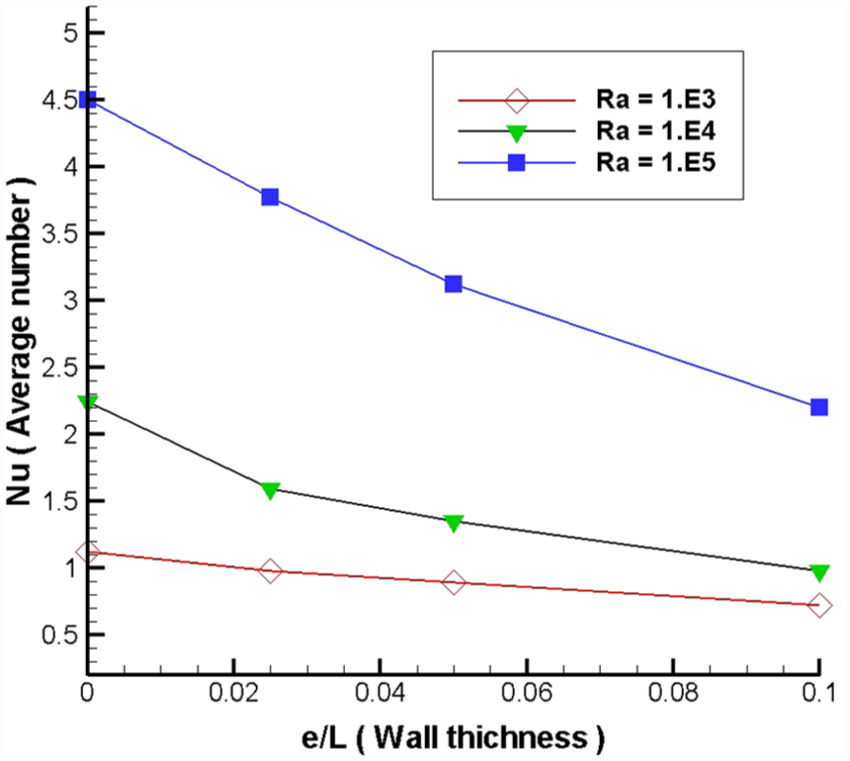
Average Nusselt number profiles for different wall thicknesses and for different Rayleigh numbers, Ra = 103, 104, and 105 and Pr = 0.71.

Profiles of average Nusselt number for different Rayleigh numbers, Ra = 103, 104, and 105 and Pr = 0.71.
Conclusion
Thermal comfort has a significant value in this work for 103 ≤ Ra ≤ 105 and Pr = 0.71. Concrete wall for different thicknesses is viewed with 0 ≤ e ≤ L/10. We are interested in convection conduction coupling. First, CFD software is used as a technique to modeling the behavior of fluid and the thermal convection in the external wall of the house. Second, the most important part in this work is to vary the thickness of the building material of the outer wall four times and calculate the Nusselt number and exchange coefficient of heat transfer to find a cloud point, respectively, for the thicknesses e = 0, L/40, L/20, and L/10. Afterward, we developed a relationship that helps us to know the Nusselt number and exchange ratio for each thickness (e) belongs to the interval [0, L/10] by the Lagrange polynomial interpolation method and then we developed a FORTRAN program to control the nonlinear equation of order three (equation (22) or equation (23)). This method is for predicting exchange coefficient of convection to optimize the design of walls in buildings. Since, in interpolation we must determine a mathematical equation include and pass on a set of points, predictive simple correlation was developed to estimate the value of the average Nusselt number and the coefficient of heat transfer for exchange any thickness ranging from 0 to L/10. It is just enough to replace the thickness value in equation (21), to calculate the Nusselt number planned before the design and construction of walls.
Footnotes
Acknowledgements
The authors thank all reviewers for taking the time and energy to review our work.
Academic Editor: Yanping Yuan
Declaration of conflicting interests
The author(s) declared no potential conflicts of interest with respect to the research, authorship, and/or publication of this article.
Funding
The author(s) disclosed receipt of the following financial support for the research, authorship, and/or publication of this article: This work was supported by the Research program sponsored by the Faculty of Science and Technology, Department of technology, ENERGARID Laboratory, T.M. University, Bechar, Algeria.