




Abstract
To keep a high heat transfer rate, it is important to retain the water in nucleate boiling regime and prevent film boiling. In this research, the continuum approach is applied to study liquid vaporization within a textured surface. The volume-of-fluid method and cavitation model are used in this simulation. The primary focus is on reproducing qualitative trends using continuum as molecular dynamic studies and gaining insights into the underlying mechanisms. From the simulation results, it is found that the superhydrophilic surface stabilizes the liquid existing inside the pore.
Introduction
Heat transfer influences technologies in various fields. In particular, boiling occurs in numerous industrial applications such as high heat flux electronic devices, 1 chemical processes, 2 and power plants. 3 During the nucleate boiling process, a heated surface is placed adjacent to a liquid which then vaporizes. The vaporization produces large latent heat, making it an efficient mode of heat transfer. Film boiling, on the other hand, leads to inefficient heat transfer and potentially damages the heated surface, because, unlike nucleate boiling, it lacks a stable insulating vapor layer between the liquid and the surface. Thus, for maintaining a high efficiency of heat transfer, nucleate boiling is preferred and film boiling should be avoided.
To enhance nucleate boiling and prevent film boiling, textured or chemical treatment of the surface is suggested. Surface characteristics are known to be a critical factor in determining the efficiency of heat transfer.4–11 Utilizing optimal surfaces can increase energy efficiency and have a profound impact on industrial applications. For example, superhydrophilic surfaces have been designed to promote wetting and enhance the heat transfer efficiency by changing the surface interfacial chemistry property or altering the surface texture spacing and geometry. Surface texture can increase the wettability, and capillary pressure can drive the pooled liquid into the pore which is created by the surface texture.5,6 The invading liquid can lead to vapor evacuation from roughness so vapor film formation is inhibited as well. This roughness-based wettability is more effective for pillar-type geometries with large spacing. With small spacing between pillars, resistance makes lateral evacuation of vapor difficult. Hence, it is essential to define the critical roughness scale.
Molecular dynamic (MD) simulations have been applied to study the sustaining dry surfaces under water. 12 However, MD simulations are expensive and in limited scale. In this work, we explore whether it is possible to study vapor vaporization within textured surface using continuum approach. Instead of MDs and Boltzmann equation, continuum approach uses continuity equation, momentum equation, and energy equation to describe the fluid physics.
Energy analysis
Superheated liquid is seen as metastable state at a liquid pressure pl which is lower than the saturation pressure psat for a given temperature Tl (see blue inverse triangle in Figure 1).

Typical liquid–vapor phase diagram for water.

The schematic of textured surface: the roughness valley (pocket) are in between square microposts.
In this liquid–vapor phase diagram, the co-existence curve can be represented by the Clausius–Clapeyron equation

where psat is the saturation pressure, pl is the liquid pressure, hlv is the mass-specific change in enthalpy during phase change, vv is the specific volume of the vapor, vl is the specific volume of the liquid, Tl is the liquid temperature, and Tsat is the saturation temperature.
For a liquid–vapor interface at the top of the pore, if it is a mechanical equilibrium state, the Young–Laplace equation gives the radius of curvature re

where pv and pl are the pressures of the vapor and liquid phases, respectively;

Another way to express phase change is by equating the chemical potential at that temperature; the pressure of the liquid and the vapor during the phase change is

where pl and pv are the liquid and vapor pressures during the phase change, respectively. psat is the saturation pressure (the pressure on the co-existence curve at temperature Tl). For a typical ambient condition,

To prevent the formation of vapor nuclei, or promote condensation, pore diameter D should satisfy the following equation

where

Jones et al. 12 performed MD simulation to study the sustaining dry surfaces under liquid. However, MD simulation is timely and computationally expensive. Also, the calculation domain size is limited to nano scale. The objective of this study is to perform a micro-scale continuum numerical simulation of superheated liquid sustaining inside a pore to investigate the effect of contact angle and surface texture. The primary focus in this research is on using continuum and liquid–vapor mass transfer model and reproducing qualitative trends as MD studies and gaining insights into the underlying mechanisms.
Numerical method
There are several simulation methods proposed to study the vapor–liquid phase change problem, such as the volume-of-fluid (VOF) method, 13 lattice Boltzmann method, 14 immersed boundary method, 15 direct front tracking method,16,17 and level set (LS) method. 18 The VOF method has been used for nucleate, film boiling, and dropwise condensation simulations. We choose VOF method to study this pore vaporization problem.
VOF
VOF method is implemented in this research; the two phases are represented by phase volume and are defined as follows: in VOF, the two phases are represented by phase volume fractions such that

where
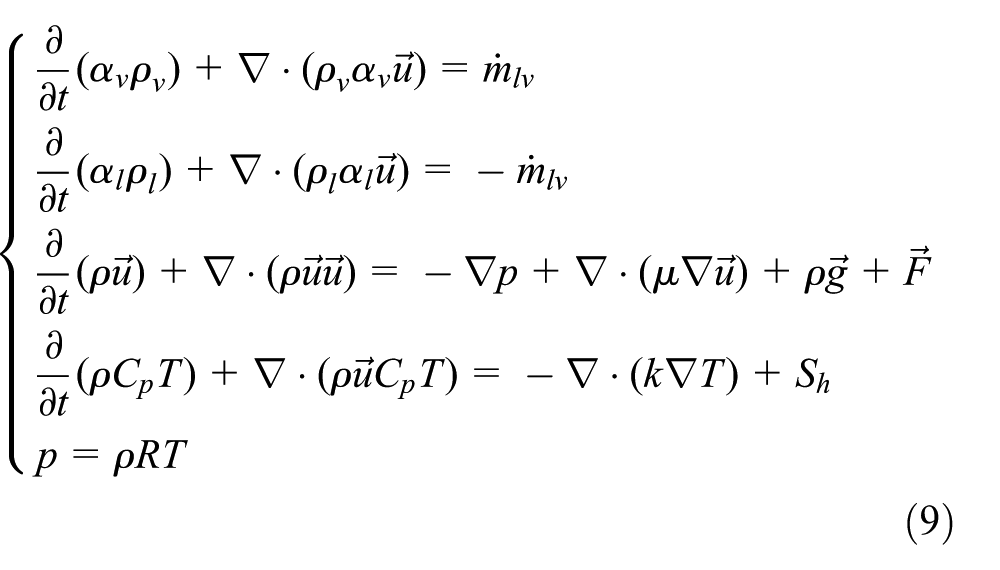
where

where subscripts l and v represent the liquid and vapor phases, respectively. In the momentum equation,

where

Cavitation: Merkel mass transfer model
To study vaporization in the isothermal condition, a cavitation model is used here.20,21 There are various cavitation models, and Merkel model was chosen in our simulation. The mass transfer

where

Problem description
To define the critical pore diameter, equation (7) is used here. The liquid–vapor surface tension is chosen as

D is approximately equal to

The schematic of 2D problem description.
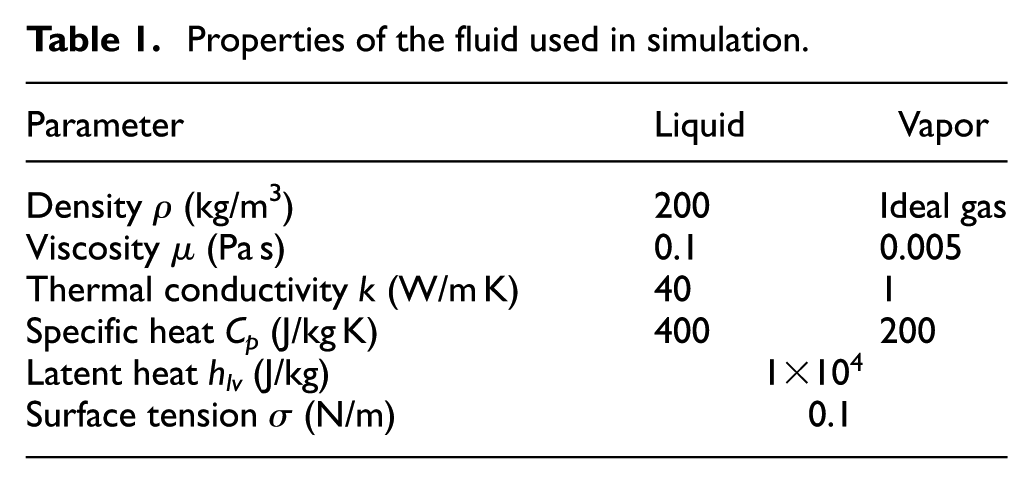
Properties of the fluid used in simulation.
Results and conclusion
Using the numerical methods and governing equations discussed in previous section, we model the vaporization in surface roughness under different outlet pressure and contact angle at bottom wall. In the following results of phase contour, red color represents the vapor, and the blue one represents the liquid.
Pressure outlet 26.12 bar under different contact angles
In the following results of phase contour, red color represents the vapor, and the blue one represents the liquid. Figure 4 shows the phase change at pressure outlet

Phase contour at p = 26.12 bar,

Pressure contour at p = 26.12 bar,

Temperature contour at p = 26.12 bar,
Figure 7 shows the phase change at pressure outlet

Phase contour at p = 26.12 bar,
Pressure outlet 24.12 bar under different contact angles
As the outside boundary pressure decreases as shown in Figure 8, it displays the phase change at pressure outlet

Phase contour at p = 24.12 bar,
Figure 9 shows the phase change at pressure outlet

Phase contour at p = 24.12 bar,
Pressure outlet 22.12 bar under different contact angles
The outside boundary pressure is set as
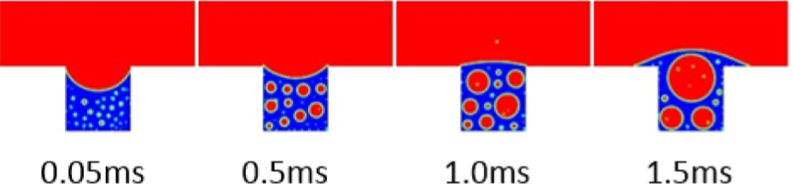
Phase contour at p = 22.12 bar,
The outside boundary pressure is set as

Phase contour at p = 22.12 bar,
Conclusion
To summarize, we have demonstrated a numerical simulation using continuum to study superheated liquid vaporization within the surface texture. While the pressure outlet is far below the saturation pressure, there is more vaporization produced. Also, it is found that the superhydrophilic surface stabilizes the liquid existing inside the pore which is in agreement with the experimental results. Our numerical simulation successfully combines the VOF method and cavitation model to reproduce superheated liquid vaporization in surface roughness and has reasonable simulation results comparing with theory and experiments.
Footnotes
Academic Editor: Oronzio Manca
Declaration of conflicting interests
The author(s) declared no potential conflicts of interest with respect to the research, authorship, and/or publication of this article.
Funding
The author(s) disclosed receipt of the following financial support for the research, authorship, and/or publication of this article: This work was supported, by Taiwan National Science Council Grants NSC.