




Abstract
This research work addresses the numerical solutions of nonlinear fractional integro-differential equations with mixed boundary conditions, using Chebyshev wavelet method. The basic idea of this work started from the Caputo definition of fractional differential operator. The fractional derivatives are replaced by Caputo operator, and the solution is approximated by wavelet family of functions. The numerical scheme by Chebyshev wavelet method is constructed through a very simple and straightforward way. The numerical results of the current method are compared with the exact solutions of the problems, which show that the proposed method has a strong agreement with the exact solutions of the problems. The numerical solutions of the present method are also compared with steepest decent method and Adomian decomposition method. The comparison with other methods reveals that this method has the highest degree of accuracy than those methods.
Keywords
Introduction
Many important problems in fluid mechanics, viscoelasticity, electromagnetic, and other fields of science and engineering are modeled by fractional differential and integral equations.1,2 Due to the real facts of its applications in different areas of research, the researchers have taken keen interest in the study of fractional calculus. In this context, the Volterra–Fredholm fractional integro-differential equations have an important role in various fields of biomechanics, elasticity, economics, fluid dynamics, heat and mass transfer, oscillation theory, and airfoil theory.3,4 The challenging work is to find the solution while dealing with Volterra–Fredholm fractional integro-differential equations. Therefore, many researchers have tried their best to use different techniques to find the analytical and numerical solutions of these problems, for example, Adomian decomposition method (ADM), 5 spline collocation method (SCM), 6 fractional transform method (FTM), 7 homotopy perturbation method (HPM), 8 operational tau method (OTM), 9 shifted Chebyshev polynomial method (SCPM), 10 rationalized Haar function method (RHFM), 11 exp-function method, 12 traveling wave transformation method, 13 and Cole–Hopf transformation method, 14 and also see the work in Yang et al., 15 Sayevand and Pichaghchi, 16 and Wang and Liu. 17 Recently, Yang et al. 18 did a comprehensive study of the methods which have been used for the solutions of the problems containing fractional derivatives and integral operators.
Besides these methods, most of the authors have applied a comparatively new numerical techniques based on wavelets.19–22 The methods based on Chebyshev wavelets have gained much importance during the last decade because of its simple, effective, and straightforward implementation. Therefore, the researcher paid great attention to these methods to solve problems in different fields of science and engineering, for example, Chebyshev wavelet operational matrix (CWOM), 23 Chebyshev finite difference method (CFDM), 3 SCPM, 10 and Chebyshev wavelet method (CWM).24,25
In this article, an efficient CWM is used to obtain the numerical solutions of some Volterra–Fredholm fractional integro-differential equations. The simulations are performed by the proposed method easily. The numerical results found by the present method are compared with other numerical methods, showing the greatest degree accuracy than any other method.
Preliminaries and definitions
To continue with this work, we present some definitions and other mathematical preliminaries. These concepts play very massive role to complete this work.
Definition 1
The Riemann fractional integral operator

where
This integral operator has the following properties

where
Definition 2
The Riemann fractional derivative of order

where n is an integer.
However, the Riemann fractional derivative has certain drawbacks due to which Caputo proposed a modified differential operator.
Definition 3
The Caputo definition of fractional differential operator is given by

where
It has the following two basic properties

Properties of the Chebyshev wavelets
Wavelets consist of family of functions generated from the dilation m and translation l of a single function

If we restrict the parameters l and m to discrete values as

We have the following family of discrete wavelets

where
The second kind of Chebyshev wavelets is constituted of four parameters,

where

Here,

CWM
In this article, we consider the fractional integro-differential equations of the form

With the initial conditions given by

For
The solution to equation (3) can be extended by Chebyshev wavelets series as

where

This shows that there are
In this article, we have considered some initial and mixed boundary value fractional integro-differential equations of order less than one. There are two conditions for mixed boundary value problem. The mixed boundary conditions are approximated by CWM as given in the following equations.
The first mixed boundary condition is approximated as

and the second is

The remaining

Assume that equation (6) is exact at

The combination of equations (6)–(8) forms the linear system of
Numerical examples
Example 1
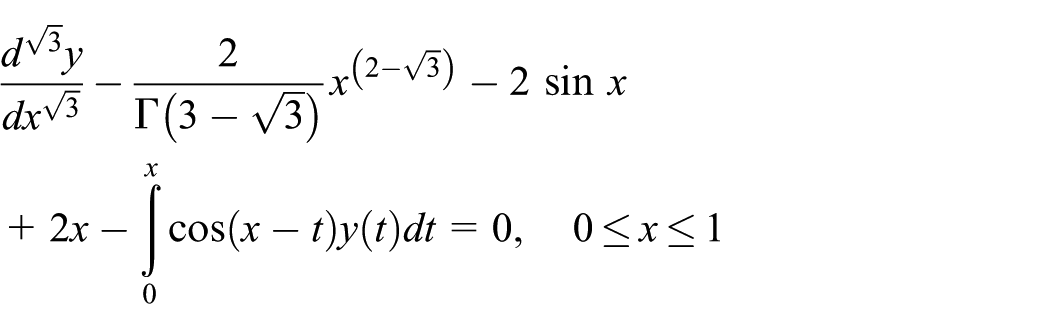
Consider the following fractional order nonlinear boundary value problem 27
With mixed boundary conditions

and

The exact solution is

In Table 1, the exact solution and approximate solution by CWM of example 1 are represented by y (exact) and y (CWM), respectively (Figure 1). The CWM is applied for
The numerical results of Example 1.

CWM: Chebyshev wavelet method; ADM: Adomian decomposition method.
The graph of exact solution versus Chebyshev wavelet approximation of Example 1.

The graph of errors obtained by ADM method and CWM of Example 1.
Example 2
Consider the following nonlinear fractional Volterra–Fredholm integro-differential equation 27

With the boundary conditions

and

The function
Table 2 analyzed the exact solution y (exact), the approximate solution by CWM y (CWM), error by steepest decent method, and error by CWM error (CWM) (Figures 3 and 4). The comparison of the absolute error of the proposed method with steepest decent method is shown. It is very obvious from this table that the present method has an excellent accuracy when compared with steepest decent method. The numerical simulations are done using
The numerical solutions of Example 2.

CWM: Chebyshev wavelet method; ADM: Adomian decomposition method.

The graph of exact solution versus Chebyshev wavelet approximation of Example 2.

The graph of errors obtained by ADM method and CWM of example 2.
Example 3
In this example, we consider the nonlinear fractional integro-differential equation

With the initial condition

The exact solution is
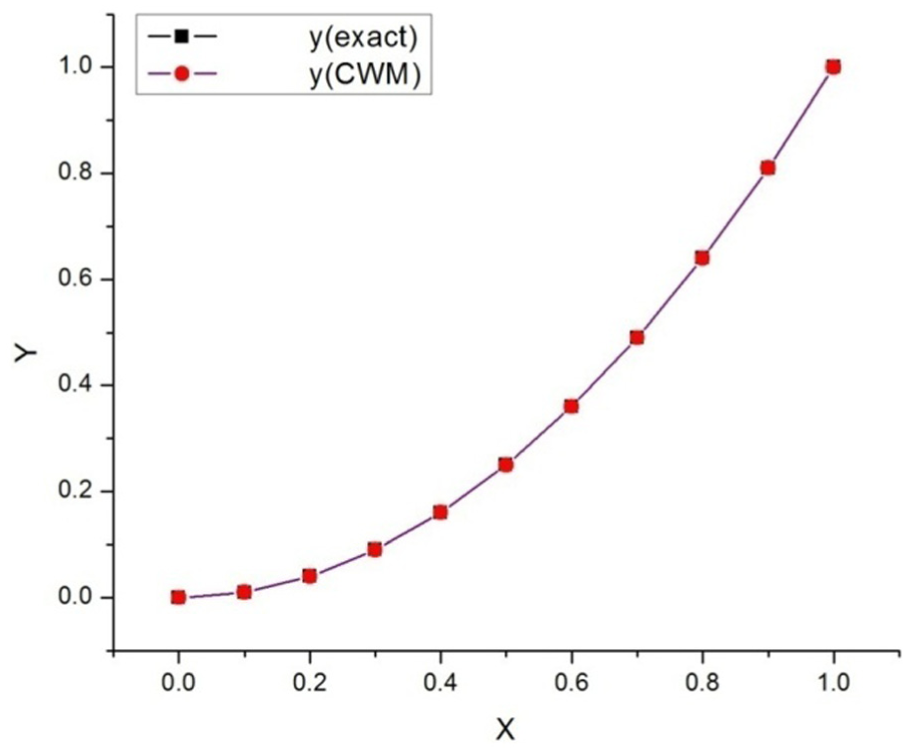
Table 3 displayed the numerical results of example 3 using CWM. The exact solution is represented by y (exact), and approximate solution obtained by CWM is denoted by y (CWM) (Figure 5). Similarly, the errors associated with ADM and CWM is error (ADM) and error (CWM), respectively (Figure 6). The comparison of the errors obtained from ADM and ADM is highlighted. This table shows that the numerical results obtained by CWM are highly accurate than the result of ADM. This method has high degree of accuracy which is the unique feature of this method.
Numerical results for Example 3.
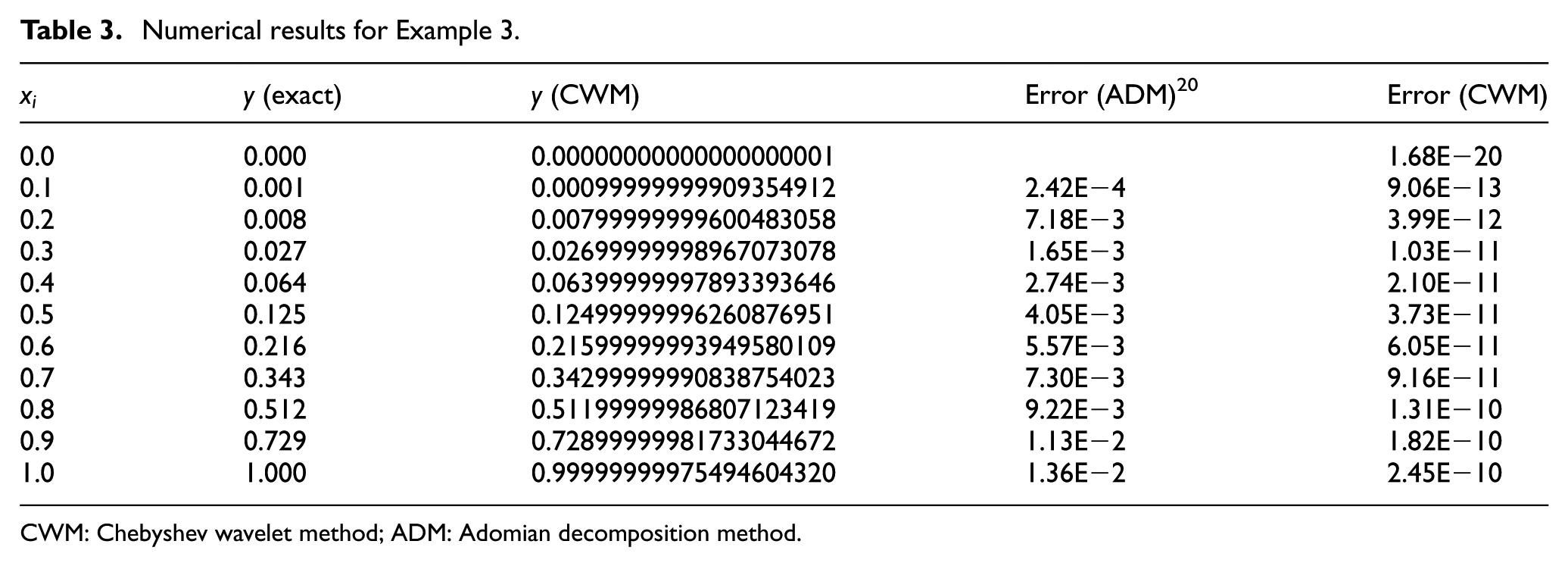
CWM: Chebyshev wavelet method; ADM: Adomian decomposition method.

The graph of exact solution versus Chebyshev wavelet approximation of Example 3.
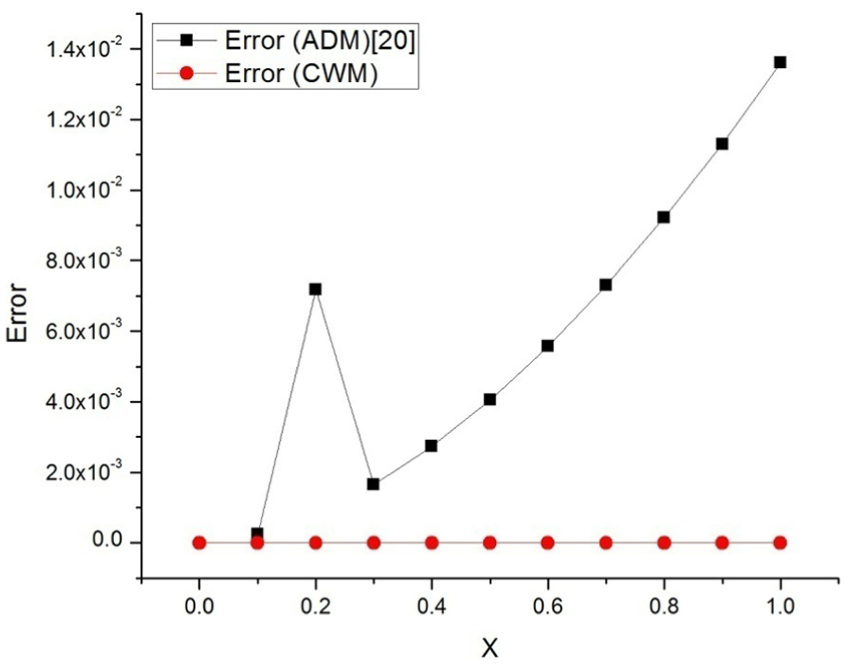
The graph of errors obtained by ADM method and CWM of Example 3.
Example 4
In this example, we consider the nonlinear fractional integro-differential equation

With the initial condition

The exact solution is
Table 4 shows the numerical results obtained by ADM and the present method CWM. The numerical results obtained by CWM and exact solutions are, respectively, denoted by y (exact) and y (CWM) (Figure 7). The corresponding errors generated by ADM and CWM are denoted by error (ADM) and error (CWM) (Figure 8). The algorithm is applied for
The numerical solution of Example 4.
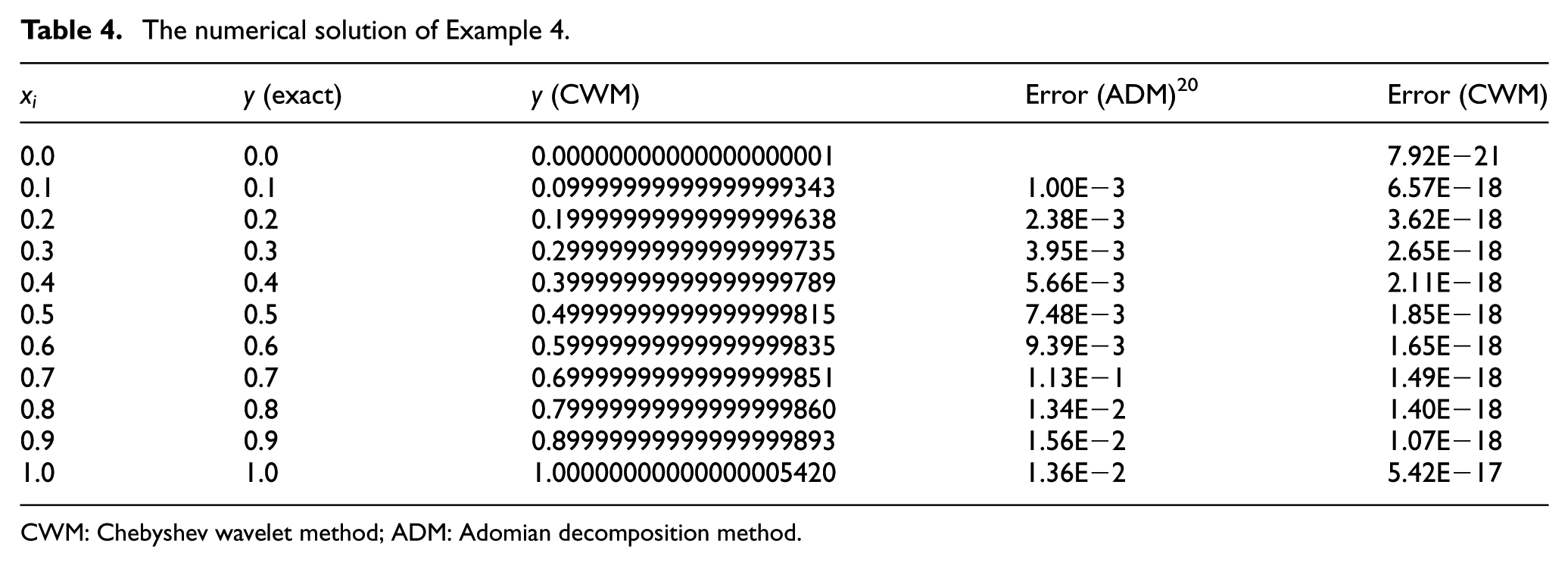
CWM: Chebyshev wavelet method; ADM: Adomian decomposition method.

The graph of exact solution versus Chebyshev wavelet approximation of Example 4.
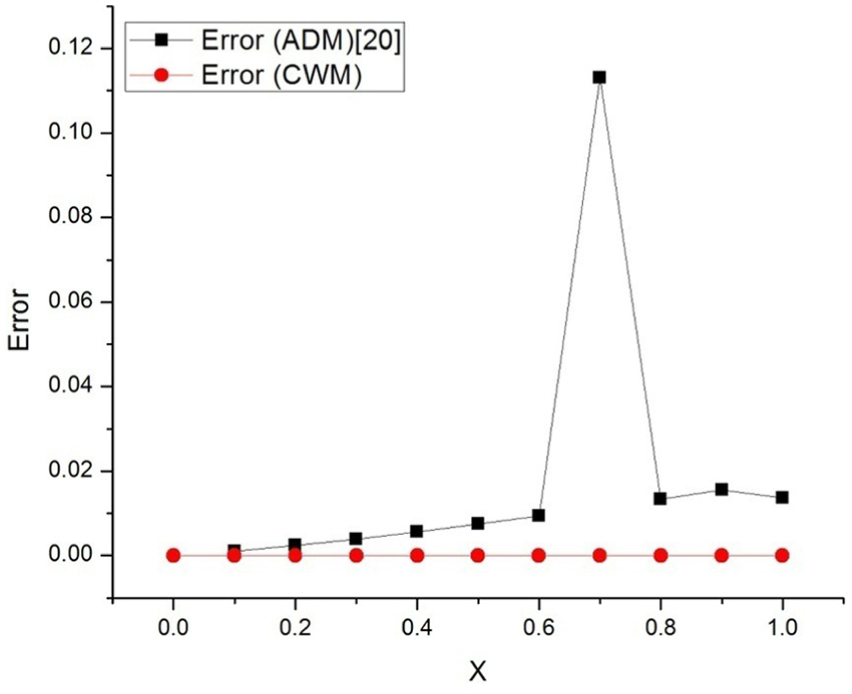
The graph of errors obtained by ADM method and CWM of Example 4.
Conclusion
This work has the capability of introducing an efficient method to solve fractional order Fredholm integro-differential equations. The CWM is implemented to solve these types of integro-differential equations. It is investigated through numerical simulation that the current method has the highest accuracy than any other method in the literature. For future work, we will continue with these techniques for the numerical solution of other high nonlinear integro-differential equations.
Footnotes
Acknowledgements
The authors are highly grateful to the referees for their valuable comments.
Academic Editor: Xiao-Jun Yang
Declaration of conflicting interests
The author(s) declared no potential conflicts of interest with respect to the research, authorship, and/or publication of this article.
Funding
The author(s) received no financial support for the research, authorship, and/or publication of this article.