




Abstract
In this work, we aim to analyze the logistic equation with a new derivative of fractional order termed in Caputo–Fabrizio sense. The logistic equation describes the population growth of species. The existence of the solution is shown with the help of the fixed-point theory. A deep analysis of the existence and uniqueness of the solution is discussed. The numerical simulation is conducted with the help of the iterative technique. Some numerical simulations are also given graphically to observe the effects of the fractional order derivative on the growth of population.
Keywords
Introduction
The logistic equation describes the population growth. It was first proposed by Pierre Verhulst that is why it is also known as Verhulst model. The mathematical equation is a continuous function of time, but a modified version of the continuous model to a discrete quadratic recurrence model is said to be the logistic map which is also extensively used.
The continuous form of the logistic equation is expressed in the form of nonlinear ordinary differential equation as 1

In the above equation (1), N indicates population at time t,

Equation (2) is said to be logistic equation.
Fractional calculus in mathematical modeling has been gaining great admiration and significance due largely to its manifest importance and uses in science, engineering, finance and social sciences. Due to its wide applications, many scientists and engineers investigated in this special branch and introduced various denotations of fractional derivatives and integrals.2–7 In this connection, a monograph by Baleanu et al. 8 presents applications of nanotechnology and fractional calculus. A monograph by Kilbas et al. 9 provides an excellent literature related to basic concepts and uses of fractional differential equations. In this sequel, Bulut et al. 10 analyzed differential equations of arbitrary order analytically. Atangana and Alkahtani 11 examined the fractional Keller–Segel model using iterative technique. Alkahtani and Atangana 12 analyzed a non-homogeneous heat model involving a new fractional order derivative. Atangana 13 studied a fractional generalization of nonlinear Fisher’s reaction–diffusion equation using iterative scheme. Singh et al. 14 studied the Tricomi equation involving the local fractional derivative with the aid of local fractional homotopy perturbation sumudu transform technique. Kumar et al. 15 reported the numerical solution of fractional differential-difference equation using homotopy analysis Sumudu transform scheme. Choudhary et al. 16 examined the fractional model of temperature distribution and heat flux in the semi-infinite solid using integral transform technique. Yang et al. 17 obtained an exact traveling-wave solution for KdV equation associated with local fractional derivative. Yang et al. 18 investigated some novel uses for heat and fluid flows associated with fractional derivatives having non-singular kernel. Yang et al. 19 studied a new fractional derivative without singular kernel and showed its uses in the modeling of the steady heat flow. Hristov 20 examined Cattaneo concept of flux relaxation with a Jeffrey’s exponential kernel in view of its association with heat diffusion pertaining to time derivative of fractional order termed in Caputo–Fabrizio sense. Golmankhaneh et al. 21 studied the synchronization in a non-identical fractional order of a modified system. The fractional generalization of logistic equation associated with Caputo fractional derivative is studied by many authors such as El-Sayed et al., 22 Momani and Qaralleh 23 and many others.
Thus, the fractional modeling is very useful in description of natural phenomena. But the novel fractional derivative given by Caputo and Fabrizio is more suitable to describe the growth of population because its kernel is non-local and non-singular. Therefore, we replace the time derivative in equation (2) by a new fractional derivative discovered by Caputo and Fabrizio, and equation (2) converts to a time-fractional model of the logistic equation expressed in the following manner

subject to the initial condition

The principal objective of this work is determining the novel fractional derivative to the nonlinear logistic model and imparting in detail the analysis of the solution of the nonlinear model with the aid of the fixed-point theory. The structure of this article is as follows: in section “Preliminaries,” the fundamental concept of new fractional derivatives defined by the Caputo–Fabrizio is given. In section “Equilibrium and stability,” the equilibrium stability of initial value problem (IVP) associated with new Caputo–Fabrizio fractional derivative is discussed. The fractional logistic equation and its stability analysis are examined in section “Fractional model of logistic equation associated with new fractional derivative.” In section “Existence and uniqueness,” the existence and uniqueness of the solution are examined. Section “Numerical results and discussions” contains the numerical simulation of fractional logistic equation. Finally, section “Conclusion” is dedicated to the conclusions.
Preliminaries
Definition 1
If

In the above expression,
But if

Remark 1
If

Moreover

The corresponding fractional integral resulted to be essential. 6
Definition 2
Let

Definition 3
If

In the above formula (10),
Equilibrium and stability
Let us take the following IVP associated with Caputo–Fabrizio fractional derivative

and

To compute the equilibrium point for equation (11), put

In order to find the asymptotic stability, take

Using equation (14) in (11), we get

which yields

As we know that

which implies that

where

Further assume that the solution
Fractional model of logistic equation associated with new fractional derivative
Here, we examine the equilibrium and stability of the fractional generalization of logistic equation associated with the newly developed Caputo–Fabrizio fractional derivative.
Let us consider that

To compute the equilibrium points, put

which gives the equilibrium points
Next, to investigate the stability of the equilibrium points, we find the following result

which yields

Then, the solution of fractional order IVP

is presented as

In this case, the point
In order to check the stability of the point

which is

Therefore, the equilibrium point
Next, we present the existence and uniqueness for the solution of the logistic equation of fractional order (3).
Existence and uniqueness
Here, we present the analysis of the fractional model of logistic equation. Applying the Losada–Nieto fractional integral operator on equation (3) we get the following result

For simplicity, we interpret

The operator K has Lipschitz condition providing that the function x has an upper bound. So if the function x is upper bounded then

On using the inequality of triangle on equation (28), it yields

Setting

Therefore, the Lipschitz condition is fulfilled for K, and if additionally
Theorem 1
Considering that the function x is bounded, then the operator presented below satisfies the Lipschitz condition
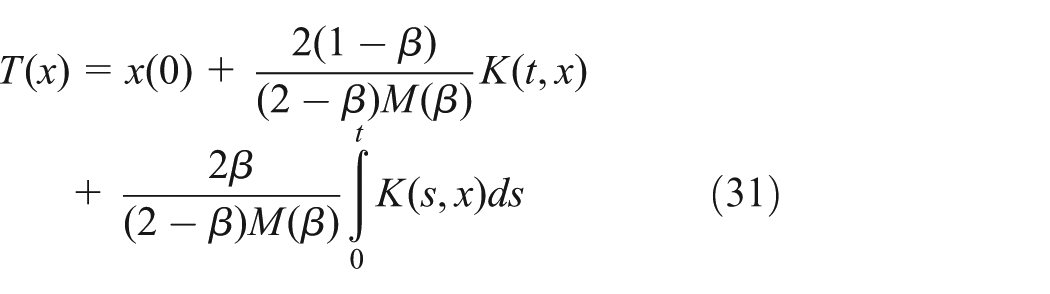
Proof
Suppose both the functions x and y are bounded with
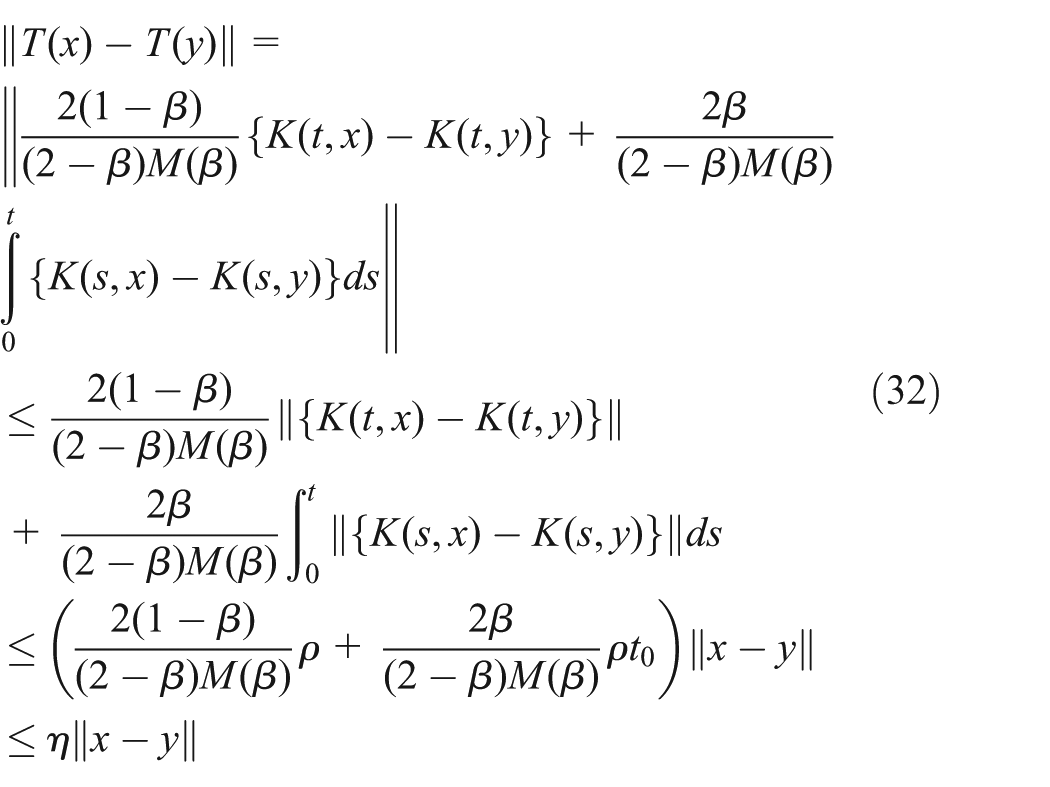
Hence, the theorem is proved.
Theorem 2
Considering that the function x is bounded, then the operator

satisfies the result

In the above inequality (34),
Proof
Let us assume that x be bounded function, then we have

Hence, the theorem is proved.
Theorem 3
If it is assumed that the function x is bounded, then the operator

Proof
Let

Hence, the theorem is proved.
Existence of the solution
To show the existence of the solution, we employ the notion of iterative formula. In view of equation (27), we set up the following iterative formula

and

The difference of the successive terms is represented as follows

Its usefulness is to notice that

Slowly but surely we assess

Making use of the triangular inequality, equation (42) becomes

As the Lipschitz condition is fulfilled by the kernel, it yields

Then

Now taking the above result into consideration, we derive the following result expressed as the subsequent theorem.
Theorem 4
The fractional model of logistic equation associated with equation (3) has a solution under the condition that we can find t0 satisfying the following inequality

Proof
Here, we have the function

Therefore

exists and is a smooth function. Next, we demonstrate that the function presented in equation (48) is the solution of equation (3). Now it is assumed that

Therefore, we have

On using this process recursively, it yields

Now taking the limit on equation (51) as n tends to infinity, we get

Hence, proof of existence is verified.
Uniqueness of the solution
Here, we present the uniqueness of the solution of equation (3). Suppose, there exists an another solution for equation (3) be

On taking the nom on both sides of equation (52), it yields
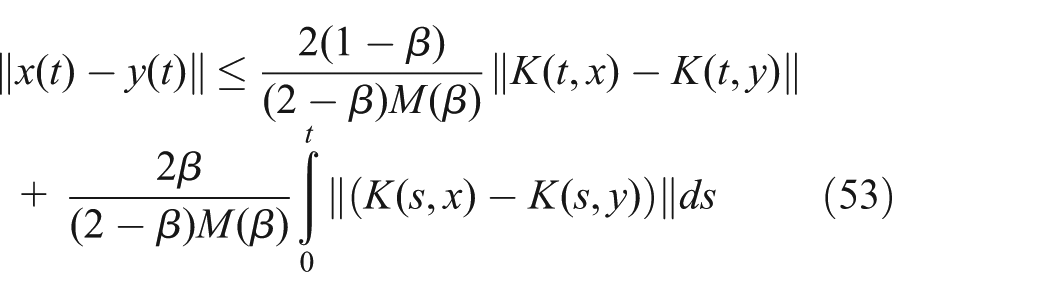
By employing the Lipschitz conditions of kernel, we obtain
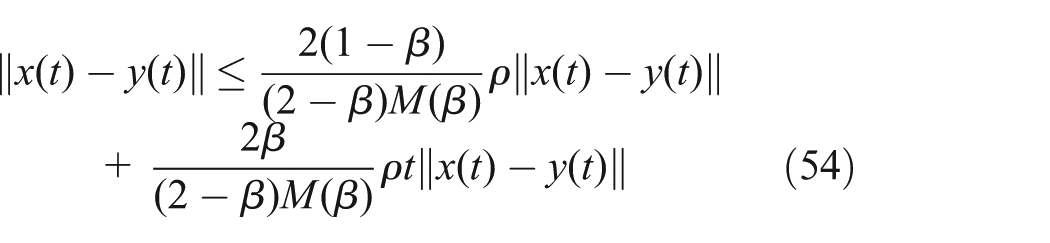
This gives

Theorem 5
If the following condition holds, then fractional logistic equation (3) has a unique solution

Proof
If the aforesaid condition holds, then

which implies that

Then, we get

Hence, we proved the uniqueness of the solution of equation (3).
Numerical results and discussions
Here, we compute the numerical solution of fractional model of logistic equation (3) using perturbation-iterative technique and Padé approximation.
24
For the numerical calculation, the initial condition is taken as

The response of solution

The behavior of the solution
Conclusion
In this article, we have studied the logistic equation involving a novel Caputo–Fabrizio fractional derivative. The stability analysis of model is conducted. The existence and uniqueness of the solution of logistic equation of fractional order are shown. The numerical solution is obtained using an iterative scheme for the arbitrary order model. The most important part of this study is to analyze the fractional logistic equation and related issues. It is also observed that the order of time-fractional derivative significantly affects the population growth. Hence, we conclude that the proposed fractional model is very useful and efficient to describe the real-world problems in a better and systematic manner.
Footnotes
Academic Editor: Xiao-Jun Yang
Declaration of conflicting interests
The author(s) declared no potential conflicts of interest with respect to the research, authorship, and/or publication of this article.
Funding
The author(s) disclosed receipt of the following financial support for the research, authorship, and/or publication of this article: The authors extend their appreciation to the International Scientific Partnership Program ISPP at King Saud University for funding this research work through ISPP# 63.