



Abstract
To enhance the robustness of the gate assignment, reduce the possibility of flight conflict, and improve the quality of passenger services, a multi-objective gate assignment model is proposed by minimizing flight conflict probability and number of flights assigned to aprons. The biogeography-based optimization algorithm is used to solve the proposed model with a new method for estimating the conflict probability. The simulation results show that the ratio of interval time of two flights assigned to the same gate between 60 and 120 min is as high as 82% when the rate of the flights assigned to aprons is controlled below 0.4. This means that the robustness increases greatly, and the probability of flight conflicts decreases, which is beneficial to the implement of flight assignment plan. In addition, the biogeography-based optimization algorithm is more effective to solve the proposed model and very easy to find out the optimal solutions.
Introduction
With the rapid growth of civil aviation transportation in China, air traffic has increased dramatically, resulting in the increase in flight delays and congestion.1,2 The actual departure or arrival time of aircraft is uncertain due to the increase in flights. At present, most China airports adopt pre-established gate assignment. Each aircraft is assigned to the corresponding gate according to the expected arrival or departure time ahead. But the pre-established gate assignment schedule often cannot match with the need due to the influence of uncertain factors such as weather or traffic flow. Gate assignment is becoming more and more complicated.
One of the most important uncertain factors is the random delay of aircraft through the statistics of many pre-established gate assignment schedule. 3 The random delay of aircraft may decrease the robustness of gate assignment and increase the transit time of flights. Robustness of gate assignment is to ensure minimal interference in pre-established gate assignment, considering the influence of uncertain factors, under the precondition of aircraft safety. The main goal of the ground movement problem is to minimize the time spent by the aircraft during their ground movements. 4 Therefore, how to improve the robustness of gate assignment and decrease the transit time under uncertain factors have become the hot spot of ground resources operation in hub airport.
The rest of this article is organized as follows. Section “Review” presents a review of the gate assignment problem (GAP). Section “Model development” presents a multi-objective gate assignment model with taking the robustness of schedule into account. Section “Gate assignment optimization simulation based on BBO” presents the biogeography-based optimization (BBO) algorithm to solve the multi-objective optimization model. The numerical results are reported in section “Numerical,” and the conclusions are presented in section “Conclusion.”
Review
Scholars in the world have carried out extensive research on how to optimize the gate assignment schedule to improve the efficiency of airport ground resource, and they have obtained many research results. In this article, the models and simulation of gate assignment are summarized, respectively.
Some scholars established single-objective gate assignment models to minimize the walking distance of passengers,5,6 the sliding distance of flights,7,8 or the leisure time of gates. 9 However, some scholars established multi-objective models to optimize the gate assignment. P Kumar et al. 10 considered different conflicting objectives such as maximization of gate rest time between two turns, minimization of towing an aircraft with a long turn, and minimization of overall cost. U Dorndorf et al. 11 established a model to maximize the total assignment preference score, to minimize the number of unassigned flights during overload periods, to minimize the number of tows, and to maximize a robustness measure. HK Sang et al. 12 proposed a model to minimize weighted nominal taxi time and weighted taxi delay, as well as passenger transit time in the terminal. Y Jiang et al. established a model according to the problems of airport passenger service quality. A gate assignment model is based on minimizing the total walking distance of all passengers and balancing the average walking distance of passengers among different airlines. 13 KV Prem et al. 14 introduced new additional objectives to gate assignment that have not been studied in the literature, including maximization of passenger connection revenues, minimization of zone usage costs, and maximization of gate plan robustness. KC Chong et al. took two kinds of considerations into account. One is passenger walking distance from arrival gate to departure gate, and the other is the transport baggage distance from one gate to another. The objective was to minimize the total distance between the gates related to assign the arrival plane to the suitable gates. 15
Some scholars also proposed optimization methods or intelligent algorithms to solve the GAP. MG Hakk et al. proposed a method that combined the benefits of heuristic approach with some stochastic approach instead of using a purely probabilistic approach to top-down solution of the GAP. The proposed method generates an assignment order for the whole planes that corresponds to assignment priority. 16 Y Pi et al. developed a novel airport gate assignment problem (AGAP) model. The greedy randomized adaptive search procedures (GRASP) have strong intuitive greedy appeals, prominent empirical track records, and trivial to be efficiently implemented on parallel processors. More importantly, GRASP can overcome the precocity. Experimental results demonstrate that the GRASP algorithm on AGAP evidently exceeds GA algorithms on the quality of solutions and time complexity. 17 CH Yu et al. built a mathematical model to show the relationship among three factors impacting on the gate assignment: robustness, tows, and passenger transfer distance. An artificial intelligence-based hybrid meta-heuristic algorithm was designed to solve this problem. 18 O Aoun et al. adopted the original algorithm based on Markov decision process (MDP) to solve the GAP under uncertainty and introduced some stochastic parameters that depend on probabilities to express fluctuations in flight operations. The MDP provided a robust solution for the GAP. 19 YH Wang et al. 20 built a mixed set programming method to build a data and logical model of gate assignment and developed efficient search strategies to achieve global optimal solution. KC Chong et al. proposed a model to minimize the total distance between the gates that are related to assign the arrival plane to the suitable gates. An integer linear programming (ILP) model was built to solve the GAP. 21 M Marinelli et al. proposed a meta-heuristic approximation approach, namely, simulated annealing to solve the GAP. The results suggested that the decreasing number of un-gated flights occurred with the implementation of the proposed method. 22 M Marinelli et al. proposed a hybrid approach called biogeography-based bee colony optimization (B-BCO). This approach is obtained fusing two meta-heuristics: BBO and bee colony optimization (BCO) algorithms. The proposed B-BCO model integrates the BBO migration operator into the bee’s search behavior. 23
The multi-objective models are built to solve the GAP. The heuristic algorithm is often combined with other algorithms to solve these models. These articles are mostly concerned about travelers and airports, while the robustness of gate assignment schedule should also be taken into consideration. Many scholars also established models to improve the robustness of gate assignment. A Lim and Wang 24 established a stochastic plan model by determining an evaluation function that had nothing to do with the real arrival or departure times of flights. BC Smith et al. established a gate assignment model from the perspective of different models. It required the same type of flights to be assigned to the same gates as possible as it could, so the robustness could be improved. 25 Dumas et al. 26 established a gate assignment model from the network effect to reduce the scale of gates assignment. G Diepen et al. established a cost function to evaluate the spare time between two consecutive flights assigned to the same gate. They improved the robustness of gate assignment by minimizing the total cost. 27 SW Yang et al. designed an improved gray model (GM) (1, 1) model to predict the arrival time or departure time of flights. And on the basis of this, the gate is assigned beforehand to improve the robustness. 28 L Xu et al. regarded the GAP as a stochastic binary integer programming problem. Flights were divided into different uncertain sets. Robust solution was to ensure that gate assignment was flexible to uncertain arrival or departure time of flights in the sets. 29 U Dorndorf et al. 11 established a model to minimize the unassigned flights during the overload period to maximize the robustness. JH Li et al. introduced different probability distributions of flight delay and established robust gate assignment model to minimum conflict probability. And the greedy tabu search algorithm was designed to solve the model. 30 H Zhao and Cheng 31 put forward a mixed-integer model to find the more robust solve for gate assignment model and designed ant colony algorithm. XT Wang et al. 32 converted the gate assignment into selection of corresponding gate type and established mathematical model to increase the robustness of gate assignment. ME Narciso et al. put forward an experimental method to assess the minimum number of gates required by arrival or departure flights under limited delay. And they analyzed shortcomings and benefits on different strategies. 33
To sum up, researches on gate assignment robustness mainly focused on the balance among free time of gates and the decrease on the number of unassigned flights. The robustness of gate assignment is mainly reflected in the conflict probability between two consecutive flights assigned to the same gate, so this article adopts a new way to estimate conflict probability between two flights. The gate assignment plan is optimized by minimizing the conflict probability, and the number of flights assigned to aprons is controlled minimum as the other object. The BBO algorithm is used to simulate the model. The results show that the cost is saved and the utilization rate of gates is improved. These two objects are combined to find a new way to improve the robustness of gate assignment.
Model development
Assumptions
According to the operation requirement of hub airports and air traffic management, some assumptions for gate assignment model development are proposed as follows. (1) The gate assignment is a continuous operation process. So the article selects all the arrival–departure flights in a certain period to engage in research. (2) The capacity of airport can meet the demand of flights within the research period, each aircraft can be assigned to a gate, including gates and aprons, and the aprons are always available for flights. (3) When an aircraft performs the arrival and departure flight at the same time, it is defined as flight pair. The flight pair needs to be assigned to the same gate and has a same flight number. (4) All the information of flights within the research period, including flight schedule plan, aircraft basic information, gate information, is known.
Notation
The indices, parameters, and variables used in the model are defined as follows:
F: flight set
G: gate set,

t: buffer time interval of two connected flights which are assigned to the same gate. The actual service time interval for flight


Model
The robustness of schedule is taken into account to study the gate assignment in hub airport in China, and the utilization of aprons is also considered, which is related to the operation cost. The presented gate assignment optimization model is a bi-objective model.
According to the flight schedule, the arrival time

where
For both airports and airlines, it is important to improve the proportion of passengers embarking/disembarking through aerobridge (referring to passing rate) to decrease the operation cost. Thus, the gate assignment objective function (2) is established on the basis of minimizing the number of flights assigned to aprons

where
The model of gate assignment can be established as follows


Subject to





Equation (5) is used to judge whether flight
Equations (6) and (7) indicate that each flight has only one gate to be assigned. Therefore, for the flight
Equation (8) indicates that two flights cannot be arranged to the same gate at the same time. When
Equation (9) means that the gate type should match the aircraft type. When
Equation (10) is a positive integer constraint.
Gate assignment optimization simulation based on BBO
A heuristic BBO algorithm is adopted to simulate and solve the gate assignment optimization model. The BBO algorithm is a new intelligent optimization algorithm, which has better search efficiency than the previous intelligent optimization algorithms. The BBO algorithm was originally proposed in the study by Simon 34 which is based on the mathematical models of biogeography. In principle, there are two main operators in BBO, that is, migration and mutation. Before optimizing, each individual of population is evaluated and then follows migration and mutation step to reach global minima.
Encoding way
In the simulation process, the arrival–departure flights within the study period and the gates at the airport are encoded to form the real number code.
Generating initial solution
The gate assignment is a multiple-objective constraint problem. In this article, the initial solution is generated by generating the roulette to improve efficiency. The gate is assigned to the flight randomly. So, the initial solution usually does not meet the constraints.
Designing habitat suitability index
The individual in the BBO algorithm corresponds to the nature habitat. Habitat suitability index (HSI) is used to measure the quality of the individual in the nature habitat and regard it as a reference to rank the individual. Object functions

where
Then, the HSI function can be expressed as follows

where M is a large real number, so
The operation of BBO algorithm
Migration and mutation operation are included in the operation of BBO algorithm. Migration operation includes emigration and immigration. Species with high HSI have high emigration and low immigration rate. Species with poor HSI is opposite. Mutation operation is used to enhance the diversity of individual in the habits. Both of them can change the HSI. After the migration and mutation operations, the coding sequence may not satisfy the constraints any more. Therefore, the feasibility of the coding sequence needs to be tested. Then, update the individuals and continue to proceed with the iteration. Finally, the optimal solution to satisfy the constraint is selected. The process of BBO is shown in Figure 1.

Gate assignment model process based on the BBO algorithm.
The BBO algorithm process mainly includes two operations, the migration and the mutation, whose operation procedures are shown as follows. Given hypothesis that the number of habitats is d, and characteristic vector of habitat individual i corresponds to a candidate solution set
Migration operation
According to the principle of BBO, species with better HSI have high emigration rate and low immigration rate. Species with poor HSI is opposite. The migration operation includes the immigration and emigration operation and can change the HSI. Rank the individual according to the HSI. The immigration rate

where q indicates the maximum number of species, s indicates the number of species for inhabitat individual. The number of species can be determined by the HSI. In this article, the maximum number of species is equal to the number of habitat individual, and the habitat individual can be arrayed by HSI. The species number of individual habitat, whose HSI is maximum, is d. The species number of individual habitat i is
The procedure of migration.

Mutation operation
Mutation operation is used to enhance the diversity of individual in the habitats and change the habitat suitability values. Mutation probability is small. This article adopts a simple mutation manner. Each iteration selects species elements
The procedure of mutation.

Numerical
The data for simulation
The data for simulation are the real operation data from a hub airport in China. There are total 61 groups of flight data to be used to simulate the model. The selected flights are waiting to be allocated to gates during 8:00–15:00.The flight data include flight number, type of aircraft, arrival time, and departure time, as shown in Table 3.
The flight data during 8:00–15:00 from a huge airport in China.

L: large aircraft; M: medium aircraft; S: small aircraft.
Gates G000–G015 in the hub airport are selected to simulate the gate assignment model. The relevant gate information includes gate number and types of gate. In addition, G000–G014 are gates, and G015 is a set of aprons, which are always available for flights. The available gate data are shown in Table 4.
The available gate data at the hub airport in China.
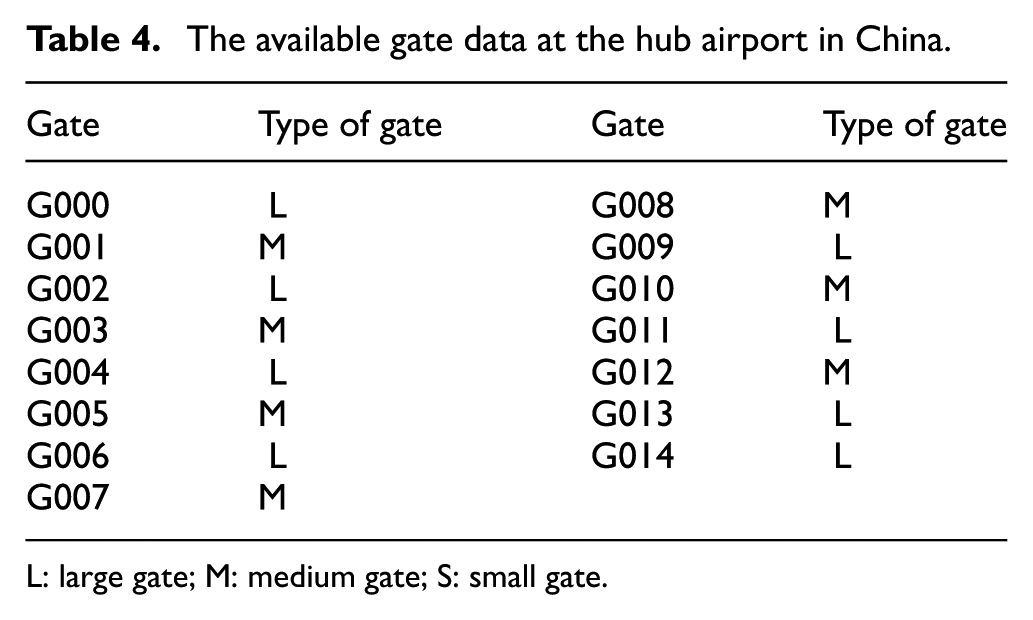
L: large gate; M: medium gate; S: small gate.
The layout of the gate position in the hub airport is shown in Figure 2. The airport consists of three parts: terminal, taxiway, and runway. Gates G000–G014 are near the terminal, others away from terminal are aprons. Parking at these gates G000–G014 can help to reduce passengers walking distance and airport operation cost. The green taxiing routes are departure routes and the red taxiing routes are arrival routes. The arrival flights land on the runway and slide into these gates along the red taxiway routes, while the departure flights are pushed out from these gates and slide into the runway to take off along the green taxiway routes.
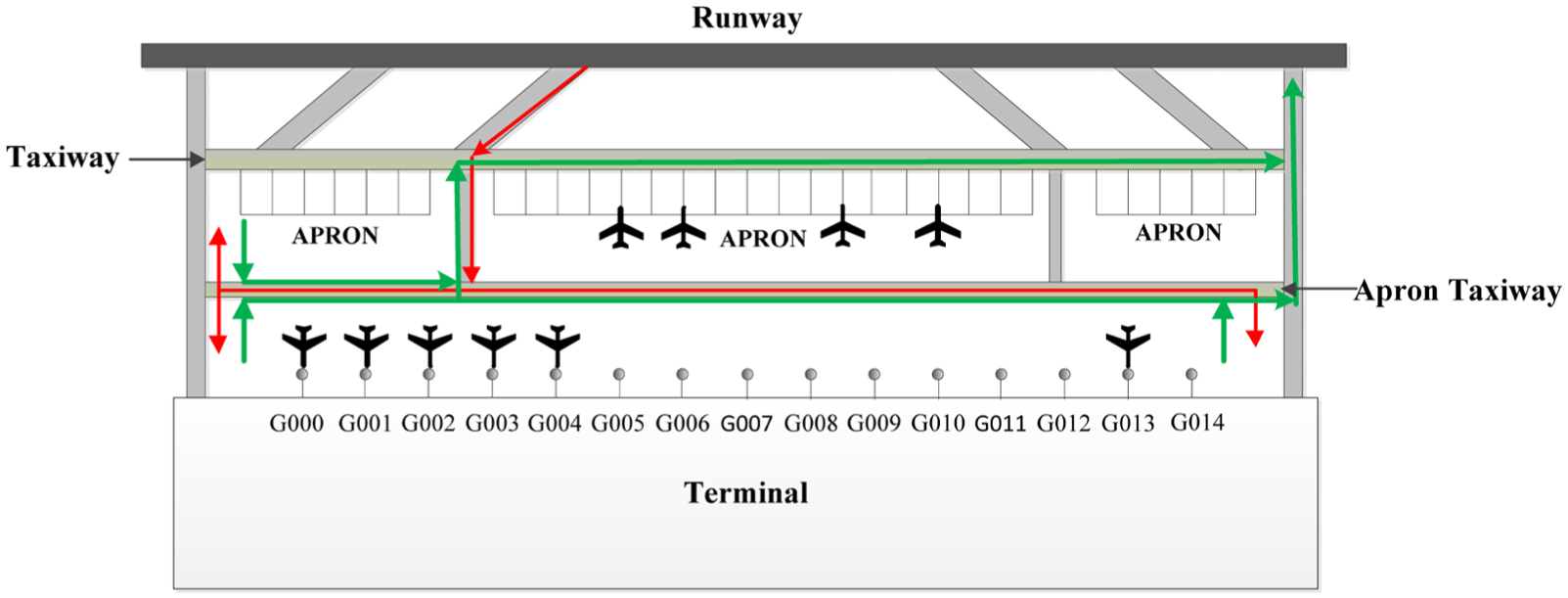
The layout of the gate position in the hub airport.
A new way to estimate
Conflict probability function

Expression form of power function is shown as follows

Expression form of exponential form is shown as follows

where t indicates the buffer time between two consecutive flights. The turnaround time for a flight is 30 min. Buffer time for each flight is defined as
In addition,
This article, respectively, adopts exponential function and power function to indicate the conflict probability. Conflict probability curve generated by two functions is shown in Figure 3.

Illustration of
It can be seen from Figure 3 that the value of
The model is simulated according to objective function (1) with two different
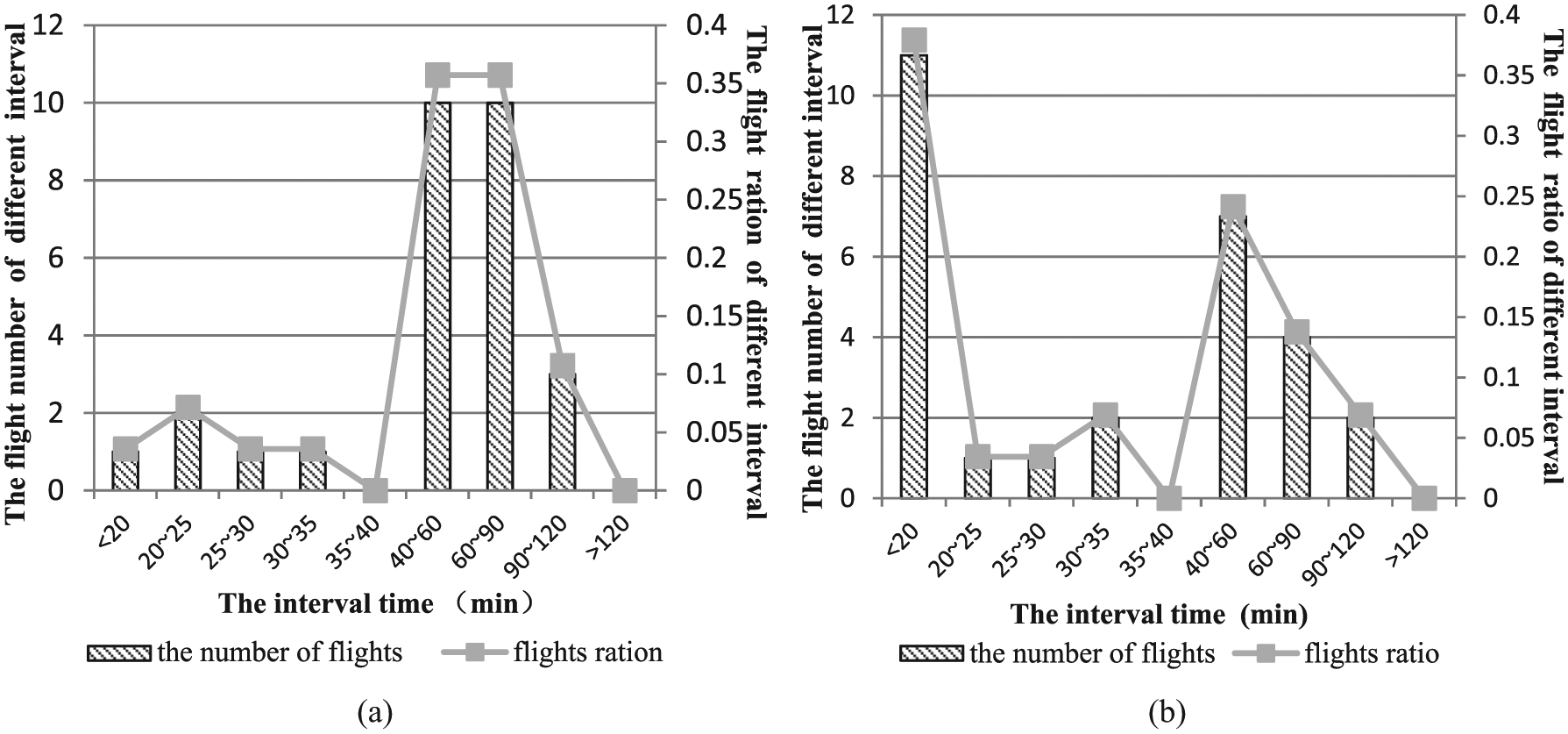
The interval time adopting (a) exponential function and (b) power function.
Figure 4(a) indicates the distribution of interval time when adopting exponential function, and Figure 4(b) indicates the distribution of interval time when adopting power function. It can be seen from Figure 4(a) and (b) that the number of interval time below 30 min under probability curve of the exponential function is less than that under probability curve of the power function. The distribution of interval time below 30 min is mean under probability curve of the exponential function, and flight ration of them below 30 min is less than 0.05. But the distribution of interval time below 30 min is not mean under probability curve of the power function, and the flight ration of interval time below 20 min is 0.38. This can easily lead to conflict on consecutive flights during rush hours and cannot improve the operation efficiency of the ground resources. So we select exponential function as evaluation index.
Numerical
Exponential function is selected as the evaluation function, and the model is solved by BBO algorithm. The model is simulated under the situation of best robustness (objective function (1)) and the lowest distribution rate of flights assigned to aprons (objective function (2)), respectively. The value of objective function changes with the increase in iteration, as shown in Figure 5(a) and (b). Different color represents different number of population, and each line indicates the change tendency of the objective function under the specific population number.

The 2D figure on the evolution process of (a)
It can be seen from Figure 5(a) that the values of objective function
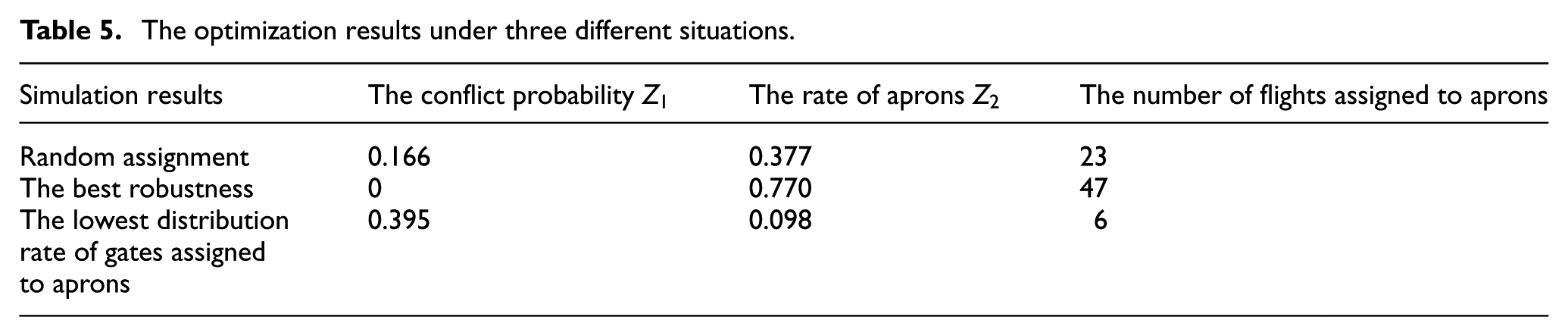
In the process of simulation, the results of gate assignment are compared under the situation of random assignment (not considering the objective function), the best robustness (only considering the objective function 1), and the lowest distribution rate of gates assigned to aprons (only considering the objective function (2)), respectively. The results are shown in Table 5 and Figure 6.
The optimization results under three different situations.

The comparison results of conflict probability and the rate of aprons under three different situations.
The following conditions can be seen from Table 5 and Figure 6:
Under the situation of best robustness, the minimum conflict probability of gate assignment is zero, indicating that conflict will not be caused. At the same time, the distribution rate of flights assigned to aprons is as high as 0.770, which is the highest among them. A total of 14 flights are assigned to gates, while other flights are assigned to aprons. The robustness of gate assignment is improved, while the distance of aircraft’s sliding and passengers’ walking is increased. This will increase operation cost and reduce the service satisfaction of passengers.
Under the situation of the lowest rate of flights assigned to aprons, the number of flights assigned to aprons is much less than that under other situations. This will decrease sliding distance of flights, the cost of airlines, and the walking distance of passengers, while the conflict probability under this situation is more than that under other situations. It decreases the robustness, which indicates that this way of gate assignment may lead to conflict and delay of flights.
It can be seen from above that better robustness may increase the number of flights assigned to aprons and then increase the operation cost of airlines. The rate of flights assigned to aprons will lead to the worse robustness of gate assignment and flight delay. So, during the process of gate assignment, the robustness and the rate of flights assigned to aprons can be both taken into consideration.
The objective function
The simulation results of gate assignment under different rates of aprons


The conflict probability and number of flights assigned to aprons under different rates of aprons
It can be seen from Table 6 and Figure 7 that the value of objective function
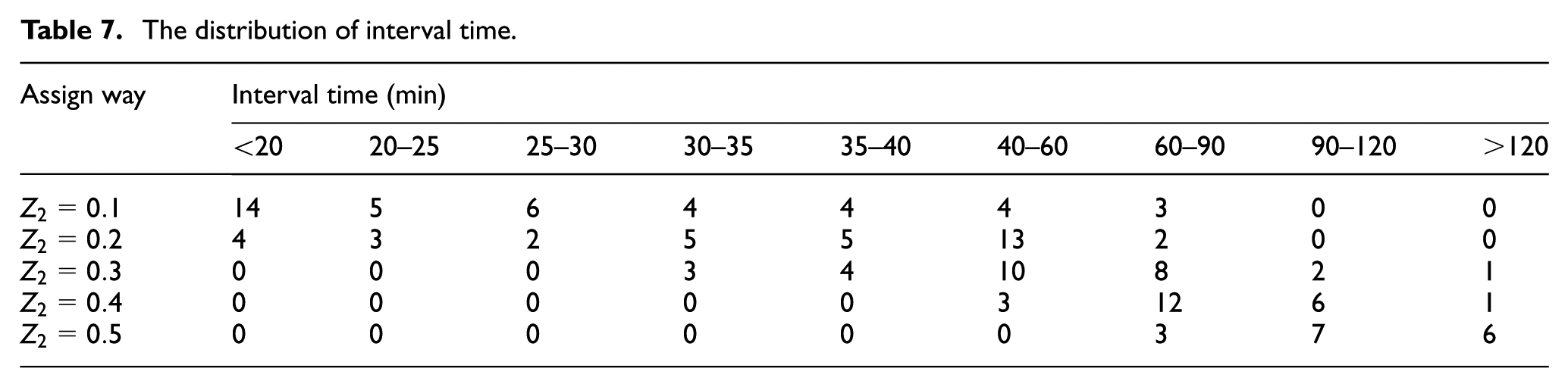
More flights are assigned to aprons, fewer flights are assigned to gates, resulting the interval time between two consecutive flights assigned to the same gate is longer. The impact on other flights is smaller when delays on one or more flights are caused by weather or other reasons. The gate assignment is uneasy to be disturbed, reducing the probability of conflict and improving the robustness. Compare the time interval distribution between two consecutive flights under the situation of first come first served and
The distribution of interval time.
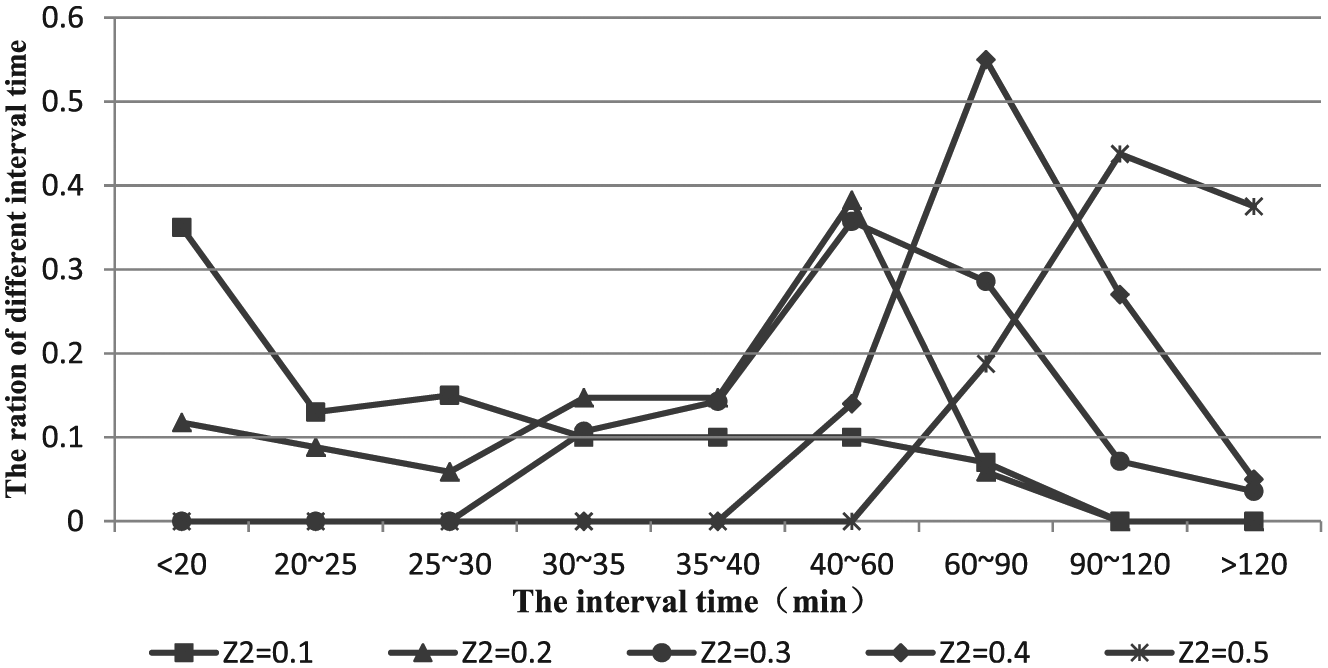
The ratio of different interval times.
Table 7 indicates the time interval distributions of consecutive flights allocated to the same gate in the three different kinds of situation. Figure 8 indicates the proportion of intervals time between consecutive flights allocated to the same gate in the three situations. It can be seen from Table 7 and Figure 8 that when
Increasing of flights assigned to aprons will improve the robustness of gate assignment, which also leads to longer passenger walking distance and lower airport service satisfaction. And if utilization of gate increases immensely, flights’ conflict may easily happen at busy period and delay increases. Therefore, the robustness and the number of flights assigned to aprons should be both considered. In view of the two kinds of factors, it can be concluded that the robustness and passing rate of gate assignment both meet airport operation requirements when

The Gantt chart of gate assignment results when
Conclusion
In this article, a multi-objective gate assignment model is proposed to minimize flight conflict probability and number of flights assigned to aprons. By controlling the proportion of flights assigned to the apron, we can find out optimally robust assignment results under different proportions. The model is simulated using actual operation data from a hub airport in China, so the results are more reliable. The BBO algorithm is more effective to solve the model and very easy to find out optimal solutions; meanwhile, its program is very simple. For different airports, the proposed model can be used to optimize gate pre-assignment according to actual situations and improve the performance and stability of the plan. Gate assignment plan of different robustness should be chosen based on actual situations at these airports. Flexibility of gate assignment is also improved by controlling the proportion of aprons.
This article mainly considers that how the flight conflict influences the robustness of gate assignment. Besides, other factors like weather and walking distance of passengers can also be taken into consideration when optimizing the gate assignment.
Footnotes
Academic Editor: Xiaobei Jiang
Declaration of conflicting interests
The author(s) declared no potential conflicts of interest with respect to the research, authorship, and/or publication of this article.
Funding
The author(s) disclosed receipt of the following financial support for the research, authorship, and/or publication of this article: This work was supported by National Nature Science Foundation of China 61104159 and 61573181, the National Nature Science Foundation of China and Civil Aviation Administration of China U1333117, the Natural Science Foundation of Jiangsu Province BK20131366, and the Youth Science and Technology Innovation Foundation NS2013067.