



Abstract
Recently, the exclusive compulsory technical code (GB 50982-2014) for structural health monitoring of buildings and bridges in China has been developed and implemented. This code covers the majority of the field monitoring methods and stipulates the corresponding technical parameters for monitoring of high-rise structures, large-span spatial structures, bridges and base-isolated structures. This article first presents the comprehensive review and linear comparison of existing structural health monitoring codes and standards. Subsequently, the progress of the codification of GB 50982-2014 is imparted and its main features and specifications are summarized. Finally, in accordance with GB50982-2014, several representative structural health monitoring practical applications of large-scale infrastructures in China are exemplified to illustrate how this national code can bridge the gap between theory and practical applications of structural health monitoring. This technical code is an important milestone in the application of well-established structural health monitoring techniques into the realistic and complex engineering projects. Also, it can provide abundant and authoritative information for practitioners and researchers involving the structural health monitoring techniques.
Introduction
The rapid growth of large-scale civil infrastructures has undoubtedly driven and accelerated the development and application of structural health monitoring (SHM) in China. SHM, formally defined in the late 20th century, refers to the long-term or periodic monitoring and systematic analysis of key structural and environmental parameters in situ so as to identify structural characteristic parameters, detect damages and evaluate the structural conditions. Finally, it can provide crucial and comprehensive information for the engineers or owner to recognize the abnormal states or accidents at an early stage as well as facilitate the maintenance and rehabilitation, thereby preventing the casualties and economic losses.1–7 However, the gap between the research and practical applications of SHM has been widely noted and received great concerns. The main reason can be attributed to the lack of standardization of SHM principles and best practice guidelines (BPG). The authoritative and standardized specifications of SHM in civil engineering infrastructures are a cumbersome task since structures are different from each other in terms of structural forms, structural performance and resisting capability as well as types of subjected loads. Meanwhile, developing and implementing codes and standards is normally time-consuming and not always in perfect alignment with priorities in research community. 8
In the past decade, the significance of establishing codes and standards in accelerating the employment of SHM technologies and methodologies has been increasingly emphasized. As a result, several codes or standards have been developed and released. The first guideline for SHM is the Guidelines for Structural Health Monitoring, 9 which was published by Intelligent Sensing for Innovative Structures (ISIS) of Canada in 2001. This guideline presents the interim summary of the state-of-the-art of SHM techniques at that moment, including static field testing, dynamic field testing, periodic monitoring and continuous monitoring. International Organization for Standardization (ISO) presented an informal international standard for measuring and processing the vibration response of bridges and buildings.10–12 In the United States, Federal Highway Administration (FHWA) and International Federation for Structural Concrete (FIB) released the guidelines of Development of a Model Health Monitoring Guide for Major Bridges 13 and Monitoring and Safety Evaluation of Existing Concrete Structures 14 for bridge health monitoring. These guidelines include almost all aspects of SHM engineering applications for bridges, including monitoring concepts, structures and materials, inspection technology, measurement method, implementation issues and data acquisition, systems analysis, condition assessment and structural reliability analysis. Structural Assessment, Monitoring and Control (SAMCO) of European Union issued Guideline for Structural Health Monitoring 15 in 2006, which was intended to introduce the SHM procedures and technologies to infrastructure system owners and engineering practitioners. Also, Russian Federation has developed Russian GOSTR 53778-2010, 16 which introduces the visual inspection, testing technologies and condition-based classification schemes for different types of structures. Wenzel 17 also presented and summarized existing SHM technologies of bridges, which provided much valuable information for the conceptual design of SHM systems and subsequent processing. In 2012, Germany issued an official guideline for the monitoring of bridges and other engineering structures. 18 The existing and comprehensive guidelines have witnessed the significant progress of SHM for large-scale infrastructures and presented a detailed and interim summary of the available SHM technologies and methods as well as the engineering application procedures. Eventually, they will lay the foundation for the authoritative and abundant codes and standards of SHM, which can significantly promote the engineering applications of SHM.
This article first presents a comprehensive review of the developments of SHM codes and standards in China, particularly for the codification of Technical code for monitoring of building and bridge structures (GB 50982-2014). In addition, the engineering application procedures and SHM technologies of several representative cases in China are imparted, which exemplified the specifications of this SHM code. The content of this article is as follows: section “Development of SHM codes and standards in China” gives a brief overview of the history of the development of the SHM codes and standards in China. Section “Main contents and features of GB50982-2014” describes the main contents and features of GB50982. Section “Representative SHM engineering applications based on GB50982-2014” presents some typical engineering applications of SHM to infrastructures in accordance with GB50982. The concluding remarks are summarized in section “Conclusion.”
Development of SHM codes and standards in China
It is worth noting that there are two main systems to develop and refine the standards of construction engineering in China, namely, the engineering construction standard by the government of China and the engineering construction standardization by professional associations. The engineering construction standards include local standards, industrial standards and national standards or codes, which are mandatory or recommended and supervised by the Government of China; whereas, the China Association for Engineering Construction Standardization (CECS) is the main professional association for engineering construction standardization with recommended requirements, which does not belong to the Government of China according to the “Standard law of the People’s Republic of China.”
The development of codification of SHM technologies has seen a rapid progress with the emerging standards, codes and specifications of different regions and varying levels. Table 1 summarizes and compares the existing SHM codes and standards in China. The first SHM specification of Structural health monitoring system technical specification for bridge of Tianjin (DB/T29-208-2011) 19 was issued by Tianjin municipal government in 2011, which is applicable for bridge health monitoring in Tianjin. Afterwards, CECS issued Design standard for structural health monitoring systems (CECE 333:2012) 20 for both buildings and bridges across mainland China. In 2013, Ministry of Housing and Urban-Rural Development of China promulgated the industrial standard Technical code for construction process analyzing and monitoring of building engineering (JGJ/T 302-2013) 21 for buildings and then the authoritative and mandatory national SHM code in China, Technical code for monitoring of building and bridge structures (GB 50982-2014). 23 China has its own national SHM code after the promulgation of GB 50982-2014, which provides a detailed summary of the existing SHM techniques and a comprehensive specification on the monitoring of superstructures as listed in Table 1. As compared to others, GB 50982-2014 is the exclusive national code with mandatory specifications on the monitoring of superstructures in China and the other relevant local, industrial, or professional association codes and standards are in its scope of jurisdiction. Therefore, the development and implementation of GB 50982-2014 can not only benefit to provide the authoritative and comprehensive information of the SHM technologies but also facilitate the standardization and unification of the SHM codes and standards in China. For monitoring of superstructures, if details are not specified in GB 50982-2014, it is of necessity to refer to other suitable SHM codes or standards of China. For example, the industrial standard Technical specification of safety monitoring system for highway bridge structures (JT/T 1037-2016) 22 was released by Ministry of Transportation of China for further refining the monitoring contents of bridges.
Comparison of five SHM codes and standards in China.
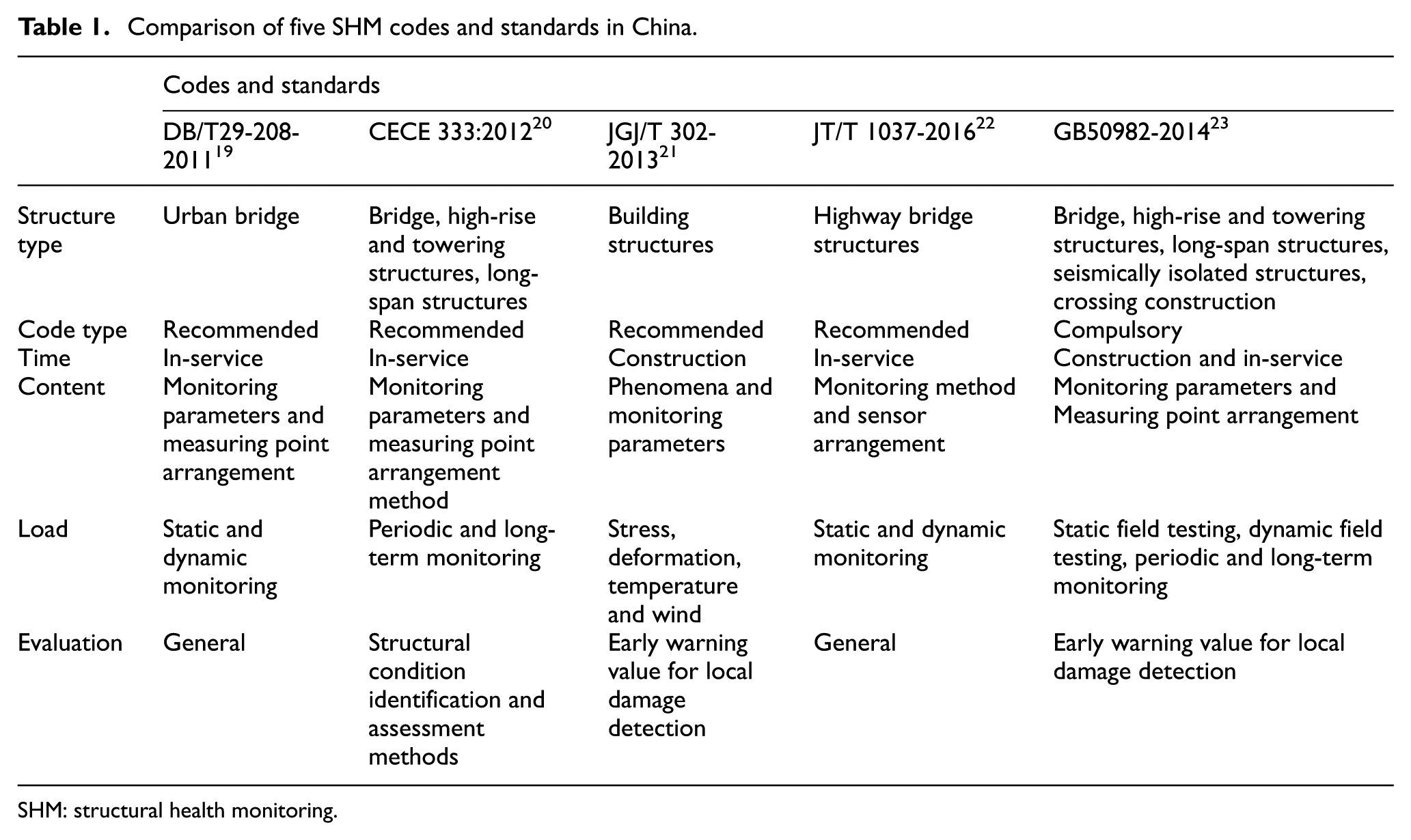
SHM: structural health monitoring.
Main contents and features of GB50982-2014
GB50982-2014 consists of eight chapters, two appendixes and explanations. The main content includes (1) general provisions; (2) definitions (terminology; notation); (3) basic requirements (according to monitoring procedure for construction and post-construction); (4) monitoring methods; (5) specifications for various types of structures: high-rise building and structure, long-span spatial structure, bridge structure, seismically isolated structure and crossing construction (guidelines for sensor arrangement, monitoring parameters and condition assessments for construction and post-construction); and (6) technical requirements (monitoring requirement of different types of bridges and technical requirements of monitoring equipment).
Main features of GB 50982-2014 are as follows:
GB 50982-2014 is the first and exclusive national SHM code with mandatory requirements in China. And it distinguished the differences between the traditional structural inspection and structural monitoring. For an example, settlement observation has been termed as monitoring in this national code, rather than the traditional inspection. In addition, the contents of GB50982-2014 are organized in consistence with structural monitoring procedure. Therefore, the direct use of this national code into engineering practices is feasible, which can provide the comprehensive knowledge and rudimentary requirements of SHM technologies. The implementation of this code tends to bridge the gap between the research and practical applications of SHM in China.
GB 50982-2014 embraces structural monitoring specifications for a variety of structural types. For each type of structure, this code presents monitoring parameters, technical requirements of monitoring sensors and devices, optimal sensor arrangement and so on. Moreover, this code puts emphasis on the structures that require monitoring during the construction and post-construction stages, and SHM system is highly recommended to be installed on high-rise and towering structures, long-span spatial structures and bridges, as well as seismically isolated structures. Additionally, the monitoring of existing structures should be conducted in the case of neighboring crossing construction.
GB50982-2014 covers the full lifecycle of structures. It specifies structural monitoring during construction and post-construction with their basic features and requirements. Furthermore, GB50982-2014 includes detailed and comprehensive monitoring parameters, such as stress and strain, deformation and crack, vibration, wind effects and wind-induced response, earthquake excitation and seismic response, temperature and humidity, cable force, bridge corrosion, bridge traffic and bridge scour. Meanwhile, the monitoring methods or techniques for building and bridge structures are classified by the monitoring parameters in this national code, which can be carried out accordingly and readily.
Representative SHM engineering applications based on GB50982-2014
This section presents some of the representative cases of implementing SHM systems in accordance with GB50982-2014. It is noteworthy that these projects have been carried out for years, and more details on these projects can refer to the literature by the authors. 24
Bridge structure
Caiyuanba Bridge of Yangtze River is a major project for the river-crossing transportation in Chongqing. The length of the bridge is 800 m with the main span of 420 m, which is the longest span of tied-arch bridges in the world, as shown in Figures 1 and 2.

Schematic diagram of Caiyuanba Bridge.
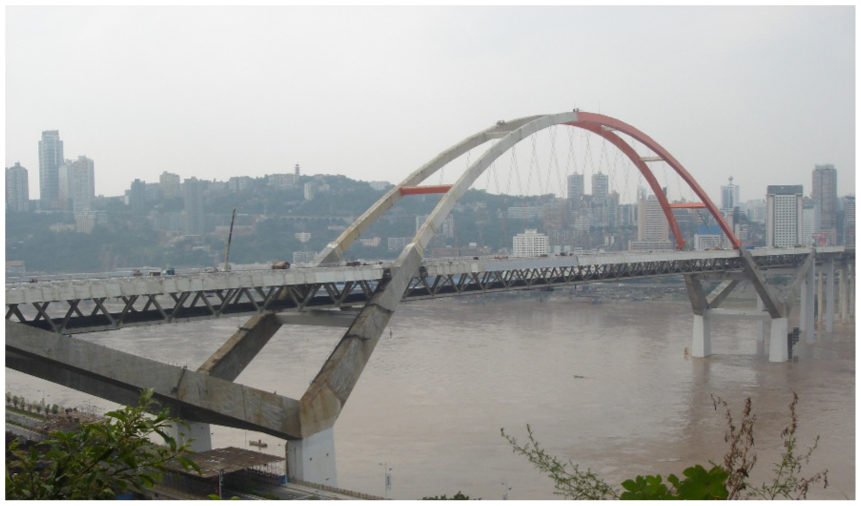
Photograph of Caiyuanba Bridge.
With reference to provisions 3.4.1, 3.4.3 and 7.1.2 of GB50982-2014, the objective of monitoring Caiyuanba Bridge is to assess the stress and deformation conditions of its structural elements during the service stage to prevent the extreme loadings and ensure its structural performance within the acceptable ranges of the design requirement and the provisions of GB50982-2014. The monitoring parameters follow the provisions 7.1.5 of GB50982-2014, which contain three-dimensional deformation and acceleration, deflection of steel truss girder, support displacement, static stress of concrete structures, dynamic stress of steel structures, cable force of tied bar and hanger rod, as well as environmental temperature. All the monitoring parameters and corresponding monitoring schemes were in accordance with the requirements of Chapter 4, appendices A and B of GB50982-2014. Similarly, the determination of monitoring parameters in the SHM engineering applications for other bridge structures should also follow these provisions provided in GB50982-2014. The arrangements of measurement sensors for Caiyuanba Bridge are illustrated in Figures 3 and 4.

Sensors installed for deflection measurements of steel truss girder.

Sensors installed for static stress measurements of concrete beams.
Monitoring results of deflection of steel truss girder
Proof load testing of Caiyuanba Bridge was carried out upon its completion, and the monitoring results of deflection of steel truss girder during loading and rebounding are shown in Figures 5 and 6. In general, good agreements of the deflection results are found between the proof load testing data and theoretical values.

Symmetrical loading for maximum moment in the north of steel arch (rebounding: unloading condition).

Loading for maximum moment in the distance of 1/4 span to the north of steel arch (loading on symmetry: loading at the center of the bridge; loading on part: loading near the target section).
Monitoring results of normal state
Following the requirements in Chapters 3.3 and 3.4 of GB50982-2014, the SHM system installed on the bridge is capable of evaluating the structural state by displaying graphs and reports, respectively. The three-dimensional model of the entire bridge structure is shown in Figures 7 and 8, while Table 2 shows the automatic evaluation result of each monitoring point.
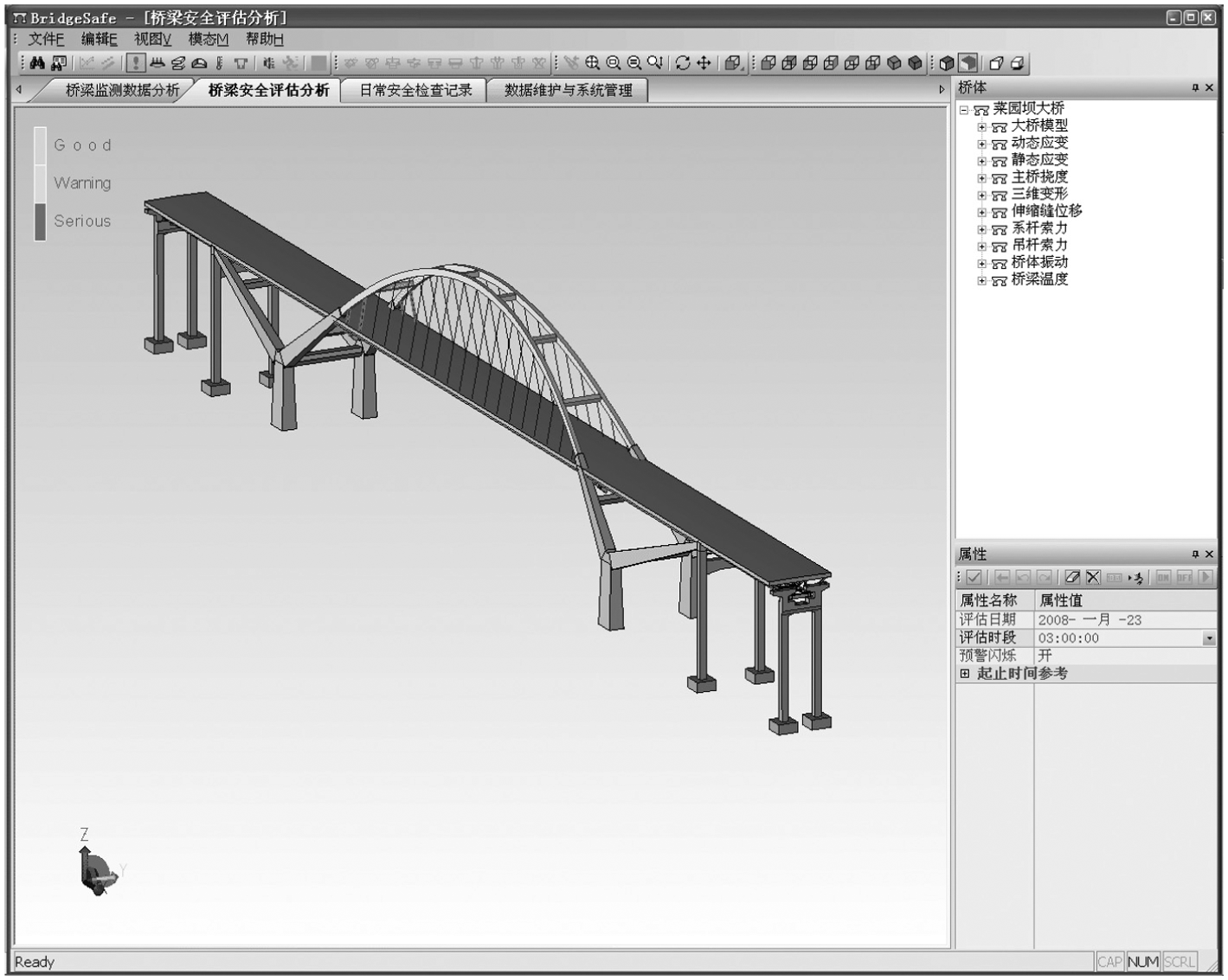
3D model of the whole bridge for conditional assessment.

Automatic evaluation results at monitoring points.
SHM system report.

SHM: structural health monitoring.
High-rise structure
International Finance Center (IFC) is the second tallest building in Hong Kong with a height of 420 m. It has a frame-core-tube structural system supported by eight mega columns and three strengthening stories around core tube. The general footprint of the building is about 57 m × 57 m, which reduces to 39 m × 39 m at the roof level. IFC is featured by the high flexibility, low damping and light-weight; therefore, it is significantly wind-sensitive, in particular to take account of the fact that Hong Kong is located in a typhoon-prone region.
As specified in the provisions 4.7.1 and 4.7.2 of GB50982-2014, the monitoring parameters of a wind-sensitive structure normally include wind pressure on cladding, wind speed and wind direction atop the building, wind-induced displacement and vibration of the high-rise structure. The SHM system installed on IFC is in good accordance with the requirements of the monitoring procedure as provided in Chapter 5 of GB50982-2014 for high-rise buildings. The sensor sub-systems installed on IFC, such as the hardware system and data acquisition sub-system, are illustrated in Figures 9 and 10, respectively. The technical parameters of various sensors follow the corresponding specifications in Chapter 4.7 and appendix A. Besides that, the sensor locations are determined according to the basic requirements for the structural monitoring of a high-rise building as specified in the normative provisions 5.3.8, 5.3.12, 4.7.3, 5.3.10 and 4.7.6, including four accelerometers for acceleration measurements, three anemometers for wind velocity records, four wind pressure transducers and global positioning system (GPS) (installed at the top of the building).

Structural health monitoring system for 2IFC.

Software system for 2IFC.
The software system for the SHM system of IFC was developed in accordance with the corresponding requirements prescribed in Chapters 3.2, 3.4 and 5.3 of GB 50982-2014. Furthermore, the monitoring data analysis is of great significance for understanding of the wind effects on super-tall buildings during the landfall of typhoon; therefore, it should comply with the normative provision 3.4.1. More details about this structural monitoring system can be found in Yang et al. 24 And, it is a representative case of the high-rise building to exemplify GB50982-2014; 24 therefore, the SHM system installed on IFC provides the best practice guideline for other similar structures.
Large-span structure
Figure 11 shows a university sports center located in Beijing, with a total area of 269,000 m2. It is characterized by a steel lattice shell structure and a typical large-span spatial structure, which was a table-tennis competition venue for 2008 Summer Olympics in Beijing. A real-time SHM system was equipped on this structure, which is aimed to alarm the impending abnormal states or accidents at an early stage during the construction and post-construction periods.
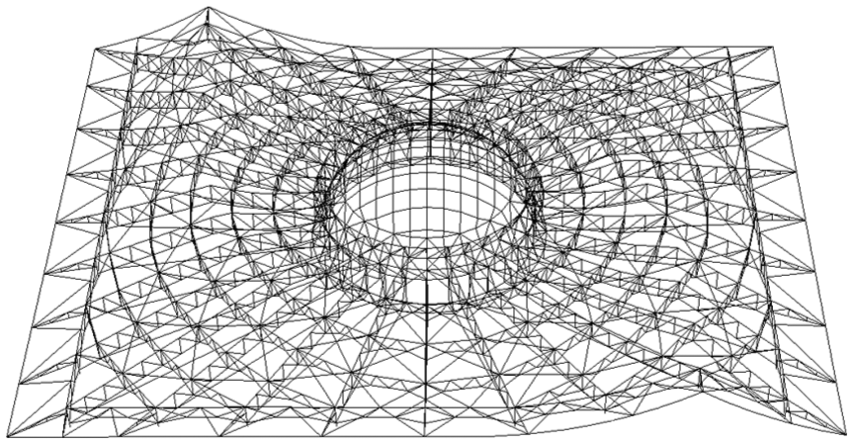
Computational model of the sports center using ABAQUS.
As stipulated in the normative provision 3.3.4 of GB50982-2014, the construction simulation of this sports center was performed step by step, following the realistic construction procedure considering different loading combinations. Figure 12 shows the simulation results at the construction stage.

Stress of steel members after temperature declined by 15°.
More than 62 vibration wire strain sensors were installed on the truss and the strut to monitor the internal stress states, and a total number of six electronic displacement meters were mounted on the joint to monitor the vertical displacements. Six additional electronic displacement meters were mounted on supports to monitor the horizontal displacements. Figure 13 shows the sensors installed on the steel truss and the steel strut. The sensor installation should be in accordance with the normative provision 3.2.1 of GB50982-2014.
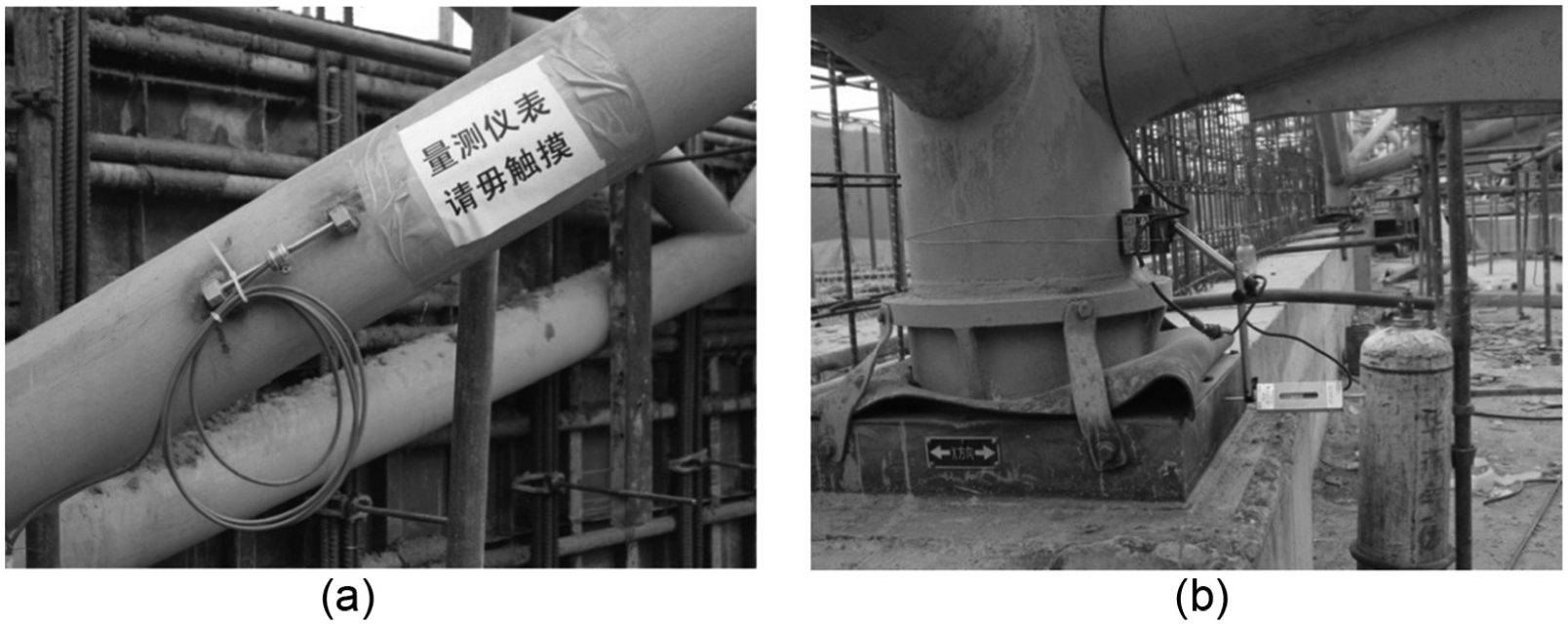
Photographs of sensors installed on structures: (a) stress sensor on a steel member and (b) displacement sensor in a support.
This SHM system was an integrated platform of four modules, including the sensor module, data acquisition and transmission module, data management module and condition assessment module. Figure 14 shows the monitoring center and data analysis unit. More details of the SHM system can refer to Yang et al. 24

Photograph of the monitoring center.
On the basis of aforementioned monitoring projects, the flowchart of a typical SHM engineering practice is illustrated in Figure 15, which is in accordance with normative provisions of GB 50982-2014. This flowchart presents the step-by-step procedure for the development and implementation of the SHM system for the large-scale civil engineering project, which is of great use for the decision-making of the owners and managers of structures.

Flowchart of a typical SHM engineering practice.
Conclusion
This article presents the comprehensive review of existing SHM codes and standards. And then, the progress of the codification of GB 50982-2014 is imparted and its main features and specifications are summarized. Finally, several representative SHM practical applications in accordance with GB50982-2014 in China are provided to demonstrate this national code. GB50982-2014 is the first and exclusive SHM national code in China; therefore, its implementation could significantly accelerate the application of SHM technologies and methodologies.
Notwithstanding, some problems still remain that are worthy of further investigation, such as standardization of SHM principles and engineering practices, establishment of a rational and well-recognized methodology for development of SHM codes and standards, application of laboratory-based research achievements into engineering practice, development of reliable SHM systems and data analysis methods and integration of SHM strategies at the design stage. It is expected to refine GB50982 with the consideration of these problems.
Footnotes
Academic Editor: Jun Li
Declaration of conflicting interests
The author(s) declared no potential conflicts of interest with respect to the research, authorship, and/or publication of this article.
Funding
The author(s) disclosed receipt of the following financial support for the research, authorship, and/or publication of this article: This work was sponsored by National Natural Science Foundation of China (Grant No. 51308565 and 51608075), the Fundamental Research Fund for the Central University (No. 106112016CDJXY200007 and 106112016CDJXY200010), the Chongqing Municipal Natural Science Foundation (Frontier and Applied Basic Research Project No. cstc2014jcyjA30008) and the Applied Technology Research and Development Project Funding of Fulin District (No. FLKJ, 2014ABA2041).