



Abstract
A novel output-only subspace identification method is proposed to estimate the structural parameters of a shear-beam building under unknown ground excitation. The unique feature of the method is that both the structural parameters and the ground acceleration can be identified using only the absolute acceleration response, and no displacement and velocity responses are required. The method uses two subspace identification techniques sequentially and iteratively. The first technique extracts modal parameters of the building (natural frequencies, damping ratios, and mode shapes) using the absolute acceleration response and assumed or identified ground acceleration. These modal parameters further lead to the estimation of the building’s structural parameters when the mass properties of the building are known. The second technique then estimates the ground acceleration using the absolute acceleration and the obtained structural parameters from the first technique. The two techniques are performed iteratively until the estimated structural parameters converge. A numerical example and a laboratory test are used to illustrate the proposed identification method. Results show that the estimation of structural parameters is fairly robust to the presence of measurement noise while the unknown ground acceleration is not in high frequency range. Factors influencing the performance of the technique are also studied and discussed.
Keywords
Introduction
Identifying modal and structural parameters for civil engineering structures is very important for their design verification, performance estimation, condition monitoring, damage detection, and safety assessment. This issue has been intensively researched and the solutions are well established when both the input and the output of a system are known.1–3 However, it is quite common in practice that the input may not be available due to either unmeasured or immeasurable condition. Different methods4–6 have been developed to estimate the unknown input with knowing all structural properties. However, in the field of structural identification, the structural properties are also unknown. Hence, it is necessary to develop techniques that can identify modal and structural parameters using output data only.
One common technique for output-only structural identification is to assume that the unknown inputs have a certain known characteristics such as white noise process.7–9 Although this approach has seen many successful applications, significant errors seem unavoidable when the assumed characteristics of the inputs are not actually met. Another approach is to express the unknown input as a superposition of some orthogonal functions. 10 The structural parameters and the orthogonal coefficients are then identified simultaneously. However, the technique requires that the type and the number of the orthogonal functions be specified and might lead to an ill-posed problem if not considered carefully. The third approach estimates the structural parameters and the unknown input simultaneously without using any prior information of the input. Wang and Haldar11,12 developed an iterative identification method for structures with viscous damping, in which the structural parameters were obtained using a least-squares method, while the unknown input was estimated from the identified structural parameters in each iteration. Note that the presence of proportional damping in this type of technique would lead to a nonlinear estimation problem which increases the complexity of computation. To address this issue, Ling and Haldar 13 proposed a modified iterative least-squares algorithm where the Taylor series approximation was used to transform a set of nonlinear equations to a set of linear ones. Zhao et al. 14 demonstrated that the structural parameters of a shear-beam building subject to ground excitation could not be uniquely identified using only the absolute structural responses. A hybrid identification method combining the time-domain information with the modal information was then proposed to identify the structural parameters and reconstruct the seismic input. Yang et al. 15 developed a recursive least-squares estimation technique with unknown input to identify the structural parameters as well as the unmeasured excitations. A comparison of the necessary information among the above different output-only approaches and the proposed approach in this article is summarized in Table 1.
Summary of output-only structural identification approaches.
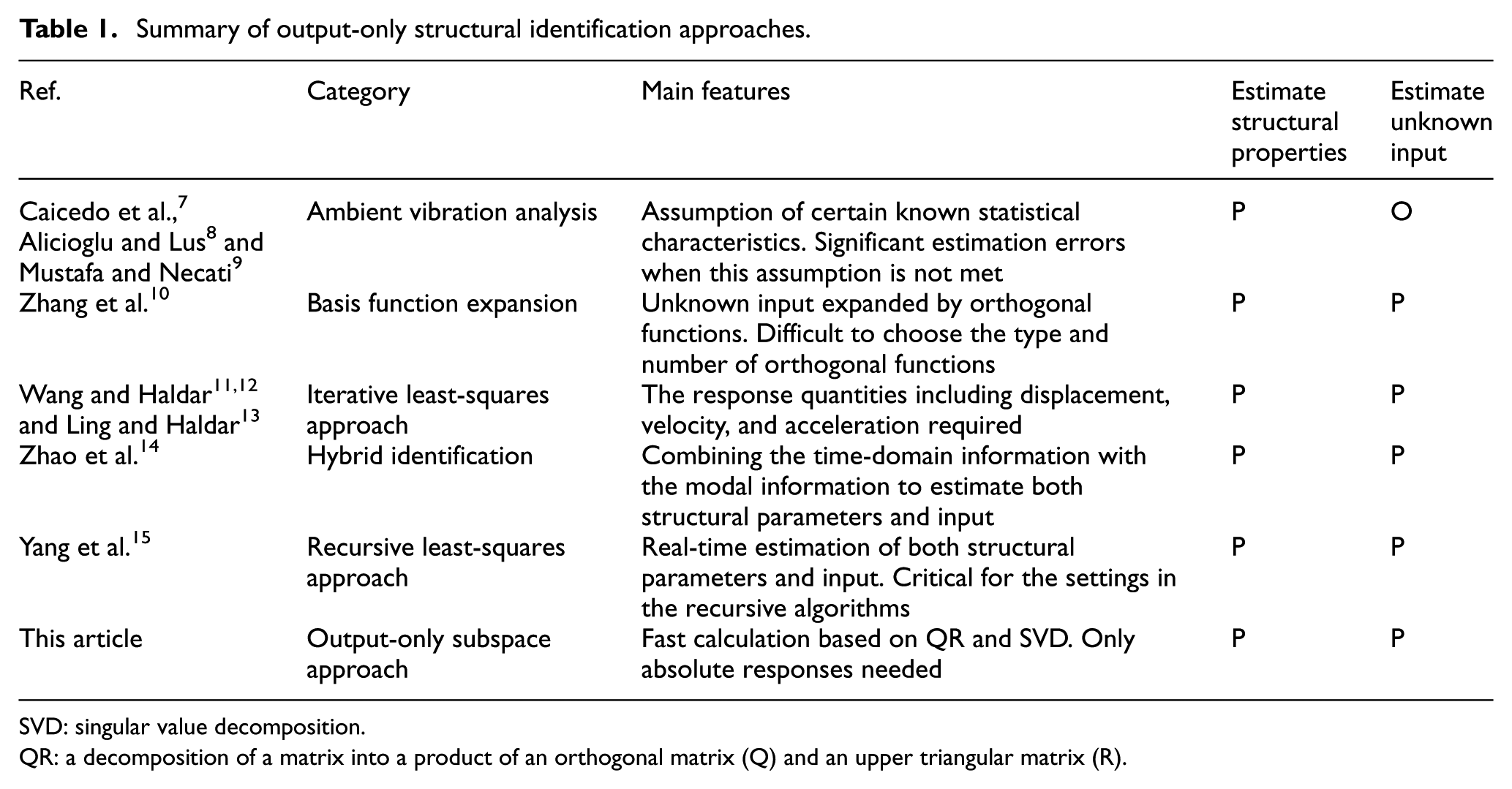
SVD: singular value decomposition.
QR: a decomposition of a matrix into a product of an orthogonal matrix (Q) and an upper triangular matrix (R).
Note that most of the least-square-based techniques mentioned above require that the acceleration, velocity, and displacement of the structure be measured either directly or indirectly via further data processing. Although the acceleration response of a structure can be easily and accurately obtained, the accurate measurement or determination of its velocity and displacement responses remains a challenging task in practice. Significant estimation errors seem unavoidable when these velocity and displacement responses are obtained via integration of acceleration due to the presence of measurement noise. 16
In this study, a novel identification method is proposed for a shear-beam building under unknown ground excitation. Modal, structural parameters, and the ground acceleration can be identified using only the absolute acceleration responses of the building, and no displacement and velocity responses are required. The method uses two subspace identification techniques sequentially and iteratively. The first technique extracts modal parameters of the building, including the natural frequencies, the damping ratios, and the mode shapes, using the absolute acceleration of the building and assumed/identified ground acceleration. When the mass properties of the building are known, these modal parameters further lead to the estimation of the building’s structural parameters. The second technique then estimates the ground acceleration based on the absolute acceleration and the obtained structural parameters of the building. The two techniques are performed iteratively until the estimated modal/structural parameters converge. A numerical example and a laboratory test are used to illustrate the proposed technique along with some factors influencing the identification performance.
Subspace identification of modal and structural parameters
The discrete state-space formulation for a general dynamic system with p inputs, p outputs, and N state variables can be expressed as follows

where

The number of block rows i is a user-defined quantity which should be at least larger than the maximum order of the system.
17
Theoretically, a larger i gives more stable and robust estimation of system information from the measured data if the data length is infinitely long. However, very large i may result in the over-smoothing issue when there are disturbance and measurement noises for the situation of data with finite length. A procedure for the choice of i is given in the section of illustrative examples. The parameter j is typically set to
The extended observability matrix

where

The column space of

For simplicity, the MATLAB syntax is adopted in the above equations. Also,

where
As mentioned above, the subspace identification method can be used to extract the system matrices up to a similarity transform from inputs and outputs. These system matrices cannot be directly connected to the physical parameters of the structure unless additional information such as the structural model is provided. In this study, the following assumptions are adopted: (1) the structure is an n-degree-of-freedom (n-DOF) shear-beam building with story mass and stiffness coefficient of

(2) The building mass matrix is assumed to be known. Typically, for shear-beam building, it can take the lumped diagonal form

Consider first the following Eigen equation for typical structural dynamics problem

Equation (9) can be cast into a regression form 7

in which

The term

Note that equation (12) contains
It should be pointed out that if all the modes of the structure can be identified, the full stiffness matrix

where
It should be pointed out that since both equations (9) and (13) are function of mass
The two Rayleigh damping coefficients

Similar to the identification of stiffness coefficients, h groups of natural frequencies and damping ratios can be assembled, and the damping coefficients are then obtained by the least-squares technique.
Subspace identification of input ground acceleration
After obtaining the stiffness and the damping matrices in previous section, the system matrices for the building in state-space form like equation (1) take on the following explicit expressions

where
After substituting equation (15) into equation (1), it can formulate the block input–output relation as follows

where
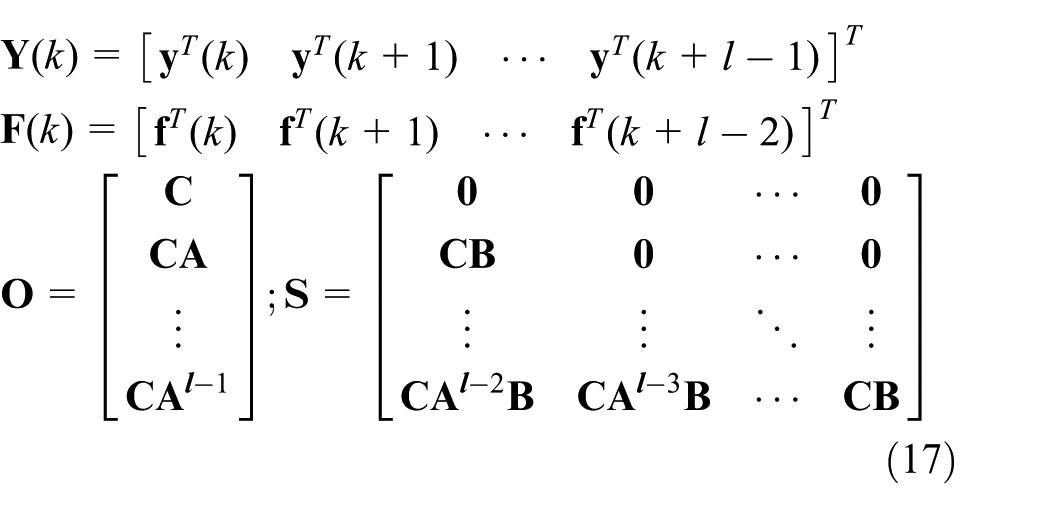
The rth block component of

Note i in equation (3) is replaced by l (the row number of the output vector) in equation (17) to highlight that they are not necessarily the same.
Assume matrices

where

Multiplying

where

Equation (19) ensures that the matrix
Sequential estimation of structural parameters and ground acceleration
The two subspace techniques shown above can be used sequentially to identify the structural parameters of a shear-beam building and the unknown ground acceleration. Note that for identifying the structural parameters, it is necessary to know the input and the output of the building as well as its mass matrix, while the output and the building’s system matrices are needed to estimate the ground acceleration. A sequential identification procedure with iteration is shown in Figure 1 to estimate both the structural parameters and the ground acceleration using only the absolute acceleration measurement of the building. To initialize the algorithm, the following parameters or values are needed: the system order N, the dimensions of the input/output Hankel matrices i, j, and l, and the initial guess of input ground acceleration (zero or a white noise much smaller than the response intensity). The system order N can be inferred from either the power spectral density (PSD) of the observed output or the singular values of the matrix

Flowchart of the proposed subspace identification method with iteration.
Numerical example
First, a numerical example of a three-story shear-beam building
11
was used to demonstrate the proposed technique. The structural parameters of the building were
White noise ground excitation
A Gaussian white noise process with an intensity of 0.1 m2/s4 was used to excite the building. Absolute acceleration responses at all the three floors were assumed to be measured at a sampling frequency of 50 Hz for 100 s. Thus, the number of data for each absolute acceleration response is s = 5000. These measured responses were superimposed with uncorrelated white noises. Different noise levels in terms of root mean square (RMS) were considered in this study. One dataset of measured responses which were used for identification is shown in Figure 2. The average PSD of the measured responses is also plotted which shows that all three modes of the building were well excited. This result suggested that the system order N should be set as 6.

Absolute acceleration responses (with 1% RMS noise) and their averaged PSD.
Known input case
The subspace identification algorithm was first tested with known ground excitation. Hence, only the subspace identification for modal and structural parameters was performed without the iteration process for this case. It is instructive to see how the row number of the Hankel matrix i could be chosen to obtain acceptable identification performance. As for the column number j, it was so determined that all the 100-s data were used for identification. Figure 3 shows the identified stiffness and Rayleigh damping coefficients for different values of i ranging from 3 to 200 using the measured data in Figure 2. It can be found that all the identified parameters are almost the same as their exact values while there are only slight fluctuations for the two Rayleigh damping coefficients for small values of i. These results indicate that the estimation of modal and structural parameters is insensitive to i as long as it is larger than the minimum value (

Effect of i on the identification performance under known input (1% RMS noise).
Statistical analysis of the identified parameters using 5000 simulations of different randomly generated ground motions for
Statistics of estimated parameters under known input for different i (1% RMS noise).

RMS: root mean square.

where
Unknown input case
It is expected that the identification for the unknown input case will have larger estimation error statistically than the known input case. Based on the known input case,

where
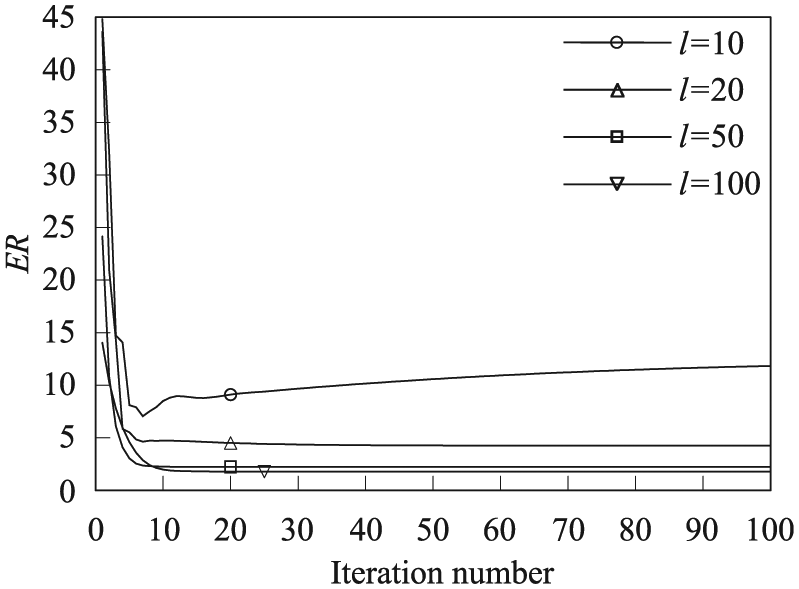
Effect of l on the response fitting performance under unknown input (1% RMS noise).
The identified modal and structural parameters using the measured data in Figure 2 are shown in Figures 5 and 6 after 20 iterations. Identified results of both 1% and 5% RMS noises are plotted for comparison. It can be seen that the overall convergence among different parameters could be clearly observed and most parameters converge quickly with around 10 iterations and closely approach to their exact values. It is seen that even in the first iteration where the unknown excitation was assumed to be white noise and initially taken to be zero in the identification algorithm, the modal frequencies were estimated quite accurately since all the vibrational modes of building were well excited. Furthermore, although the estimation of the damping ratios is less accurate in the first iteration, they approach their exact values very quickly. Using the identified modal parameters and the mass matrix, the structural parameters of the building were calculated and shown in Figure 6. The estimation errors after 20 iteration for stiffness coefficients are 1.41%, 0.07%, and 0.05% for 1% RMS noise and 2.42%, 0.40%, and 0.24% for 5% RMS noise, respectively. The estimation errors for the Rayleigh coefficients are 0.61% and 2.67% for 1% RMS noise, and 1.32% and 5.39% for 5% RMS noise, respectively. These results indicate that the proposed technique is not significantly affected by the increase in measurement noise intensity from 1% to 5%.

Iteratively identified natural frequencies and damping ratios for the three-story shear-beam building under white noise ground excitation.

Iteratively identified structural parameters for the three-story shear-beam building under white noise ground excitation.
The identified structural parameters were iteratively used to identify the ground acceleration. The identified ground acceleration time history after 20 iterations and its PSD are shown in Figures 7 and 8 for 1% RMS and 5% RMS noises, respectively. Note that only 5 s of data is plotted instead of the entire 100 s such that a clear comparison can be made. It is seen that the identified ground acceleration in time domain matches very well with the exact ground acceleration for 1% RMS noise, while large deviations are observed for 5% RMS. Figure 7 also shows that the PSDs of identified and exact ground acceleration are close in the low-frequency region and different slightly in the high-frequency region. This indicates that the input estimation is less accurate in the high-frequency region. This phenomenon can be observed more vividly for 5% RMS in Figure 8. It is seen that the measurement noise intensity can have a significant influence on the accuracy of ground acceleration estimation especially in the high-frequency region. However, it is found that by estimating also the input, the accuracy of structural properties could be significantly improved as seen from the iteratively estimated parameters in Figures 5 and 6.
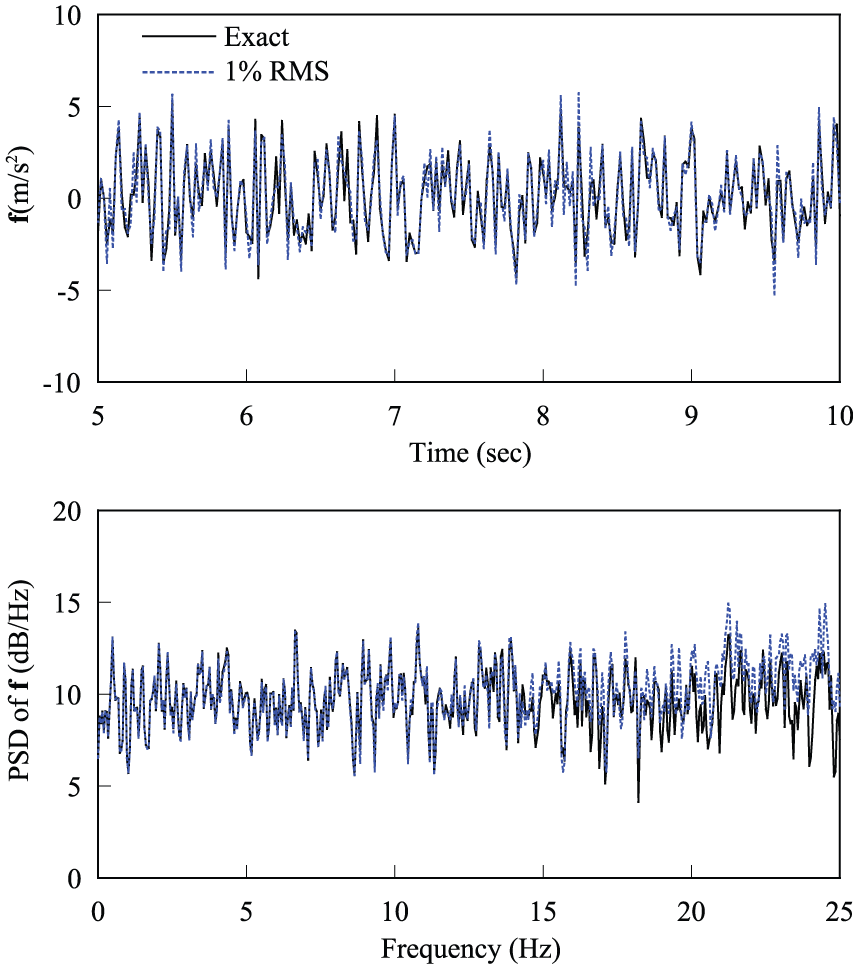
Identified ground acceleration and its PSD (1% RMS noise).

Identified ground acceleration and its PSD (5% RMS noise).
Statistical analysis of the identified parameters for the unknown input case was further performed using 5000 simulations of different randomly generated ground motions. Table 3 shows the statistics of the identified parameters under 1% RMS and 5% RMS noises, respectively. In the statistical analysis, more number of iterations, 200 for each simulation was chosen to study the different convergence trends of the parameters. It can be seen that all the parameters are approximately unbiased. However, it should be pointed out that the stds and the coefficients of variation (covs) of the stiffness coefficient
Statistics of estimated parameters after 200 iterations under unknown input.
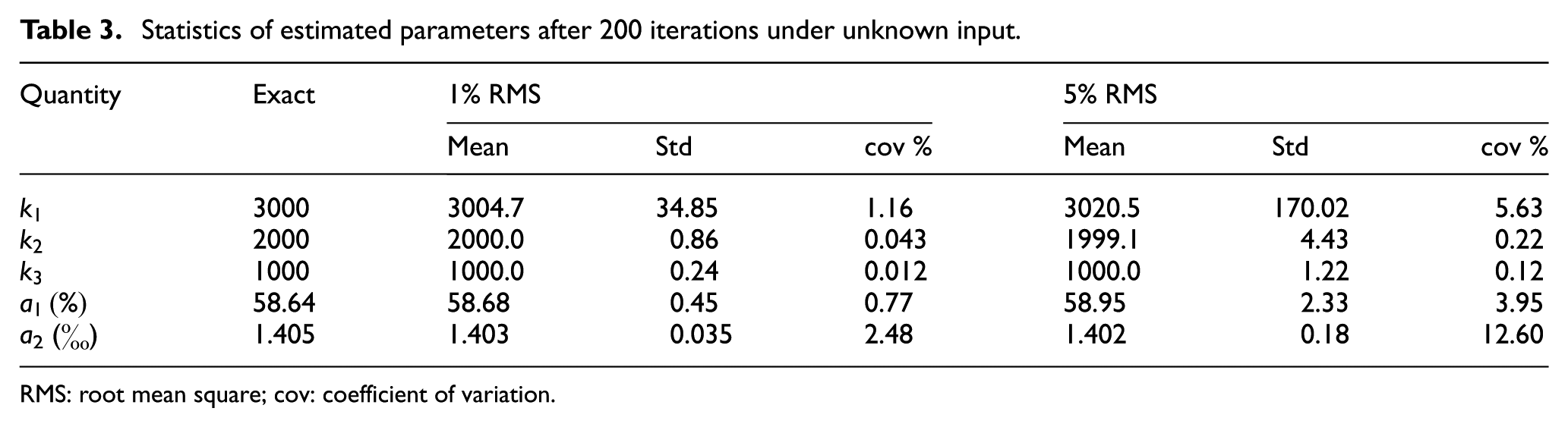
RMS: root mean square; cov: coefficient of variation.

Mean values and 1 − σ bounds of the estimated structural parameters under (a) 1% RMS noise and (b) 5% RMS noise.
Historical earthquake ground excitation
As demonstrated above, the proposed subspace identification technique is quite effective when the ground motion is white noise. In the following, the applicability of the proposed identification technique under non-white historical earthquake records is studied. The 1940 El Centro earthquake was used to excite the building and the absolute acceleration responses with a sampling frequency of 50 Hz were assumed to be measured output. High levels of measurement noises with 5% and 10% RMS were added to study the robustness of the technique. Following the previous analysis results, the parameters for the subspace identification technique were set as

Iteratively identified natural frequencies and damping ratios for the three-story shear-beam building under the El Centro earthquake excitation.

Iteratively identified structural parameters for the three-story shear-beam building under the El Centro earthquake excitation.

PSD of the identified El Centro ground acceleration.
Experimental study
An experimental study was performed on a three-story shear-beam building model as shown in Figure 13 to further validate the proposed technique. The building was made of aluminum and its dimensions are

The three-story building model and its simplified three-DOF shear-beam model.

Absolute acceleration measurements and their averaged PSD for the three-story laboratory model.
Figure 15 presents the iterative results of the identified natural frequencies and stiffness parameters. The results from the static test are also presented for comparison. It is seen that the initial estimates of both the natural frequencies and the stiffness coefficients assuming white noise input are close to their respective values obtained from the static test. The three natural frequencies converged to 4.15, 12.75, and 18.64 Hz, and the three stiffness coefficients to 19.51, 25.39, and 23.42 kN/m very quickly. The maximum difference in the estimated and the static stiffness coefficients is 13.5% in

Iteratively identified natural frequencies and stiffness parameters for the three-story laboratory model.

Iteratively identified damping ratios for the three-story laboratory model.

Identified ground acceleration and its PSD for the three-story laboratory model.
Concluding remarks
In this article, a novel approach to identify modal and structural parameters for a shear-beam building under unknown ground excitation is presented. The unique feature of the method is that both the structural parameters and the ground acceleration can be identified using only the absolute acceleration responses of the building. This method consists of two subspace techniques which are used sequentially and iteratively. The first technique extracts modal parameters of the building, including the natural frequencies, the damping ratios, and the mode shapes, using the absolute acceleration of the building and assumed/identified input forces. When the mass properties of the building are known, these modal parameters further lead to the estimation of the building’s structural parameters. The second technique then estimates the input ground acceleration based on the absolute acceleration and the obtained structural parameters of the building. The two techniques are performed iteratively until the estimated structural parameters converge through the response fitting error curve. A numerical example and a laboratory test are used to illustrate the proposed technique. Results show that the method could accurately identify most of the structural parameters and reasonably estimate the input ground acceleration in low frequency range using only the absolute acceleration of the building. Also, the identification performance of the structural parameters does not seem to be significantly affected by the presence of measurement noise and the type of input ground acceleration. Note that the performance of the method is affected by some pre-assigned parameters such as the dimension of Hankel matrix and the row number of the output vector. Some suggestions on the selection of these parameters are discussed and presented in this study.
Footnotes
Appendix 1
Acknowledgements
Author Zhen Li is now affiliated to China Overseas Holdings Limited, Hong Kong.
Academic Editor: Philip Park
Declaration of conflicting interests
The author(s) declared no potential conflicts of interest with respect to the research, authorship, and/or publication of this article.
Funding
The author(s) disclosed receipt of the following financial support for the research, authorship, and/or publication of this article: This study is supported by the Hong Kong Research Grants Council Competitive Earmarked Research Grant 611112 and National Natural Science Foundation of China (51408383).