




Abstract
Using random variables to describe uncertain parameters in structural systems, its initial strength and the evolution process of the strength degradation is regarded as the Gamma process. In this article, we propose a new method on reliability sensitivity numerical analysis of mechanical structure based on Gamma processes. Then, we use the fourth moment method based on frequency curve of Pearson to solve the problem of reliability calculation with random parameters of arbitrary distributions. Formulas for calculating the reliability sensitivity with respect to the mean and the variance of the random variables are derived. The reliability analysis of the welded box girders of crane is taken as an example to verify the proposed method. The results show that the method can effectively solve the problem of the reliability sensitivity of structural systems with strength degradation.
Keywords
Introduction
The traditional mechanical structural reliability models often do not consider the structural strength degradation, thus resulting obtained reliability is a constant value.1–3 In practical engineering, the long service of the mechanical structure leads to wear and tear of the material, time-varying of load effects, gradual decrease in structural strength, and a variety of other factors lead to gradient properties of structural reliability and failure probability. Therefore, the real situation can be reflected more actually by the gradient reliability, especially given that the gradient reliability of the structural strength degradation is very important for objective assessment of the reliability of mechanical structures and systems and to the safe operation, rational development, and maintenance projects of the entire system.
4
Andrieu-Renauda and Lemairea
5
put forward an efficient method to solve time-varying reliability on the basis of the analysis techniques of system reliability; the effects of degradation are considered by a stress intensity interference model given by Lewis and Chen;
6
however, it only analyzes the situation that considers deterministic stress and stochastic intensity degradation or random stress and deterministic intensity degradation; when considering the independence between the stress and the strength degradation, Deng and Gu
7
studied stress intensity reliability problems under the discrete stochastic stress and strength degradation. In fact, the strength degradation of the product is usually caused by the effect of stress; therefore, they are not independent. Chen and Shen
8
established a numerical analysis method which can simulate the steel structure and structural strength degradation thereof. Qin and Yang
9
established the calculation model for time-varying reliability of the existing bridge and used adaptive importance sampling method to calculate the time-varying reliability index. The above research is carried out in the premise of obtaining the exact distribution of the structural parameters. For this reason, this article tries to describe the mechanical structural strength degradation with Gamma random process; on this basis, the reliability index and reliability sensitivity are deduced based on the fourth-order moment method of Pearson frequency curves. The sensitivity variation of random variables was studied on the basis of reliability analysis, and the curve of reliability and sensitivity was mapped by taking the metal structure of the
Structural strength degradation model of Gamma process
Mechanical structural strength degradation is in one way diminishing. Gamma degradation process is a random process subjected to the same size parameter Gamma distribution and having independent non-negative increments, which is suitable for modeling the damage that accumulates over time a series of small increments, such as structural fatigue, wear, crack growth, and creep.10,11 Random degradation process of the structure strength is considered to be a Gamma process that can ensure the monotone increasing of the degradation.
Definition of Gamma random process
Suppose the probability density function of the random variable X is

where
When
Mean and variance of Gamma random process
The degradation amount of structural strength at

The mean value and variance of degradation amount of structural strength at t is

We consider degradation as a stationary gamma process with

Parameter estimation of Gamma random process
Gamma function
Suppose there are m samples used for structural strength degradation test, they are tested at
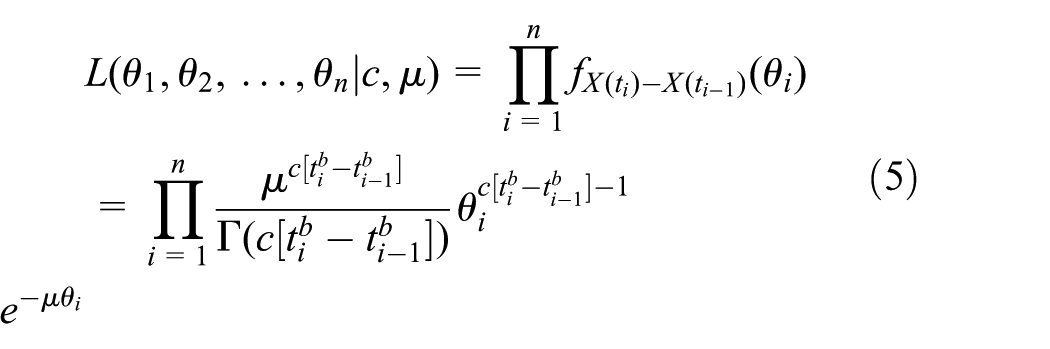

As for the first partial derivative of the log-likelihood function, the maximum likelihood estimator

Structure performance function of the failure probability with fourth moment calculation method
Structural reliability design perturbation method
In the process of mechanical structure reliability design, structure function (limit state functions) as a function of the basic variables by

where R is the structural effect and S is the load effect. They are main target of the reliability study of the mechanical structure. Functions between the two determine the reliability of the mechanical structure. The basic random variable

where the subscript d represents the determined part of the random variable, and the subscript p represents the random part of the random variable. Both of them have zero mean, and the value of the random part is much smaller than that of the determined part.

Applying algebra theory of Kronecker and stochastic analysis theory, the following three expressions can be obtained by taking the second, third, and fourth moment of formula (10) on both sides


where the power of Kronecker.
The partial derivative of structural performance function

The second moment, third moment, and fourth moment can be obtained by substituting formula (14) into formulas (11), (12), and (13).
Based on Pearson frequency curves’ fourth moment method
When the skewness
Formulas (11)–(13) are standardized by

where
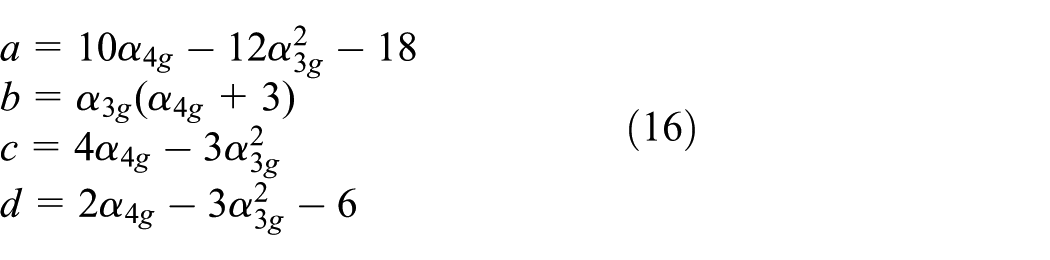
Because

The corresponding fourth moment reliability index derived from formulas (15)–(17) is

Mechanical structure deduced reliability sensitivity
According to formula (18), the sensitivity calculation formula of

where


Verification and analysis of cases considered
A metal structure of a DQ

The metal structure system of bridge crane.
Main technical parameters of bridge crane.

The main structure of the bridge crane uses Q 235 steel, and the following values of the bridge crane are calculated: the allowable stress
The following six random variables are confirmed: W (lifting load), B (main beam width), H (main beam height), E (Elastic modulus),
Structure random variable of the bridge crane and statical properties.

The parameters of the Gamma process are calculated from previous section,
Choosing the case where a fully loaded trolley is located in the middle of bridge crane and the cart is static as the analysis object, the structural failure of the bridge crane occurs when

Using ISIGHT-FD software to integrate the finite element analysis process, sample data of the random variable stress response can be obtained by the experiment design method.
ISIGHT-FD is used to integrate ANSYS, the above six uncertain parameters are selected, and the Latin hypercube sampling technique is called in the ISIGHT-FD to sample the parameters. Because the six uncertain parameters are selected, only 200 sets of samples need to be input. The output samples of the stress response of the dangerous parts can be obtained by the experimental design, thereby obtaining 200 samples
The computing result of the reliability is shown in Figure 2. 28 The metal structure reliability of bridge crane considering strength degradation with Monte-Carlo simulation is compared in Figure 2. It can be obtained from Figure 2 that the computing results of both methods of fourth-order moment method are very close. It is acceptable to use this method to calculate the results of the reliability of strength degradation, and the varying pattern of the reliability conforms to the actual engineering situations.

Parametric sensitivity in reliability analysis of the mechanical components.
Figures 3 and 4 are the reliability sensitivity of the means and variances of the load W of the bridge crane metal structure, the height H and width B of the main beam, and the elastic modulus E. The variability of these six variables affects the structural reliability rank from large to small: W (lifting load)

The reliability sensitivity with respect to the random variables mean.

The reliability sensitivity with respect to the random variables variance.
Figure 5 show the reliability sensitivity with respect to process parameters
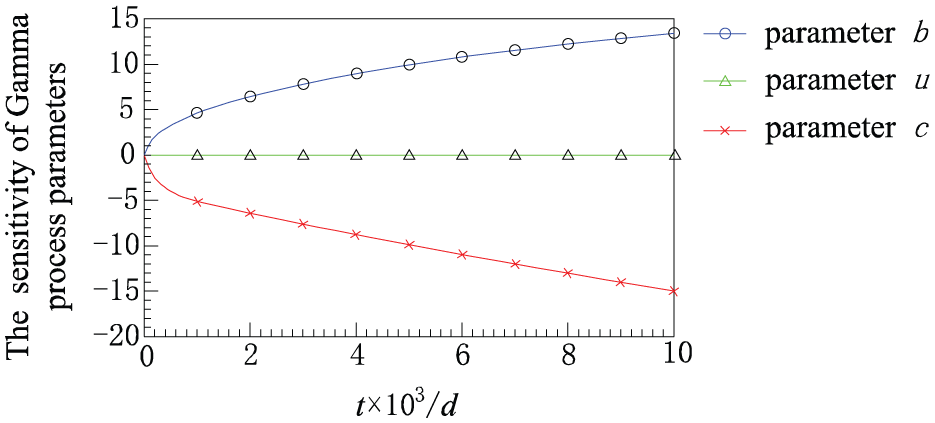
The reliability sensitivity with respect to Gamma process parameters.
Conclusion
This article combines theoretical analysis with numerical simulation to verify the validity of the fourth moment method based on Pearson frequency curve in gradual reliability of structure on the basis of Monte-Carlo simulation and finite element method. Conclusions can be obtained as follows:
Assuming the structural strength degradation obeys the Gamma random process, a reliability and reliability sensitivity analysis method which considers the strength degradation of mechanical parts is proposed.
In the reliability design of the bridge crane structure, the main ways to improve the reliability of metal structure are to increase the mean of the height of a main beam and reduce the variance of the thickness of a flange plate, and it can also be achieved by reducing the average thickness of the web.
The random parameters b and c of Gamma random process have a great influence on the reliability of parts. The reliability improves with parameter b and reduces with parameter c.
Footnotes
Academic Editor: Yongming Liu
Author’s note
Authors Zhengmao Yang and Yanshan Zhang are equal contributors for the first author in this manuscript.
Declaration of conflicting interests
The author(s) declared no potential conflicts of interest with respect to the research, authorship, and/or publication of this article.
Funding
The author(s) disclosed receipt of the following financial support for the research, authorship, and/or publication of this article: This work was supported, in part, by the National Natural Science Foundation of China under Grant No. 61571042 and by the Beijing Higher Education Young Elite Teacher Project (YETP1221).