




Abstract
A new method for computing the failure probability of the fatigue life is proposed, dealing with uncertain problems with both random and interval variables. Using a Taylor expansion and the concept of statistical moment, the first four central moments of the structural fatigue life performance function are obtained. Then, using a second Taylor expansion, the first four central moments are expanded at the midpoint of the interval variable, and the intervals of the statistical moments of the performance function are calculated. The obtained moment information is applied into an Edgeworth series expansion expression, giving the cumulative distribution function of the structural fatigue life performance function and getting its interval of the failure probability. Two numerical examples of growing complexity are employed to demonstrate the feasibility of the proposed approach.
Keywords
Introduction
A large amount of experimental results and data samples have shown that the dispersion in the fatigue life of the structural components or mechanical parts should not be omitted. The structural fatigue life is affected by many factors, such as material properties, geometry parameters, loading history, and the environmental conditions. A lot of research has been carried out on the reliability analysis of the fatigue life.
The Hasofer–Lind (HL) algorithm 1 and the Rackwitz–Fiessler (RF) algorithm 2 propose a transformation of the non-normal variables into normal variables, which results in an approximate estimation of the failure probability of the fatigue life by solving the so-called reliability index. Wu and Wirsching 3 used the modified first-order second moment method to solve the reliability of the implicit fatigue life performance functions. Wirsching et al. 4 applied the same method to analyze the reliability of the crack initiation life and the crack propagation life. Meng and Sha 5 proposed a neural network to perform the reliability optimization design of the structural fatigue life. Li and Meng 6 developed a robust optimization design method for the structural fatigue life. Gao et al. 7 presented the fatigue reliability analysis of a turbine based on the radial basis function neural network (RBFAN). Li and Yao 8 proposed the fatigue reliability analysis of structural components based on the stochastic finite element method (SFEM). Meng et al. 9 proposed the fatigue reliability analysis of a loader beam based on the RBFAN response surface method. Wirsching 10 proposed a fatigue reliability of offshore structures. Zhao et al. 11 presented the fatigue reliability of steel bridge components. CG Soares and Ivanov 12 deal with the reliability of hull girders concentrated on the hull girder collapse mode. Kwon and Frangopol 13 proposed a bridge fatigue reliability assessment using probability density functions of the equivalent stress range based on field monitoring data. Soares and Garbatov 14 presented for the assessment of the reliability of a ship hull with respect to fatigue failure of the ship hull girder. Gao and Xiong 15 introduced several important aspects in the fatigue/fracture reliability and their application on the practice. In the above-mentioned investigations, the methods proposed for the reliability analysis of structural fatigue life are usually based on probability theory. When there are insufficient sample data to build a probabilistic model, the uncertain information can also be described by interval variables. Qiu and Wang 16 proposed the interval estimation method to perform the fatigue life reliability analysis and compared it to the probabilistic reliability. However, in practical engineering, different kinds of uncertain variables may exist in the same structures, resulting in a structural fatigue life reliability problem with both random and interval variables. An and An 17 combined the mean value–modified first-order second moment (MVFOSM) and the interval number operations and calculated the interval of the failure probability of the structural fatigue life. However, the MVFOSM could not consider the distribution of random variables, and the interval operations had an interval expansion problem.
In this article, a simple method for fatigue life reliability analysis was proposed, estimating the fatigue reliability problems with random and interval variables. Using a Taylor expansion and the concept of statistical moment, the first four central moments of the structural fatigue life performance function are obtained. Then, using the same Taylor expansion again, the first four central moments are expanded at the midpoint of the interval variable, and the intervals of the first four central moments of the performance function were achieved. The obtained moment information was applied in the Edgeworth series expansion expression, giving the cumulative distribution function of the structural fatigue life and getting the interval of the failure probability of the structural fatigue life.
Structural fatigue life
According to the stress life method, the structural fatigue life N, under the constant stress ratio R, can be expressed as follows

where
Since the fatigue parameters of the material are mostly obtained under fully reversed loading, equation (1) can be rewritten as follows

where
When the mean stress is taken into consideration, according to the Goodman 18 formula, its expression is as follows

where


where
From equations (2) and (3), the following equation may be obtained

When the structure is subjected to random loads, the Palmgren–Miner 19 linear cumulative damage rule is typically used, which states that the cumulative fatigue damage is a linear accumulation of the fatigue damage of each cycle. Therefore, the cumulative fatigue damage D is as follows

where k is the rank number of the stress amplitude level. To the

Wirsching
20
suggested that when

And, according to the reliability theory, the structural fatigue life performance function may be defined as follows

where
Statistical moments of the fatigue life performance function with hybrid variables
For the problem with both random and interval variables, the structural fatigue life performance function

where

where
The statistical moments should be calculated to approximate the cumulative distribution function of the fatigue life performance function expressed in equation (11). Monte Carlo simulation (MCS) is a comprehensive method to calculate the statistical moments of the structural responses. It can deal with any kind of function type without considering the dimensions. However, it needs large amount of simulations to ensure its precision. The point estimation method was first proposed by Rosenblueth,
21
Wang et al.,
22
and Seo and Kwak
23
pointed out that this method may be used to estimate the statistical moments and was exploited vastly for engineering applications. The point estimation method is usually affected by the type of the random variables and other factors, leading to a dissatisfactory precision.
24
Therefore, in this article, a Taylor series expansion is applied to the first two items. Assuming that the first four moments of



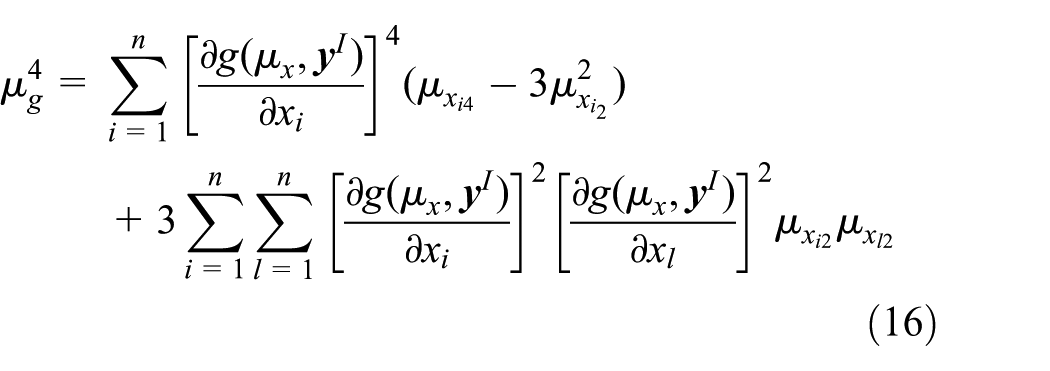
where
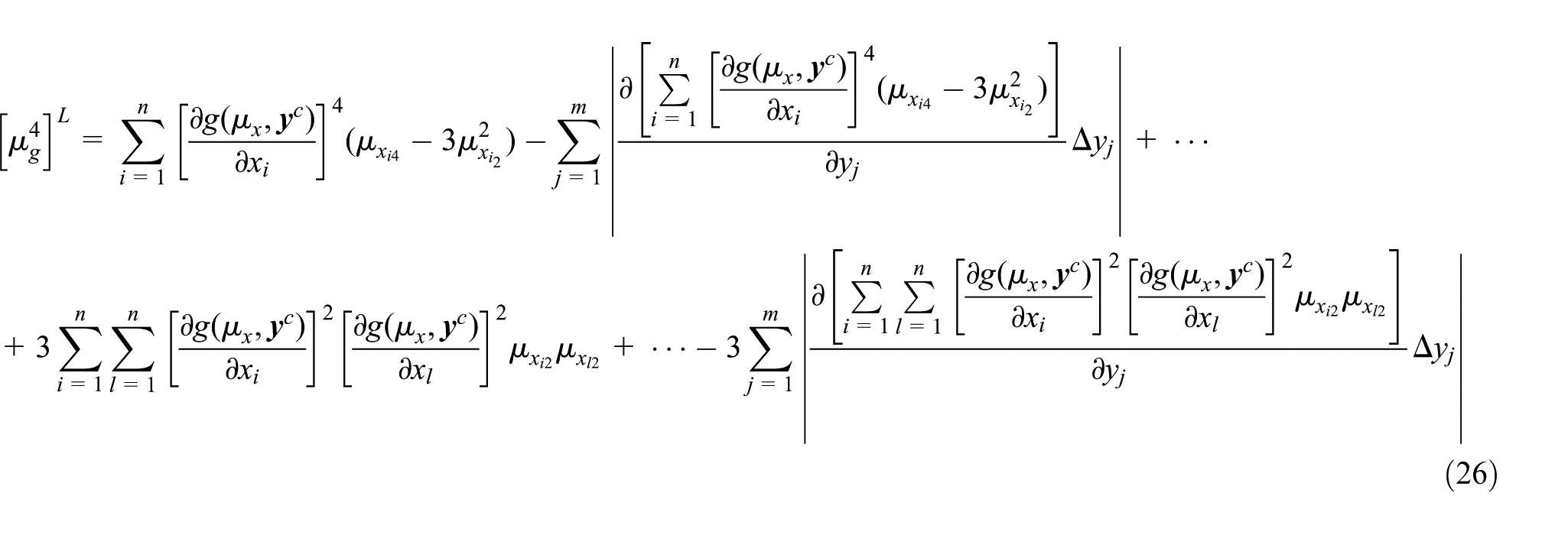
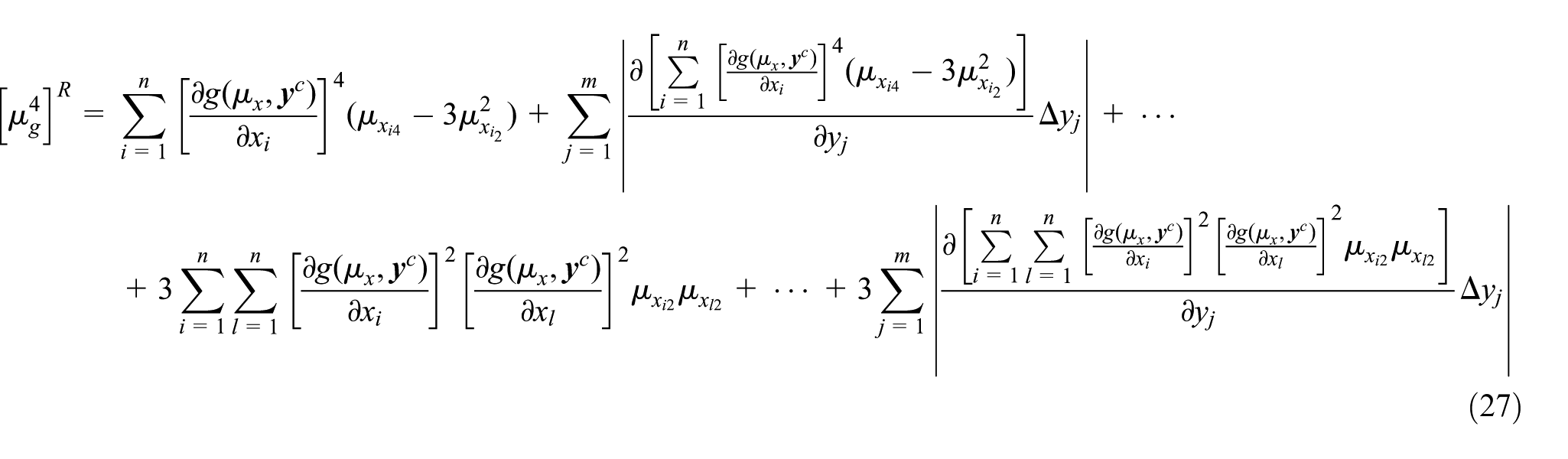
If directly using the interval arithmetic operations to compute the intervals in equations (13)–(16), it will lead to the interval expansion. Therefore, the Taylor expansion method can be applied to transform the uncertain interval problem into a certain interval one. If

where the lower


where



Edgeworth series
Either the probability density function or the joint probability density function needs to be known in order to calculate the failure probability. Due to insufficient sample data, the exact distribution of the parameter could not be determined, and the distribution type is known to affect the correctness of the results. Even for a given probability distribution type, it is difficult to use the integral method to calculate the failure probability.
After obtaining the statistical moments of the structural fatigue life performance function given in equations (20)–(27), the cumulative distribution function of the performance function can be fitted. To do so, the following methods are available: the maximum entropy method, 25 the polynomial method, 26 the finite mixture density method, 27 the Pearson system, 28 and the saddle point approximation method. 29 These methods cannot avoid singularities, and the obtained numerical solutions may become unstable during the calculations. Therefore, the Edgeworth series is chosen to expand the unknown probability distribution into the expression of a standard normal one, thus obtaining the failure probability of the structure.
It is known from the Edgeworth series expansion method that the cumulative distribution function


where


where
Numerical examples
A cantilever beam
A cantilever beam is pictured in Figure 1, with its material 16Mn,
33
length

A cantilever beam.
Parameters of the cantilever beam.
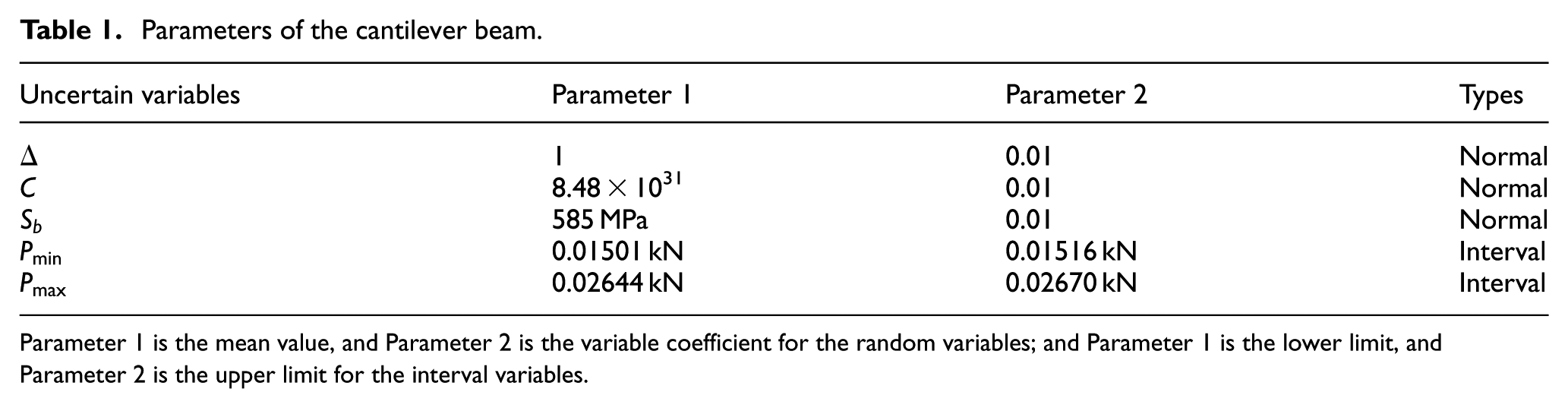
Parameter 1 is the mean value, and Parameter 2 is the variable coefficient for the random variables; and Parameter 1 is the lower limit, and Parameter 2 is the upper limit for the interval variables.
Table 2 provides a comparison of the first four central moments between the MCS method and the one proposed in this article. In Table 3, the failure probability of the fatigue life calculated with the proposed method corresponds to (0.00096, 0.001554), and when calculated with the MCS, it becomes (0.00092, 0.001514), with the relative error being (4.17%, 2.57%). The variation of the failure probability of the fatigue life with respect to the different design life is depicted in Figure 2. It may be seen from this figure that as the design life increases, the failure probability also increases, and when
Comparison of the first four central moments.

MCS: Monte Carlo simulation.
Comparison of the failure probability of the fatigue life.

MCS: Monte Carlo simulation.

Relationship between the designing life and the failure probability.
Pressure vessel
A pressure vessel is illustrated in Figure 3, with material

Structural scheme of the pressure vessel.

Loading history of the pressure vessel.

Finite element model of the pressure vessel.
Characteristics of the pressure vessel’s parameters.

Parameter 1 is the mean value, and Parameter 2 is the variable coefficient for the random variables; Parameter 1 is the lower limit, and Parameter 2 is the upper limit for the interval variables.
The intervals of the maximum stress and the minimum stress under different stages of the loading history were obtained using the finite element codes of the pressure vessel. The upper limits and the lower limits of the first four central moments of the structural performance function were obtained using the moment method and the Taylor expansion, which were given by equations (20)–(27). After substituting the central moments into equations (30) and (31), the cumulative distribution function, the probability density function, and the interval of the failure probability of the fatigue life could be obtained. Table 5 shows a comparison of the first four central moments between MCS and this article. In Table 6, the interval of the failure probability of the fatigue life calculated with the proposed approach is (0.001542, 0.006831), and the one calculated with the MCS is (0.001610, 0.006710), with the relative error being (4.23%, 1.80%), showing a good consistency between the two methods. Furthermore, the relation between the design life and the failure probability is shown in Figure 6. When the design life increases, the failure probability also increases, and as
Comparison of the first four central moments between MCS and this article.

MCS: Monte Carlo simulation.
Comparison of the failure probability of the structural fatigue life.

MCS: Monte Carlo simulation.

Relationship between the design life and the failure probability.
Conclusion
A structural fatigue life reliability method is proposed in this article, which can accurately solve uncertain problems with both random and interval variables. By combining the Taylor expansion method and the concept of the statistical moments, the expressions of the statistical moments of the performance function were obtained. With respect to the interval variables, by conducting a Taylor expansion at their midpoint, the intervals of the first four central moments were calculated. After substituting the moments into the Edgeworth series expansion formula, the interval of the failure probability was obtained. Two numerical examples of growing complexity clearly showed the relative high precision of the proposed method when dealing with a nonlinear problem or an implicit performance function. The proposed method has the benefit of not requiring the use of multiple integrals to solve the statistical moments of the performance function, does not need to search for the most probable point, and does not need to calculate the inverse of the performance function.
It can transform uncertain interval problems into certain interval problem using a Taylor expansion and avoiding the interval expansion. This hybrid fatigue life reliability analysis approach could utilize the merits of every single reliability model, reflecting the actual safe situation more comprehensively.
Footnotes
Academic Editor: Yongming Liu
Declaration of conflicting interests
The author(s) declared no potential conflicts of interest with respect to the research, authorship, and/or publication of this article.
Funding
The author(s) disclosed receipt of the following financial support for the research, authorship, and/or publication of this article: This work was financially supported by the National Key Scientific Instrument and Equipment Development Project, China (grant no. 2012YQ030075) and Jilin Provincial Department of Science and Technology Fund Project (grant no. 20160520064JH).