




Abstract
Aiming to resolve the problems of a variety of uncertainty variables that coexist in the engineering structure reliability analysis, a new hybrid reliability index to evaluate structural hybrid reliability, based on the random–fuzzy–interval model, is proposed in this article. The convergent solving method is also presented. First, the truncated probability reliability model, the fuzzy random reliability model, and the non-probabilistic interval reliability model are introduced. Then, the new hybrid reliability index definition is presented based on the random–fuzzy–interval model. Furthermore, the calculation flowchart of the hybrid reliability index is presented and it is solved using the modified limit-step length iterative algorithm, which ensures convergence. And the validity of convergent algorithm for the hybrid reliability model is verified through the calculation examples in literature. In the end, a numerical example is demonstrated to show that the hybrid reliability index is applicable for the wear reliability assessment of mechanisms, where truncated random variables, fuzzy random variables, and interval variables coexist. The demonstration also shows the good convergence of the iterative algorithm proposed in this article.
Keywords
Introduction
In engineering structure reliability analysis, it is common that various types of uncertainties coexist, such as probabilistic uncertainties, non-probabilistic uncertainties, and fuzziness. This is attributed to the existence of various uncertain variables with various data samples and various characters in modern complexity structure systems. For example, uncertain variables can be described as random variables when sample data are adequate, and an accurate probability distribution can be obtained. However, an accurate probability distribution cannot be obtained when the sample data are limited. Large differences can be found in the results of the probabilistic reliability for small changes in the probability distribution, for uncertain variables. 1 Therefore, uncertainty variables cannot be treated as random variables when their sample data are not enough to obtain accurate probabilistic reliability analysis results. However, the boundaries of uncertain variables may be easy to be determined, such as structure dimensions whose tolerances, also boundaries, are easily obtained from the designer. Therefore, it is appropriate to use a non-probabilistic interval variable to describe these uncertain variables. Also, some uncertain variables are fuzzy and they should be described as fuzzy variables. Therefore, it is meaningful to present a hybrid reliability index, based on a random–fuzzy–interval reliability model, and its solving method for structural hybrid reliability analysis.
The reliability analysis of hybrid uncertain structures, where various uncertainty parameters coexist, has increasingly attracted the attention during the recent years. Some numerical methods have been proposed, such as the function approximation technique, 2 the iterative rescaling method, 3 and the probability bounds approach. 4 Elishakoff and Pierluigi 5 considered the combination of probabilistic and convex models of uncertainty on acoustic excitation parameters. The optimization design and the solution algorithm, which are based on a hybrid reliability model with random variables and interval variables, were presented by Du et al. 6 A new hybrid model with random variables, multi-ellipsoidal variables, and an effective iterative algorithm were presented by Luo et al. 7 Gao et al. 8 presented a hybrid probabilistic and interval method for engineering problems, described by a mixture of random and interval variables. Wang and Qiu 9 evaluated the reliability of a probabilistic and interval hybrid structural system, based on the interval reliability model and probabilistic operation. Interval variables were treated as uniformly distributed random variables. The results were consistent with the results derived from a double-optimization model, which searched for the minimum of the limit-state function in the inner loop and for the probability reliability index in the outer loop. 10 Ni et al. 11 presented a hybrid reliability model, which contains fuzzy random and non-probabilistic uncertainties. Jorge et al. 12 proposed a Monte Carlo method that can be applied to probabilistic as well as to interval approaches for reliability analysis. There is a limited number of research articles focused on hybrid reliability analyses of engineering structures. Based on a hybrid model of random variables and multi-ellipsoidal variables, 7 a reliability optimization design for adhesive-bonded steel–concrete composite beams, with probabilistic and non-probabilistic uncertainties, has been performed by Luo et al. 13 The hybrid reliability of structural fractures, with random variables and interval variables, has been studied by Jiang et al., 14 and the failure probability interval of structural fractures was obtained using an effective iterative algorithm based on the response surface method. Based on the probabilistic reliability model and interval arithmetic, the interval of the probabilistic reliability index of structural systems was presented by Qiu and Wang. 15 Xia et al. 16 performed hybrid uncertain analysis in a structural–acoustic problem using random and interval parameters. Chen et al. 17 presented a hybrid perturbation method (HPM) for the prediction of the exterior acoustic field with interval variables and random variables.
From above references, we can see that hybrid reliability with two kinds of uncertain variables has been widely studied. However, hybrid reliability that involves three kinds of uncertain variables should be further studied. Moreover, the distributions of random variables are infinite in the above references. However, truncated random variables should be employed, instead of continuous random variables, for practical engineering applications because most of random variables are bounded. 18 Therefore, a hybrid reliability model that accommodates truncated random variables, fuzzy random variables, and interval variables should be considered.
In this article, a hybrid reliability index and its solving method, based on random–fuzzy–interval model, is presented. First, three various uncertainty variables and their models are introduced. Then, based on the interference relationship between the convex domain, formed by normalized interval variables, and the limit-state surface, the hybrid reliability index is defined. The calculation flowchart and solving method of the hybrid reliability index are presented, and the validity of solving method is verified through the calculation examples in literature. 7 Finally, a numerical example of wear reliability analysis of synchronizer cone surface is demonstrated.
Uncertain variables and their reliability models
Truncated random variables and truncated probability model
When accurate probability distributions of uncertain variables can be obtained, random variables and the probabilistic reliability model can be used to evaluate the reliability of engineering structures. However, design variables are generally bounded in engineering applications, and they are impossible to take the values of
Assumed that


where

where

where
Fuzzy random variables and fuzzy random reliability model
Fuzzy random variables are common in engineering.20–22 In many cases, since it is difficult to provide specific definitions and limits, the uncertainty of variable will be caused. Especially, for the multiple failure problems caused by fatigue, wear, corrosion, and creep, occurred in a mechanical system, there is no specific limit for their safety and failure and it is a gradual transitional procedure. In addition, due to the insufficient reliability data and the imperfection of the subjective cognizance of human being, a large number of fuzzy information exists in mechanical designs. Thus, the fuzzy random variables can be employed to describe above two kinds of fuzzy information. The formula of the fuzzy random reliability model is as follows 14

where

where
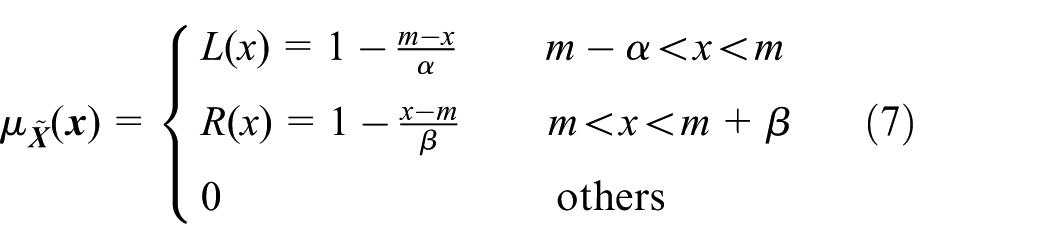
where m, α, and β are the coefficients to determine the membership function
The formula of normal membership function is as follows

Interval variables and non-probabilistic reliability model
When data samples of structure are not sufficient in engineering problems, the accurate probability distribution cannot be obtained, and a small error of the probability distribution can cause large calculation errors in the structure reliability. 1 However, the upper and lower boundaries of uncertainty variables are easy to be obtained. For example, accurate probability distribution of structure dimensions is difficult to obtain because its data samples are not sufficient at the early stage of product development; however, its tolerance can be easily provided by the designer. Therefore, the non-probabilistic interval variable can be employed to describe the uncertainty as follows 23

where

where
The non-probabilistic interval reliability index

where
The hybrid reliability model with random variables, fuzzy random variables, and interval variables
Considering that truncated random variables, fuzzy random variables, and interval variables usually coexist in engineering designs, the safety margin equation M can be written by employing the stress–strength interference model as follows

where
First, the fuzzy random variable


The transformation from fuzzy random variable to random variable is the equivalent mathematic transition, and the possibility distribution of the fuzzy random variable has not been changed. 25
Second, the probability density function and cumulative probability distribution functions of the truncated random variable

Following, the stress–strength interference problems in the structural safety margin equation that contain the truncated random variables and interval variables are discussed. Two different cases correspond to these problems, whether the limit-state surfaces interfere with the normalized square convex region or not, and it is explained by the simplest safe margin equation with only strength R and stress S, as shown in Figure 1.
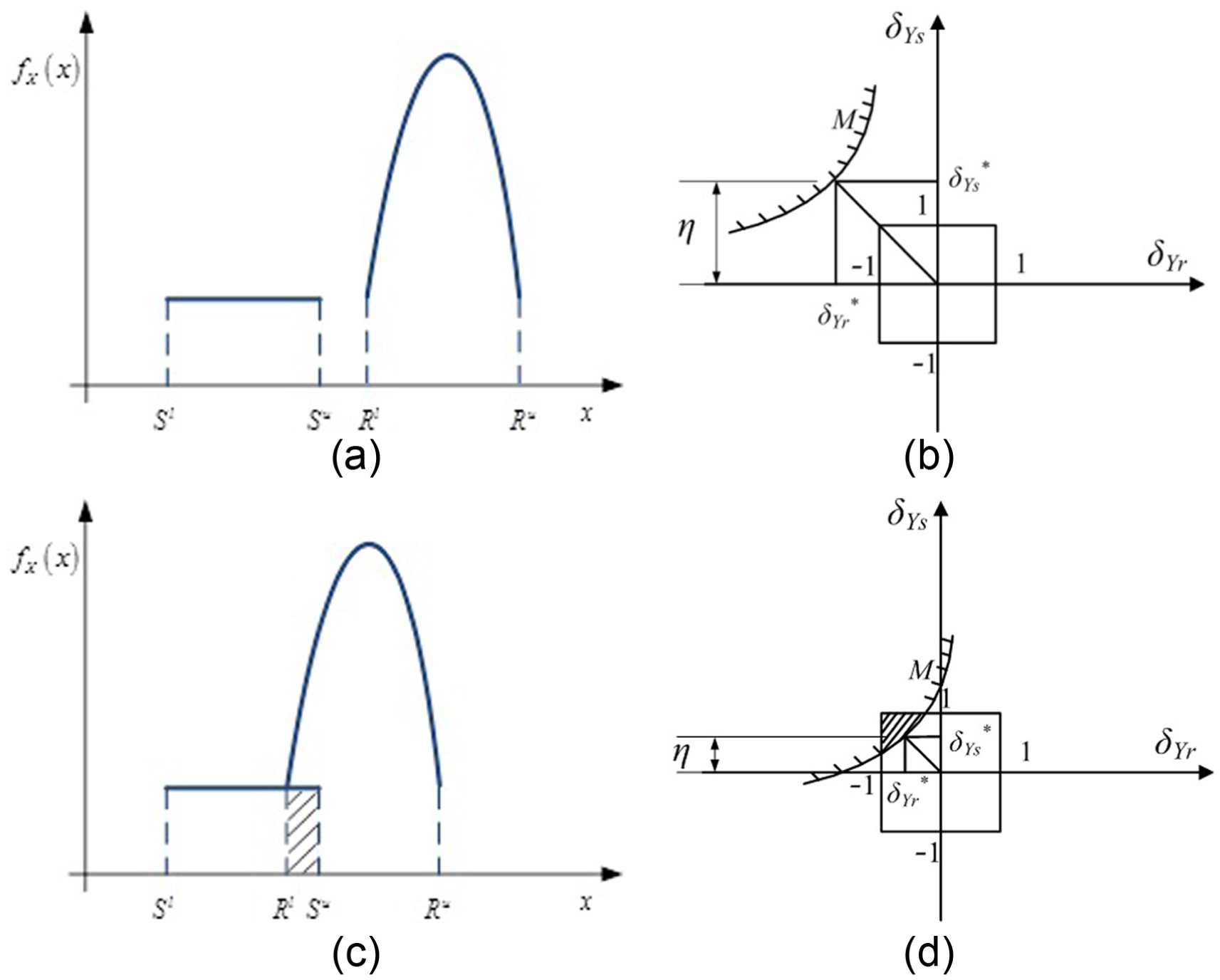
Two different cases: (a)
It is clear that when the strength R does not interfere with the stress S, as presented in Figure 1(a), the strength R is always higher than stress S and
However, the non-probabilistic reliability index
From the above analysis, we can see that

Comparing with the hybrid reliability model proposed in literature, 7 the hybrid reliability model proposed in this article has the following advantages:
It can resolve the reliability analysis problems of mechanical structures, which include truncated random variables, non-probability variables, and fuzzy random variables at the same time. However, literature 7 can only resolve the problems of random variables and non-probability variables and cannot consider the cases when the fuzzy random variables exist.
The distributed region of random variables considered in literature 7 is infinite. However, the distributed region of random variables in engineering applications should be limited and it will be more appropriate to use the truncated random variables instead of the random variables.
When employing the truncated random variables, the situation shown in Figure 1 will occur. There is no way to measure the reliability degree by employing the reliability model of literature, 7 which is based on the traditional probability concept, which can be solved very well using the hybrid reliability model proposed in this article.
Following normalization of the original uncertain variables X and Y into u and v, the limit-state function
When

where
When

where
To solve

where C is a weight coefficient.
The solving method of hybrid reliability index
Calculation flowchart of the hybrid reliability index
The calculation flowchart of the hybrid reliability index

Flow graph of calculating hybrid reliability index.
The modified limit-step length iterative algorithm (MLSLIA) is provided in order to solve


where
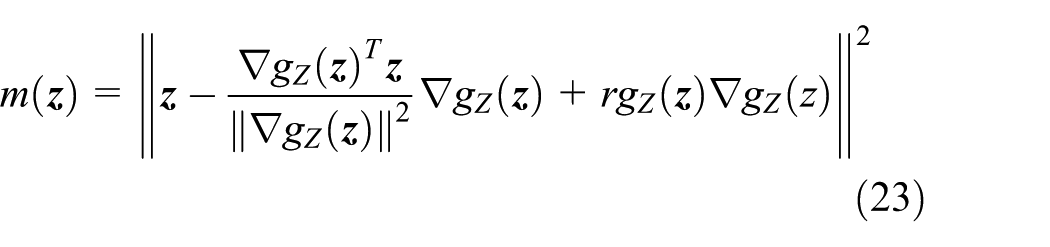
Combining with searching the optimal step length
Step 1. Set the initial parameters, such as k = 0,
Step 2. First, the searching interval
Step 3. If
Step 4. When

Step 5. The penalty coefficient

Then, set k = k + 1. If
Generally, the initial penalty coefficient


If
Validation example
The example presented in this section is used to validate MLSLIA when used to solve the hybrid reliability index. Here, the example of Luo et al.
7
is used, and its structural performance function only contains random variables and non-probabilistic variables. The iteration convergence criterion is set as
The structural performance function of a cantilever beam can be expressed as follows 7

The uncertainty characteristics of the variables are listed in Table 1. The iteration results in Table 2 are consistent with those presented in the literature. 7 Thus, MLSLIA can be considered as a valid method to calculate the hybrid reliability index.
Uncertain variables.
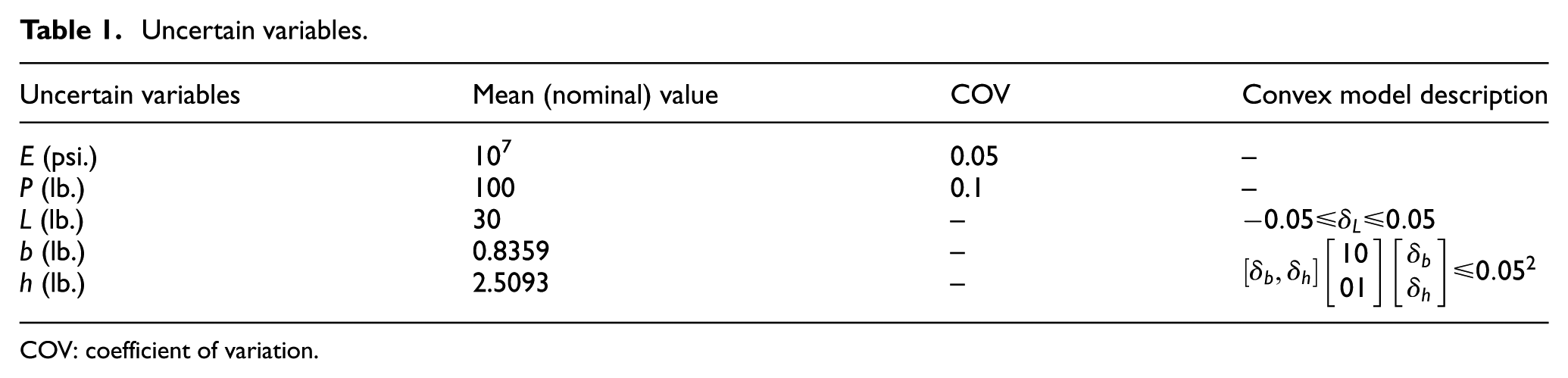
COV: coefficient of variation.
Iteration process.

Numerical examples
In this section, a numerical example where random variables, fuzzy random variables, and interval variables coexist is presented, that is, the wear reliability evaluation of mechanisms. The wear of mechanisms relates to many factors, such as loads, velocity, lubricating conditions, ambient temperature, and surface hardness. These factors are considered fuzzy to some extent. Considering the effect to these fuzzy factors, it is difficult for the allowance wear loss, which is provided in the form of a constant, to determine the failure of wear. The wear failure of mechanisms is considered as fuzzy random variable. Recently, many researches have been focused on fuzziness of wear in literatures.28–32 However, besides the fuzzy random variables, there are also other variables, such as the random variables and the non-probabilistic interval variables, in engineering applications, due to the absence of sample data. Moreover, the wear failure of kinematic pairs and parts of mechanisms account approximately for 30%–80% of the total failures of mechanisms. Therefore, it is meaningful to perform wear reliability analysis of mechanisms using the random–fuzzy–interval hybrid reliability model presented in this article.
The wear loss of mechanisms can be modeled by Archard’s law, and the mathematical expression is given as follows 33

where
Before wear failure occurs, wear

Here, the allowance wear loss is considered as a fuzzy random variable, and the wear coefficient
Here, it was selected to perform the wear hybrid reliability analysis of a synchronizer cone surface as a numerical example. In Figure 3,


Cone surface wear of synchronizer.
After n connection shift, the wear loss

where n is the number of connection shift, F is the applied force,
The uncertainty parameters of the synchronizer cone surface are listed in Table 3. As the allowance wear loss is a fuzzy random variable,
Uncertainty parameters of synchronizer.

According to the experience of the designer engineer, the membership function of wear loss

When the number of meshing equals
Iterative process of
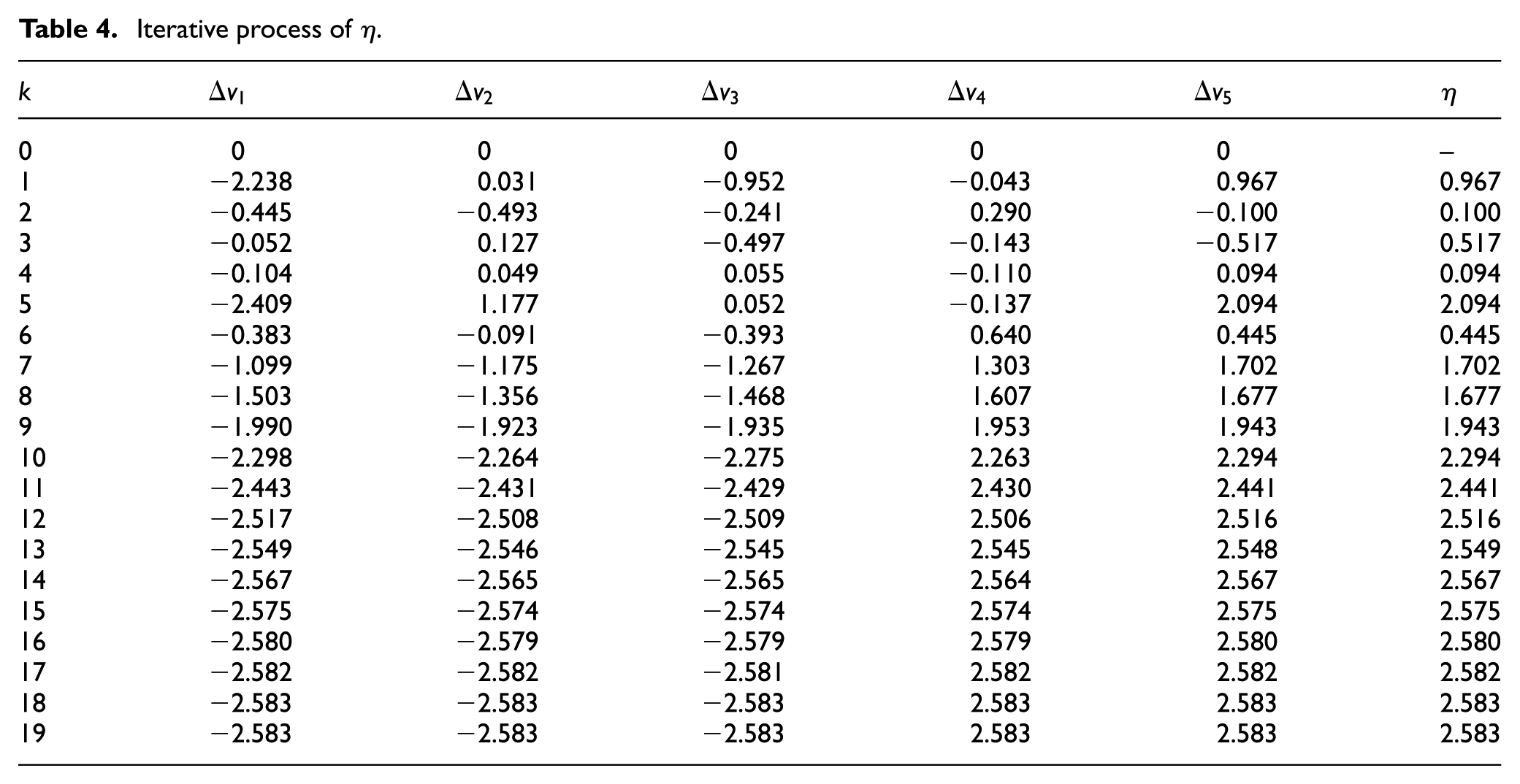
When n = 5000 times, the iterative process of
Iterative process of

Iterative process of

The change in the wear reliability indexes

The change of hybrid reliability index.
The iterative process of the reliability indexes
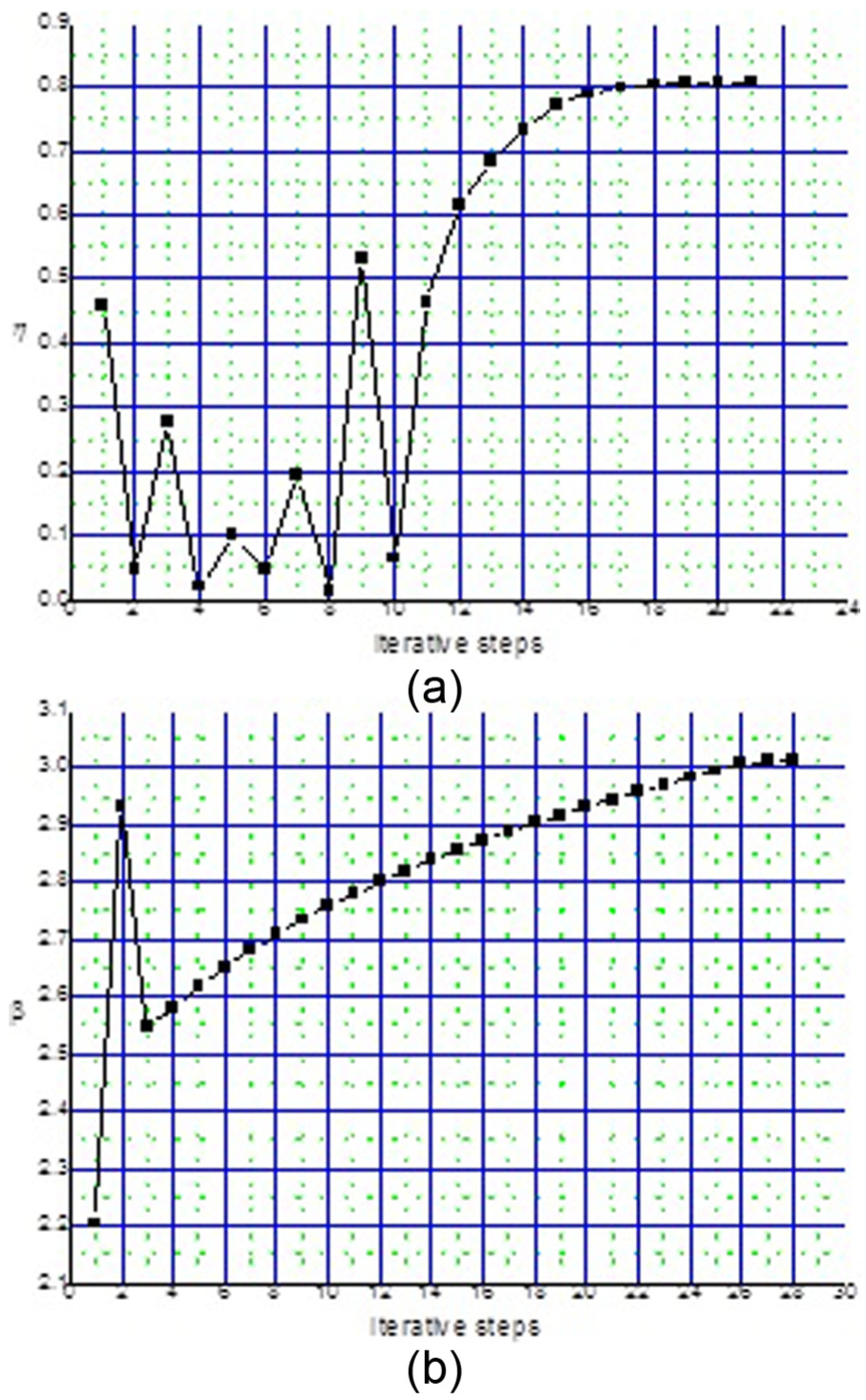
The iteration of the hybrid reliability index: (a) the iteration process of
When

The change of the hybrid reliability index
Conclusion
This article presented a new hybrid reliability model and its solving method, based on the random–fuzzy–interval model. The hybrid reliability index
Footnotes
Academic Editor: Yangmin Li
Declaration of conflicting interests
The author(s) declared no potential conflicts of interest with respect to the research, authorship, and/or publication of this article.
Funding
The author(s) disclosed receipt of the following financial support for the research, authorship, and/or publication of this article: This work was supported by the National Natural Science Foundation of China (grant no. 51305421), the National Defense Technology Basis Research Project (grant no. JSZL2014130B005), and the Development of Science and Technology Project of Jilin Province (grant no. 20140520137JH).