




Abstract
Concurrent engineering has obtained increasing attention to solve the design problems of multidisciplinary systems. In practical engineering, there are epistemic uncertainties during whole design cycle of complex systems. Especially in earlier design phases, the effects of epistemic uncertainties are not usually easy to be quantified. It is because design information is insufficient. Furthermore, commonly used probability theory is also not suitable to be utilized. In this situation, epistemic uncertainties will be introduced unavoidably by mathematical models or simulation tools and may affect the performance of complex system significantly. To solve this problem, evidence theory is introduced and combined with the collaborative optimization method in this study. An evidence-based collaborative reliability optimization method is also proposed. Evidence theory is a powerful approach to handle epistemic uncertainties by Plausibility and Belief. Meanwhile, collaborative optimization is widely utilized in the concurrent design of complex systems. An aircraft conceptual design problem is utilized to show the application of the proposed method.
Keywords
Introduction
To obtain high safety, reliability-based multidisciplinary design optimization (RBMDO) is becoming a focus of concurrent design for complex systems.1–10 The probability theory is one of the classical methods which is commonly used in RBMDO. Generally, it could be effective when sufficient uncertainty information is available and the probability distributions of random design variables can be obtained easily. However, in the earlier design stage of complex systems (including exploratory, conceptual, and preliminary periods), there are many epistemic uncertainties because of the lack of knowledge or insufficient design information. In this situation, it is difficult for probability theory to measure uncertainties effectively. To solve this problem, different uncertainty measure and analysis methods, such as evidence theory,11,12 fuzzy sets method,13,14 and possibility theory,15,16 are proposed and developed. Compared with other methods, evidence theory has obtained more attentions in practical engineering.9,17–20 It can analysis epistemic uncertainties using human thought process, and provide corresponding descriptions dependent on incomplete or conflicting information. 17 In this study, evidence theory is introduced and combined with collaborative optimization (CO) to solve concurrent design problems of multidisciplinary systems.
The rest of this study is organized as follows. In section “Concurrent design and optimization of complex systems,” the concurrent design formulation of multidisciplinary systems using CO is given. In section “Uncertainties in engineering systems,” epistemic uncertainties in practical engineering systems are discussed in detail. The fundamentals of evidence theory are also briefly reviewed as preliminary knowledge. In section “EBCRO,” the procedure of concurrent reliability optimization under epistemic uncertainties is proposed. In section “Example,” the proposed method is utilized to solve an aircraft conceptual design problem. Section “Conclusion” gives the conclusions.
Concurrent design and optimization of complex systems
With the development of modern engineering, complex systems usually contain several strongly coupled subsystems. Consequently, the concurrent engineering (CE) has obtained increasing attentions. One of the advantages of CE is that it can utilize the joint efforts of experts in different fields to solve design and optimization problems of complex systems.21–23 Multidisciplinary design optimization (MDO) is a type of specific application of CE. In the concurrent design process of a complex system, the interactions between any two coupled disciplines (or subsystems) can be coordinated by MDO strategy. As shown in Figure 1, the optimal design solutions of complex system can be obtained at the end of MDO process. Meanwhile, the consistency requirements of interaction information can be also satisfied.

The notional depiction of MDO process. 24
Commonly utilized MDO methods can be categorized into two types according to their coordination strategies:25,26 multilevel methods and single-level methods, respectively. Multilevel MDO methods have hierarchical structures which include system and subsystem levels, generally. Each subsystem has individual analyzer at lower level. Correspondingly, design and optimization problems of subsystems can be solved independently and concurrently. Furthermore, a system coordinator is adopted at upper level to keep the consistency of interaction information between coupled subsystems. In this study, an MDO problem is formulated as

where
CO is a typical multilevel MDO method. It is convenient to be utilized to solve the design problems of distributed engineering systems when low couplings are involved. As shown in Figure 2, the concurrent strategy of CO changes the original MDO problem in equation (1) into a system optimization problem at system level and several discipline design optimization problems at subsystem level, respectively.

The concurrent strategy of CO.
The formulation of system optimization problem is given in equation (2)

where
Furthermore, the formulation of discipline design optimization problem of the ith discipline at subsystem level is given in equation (3)

where the value of

The coordination strategy of CO. 27
During the process of CO, professional designers can utilize advanced analysis software and optimization tools to solve different discipline problems simultaneously. Taking the advantage of distributed strategy, designers can just focus on their disciplinary field and do not have to care about interactions with other discipline. Considering the above features, CO is introduced and combined with evidence theory to solve RBMDO problems in this study.
Many representations of uncertainties can represent epistemic uncertainty more accurately than the traditional probability theory. One of these uncertainty representations is evidence theory which can measure the degree of uncertainty using a small amount of available information. Similar to other widely used uncertainty measure methods, two different uncertainty measures are provided by evidence theory. They are termed as Plausibility and Belief, respectively. In this study, the formulation of evidence-based collaborative reliability optimization (EBCRO) is proposed to solve the earlier design phases of complex engineering systems under epistemic uncertainties.
Uncertainties in engineering systems
Two kinds of uncertainties, aleatory and epistemic uncertainties, exist widely in practical engineering.28–33 Generally, aleatory uncertainties depict the inherent variations of engineering systems. These variations exist objectively because of the nature of random. They can be represented using corresponding random distribution when enough design information is provided. Meanwhile, epistemic uncertainties in engineering systems arise because of the lack of design information. They can be measured by non-probabilistic methods.
Considering the wide utilization of numerical models and tools by designers, there are mainly three ways that uncertainties can be introduced into engineering systems, which is shown in Figure 4. First, there will be epistemic uncertainties when a physical model is transformed to its corresponding simulation model. This is because that it is not easy to convert the nonlinearity of physical model into the corresponding mathematical equations exactly. Second, there are uncertainties in system inputs. Third, different computational methods usually provide slightly different solutions when solving the same mathematical equations. Especially, in multidisciplinary environment, these uncertainties can be transformed and accumulated between any coupled subsystems, which affect the performance of complex systems significantly.

Different sources of uncertainties in practical engineering. 34
EBCRO
Here, the fundamentals of evidence theory are given in brief. Then, a formulation of EBCRO is proposed to solve RBMDO problems.
Before introducing the basics of uncertainty measure of evidence theory, the utilized notations on set representation are explained. The uppercase variable
Basic probability assignment (BPA) in evidence theory is a fundamental way to describe epistemic uncertainties. Denoting BPA as a function
Evidence theory is based on two uncertainty measures, Plausibility

The relationship of
If evidence information is available, Plausibility and Belief of an event can be measured by

and

respectively.

It should be noted that probability theory can be treated as a special case of evidence theory. If equation (6) is replaced with equation (7)

Belief measures in evidence theory will be changed as classical probability measures in probabilistic theory. Moreover, the equations (4) and (5) will become equal in this situation, which is as

for all
In some situations, useful evidence can be obtained from different sources. Such bodies of evidence have to be combined. Denoting different evidence from two experts as the BPAs

In RBMDO, design information is usually associated with uncertainties. Thus, the purpose of RBMDO is to minimize the system objective while the reliability of each non-deterministic constraint should be greater than a required level. The corresponding evidence-based MDO problem can be formulated as

where
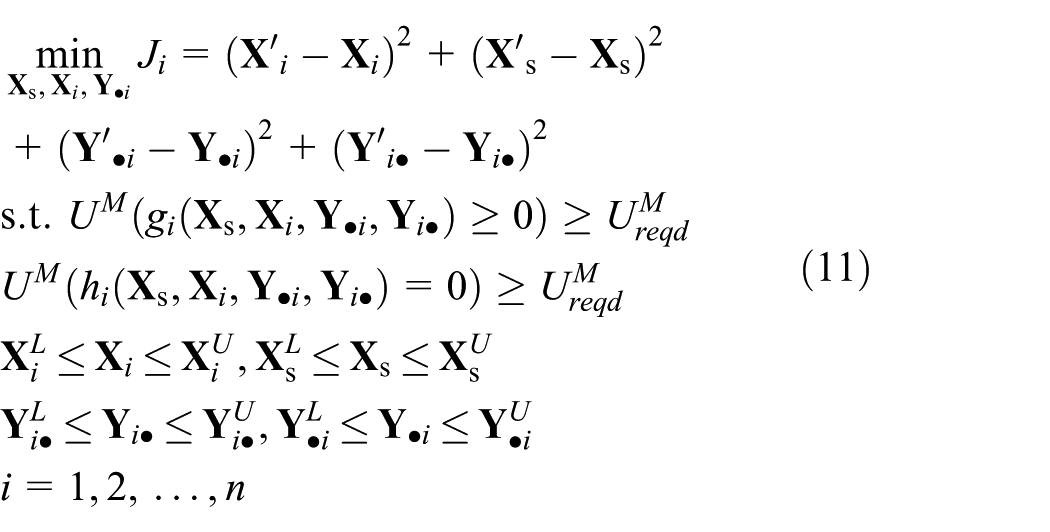
To obtain high safety and good performance in earlier design phase, all discipline constraints involving epistemic uncertainties in MDO problems should be changed into the corresponding reliability constraints. Thus, the formulation of discipline design optimization problem of the ith discipline at subsystem level in equation (3) in converted as
The detailed strategy of EBCRO is given as follows:
Step 1. Given the initial design variables and set the cycle number
Step 2. Solve the optimization problem in equation (2) at system level. When the optimization converges, output the system design solutions
Step 3. Solve the evidence-based optimization problems in equation (11) at each subsystem concurrently and sent all discipline design solutions
Step 4. Calculate
Step 5. Finish the optimization and output the final design solutions
The flowchart of EBCRO is illustrated in Figure 6.

The flowchart of EBCRO.
Example
In this section, EBCRO is utilized to solve an aircraft conceptual design problem. 20 The design solutions from EBCRO are compared with the deterministic MDO solutions. The procedure of EBCRO is performed using softwares iSIGHT™ and MATLAB™.
As shown in Figure 7, there are three disciplines in this MDO problem. The detailed information of two local design variables

The aircraft conceptual MDO problem.
The details of design variables in the example.

The formulation of the problem is given as

In this study, the epistemic uncertainties of the parameters
The measures of epistemic uncertainties in

BPA: basic probability assignment.
Correspondingly, the optimization formulation in equation (13) is changed as
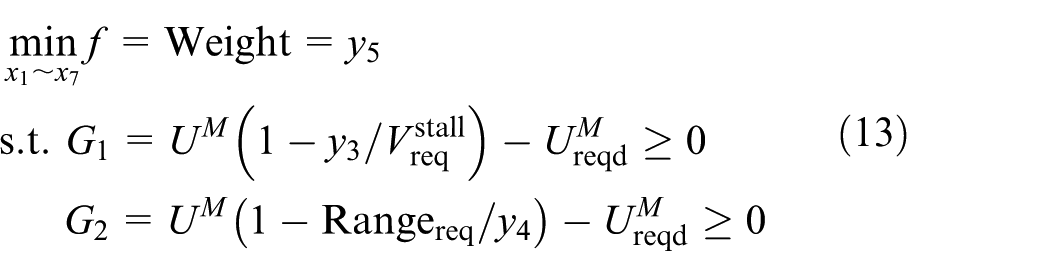
In this study, Bel is used as uncertain measure. The minimum required value
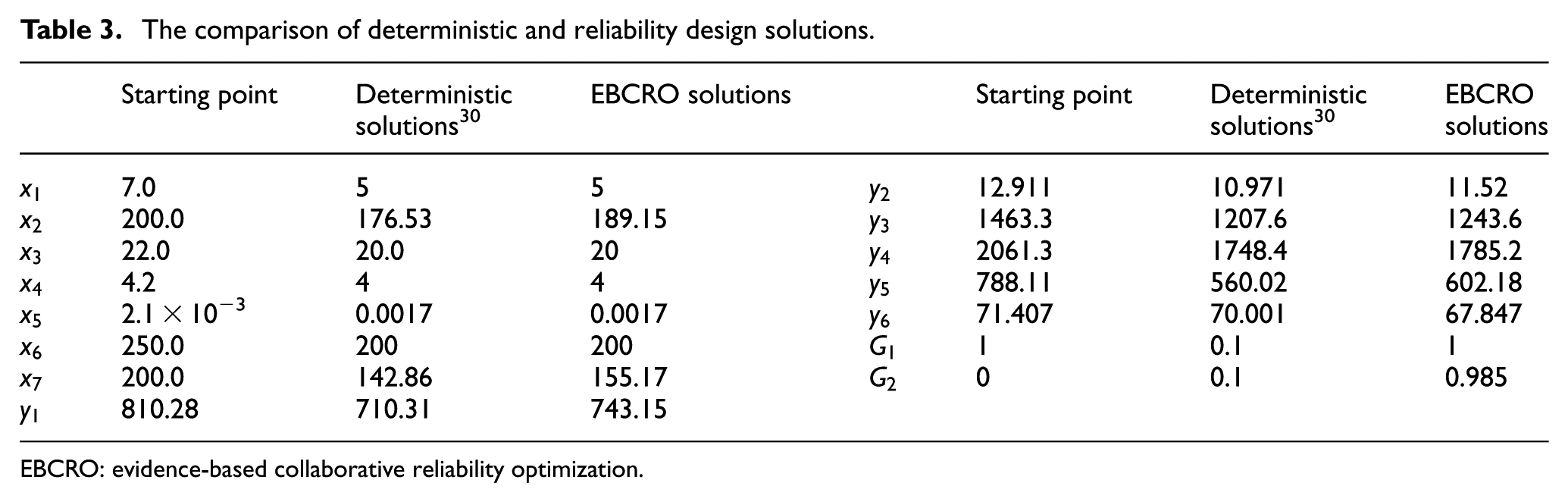
The comparison of deterministic and reliability design solutions.
EBCRO: evidence-based collaborative reliability optimization.
Conclusion
In this study, a concurrent reliability design approach which can be utilized to solve MDO problems under epistemic uncertainties in earlier phases is presented. Evidence theory is introduced and combined with CO to conduct RBMDO with incomplete information. The uncertainty measure Bel is utilized here to estimate the reliability constraints based on expert opinions. An aircraft conceptual design problem is solved to show the application of the given strategy. The results show that compared with the deterministic design solutions, the performance of reliability design solutions is more conservative. It means that the reliability design solutions from EBCRO can enjoy higher safety.
Footnotes
Acknowledgements
The authors would like to thank Mr Xiaorui Yang and Mr Yan Li for their help to improve the quality of this work.
Academic Editor: Yongming Liu
Declaration of conflicting interests
The author(s) declared no potential conflicts of interest with respect to the research, authorship, and/or publication of this article.
Funding
The author(s) disclosed receipt of the following financial support for the research, authorship, and/or publication of this article: The supports from the National Natural Science Foundation of China (Grant No. 51605080), the China Postdoctoral Science Foundation (Grant No. 2015M580780), and the Fundamental Research Funds for the Central Universities of China (Grant No. ZYGX2015KYQD045) are gratefully acknowledged.