




Abstract
In this article, two fluid conservation equations of gas–liquid two-phase transient flows are deduced with an improved mass transfer model between two phases and applied to liquid-column separation transients in pipelines. A new description of gas–liquid two-phase bubbly flow numerical calculation is structured with difference method of the Steger–Warming flux vector splitting method which is combined with NND scheme. Two experiments are chosen to validate the applicability and accuracy of the two-phase flow model: (1) Simpson’s valve closure water hammer experiment and (2) our select water hammer experiment: the power failure in the horizontal pipeline pump system experiment. Results show that a reasonable agreement is achieved by comparing to the experimental results. This method is stated to be capable of capturing shock waves and the interface mass exchange during transient process in bubble flow while suppressing calculation oscillation problem.
Keywords
Introduction
Many numerical simulations have been used to describe gas–liquid two-phase flow over last five decades. 1 There are usually three main two-phase models: homogeneous flow model, drift flux model, and two-fluid model. 2 The study of homogeneous flow model appeared early, and numerous applications have been used in some commercial software.3,4 This model was assumed two-phase in a same velocity and pressure, which does not consider interact function. Two mass conservation equations and mixed momentum equation are used to describe in this model. Using such simulation, a large number of applications have been analyzed, but there are still some restrictions which need to be improved. 1 The drift flux model, first proposed by Zuber, 5 is generally regarded as an alteration for homogeneous flow model.6–9 The model assumes that there is a relative slip velocity between interface of gas and liquid phase. Two mass conservation equations and a momentum equation are utilized in the model for each phase. The interaction exchange is described using mixture equation of conservation in energy. This two-phase flow model is available and the great significance was shown in the application when two phases are in the state of tight coupling. 9 The two-fluid model is regarded as a separated model for each phase, which includes an independent velocity, pressure, and temperature for each phase. A group of equations is used to compute void fraction, pressure, and temperature for each phase. The results have shown that a good agreement can be achieved using two-fluid model between simulation and experiment.10–15 In this article, two-fluid flow model which was based on the hyperbolic part of the Saurel et al. 12 was constructed13,16,17 for transient simulation in pipelines. The investigation is demonstrated for following six parts:
The two-phase flow is structured in two-fluid flow model by six conservation equations.
The mass transfer and interaction between two phases are described in a new method.
The Steger–Warming flux vector splitting (FVS) method is used to modify equations.
The Non-oscillatory, No free parameters, Dissipative (NND) scheme is used to discrete structural equation.
Simpson’s valve closure experiment is used to consider simulation for comparison.
The experiment of pump power failure with horizontal pipeline pump system in our lab is considered in simulation and the comparison and analysis are done.
In this article, the following assumptions are made in the simulation:
Two phases are considered as compressible.
The model is isentropic and no heat transfer between two phases is taken into account.
There is no stress interaction between phases, and friction factors at wall are equal to each other.
The stiffened equation of state (EOS) is taken in this model by the papers. 12
Two-phase flow model and properties
The mathematical formulation of two-phase flow is the base of two-fluid model, in which the pressure and void fraction of each phase can be found in this model. This two-fluid model is built by a volume fraction equation, two mass conservation equations, a mixture momentum conservation equation, and two energy conservation equations. The velocity of each phase here is assumed, in bubble flow, to be same speed without any relative slip. The hydrodynamic part of the model is based on the models by Saurel et al.12,13,16–18The volume fraction equation of gas phase is transformed mathematically, so that the form of the conservation equation is derived into conservation in the left side of equation. The model equations are as follows





where
Equation (1) is evolution equation for volume fraction of phase 1, and equations (2), (3), (5), and (6) are conservation of mass and energy for phases 1 and 2, and equation (4) is mixture momentum equation. The term

There are still some other closure relations for the interfacial terms, as

The

In this article, the closure relation
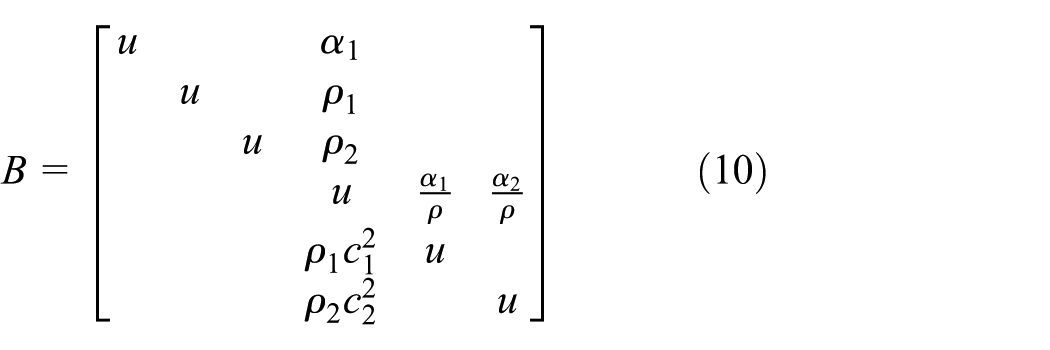
The system is unconditional hyperbolic. As shown in equation (11), there are six eigenvalues in matrix B, four of which are distinct

where c is mixture sound speed which is expressed as
Conventional closure relation
EOS
EOS is needed to close the system. A modified form of the stiffened-gas equation of state (SG-EOS) is used with same parameters in Saurel et al. 19 The stiffened EOS is expressed as equation (12)

The specific heat ratio

where

Interfacial variables
The assumptions on bubble radius we do are as follows:
Diameter of bubble is assumed that it develops in a linear growth as the gas volume change as

Number density per unit volume is assumed as a constant
There is no deformation in the transient process under the condition of the hypothesis and calculation method of interface area is shown as follows

Mechanical relaxation rates
Pressure relaxation rates
When dealing with pressure and speed relaxation phenomena under the restriction of many physical conditions, it is reasonable to assume that pressure and speed relaxation time are achieved instantaneously. This assumption is exactly satisfied for interface conditions, when pressure and speed are equalized after each time step on both boundary surfaces. It is regarded that pressure and speed relaxation time are in a microsecond scale, and two characteristics of relaxation time show a positive correlation. The relaxation phenomenon can be approximated to regard as infinitesimal where a larger time step value is selected, 13 but for a shorter period, pressure and speed relaxation phenomena have a strong impact on the precision of numerical calculation. The relaxation phenomenon is also related to many parameters of fluid characteristics and changing process.20,21
Here, for the pressure relaxation phenomenon, the relaxation parameter, as shown in equation, 22 is used (equation (16))

The mass transfer model
Both air release and water vapor are calculated in the calculation of mass transfer through interface in this work. The gas release process of air and a cavitation model are investigated to improve the overall method in this section. Some improvements are made in the calculation method of mass transfer through the interface based on the method used by Crouzet et al. 15 to ensure that model is suitable for mass transfer in bubble flow.
It is assumed that mass exchange completes in a very short time, and bubble type is always in a stable state at each time step with mass exchanging as shown in Figure 1, so jump condition through interface is shown in equation (17)


Schematic representation of the mass transfer in a two-fluid control volume.
The boundary conditions of air in liquid and gas phases can be written as shown in equation (18)

It is assumed that air content in gas phase is 1, that is, gas is pure state. The mass change at the time of boundary conditions is

Fick’s first law describes the change of concentration of dissolved gas in liquid, as shown in equation (20)

Then mass flux rate per unit area can be expressed as shown in equation (21)

The quality of gas release rate equation can be expressed in corresponding to Henry’s law. The mass flux rate per unit area can be expressed as shown in equation (22), when combined with

where
The spread coefficient k is expressed according to definition in Sherwood number, as shown in equation (23)

where the Sherwood number is
The method of cavitation calculation in liquid–vapor mass transfer
The cavitation model is introduced from calculation of interface mass transfer. It will produce a cavitation phenomenon when pressure is lower than saturated evaporation pressure. It is assumed that production of the vapor during cavitation does not influence the bubble production from the gas phase in air produce, that is, they are regarded as two different processes; however, both of them lead to the change in gas phase volume fraction.
When pressure drops to saturated evaporation pressure, according to the Rayleigh–Plesset Model under the zero gravity, cavitation is calculated in a control volume. The calculation is divided into two parts: evaporation and condensation. Assuming no heat transfer, mass transfer is therefore caused only by change of pressure, and its condensation is slower than its transpiration,23,24 which can be expressed as shown in equation (24)


where
Numerical resolution
The control equation (26) is expressed by FVS as follows

The eigenvalues of matrix are divided into two parts (

Hence, finite difference method is used to solve gas–liquid two-phase flow equations by combining FVS method of Steger–Warming with the NND scheme.
NND, proposed by Zhang and Zhuang, 25 is a non-oscillatory, containing, no free parameters and dissipative scheme. This scheme can effectively suppress the numerical oscillation in calculation using different difference scheme in upstream and downstream of the shock wave areas. It has a very high resolution in capturing the shock wave and a clear physical meaning with second-order accuracy in space. The explicit scheme is shown as equations (27) and (28)

where F is a function of U


The Steger–Warming FVS method combined with NND scheme
The derivative of positive and negative flux at zero eigenvalue is discontinuous using the Steger–Warming FVS method. The derivative discontinuation in flux will produce oscillations near zero eigenvalue, which would affect the precision and stability of the numerical calculation. Hence, flux derivative discontinuity should be considered in calculation by Steger–Warming FVS. Therefore, the Steger–Warming FVS combined with NND is as shown in equation (29)

Boundary condition
The boundary condition is described as shown in equation (30)

The method of characteristic is chosen to determine boundary conditions, as shown in equation (31)

Left eigenvectors for original matrix B are as follows in equations (32) and (33)


The corresponding change parameters are required to be calculated using boundary conditions from left eigenvectors. Other conditions in upstream and downstream can be determined subsequently. The compatibility equations are shown in equation (34)

Computation examples and validation
Simpson’s valve closure water hammer experiment
Simpson’s valve closure water hammer experiment is chosen to compare to the simulations, which has been already analyzed in the literature. 15 The analysis data from Simpson 26 are selected for calculation and comparison. The experiment consists of a horizontal pipe (which has 1 m high slope), upstream tank, and downstream valve. The fluid pressure is measured at three points along the 36 m pipeline which are located at 36, 27, and 9 m. The main parameters of fluid are referenced to the literature, 15 and the specific data are listed in Tables 1 and 2 as shown below. The number density per unit volume is Ng = 2 × 10⁶ empirically. Computing time step is 5 × 10⁻⁵ s. The water and air density is 998.2 and 2.52 kg/m3, respectively, and liquid water vapor density value is 1 kg/m3. The saturation vapor pressure is 2237 Pa.
The initial conditions of Simpson’s experiment.

EOS parameters for liquid and vapor water for Simpson’s experiment.

EOS: equation of state.
The speed is set as the boundary condition for the calculation as shown in Figure 2, where the interval velocity between 1173 and 1424 ms is used to forecast mixed pressure changes at different points. As seen in Figure 2, there is a good agreement between the simulation and experimental value in the result of mixed pressure, with a slight deviation only at peak pressure, but they still follow the same trend in the pressure. In addition, if the pressure is inputted as the boundary conditions, the prediction of the transient pressure would be improved greatly.

The pressure
The simulation of the power failure in pump system
In order to simulate pressure and volume fraction change in the pipeline at power failure of pump system, comparison experiments are performed for the simulation in the Key Lab of Hydraulic Machinery Transient, MOE, in Wuhan University. The experiment system diagram is shown in Figure 3. The system is set composed of a water tank, a pump, valves, and long horizontal pipeline. The total length of pipeline is 600 m, the diameter is 0.1 m, the material of tube is galvanized steel, the thickness of the pipe is about 3–4 mm, the sound speed is about 1280 m/s, and water level of the constant water tank is 2.3 m. The gate valve and multifunctional pump-control valve are parallel in this system, which can be used in different experiments. The position of P0 (0 m), P1 (100 m), and P2 (555 m) after valve position are data collection points on the pipeline.

The sketch of the experiment.
Two schemes are proposed for the experiments: scheme 1 (S1), no valve is closed when the power was cut off (which the fluid flows freely in tube); and scheme 2 (S2), the multifunctional pump-control valve is used when the power was cut off (the bypass valve is closed). Experimental parameters are shown in Table 3.
Initial conditions of experiment.

Thermodynamic parameters of phase can be referred in the literature. 26 In reference to sound speed under premise of its parameters, the parameters can be identified as shown in Table 4. The number density per unit volume is also taken as Ng = 2 × 10³ empirically. Computing time step is 5 × 10⁻⁵ s. The water and air density value is 998.2 and 2.52 kg/m3, respectively, while liquid water vapor density value is 1 kg/m3. The saturation vapor pressure is 2237 Pa. In this calculation, the pressure is inputted as boundary conditions, and the following four experiments and calculation are compiled in Figures 5–7.
EOS parameters for liquid and vapor water for the experiment.

EOS: equation of state.
Figure 4 shows the absolute pressure and void fraction change at P1 and P2 points in scheme 1.1. The experimental value of pressure wave attenuation is faster than the theoretical one due to the knee joints in the system. Hence, the energy loss coefficient is used to mathematically compare the results, which combined with the friction coefficient and temporarily set as 3.0. The experimental values and calculated values are shown in Figure 4. A reasonable agreement is achieved upon comparison.
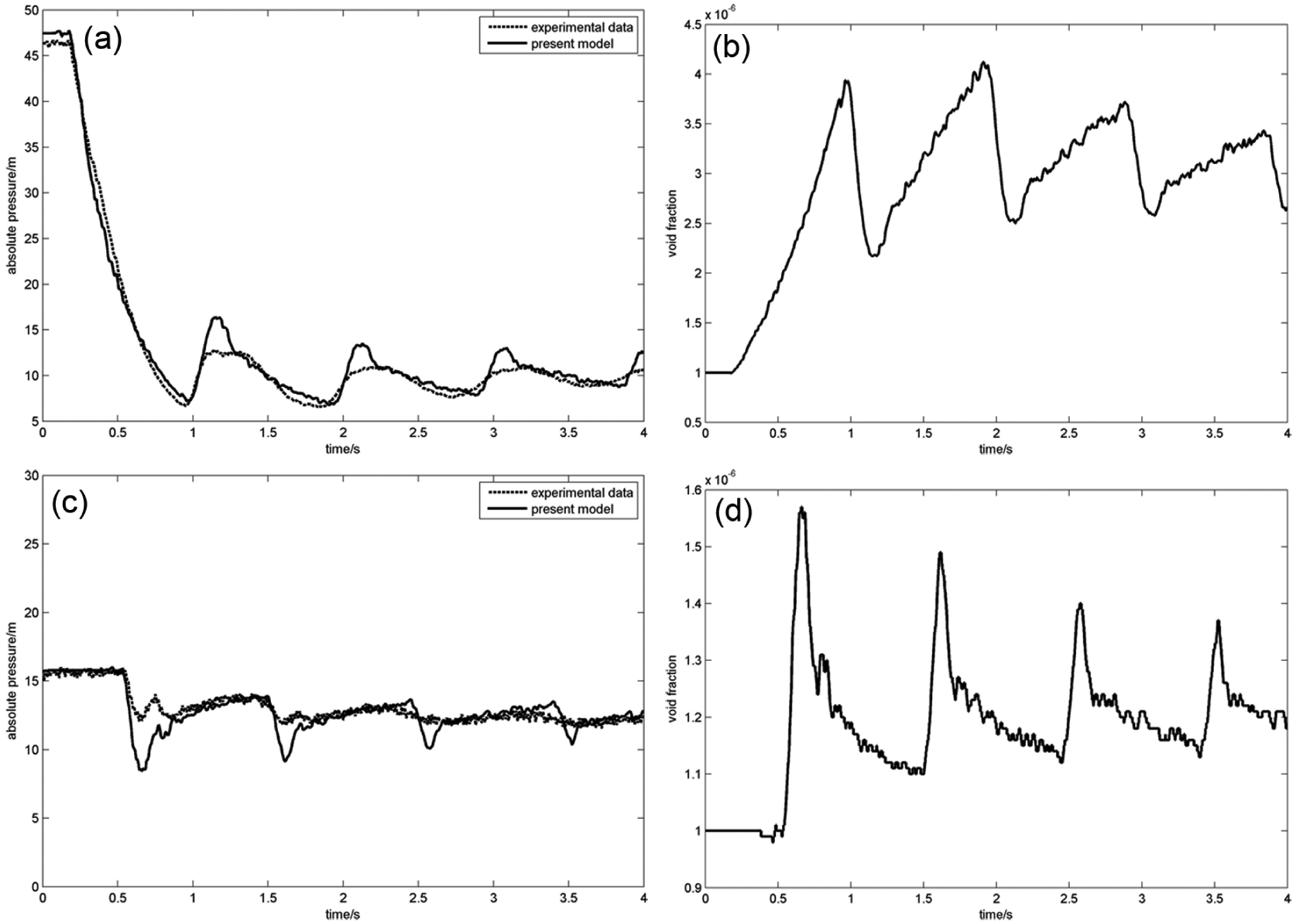
Comparison between the experimental results and computed S 1.1: (a) the comparison of pressure at Z = 100 m, (b) the calculation of void fraction at Z = 100 m, (c) the comparison of pressure at Z = 555 m, and (d) the calculation of void fraction at Z = 555 m.
Figure 5 shows absolute pressure and void fraction change at P1 and P2 points in scheme 1.2. Due to the reduction in flow rate, the energy loss coefficient is defined as 2.5.
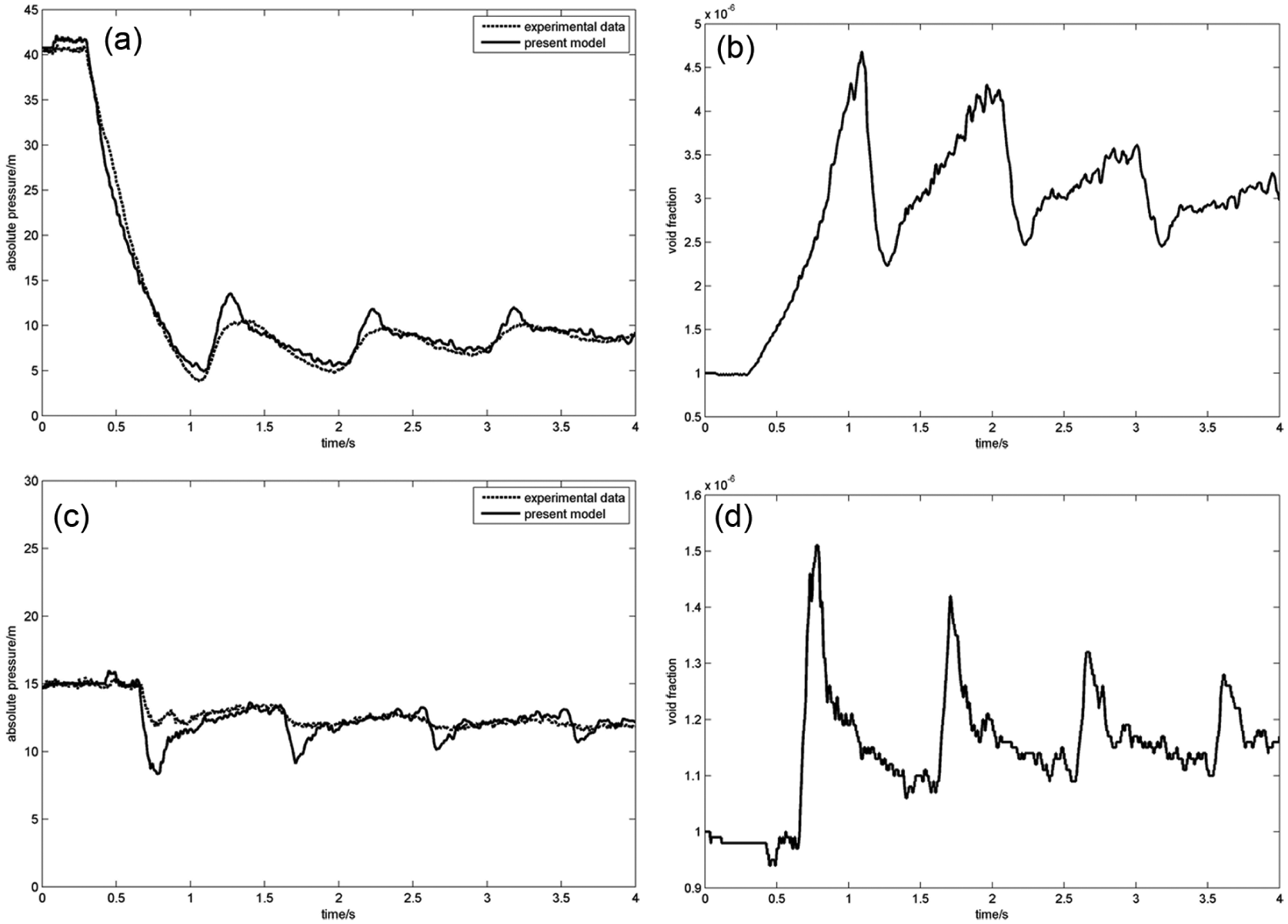
Comparison between the experimental results and computed S 1.2: (a) the comparison of pressure at Z = 100 m, (b) the calculation of void fraction at Z = 100 m, (c) the comparison of pressure at Z = 555 m, and (d) the calculation of void fraction at Z = 555 m.
Figure 6 shows the absolute pressure and void fraction change at P1 and P2 points in scheme 2.1.

Comparison between the experimental results and computed S 2.1: (a) the comparison of pressure at Z = 100 m, (b) the calculation of void fraction at Z = 100 m, (c) the comparison of pressure at Z = 555 m, and (d) the calculation of void fraction at Z = 555 m.
Figure 7 shows absolute pressure and void fraction change at P1 and P2 points in scheme 2.2. The comparison of the pressure curves show that this gas–liquid two-phase flow method can predict one-dimensional two-phase transient flow well, as well as for a good forecast analysis of void fraction at different section. It has a certain practical significance in industrial pipe system to the two-phase flow.
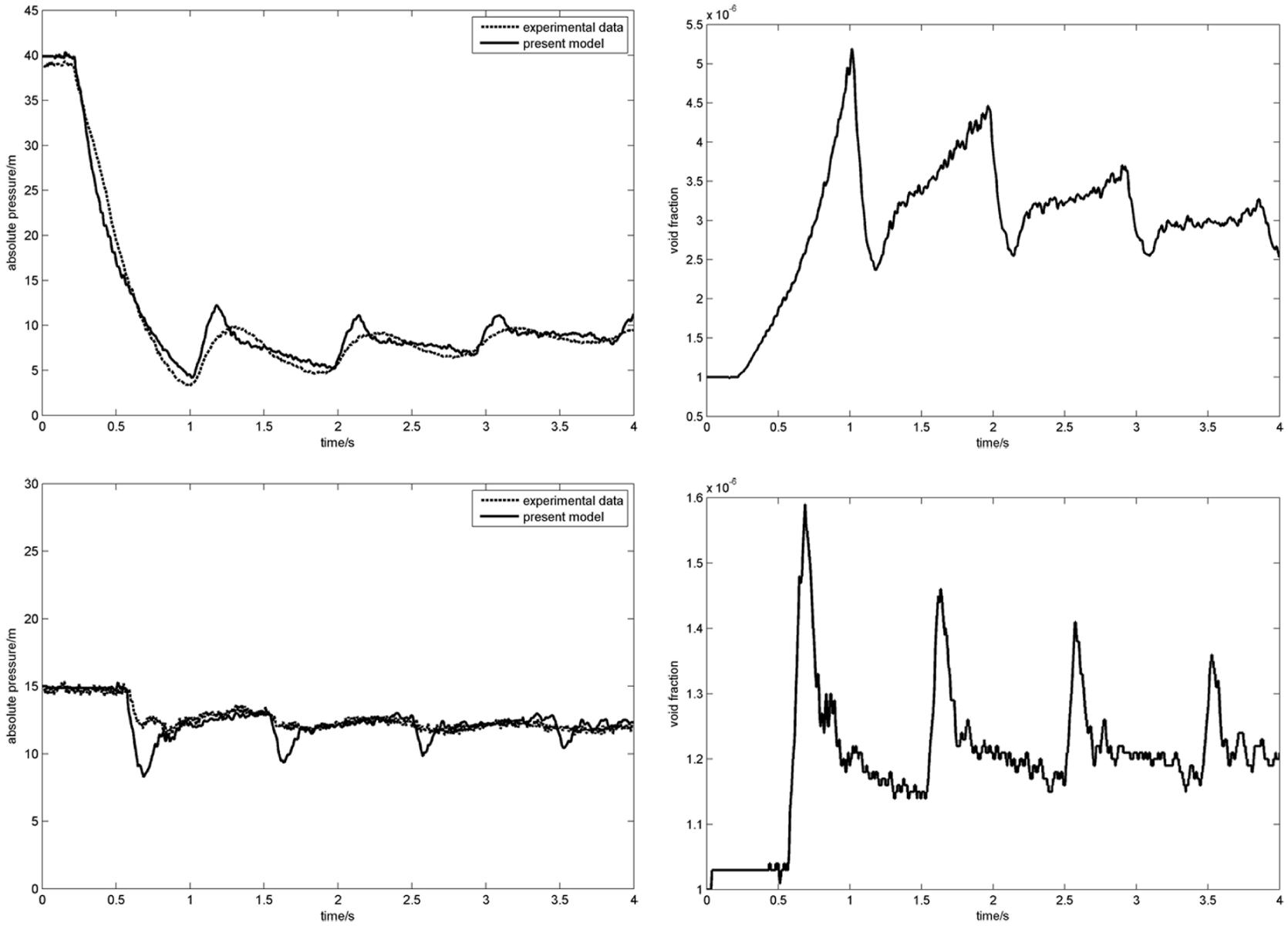
Comparison between the experimental results and computed S 2.2: (a) the comparison of pressure at Z = 100 m, (b) the calculation of void fraction at Z = 100 m, (c) the comparison of pressure at Z = 555 m, and (d) the calculation of void fraction at Z = 555 m.
Conclusion
In this article, the two-fluid model for the conservation equation is calculated with mass transfer in gas–liquid two-phase transient flow using Steger–Warming FVS method which is combined with an NND scheme. By comparing the experiment and numerical computation, the following conclusions are reached:
The combination of the Steger–Warming FVS and NND difference method in conservation gas–liquid two-phase flow equations can have a very good guarantee in stability of the simulation.
The equation of mass transfer is deduced by concentration change in two-phase flow, and this formula has great significance in industrial application, especially in bubble two-phase flow in pipelines.
A reasonable agreement is achieved by comparing the results between experimental and simulation. This method is proved to be capable of capturing shock waves and interface mass exchange during the transient process in bubble flow while suppressing the oscillation problem in the pipeline from the calculation simultaneously.
However, this model also has some certain insufficiencies due to the introduction of assumptions: (1) number density per unit volume is assumed to not change, (2) the fragmentation and integration of the bubbles are ignored, (3) no transformation in the flow model occurred, and (4) the fluid–structure interaction process is ignored. Those problems are currently being investigated to improve the model in the future.
Footnotes
Academic Editor: Ramoshweu Lebelo
Declaration of conflicting interests
The author(s) declared no potential conflicts of interest with respect to the research, authorship, and/or publication of this article.
Funding
The author(s) disclosed receipt of the following financial support for the research, authorship, and/or publication of this article: This work was financially supported by the National Natural Science Foundation of China (No. 51279145).