




Abstract
Stochastic bifurcation and chaos of a rub-impact rotor system with random stiffness under random excitation are studied in this article. Due to the irrational and fractional expressions existing in the denominator of rub-impact force, the integral process is very complicated. Taylor series expansion is used to expand the irrational and fractional expressions into a series of polynomials. Chebyshev polynomial approximation method is applied to reduce the system equations with random parameter to its equivalent deterministic one, and the responses of stochastic system can be obtained by numerical methods. Numerical simulations show that random parameters have a significant effect on the rub-impact rotor system. It may promote the nonlinear response when the rotational speed is near the 1/2 first-order critical speed and may suppress the nonlinear response when the rotational speed is over the first-order critical speed.
Introduction
Rotor bearing system is the core component of rotating machines, and its dynamic characteristics have important influence on the working performance and reliability of rotating machines. Dynamic analysis of rotor bearing system is essential in structure design, maintenance, vibration control, and fault diagnosis of rotating machines. In the past decades, there are a lot of literature works that focus on the deterministic rotor system. With the fast development of uncertainty analysis and processing technology, researchers tend to use uncertainty to explain the rotor systems. 1 In this situation, parameter may submit random distribution which is caused by external environment, manufacture, material, and installation. 2 Igusa and Kiureghian 3 first studied uncertainty and found the uncertainty in the parameters of certain systems may have significant influence on the irreliability, even when the input is a wideband stochastic process. Therefore, it is necessary to study the uncertain model instead of a deterministic one. Especially, the stability of rotor system is an important issue for design, manufacturing, and operation of rotating machinery. Chu and Lu 4 designed a special structure of stator that can simulate the condition of the full rub and observed very rich forms of periodic and chaotic vibrations. Hou et al. 5 studied the nonlinear vibration phenomenon caused by aircraft hovering flight in a rub-impact rotor system supported by two general supports with cubic stiffness. The different rubbing forms have significant influences on the dynamic responses of rotor systems, such as fixed-point rubbing, 6 local rubbing, 7 and full annular rubbing. 8 And other activities9,10 also illustrated the bifurcations and chaos of the rub-impact rotor in the deterministic system. There are many studies that focus on the research of random structures.
Fang and Leng 11 first applied Chebyshev polynomial approximation to solve the dynamical response of the random system. Then, this method was introduced to study the dynamical behavior and its control in classical nonlinear systems with random parameters.2,12 Leng et al. 13 studied the bifurcation and chaos response of a cracked rotor with random disturbance. Yang et al.14,15 studied the stochastic bifurcation and chaos of a rub-impact rotor system with random parameter and proposed Taylor series expansion method to fully transfer the random equations to its equivalent deterministic one. From the research above, Chebyshev polynomial approximation method is a good idea to deal with the stochastic nonlinear characteristics in a rub-impact rotor system with random parameters under random excitation. In this article, we focus on the stochastic response of a rub-impact rotor system with random stiffness under random excitation. The Chebyshev polynomial approximation method and Taylor series expansion method are introduced to study the nonlinear response. The complex behavior which affect by the random parameter is shown by the simulation.
Mathematical model
A schematic of a rotor system with rub-impact is shown in Figure 1. Some simplifications are applied to establish the mathematical model: (1) a schematic of a rotor system with nonlinearities which are caused by material, and a cubic term is used to represent the nonlinearity of the shaft; (2) two ends of the rotor are simply supported; (3) this rotor has viscous damping c; and (4) the stator is rigid and its surface is elastic. Then, the normal dynamic equations at the rotor center

where
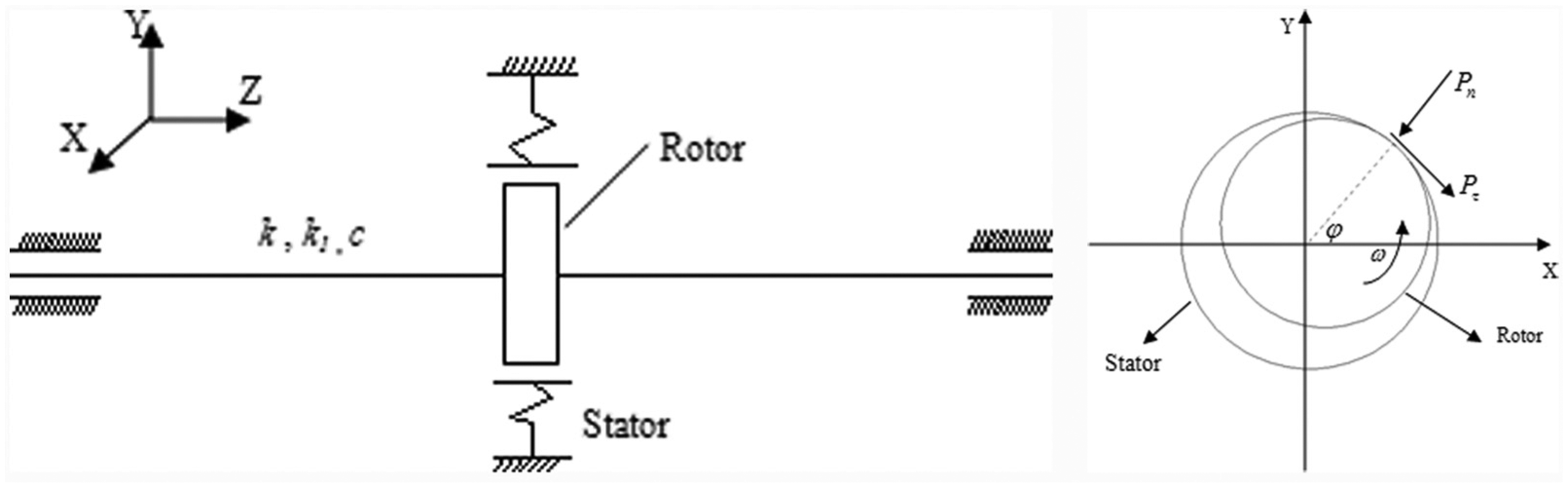
Schematic of rub-impact rotor system and rub-impact forces.
Summary of the general notation used in equation (1).

The non-dimensional equations are
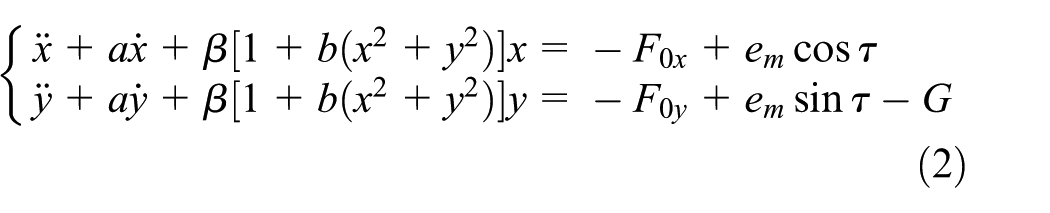
where

Therefore, considering the random stiffness under random excitation of the rub-impact rotor system, the non-dimensional equations can be written as follows

where

Monte Carlo method is a useful method in numerical analysis of nonlinear structure subject to random excitations. Shinozuka 16 presented an efficient method for digital simulation of a general homogeneous process as a series of cosine functions with weighted amplitudes, almost evenly spaced frequencies, and random phase angles. This method can be used in the numerical analysis of wind-induced ocean wave elevation, spatial random variation of material properties, and random surface roughness of airport and highway runways. In this article, we suppose that the random excitation is a standard white noise process which can be simulated as

where N is the total number of modes and N→∞,
Taylor series expansion method
Taylor series expansion method is introduced here to expand the irrational and fractional expressions into a series of polynomials. This method is used to avoid the complex integral operation when we apply Chebyshev polynomial approximation method.
Assume
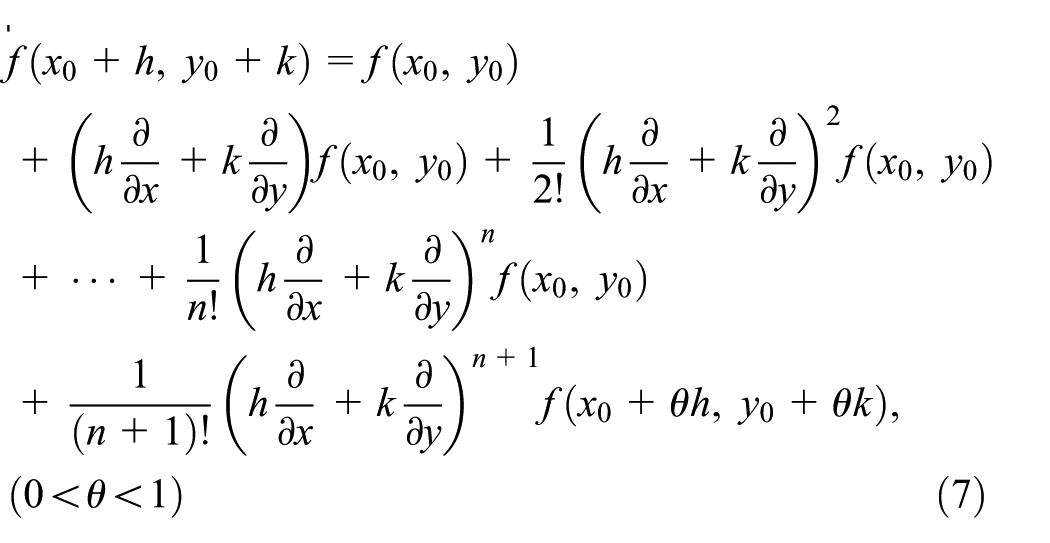
where h and k are small perturbation to the point of

When

This is a special case of Taylor series and is known as Maclaurin’s series. The irrational and fractional expressions can be expanded into a series of polynomials using Maclaurin’s series. The non-dimensional polynomial rub-impact forces of equation (3) can be written as

Chebyshev orthogonal polynomial
Chebyshev orthogonal polynomial method is used to transfer the random rub-impact rotor equation to its deterministic form. Equation (4) can be approximately expressed using the following series under the convergence in mean square

where

Substituting equations (10) and (11) into equation (4), when
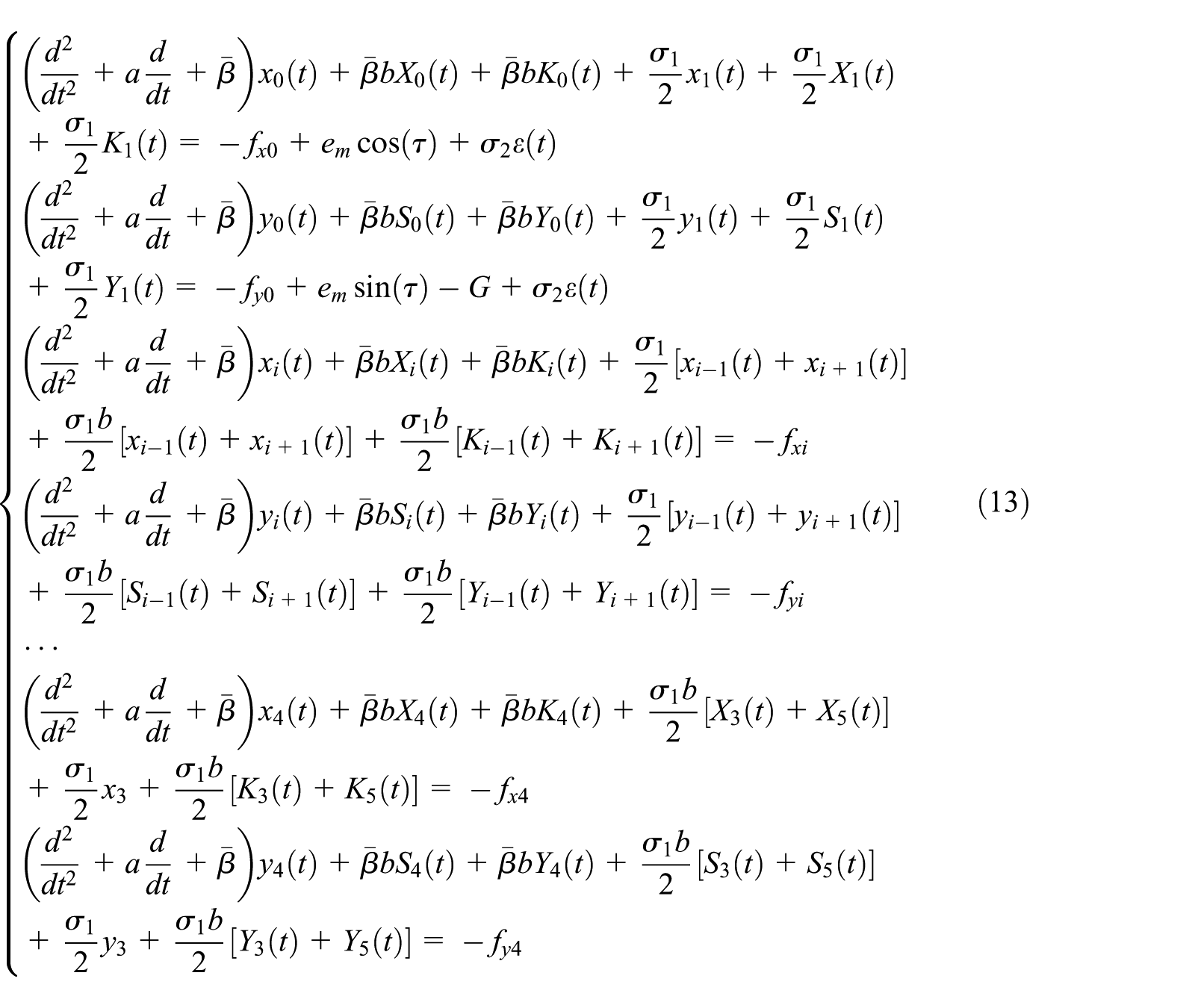
where
Equation (13) is solved by the fourth-order Runge–Kutta method. Considering the random excitation, the rub-impact rotor can be expressed as

The ensemble mean response (EMR) can be obtained as

From the above equations, the stochastic rub-impact rotor system equation (4) has been transformed into high-dimensional deterministic equation (13). We can study the original stochastic rotor system by equation (15).
Numerical results
The parameters of rub-impact system are as follows:
Methods validation
The fourth-order Runge–Kutta method is employed to simulate this system. In order to determine whether rub-impact failure occurs or not in equation (4), the friction coefficient f is defined as

Equation (4) decays to be a deterministic system with random excitation when

Bifurcation diagram of the system when
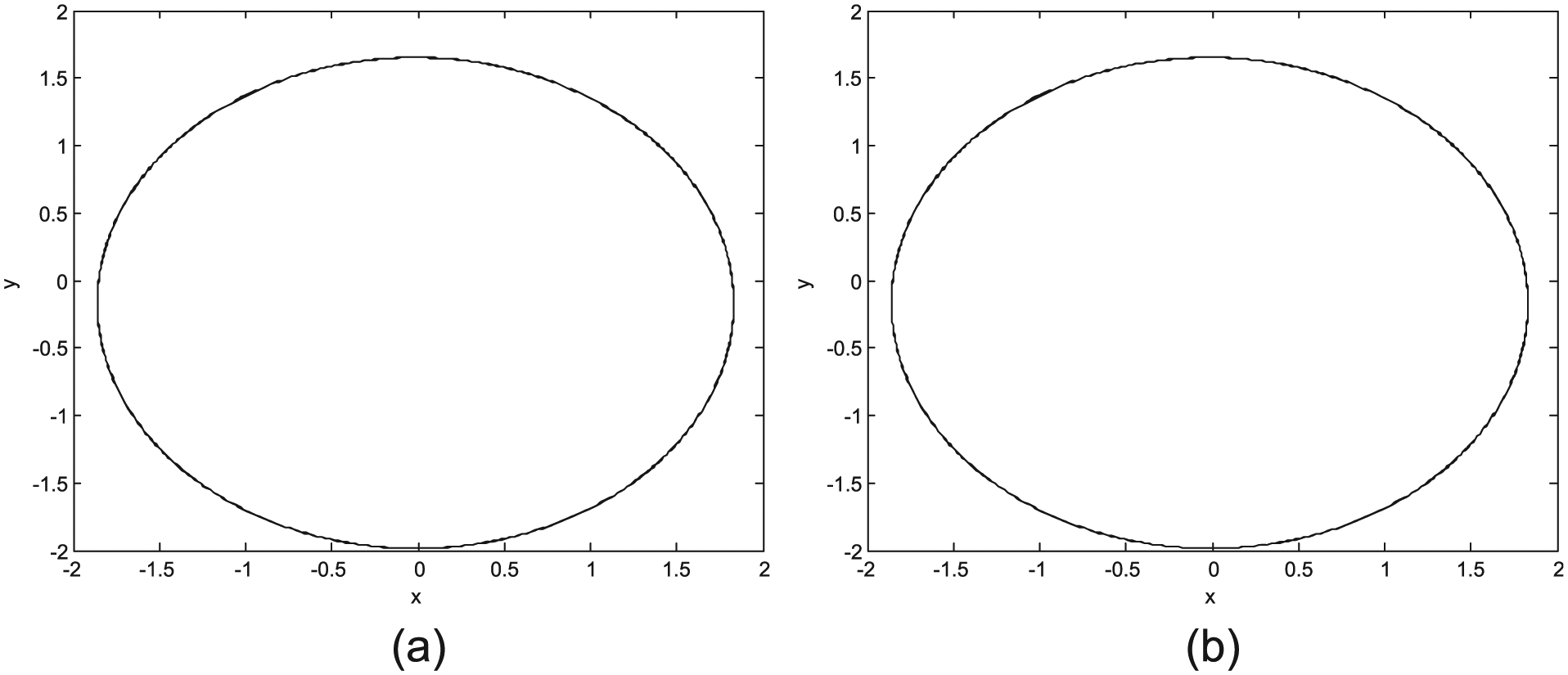
Phase plane when

The response when

The response when

The response when
The effect of random stiffness
When
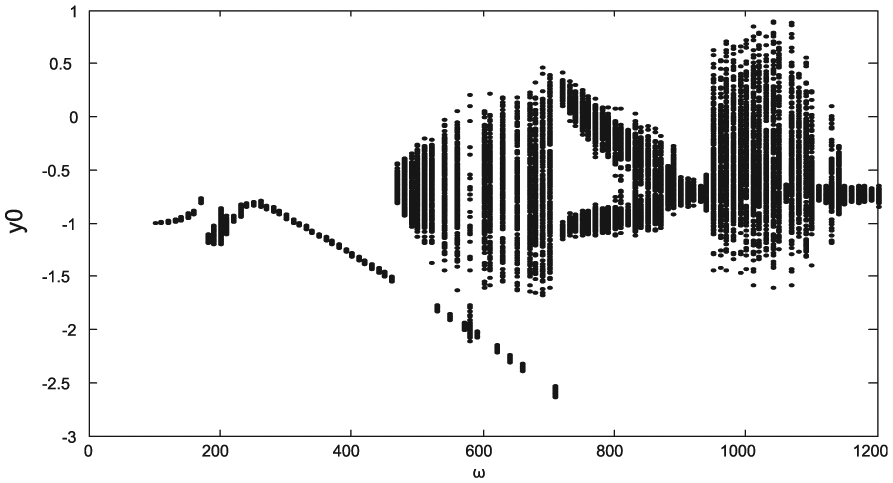
Bifurcation diagram of the system when

Phase planes when
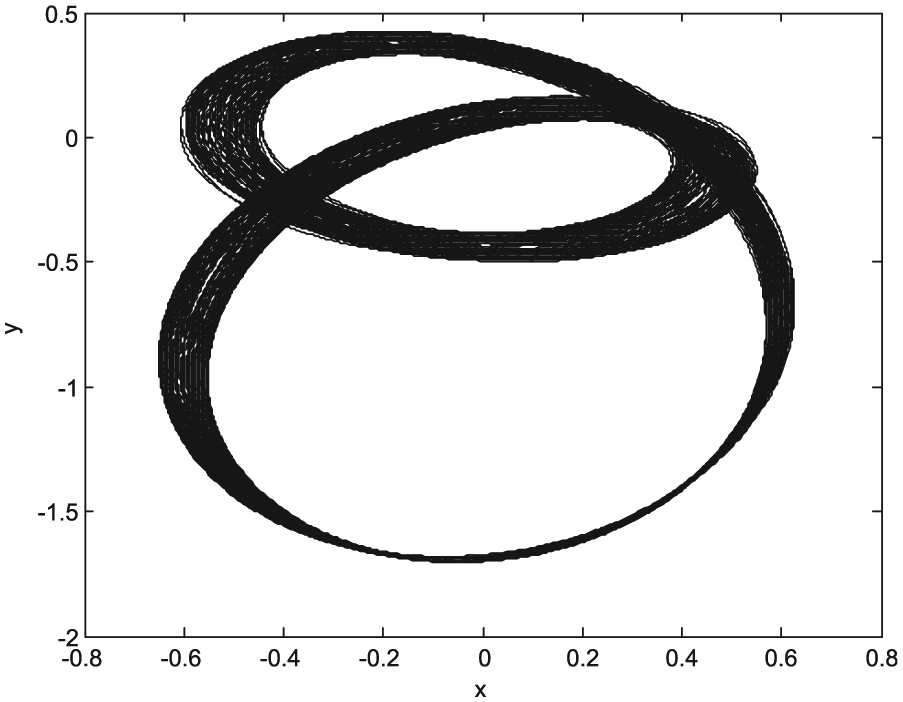
Phase planes when

Phase planes when
Figure 11 shows the rotation speed–amplitude curve for different random type. The random intensity parameters are

Rotation speed–amplitude curve of rub-impact rotor: (a) ω = 100–600 r/min and (b) ω = 700–1200 r/min.
Conclusion
Stochastic bifurcation and chaos of a rub-impact rotor system with random stiffness under random excitation are studied by the Taylor series expansion method and the Chebyshev polynomial approximation method in this article. It aims to reveal the influence of random stiffness under random excitation on the nonlinear response of rub-impact rotor. These results are useful for the design and vibration control of rotating machinery rotor. From the above simulation, the following conclusions are made:
Random parameters do not affect the dynamic responses of the rub-impact rotor system when rotational speeds are lower.
Random parameters have a significant effect on the rub-impact rotor system when the rotational speeds become higher. More importantly, the random stiffness may promote the nonlinear response when the rotational speed is near the 1/2 first-order critical speed and may suppress the nonlinear response when the rotational speed is over the first-order critical speed.
Footnotes
Appendix 1
Using the recursion relation of Chebyshev polynomial, the functions
Academic Editor: Davood Younesian
Declaration of conflicting interests
The author(s) declared no potential conflicts of interest with respect to the research, authorship, and/or publication of this article.
Funding
The author(s) disclosed receipt of the following financial support for the research, authorship, and/or publication of this article: This work was supported by the National Natural Science Foundation of China (Grant No. 11272257) and “Aoxiang New Star” of Northwestern Polytechnical University.