



Abstract
It is easy for the rotor system to produce the plastic deformation at the support after a long-term operation, this change will cause looseness of the bolt. Due to the particularity of the material and the structure for the bearing base and foundation, the elastic force of the support is nonlinear. Larger vibration of the loosening rotor under the nonlinear support will occur, resulting in the impact-rub between the rotor and stator. In order to study the dynamic behaviors of the loosening-rubbing coupling rotor system under the nonlinear support, the model is established to analyze the influencing mechanism of the key parameters such as the eccentricity, the disk offset, the looseness gap, the rubbing gap, and the nonlinear parameters on the vibrational responses of the system. The piecewise cubic nonlinear expression is applied to describe the nonlinear support with the loosing bolt; Coulomb friction is employed to characterize the rubbing of the impact-rub. The research results show that the nonlinear support will stimulate and amplify the nonlinear dynamic behaviors of the rotor system; there exists a threshold for the effect of the loosening gap on the vibrational characteristics of the system; increasing nonlinear parameters to a certain degree will cause the increase of the proportion of quasi-period and chaos. The research focus and conclusions are certain innovative in this paper. The work is of great value for fault diagnosis and structural design.
Introduction
The rotor system is prone to plastic deformation at the supporting position due to the complex alternating stress after the long-term operation, resulting in the bolt looseness. When the rotor operates under the loosening support, its vibrational amplitude is higher than that of the normal operation, which will cause the impact-rub between the blade or impeller and the static components. The impact-rub will produce the blade wear and even fracture, posing a great threat to the safe and stable operation of the unit. When the materials of the support consisting of the bearing base and foundation are the special rubber, the modern plastics or certain alloys, the elastic force of the support is nonlinear, and often with the characteristic of cubic term in the expressions because of the particularity of the material and structures of the support. The dynamics of this loosening and rubbing coupling system under the cubic nonlinear stiffness support are very complex. Therefore, the study of this complicated coupling rotor system has important academic value and engineering applications.
In the last decades, scholars have carried out much research work on the rubbing between the rotor and the stator and the loosening of pedestal. Ma et al.1,2 conducted comprehensive study on the effects of the different rubbing types and developed the model for the rubbing between the blade and the casing. Xiang et al. 3 constructed a novel model for an asymmetrical rotor system and the interactions between the nonlinear oil-film force and the impact-rub force were taken into account. Wang et al. 4 investigated the sudden imbalance of the rotor system and the impact-rub induced by the blade off by the theoretical analyses and experiments; the results show that it is obvious that the impact-rub between the rotor and the casing can lead to very complex nonlinear dynamic behaviors. Sun et al. 5 investigated the steady-state vibrational responses of a dual-rotor system which is suffering rubbing, the influences of the key parameters were analyzed. Zhang et al. 6 applied the generalized Polynomial Chaos Expansion (gPCE) to gain the nonlinear random responses of the impact-rub rotor system by the probabilistic models. Chen et al. 7 proposed a new recognition method of the pedestal looseness degree of the rotating machinery. In view of pedestal looseness fault often occur in the engineering, Ma et al. 8 constructed a Finite Element (FE) model with the looseness fault and investigated the dynamic characteristics of one-support looseness and two-support looseness. Chen et al. 9 developed the diagnosis approach of the looseness fault of the connecting bolt. Ma et al. 10 found that the reassigned wavelet scalograms can enhance the concentration of the scalogram and weaken the interference terms to some extent, so that the pedestal looseness faults can be easily identified. Jiang et al. 11 proposed a nonlinear measuring method for the pedestal looseness of the rotor systems under the steady-state conditions.
Many investigators have conducted much work on the vibration characteristics of the rotating machinery with the looseness-rubbing coupling faults, and have achieved a lot of progress. Youfeng et al. 12 studied the effect of the structural parameters on the dynamic behaviors for the flywheel rotor systems with the pedestal looseness and impact-rub coupling faults. Jiang et al. 13 proposed a nonlinear evaluation strategy for identifying the impact-rub of rotor systems with the pedestal looseness. Liu et al.14,15 developed the mechanics model and FE model of the dual-disk triad-supported rotor system with the looseness-impact-rub coupling faults. The research of dynamics characteristics about the effect of rubbing stiffness and looseness stiffness on the system was done with the equivalent stiffness model on the loose support, the nonlinear FE method, the contact theory and the wavelet packet decomposition principle. Lu et al. 16 set up a mechanical model and a FE model of a vertical dual-disk rotor system with the pedestal looseness and the impact-rub and found that the impact-rub between the rotor and the stator can weaken the low frequency vibrational responses induced by the pedestal looseness. Lee and Choi 17 conducted a research by applying Hilbert-Huang Transform (HHT) to the signals of the partial rubbing and looseness. Yang et al. 18 developed the model of a dual rotor system with the pedestal looseness and the rubbing, and studied theoretically and experimentally the effect of the stiffness of the pedestal, the eccentricity, the initial clearance on the dynamic behaviors of the system. Luo et al. 19 set up the dynamic model of the nonlinear rubbing fault rotor system with the pedestal looseness. The nonlinear dynamic behaviors were studied about the vibration system caused by the coupling faults of pedestal looseness and the rubbing fault, using the numerical value integral and Poincaré mapping methods. Ebrahimi et al. 20 applied the Runge-Kutta method to research a rotor model with characteristics of magnetically supported coaxial in auxiliary bearings to analyze the bifurcations.
Though much of study on the looseness and the impact-rub for the rotor system has been conducted, this complex rotor system considering the cubic nonlinear stiffness support is investigated scarcely, there exists this rotor pedestal with the special materials and structures in engineering applications. Hence, it is novel to study the dynamics of the rotor system of the looseness-rubbing under nonlinear support. In this paper, the complex rotor system is established, and the influence of the nonlinear parameter, the loosening gap and mass, the impact-rub gap on the dynamics of the system is studied. Considering the nonlinear support, some valuable conclusions are obtained in terms of the system stability and vibration amplitude. Therefore, the study object and conclusions are certain innovative in this work.
Modeling of nonlinear support, loose bolt, and rubbing
Pedestal looseness under nonlinear support
The high-frequency excitation is prone to induce the loosening of the pedestal after the plastic deformation of the bolts. When the bolt is loosened due to severe vibration, the bearing base and the foundation are prone to be partially separated. The schematic diagram of the looseness for the pedestal is shown as Figure 1. The mathematical model of the loosening fault is expressed by the support with the piecewise stiffness and damping in this research; the nonlinear term is characterized by the cubic stiffness. Therefore, the expressions describing the binding force and damping can be written as:


where
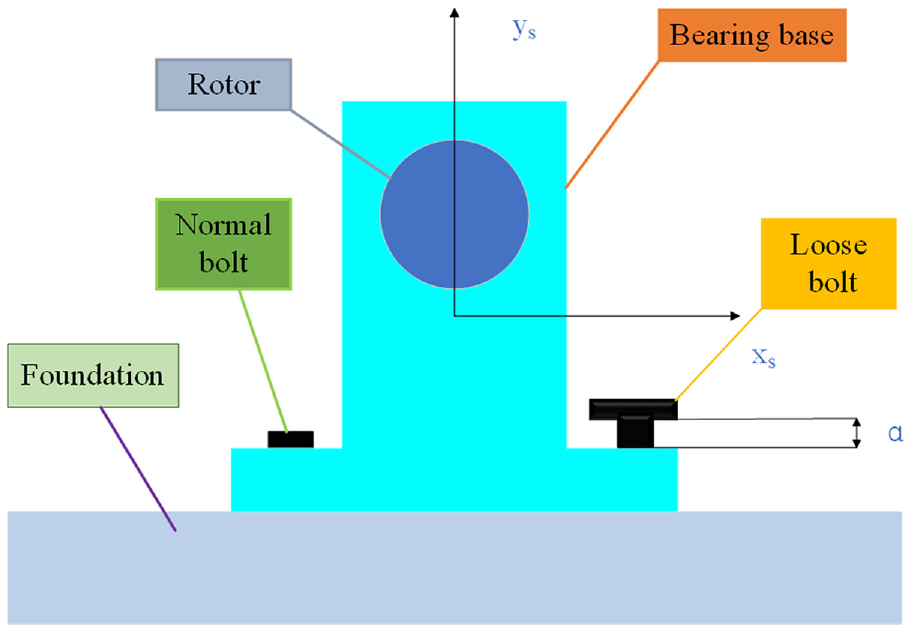
Schematic diagram of pedestal looseness.
Rubbing model
The impact-rub between the rotor and the stator is generally divided into two types, one is the full cycle impact-rub, and the other is the single point impact-rub. The single point impact-rub is selected for research in this paper, and the thermal effect caused by friction is ignored in the modeling.
Figure 2 shows a schematic diagram of the impact-rub for the rotor system where

where pd is the gap between the rotor and the stator when the system is stationary, kp is the stator stiffness, r is the relative radial displacement of the rotor, and f is the friction coefficient between the rotor and stator. In the xO1y coordinate system, the rubbing forces can be expressed as:

where

Schematic diagram of the impact-rub for rotor system.
Equation of motion
In order to develop the equation of motion for the complex rotor system, the system is modeled as Figure 3 which is the schematic diagram of the nonlinear support-loosening-rubbing coupling rotor system with an offset disk. The mass of the shaft is neglected, its length is L and its diameter is d; the concentrated mass of the support A and B at both ends is

Nonlinear support-loosening-rubbing coupling rotor system with offset disk.
When the shaft is deformed, the angle between the disk axis and the line connecting the fulcrum AB is

The kinetic energy of support is

Then the total kinetic energy

Excluding the axial and torsional deformations of the rotor, take the generalized coordinates

The potential energy of the shaft:

where


where


The potential energy of the rotor at both ends is


The dissipative energy of the disk is

where
The dissipative energy of the rotor at both ends is


The one-end-loosening-offset rotor system has nine DOFs during the steady-state whirling. The nonlinear damped differential equation of motion of the rotor system (equation (20)) is obtained according to Lagrange equation (equation (19))


where


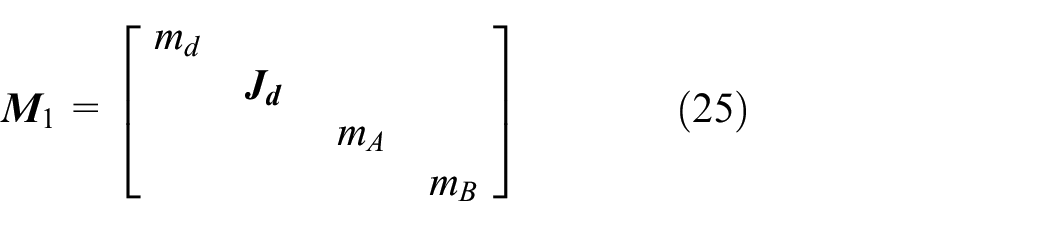

where
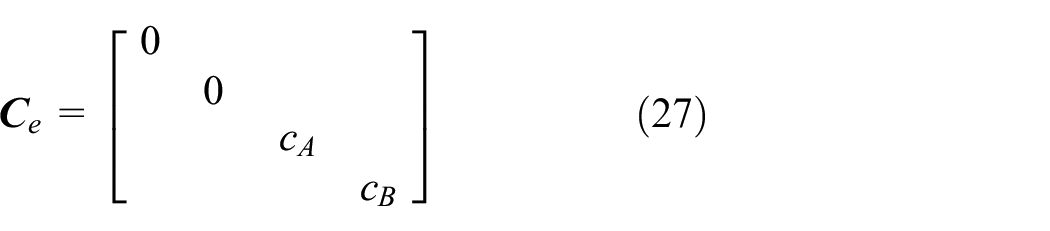





where



where

where
Substituting equations (21)–(39) into equation (20), the general differential equation of the rotor system is gained as equation (40)

Dynamic characteristics of the rotor system
The fourth-fifth order variable step size Runge-Kutta method is used to solve the equation (40) by the numerical integration. Based on the bifurcation, the waterfall curve, the axis trajectory and Poincaré diagrams of vibration response for the system, the influence of the key parameter on the dynamic characteristics for the system is studied. The main parameters of the calculation is shown in Table 1.
Main parameters of the system.

Effect of eccentricity on the nonlinear dynamics
In order to study the influence of eccentricity on the dynamic characteristics for the loosening-rubbing rotor system with the offset disk under the nonlinear support, the eccentricity e = 9 × 10⁻⁶, 2 × 10⁻⁵, 4 × 10⁻⁵, 6 × 10⁻⁵, 8 × 10⁻⁵, and 1 × 10⁻⁴ m are selected to draw the bifurcation and waterfall diagrams with the nonlinear parameters
Figure 4 is the bifurcation diagram of the vibration response of the system at different eccentricity. It can be seen from Figure 4(a) that when the eccentricity is small, the system is main in the Period-1 (P1) or stable multi-periodic motion; with the increase of eccentricity, the window of P2 motion in the speed interval (

Bifurcation diagram of the vibration response of the rotor system at different eccentricity: (a) e = 9 × 10⁻⁶ m, (b) e = 2 × 10⁻⁵ m, (c) e = 4 × 10⁻⁵ m, (d) e = 6 × 10⁻⁵ m, (e) e = 8 × 10⁻⁵ m, and (f) e = 1 × 10⁻⁴ m.
The waterfall curve of the vibration response for the system at different eccentricity is shown in Figure 5 where other frequency components except for the speed frequency in the subcritical speed interval gradually disappear as the eccentricity increases, and the amplitude of the resonance increases. With the increase of eccentricity, the window of X/2 frequency gradually widens, as seen in Figure 5(a) and (b); the amplitude of the X/3 frequency becomes obviously larger, as shown in the green circle in Figure 5(b); with the further increase of eccentricity, as shown in Figure 5(c)–(f), the wide noise continuum spectrum and the interharmonic components gradually increase.

Waterfall curve of the vibration response for the system at different eccentricity: (a) e = 9 × 10⁻⁶ m, (b) e = 2 × 10⁻⁵ m, (c) e = 4 × 10⁻⁵ m, (d) e = 6 × 10⁻⁵ m, (e) e = 8 × 10⁻⁵ m, and (f) e = 1 × 10⁻⁴ m.
In summary, the eccentricity has a significant effect on the dynamic behavior of the loosening-rubbing rotor system with the offset disk under the nonlinear support. The quasi-periodic motion of the system in the low speed interval gradually disappears with the increase of eccentricity, and the motion state in the supercritical speed interval tends to be the quasi-periodic and the chaotic motion.
Effect of disk offset on the nonlinear dynamics
In order to study the influence of disk offset on the dynamic characteristics for the loosening-rubbing rotor system with the offset disk under the nonlinear support, the offset value a = 0.1, 0.15, 0.2, 0.3, 0.35, and 0.4 m are chosen to draw the bifurcation and waterfall diagrams with the nonlinear parameters
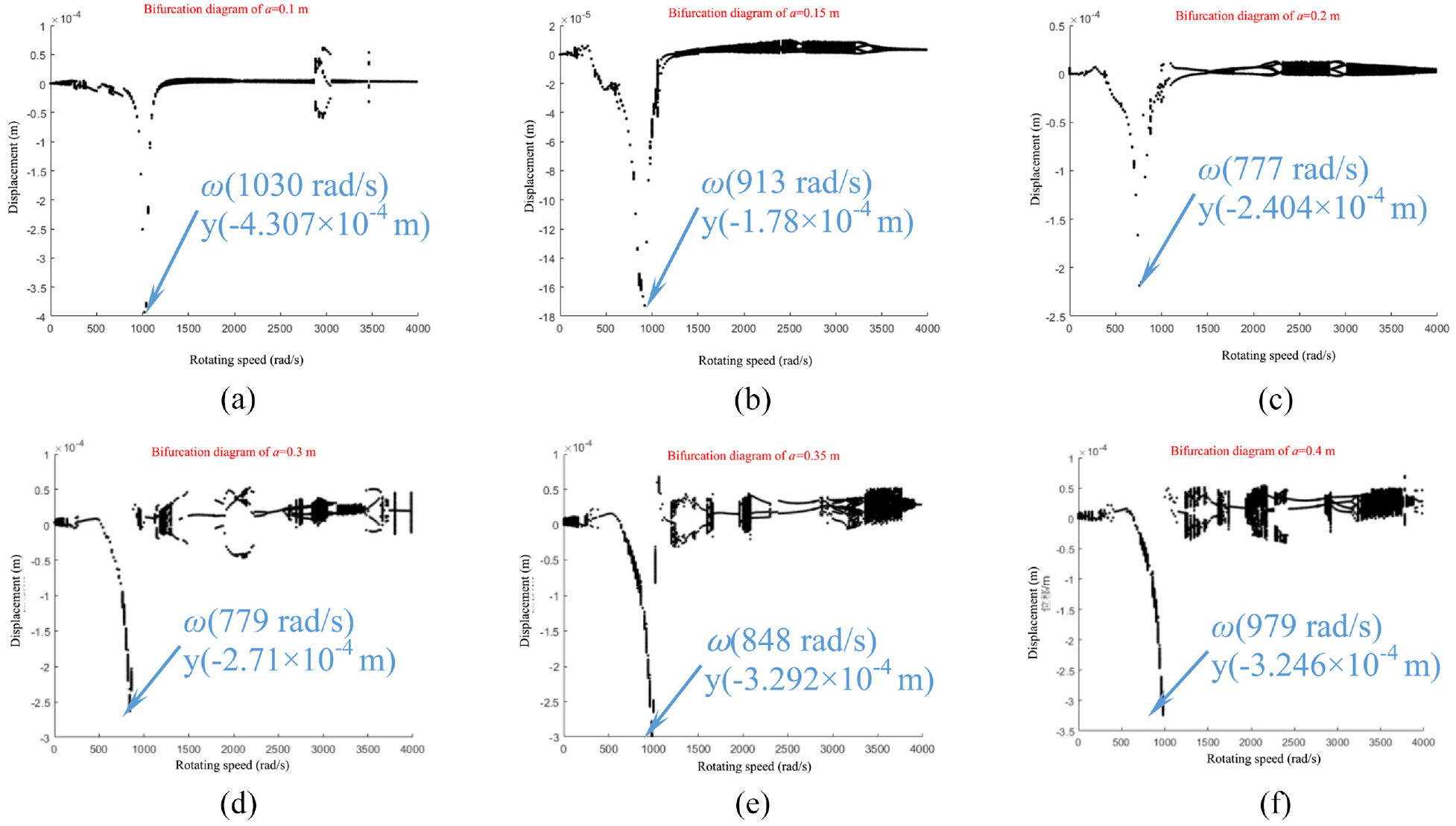
Bifurcation diagram of the vibration response of the rotor system at different disk offset: (a) a = 0.1 m, (b) a = 0.15 m, (c) a = 0.2 m, (d) a = 0.3 m, (e) a = 0.35 m, and (f) a = 0.4 m.

Waterfall curve of the vibration response for the system at different disk offset: (a) a = 0.1 m, (b) a = 0.15 m, (c) a = 0.2 m, (d) a = 0.3 m, (e) a = 0.35 m, and (f) a = 0.4 m.
Figures 6 and 7 are the bifurcation diagram and waterfall curve of the vibration response of the rotor system at the different offset disk, respectively. Compared with Figures 6(a)–(c) and 7(a)–(c), it can be found that as the offset disk gradually increases, the motion of the system in the subcritical speed interval gradually changes from the quasi-period to P1, the other frequency components except the speed frequency gradually disappeared, the critical speed of the rotor system gradually decreases. It can be seen from Figures 6(d)–(f) and 7(d)–(f) that the bifurcation characteristics of the system is affected by the offset disk. With the increase of the disk offset, the critical rotating speed of the rotor system gradually increases, the speed interval of the quasi-period and the chaos widens. Too large disk offset will increase the proportion of the quasi-period motion and the chaos, and increase the number of the interharmonics and the continuous spectra of the whole system, and the nonlinear characteristics will become more significant. Therefore, the disk offset should be controlled within the appropriate range to keep the system stable operation.
Effect of loosing gap on the nonlinear dynamics
In order to study the influence of the loosing gap on the dynamic characteristics for the rotor system, the loosing gap
Figures 8 and 9 are the bifurcation diagram and waterfall curve of the vibration response of the rotor system at different disk offset, respectively. It can be shown from Figure 8 that the bifurcation characteristics are influenced by the loosing gap, with the increase of loosing gap, the critical rotating speed of the system gradually decreases, and the vibration amplitude of the critical rotating speed gradually decreases; when the loosing gap
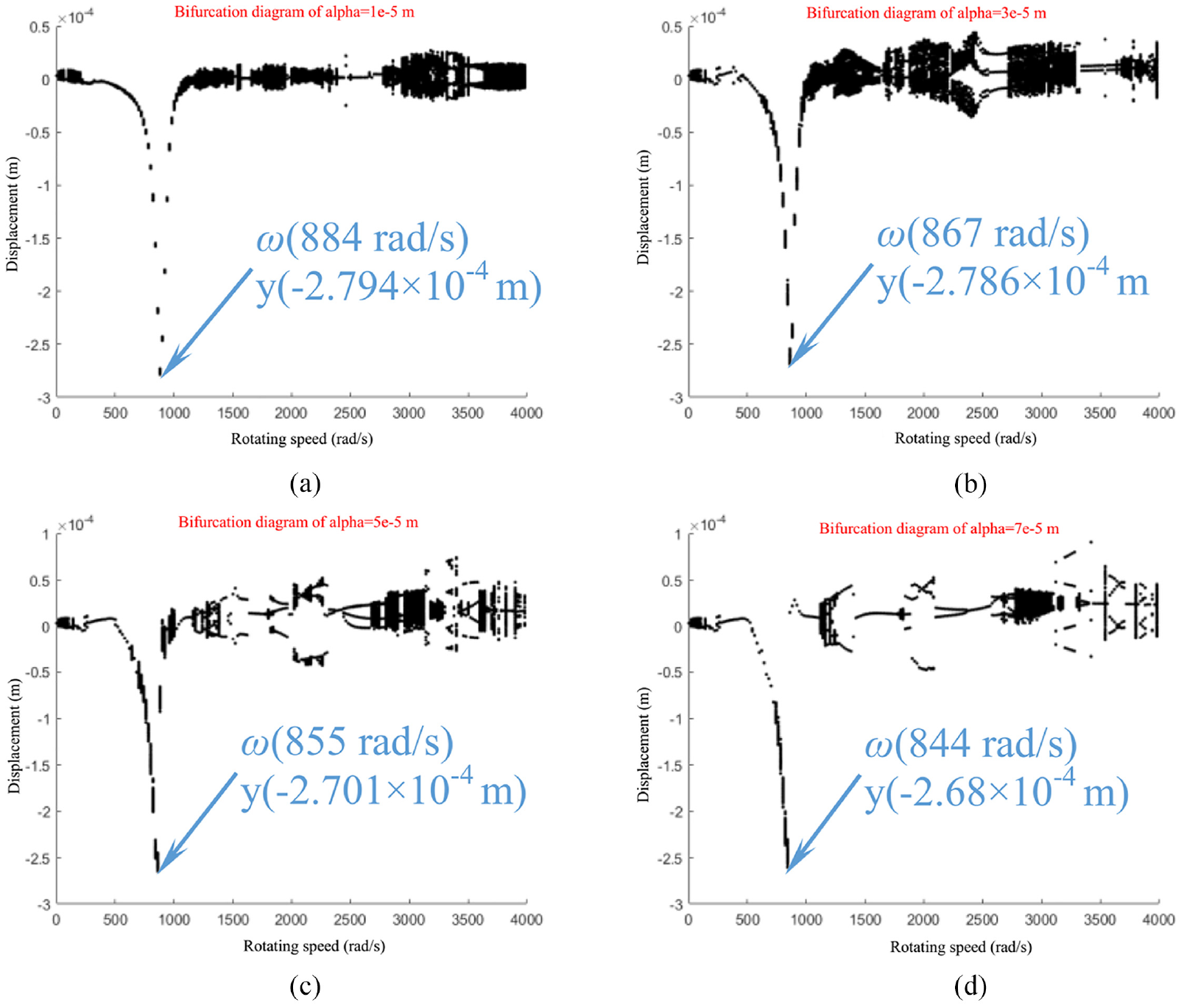
Bifurcation diagram of vibration response of the rotor system at different loosing gap: (a)

Waterfall curve of the vibration response of the system at different loosing gap: (a)
The loosening gap has an influence on the nonlinear characteristics of the system, and there exists a threshold of the loosing gap, the dynamic behaviors of the system are more significant with the increase of the loosing gap which is less than the threshold, and gradually disappears with the increase of the loosening gap greater than the threshold.
Effect of impact-rub clearance on the nonlinear dynamics
In order to study the influence of the impact-rub clearance on the nonlinear dynamics of the rotor system, the impact-rub clearance is taken as the control parameter, and the other parameters keep unchanged to draw the bifurcation diagram, as shown in Figure 10, the corresponding Poincaré and the trajectory diagrams of centroid of the rotor system at the typical impact-rub clearances are drawn for the further research, as seen in Figures 11 and 12 where the blue curves is the trajectory and the red curves is the boundary line of the impact-rub.

Bifurcation diagram of vibration displacement with the change of impact-rub clearance when
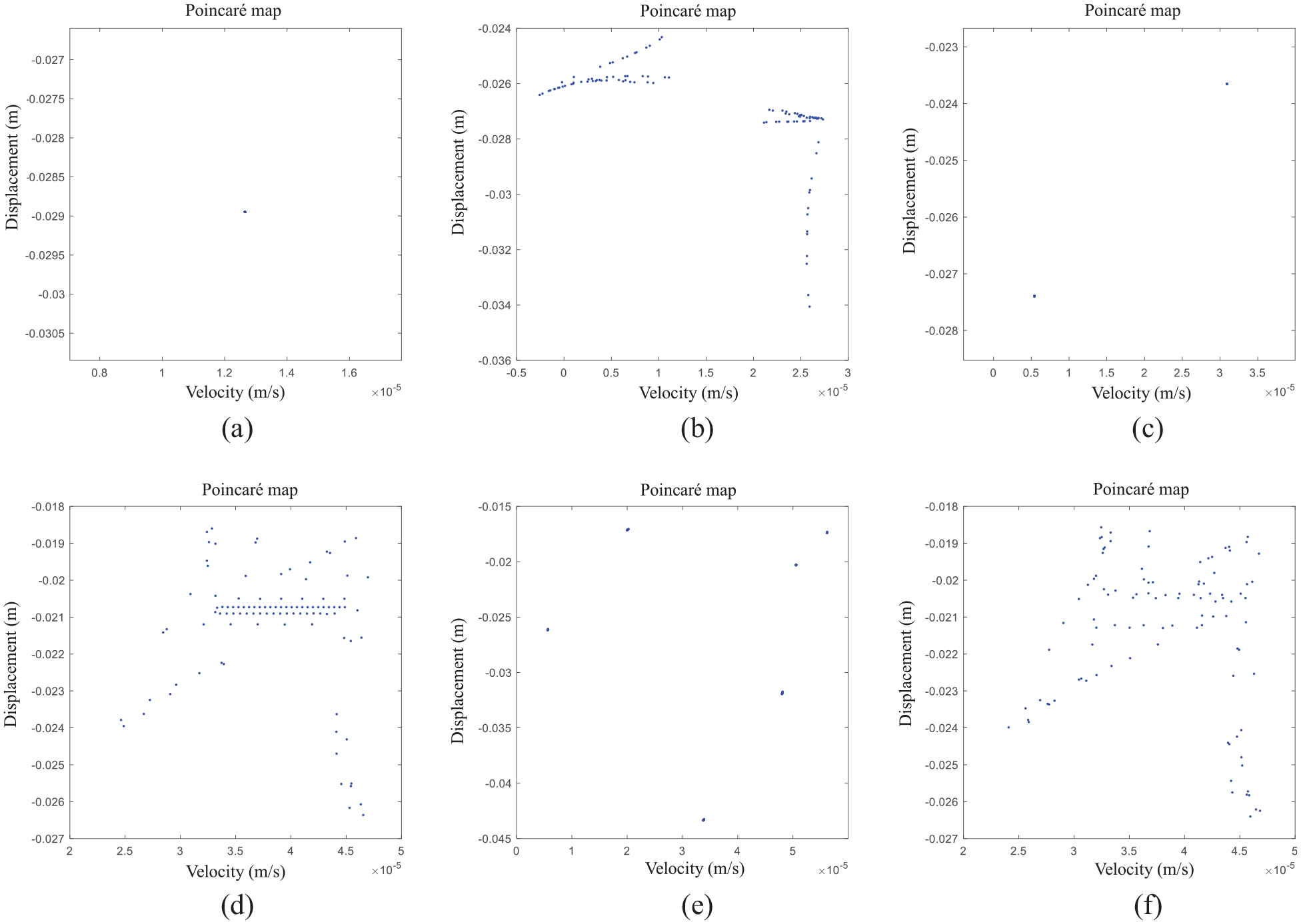
Poincaré diagram of vibration responses at different impact-rub clearances when

Trajectory diagram of vibration responses at different impact-rub clearances wn
Figure 10 is bifurcation diagram of the vibration displacement with the change of the impact-rub clearance when
Nonlinear parameter
The nonlinear parameter will directly affect the binding forces of the rotor system, and further impact on the vibration response of the system. In order to study the influence of the nonlinear parameters on the dynamic characteristics for the rotor system, the parameter

Bifurcation and waterfall diagrams of the system at the nonlinear parameter

Bifurcation and waterfall diagrams of the system at the nonlinear parameter
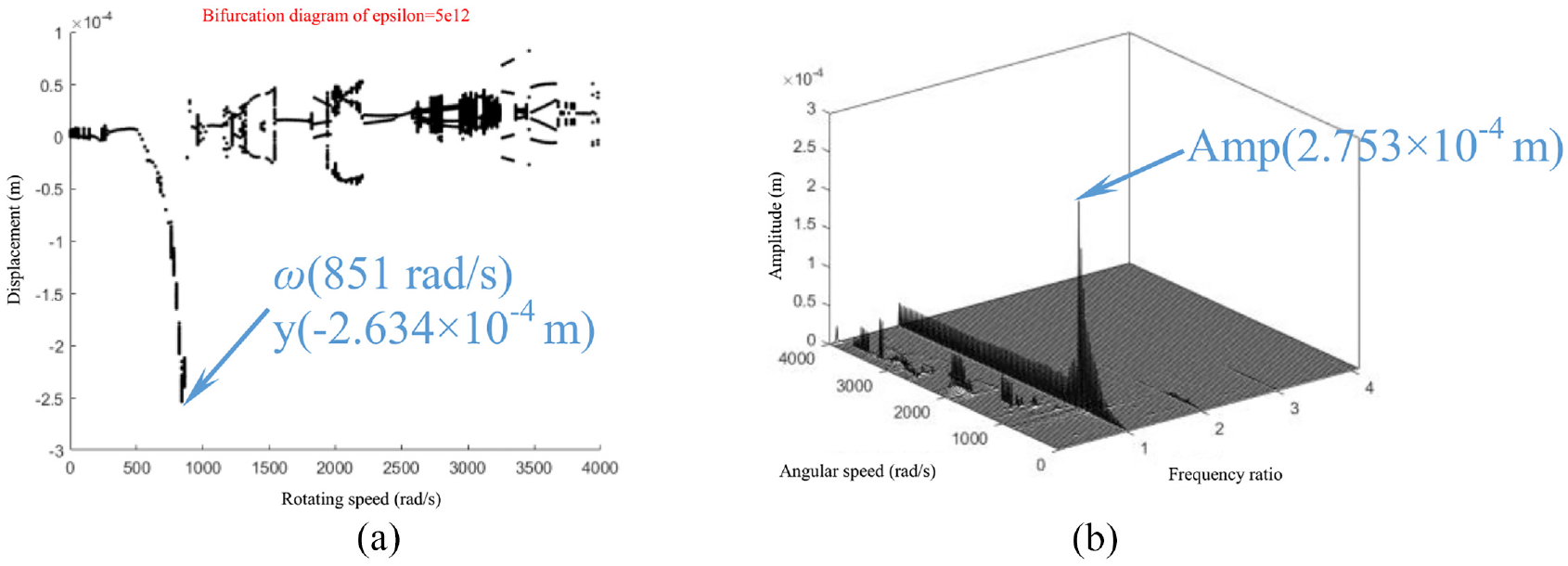
Bifurcation and waterfall diagrams of the system at the nonlinear parameter
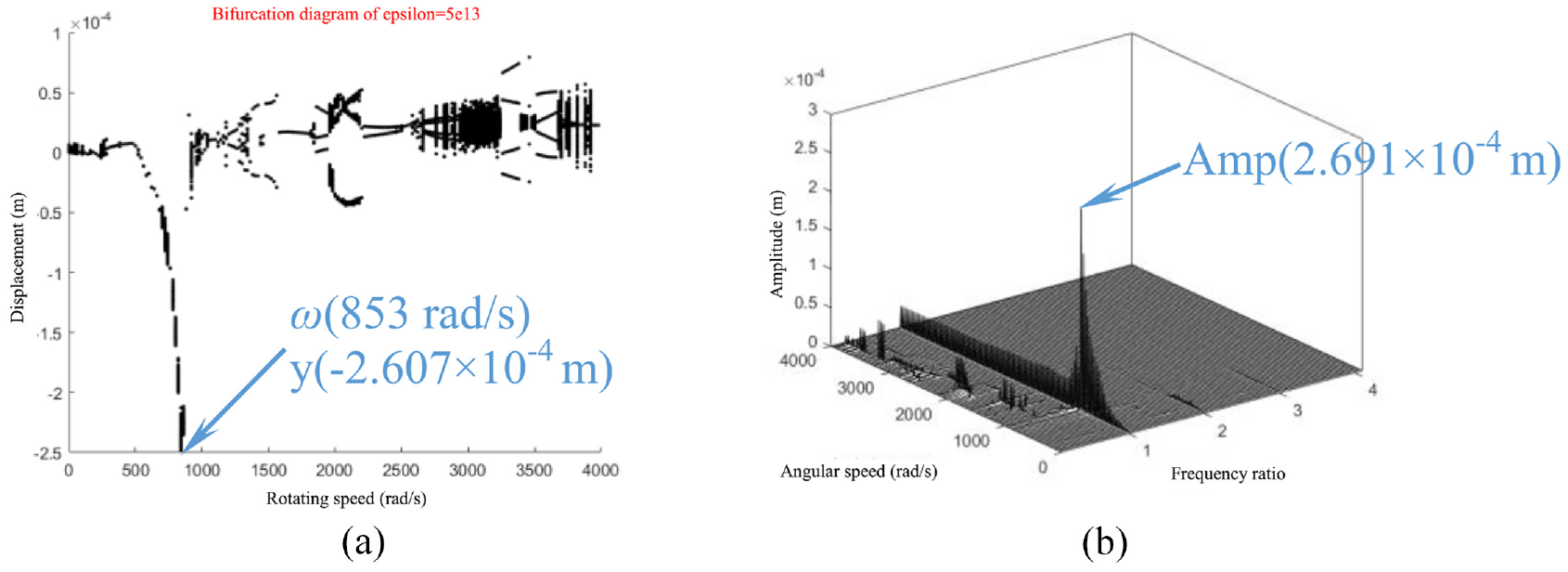
Bifurcation and waterfall diagrams of the system at the nonlinear parameter
Conclusions
The dynamic characteristics of the loosing-rubbing coupling rotor system under the nonlinear support is investigated to analyze the influence mechanism of the key parameters such as the eccentricity, the disk offset, the looseness gap, the rubbing gap and the nonlinear parameters on the vibrational responses of the system. Main conclusions are as follows:
(1) Nonlinear support will stimulate and amplify the dynamic behaviors of the system, which leads to the widening of the rotating speed window of unstable motion such as the chaos, the quasi-periodic etc. Too large offset of disk will increase the proportion of the quasi period and the chaos, and increase the number of the interharmonics and the continuous spectrum of the system, and the nonlinear characteristics become more significant;
(2) There exists a threshold for the influence of the loosening gap on the vibration characteristics of the system, with the increase of the loosening gap from zero to the threshold, the nonlinear dynamic characteristics of the system change more significant, and gradually disappear exceeding the threshold;
(3) Increasing the impact-rub clearance within a certain range is conducive to reduce the vibration, but it will make the vibration more complex and gradually tend to be chaotic in the medium and low rotating speed range. Adding nonlinear parameters to some extent will lead to the increase of the proportion of the quasi-period and the chaos.
Footnotes
Acknowledgements
We are grateful to the reviewers and editors for their valuable comments and suggestions.
Handling Editor: Chenhui Liang
Declaration of conflicting interests
The author(s) declared no potential conflicts of interest with respect to the research, authorship, and/or publication of this article.
Funding
The author(s) disclosed receipt of the following financial support for the research, authorship, and/or publication of this article: The authors are grateful to the National Natural Science Foundation of China (Grant No. 52275118).
