



Abstract
Similarity solution for the steady-state two-dimensional laminar natural convection heat transfer for a rarefied flow over a linearly vertical stretched surface is being proposed. Similarity conditions are obtained for the boundary layer equations for the vertical flat plate subjected to power law for the temperature variations. It is found that the similarity solution exists for linear temperature variation and linear stretching surface. The study shows that there are three different parameters affecting the flow and heat transfer characteristics for the rarefied flow over a vertical linearly stretched surface. These parameters represent the effects of the velocity slip (K1), temperature jump (K2), and the Prandtl number (Pr). The effects of these parameters are presented. It is found that the velocity slip parameter affects both the hydrodynamic and thermal behaviors of such flows. Correlations for the skin friction as well as Nusselt number are being proposed in terms of Grashof number (Grx), the slip velocity parameter (K1), and the temperature jump parameter (K2).
Introduction
Gaseous rarefied flows in microscale geometries have been studied extensively in the past 20 years due to their relevance to micromachined and microelectromechanical system (MEMS) devices or sensors and due to their widely used applications in the aerospace industry, biomedical engineering, and plasma applications used in material processing. An excellent review for microflows theory, fundamentals, and applications can be found in Duncan and Peterson
1
and Gad-el-Hak.2,3 This revolution in microscale sciences encourages researchers to revisit macromechanical systems and investigate the effect of miniaturizing such systems on the hydrodynamic and thermal behaviors. Rarefied, microscale, and nanoscale flows are characterized using the dimensionless Knudsen number (Kn), which represents the ratio of the mean free path
Based on the Knudsen number, the respective flow regimes can be classified into four types according to Schaaf and Chambre 4 and Cercignani and Lampis. 5 For Kn < 0.01, then the flow is in the continuum regime in which Navier–Stokes equations are valid; if 0.01 < Kn < 0.1, then the flow is in the slip regime in which Navier–Stokes equations are used with slip and temperature jump boundary conditions to solve for the flow characteristics. In the range of 0.1 < Kn < 10, the flow is in the transitional regime and for 10 < Kn, the collisions between particles are very rare and the flow is in the free molecular regime. Flow characteristics for transitional and free molecular regimes are solved primarily utilizing particle simulation methods such as the direct simulation Monte Carlo (DSMC) method. 6
For the continuum and slip flows, Navier–Stokes equations are used to solve for the physics of the flow. In the slip flows, the slip boundary condition is applied at the surfaces; in addition, if the flow is non-isothermal, a temperature jump at the surface must also be applied.
Many investigators studied the continuum flow and heat transfer characteristics over a continuously moving surface. This type of flow has a significant importance in many engineering applications that can be modeled by a stretching surface such as manufacturing processes of continuous casting, metal extrusion, glass fiber production, textiles, paper production, geothermal reservoirs, hot rolling, and manufacturing of plastic. These applications are very well illustrated and explained in Ali, 7 Kiwan, 8 Ali and Al-Yousef, 9 Elbashbeshy, 10 and Elbashbeshy and Bazid. 11
Kiwan and Al-Nimr 12 investigated the convection heat transfer over linearly stretched, isothermal microsurface via similarity solution of the boundary layer equations. They presented the correlations for skin friction coefficient and Nusselt number in terms of velocity slip and temperature slip parameters.
Kiwan and Al-Nimr 13 investigated the similarity solution for boundary layer flows in microsystems. They found that the self-similar solution exists only for the case of flow toward stagnation point over isothermal surface. They also presented the parameters, such as the slip velocity parameter (K1), the temperature jump parameter (K2), and Prandtl number (Pr), which were affecting such flows. Correlations for Nusselt number and the friction coefficient were obtained.
Zheng et al. 14 came up with an analytic solution for the flow and heat transfer on a permeable stretching sheet with non-uniform heat source/sink. They used the similarity technique to solve the problem along with the homotopy analysis method. In addition, the effects of the unsteadiness parameter, Prandtl number, and the heat sink/source parameter are presented and analyzed.
Zheng et al. 15 investigated the flow and radiation heat transfer of a nanofluid over a stretching sheet with velocity slip and temperature jump in porous medium, and they used the local similarity method to solve for the coupled partial differential equations (PDEs). They presented and analyzed the effects of the velocity slip parameter, temperature jump parameter, thermal radiation, and Prandtl number on the flow and heat transfer characteristics.
Su et al. 16 investigated the magneto hydrodynamics (MHD) mixed convective flow and radiation heat transfer over a stretching permeable wedge with Ohmic heating. In their study, a new analytical technique is proposed and approximate results are obtained. The effects of the involved parameters such as velocity slip, temperature jump on the velocity, and temperature profiles were presented and analyzed.
In the work presented by Sui et al., 17 mixed convection heat transfer in power law fluids over a moving conveyor along an inclined plate is investigated. Approximate analytical solutions utilizing the homotopy analysis method were obtained. Results show that heat transfer is strongly dependent on the values of power law exponent, inclination angle, boundary velocity ratio, and Prandtl number.
Lin et al. 18 investigated the MHD pseudo-plastic nanofluid unsteady flow and heat transfer in a finite thin film over stretching surface with internal heat generation. Governing PDEs are reduced into coupled non-linear ordinary differential equation (ODEs) and solved numerically utilizing the shooting technique along with Runge–Kutta scheme and Newton’s method. Effects of the involved parameters such as Prandtl number, power law index, and unsteadiness parameter on the velocity and temperature fields are presented and analyzed.
The problem under consideration, and up to the best of author’s knowledge, has not been investigated in the literature.
Mathematical formulation
Governing equations
The problem under consideration is treated as steady-state, two-dimensional, constant thermophysical properties, and laminar flow. Boussinesq approximation is applied to account for the buoyancy force. Slip and temperature jump boundary conditions are applied at the surfaces.
Figure 1 illustrates the geometry of the flow under investigation along with the hydrodynamic and thermal boundary layers. In this study, the slip and temperature jump boundary conditions are imposed at the boundaries. The slip flow regime in which Knudsen number is between 0.01 and 0.1 is covered.

Schematic for the problem under investigation.
The governing equations that describe the problem under investigation are summarized below.
The conservation of mass, momentum, and energy equations are given by


The boundary conditions at the wall are given by

The boundary conditions away from the wall (i.e.

To solve for the problem, let

and

Introduce a non-dimensional temperature

The governing equations and boundary conditions become 19


with boundary conditions


In order to find the condition for similarity solution to exist, Rogers 19 was followed


Substituting the above parameters into the governing equations yields


where

and

It is assumed and for convenience 19 that

and

The choice of equations (20) and (21) will yield no physical useful information. 19
The transformed boundary conditions are12,13

where

and

It is assumed that the wall is moving with a vertical velocity

The temperature jump at the wall is as follows12,13

where

Assuming
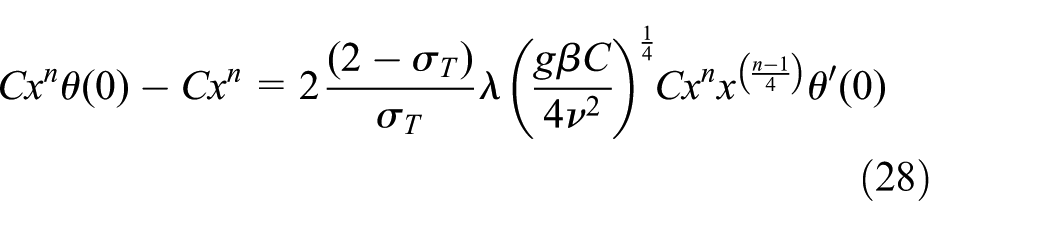
Dividing by Cxn yields

Equation (29) can be written as follows

The velocity slip at the wall for the non-isothermal wall is

The slip velocity becomes
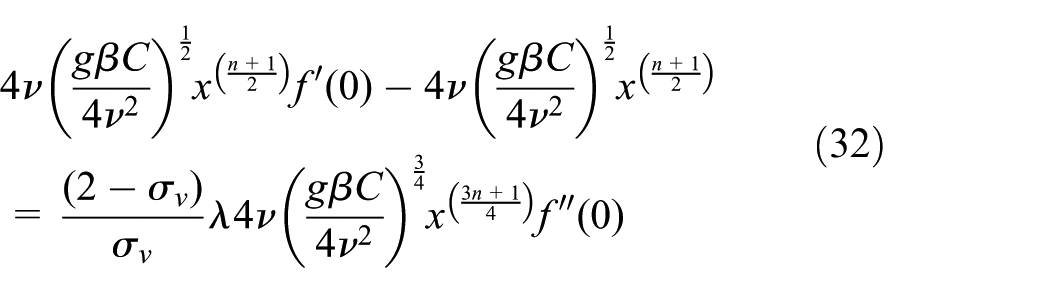
Dividing by

Equation (32) can be written as follows

By inspecting the transformed governing equations (16) and (17) along with the transformed boundary conditions (22), (29), and (32), the similarity solution exists only for n = 1 which is the case of linearly temperature variant and linear stretching surface.
For the case where n = 1,
In the previous equations, Kn is equal to the ratio of the mean free path to the characteristic length of the problem under investigation. This number measures the degree of rarefaction of the flow. It should be noted that the higher K2 is, the more temperature jump occurs.
Equation (34) represents the case of a stretching surface. For the case of a shrinking surface that we are not covering in this research, equation (34) becomes as follows

The displacement thickness is defined as

and the thermal boundary layer thickness is defined as

The skin friction coefficient is defined as follows 20

and Nusselt number is defined as follows 20

Numerical solution
The set of differential equations along with the boundary conditions derived in the previous section is solved using a variable order, variable step size finite difference method with deferred corrections. The method is based on a subroutine of Pereyra;
21
this technique primarily reduces the order of the differential equations to first-order ones, then the system of first-order differential equations is discretized using the trapezoidal rule over a non-uniform adaptively chosen mesh to make the local error almost the same everywhere. Higher-order discretization can be used by applying deferred corrections. The global error of the computations was monitored to control the computations. The system of the non-linear algebraic equations is solved using Newton’s method and the resulting system of equations is solved using the Gauss elimination. Iteration method is used to solve for
Validation of the code
Table 1 represents the comparison between the results of the current code and the results obtained by Kiwan and Al-Nimr 12 for the rarefied flow and heat transfer over a linearly horizontal stretched surface where the values of K1 and K2 are zeroes. Table 1 shows that the maximum error between the results obtained from the current code compared to the results from Kiwan and Al-Nimr 12 is 0.34%.
Comparison between the present code results and that obtained by Kiwan and Al-Nimr, 12 K1 = 0 and K2 = 0.

Results and discussion
The governing equations show that there are three parameters affecting the flow and heat transfer for rarefied flow over vertical stretched surface. These parameters are the velocity slip (K1), temperature jump parameter (K2), and Prandtl number (Pr). The effects of these parameters will be discussed in the following few sections.
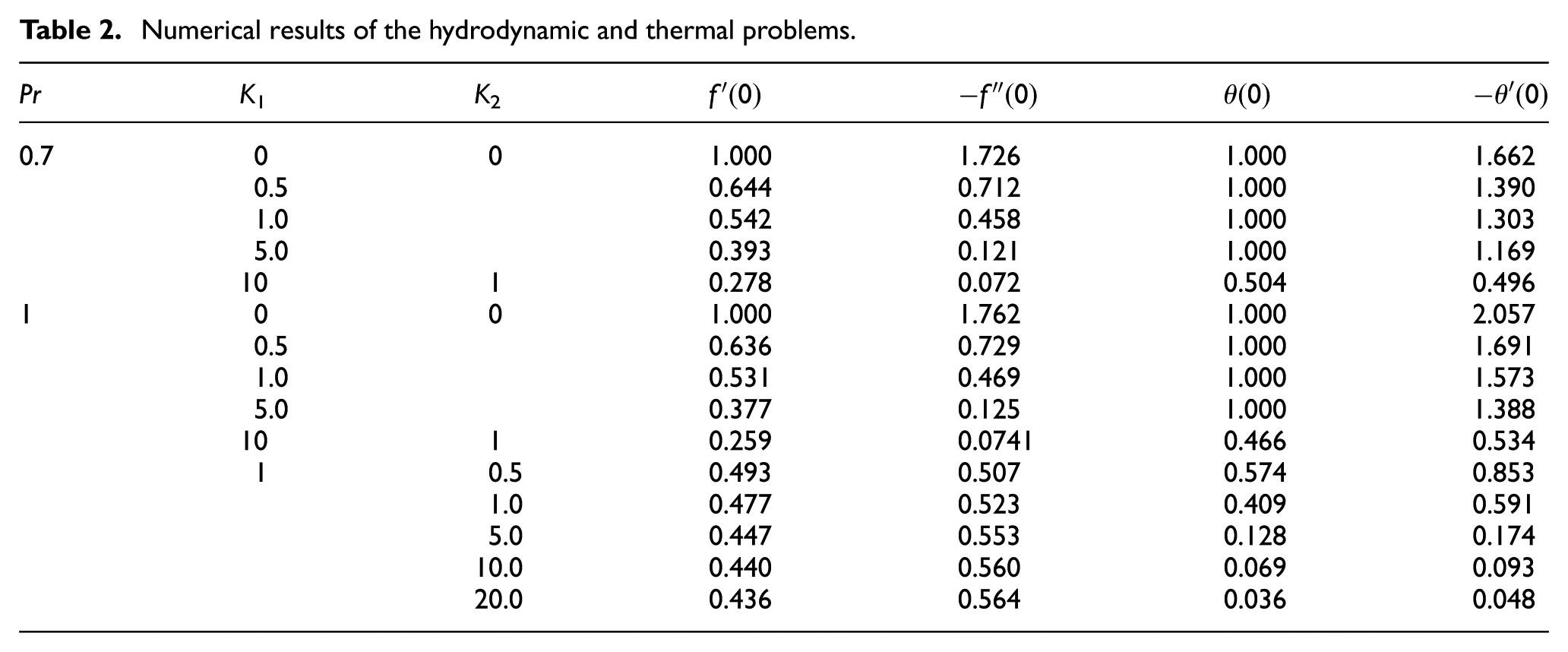
Table 2 shows the numerical results of the momentum and the thermal problem. The effects of varying Prandtl number (Pr), the slip velocity parameter (K1), and the temperature jump parameter (K2) on the values of
Numerical results of the hydrodynamic and thermal problems.
In Figure 2, the variations of the dimensionless transverse velocity with the similarity parameter η are presented. The figure illustrates that as η increases then f and v increase; this is because large values of η imply large values of x, and the amount of flow that leaves the boundary layer in the form of transverse velocity increases. It is obvious from the graph that near the leading edge and as x is increasing, the boundary layer thickness is increasing and more flow is escaping from the boundary layer in the transverse direction. In addition, the graph indicates that as the slip velocity parameter (K1) increases, the transverse velocity (v) decreases. This is due to the fact that as K1 increases, the slip velocity increases and the penetration of the wall stretching through the fluid decreases, which will result in a reduction in the displacement thickness and consequently a reduction in the transverse velocity.
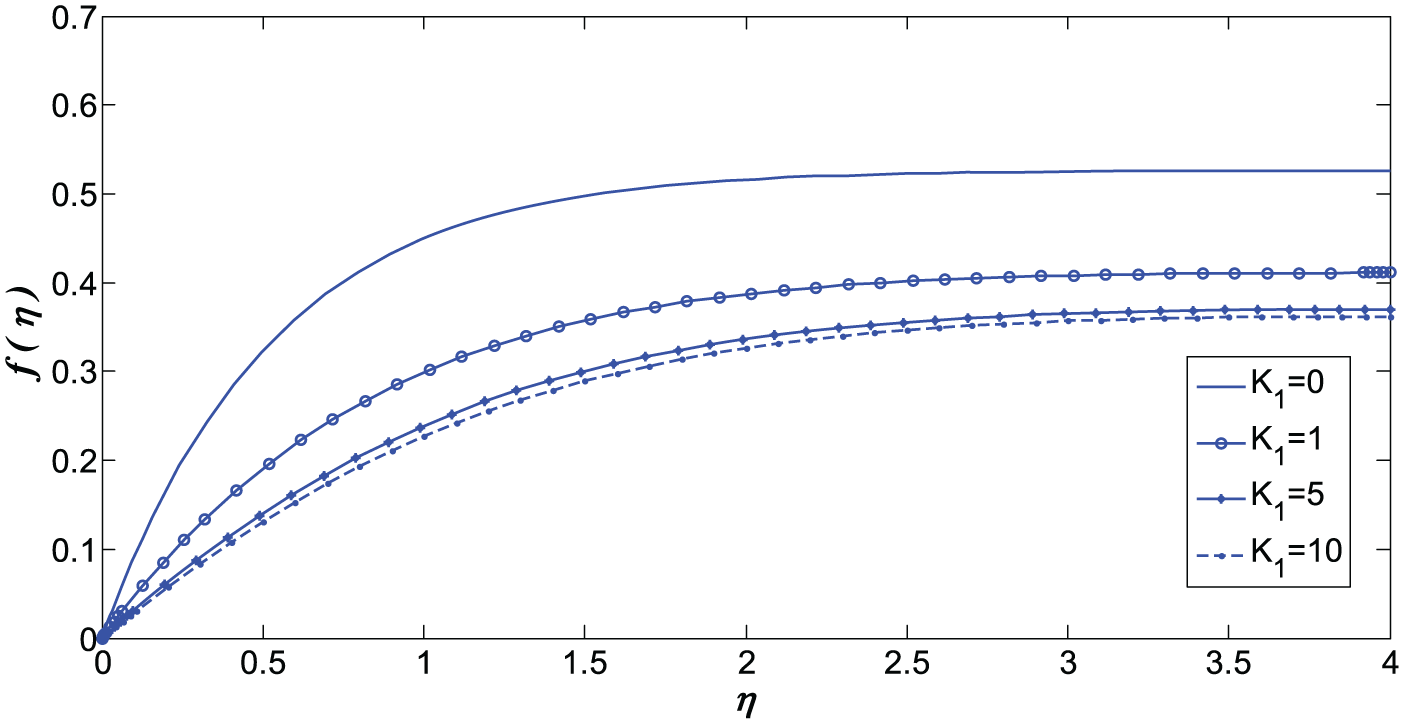
Variation of the dimensionless transverse velocity distribution with the similarity parameter
Shown in Figure 3 are the variations of the dimensionless axial velocity
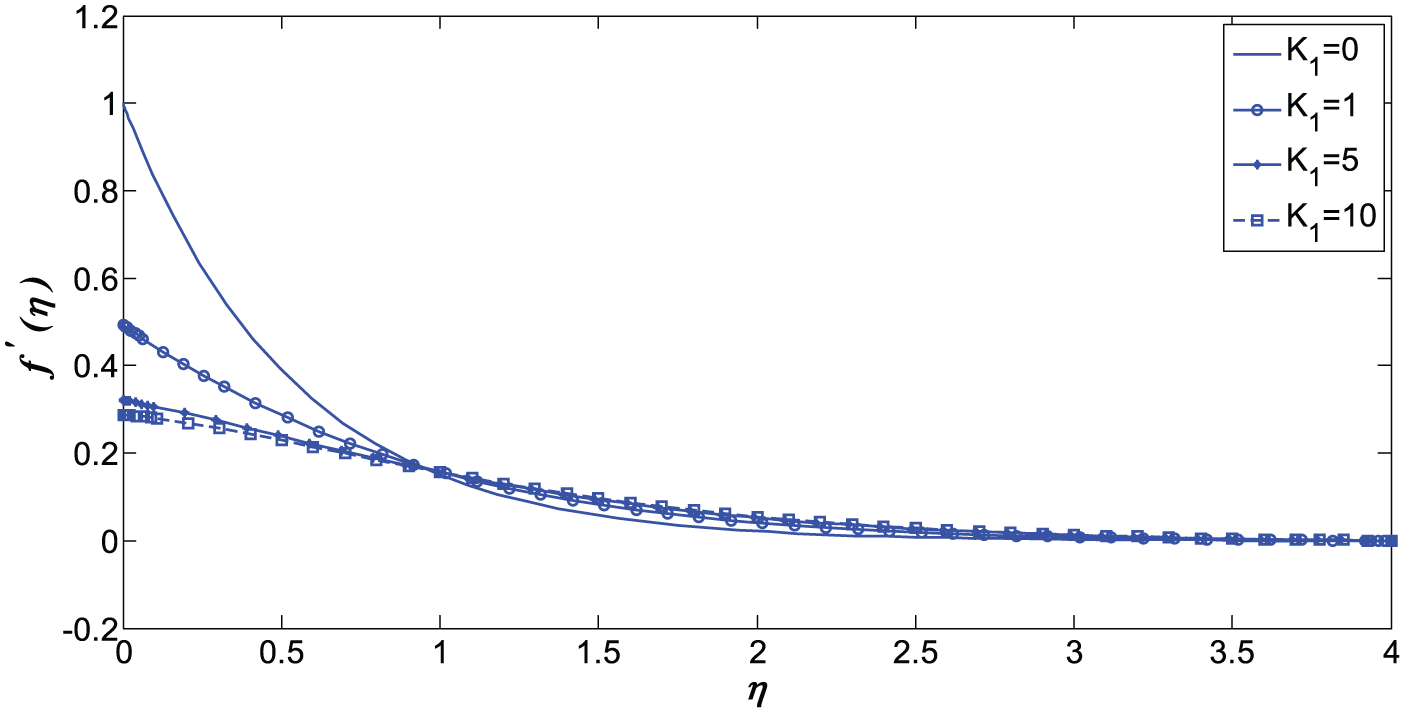
Variation of the dimensionless axial velocity distribution with the similarity parameter
Figure 4 represents the variation in the shear parameter

Variation of the dimensionless shear parameter distribution with the similarity parameter
Figure 5 shows the effect of the slip velocity parameter K1 on the dimensionless temperature
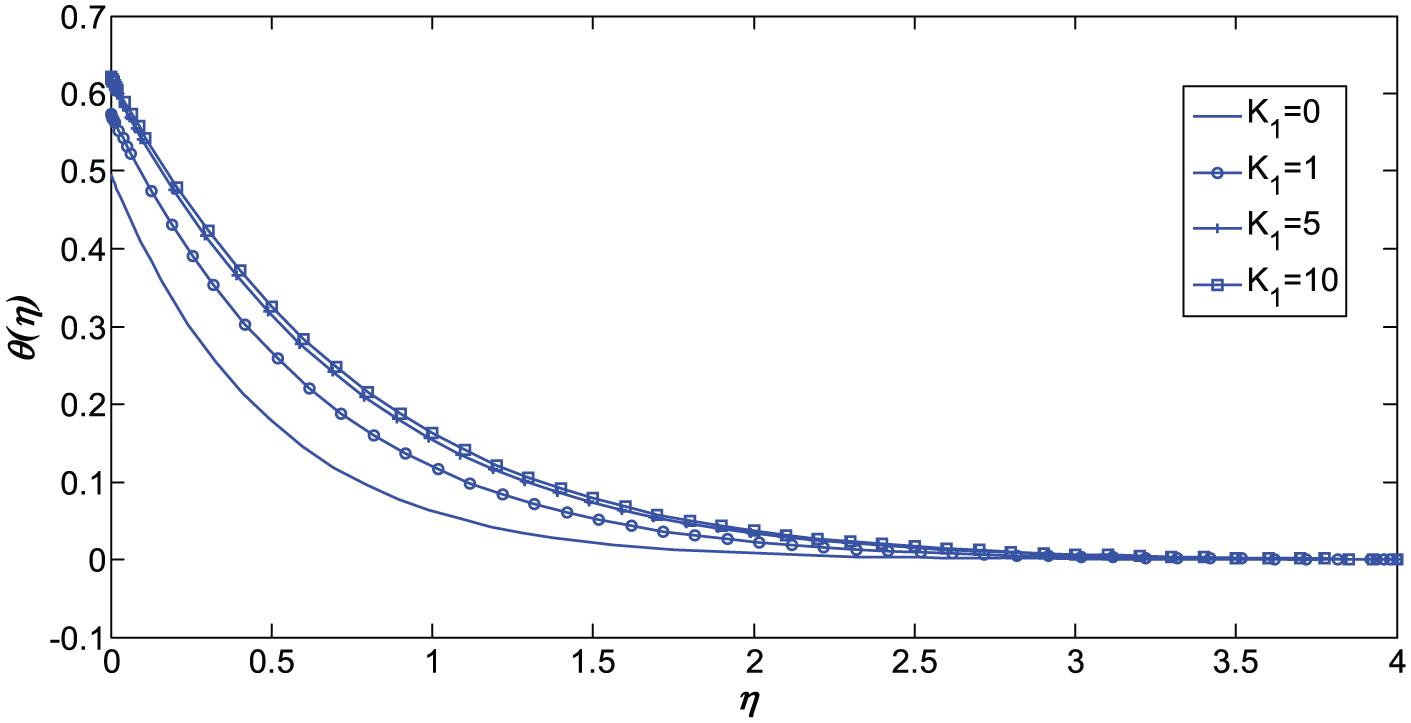
Variation of the dimensionless temperature distribution with the similarity parameter
Figure 6 shows the variation of the dimensionless temperature with the similarity parameter η at different temperature jump parameters K2, the graph shows that as K2 increases, the dimensionless temperature decreases. In addition, for values of dimensionless similarity parameter η greater than 2, the dimensionless temperature becomes equal to zero. As K2 increases, there is a reduction in the fluid temperature and less amount of heat will transfer to the fluid from the hot plate. The graph also shows that the dimensionless temperature
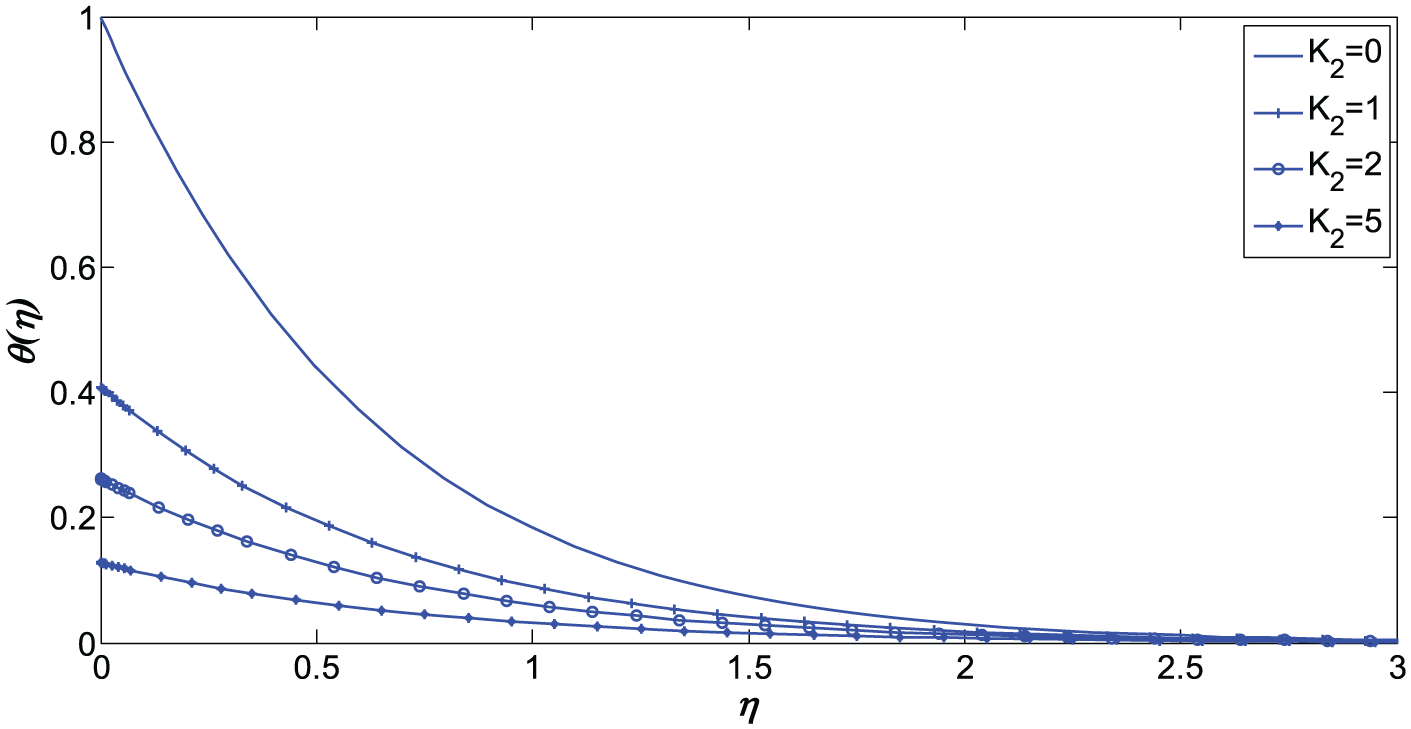
Variation of the dimensionless temperature distribution with the similarity parameter
Figure 7 shows the variation of the dimensionless temperature with the dimensionless similarity variable η at different Prandtl numbers. The graph shows that as Prandtl number increases, the dimensionless temperature decreases. Lower Prandtl numbers result from higher thermal diffusivity and lower viscosity. This will lead to more penetration of the heat into the fluid and this will eventually increases the fluid temperature. In addition, as the viscosity decreases, the stretching plate will induce less flow and consequently the temperature of the fluid increases.

Variation of the dimensionless temperature distribution with the similarity parameter
Figure 8 shows the variation of the

Variation of the dimensionless temperature gradient distribution with the similarity parameter
Figure 9 shows the variation of

Variation of the dimensionless temperature gradient distribution with the similarity parameter
In Figure 10, the effect of Prandtl number on the

Variation of the dimensionless temperature gradient distribution with the similarity parameter
Figure 11 shows the effect of Prandtl number on Nusselt number at K2 = 1. The figure shows that as Prandtl number increases, Nusselt number increases. Also, the graph shows that as K1 increases, Nusselt number decreases and that is due to the stretching effect in which less amount of fluid is induced and this will convert the convection heat transfer to a weak conduction heat transfer.

Variation of
Shown in Figure 12 is the variation of Nusselt number with the temperature jump parameter K2 for different values of Prandtl numbers and K1 = 1. As Prandtl number increases, Nusselt number increases. In addition, as K2 increases, Nusselt number decreases due to the temperature jump effect and the miscommunication between the fluid and the hot surface.

Variation of
Figure 13 shows the variation of the hydrodynamic displacement thickness with the velocity slip parameter K1 for different Prandtl numbers. The graph shows that as the value of the velocity slip parameter increases, as expected the hydrodynamic displacement thickness decreases and this is due to the fact that as this parameter increases, the fluid is not able to feel the stretching effect. Also, the graph shows that as Prandtl number increases, the displacement thickness decreases.

Variation of displacement thickness
Figure 14 shows the effect of changing the velocity slip parameter K1 and Prandtl number on the thermal boundary layer thickness at K2 = 1. The graph shows that as Prandtl number increases, the thermal boundary layer thickness decreases and that is due to the fact that higher Prandtl number gives lower thermal diffusivity and consequently less thermal penetration to the fluid. The graph also illustrates that as the velocity jump increases, the thermal boundary layer increases because as K1 increases, less fluid motion is induced due to the stretching effect.
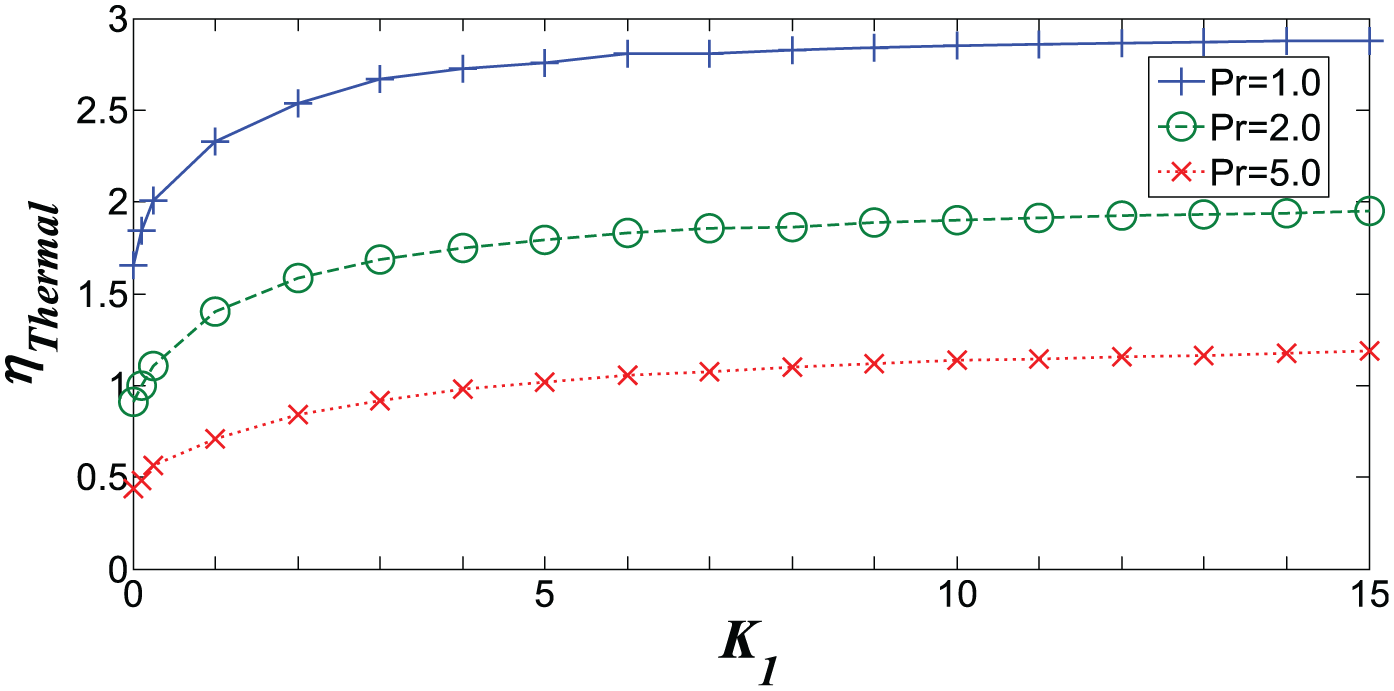
Variation of thermal boundary layer thickness
Figure 15 shows the variation of the thermal boundary layer thickness with the temperature jump parameter K2 for different values of Prandtl number and K1 = 1. The graph shows that as Prandtl number increases, the thermal boundary layer thickness decreases. In addition, the graph shows that as the temperature jump parameter increases, the thermal boundary layer decreases and that is because as the temperature jump increases, the fluid will not sense the heating effect from the wall and less heat will penetrate through the fluid.

Variation of thermal boundary layer thickness
In Figure 16, the variation of the skin friction with the slip velocity parameter K1 for different values of Prandtl number is shown. It is obvious from the figure that there is no effect for Prandtl number on the skin friction and as the slip velocity parameter increases, the skin friction decreases due to the fact that less velocity gradients at the wall are achieved with higher slip velocities.

Variation of
Correlations for both Nusselt number as a function of the velocity slip parameter K1, the temperature jump parameter K2, and Prandtl number are derived for the ranges where 0.5 < K1 < 15 and 0.5 < K2 < 15 such that
Conclusion
Rarefied flow and heat transfer characteristics for the vertical stretching surface are investigated. The similarity solution and the similarity conditions of such a problem are derived. It was found that the flow is similar for the case of linearly temperature variant and linear stretching surface. It was also found that there are three parameters affecting the characteristics of fluid and heat transfer for the vertical stretching surface, namely, the velocity slip K1, temperature jump K2, and Prandtl number, and the effect of these parameters is presented. In addition, correlations for both Nusselt number and the skin friction coefficient are presented in terms of the velocity slip parameter K1 and the temperature jump parameter K2 and Prandtl number (Pr).
Footnotes
Appendix 1
Acknowledgements
Suhil Kiwan on secondment from Jordan University of Science and Technology.
Academic Editor: Jiin-Yuh Jang
Declaration of conflicting interests
The author(s) declared no potential conflicts of interest with respect to the research, authorship, and/or publication of this article.
Funding
The author(s) received no financial support for the research, authorship, and/or publication of this article.