




Abstract
Modal frequency is an important indicator for structural health assessment. Previous studies have shown that this indicator is substantially affected by the fluctuation of ambient conditions, such as temperature and humidity. Therefore, recognizing the pattern between modal frequency and ambient conditions is necessary for reliable long-term structural health assessment. In this article, a novel machine-learning algorithm is proposed to automatically select relevance features in modal frequency-ambient condition pattern recognition based on structural dynamic response and ambient condition measurement. In contrast to the traditional feature selection approaches by examining a large number of combinations of extracted features, the proposed algorithm conducts continuous relevance feature selection by introducing a sophisticated hyperparameterization on the weight parameter vector controlling the relevancy of different features in the prediction model. The proposed algorithm is then utilized for structural health assessment for a reinforced concrete building based on 1-year daily measurements. It turns out that the optimal model class including the relevance features for each vibrational mode is capable to capture the pattern between the corresponding modal frequency and the ambient conditions.
Keywords
Introduction
The goal of structural health monitoring (SHM) is to assess the health status of a structure based on structural responses and ambient conditions measurement. 1 Modal frequency, which is related to structural stiffness, is an important indicator in SHM. Previous studies have shown that this indicator is substantially affected by the fluctuation of ambient conditions, such as temperature and relative humidity.2–6 In order to depict the relationship between modal parameters and ambient conditions, a number of long-term monitoring systems were operated for different types of structures, including bridge,7–9 reinforced concrete buildings,10–12 and other types.13–15 In these studies, it has been shown that the fluctuation of the structural dynamical properties was significant due to the variation of ambient conditions, and the modal frequencies exhibited strong correlation with temperature and relative humidity. If the modal frequency-ambient condition pattern is not appropriately captured, there will be substantial bias in the structural health assessment results. Toward the goal for reliability enhancement of structural health assessment under changing ambient conditions, pattern recognition and machine-learning approaches have received tremendous attention.16,17 A number of machine-learning algorithms have been proposed, including principal component analysis, 18 support vector machine, 19 nonlinear principal component analysis, 20 support vector machine multi-class clustering algorithm, 21 and kernel-based algorithm. 22
Due to the fact that structural health assessment exhibits significant level of uncertainty,23–26 a number of system identification approaches have been proposed.27–32 In particular, the Bayesian inference–based approach has attracted special attention as it provides a rigorous solution for uncertainty quantification and it is applicable for different problems in pattern recognition and system identification,33–35 such as modal/model updating,36–38 robust signal processing, and sensor configuration.39–43 In this article, a novel machine-learning approach is proposed to automatically select the relevance features in modal frequency-ambient condition pattern recognition based on structural dynamic response and ambient condition measurement.
In the traditional feature selection approaches,44,45 a set of model class candidates is first constructed, and each candidate contains a subset of the components of the full extracted feature vector. Model plausibility evaluation is implemented for each candidate, and it is obvious that the total number of candidates for evaluation is huge although the number of the components of the extracted feature vector is moderate. For instance, when the number of components of the full extracted feature vector is 10, 210-1 candidates in total are required for consideration given that at least one feature of the full extracted feature vector should be included in a candidate. Therefore, optimal model class determination in the traditional approaches requires large computational effort. In contrast, the proposed approach is capable of conducting continuous relevance feature selection, which is done by introducing a sophisticated hyperparameterization on the weight parameter vector controlling the relevancy of different features in the prediction model. The proposed algorithm is then utilized for structural health assessment for a reinforced concrete building based on 1-year daily measurements.
The structure of this article is outlined as follows. Dataset and feature extraction are first presented. Then, the approach for relevance feature selection is developed. Finally, the proposed approach is utilized for modal frequency-ambient condition pattern recognition for the monitored structure based on measurement.
Dataset and feature extraction
Description of dataset
The structure considered in this study is a 22-story reinforced concrete residential building, namely, the East Asia Hall. Figure 1 shows the side view and its layout plan. The floor plan of the building is in asymmetric L-shape, with the building height and the length of the two spans being 64.70, 51.90, and 61.75 m, respectively.
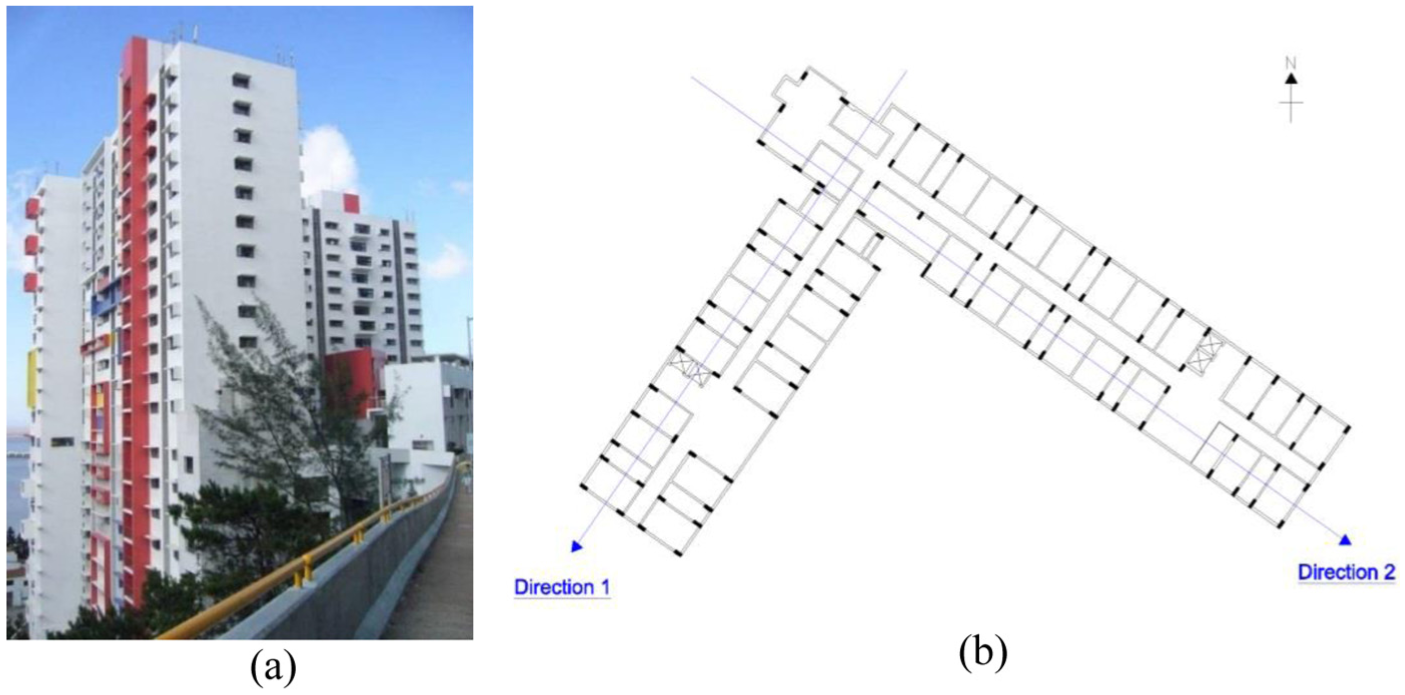
(a) Side view and (b) layout of the East Asia Hall.
The monitoring period is 1 year between 2 May 2008 and 1 May 2009. During the monitoring period, the structure was subjected to four typhoons of 15 days. In order to focus on the pattern between the structural properties and ambient conditions under normal weather conditions, the 15-day typhoon attacking period is excluded and the rest of 350 datasets are utilized in the analysis. Two accelerometers, operated based on standard exploration geophone mass-spring systems with 50 V/g sensitivity, were installed on the 18th floor with two orthogonal directions (directions 1 and 2) shown in Figure 1(b).
In order to minimize the spatial temperature difference of the monitored structure, acceleration was measured at 11:00 p.m. every day. Based on the 10-min acceleration time history of each day, the Bayesian spectral density approach46–48 is applied to identify the modal frequencies of the building. The Bayesian spectral density approach is a well-developed probabilistic approach for modal identification.46–48 The modal identification is performed by utilizing the spectral density obtained from the structural response as the data to estimate the uncertain modal parameters. The efficiency and flexibility of the Bayesian spectral density approach on modal identification had been demonstrated through successful applications with in-field measurements.11,12,38 Herein, each set of the 10-min acceleration measurement is partitioned into four segments with an equal time duration and then the averaged spectrum is obtained for modal identification. Since the squared modal frequencies of first three modes are considered, the range
Figure 2 shows the identified squared modal frequencies of the first three modes (

Identified squared modal frequencies of the first three modes (
Feature extraction
Extracted features are constructed based on the previous research of the relationship between modal frequency and ambient conditions. Watson and Rajapakse
49
correlated structural properties with temperature based on a polynomial function; Xia et al.
5
proposed a linear relationship between modal frequencies and temperature along with humidity; Rincón et al.
50
attempted to investigate the influence of structure due to the changing of relative humidity; Yuen and Kuok11,12 proposed a second-order polynomial function for modal frequencies with respect to both temperature along with relative humidity; Moser and Moaveni
51
and Moaveni and Behmanesh
52
utilized high-order (up to fourth) polynomials for correlating modal frequencies and temperature only. In summary, most of the existing works considered low-order polynomials for modal frequencies with respect to temperature only or temperature and relatively humidity; on the other hand, very few works considered high-order polynomials (up to fourth) for frequencies with respect to temperature only, neglecting the cross combinations of temperature and relatively humidity. In this study, in order to comprehensively take different possible patterns into consideration, the extracted features include not only higher order functions of the temperature and the relative humidity but also the cross combinations of them. Finally, the feature vector

where the normalized temperature

Correlation coefficients between the squared modal frequency and each feature component for the three modes: (a) upper: mode 1; (b) middle: mode 2; and (c) lower: mode 3.
Relevance feature selection
Consider the mth vibrational mode of the structure. The modal frequency-ambient condition pattern given the feature vector with

where

In order to conduct continuous relevance feature selection for the mth mode, a sophisticated hyperparameterization on the weight parameter vector

where
Using Bayes’ theorem, the posterior PDF for

where


The posterior mean vector
Optimization of hyperparameter vector and prediction-error variance
According to Bayes’ theorem, the posterior PDF of the hyperparameter vector

where
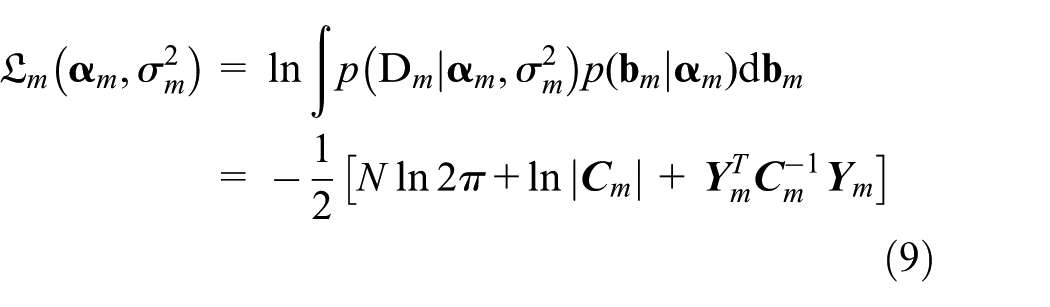
with the matrix

where

where


Let

The first term

The second term

with


As the ith hyperparameter

Thus, the optimal value of the ith hyperparameter

Based on the updated value of

where
Summary of the proposed approach
The procedures of the proposed algorithm are shown in Figure 4 and are as follows. For pattern recognition of the mth mode, the algorithm starts from a single feature and proceeds by adding, pertaining and/or deleting features.
Initialize
Select the initial feature
Initialize

Compute
Update
If
If
If
Update
Repeat Steps 4–6 until convergence achieves so the final learning results are obtained.

The procedures of the proposed algorithm.
Modal frequency-ambient condition pattern recognition
Table 1 shows the weight parameter identification results of the optimal models of the three modes, the optimal values (outside the parentheses), and the standard deviations (inside the parentheses), and the sign “–” indicates that the weight parameter is not included in the optimal model, representing that the associated feature is irrelevant. It is observed that the optimal models of the three modes possess different relevant features shown as follows


Weight parameter identification results of the optimal models of the three modes.

– indicates that the weight parameter is not included in the optimal model.
Both the temperature and relative humidity exist in all the three optimal models, showing that these two ambient factors influence the modal frequencies of different modes and they should be considered simultaneously in modal frequencies prediction. This conclusion is consistent with that by Xia et al.
5
and Yuen and Kuok.11,12 On the other hand, the optimal models for different modes possess different combinations of the two ambient factors. The reasons are given as follows. In practical monitoring of a target structure under changing ambient and operational conditions, fluctuations of modal frequencies are induced by multiple environmental factors, not only temperature and relative humidity but also other factors, such as wind load,
59
rainfall, support reaction,
60
and soil–structure interaction,61,62 and the degrees of participation of different environmental factors to the modal parameters of different modes are possibly not identical. On the other hand, it is worth noting that although only the temperature and relative humidity are utilized in the study, the temperature and relative humidity are the primary effects while other factors (wind load, rainfall, support reaction, soil–structure interaction) are the secondary effects in modal frequencies prediction. This conclusion is supported by checking the normalized residual plot of the three modes shown in Figure 5 that most of the normalized residuals satisfy
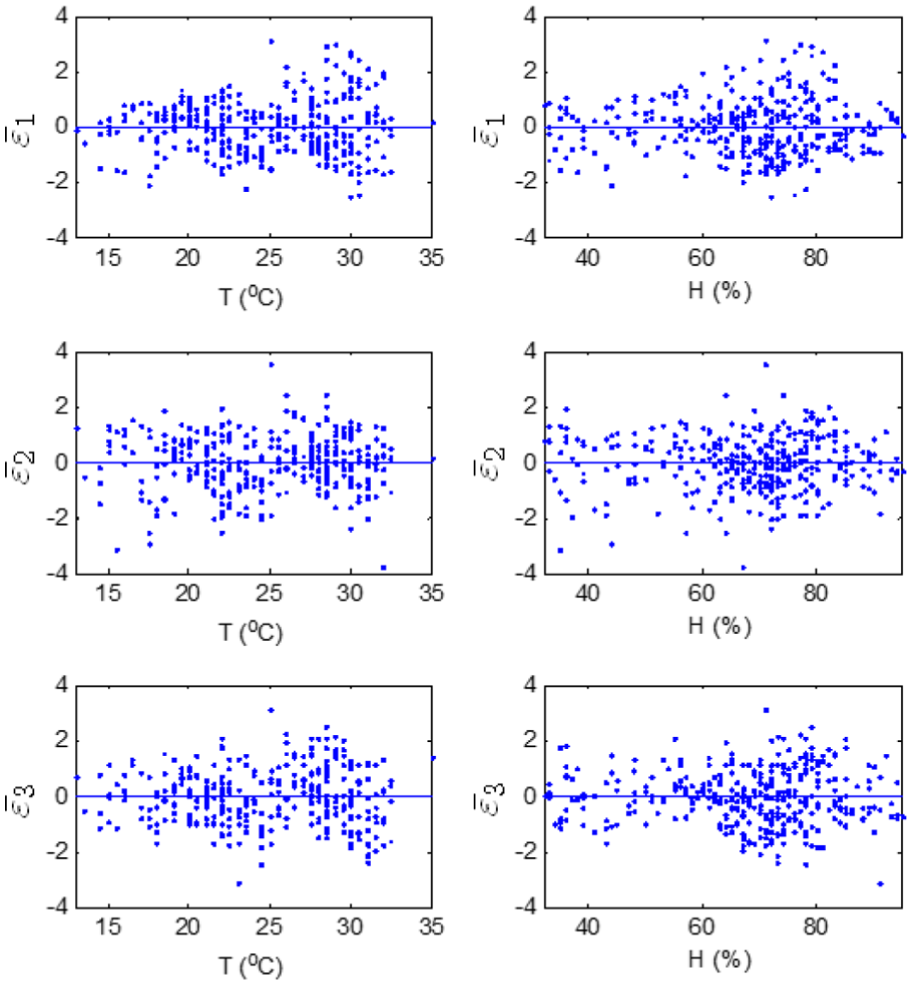
Normalized residual plot of the three modes (
Note that in Bayesian spectral density approach,46–48 not only identified values but also associated uncertainties of modal frequencies are available. It is worth noting that unequal uncertainty values for modal frequencies of different days may lead to heterogeneous error pattern, requiring the development of the heterogeneous Bayesian inference and learning framework. 63
Figures 6 and 7 show the squared modal frequencies versus the temperature and relative humidity of the three modes, respectively. The modal frequency–temperature curves of Figure 6 are plotted with the relative humidity evaluated at its sample mean (67.9%), and the modal frequency–relative humidity curves of Figure 7 are plotted with the temperature with its sample mean (24.7°C). The increasing trends of these curves satisfy the correlation analysis results of Figure 3 for different modes. Finally, the design modal frequency contours of the optimal values and the associated uncertainties for the three modes are given in Figure 8. The left three subplots are for the optimal values of modal frequencies given the temperature and the relative humidity for modes 1, 2, and 3, respectively, and the right three subplots are for the corresponding associated uncertainties for modes 1, 2, and 3, respectively. Note that different modes associate with different uncertainty contours because they possess different optimal models. In addition, it can be observed that the uncertainty level of the corner regions in the uncertainty contours is higher than that of the central region. This is due to the non-uniform distribution of the input measurement that most of the measured data points locate in the center region while very few locate in the corner region, especially for the top right and bottom right regions. On the other hand, the non-uniform distribution of the input measurement also reflects the ambient condition pattern of the city for the monitored structure that, high temperature is with intermediate level of relative humidity rather than high or low level of relative humidity.

The squared modal frequencies versus the temperature of the three modes.

The squared modal frequencies versus the relative humidity of the three modes.
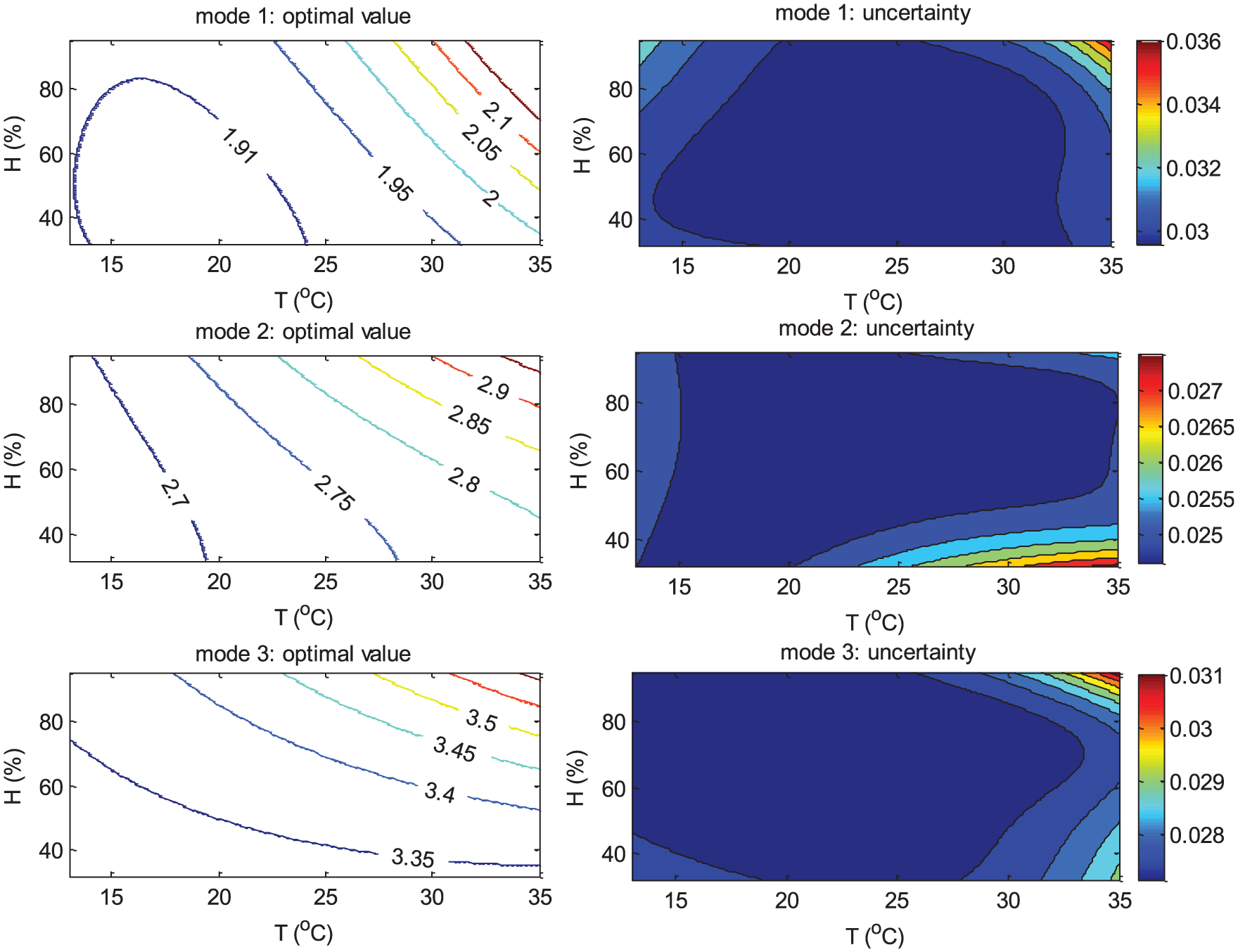
Design modal frequency contours of the optimal values (left three subplots) and the associated uncertainties (right three subplots) for the three modes.
Conclusion
In this article, a novel machine-learning algorithm is proposed to automatically select relevance features in modal frequency-ambient condition pattern recognition based on structural dynamic response and ambient condition measurement. In the traditional feature selection approaches, 3 × (215-1) candidates in total are required to obtain the optimal model classes for the three modes based on the 15-component full extracted feature vector, which requires large computational effort. On the other hand, in the proposed approach, the optimal model classes for modal frequency predictions of different vibrational modes of the structure are determined by first introduction of the hyperparameter in the ARD prior for the weight parameter vector, which controls the relevancy of different features in the prediction model, then conducting hyperparameter optimization by maximum evidence estimation. During the optimization process, the irrelevance components of the weight parameter vector as well as the corresponding features are automatically pruned out while the relevance terms are retained. The proposed algorithm is utilized for structural health assessment for a reinforced concrete building based on 1-year daily measurements. It turns out that the optimal model classes of different vibrational modes of the structure are capable to capture the modal frequency-ambient condition patterns of different modes. In addition, the design modal frequency contours of the optimal values and the associated uncertainties are given, which provides an efficient tool for modal frequency prediction in future analysis.
Footnotes
Academic Editor: Jun Li
Declaration of conflicting interests
The author(s) declared no potential conflicts of interest with respect to the research, authorship, and/or publication of this article.
Funding
The author(s) disclosed receipt of the following financial support for the research, authorship, and/or publication of this article: This work was supported by the National Natural Science Foundation of China (51508201), the China Postdoctoral Science Foundation, and the State Key Laboratory of Subtropical Building Science, South China University of Technology (2016ZB26).