




Abstract
This study determines the effect of the initial pressure on the propagation of a Chapman–Jouguet detonation wave from a stoichiometric C3H8/O2 mixture (donor) to a stoichiometric C3H8/air mixture (acceptor). Depending on the initial pressure ratio in the donor and the acceptor, the result can be a smooth transmission, a re-initiated detonation wave, or a transmitted shock wave. When the donor is divided into a driver donor and a driven donor, the degree of overdrive in a driven donor varies with the donor pressure ratio. There must be a greater degree of overdrive in the driven donor for re-initiation of a detonation wave in the acceptor, particularly if the initial pressure in the driven donor is lower than the Chapman–Jouguet pressure in the acceptor. The bi-dimensional effect is also another major factor.
Introduction
In applications where a pre-detonator is used in pulse detonation engines, the propagation of a detonation wave from a hydrocarbon–oxygen mixture (donor) to a hydrocarbon–air mixture (acceptor) is of interest. In a highly sensitive mixture, a detonation wave can be initiated via the deflagration-to-detonation (DDT) process. Previous studies1,2 have found that when an incident detonation wave propagates into a less sensitive mixture, there are several modes of wave transmission, depending on the properties of the two mixtures. Initiation energy is another important parameter. 3 The longer the donor (less effect from the rarefaction wave), the higher the degree of overdrive in the acceptor. The wave propagation is characterized as detonation decay, decay and re-initiation, detonation transition, and critical detonation transition. Engebretsen et al. 4 also noted that the strength of the incident shock is critical in detonation re-initiation, particularly when there is a low-sensitivity mixture in the acceptor. Haloua et al. 5 showed that the detonation propagation mode varies with the initial pressure of the mixture in the acceptor. As the initial pressure decreases, a stable detonation wave may switch into a shuttered detonation wave, a galloping detonation wave, or a failure. The tube or channel size also plays an important role for detonation propagation. 6 When a detonation wave propagates from a large tube into a narrow channel, there is a velocity deficit. As the width of the channel decreases, the stable detonation wave may transit to a galloping detonation wave or a failure. A study by Li et al. 7 also noted that a transmitted overdriven detonation wave occurs when there is a strong incident overdriven detonation wave. Krivosheev and Penyaz’kov 8 found that the value of the critical pressure for successful wave transmission is reduced by a factor of 3–5 when there is an overdriven detonation wave.
In some previous studies, the incident detonation wave was not in a stable condition; for example, an overdriven detonation wave approaching the Chapman–Jouguet (CJ) state. In this study, a CJ detonation wave is formed in a stoichiometric C3H8/O2 mixture in the donor or in the driver donor when the donor is divided into two sections. An overdriven detonation wave is generated in the driven donor and the degree of overdrive varies with the donor pressure ratio. The incident detonation wave then propagates into a stoichiometric C3H8/air mixture at a fixed initial pressure. The effect of the initial pressure on the propagation of an incident detonation wave is determined. In a tube of finite size, a curved detonation wave propagates downstream. Because of the curvature, the streamline of the burned products behind the detonation wave turns at a small angle toward to the tube wall. Flow expansion results in a decrease in pressure and a reduction in the degree of overdrive. 9 This bi-dimensional effect, which affects detonation propagation, is also studied.
Experimental setup
The experimental setup is shown in Figure 1. The smooth, aluminum 6061-T6 tube with an inner diameter of 50.8 mm is 1219.2 mm in length. The donor and the acceptor are 762 and 457.2 mm, respectively. For a stoichiometric C3H8/O2 mixture at 1 atm, Li et al. 10 demonstrated that the run-up distance for DDT (xDDT) is approximately 150 mm from the closed end of a smooth tube with an inner diameter of 50.8 mm. An overdriven detonation is observed and this approaches a CJ detonation at x/xDDT ≈ 2, where x is the streamwise distance from the closed end. 7 Li et al. 11 also studied the diaphragm effect (t = 25–100 µm in thickness) on detonation propagation across a mixture. Quenching of the incident detonation wave near the interface is observed and the presence of the diaphragm means that a longer distance is required for the re-initiation of a detonation wave in the acceptor. It was also found that the propagation velocity of a detonation wave when t ≤ 50 µm is similar to that for mixtures that are separated by a slide gate valve (no diaphragm). Therefore, a thin LUMIRROR Mylar diaphragm (t = 30 µm) is located at x = 762 mm for this study. This separates the donor (C3H8/O2) and the acceptor (C3H8/air at 1 atm). A CJ detonation wave forms ahead of the diaphragm, which is denoted for Case A. To study the propagation of an overdriven detonation from a C3H8/O2 mixture to a C3H8/air mixture, the donor with C3H8/O2 is divided into a driver donor and a driven donor (Case B). Another Mylar diaphragm (t = 30 µm) is located at x = 584.2 mm. Notably, the driven donor is 177.8 mm in length, in which the overdriven detonation is relatively stable from the preliminary tests. Prior to each run, the tube is evacuated to 20 Pa. The C3H8 and O2 are then injected into the tube and the equivalence ratio of the mixtures was determined by the partial pressure method. For Case A, the initial pressure of the donor, pd, ranges from 0.5 to 2.25 atm. The cell width is 1.87–0.32 mm 12 and the ratios for the tube diameter and cell width are 27–158. For Case B, the initial pressures in the driver donor, pd1, and the driven donor, pd2, are 0.5–2.0 and 0.027–0.5 atm, respectively. The donor pressure ratio (pd* = pd1/pd2) ranges from 1 to 33. The acceptor that is filled with the stoichiometric C3H8/air has an initial pressure, pa, of 1 atm for all test cases. It is also noted that the form of diaphragms is not planar at different pressures in the tube sections and some time is required for its destruction. To ensure the homogeneity of the mixtures in the donor and the acceptor, two circulation pumps are used for approximately 3 min. The filling pipes are mounted near both end of the donor to ensure homogeneity of mixtures and the concentration of the mixtures is calibrated by gas chromatography (CHINA chromatography Model 9800 GC/TCD). The ignition system consists of a transformer (May & Christe z201402e2, 220–14,000 V) and an electric spark at the closed end and the maximum effective discharge energy is estimated to be 0.5 J.

Experimental setup: 1. donor (Case A) or driver donor (Case B); 2. donor (Case A) or driven donor (Case B); 3. acceptor; 4. piezoelectric pressure transducers; 5. spark electrodes; 6. Mylar; 7. Mylar (only for Case B); 8. circulation pump; and 9. vacuum pump.
The velocities of the shock and detonation waves were measured using time-of-flight, by pressure sensors. Piezoelectric pressure transducers (PCB 113B22) were installed on the tube wall (x = 3.81–30.48 cm). The rise time for the transducers is 1 µs. Sensors were mounted on the donor to characterize the propagation of the incident detonation wave (overdriven or CJ detonation). The wave velocity in the acceptor was also measured. The propagation speed of the pressure wave was estimated to be u = ΔL/(Δt ± et), where Δt and ΔL are the propagation time for a wave past two pressure sensors and the spacing between them (=3.81 cm), respectively. The uncertainty in the propagation time for a detonation past two pressure sensors is equal to
Results and discussion
Case A: CJ detonation
For a detonation shock tube, a self-sustained detonation wave in a driver tube (or the donor) is attenuated because there is a reflected rarefaction wave. This results in direct transmission, re-ignition, or a transmitted shock wave in a driven tube (or the acceptor). In this study, the experiments were conducted using a stoichiometric C3H8/O2 mixture at pd = 0.5–2.25 atm. The pa value for a stoichiometric C3H8/air mixture or air in the acceptor was 1 atm. It is expected that the pressure wave for a C3H8/air mixture that does not undergo chemical reaction propagates at the same speed as that of the air in the acceptor. The variations in the speed of the pressure wave versus pd near the diaphragm (x* = 0.44) are shown in Figure 2. It is seen that the pressure wave propagates at a greater speed when there is an increase in pd. At pd = 1.75–2.25 atm, the speed of the pressure wave in a C3H8/air mixture is greater than that for air (ΔV ≈ 140 m/s), indicating there is a chemical reaction from C3H8/O2 to C3H8/air at higher pd.
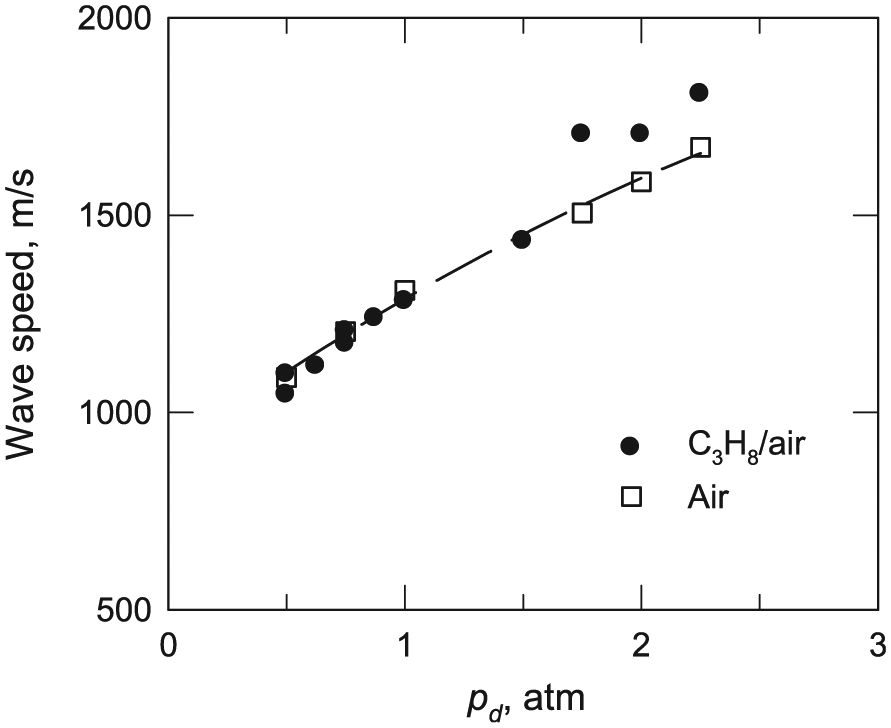
The speed of the pressure wave at x* = 0.44 for a C3H8/air mixture or air in the acceptor.
When there is a C3H8/O2 mixture in a donor that is 762 mm in length, a CJ detonation wave is formed ahead of the diaphragm. 7 It is also known that a C3H8/air mixture is less sensitive than a C3H8/O2 mixture for the same initial conditions. Therefore, both the velocity, VCJ, and pressure, pCJ, of a CJ detonation wave in a C3H8/O2 mixture are greater than those for a C3H8/air mixture. Therefore, when an incident CJ detonation wave propagates from a C3H8/O2 mixture to a C3H8/air mixture, the transmitted wave is an overdriven detonation wave. The velocity of the transmitted pressure wave in the acceptor is shown in Figure 3. The origin in the abscissa corresponds to the location of the diaphragm and the relative distance from the diaphragm x* (=x/d) is normalized by the tube diameter. In the diagram, x* denotes a location that is equidistant from the two pressure transducers. The value of VCJ for a C3H8/air mixture at 1 atm is also shown, for reference. When pd = 2 atm, the incident detonation wave is smoothly transmitted to the acceptor and an overdriven detonation wave propagates downstream. When the value of pd is reduced (=1.0 and 0.75 atm), there is quenching of the detonation near the interface and a re-initiated detonation wave with a lower degree of overdrive (V* = V/VCJ) forms at locations further downstream. When pd = 0.5 atm, there is no transmission of the incident detonation wave. Instead, a transmitted shock wave (or a quasi-detonation wave) is observed within the limited length of the acceptor.

The effect of pd on the propagation of a pressure wave in the acceptor.
Case B: overdriven detonation
When the donor is divided into a driver donor and a driven donor, V* in the driven donor is dependent on pd*. Figure 4 shows the distribution of the speed of the pressure wave in the acceptor. pd1 ranges from 0.5 to 2 atm and pd2 = 0.5 atm (pd* = 1, 2, and 4). Note that pd* = 1 corresponds to Case A, where pd = 0.5 atm, in which a quasi-detonation wave (no re-initiated detonation) propagates downstream within the limited length in this study. When pd* = 2 and 4 (V* = 1.04 and 1.09, respectively), the incident overdriven detonation is successfully transmitted to the acceptor (x* = 1.27) either by re-initiation (pd* = 2) or by smooth transmission (pd* = 4). At further downstream locations, the value of V* increases as pd* increases. For a fixed value of pd1 (=1 atm), a decrease in pd2 also results in an increase in pd*. Note that the value of pd2 is less than that for pa. When pd* = 6, 21, and 33, V* = 1.18, 1.41, and 1.53 (V = 2681, 3175, and 3402 m/s), respectively. The corresponding peak driven donor pressure is 12.31, 6.12, and 4.56 atm. The distribution of the speed of the pressure wave in the acceptor is shown in Figure 5. The pressure of the incident overdriven detonation is less than the value of pCJ for a C3H8/air mixture in the acceptor. Quenching of detonation is seen near the interface and no smooth transmission is observed in all three test cases. When pd* = 6 and 21, re-initiated overdriven detonation waves form at x* = 2.02 and 1.27, and then decay to a CJ wave at locations further downstream. Therefore, even though the incident overdriven detonation is not directly transmitted to a detonation wave in the acceptor, there is transmission by re-initiation for greater values of V* or pd*.

The effect of pd* on the propagation of a pressure wave in the acceptor when pd2 = 0.5 atm.

The effect of pd* on propagation of a pressure wave in the acceptor when pd1 = 1.0 atm.
The effect of a decrease in pd1 on the propagation of an incident overdriven detonation wave is also of interest. In Figure 6, pd1 is fixed at 0.75 atm and the value of pd* ranges from 2.0 to 15 (pd2 = 0.05–0.375 atm). When pd* = 2.0 and 4.5, V* = 0.95 and 1.06, respectively. The incident overdriven detonation wave is not transmitted to the acceptor, or a shock wave is transmitted. With the value of pd* increases (=7.5; V* = 1.18 or V = 2681 m/s; the peak driven donor pressure = 8.3 atm), there is no instantaneous initiation of a transmitted detonation wave. Instead, a transmitted shock forms and then a re-initiated detonation is observed at x* ≈ 4.27. At locations further downstream, V* approaches the CJ value. When pd* = 9.5 and 15.0 (V* = 1.25, and 1.33; V = 2822 and 2998 m/s, respectively), the re-initiation occurs further upstream, that is, x* = 2.02 and 1.27, respectively. The corresponding peak driven donor pressure is 8.03 and 6.33 atm. Therefore, even when there is a relatively lower pressure in both the driver and the driven donors, an increase in V* (or higher pd*) results in re-initiation of the detonation in the acceptor. It is also noted that the re-initiated detonation appears to be unstable. There is a repeated process of decay, transition, and decay (or longitudinal pulsations), which may correspond to a spinning detonation.7,14 A study by Austin and Shepard 15 demonstrated that the cell width of a stoichiometric C3H8/air mixture at 1 atm is 51.3 mm and that this value varies with the value of V*. 16 In this study, the tube diameter (=50.8 mm) is similar to the cell width and this partially accounts for the unstable detonation wave in the acceptor.
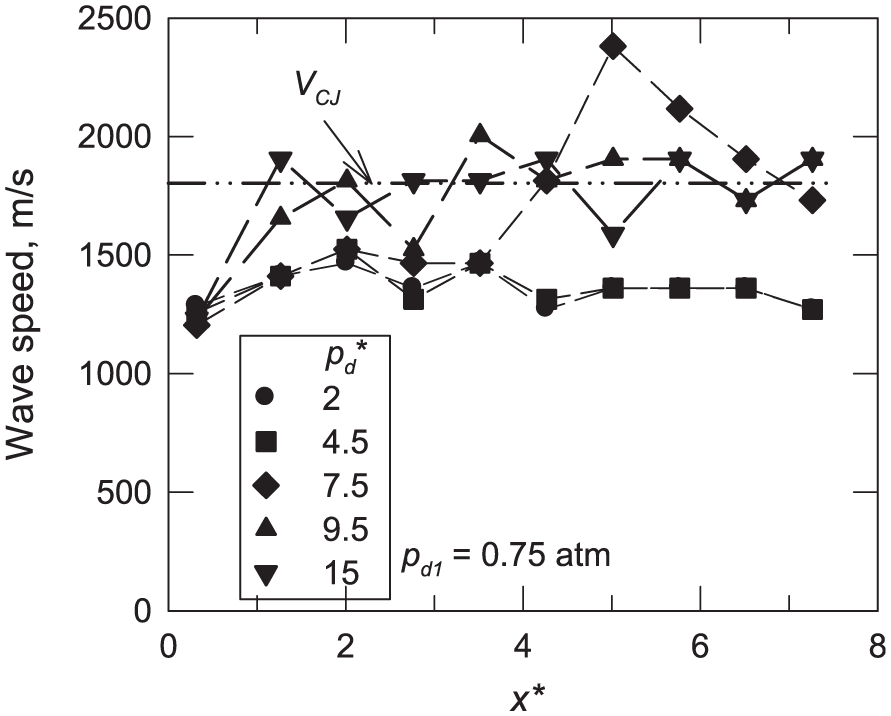
The effect of pd* on propagation of a pressure wave in the acceptor when pd1 = 0.75 atm.
The “shock wave amplification through coherent energy release (SWACER)” theory, which is similar to the induction time gradient theory that was developed by Zeldovich et al., 17 provides a qualitative description of DDT.18,19Figure 6 shows that a detonation wave is re-initiated in the acceptor when pd1 = 0.75 atm and pd* = 15.0. The pressure profiles are shown in Figure 7. It is seen that the peak pressure of the transmitted shock wave increases continuously as it propagates downstream. The maximum peak pressure (≈52 atm) is observed at x* = 3.14. At locations further downstream locations (x* = 3.89 and 4.64), the amplitude of the peak pressure (≈34 atm) is similar, which demonstrates an overdriven detonation that corresponds to shock amplification and slows down to a CJ condition. When pd* = 7.5, a detonation wave is also initiated in the acceptor and the pressure profiles are shown in Figure 8. It is seen that the shock wave propagates downstream and the peak pressures are 21–25 atm at x* = 0.89–3.14, which corresponds to a transmitted shock wave. At x* = 3.89, the increase in the initial pressure is approximately the same, following a second peak pressure of 50 atm. A high peak pressure (or a detonation wave with a higher value for V*, as shown in Figure 6, is observed at x* = 4.64. A localized explosion probably occurs at x* = 3.89–4.64, resulting in larger local pressure and velocity than those for pd* = 15.0. The second peak pressure at x* = 3.89 corresponds to the upstream propagation of a retonation wave, so the re-initiation originates from the heated unburned mixture behind the shock wave. When pd* = 9.5, the propagation pressure wave is similar to that for pd* = 7.5. This implies that a re-initiated detonation wave corresponds to a local explosion that originates near the turbulent flame, or the SWACER mechanism, depending on the value of pd*.
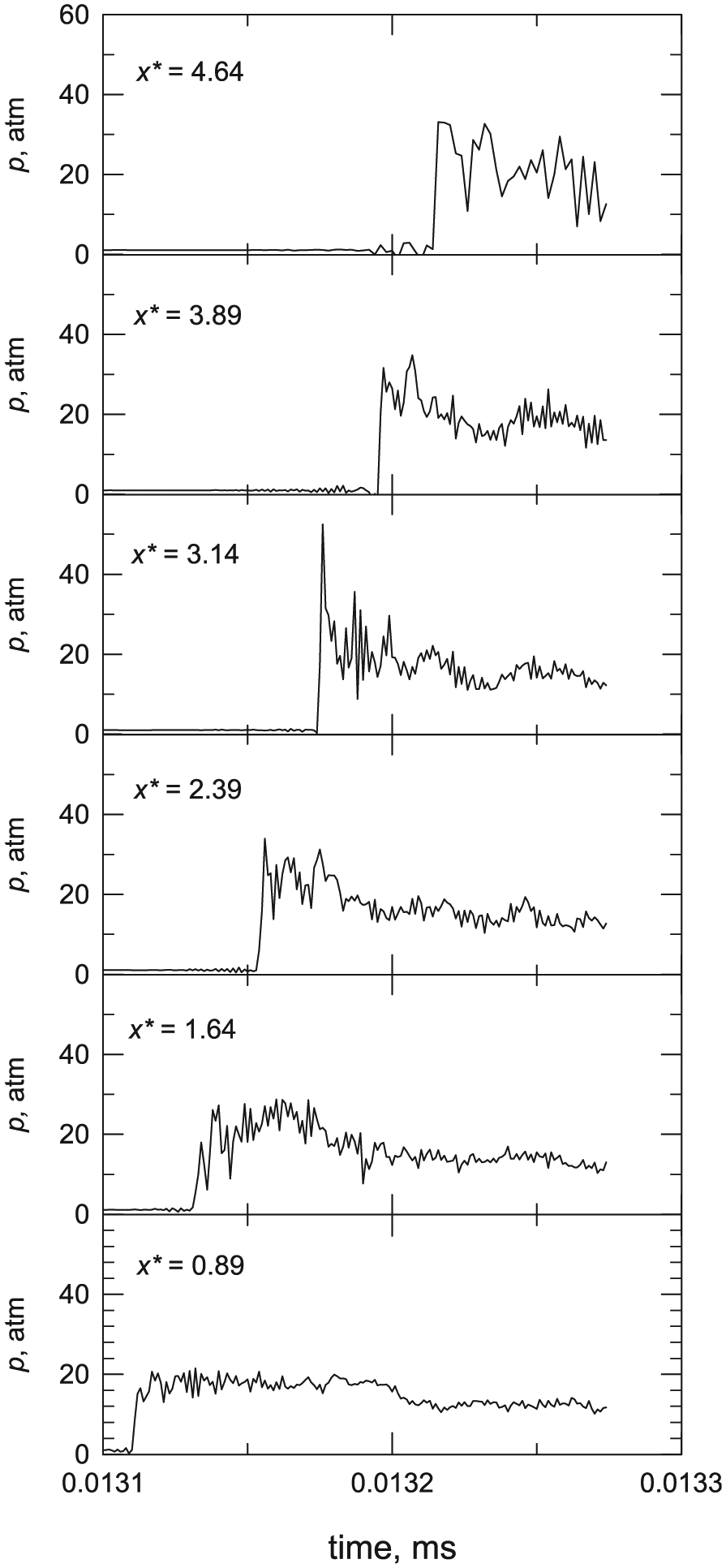
The pressure profiles for the sensors in the acceptor when pd1 = 0.75 atm and pd* = 15.0.

The pressure profiles for the sensors in the acceptor when pd1 = 0.75 atm and pd* = 7.5.
Both the pressure and the velocity of the burned products in the donor are dominant elements in the transmission of an incident detonation wave that propagates into the acceptor. The normalized wave velocity, S*, and the pressure, p*, are shown in Figure 9, where
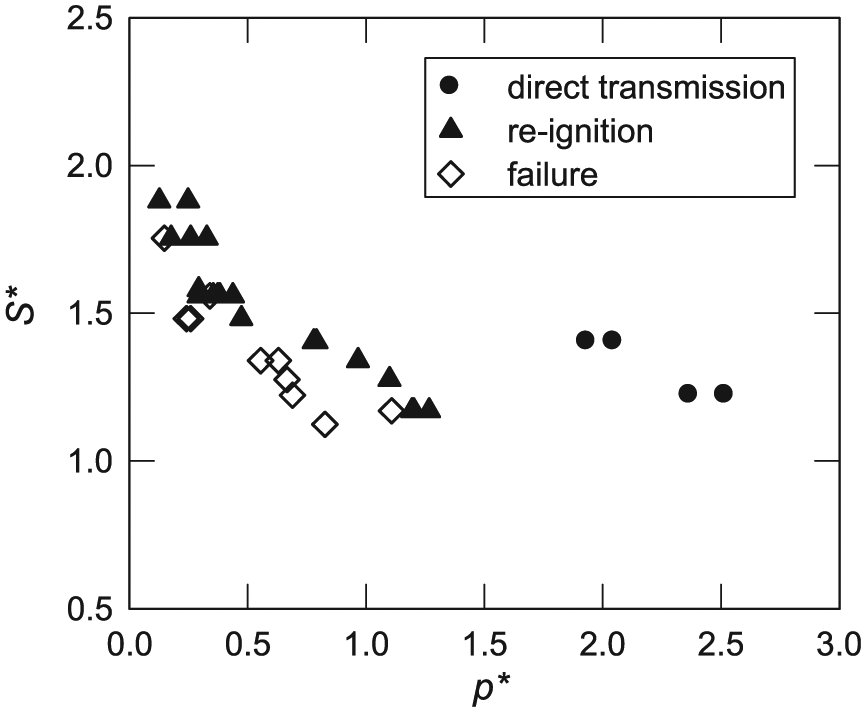
The pressure and velocity ratios when there is transmission of a detonation wave across a mixture.
Bi-dimensional effect on the degree of overdrive in the donor
As previously mentioned, a CJ detonation wave forms ahead of the first diaphragm for Case B and the value of V* in the driven donor is dependent on pd*. According to the Hugonoit equation, the mechanical balance of a flow means that the particle velocity in the driver donor must be equal to that of the driven donor; that is,

where
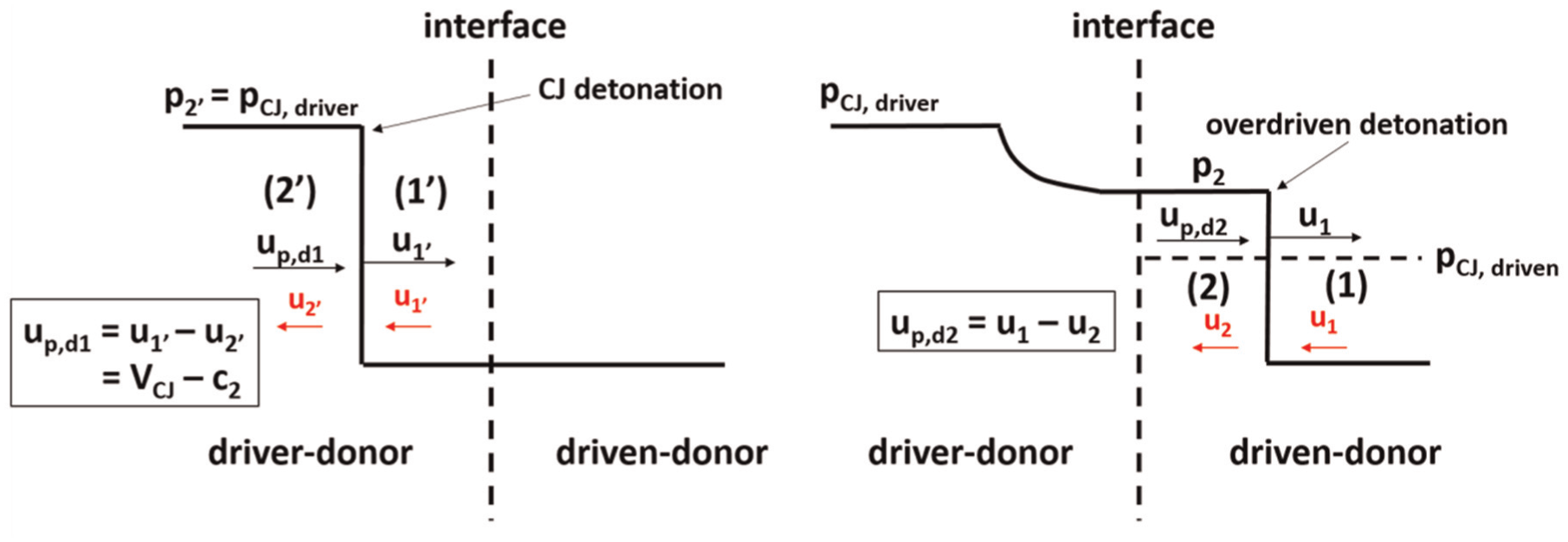
A sketch of wave propagation in a driver donor and a driven donor.
The bi-dimensional effect in a tube of finite size may result in a decrease in V*, when a curved detonation wave propagates downstream.
9
The non-dimensional modified pressure, P, is given as

The degree of overdrive versus pressure ratio for a stoichiometric C3H8/O2 mixture.
Conclusion
An experimental study is conducted to investigate detonation propagation from a stoichiometric C3H8/O2 mixture (donor) to a stoichiometric C3H8/air mixture (acceptor, pa = 1 atm). For Case A, there is direct transmission, re-ignition, or a transmitted shock wave. A greater initial pressure in the donor (pd ≥ 0.5 atm or pd/pa ≥ 0.5) is required for successful transmission. For Case B, the donor is divided into a driver donor and a driven donor. When there is a fixed pressure in the driven donor (pd2 = 0.5 atm), a CJ detonation wave is formed in the driver donor. The degree of overdrive in the driven donor (V* = 1.04–1.53) varies with the initial donor pressure ratio (pd* = 2–33). When the initial driver donor pressure (pd1 = 0.75 atm) is fixed, there is a transmitted shock and a re-initiated detonation is observed at locations further downstream, for pd* = 2–15. In a tube of finite size, the bi-dimensional effect results in a lower degree of overdrive than the theoretical value, particularly when there is a decrease in pd2. It is found that an incident overdrive detonation at high pressure is required for smooth transmission. Re-initiated detonation waves are observed through a local explosion or possibly a SWACER mechanism, which is dependent on the value of pd*. The velocity of an incident overdriven detonation wave also plays an important role. Therefore, even for lower values of the initial pressure in both the driver and the driven donors, a detonation wave in the acceptor can be re-initiated when there is a higher degree of overdrive in the driven donor.
Footnotes
Appendix 1
Academic Editor: Takahiro Tsukahara
Declaration of conflicting interests
The author(s) declared no potential conflicts of interest with respect to the research, authorship, and/or publication of this article.
Funding
The author(s) disclosed receipt of the following financial support for the research, authorship, and/or publication of this article: This work was supported by the Ministry of Science and Technology (MOST 101-2221-E-006-079), Taiwan, Republic of China.