




Abstract
In order to clarify the fracture behaviors of nanocomposite ceramics under ultrasonic vibration–aided grinding, the stress under ultrasonic was analyzed by non-local elastic theory. A similarity model of bending fracture experiment was built to allow online observation of fracture process, according to the actual conditions of fracture damage under ultrasonic vibration–aided grinding and the similarity law. The experiments validated the theoretical analysis: as the ultrasonic frequency increases, fatigue life is distinctively shorter, and the fatigue crack extends faster and is more stable; the deflection angle decreases as the ultrasonic frequency increases, and it is biggest (47.53°) under 19.9 kHz; the phase transition occurs in the fracture process and the amount of phase transformation increases with the increase in ultrasonic frequency and zirconia content, and it can reach the maximum value when the zirconia content is about 25% and then declines; the greater the ultrasonic frequency, the more obvious the transgranular fracture, the more microcracks on the crystal layers, and the more smooth the fracture surface.
Introduction
Nanocomposite ceramics possess ascendant mechanical properties and physical characteristics, including high strength at elevated temperatures, low thermal expansion, good wear resistance, chemical inertness, and more. 1 They have become a research focus in application fields such as the military industry, aerospace, precise instruments, and the machine-tool industry. However, applications for the components of such materials have been impeded by their finishing costs and by fracture damage during the machining process due to high brittleness, bad uniformity, low reliability, lower malleability, and intensity. 2 Therefore, it would be desirable, though challenging, to develop a cost-effective machining process that could improve processing efficiency in terms of surface finish and surface integrity for ceramic components. In order to create a cost-effective machining process, many efficiency and ultra-precision machining methods were studied by many researchers for ceramics, including pre-stressed machining, electrolytic in-process dressing (ELID) grinding, magnetic abrasive polishing, and ultrasonic vibration–aided grinding.3–7 Currently, ultrasonic vibration–aided grinding is considered a high maturity method among these methods, and the effects of ultrasonic waves on ceramic materials were studied from the micro- or macro-perspectives in the past.8,9 However, few studies explored the effects of ultrasonic waves on the material’s internal characteristics by connecting the macrostructure and the microstructure. 10 This study aims to get a better understanding of the effects of excited ultrasound on the fracture behaviors and reveal the precise and efficient features of ultrasonic vibration–aided grinding of nanocomposite ceramics. According to the actual conditions of ultrasonic vibration–aided grinding and the similarity law, a similarity model of a three-point bending fracture experiment under ultrasonic stress was built, which can realize online observation of the fracture process. Through the dynamic simulation model experiment, the fracture behaviors of nanocomposite ceramics were revealed under a high cycle stress, and the fracture mechanism was primarily analyzed. The results have a guide function and practical value for enriching fracture theory and machining practice for the nanocomposite ceramics.
Stress analyses by non-local elastic theory
Non-local elastic theory belongs to and is an expansion and development of the generalized continuum mechanics. Compared with the classical generalized continuum mechanics, the non-local elastic theory takes into account the long-range interaction between atoms. Although non-local elastic theory is still a macroscopic method, it can involve the interior microscopic structure of the object, which expands the application scope of classical generalized continuum mechanics. There is a wave scattering phenomenon when the external ultrasonic wavelength is much longer than the atomic size of the object, which is an important conclusion in non-local elastic theory. 11 In the similarity model of three-point bending fracture experiment, the nano-zirconia-toughened alumina nanocomposite ceramic was chosen as a research object, and its average particle diameter was 50 nm. The ultrasonic wavelength can be calculated by the following equation

where λ, c, and f are the ultrasonic wavelength, wave velocity, and frequency, respectively, in the nanocomposite ceramic. After further searching literatures, the wave velocity in nanocomposite ceramic has not yet a determined values, and the wave velocity in ceramic is about 5639–5300 m/s. So the ultrasonic wavelength in nanocomposite ceramic must be in the range of 281.95–176.67 (ultrasonic frequency in the range of 20–30 kHz). The ultrasonic wavelength is far longer than its average particle diameter of specimens (50 nm) in the simulating model experiments, so the non-local elastic theory can be used to explain the changes in non-local stress under ultrasonic vibration-aided grinding.
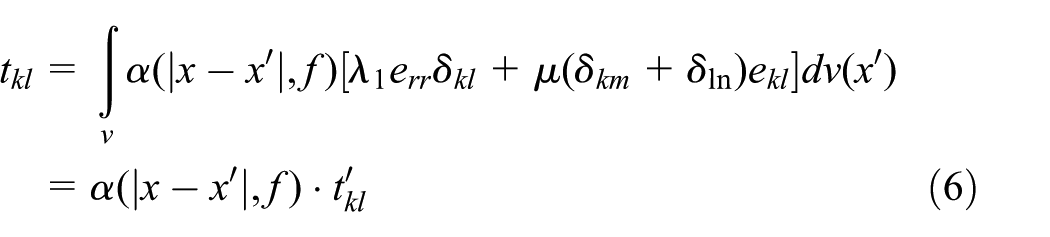
Assuming the specimens were isotropic and had little deformation when external force is applied, the stress state of each point (x) on specimens not only depends on its strain state but also on the other points (x′) around the point (x). The most common form of non-local elasticity constitutive relation is an integral on the entire affected area. So it can be explained as the following equations12,13



where tkl is the non-local stress, V is the affected area, and ekl is the strain tensor defined by the classical elasticity theory at point x, relating to the linear strain tensor at any point (x′) in affected area; λ1 and µ are the classic Lame constant, f is the ultrasonic frequency, and

The change in non-local stress can be obtained from the variation in the non-local modulus, which can be obtained through ultrasonic wave velocity experiments. The experiment showed
where
Similarity model of bending fracture experiment
Specimens
The nano-zirconia-toughened alumina nanocomposite ceramic was chosen as the research object. The workpieces were produced by Jiaozuo Micro-nano Precision Ceramic Production Company through hot isostatic pressing sintering; its maximum sintering temperature was 1640°C. Before the experiment, the workpieces were polished and divided into four subtypes according to the content of zirconium oxide: 1# (15%), 2# (20%), 3# (25%), and 4# (30%). According to GB/T 6569-2006/ISO 14701:2000, Fine ceramics (advanced ceramics, advanced technical ceramics) – Test method for flexural strength of monolithic ceramics at room temperature, 15 the three-point bending fracture experiment was developed and the workpieces’ geometric shape was a standard sample, as shown in Figure 1.

Schematic diagram of specimens’ shape and clamping in simulating model experiments.
During the experiment, the ultrasonic vibration system transmitted high-frequency cycle stress to the workpieces, which can cause the workpieces to hold transverse vibration. In order to make the workpieces have the same natural frequency as the ultrasonic vibration system, the workpieces must have the same resonance frequency as the ultrasonic vibration system. So, in the dynamic simulating model experiments, the workpieces must satisfy the resonance condition of transverse vibration, and its specific size must be calculated according to the principle of wave propagation. The theoretical computation results show that under different zirconia contents, although the elasticity modulus, relative density, and other physical parameters were slightly different, there was little difference in their specific sizes between different ultrasonic frequencies. 16 At the same time, to maintain consistent experiment conditions, the workpieces’ geometric shape was finally determined as follows: 38 mm as length (L), 4 mm as width (b), and 3 mm as height (h). According to GB/T 6569-2006/ISO 14701:2000, 15 the workpiece’ test span is 30.0 mm, and the parallelism error between the rollers should be less than 0.015 mm. All the rollers and tool head should be placed perpendicular to and closely in contact with the workpieces, and their location tolerance is less than 0.1 mm.
Experimental equipment and method
Based on the similarity principle, the three-point bending fracture experiment under ultrasonic high-frequency cycle stress was designed to realize online observation of the fracture process, as shown in Figure 2.

Measuring field of three-point bending fracture damage experiment (1: ultrasonic generator; 2: ultrasonic vibration system; 3: tool head; 4: workpieces; 5: high-speed camera; 6: display device).
The experiments were conducted on the modified universal testing machine, and the absence or presence of the ultrasound treatment was used to control the experiment state: when the ultrasonic generator is open, the ultrasonic vibration–aided acoustic system begins to work, and at this time the experiment is under ultrasonic high-frequency cycle stress; otherwise, it is considered an ordinary three-point bending fracture experiment. The lower surface of the workpieces is in tension stress state, and the upper surface is in a state of compressive stress. In a general way, fracture cracks’ initiation and propagation occur in the state of tension stress, so the observation point was selected in the middle-lower surfaces of the workpieces, as shown in Figure 1. Each experiment took out 40 workpieces from four subtypes, the workpieces were loaded onto the middle of the upper surface, and the loading rate was 0.3 m/s. The high-frequency vibration passes through the ultrasonic vibration system along the principal axis down and acts on the workpieces via the tool head. Moreover, a preliminary attempt at online observation of the three-point bending damage fracture experiment under ultrasonic high-frequency cycle stress was made, and the device type VW-6000 was used which consists of high-speed camera and display device.
The nano-zirconia-toughened alumina nanocomposite ceramic materials mainly include alumina matrix (Al2O3), tetragonal zirconia (t-ZrO2), and monoclinic zirconia (m-ZrO2). In the fracture experiments under ultrasonic high-frequency cycle stress, if there is a stress-induced transformation, the phase inversion will take place between tetragonal zirconia and monoclinic zirconia (t-ZrO2 → m-ZrO2) on the fracture surface, which can help to judge whether a phase transition occurs on the fracture surface by analyzing the contents of t-ZrO2 in the sum of t-ZrO2 and m-ZrO2 (Vt) before and after the experiments. Before the experiments, the X-ray diffraction experiment was carried out on the workpiece’s surfaces and Vt were measured. The test result was shown in Figures 3 and 4.

X-ray diffraction photographs of different specimen surfaces: (a) 1#, (b) 2#, (c) 3#, and (d) 4#.

Content of t-ZrO2 and m-ZrO2 in the different zirconia content specimen surfaces.
From Figure 4, with the increase in zirconium oxide content of the workpieces, Vt increases, and it reaches the maximum value when the zirconia content is about 25% (3#). Then these results were compared with that on the fracture surfaces after the experiments. Finally, the scanning electron microscope (SEM) type Jsm 5610-LV was applied to observe the morphology of the fracture morphologies, and the influences of ultrasonic high cycle stress on fracture mode and rupture surface microstructure were analyzed.
Experimental results and discussion
Online fracture process
Figure 5 is the online fracture process under 19.9 and 29.6 kHz, and the fatigue fracture processes under other ultrasonic frequencies are too similar to show here. The fatigue life significantly decreases with the increase in ultrasonic frequency: it is 67 s under 19.9 kHz and 22 s under 29.6 kHz. The crack propagation speed at low ultrasonic frequency is slower than that at high ultrasonic frequency, and the time of crack initiation accounts for about 2.64% of the entire fracture process under 19.9 kHz, but 1.57% under 29.6 kHz. Compared with the low ultrasonic frequency, the average stress under high ultrasonic frequency increases and its crack extension can get more energetic. Therefore, the crack extends faster and is more stable with the increase in ultrasonic frequency, which indicated that, under some conditions, the ultrasonic vibration–aided machining at high ultrasonic frequency was an effective method suitable for machining the nanocomposite ceramics.
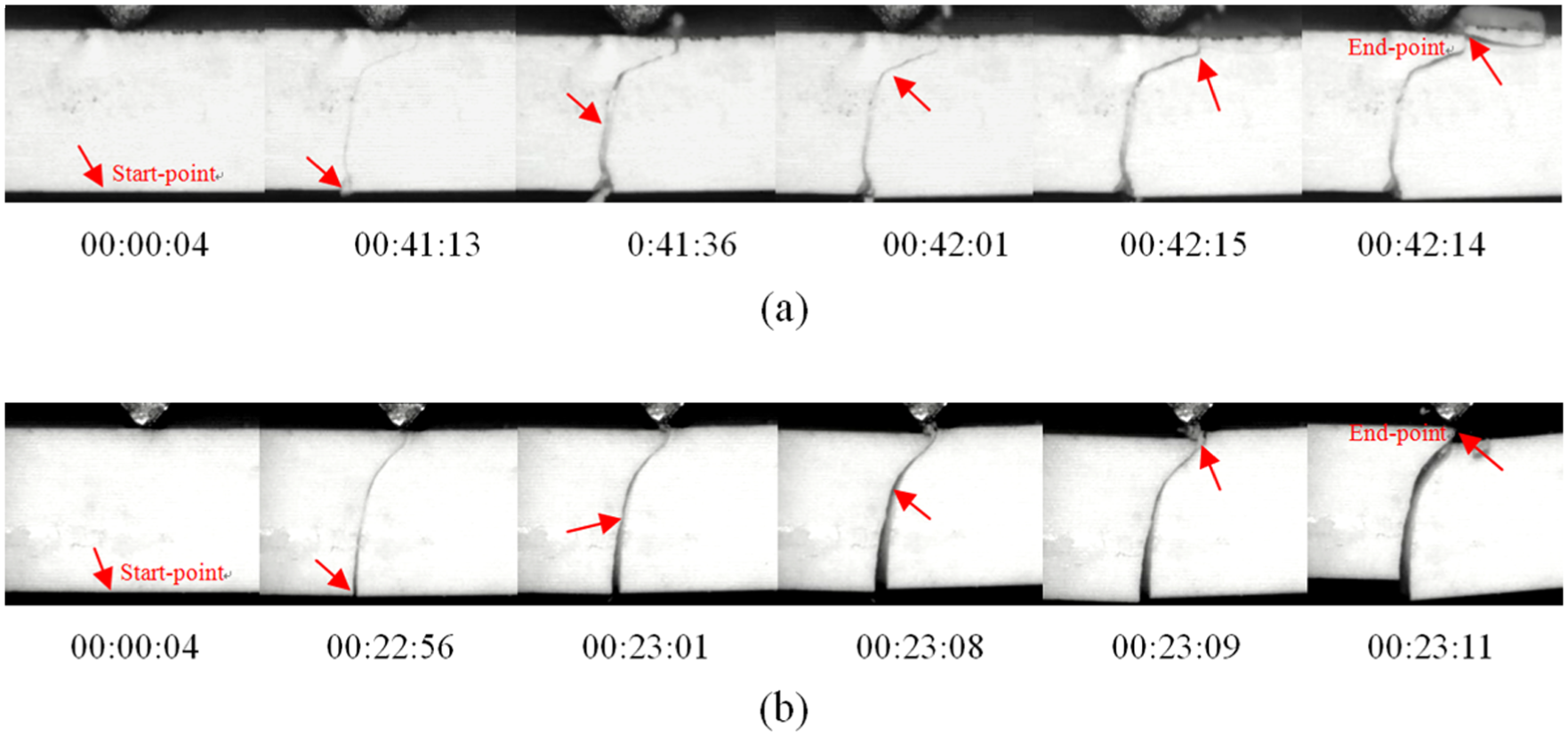
Online fatigue fracture process under (a) 19.9 kHz and (b) 29.6 kHz.
From Figure 5, we also found that the end-point position of crack was different under different ultrasonic frequencies. The end-point is the intermediate working point under high ultrasonic frequency (29.6 kHz), but it offsets and is other point around the intermediate working point under low ultrasonic frequency (19.9 kHz). This was because under low ultrasonic frequency cycle stress, the deformation was smaller compared with high ultrasonic frequency cycle stress, and the defects of the workpieces had a great effect on the end-point positions of the cracks. The distribution of defects in the nanocomposite ceramics is discrete essentially, and the stress has no significant distinction between the working point and the other points around it. So, under low ultrasonic frequency, the end-point of crack was at the biggest defect around the working point. The start-point was at about the same place, but the end-point position of cracks were different under different ultrasonic frequencies, so the direction of fracture crack deflected. The deflection angle decreases with the increasing ultrasonic frequency, and it is greatest under 19.9 kHz. After measuring with the three-dimensional (3D) dynamic microscopic analysis system, it is 47.53°. The results show that under certain conditions, ultrasonic vibration–aided machining had better machining quality under high ultrasonic frequency.
Fracture phase analysis
The difference in tetragonal zirconia volume content between specimen and fracture surface can be defined as the amount of phase transformation (ΔVt-m). ΔVt-m can be expressed by the following equation

where Vt-m is the amount of phase transformation, Vt-B and Vt-A are the content of t-ZrO2 in the sum of t-ZrO2 and m-ZrO2 before and after experiments, respectively. The amount of phase transformation under different ultrasonic frequencies was shown in Figure 6.
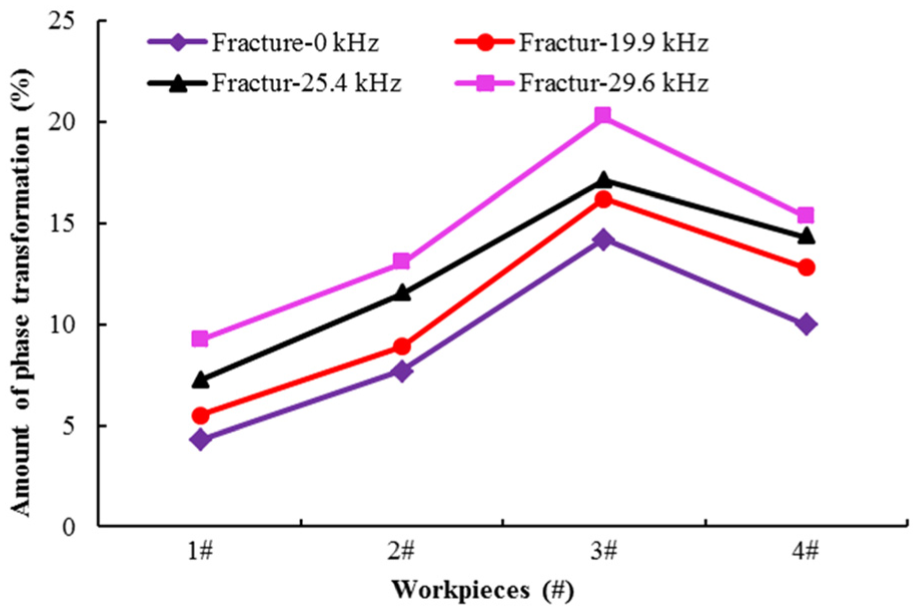
Amount of phase transformation under different ultrasonic frequencies.
From Figure 6, there is a phase transition in the experiments. This was because tetragonal zirconia is the high-temperature stable phase and monoclinic zirconia is the low-temperature stable phase. Under low temperature, the tetragonal zirconia can keep its stable state due to the inhibition of matrix, but if the constraining force decreases or disappears under the action of external force, the zirconium oxide particles will be from the tetragonal phase into monoclinic phase, and the phase change has occurred. In the fracture experiment under ultrasonic high-frequency cycle stress, the cycle stress increases the energy of zirconium oxide particles which makes the stress-induced transformation occur.
From Figure 6, we also found that ΔVt-m increases with the increase in zirconia content, and it reaches the maximum value when the zirconia content is about 25% (3#) and then declines. The phenomenon may happen because the zirconia content may influence the improvement of matrix performance only when it reaches a certain degree, but higher levels of zirconia content may cause a large likely decrease in the material strength because of gathering of nana-sized crystals. 17 In addition, it can be seen that ΔVt-m increases with the increase in ultrasonic frequency. This may be because with the increase in ultrasonic frequency, the contact force presents a higher frequency strain rate, and the stress-induced phase transformation occurs more easily.
Fracture surface morphology
SEM of fracture surfaces under different ultrasonic frequencies was shown in Figure 6. We can see that the larger gray granules are alumina and the white granules are zirconia. It can be clearly observed that there are two states of zirconium oxide particles: one is the larger irregular zirconium oxide aggregate scatters in the alumina grain boundary which are marked in red circle, and the other is the very fine zirconium oxide particles distributed in the alumina grain which are marked in yellow circle. Zirconium oxide particles distributed in alumina grain made it produce abundant dislocation morphologies in the alumina crystals. As the grain size and distribution have a certain randomness, the residual stress field was very complex, making the dislocation complicated and diversified.
Figure 7(a) shows that there are more integrity grains and grain boundaries at the fracture section which are marked in red arrow, compared with Figure 7(b)–(d). Cracks develop along the crystal boundary between adjacent crystals, and the crack extension line is randomly selected along the crystal boundary. The section is uneven, and there is a small amount of tear ridges and dimples on the fracture surface which are marked in yellow arrow. This suggested that the material damage and crack extension were no longer entirely along the grain boundary, but partly transgranular at the fracture. Generally, the intergranular fracture is a typical brittle fracture, and its crack propagation path follows the principle of minimum energy and propagates along the weakest binding force area. So, the presence of transcrystalline fractures indicated that in the experiment, the grain boundary was strengthened, forcing rupturing through the crystal, and the material performance was improved.

Scanning electron micrograph (SEM) of fracture surfaces under different ultrasonic frequencies: (a) 0 kHz, (b) 19.9 kHz, (c) 25.4 kHz, and (d) 29.6 kHz.
From Figure 7(b)–(d), it can be clearly observed that as the frequency increases, there are large amounts of cracks on the grain section, and crack bridging is more obvious, which is marked in green circle and can be concluded that the fracture model tends to mix transgranular and intergranular. There also are tear ridges and dimples on the fracture surfaces, and the phenomenon is more obvious with the increase in frequency. And this is due to the effect of the ultrasound wave which changes the microstructure of nanocomposite ceramics. For example, it can strengthen the grain boundaries and make the cracks more inclined to extend into the matrix. So the greater the ultrasonic frequency, the more obvious the transgranular fracture, the more microcracks on the crystal layers, and the more complicated the growth paths of cracks.
Conclusion
In this study, a similarity model of the bending fracture experiment was developed for clarifying the fracture behaviors of the nanocomposite ceramics under ultrasonic vibration–aided grinding. Moreover, the stress variation under ultrasonic was analyzed by the non-local theory and validated by these similarity experiments. From this study, the following conclusions can be drawn:
As the ultrasonic frequency increases, fatigue life is significantly shorter, the fatigue crack extends faster and is more stable, and the deflection angle decreases (it is biggest (47.53°) under 19.9 kHz). The results show that ultrasonic vibration–aided machining can have a higher machining efficiency under high ultrasonic frequency.
The phase transition has occurred in the fracture process and the amount of phase transformation increases with the increase in ultrasonic frequency and zirconia content, and it can reach the maximum value when the zirconia content is about 25% and then declines. These results suggested that the content of ZrO2 in a proper range (about 25%) can improve the processing property of the nanocomposite ceramics.
The greater the ultrasonic frequency, the more obvious the transgranular fracture, the more microcracks on the crystal layers, and the more smooth the fracture surface. So it can be concluded that ultrasonic vibration–aided machining can have a better machining quality under high ultrasonic frequency.
The nanocomposite ceramics have unique fracture behaviors under different high-frequency cyclic stress. From these results, it can be concluded that the ultrasonic vibration–aided machining under high ultrasonic frequency is more suitable for precision machining of the nanocomposite ceramics. As these test results were limited by the ultrasonic device, the results only came to some frequencies of ultrasonic vibration–aided grinding.
Footnotes
Appendix 1
Academic Editor: Jianqiao Ye
Declaration of conflicting interests
The author(s) declared no potential conflicts of interest with respect to the research, authorship, and/or publication of this article.
Funding
The author(s) disclosed receipt of the following financial support for the research, authorship, and/or publication of this article: This work was supported by the National Science Foundation of China (contract nos 51475148 and 51175153) and the Fostering Foundation of Henan Polytechnic University for the Excellent PhD Dissertation.