



Abstract
Toric Bézier patches are a multi-sided generalization of classical rational Bézier patches which are widely used in free-form surface modeling. In this article, we study the problem of finding the patch with minimal area among all possible toric Bézier patches with the given boundaries, that is, the Plateau–toric Bézier problem, and obtain an approximation of minimal toric Bézier patch. Some representative examples are given to verify our results.
Introduction
The study of the minimal surfaces is a hot topic as it exploits a broad spectrum of mathematics and physics. In mathematics, the minimal surfaces are a kind of surfaces which locally minimize their area. These surfaces, characterized by the fact that the mean curvatures vanish, have wide applications in surface design. Physically, the minimal surfaces are familiar as soap films; 1 they have close relationships with a lot of problems in materials science, civil engineering, ship manufacture, and so on. For instance, Wang 2 proposed a surface modeling method of atoms and molecules based on the minimal surfaces. Moreover, Séquin 3 applied them in designing the interactive computer-aided design (CAD) tools for engineering designs.
One of the oldest surface design problems in computer-aided geometric design (CAGD) is the Plateau problem: 4 to find the surface of minimal area among all possible surfaces with given boundaries.
Bézier curves and patches play an important role in CAGD. Triangular and rectangular Bézier patches are mostly used to design freedom surfaces as the surface fitting tools. 5 The problem of Plateau–Bézier, that is, to find the surface of minimal area among all Bézier patches with given boundaries has been explored by Monterde with the Dirichlet energy functional (cf. Monterde4,6). Nitsche 7 and Osserman 8 gave a comprehensive survey of the minimal surfaces. Cosín and Monterde 9 studied the properties of the control nets of the Bézier patches which are an approximation of the minimal surfaces. The Plateau–Bézier problem for triangular Bézier patches was studied by Arnal et al. 10 Hao et al. 11 investigated the Plateau quasi–Bézier problem and the harmonic quasi-Bézier patches. Ahmad and Masud12,13 presented a curvature algorithm to reduce the area of a surface with variational minimization. In this article, we construct the minimal surface spanned by finite number of boundary curves with the toric Bézier patches.
Toric Bézier patches, introduced into the geometric modeling by Krasauskas 14 from the theory of toric varieties in algebraic geometry and toric ideals in combinatorics (cf. Sturmfels 15 and Cox et al. 16 ), are a multi-sided generalization of classical Bézier patches. There are wide shape possibilities for toric Bézier patches and many well-known surfaces of lower degrees are found to be special cases of toric Bézier patches. 17 In 2002, Krasauskas and Goldman18,19 presented the de Casteljau pyramid algorithm, elevation algorithm, and blossoming algorithm of toric Bézier patches based on the depth of the convex polygons. García-Puente et al. 20 gave the geometric significance of the control structures of toric Bézier patches. The G1 continuity of toric Bézier patches was discussed by Sun and Zhu. 21 Liu et al. 22 constructed toric Bézier patches to fill n-sided holes.
In this article, we study the Plateau problem with multi-sided boundaries and obtain an approximation of minimal surface with toric Bézier patches. The rest of the article is organized as follows. In section “Toric Bézier patches and the Dirichlet functional,” we recall the notations and definitions of the toric Bézier patches and present the Dirichlet functionals of toric Bézier patches. In section “Extremals of the Dirichlet functional,” we present the toric Bézier patches of minimal area with the Dirichlet functionals. Moreover, the Dirichlet extremals and some representative examples are given in section “Examples.”
Toric Bézier patches and the Dirichlet functional
The Minkowski sum and the discrete convolution
Let P and Q be two arbitrary sets of finite integers in Z2. The Minkowski sum of P and Q is the set

where
Let

where
Toric Bézier patches and their derivatives
Let
The normal vector
For each lattice point

where
Let

Equation (1) gives the following recurrence relation:
Hence

Definition 1
A toric Bézier patch defined on

where
In fact, if we set
Notice that if

so that the parametric surface
Remark 1
Let k and l be two positive integers. If
The lattice polygon
The Dirichlet functional
Let

where E, F, and G are the coefficients of the first fundamental form of toric Bézier patch. 4
Because the area functional is high nonlinearity, Douglas used the Dirichlet functional instead of the area functional to resolve the minimal surface problem. 8 The Dirichlet functional is defined as

Actually,
Douglas proved an important property that both functionals have the same extremals among all functions. 8 For the toric Bézier patches, both the functionals exit the minimums, but the extremal of Dirichlet functional we obtain is an approximation of the extremal of the area functional. 4
Proposition 1
The functionals
In fact, we only need to prove that the functionals
Since the boundaries of toric Bézier patch are determined by the control points on the boundaries, the Plateau–toric Bézier problem can be presented as follows: given the boundary control points indexed by the lattice points on the edges of
Extremals of the Dirichlet functional
From the previous analysis, we investigate the Plateau–toric Bézier problem by minimizing the Dirichlet functional to get an approximation of minimal toric Bézier patch. Instead of computing the Euler–Lagrange equation of the Dirichlet functional, we simply compute the patch
Theorem 1
The toric Bézier patch

where
Proof
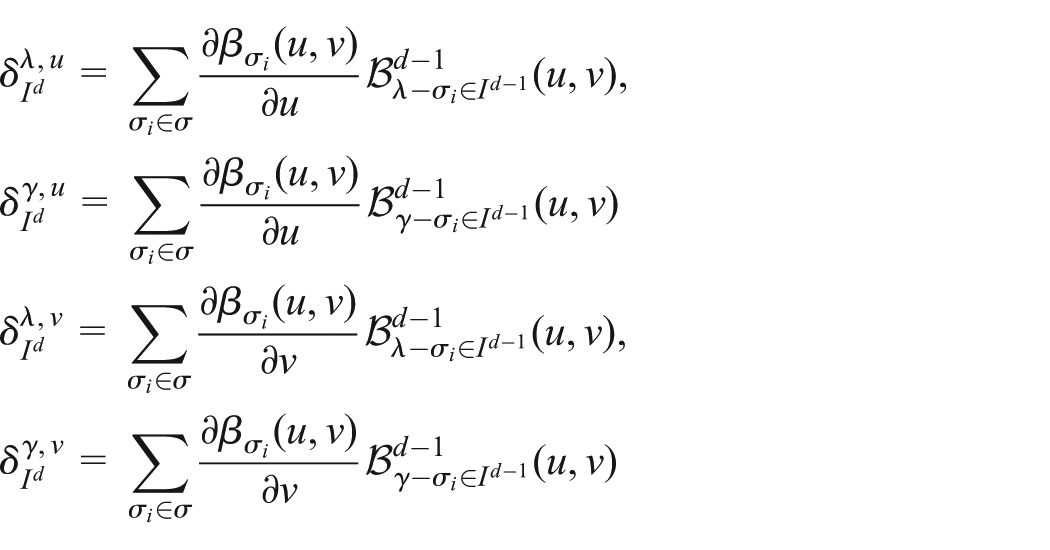
For an inner control point
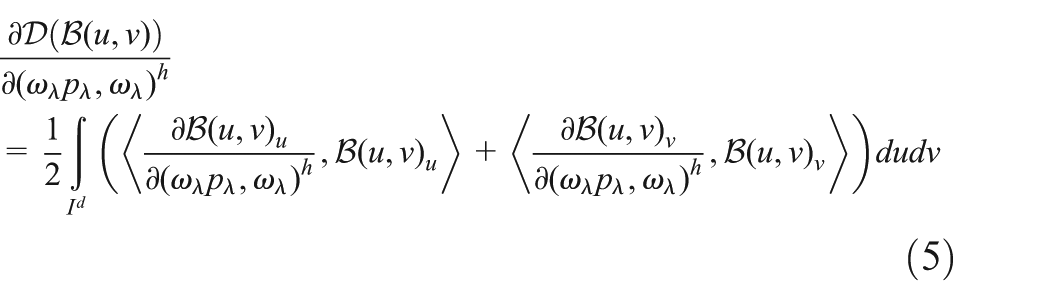
By the definition of toric Bézier patch and equation (4), we get the partial derivatives of

Similarly

Then we compute the derivatives with respect to the coordinates of


and
Then substituting equations (6) and (7),
Remark 2
The triangular Bézier patch of minimal area 10 and the Plateau–Bézier problem 6 are the special cases of the above Theorem 1.
Actually, as mentioned in Remark 1, when
The above theorem demonstrates that the inner control points and weights of the toric Bézier patch are totally determined by the boundary control points and weights. Assuming the inner control points and weights as unknown, the linear equation system is always compatible and can be solved in terms of the boundary control points and weights.
Examples
In this section, some examples will be discussed. In order to simplify the expression and calculation, we assume the weights all equal in the following examples.
Example 1
In this example, we give a minimal toric Bézier patch defined on the convex hull
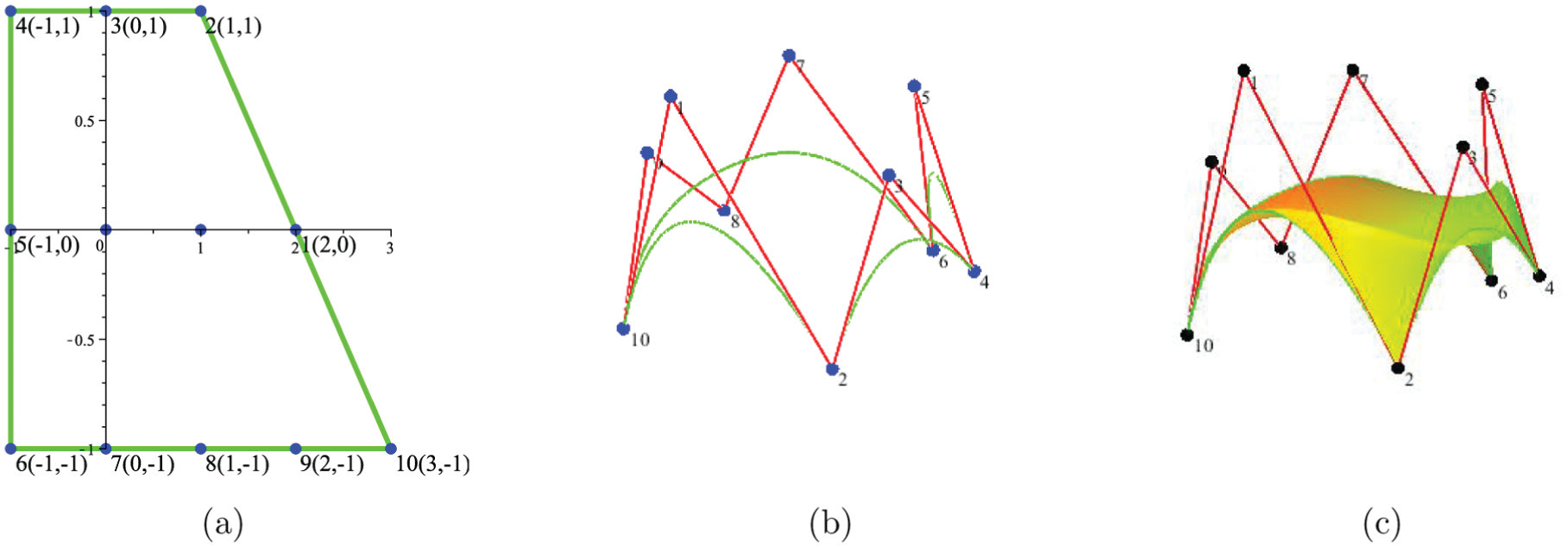
The minimal toric Bézier patch defined on a tetragon: (a) the convex hull, (b) the boundary curves, and (c) the toric Bézier patch.
The edges of

Then we get the toric Bernstein basis function for every lattice point

The corresponding coefficients
By the basis functions on the boundary and the given control points, we get the boundary curves, which are shown in Figure 1(b).
Substituting

Figure 1(c) shows the corresponding toric Bézier patch.
Example 2
In this example, we give a minimal toric Bézier patch defined on the convex hull
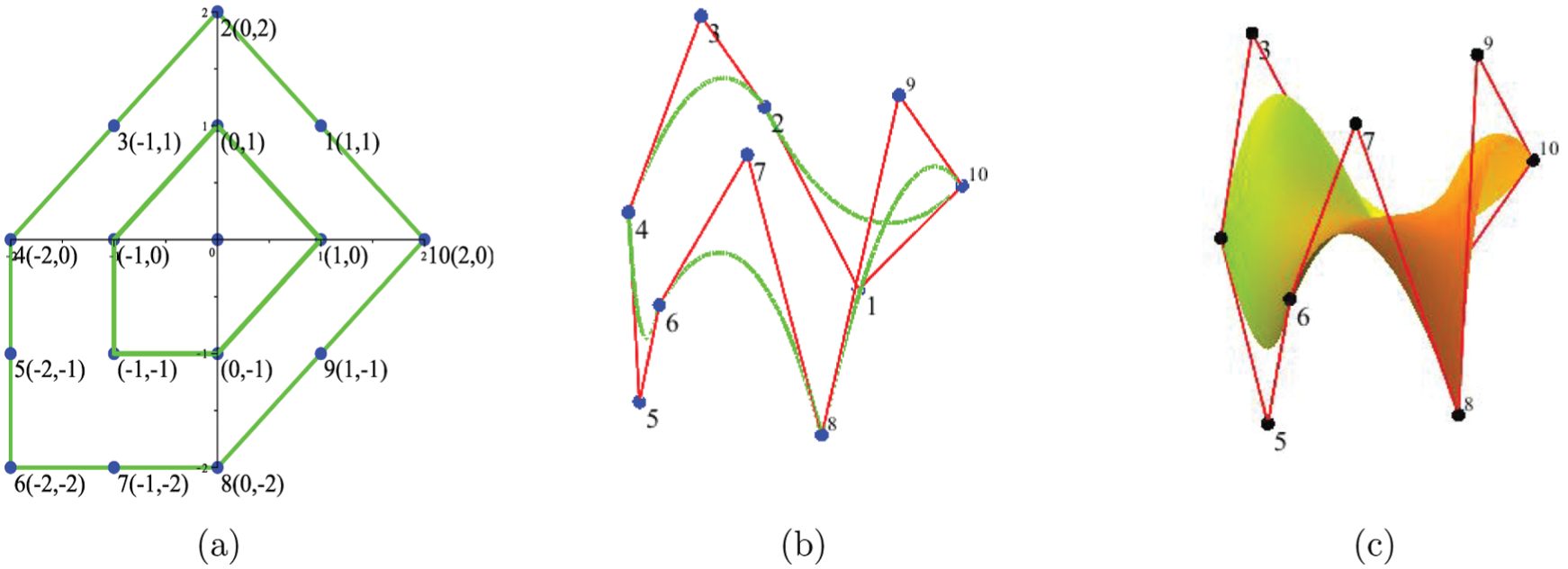
The minimal toric Bézier patch defined on a pentagon: (a) the convex hull, (b) the boundary curves, and (c) the toric Bézier patch.
The edges of

Then we get the toric Bernstein basis function

By equation (3), the toric Bernstein basis functions

where
The boundary curves are shown in Figure 2(b). By Theorem 1, we get the inner control points

Figure 2(c) shows the corresponding toric Bézier patch; notice that it is a pentagonal parametric surface.
Example 3
This example shows the minimal toric Bézier patch defined on the convex hull
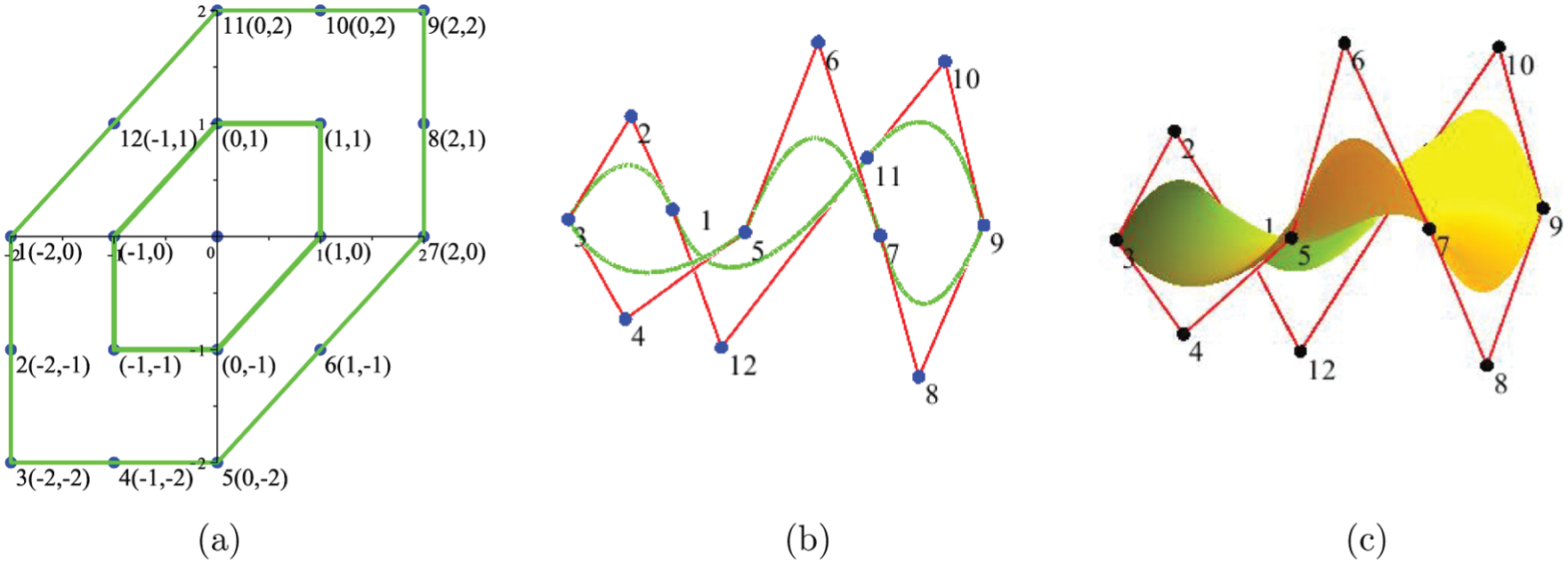
The minimal toric Bézier patch defined on a hexagon: (a) the convex hull, (b) the boundary curves, and (c) the toric Bézier patch.
The lines of each edge of

The toric Bernstein basis function for every lattice point

Then by equation (3), the toric Bernstein basis functions
The boundary curves are shown in Figure 3(b). By Theorem 1, we get the inner control points

The corresponding toric Bézier patch is shown in Figure 3(c); notice that it is a hexagonal parametric surface patch.
Conclusion and future work
In this article, we study the Plateau–toric Bézier problem with the Dirichlet functional and present a method to construct the approximation of the minimal toric Bézier patch. Three examples with different types of parametric domains are illustrated to show the effectiveness of the presented method. Each example denotes a kind of minimal and multi-sided parametric surface patches which implies a lot of shape possibilities for engineering design and CAGD. The hexagonal toric Bézier patch constructed in Example 3 is the best solution in the examples for potential engineering problems, in which the domain of the patch is symmetric.
As well known, the minimal surfaces have close relationships with a lot of problems in biology, materials science, civil engineering, ship manufacture, and so on. Therefore, to study the potential application of the minimal surfaces in these fields is a very interesting topic. For future work, we will study not only the toric Bézier patches of minimal area in theory but also the minimal toric Bézier patches in engineering design and CAGD for applications.
Footnotes
Academic Editor: ZW Zhong
Declaration of conflicting interests
The author(s) declared no potential conflicts of interest with respect to the research, authorship, and/or publication of this article.
Funding
The author(s) disclosed receipt of the following financial support for the research, authorship, and/or publication of this article: This work was partly supported by the National Natural Science Foundation of China (nos 11271060, 11290143, and 11401077), Fundamental Research of Civil Aircraft (No. MJ-F-2012-04), the Program for Liaoning Excellent Talents in University (No. LJQ2014010), and the Fundamental Research Funds for the Central Universities (No. DUT16LK38).