




Abstract
In order to investigate the characteristics of boiling heat transfer for hydrocarbon mixture refrigerant in plate-fin heat exchanger which is used in the petrochemical industry field, a model was established on boiling heat transfer in vertical rectangular channel. The simulated results were compared with the experimental data from literature. The results show that the deviation between the simulated results and experimental data is within ±15%. Meanwhile, the characteristic of boiling heat transfer was investigated in vertical rectangular minichannel of plate-fin heat exchanger. The results show that the boiling heat transfer coefficient increases with the increase in quality and mass flux and is slightly impacted by the heat flux. This is because that the main boiling mechanism is forced convective boiling while the contribution of nucleate boiling is slight. The correlation of Liu and Winterton is in good agreement with the simulation results. The deviation between correlation calculations and simulation results is mostly less than ±15%. These results will provide some constructive instructions for the understanding of saturated boiling mechanism in a vertical rectangular minichannel and the prediction of heat transfer performance in plate-fin heat exchanger.
Introduction
In the recent years, compact heat exchangers with minichannel types are widely concerned, which present several advantages such as reduced size and higher efficiency, with the benefit of both cost and safety. Plate-fin heat exchangers (PFHE), as a type of compact exchangers with high performance, have been widely used in petrochemical industry field.1–4 It consists of many rectangular minichannels. The gap size of rectangular minichannels is usually about 0.5–10 mm5–7 in the PFHE. It is a key technology to predict the boiling heat transfer performance on hydrocarbon mixture refrigerant in a rectangular minichannel for the PFHE in petrochemical industry field. 8 However, the realistic phenomena have scarcely been explored on boiling heat transfer for hydrocarbon mixture refrigerant in a rectangular minichannel until now. 9
Although many investigations have been done to investigate the phenomena of boiling heat transfer in the minichannel of compact heat exchangers, there are many contradictions in the available literature on this subject.10,11 Meanwhile, because of the complexity of the phenomenon of boiling heat transfer on hydrocarbon mixture refrigerant and the limitations of computational technology and measurements,1,12–14 it is still under open discussion for the mechanism to dominate the boiling heat transfer in the vertical rectangular minichannel. For example, the boiling heat transfer coefficient is not dependent on vapor quality while dependent on heat flux according to Feldman et al. 15 and Ma et al. 16 In other words, the nucleate boiling and forced convection boiling are the main mechanisms for boiling heat transfer in the minichannel. According to the literature,14,17–23 the heat flux and system pressure have a certain influence on the boiling heat transfer coefficient while the dependency on vapor quality and mass flux is insignificant. The above results show that the key mechanism for boiling heat transfer in the minichannel is nucleate boiling while the forced convective boiling is slight. At the same time, Sumith et al. 10 also experimentally surveyed the boiling heat transfer on water in a vertical minichannel with 1.45 mm diameter under the atmospheric pressure. The results show that the main heat transfer mechanism for the saturated boiling heat transfer in a vertical minichannel is the liquid film evaporation. Most of the above investigations are mainly focused on the boiling heat transfer of simplex refrigerant in minichannel. At the same time, the understanding of the heat transfer mechanism is not clear on boiling heat transfer in the minichannel according to the above analysis.24–26
At the same time, because of the practical significance of heat transfer coefficient correlation in the boiling heat transfer performance design of PFHE, many investigations have been made on correlating boiling heat transfer coefficient and many correlations have also been obtained on the basis of experimental data in the minichannel.27,28 Nevertheless, it is very difficult to find a reasonable and accurate correlation to calculate the boiling heat transfer coefficient in the minichannel of PFHE.29,30
In this article, a model on boiling heat transfer in vertical rectangular minichannel of PFHE was established and validated by the experiment data from literature. The characteristics of boiling heat transfer were investigated on hydrocarbon mixture refrigerant in vertical rectangular minichannel. A correlation was proposed to calculate the boiling heat transfer coefficient on hydrocarbon mixture refrigerant in a vertical rectangular minichannel.
Analysis of mathematic-physical mode
In this article, the characteristics of saturated boiling heat transfer was investigated on hydrocarbon mixture refrigerant in a vertical rectangular minichannel whose cross-section dimension is 1.6 × 6.3 mm and the length is 200 mm. The analysis model is depicted in Figure 1.

The vertical rectangular minichannel model.
Simulation mechanism
In order to investigate the boiling heat transfer in a vertical rectangular minichannel, the inhomogeneous two-fluid model and thermal phase change model are used. For conservation of mass, momentum, energy, and turbulent quantities for the study in a Cartesian coordinate system, the Reynolds-averaged governing equations can be written as follows:
Mass conservation


where r, ρ, and U represent the volume fraction, density, and velocity, respectively. Subscripts g and l denote vapor phase and liquid phase, respectively.

where
For the mixture model in CFX,

where
According to equations (3) and (4), the mass flow rate in per unit volume is related to the interfacial length scale and the interphase mass flux. The interfacial length scale between liquid phase and vapor phase can be written as

where
Momentum conservation


where p, µ, and µt represent pressure, viscosity, and turbulent viscosity, respectively. M represents the total of interfacial forces taking on a phase as a result of the existence of other phase, that is, momentum transfer and drag forces with interphase mass transfer and so on. The
In this article, the standard k-ε turbulent model is used in vapor phase and liquid phase, respectively. For the liquid phase, the turbulent viscosity is modeled as

where Cµ is a constant given as 0.09. ε and κ represent turbulence dissipation rate and turbulence kinetic energy of vapor phase, respectively. Turbulent kinetic energy and turbulence dissipation rate transmission equation for vapor phase can be written as
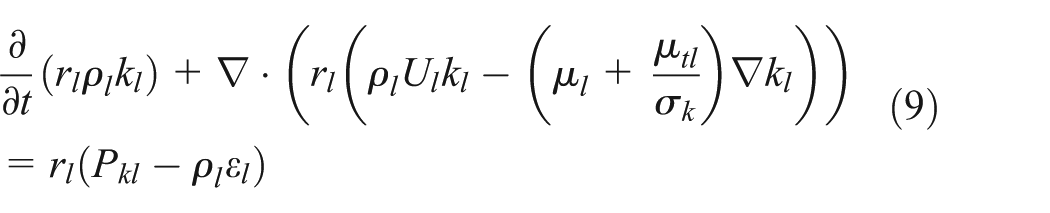

where Cε1, Cε2, σk, and σε are 1.44, 1.92, 1.3, and 1.0, respectively. According to viscous and buoyancy forces modeled, the vapor phase turbulence production

where

Energy conservation


where H and λ represent the enthalpy and thermal conductivity, respectively. Q represents the interphase sensible heat transfer to one phase across interfaces with the other phase.

Substituting equation (3) in equation (15), the interphase mass flux from liquid phase to vapor phase,

Based on the two resistance models in CFX, the sensible heat transfer process is achieved by defining two heat transfer coefficients on each side of the phase interface. Therefore, the interphase sensible heat transfer to liquid phase and that to vapor phase can be expressed as, respectively


where

where
In this study, a zero resistance condition is adopted for the liquid phase on one side of the phase interface, which is to make the interfacial temperature have the same temperature with the liquid phase,

where
Analytical methods
The components and physical property vary with temperature for hydrocarbon mixture refrigerant. Meanwhile, the characteristics of boiling heat transfer on hydrocarbon mixture refrigerant in the vertical rectangular minichannel are obviously impacted by the components and physical property. Therefore, based on Soave equation (SRK equation), the components and physical property are calculated on hydrocarbon mixture refrigerant at different operation pressure and temperature. The calculation is listed in Table 1.
The properties of mixture refrigerant (methane, propane, and ethylene) at different temperatures.

Meanwhile, the characteristics of boiling heat transfer on hydrocarbon mixture refrigerant in a vertical rectangular minichannel are investigated by ANSYS-CFX. In order to guarantee the grid arrangement with fine meshes quality, the fluid area is discretized into hexahedral finite control volumes by the ICEM software. The simulations were performed with three different meshes: 711,000, 1,400,000, and 2,830,000 cells. The simulation results show that the calculation results become mesh independent when the mesh amount exceeds 1,400,000 cells. At the same time, the computation efficiency and mesh sensitivity were considered in this article. Therefore, the total number of mesh cells applied in the article was 1,400,000. The diffusion terms are solved by the central differential scheme. The convection terms are solved using the high-resolution scheme, which is second-order accurate. The transient term is solved by the first-order backward Euler scheme. The mass flow, vapor volume fraction, and temperature boundary are adopted at inlet. Outlet is set by the static pressure and the constant heat flux is used in the wall of vertical rectangular minichannel.
In order to facilitate the convergence, the steady-state solution in a vertical rectangular minichannel is obtained first and then it is used as the initial condition for other cases.
Results and discussion
Comparison between simulation results and experimental data
In order to validate the model on boiling heat transfer of hydrocarbon mixture refrigerant in a vertical rectangular minichannel, Figure 2 depicts the relation between the simulation results and the experimental data from literature 2 at different vapor quality for heat flux q = 1.1 kW/m2, the mass flux m = 50 kg/(m2 s) and heat flux q = 6 kW/m2, the mass flux m = 215 kg/(m2 s). The results show that the deviation between the simulated results and experimental data obtained from literature 2 is within ±15% (hSIM is the simulated results and hEXP is the experimental data from literature 2 ).
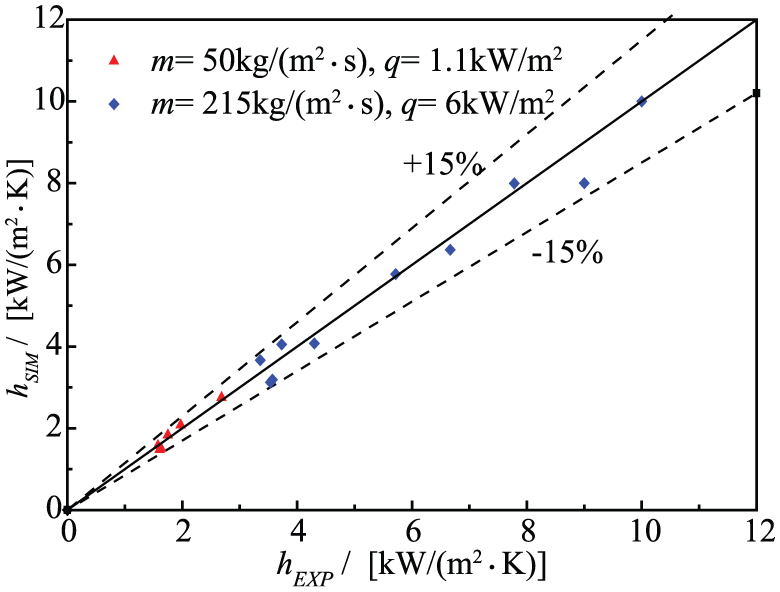
Comparison between simulation results and experiment at different mass fluxes and heat fluxes.
For the sake of further verifying the rationality of the model on boiling heat transfer of hydrocarbon mixture refrigerant in a vertical rectangular minichannel, the boiling heat transfer in a vertical rectangular minichannel is simulated at the condition of different heat flux. At the same time, the simulation results are compared with the experiment data. Figure 3 is the relation between simulation results and experimental data from literature. 2 The results show that the simulation results are consistent with experimental data from literature and the deviation is within ±15% between the simulation results and experimental data at different heat flux for the mass flux m = 215 kg/(m2 s), the vapor quality x = 0.5 and the mass flux m = 215 kg/(m2 s), the vapor quality x = 0.25.

Comparison between simulation results and experiment at different vapor quality.
Characteristic of boiling heat transfer
In this part, the characteristics of saturated boiling heat transfer are investigated based on the above model validated by the experimental data from literature. 2 The vapor quality is independent on the saturation temperature and pressure for the boiling heat transfer on simplex refrigerant. However, for the boiling heat transfer on hydrocarbon mixture refrigerant in PFHE, the vapor quality is dependent on the saturation temperature and pressure. Therefore, the influence of saturation temperature and pressure is a necessity for this study.
Figure 4 presents the heat transfer coefficient as a function of saturated temperature at different heat fluxes with mass flux m = 250 kg/(m2 s) and at different mass fluxes with heat flux q = 20 kW/m2. The results show that the heat transfer coefficient increases with the increase in saturated temperature. The influence of mass flux is obvious for the heat transfer coefficient while that is slightly impacted by the heat flux. Specifically, the heat transfer coefficient rises gradually with the mass flux. According to Table 1, the vapor quality increases as the saturated temperature increases. Therefore, the above results further indicate that the forced convection boiling is the main mechanism for boiling heat transfer on hydrocarbon mixture refrigerant in a vertical rectangular minichannel. At the same time, the change of components and physical property of vapor or liquid phase is also a major influence factor for hydrocarbon mixture refrigerant.

The heat transfer coefficient versus saturated temperature.
Figure 5 illustrates the variation of the heat transfer coefficient with saturated temperature at different pressures with mass flux m = 250 kg/(m2 s), heat flux q = 20 kW/m2. The results show that the heat transfer coefficient also increases as the saturated temperature increased. The influence of pressure is obvious for the heat transfer coefficient when the saturated temperature is less than 203 K. Meanwhile, the higher the pressure, the larger the heat transfer coefficient. When the saturated temperature is more than 203 K, the heat transfer coefficient is slightly impacted by the pressure.

The heat transfer coefficient versus saturated temperature at different pressures.
Figure 6 depicts the relation between the heat transfer coefficient and mass flux at different saturated temperatures with heat flux q = 20 kW/m2, pressure P = 0.32 MPa and at different heat fluxes with saturated temperature T = 195 K, pressure P = 0.32 MPa. The results show that the heat transfer coefficient is obviously impacted by the mass flux and linearly increases with its increase. Also, the higher the saturated temperature, the larger the heat transfer coefficient. The influence of the heat flux is slight for the heat transfer coefficient.

The heat transfer coefficient versus mass flux.
The influence of mass flux for heat transfer coefficients at different pressures is also analyzed in Figure 7. The plots are drawn at different pressures for heat flux q = 20 kW/m2, saturated temperature T = 195 K. The results also indicate that the heat transfer coefficient is obviously impacted by the mass flux and linearly increases with its increase. Meanwhile, the higher the pressure, the larger the heat transfer coefficient.
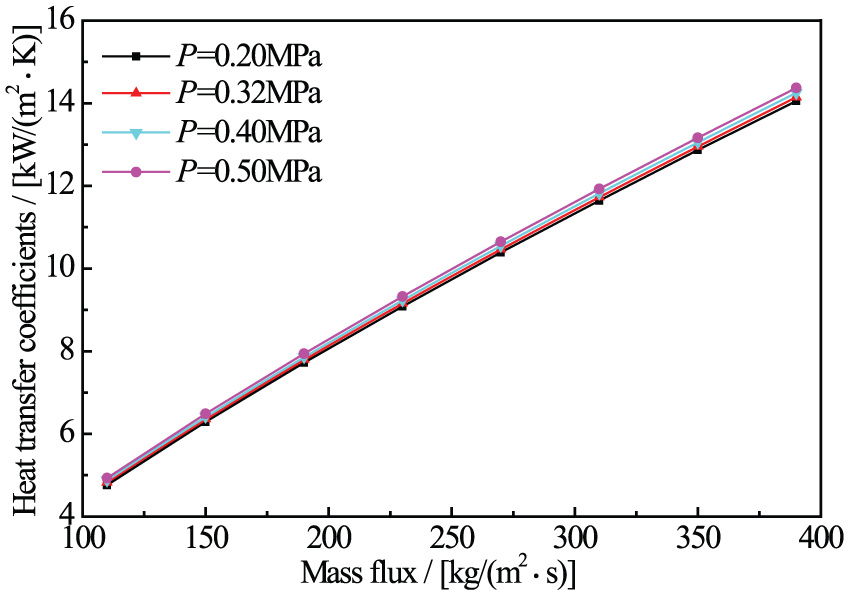
The heat transfer coefficient versus mass flux.
To sum up, for the boiling heat transfer of hydrocarbon mixture refrigerant in a vertical rectangular minichannel, the heat transfer coefficient increases as the saturated temperature and the mass flux increased because the forced convection boiling mechanisms enhance with the increase of that for boiling heat transfer on hydrocarbon mixture refrigerant in a vertical rectangular minichannel. Meanwhile, the heat transfer coefficient is obviously impacted by the pressure while the influence of heat flux is minimal for that.
Comparison between simulation results and existing correlation calculations
At present, many correlations on heat transfer coefficient for boiling heat transfer in a vertical rectangular minichannel have been given in terms of experimental data based on single-component refrigerant. It is very difficult to select an appropriate correlation for the design in engineering. At the same time, it is necessary to verify the rationality of the heat transfer coefficient correlations based on the experimental data of single-component refrigerant to predict the boiling heat transfer of hydrocarbon mixture refrigerant in a vertical rectangular minichannel. Therefore, the correlation calculations from different studies are compared with the simulation results at the temperature T = 150–215 K, mass flux m = 100–400 kg/(m2 s), pressure P = 0.2–0.5 MPa, and heat flux q = 5–20 kW/m2. The optimal correlation is recommended to predict the heat transfer coefficient on the boiling heat transfer of hydrocarbon mixture refrigerant in a vertical rectangular minichannel. Table 2 lists the correlations used in this article.
Common correlation on boiling heat transfer coefficient.

Figure 8 depicts the relation between simulation results and correlation calculations on the boiling heat transfer coefficient of hydrocarbon mixture refrigerant in a vertical rectangular minichannel. Here, hSIM and hCOR represent the simulation results and correlation calculations, respectively. The results in Figure 8(a) show that the deviations are more than 15% in most cases and the calculations by the Tran’s correlation are much larger than the simulation results. Figure 8(b) shows that the deviations are more than −15% in most cases and the calculations by the correlation of Bertsch et al. are less than the simulation results. In other words, it is still very difficult to accurately predict the boiling heat transfer of hydrocarbon mixture refrigerant in a vertical rectangular minichannel by the correlation of Tran et al. and Bertsch et al. Figure 8(c) indicates that the calculations by correlation of Gungor and Winterton are much larger than the simulation results in most case and the deviations are less than ±15% in most cases. But the deviations between the simulation results and correlation calculations are still more than 15% in many cases. According to Figure 8(d) and (e), the calculations by correlation of Kandlikar and Sun and Mishima are less than the simulation results in most cases. The relation between the calculations by correlation of Liu and Winterton and the simulation results is shown in Figure 8(f). The results show that the deviations between the simulation results and the correlation calculations are less than ±15% at most conditions though the calculations by correlation of Liu and Winterton are less than the simulation results. At the same time, the calculations by correlation of Liu and Winterton have much better agreement with the simulation results compared with the above other models.
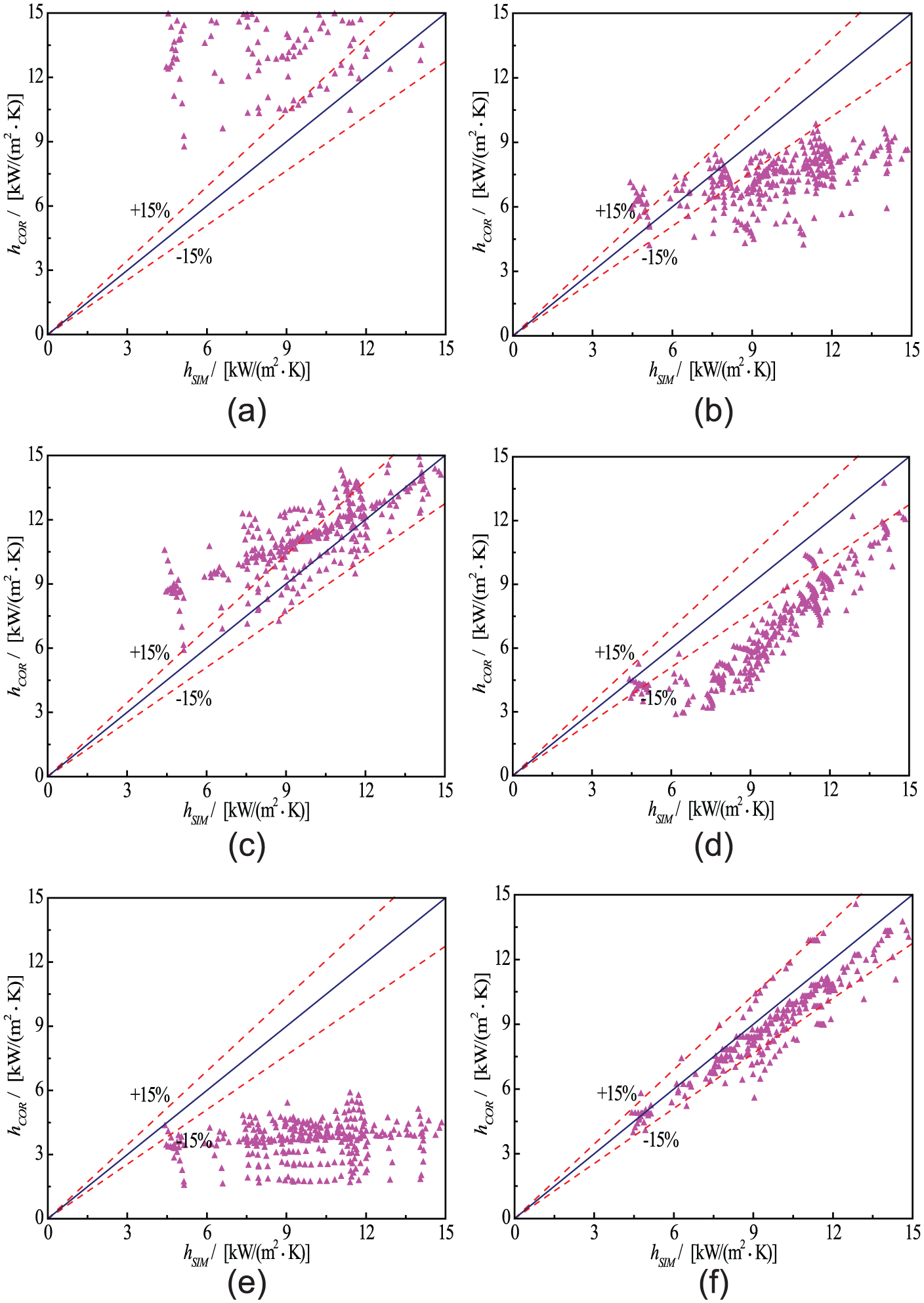
Comparison between simulation results and correlation calculations: (a) comparison between simulation results and correlation of Tran et al.; (b) comparison between simulation results and correlation of Bertsch et al.; (c) comparison between simulation results and correlation of Gungor and Winterton; (d) comparison between simulation results and correlation of Kandlikar; (e) comparison between simulation results and correlation of Sun and Mishima; and (f) comparison between simulation results and correlation of Liu and Winterton.
Conclusion
In this article, a model was established to investigate the characteristics of boiling heat transfer on hydrocarbon mixture refrigerant in a vertical rectangular minichannel. ANSYS-CFX simulation was done on the boiling heat transfer. The simulation results were compared with the existing correlations of heat transfer coefficient developed in the literature. The following conclusions can be drawn from this study:
The results obtained by numerical simulations on heat transfer coefficient in a vertical rectangular minichannel show that the simulation results are consistent with the experiment data from the literature. Simultaneously, the deviations are within ±15% between simulation results and experiment data from the literature.
Due to the influence of the forced convection boiling mechanisms, the heat transfer coefficient increases with the increase in saturated temperature and the mass flux. The influence of the pressure is obvious for the boiling heat transfer of hydrocarbon mixture refrigerant in a vertical rectangular minichannel when the saturated temperature is less than 203 K.
The calculations of heat transfer coefficient by correlation of Liu and Winterton are in good agreement with the simulation results compared with other correlations though the calculations by correlation of Liu and Winterton are less than the simulation results. At the same time, the deviations between the simulation results and correlation calculations are less than ±15% in most cases at the temperature T = 150–215 K, mass flux m = 100–400 kg/(m2 s), pressure P = 0.2–0.5 MPa, and heat flux q = 5–20 kW/m2.
Footnotes
Appendix 1
Academic Editor: Mohammad Reza Salimpour
Declaration of conflicting interests
The author(s) declared no potential conflicts of interest with respect to the research, authorship, and/or publication of this article.
Funding
The author(s) disclosed receipt of the following financial support for the research, authorship, and/or publication of this article: This work was supported by the National Natural Science Foundation of China (51378318).