




Abstract
Water is one of the most important constituents of the human body. Daily consumption of water is thus necessary to protect human health. Daily water consumption is related to several factors such as age, ambient temperature, and degree of physical activity. These factors are generally difficult to express with exact numerical values. The main objective of this article is to build a daily water intake recommendation system using fuzzy methods. This system will use age, physical activity, and ambient temperature as the input factors and daily water intake values as the output factor. The reasoning mechanism of the fuzzy system can calculate the recommended value of daily water intake. Finally, the system will compare the actual recommended values with our system to determine the usefulness. The experimental results show that this recommendation system is effective in actual application.
Introduction
Humans must drink water every day to maintain homeostasis in the body. For an adult male, water may account for 60% of body weight, while for adult women and elderly individuals, water may account for 50% of their body weight. 1 Water can be lost through urine, feces, respiration, and transpiration. Under high temperature and high physical activity, the loss of body water will intensify. The Tropical Agriculture Association 2 has published water requirements for humans, animals, and irrigated crops, given in liters per year. Based on those figures, the minimum water requirement for fluid replacement for a 70-kg human in a temperate zone is 3 L/day or 42.9 mL/kg. Minimum requirements for an individual of the same size but in a tropical zone are 4.1–6 L/day or 58.6–85.7 mL/kg.
Although replenishment of water is necessary, it is difficult to accurately determine the exact value of the water, which is related to many factors. Several agencies and organizations have established recommended values for daily drinking water for evaluation and suggestion. The Dietary Reference Intakes (DRI) 3 for water are shown in Table 1.
Daily water needed for different ages.
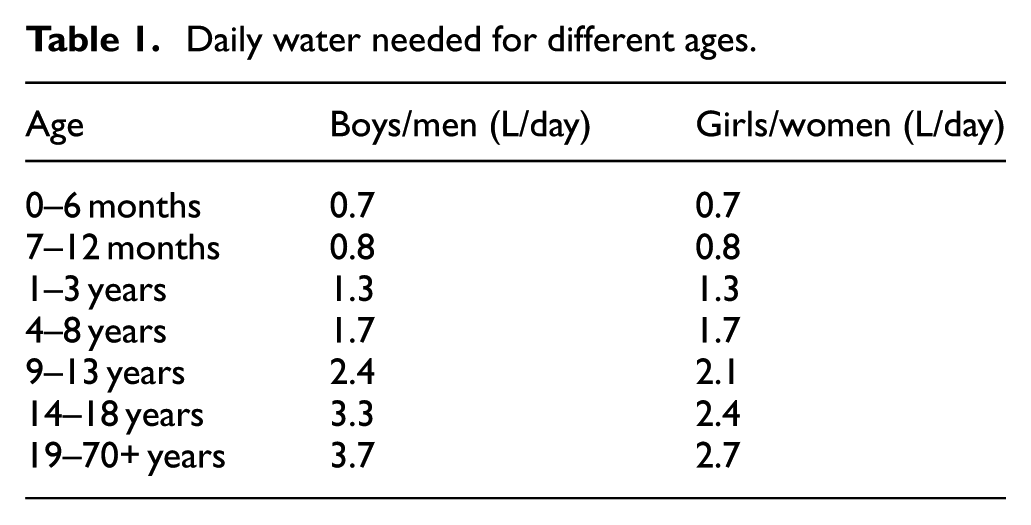
The recommended values given by these agencies and organizations are all rough values. This is because the exact value of daily water intake is associated with many factors, such as age, weight, temperature, and activity. This shows that a more accurate water intake recommendation system for ensuring human health is useful and important.
Following the conventional approach to this problem presents considerable difficulties. The reason is that it is difficult to express the factors involved with exact numerical values. For example, it is difficult to use extremely precise values to describe the current temperature. Instead, people may say “Today is very hot” or “it is a little cold today.” Therefore, conventional statistical methods are not suitable for constructing this recommendation system. In this article, we use the fuzzy system to build a recommended daily water intake system because fuzzy systems have unique advantages in processing such semantic data.
In this article, we use the fuzzy system to analyze daily water intake and associated factors, including the ambient temperature, activity level, and age. Through the analysis of these factors and the appropriate formulation of the fuzzy system, we can construct a more accurate recommendation system for daily drinking water. At the same time, we can verify that the two values are close and reasonable. We have also designed a real system to verify our fuzzy system.
The rules design process is one of constant adjustments. Based on the literature, we designed the rules and input them into the fuzzy system. We then compared the results with recommended value which is from the authority’s recommendation. If the results are not correct, we need to adjust the rules and membership functions.
The remainder of this article is organized as follows: section “Fuzzy theory and application” presents the literature on fuzzy theory and its applications. In section “Design of fuzzy logic and infrastructure,” the overall structure and inference module are introduced. Section “Fuzzy rules design and analysis” describes the fuzzy rules design and analysis. Finally, the conclusion and recommendations are given in section “Conclusion and future works.”
Fuzzy theory and application
Fuzzy logic is an area of soft computing that enables a computer system to reason with uncertainty. 4 It focuses on describing different levels of things in the real world. It extended the range of truth values to all real numbers into the interval between 0 and 1. Unlike two-valued Boolean logic, fuzzy logic is multi-valued. It deals with degrees of membership and degree of truth. Fuzzy logic uses continuous values between 0 and 1 to represent that things can be partly true and partly false.
A fuzzy inference system using fuzzy sets to construct rules is needed. Unlike the aforementioned conventional set, a fuzzy set expresses the degree to which an element belongs to a set. Hence, the characteristic function of a fuzzy set is allowed to have values between 0 and 1, which denotes the degree of membership of an element in a given set. 5
If X is a collection of objects denoted generically by x, then a “fuzzy set”A in X is defined as a set of ordered pairs

where UA(x) is called “membership function” (or MF for short) for the fuzzy set A. The MF maps each element of X to a membership grade (or membership value) between 0 and 1.
The general fuzzy logic and infrastructure is presented in Figure 1. Fuzzy logic can accept linguistic variables as input data. The input variables in a fuzzy system are in general mapped by sets of membership functions similar to this, known as “fuzzy sets.” The process of converting a crisp input value into a fuzzy value is called “fuzzification.” 6 An inference engine is actually the processing stage which invokes each appropriate rule from the rule base and knowledge base and generates a result for each and then combines the results of the rules. The system structure is shown in Figure 1. A detailed explanation is given below:
1. Fuzzification: In this stage, the system accepts the input variables, which may be linguistic words, and evaluates which fuzzy sets the input variables should belong to and the degree of their membership.
2. Knowledge base: Fuzzy sets and membership functions are stored in the knowledge base and may be used as fuzzy rules to generate input and output.
3. Rules base: Stored in the rule base are fuzzy rules based on expert knowledge. The statement of (IF–THEN) is usually used to describe the fuzzy rules. If the control system has multiple fuzzy variables, the (IF AND–THEN) statement is used to describe the fuzzy rules. 6

The infrastructure of the fuzzy system.
For example: water intake recommendation may be described with the following statement:
R1: IF age is child and temperature is low and activity is low THEN water intake is low–low.
where R1 represents a rule, the IF part is called the premise portion, and the THEN part is called the inference result.
4. Inference engine: Fuzzy reasoning is a process in which the fuzzy output is determined through fuzzy logic operation following the IF–THEN rules stored in the rules base. There are many fuzzy reasoning methods such as the max–min operation in the Mamdani mode.
5. Defuzzification: After the process of fuzzy reasoning, fuzzy control values will be obtained, but they must undergo defuzzification to obtain crisp outputs and be put into the control system. There are many common defuzzification methods, such as the maximum home value method, the center of gravity method, and the weighted average method.
Design of fuzzy logic and infrastructure
The daily amount of water needed is related to many factors, which may include the environmental temperature, age and weight, gender, and daily exercise. The human body may have different sources of water, such as fruits, vegetables, or milk. In the stage of fuzzy logic and architecture design, though it is necessary to take these factors into account, it is also necessary to ensure that the fuzzy infrastructure and the structure of the system are simple and reliable. After repeated design, experiment, and adjustment, the three most important factors, age, temperature, and activity, were used as the input factors to determine the recommended value of daily drinking water.
Age, ambient temperature, and physical activity are directly related to the body’s water consumption. For people of different ages, the demand for water is different. In general, as age increases, the body’s demand for water slowly declines. The recommended daily water intake for different ages is shown in Table 2. 7 For example, for an adult male of 70 kg, the recommended daily water intake is 40 × 70 = 2800 mL. However, to make the recommended values more practical and accurate, it is necessary to consider other factors, such as actual ambient temperature and daily exercise.
Relationship between age and water intake recommendation.

Ambient temperature is a remarkable factor that has a great influence on the needed daily water intake. Under normal temperature (22°C–25°C), the body consumes 1500–2500 mL of water per day. However, when the temperature is higher, water losses will increase. In an extremely hot environment, the body will lose 1.5 L/h water through transpiration. 8
The degree of physical activity is another factor which has a remarkable influence on daily water consumption. Strenuous exercise or heavy physical labor consumes water in the body through sweat and transpiration. Thus, replenishment of water is particularly necessary. In daily life, the level of physical exercise is closely related to the type of work engaged in. We use the basic metabolic rate (BMR) to measure the level of physical activity. According to the type of work or the intensity of motion, the value range is between 1 and 2.5. The corresponding data are shown in Table 3.9,10
Physical activity levels (BMR).

BMR: basic metabolic rate.
The first input factor is age. By analyzing range of ages and daily water intake recommendation, the age variable is divided into following fuzzy sets: child, teenage, adult, and old. The age membership function is shown in Figure 2. The range of age is between 0 and 120 years. The reason for using a trapezoid for the old membership function is that the age above 80 is usually defined as elderly.

Membership function of age (year).
The second input factor is ambient temperature. We set the range of temperatures from 0°C to 50°C, which in the fuzzy set is accordingly divided into low, medium, and high, as shown in Figure 3.
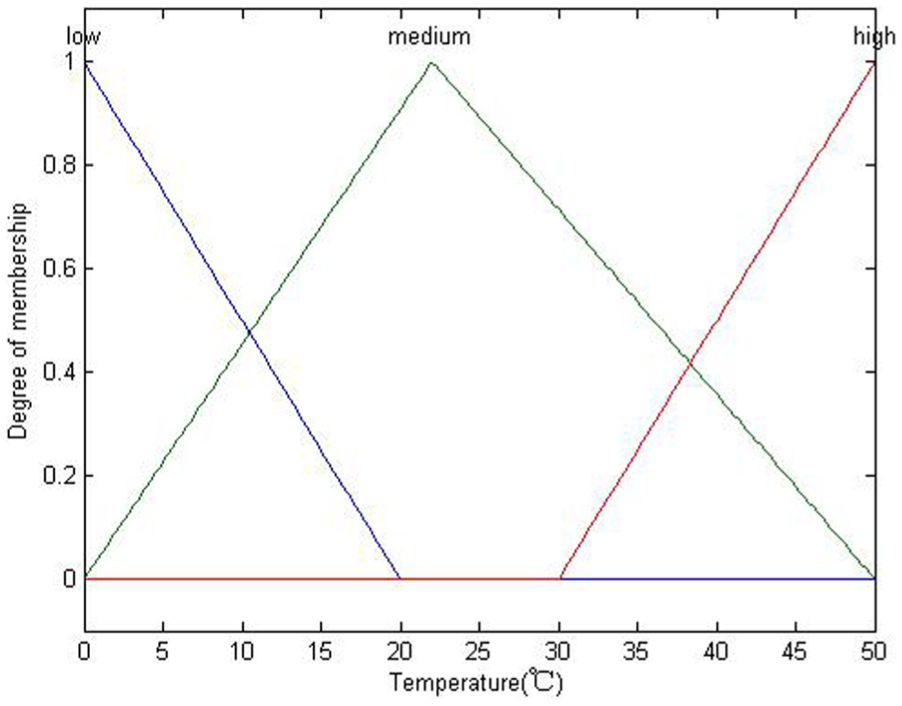
Membership function of temperature (°C).
The third input factor is physical activity. We set the value range from 1 to 2.5, with the fuzzy set accordingly divided into low, medium, high, and very high, as shown in Figure 4.
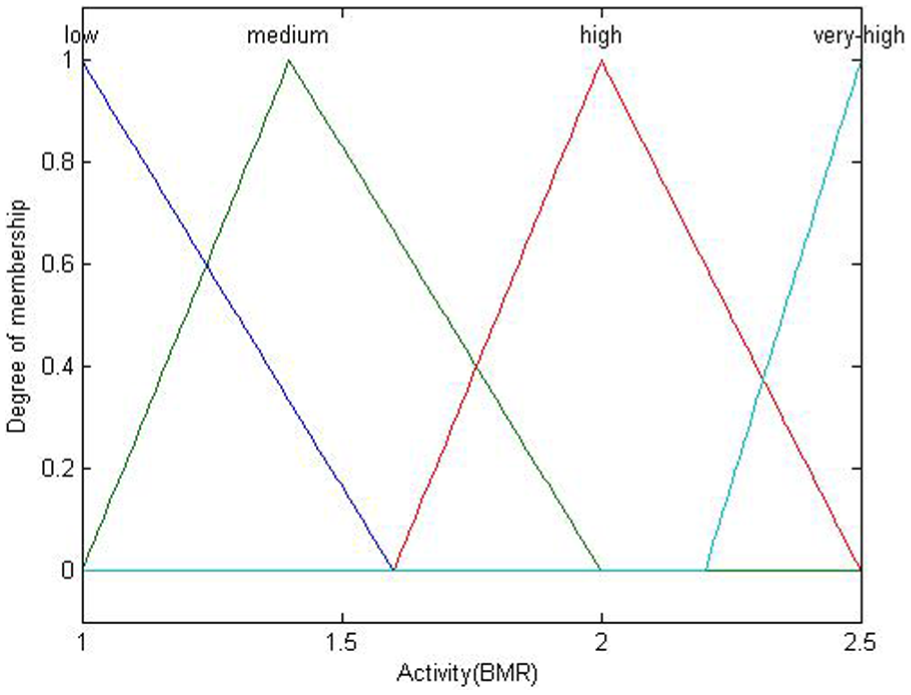
Membership function of activity (BMR).
As the output factor, we set the range value for the daily water intake recommendation from 0 to 5000 mL. The fuzzy sets are divided into following values: low–low, low, low–medium, medium, high–medium, high, and very high. The membership function is shown in Figure 5.

Membership function of daily water intake (mL/day).
Fuzzy rules design and analysis
In our fuzzy system for the daily water intake recommendation, the three input variables were age, temperature, and physical activity, where age is divided into the child, teenage, adult, and old subsets; temperature is divided into the low, medium, and high subsets; and exercise is divided into the low, medium, high, and very high subsets. This means that the number of fuzzy rules will be 4 × 3 × 4 = 48 [10]. These rules and the corresponding results are shown in Table 4.
Fuzzy rules for daily water intake recommendation.

BMR: basic metabolic rate.
Under the single factor condition, we consider age, temperature, and activity to be reasonable input factors in determining the daily water intake. We use MATLAB as the analysis tool. After setting the range of MF, we designed the rules and input these rules into MATLAB. Using the fuzzy reasoning function of MATLAB, we can obtain the two-dimensional (2D) relationship figures of input factors. Figures 6–8 show three relationships: the relationship between age and water consumption, the relationship between temperature and water consumption, and the relationship between activity and water consumption, respectively.

Relationship between age and daily water consumption.

Relationship between temperature and daily water consumption.

Relationship between activity and daily water consumption.
The three-dimensional (3D) relationship of age, temperature, activity, and water intake is shown in Figures 9 and 10.
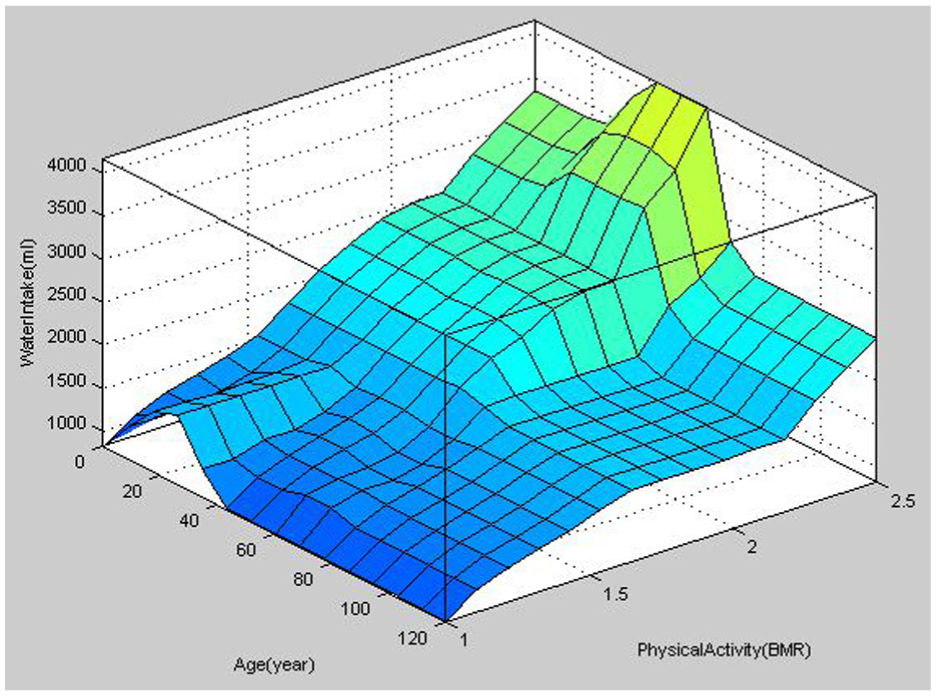
Relationship between age, activity, and water intake.
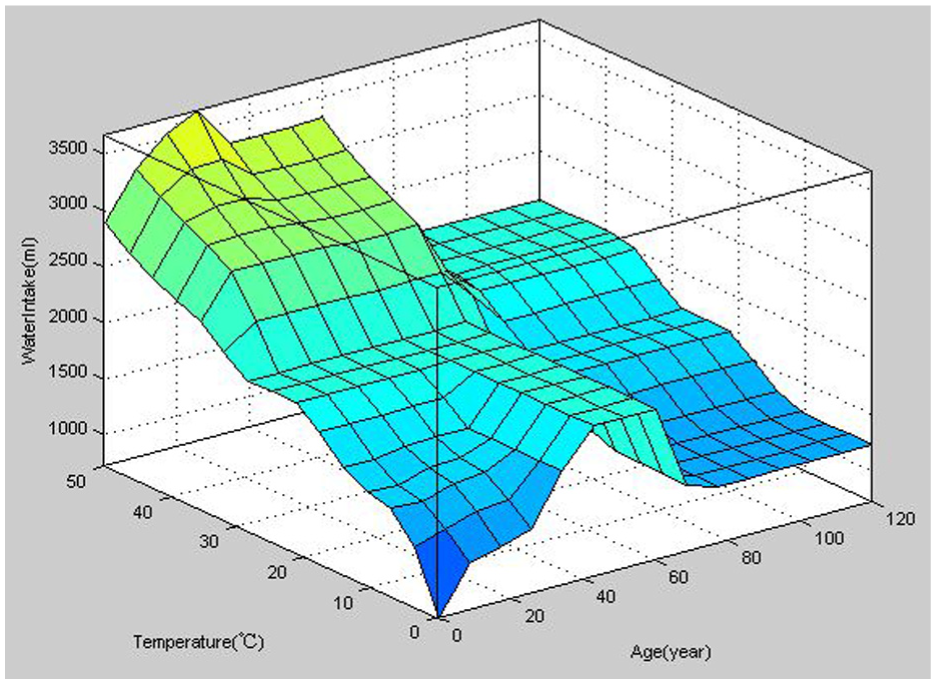
Relationship between age, temperature, and water intake.
Figure 11 shows that the recommended value for water intake is 1670 mL/day for a 27-year old when the temperature is 20.4°C and physical activity is 1.81 (BMR). The system compares the data to data from the OKMEYDANI Training and Research Hospital in Table 5. 8 The results indicate that the OKMEYDANI Training and Research Hospital recommendation data are very close to our results.

Recommended daily water intake from fuzzy logic.
Recommended daily water intake from the OKMEYDANI Training and Research Hospital.

BMR: basic metabolic rate.
The results obtained from our fuzzy system appear to be reasonable within the range of recommendations. If the resulting values are very close to the median, we can say the system is valuable. Through continuous adjustment, we can obtain a satisfactory result from the fuzzy system.
For example, for a 25-year-old adult and an ambient temperature of 30°C, the recommended value from the fuzzy inference system was 2820 mL/day. The actual recommended value, assuming the body weight is between 50 and 80 kg, is 2000–3200 mL, with a median of 2600 mL. This value is very close to our result. Since at 30°C humans should be drinking more water, the recommended value of 2820 mL is reasonably accurate. For an individual aged 60, under a temperature of 25°C and activity of 1.75, the recommended water intake is 1630 mL. We performed many tests across different age groups and temperature conditions and the results were satisfactory.
In this study, a fuzzy system for daily water intake recommendations using the core method is proposed. The system includes hardware and software. The hardware includes Arduino, a Bluetooth module and a coaster electric scale module. The software is based on our proposed method to obtain user information and to make suggestions for users’ daily water intake. The system uses Arduino and a Bluetooth electronic scale and provides an algorithm to determine the user water intake during a period of time. The Bluetooth module can be used to connect Arduino and a smart phone within the appropriate distance. The system can read the weight values from the Bluetooth electronic scale and display the result on smart phones. Meanwhile, the system can calculate the amount of water intake from the Bluetooth electronic scale for a given period of time. The test results show whether the actual amount of user water intake is consistent with our recommendation for water intake.
Conclusion and future works
Since the fuzzy system can deal with uncertain and vague data, we use it to evaluate the daily water intake recommendation. Through careful design and adjustment of the rules, we obtain more accurate results for the recommendations. In our fuzzy logic system, the system uses age, temperature, and physical activity as input factors and develops 48 rules to determine the recommended daily water intake. However, we are working on improving the system stability and on obtaining more detailed data. The recommendation system can be used for future development of the actual products. In the next step, we will add body weight as an input factor to improve the accuracy of the recommended values. In subsequent work, we also will add more factors and hardware to improve the accuracy of the recommendation values and implement a business application system based on fuzzy logic reasoning.
Footnotes
Academic Editor: Stephen D Prior
Declaration of conflicting interests
The author(s) declared no potential conflicts of interest with respect to the research, authorship, and/or publication of this article.
Funding
The author(s) disclosed receipt of the following financial support for the research, authorship, and/or publication of this article: This paper is supported by Ministry of Science, Taiwan, with project numbers MOST-103-2221-E-324-028 and MOST-104-2221-E-324-019-MY2. In addition, the paper was also supported by National Natural Science Foundation of China (61373147) and Science and Technology Planning Project of Fujian Province (2016Y0079).