



Abstract
Product style characteristics have a large impact on product function. Making an objective and precise assessment of style characteristic has become an increasing importance to improve the production efficiency and reduce environmental pollution. This work proposes a framework built by analytic hierarchy process and technique for order preference by similarity to ideal solution methods, that is, analytical hierarchy process and technique for order performance by similarity to ideal solution, to evaluate automotive style design alternatives’ performance, together with automotive style design characteristics. Analytic hierarchy process is applied to obtain weights of the performance, and technique for order preference by similarity to ideal solution is adopted to rank the design alternatives. A case study is illustrated to test and verify the proposed method. Simultaneously, sensitivity analysis is provided to monitor the robustness of this method. The results show that it provides an effective and feasible method for evaluation of automotive style design alternatives’ performance.
Keywords
Introduction
Successful and innovative product design is highly correlated with the development of enterprises. Especially, due to the fiercely competitive pressure to economic and social awareness of public life needs for high-quality products, product design approach has already oriented to customer rather than production or modern marketing. Thus, quality function deployment (QFD), as a far-ranging customer-oriented methodology used in order to assist in product design and development, is aroused.
Wang et al. 1 compare two weighting methods in QFD: analytic hierarchy process (AHP) and prioritization matrix method. Yung et al., 2 Lin et al. 3 and Erkarslan and Yilmaz 4 analyse design characteristics in QFD using AHP method. Kwong and Bai 5 determine the importance weights based on the client needs by combining fuzzy AHP and extent analysis approach. Nepal et al. 6 present a fuzzy AHP method for prioritizing customer satisfaction attributes in target planning. Li et al. 7 propose a systematic method which determines the final priority sequence according to customer requirements based on the integration of a minimum deviation using scorecard, AHP and scale integrated method. Fung et al. 8 combine AHP and fuzzy logic to obtain target values for product features. Dawson and Askin 9 present a nonlinear mathematical method in order to determine optimal engineering features based on the constraints of costs and life-cycle time. To achieve sustainability, environmental factors are introduced to the QFD problem. For example, Sakao 10 presents an eco-design method integrating QFD, life-cycle evaluation and theory of inventive problem solving (TRIZ) to effectively improve reliability of the product design for product eco-design activities. Utne 11 uses an Eco-QFD, which combines QFD, life-cycle cost and life-cycle analysis, to evaluate environmental effects and costs in the system development process and to improve the environmental performance of the Norwegian fishing fleet. Ramanathan and Yunfen 12 use data envelopment analysis in QFD based on cost and environmental factors. Lin et al. 13 propose a novel model which combines analytic network process (ANP) and fuzzy QFD to analyse the requirements of environmental production for an original firm in Taiwan. Yang et al. 14 present a QFD method for identifying pivotal index and evaluating environmental performance. Buyukozkan and Berkol 15 establish a decision framework combining ANP, QFD and zero-one goal programming models to determine the design requirements for a sustainable supply chain.
After design characters are identified, design alternatives need to be established and selected, and it belongs to a multiple-criteria decision-making (MCDM) problem. For this kind of problems, the technique for order preference by similarity to ideal solution (TOPSIS) is a useful tool to solve it. For example, Ic 16 adopts the TOPSIS method to evaluate and assess the company ranking. Tong et al. 17 obtain the optimal factor combination according to the overall performance index for multiple responses using TOPSIS method. Ulker and Sezen 18 adopt the TOPSIS method to determine the best printed circuit board design computer-aided design (CAD) tool problem. Garcia-Cascales and Lamata 19 use this method to select a cleaning system for pieces of four stroke engines. Khademi-Zare et al. 20 adopt it to rank customer attributes in QFD. However, the TOPSIS method does not have the chance to apply in the evaluation of automotive style design alternatives.
According to the above literature review, we can obtain that current researchers mainly analyse the economical and environmental factors on QFD problem. However, product style characteristics, for example, proportion, morphological image and colour, have a large impact on the product design; thus, style characteristics should be considered when an optimal product design schedule is determined. In addition, researchers concentrate on some design products including printed circuit board and personal digital assistant, but they pay little attention to the automotive style/body design problem. Although some researchers have proposed to use fuzzy logical21–23 and genetic algorithm 24 to address the product form design problem, these methods still heavily depend on subjective experience/intuition of one or several designer and assume that each factor involved with design characteristics is equally important. In fact, based on the actual customer requirements, each factor associated with design characteristics should have different importance degree by identifying main design characteristics of a desired product. Also, the determination of design schedule should consider the requirements of multi-designer to avoid the insufficiency of subjective experience of one or several designers. To do so, this work proposes to evaluate the automotive style design problem using an integrated AHP-TOPSIS approach. Namely, AHP is applied to resolve the weights of evaluation criteria/factor of automotive style design, and TOPSIS is adopted to select the optimal design alternatives. The purpose of this work is to generate an effective method to determine an optimal automotive style design scheme by taking style characteristics, the weights of evaluation criteria and the design experiment of multi-designer into account. Compared with previous studies, this work has three advantages. (1) An evaluation framework to guide designers for the automotive style design is defined and developed, that is, evaluation criteria/factor for an automotive style design is defined and its evaluation framework is presented. (2) An integrated AHP-TOPSIS approach is adopted to select the optimal scheme for automotive style design alternatives, which makes full use of quantitative analysis and weight allocation features of AHP and the better ability of scheme selection of TOPSIS. (3) Comparing with the results of TOPSIS analysis, this work validates the effectiveness and feasibility of the proposed approach in evaluating an automotive style design alternative problem, and its sensitivity analysis is presented.
The rest of this work is organized as follows: section ‘Assessment approach’ presents a combined AHP-TOPSIS approach. Section ‘Case study’ introduces an evaluation framework for an automotive style design alternatives and performs its design assessment analysis. Section ‘Comparative validation’ verifies the method’s effectiveness and its sensitivity analysis. Finally, section ‘Conclusion’ concludes our article and describes several future study issues.
Assessment approach
In this work, we combine two MCDM methods to assess the automotive style design alternatives, that is, the weight of each criterion is made up via AHP and design schemes are selected using TOPSIS.
AHP
AHP is an MCDM technique developed by Saaty 25 for assessing and selecting alternatives according to a set of selected criteria based on the elements of the hierarchy related to any evaluation index of the decision problem. The principle is to decompose factors affecting the complex issues and categorize these factors into different levels in a hierarchical structure – the target layer, the rule layer and the index layer, that is, goal level, criterion level and factor/attribute level in this article. Then, it rates layer by layer through a comparison between two factors. It also provides a methodology to calibrate the numeric scale for the measurement of quantitative as well as qualitative performances. 26
Matrix A is a comparison matrix in which every element aij (i, j = 1, 2, …, k) expresses the individual preference of expert regarding alternative Ai compared to alternative Aj. Thus, the comparison matrix A can be expressed as


In addition, random consistency index RIk is shown in Table 1.
Random consistency index (RIk).

The vector of weights w = (w1, w2, …, wk) about the elements i = 1, 2, …, k can be obtained from the pairwise comparison matrix (PWCM) A by the eigenvector method as shown in equation (3)27–31

where w is the eigenvector corresponding to the maximal eigenvalue λmax of matrix A.
The inconsistency of matrix A can be obtained by the consistency ratio CRA = CIA/RIk, where consistency index CIA = (λmax − k)/(k − 1). If CR < 0.1, the judgement matrix is acceptable, otherwise, it is considered inconsistent. Random consistency index RIk depends on the size of the matrix A. It can be acquired from Table 1. Since the column(s) of any 1 × 1 or 2 × 2 comparison matrices are dependent, RI is assumed to be 0. This means division by zero in CRA and causes CRA to tend towards infinity, that is, matrices of sizes 1 and 2 are always consistent.27,28,31 Note that the PWCM is established, the interviewed expert needs depend on Table 2. 32
AHP scale for combinations.

TOPSIS
TOPSIS is an MCDM method to obtain the optimal solution, which is first proposed by Hwang and Yoon.33–35 It has the following steps:
Step 1. Build a ranking decision matrix and it is written as

where Ai represents the alternatives i, i = 1, 2, …, m; Fj means ith attribute or factor, j = 1, 2, …, n, related to ith alternative and xij is a crisp value denoting the performance rating of each alternative Ai associated with each criterion Fj.
Step 2. Compute the normalized decision matrix Y = [yij].
For the benefit attribute or factor, the normalized value yij is expressed as
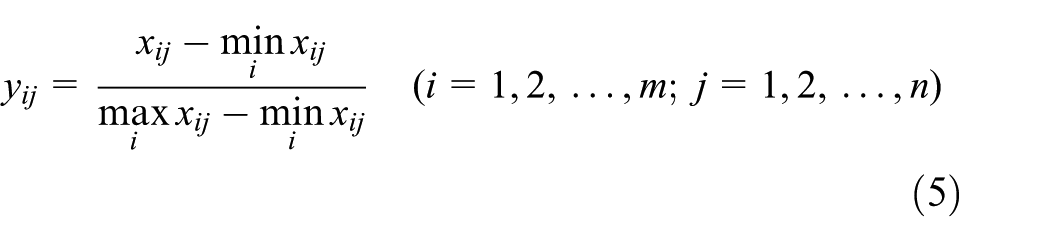
For the cost attribute or factor, the normalized value yij is expressed as
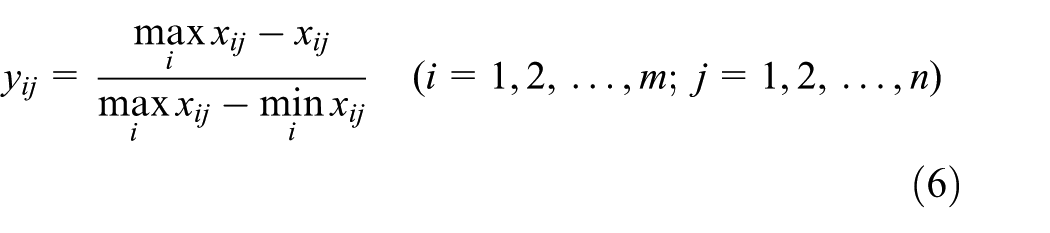
Step 3. Compute the weighted normalized decision matrix Z = [zij] according to equation (7)

where wj denotes the weight of the jth attribute or factor.
Step 4. Compute positive-ideal and negative-ideal solutions, and they are denoted as


Thus,
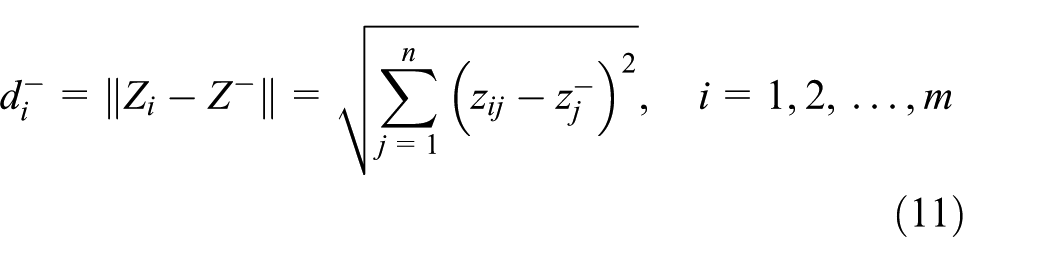
Step 5. Calculate the distances of each alternative to the positive-ideal solution

Step 6. The closeness index

Clearly,
Integrated AHP-TOPSIS judgement method
Let

Case study
In this section, considering the style design evaluation of BMW automobile as an example, this work presents its evaluation processes using integrated AHP and TOPSIS method. The detailed steps can be listed as follows.
Hierarchy criteria/factor of automobile style design evaluation
Based on the related literatures36,37 and expert interview, automobile styles are composed of four kinds of characteristic groups: rear characteristic group, front characteristic group, side characteristic group and top characteristic group. Accordingly, we establish a hierarchy structure of automobile style design evaluation, which is shown in Figure 1 and includes three levels: goal, criterion and factor/attribute levels. Goal level (G) includes automobile style design evaluation (G1) and criterion level (C) includes rear characteristic group (C1), front characteristic group (C2), top characteristic group (C3) and side characteristic group (C4). Rear characteristic group includes four factors: tail lamp style (F1), rear view profile (F2), the ratio of rear window on the whole back wall (F3) and the whole back wall (F4). Front characteristic group includes four factors: head lamp style (F5), intake grille structure style (F6), the ratio of intake grille on the whole front wall (F7) and hood shape surface tendency (F8). Top characteristic group includes four factors: the unification of skylight function and its style (F9), trunk cover profile (F10), plan outline (F11) and the whole top girth style (F12). Side characteristic group includes four factors: the unification of side window function and its style (F13), side window profile (F14), waistline curvature and location (F15) and delicate hand form (F16).

Hierarchy structure of automobile style design evaluation.
Weight determination via using AHP
The weight of each criteria/factor has a large impact on decision-making of automotive style design. To do so, this work uses AHP to obtain the weight of evaluation index of automotive style design. The detailed steps are presented as follows:
1. Establish pairwise comparison matrices
Based on the expert interview, we establish the PWCM from automotive style design perspective (G1–C), which is presented in Table 3.
PWCM from automotive style design perspective (G1–C).
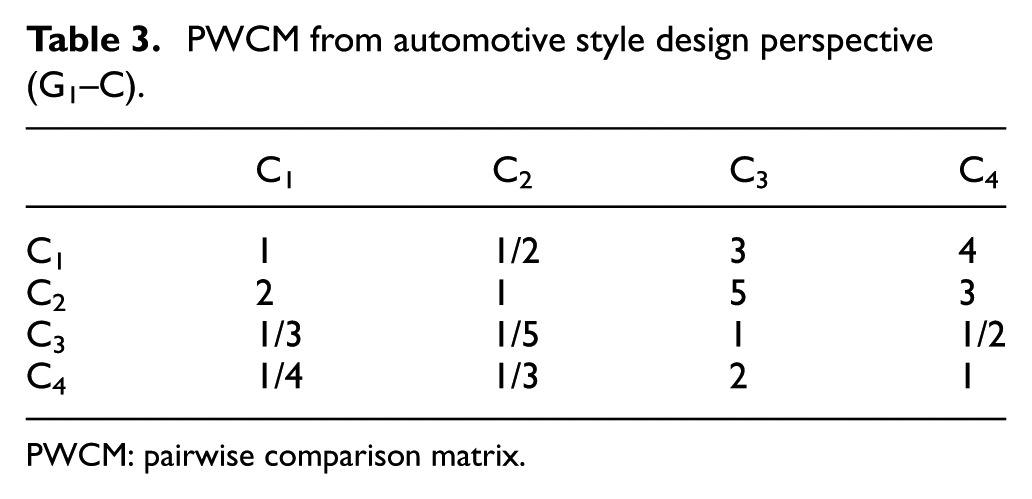
PWCM: pairwise comparison matrix.
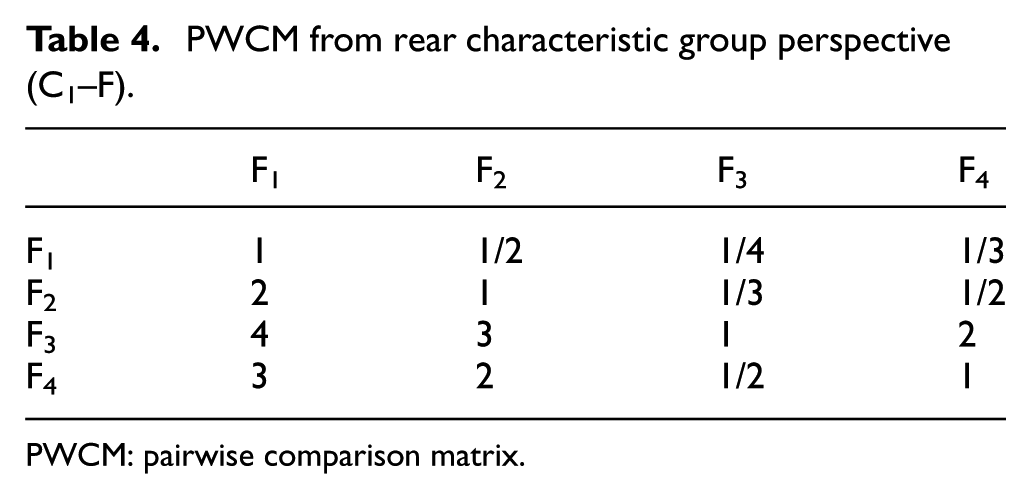
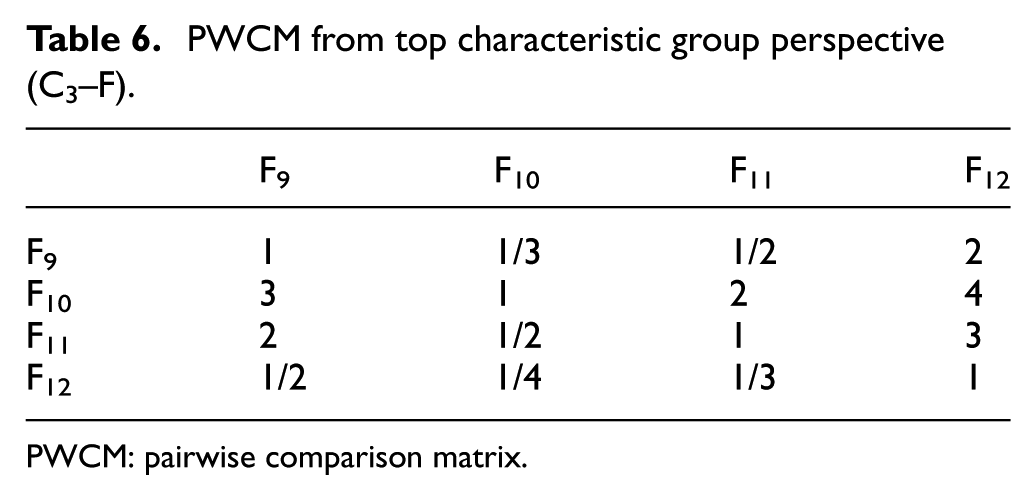
Similarly, we establish PWCM from rear characteristic group perspective (C1–F), from front characteristic group perspective (C2–F), from top characteristic group perspective (C3–F) and from side characteristic group perspective (C4–F), which are presented in Tables 4–7, respectively.
PWCM from rear characteristic group perspective (C1–F).
PWCM: pairwise comparison matrix.
PWCM from front characteristic group perspective (C2–F).

PWCM: pairwise comparison matrix.
PWCM from top characteristic group perspective (C3–F).
PWCM: pairwise comparison matrix.
PWCM from side characteristic group perspective (C4–F).

PWCM: pairwise comparison matrix.
2. Criteria/factor importance degree and consistency ratio test
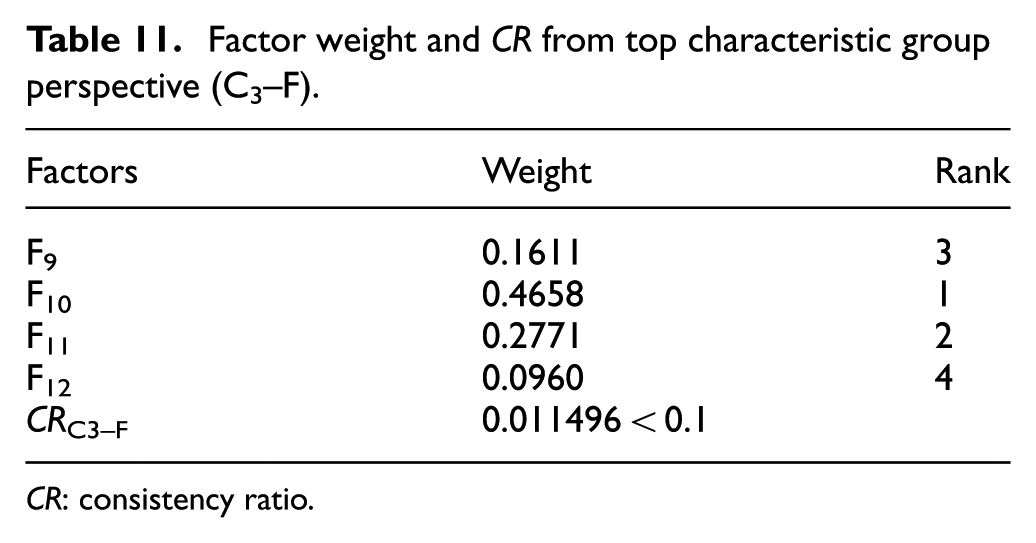
According to equation (3), the importance degree (weight) of each criteria/factor of PWCM and consistency ratio CR can be obtained. The importance of each criteria/factor and its consistency ratios of each PWCM are shown in Tables 8–12, respectively.
Criteria weight and CR from automotive style design perspective (G1–C).

CR: consistency ratio.
Factor weight and CR from rear characteristic group perspective (C1–F).

CR: consistency ratio.
Factor weight and CR from front characteristic group perspective (C2–F).

CR: consistency ratio.
Factor weight and CR from top characteristic group perspective (C3–F).
CR: consistency ratio.
Factor weight and CR from top characteristic group perspective (C4–F).

CR: consistency ratio.
In addition, based on the above results, we obtain each factor weight on overall goal of automotive style design, which is shown in Table 13. Note that each factor importance on overall goal = wG1–Ci × wCi–Fj (i = 1, 2, 4; j = 1, 2, …, 16). For example, the weight of factor F1 on the overall goal = wG1–C1 × wC1–F1 = 0.2958 × 0.096 = 0.0284.
Factor weight and rank on overall goal.

From Table 13, it can be seen that rear characteristic, front characteristic and side characteristic groups have a large importance on the automotive style design, and the results reflect the actual condition of the automotive style design.
Automotive style design assessment
Considering the style design assessment of BMW automobile, as shown in Figure 2, this section presents the optimal design alternative selection using the TOPSIS method. 38
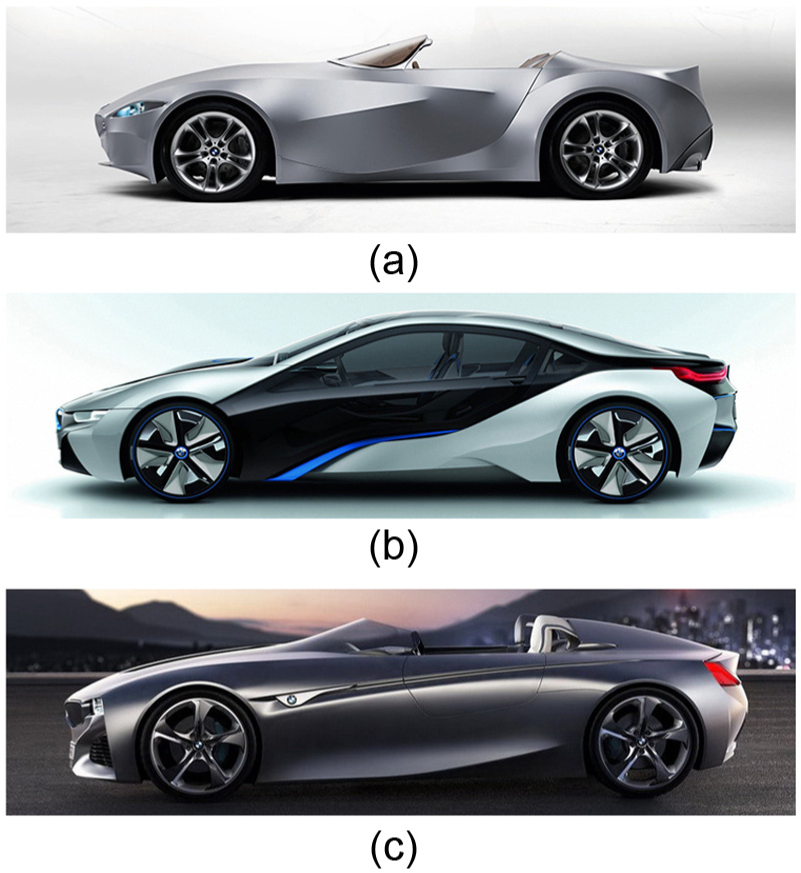
Automotive style design alternatives: (a) alternative 1, (b) alternative 2 and (c) alternative 3.
First, based on 20 expert’s interview, the factor performance score of each alternative on automotive style design is listed in Table 14. Note that the score is evaluated by the stanine method, that is, STAndard NINE.
Score of each factor for design alternatives.

Criterion assessment for automotive style design alternatives
1. The automotive style design assessment from the rear characteristic group perspective
According to Table 14, a decision matrix for the style design assessment is established

Based on equations (5) and (6), its normalized decision matrix is obtained

Using equation (7), the weighted normalized decision matrix is obtained

Thus,
According to equations (10) and (11), the distances of alternative 1 to the positive-ideal and negative-ideal solutions are
In addition, based on equation (12), the closeness index for each alternative is listed as follows:
2. The automotive style design assessment from the front characteristic group perspective
Slimily, the closeness index for each alternative is listed as follows:
3. The automotive style design assessment from the top characteristic group perspective
Slimily, the closeness index for each alternative is listed as follows:
4. The automotive style design assessment from perspective of the side characteristic group
Slimily, the closeness index for each alternative is listed as follows:
Overall assessment for automotive style design alternatives
Based on section ‘Establish pairwise comparison matrices’, the overall judgement matrix
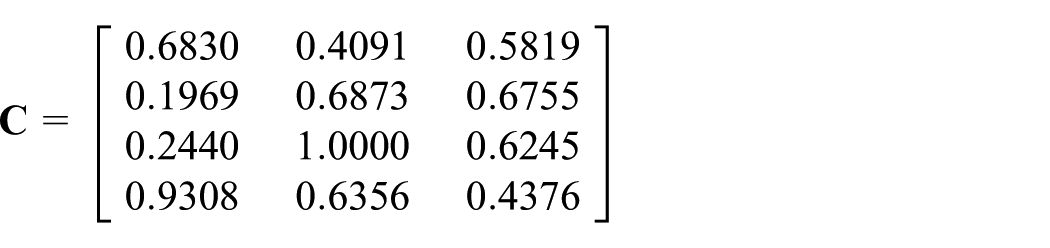
The weight vector for the criterion level

The results denote the overall performance for each alternative: the overall closeness index for alternative 1 is 0.4459, the overall closeness index for alternative 2 is 0.6284 and the overall closeness index for alternative 3 is 0.6102, that is, alternative 2 > alternative 3 > alternative 1.
Comparative validations
In this section, this work presents the comparison of the AHP-TOPSIS with TOPSIS, another decision-making technique, as well as a sensitivity analysis conducted on variations in criteria weights.
Comparison of the obtained results with TOPSIS method
In this work, the TOPSIS method is adopted to compare the outcomes of the proposed method. 16 Note that the equal weight method is adopted via using TOPSIS. The results of closeness index for both methods are presented in Table 15.
Comparison results for both methods.

AHP: analytic hierarchy process; TOPSIS: technique for order preference by similarity to ideal solution.
From Table 15, it can be seen that the results of both methods are consistent and close basically. This shows that the integrated AHP-TOPSIS method is reasonable and feasible when it is used to assess automotive style design alternatives.
Sensitivity analysis
In addition, to further test the effectiveness of the adopted method, its sensitivity analysis is conducted by adjusting the values of importance of the main criteria obtained from AHP procedures. The AHP approach is constructed on attitudes of the automotive style design. Three new cases (or scenarios) are generated when sensitivity analysis is performed, as shown in Table 16. Their results are presented in Table 17.
PWCM for different cases.

PWCM: pairwise comparison matrix.
The results of sensitivity analysis.

Sensitivity analysis shows that the results of the integrated AHP-TOPSIS approach are quite sensitive to the weight assigned to the evaluation criteria. The result shows that the assessment of decision makers is a very critical step to evaluate automotive style design alternatives and their decisions and experiments greatly contribute to the determination of the selection process. Therefore, this work can raise the designers’ awareness about the potential impact of decision-makers effectively and provide a normative direction for the future presence of a qualified decision-making group, which has a large potential for the automotive style design development.
Conclusion
Automotive style design is one of the important components of automotive product development, and it is a complex decision-making problem including multiple influencing factors. To do so, this work proposes a multi-criteria decision-making problem for an effective automotive style design evaluation for the first time. First, based on an extensive review of literature and experts’ opinions, 16 evaluation factors/attributes are determined and grouped into four main criteria: rear characteristic, front characteristic, top characteristic and side characteristic groups. A systematic hybrid MCDM method combining AHP and TOPSIS is adopted to assess the performance of the automotive style design alternatives. By comparing with TOPSIS, the effectiveness and feasibility of the hybrid method is validated in assessing automotive style design alternatives.
The future direction will focus on moving from the existing assessment method to integrating the evaluation procedure into a computer-assisted design support system for the automotive style design alternatives. Also, the information of experts has an uncertain and imprecise feature; some MCDM methods integrating uncertain theory for automotive style design alternatives need to be developed in the future.39–43
Footnotes
Academic Editor: Nasim Ullah
Declaration of conflicting interests
The author(s) declared no potential conflicts of interest with respect to the research, authorship and/or publication of this article.
Funding
The author(s) disclosed receipt of the following financial support for the research, authorship, and/or publication of this article: This work was financially supported by National Natural Science Foundation of China under Grant Nos 51405075, 51575232 and 51478204 and Funds for International Cooperation and Exchange of the National Natural Science Foundation of China under Grant No. 51561125002.