




Abstract
Axial-flow pump with a two-way passage has been widely employed in irrigation and drainage projects. Because of the shape of the two-way inlet passage, the impeller easily induces vibration due to unstable turbulent flow. This vibration results in structural cracks and even hinders the safe operation of the pump. Deformation and stress distributions in the impeller were calculated using two-way coupled fluid–structure interaction simulations, and a quantitative analysis of blade deformation and stress is carried out to determine the structure critical region. The results show that the values of deformation and stress significantly decrease with an increasing flow rate and a decreasing head, and the maximum total deformation can be found in the impeller rim, while the maximum equivalent stress can be obtained near the impeller hub. The total deformations in the blade rim decrease from blade leading edge to trailing edge, and the equivalent stress in the blade hub initially increases and then declines, and in the end, it rapidly increases from the blade outlet to inlet. These results reveal the deformation and stress in the impeller to ensure reliability and specific theoretical guidance for the structural optimization design of a pump device.
Keywords
Introduction
An axial-flow pump device with a two-way passage consists of an impeller, a guide vane, a two-way inlet passage, and a two-way outlet passage. Because of its advantages of a small floor area and easy maintenance, it is often adopted to meet the demand of a large farmland and the associated drainage. However, a vortex is easily formed in the two-way inlet passage. The bad flow state in the inlet passage will lead to flow separation and, in turn, a vortex in the impeller, which may cause impeller vibration (deformation and stress problems). These problems will lead to degradation of the pump device performance, thus hindering its safe operation. Fluid–structure interaction (FSI) produced this phenomenon. Therefore, determining the stress distribution and deformation in the impeller to ensure the reliability of the pump device requires not only a solution for the internal flow field of the pump but also an analysis of the structural mechanics of the impeller.
In recent years, an increasing number of researchers have begun to apply the theory of fluid–solid coupling to turbomachinery1–4 and other types of pumps. Deformation and stress in the impellers of multistage centrifugal pumps were evaluated by Schneider et al. 5 Also, the influence of impeller design parameters on the resulting deformation and stress was investigated. Benra and Dohmen 6 applied different coupling methods of fluid and structural dynamics to compare impeller orbit curves; moreover, Benra et al. 7 determined pump impeller deflections and compared FSI simulations with measurements. Erath et al. 8 modeled the FSI produced by a water hammer during shutdown of high-pressure pumps and compared it with an experiment measuring a pipe system with pump shutdown and valve closing. A two-way coupling method was used to analyze the effect of the impeller FSI on the flow field by Jiang et al. 9 Liu et al. 10 studied the inner flow mechanism of the FSI effect on the external characteristics and analyzed the external characteristics and internal flow features of a diffuser pump with the two-way flow solid coupling method. The dynamic stresses in a single-blade centrifugal pump impeller were analyzed by Pei et al.11,12 using different operating conditions. Also, the partitioned FSI solving strategy was applied to quantitatively determine the coupling effects of a fluid–structure system on the unsteady flow in a single-blade centrifugal pump. A one-way FSI was used to accurately assess the deformation and stress in the impeller in a multistage submersible pump in Shi et al. 13 The flow pressure and centrifugal force imposed on the impeller were used to evaluate the maximum equivalent stress and deformation in the impeller. Wu et al. 14 primarily adopted fluid dynamics to conduct comprehensive numerical simulations of the unsteady turbulent flow of hydraulic turbine units under four operating conditions with different outputs at the rated head to analyze the causes of runner blade cracks. In addition, Wu et al. analyzed and compared the changes in the velocity field, pressure field, and pressure pulsation situations inside the runner under various conditions. In addition, some literatures about FSI analysis on axial-flow pump can be observed;15–17 however, the detailed analysis in a quantitative sense is still not enough, and only few studies considering the effect of inlet and outlet passages on the flow-induced vibration for axial-flow pump device can be found.
In this study, FSI simulations were performed to quantify the deformation and stress in the impeller of an axial-flow pump device with a two-way passage. A strong FSI effect was realized with a two-way coupling method during the calculation. The deformation and stress in the impeller were calculated under various operating conditions to obtain the distribution of the stress and deformation.
Mathematical model and FSI setup
Pump and system parameters
Figure 1 displays a cut-away photograph of the analyzed test pump, which is an axial-flow pump device with a two-way passage. The impeller outer diameter is 300 mm, and the impeller hub diameter is 115 mm. The impeller blade number is 3, and the guide vane blade number is 5. Table 1 lists the material characteristic parameters of the rotor structure and the design parameters of the pump.

Cut-away photograph of the test pump.
Parameters of the pump system.

Governing equations and coupling approach
In our study, a fluid part Ωf and a solid part Ωs comprised the problem domain Ω, which can both be arbitrary in terms of the shape and the location of the solid and fluid parts. The structural domain Ωs and the fluid domain Ωf were separated by the conjoined interface. The fact that the fluid field is formulated and solved on a deforming grid is the essential feature. The deformation of the grid with the structure occurs at the interface, and the grid deformation extends into the fluid field. Figure 2 shows the scheme of the partitioned FSI simulation system. The finite volume method was used initially to compute the flow field, and subsequently, a number of flow parameters were solved. The force load is transferred to the structural dynamic solver through the fluid–structure interface, and these are the boundary conditions for finite element method (FEM) analysis. Therefore, the deformation of the structure can be solved. Next, the FSI calculation convergence is checked considering all the load components that are transferred between the two solvers individually. The FSI calculation will restart from the fluid field simulation if the load that was transferred converges on a specific convergence target for the next time step. Otherwise, the FSI iteration will continue for the current time step. When the convergence of the loads is transferred across the physical interface, the stagger iteration loop will stop. Equation (1) defines the convergence criterion for the load transfer procedure

where

When e reaches a negative value, every quantity will be converged.

Flowchart of the coupled solution.
Flow is considered to be a viscous, three-dimensional, and unsteady turbulent flow. Therefore, the use of three-dimensional Reynolds-averaged Navier–Stokes questions was assessed. Equations (3) and (4) are for mass conservation and momentum conservation for an incompressible fluid, respectively. Time symbols were excluded since all variables were mean flow quantities


where dynamic viscosity is µ, the source item is represented by Fi, and the Reynolds stress is represented by
The equations were enclosed with a shear stress transport (SST) turbulence model, and the SST model was a modified


The following equations are used to calculate the turbulence viscosity




where the coefficients are as follows:
The ANSYS code was used for analysis of the impeller that was coupled to the flow calculation for the structure domain. The transient dynamic equation was

where
Calculation grids and boundary conditions
Only the pressure is included in the fluid load in the present case. The flow is influenced by the structural deformation by changing the flow geometry. Also, there is no consideration of the influence of the vibration velocity at the moment. The dominant hydrodynamic force component changed slowly, in addition, in comparison to the first rotor natural frequency. A static analysis can be used to determine the structure’s response. It can be assumed that the structure’s response may vary slowly with respect to time. The assumption that only the deflection displacement is considered in the coupled calculations, which were mentioned above, can be seen as acceptable.
The grid generation tool ICEM-CFD 14.5 was used to generate the structured grids for the impeller and guide vane and the unstructured grids for the inlet and outlet passages. Figure 3(a) shows the grids of all the domains partially. Also, the total number of grid nodes for both the stationary and rotating domains was 7,380,888, which was determined by grid independence analysis, as shown in Figure 3(b). There is a second-order of accuracy for the discretization in space. Also, the second-order backward Euler scheme was chosen for time discretization. The interface between the inlet passage and impeller and the guide vane and impeller was set to “transient rotor–stator” to capture the transient rotor–stator interaction in the flow. This was done because the relative position between the impeller and inlet passage with this kind of interface, as well as that between the impeller and guide vane, was changed for each time step. A smooth wall condition was used for the wall function. The chosen time step for the transient simulation was 3.2258 × 10⁻⁴ for the nominal rotating speed. This speed corresponded to a changed angle of Δϕ = 3°. The iteration stopped when the maximum residual was <10−4 within each time step. To reach the periodically stable results of unsteady flow simulation, 10 revolutions with total time of 0.387096 s have been calculated, and the results were used as the initial boundary for FSI simulation. To make the unsteady FSI results stable, additional six revolutions with total time of 0.232258 s have been calculated.
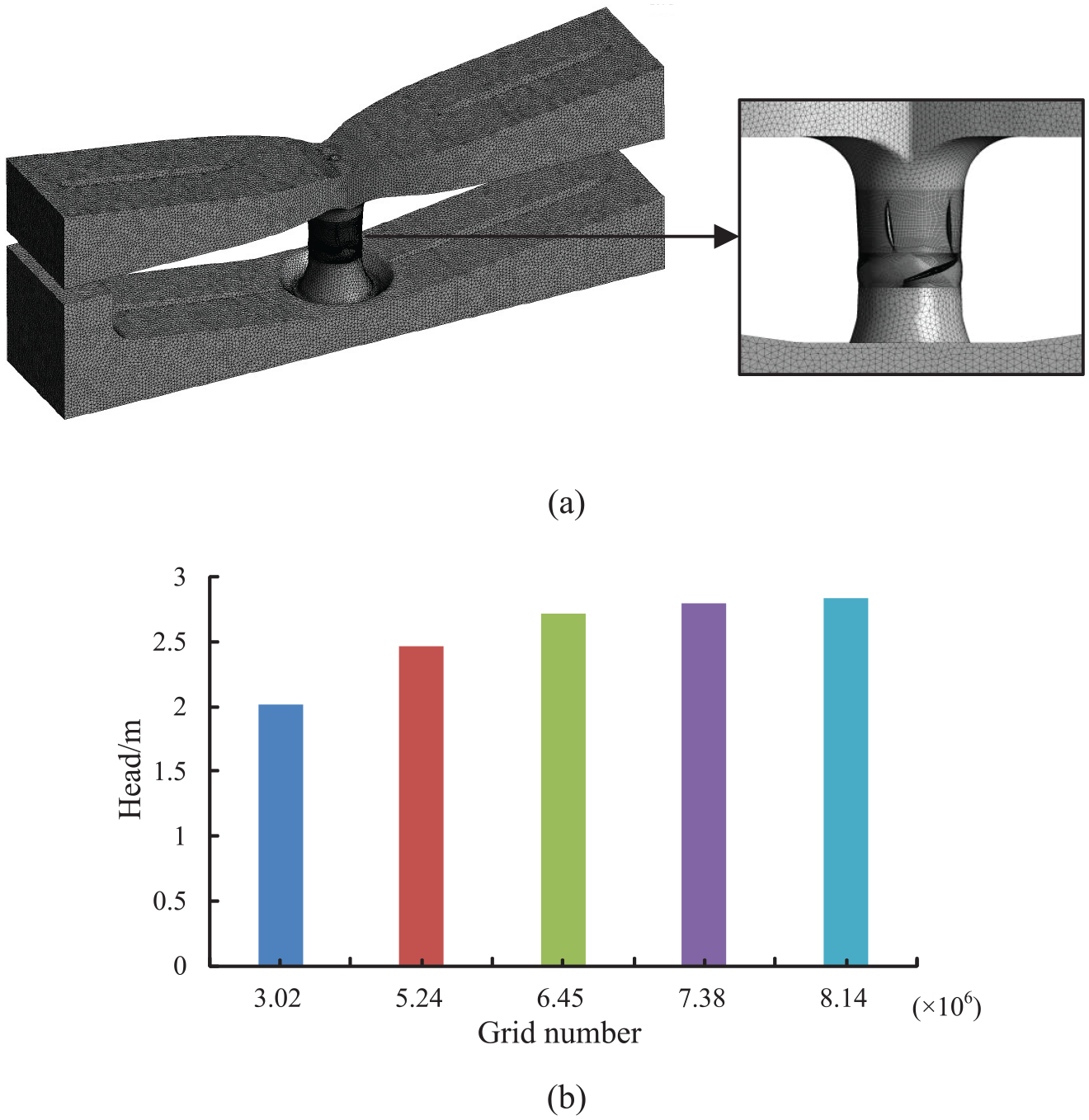
Mesh of the CFD model: (a) grids of all the domains and (b) grid independence analysis.
The FEM model is shown in Figure 4. The fluid–structure interfaces for all wetted surfaces of the blade were defined. The total mesh size of the structure model is 18,540, which was determined by the analysis of the grid independence. The face’s fixed support boundaries are applied to the impeller hub. Figure 5 shows that the hub front and end surfaces were fixed against the axial movement. The cylindrical hub surface was locked against the tangential and radial movements.

Detailed mesh for impeller.

Impeller constraints.
As shown in Figure 6, the data are transferred between the fluid and solid domains through a coupling surface. Different interpolation ways have been selected, and the conservative interpolation and the profile preserving interpolation are used for force and deformation transfer, respectively. The under relaxation factor, as an external load transfer parameter, was fixed at 0.75 for all data transferred between the two solvers, and this is an empirical value which has been approved to be an appropriate value for an accurate results.11,12 This was done to control the solving convergence process. The convergence target for the load transfer was 0.01. Also, the nonmatching area fractions between the structure sides and fluid during the interpolation mapping process for the blade interfaces were <0.4%. This indicated that the two sides of the fluid–structure interface for the load transfer had nearly the same shape, which can make less error for the load transfer. In this article, the time-dependent wall force can be calculated using variable p(t) as follows

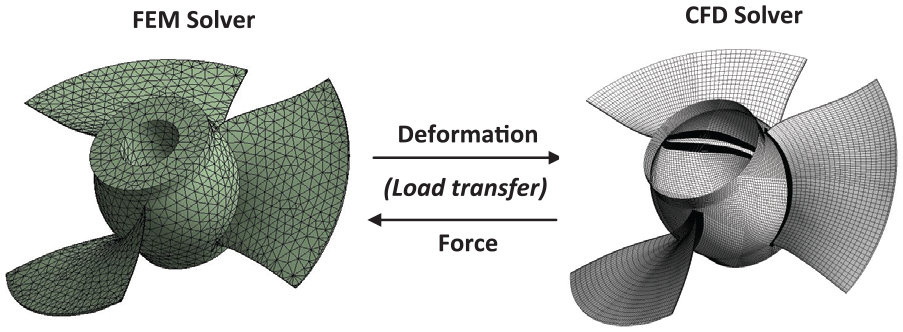
Data interpolation mapping procedure.
To verify the accuracy of the numerical results, the performances of the head versus flow rate were compared between numerical and experimental results. Figure 7 shows that the calculated head is greater than the measurement value, and the calculated head with strong FSI is closer to the measurement value. The calculated heads with and without FSI were both obtained from the average values of unsteady FSI and computational fluid dynamics (CFD) results separately, which have the same initial time and total calculation time. Although small deviations are observed for different flow rates, good agreement is obtained.

Comparison of numerical and measured Q–H curves.
Results and discussion
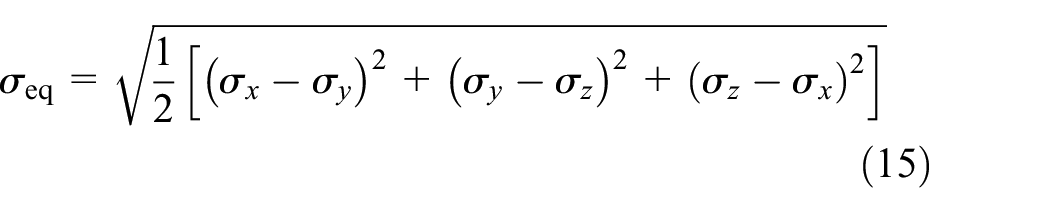
The equivalent stress σeq can be calculated by the following equation
Figures 8 and 9 show the maximum equivalent stress and total deformation of the whole structure for different flow rates. The maximum values of the equivalent stress and total deformation decrease with an increasing flow rate and a decreasing head.
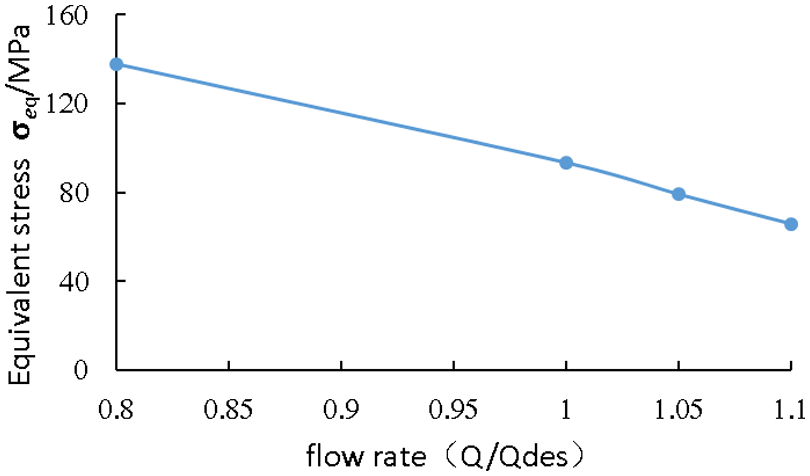
Maximum equivalent stress for different flow rates.

Maximum total deformation for different flow rates.
Figure 10 shows the distribution of the total deformation on the impeller blade for the four investigated flow rates, which is viewed from the impeller outlet. The total deformation values decrease with an increasing flow rate. Also, the total deformation grows from the hub to the outer diameter. Figure 11 illustrates the equivalent stress distribution on the impeller blade. The higher equivalent stress values can be observed in the area near hub and are quantitatively shown to decrease with an increasing flow rate.

Distribution of the total deformation on impeller surface.

Distribution of the equivalent stress on impeller surface.
To study the trend of the total deformation and equivalent stress on the crucial position of the impeller in detail, the wireframe paths are defined in Figure 12. The labels hub-ss, hub-ps, rim-ss, and rim-ps indicate the paths with the direction from the blade trailing edge to leading edge. The leading edge-ps, leading edge-ss, trailing edge-ss, and trailing edge-ps show the paths with the direction from the hub to rim. The short arc paths from the pressure side to suction side are indicated by rim-lr, hub-lr, rim-tr, and hub-tr. In this figure, ps is the pressure side and ss is the suction side.

Investigated paths on the wireframe.
The distributions of the total deformation on the impeller blade in the examined wireframe paths for the investigated flow rates are shown in Figure 13. The total deformation represents the maximum value among all time steps of each point along the paths. The trend of the total deformation curves remains unchanged for different flow rates, but the values decrease with an increasing flow rate.

Distribution of the total deformation in the impeller wireframe paths for different flow rates.
Regarding the paths of leading edge and trailing edge, the total deformation increases along the direction from the impeller hub to rim, and in the paths of rim, the deformation decreases from the blade inlet to outlet. In the paths of hub-ps and hub-ss, the total deformation first increases and then decreases, and the peak values of the two paths can be found near a path length of 0.6. In the paths of rim-lr, hub-lr, rim-tr, and hub-tr, the total deformation almost remains unchanged from pressure side to suction side.
The distributions of the equivalent stress on the impeller blade in the wireframe paths for the four flow rates are shown in Figure 14. The equivalent stress is defined as the maximum value among all time steps on each point along the paths. The stress values decrease with an increasing flow rate, and in particular, there is a little difference in the equivalent stress curves under 1.05Qdes and 1.1Qdes because the operating points are quite close.

Distribution of the equivalent stress in the impeller wireframe paths for different flow rates.
In the paths of rim-ps and rim-ss, the equivalent stress first increases and then decreases dramatically from the trailing edge to leading edge, and the peak values in the two paths can be found near a path length of 0.8. In the paths of hub-ps and hub-ss, the equivalent stress first increases in the path length range of 0–0.65 and then decreases in the range of 0.65–0.88 and finally rises dramatically in the range of 0.88–1.
The peak values of the equivalent stress from the impeller hub to rim can be found in the path length range of 0–0.2. In the paths of leading edge-ps, trailing edge-ss, and trailing edge-ps, the equivalent stress first rapidly increases and then decreases gradually, and in the leading edge-ss, the equivalent stress continues to decrease from the hub to rim.
In the paths of rim-lr and rim-tr, the equivalent stress first decreases and then increases from pressure side to suction side, and the valley values can be seen near path lengths of 0.6 and 0.5. In the hub-tr, the equivalent stress basically remains unchanged except for Q = 0.8Qdes when the equivalent stress fluctuates from 12 to 5 MPa. In the hub-lr, the equivalent stress continues to slightly increase from pressure side to suction side.
Conclusion
A coupled solution of the flow field and structural response of the impeller was established using a two-way coupling method to study the distribution of stress and deformation in the impeller and quantitatively analyze that on the blade along the wireframe paths for different flow rates. The following conclusions can be drawn:
The maximum equivalent stress and maximum total deformation in the impeller are greatly influenced by flow rate, and their values drop with an increasing flow rate and a decreasing head.
The total deformation in the impeller is greater near the blade rim, where the maximum value can be found. The equivalent stress is greater near the blade hub, where the maximum value can be obtained.
The total deformations in the blade rim decrease from blade leading edge to trailing edge, and the total deformations in the paths of leading edge and trailing edge decrease from impeller rim to hub. The equivalent stress in the blade hub initially increases and then declines, and in the end, it rapidly increases from the blade outlet to inlet. In addition, the equivalent stress rises dramatically at first and then descends gradually from the impeller hub to rim.
Because of the loading by complex fluid forces and constraints, the deformation and stress distribution in the impeller cannot be described analytically. However, the knowledge of stress and deformation distribution, especially the field of maximum stress and deformation, is significant for structure design.
Footnotes
Appendix 1
Academic Editor: Mark J Jackson
Declaration of conflicting interests
The author(s) declared no potential conflicts of interest with respect to the research, authorship, and/or publication of this article.
Funding
The author(s) disclosed receipt of the following financial support for the research, authorship, and/or publication of this article: This study was supported by National Science & Technology Pillar Program of China (2015BAD20B01), National Natural Science Foundation of China (grant no. 51409123), Natural Science Foundation of Jiangsu Province (grant no. BK20140554), and China Postdoctoral Science Foundation (grant no. 2015T80507).