




Abstract
Failure mode and effects analysis is an important methodology, which has been extensively used to evaluate the potential failures, errors, or risks in a system, design, or process. The traditional method utilizes the risk priority number ranking system. This method determines the risk priority number by multiplying failure factor values. Dempster–Shafer evidence theory has been combined with failure mode and effects analysis due to its effectiveness in dealing with uncertain and subjective information. However, since the risk evaluation of different experts may be different and some even conflict with each other, Dempster’s combination rule may become invalid. In this article, for better performance of application of evidence theory in failure mode and effects analysis, a modified method is proposed to reassign the basic believe assignment taking into consideration a reliability coefficient based on evidence distance. We illustrate several numerical examples and use the modified method to obtain the risk priority numbers for risk evaluation in failure modes of aircraft engine rotor blades. The results show that the proposed method is more reasonable and effective for real applications.
Keywords
Introduction
Failure mode and effects analysis (FMEA) is an efficient approach used to define, identify, and eliminate known or potential failures and errors from system, design, or process.1,2 This methodology is widely applied to several industry fields such as aerospace, engineering design, and manufacturing to gather important information.3–6 FMEA can not only help analysts to identify known and potential failure modes and their causes and effects but also help them to prioritize the identified failure modes. It can help designers to adjust the existing programs, take recommended measures to reduce likelihood of failures, decrease probability of failure rates, and avoid potential accidents.7,8
In general, the priority of a failure mode is determined by the risk priority number (RPN), which is obtained by multiplying the values of occurrence (O), severity (S), and detection (D) of a failure mode. The three factors O, S, and D are all evaluated using ratings (also called rankings or scores) from 1 to 10. The failures with higher RPNs are assumed to be more important and should be given higher priority. FMEA has been proved to be one of the most important early preventative initiatives during the design stage of a system, product, process, or service. However, the RPN-based approach has been extensively criticized for various reasons:3,9,10
The relative importance among risk factors is not taken into consideration in determining the priority of the failures. The three factors are assumed to be of equal importance, but this may not be the case in practical applications.
The RPN considers only three factors mainly in terms of safety. Other possible influencing factors such as economical aspects are ignored.
It is usually difficult or even impossible to give exact numerical evaluations of practically intangible quantities associated with the risk factors.
Different sets of O, S, and D ratings may produce exactly the same value of RPN, although their hidden risk implications may be totally different. For example, two different failures with the O, S, and D values of 1, 4, 9 and 1, 6, 6, respectively, have the same RPN value of 36.
The RPN elements have many duplicate numbers. Although 1000 numbers are assumed to be produced from the product of O, S, and D, only 120 of them are unique.
Several techniques were developed in order to improve the FMEA methodology.7,9,11–14 Chang 15 proposed a more general RPN method considering situation parameters and relationships. Sankar and Prabhu 10 proposed the modified approach for prioritization of failures. This method defines the new ratings from 1 to 1000 to represent possible severity–occurrence–detection states and provides a much more sensitive ranking process to quantitate risk factors. Fuzzy set theory 16 is widely used in many applications due to its efficiency to model fuzzy information:17–23 for example, environmental impact assessment, 17 decision-making, 19 and marketing mix planning. 21 It is also applied in FMEA under uncertain environment.24,25 For example, Bowles and Pelaez 13 described a fuzzy logic–based approach for prioritizing failure in a system failure mode. Pillay and Wang 9 proposed a fuzzy rule–based approach with the fuzzy rule base and gray relation theory.
Based on the above review, the limitations of the traditional RPN have been investigated. In real applications, like the analysis of aircraft turbine rotor blades, risk factors occurrence (O), severity (S), and detection (D) are difficult to be determined precisely. Besides, FMEA is a group decision behavior and cannot be performed on an individual basis.9,26 Considering their different expertise and backgrounds, various uncertainties are present in FMEA expert group’s subjective and qualitative assessments, such as imprecision, fuzziness, incompleteness, and conflict. Therefore, one key issue of FMEA is the representation and handling of various types of uncertainties in evaluating failure modes with respect to the risk factors. Liu et al. 26 proposed a new risk priority model, which is based on a more effective representation of uncertain information, called D numbers, and an improved gray relational analysis method, gray relational projection (GRP). In the proposed model, the assessment results of risk factors given by FMEA expert group are expressed and modeled by D numbers. The GRP method is used to determine the risk priority order of the failure modes that have been identified.
The Dempster–Shafer (D–S) evidence theory has been employed to quantify the imprecision and uncertainty in reliability and failure analysis. Yang et al. 7 employed the D–S evidence theory to analyze different failure modes and applied it to the risk priority evaluation of failure modes of rotor blades of an aircraft engine. However, when experts give different and precise values of the risk evaluation factors, the basic believe assignments (BBAs) constructed by Yang et al.’s 7 method become highly conflicting evidence which cannot be fused by Dempster’s combination rule directly. 27 Su et al. 28 proposed a modification of Yang et al.’s 7 method, using uncertain reasoning method based on Gaussian distribution. However, this method can only be used to deal with conflicting situations. To solve this problem, many approaches have been proposed and can be divided into two fields: one is to improve the combination rule 29 and the other is to modify the original evidences. 30 In this article, we proposed a method based on the second idea, that is, reassign the BBAs using reliability coefficient with evidence distance 31 to solve the problem of conflicting. This method is completely driven by data, and the weights of evidences can be obtained dynamically. It has the merits of practicability compared with the methods developed in Yang et al. 7 and Su et al. 28 and simplicity compared with the approach proposed by Liu et al. 26
The rest of the article is organized as follows. Section “Theoretical background” recalls the basic theoretical background of failure risk analysis and outlines the most important methods available in the literature. Section “Description of the new method for risk evaluation” describes the new method developed in this study. In section “Test problems and discussion of results,” the validity of the proposed approach is tested in ad hoc designed examples and in a real problem. The study is briefly summarized in section “Conclusion.”
Theoretical background
In this section, we briefly introduce the basic concepts including RPN and D–S evidence theory.32,33 Due to its efficiency to represent and fuse uncertain information, D–S evidence theory is widely used in many real systems,34–43 such as credal classification 37 and reliability analysis. 38
RPN
In FMEA, the risk evaluation is determined using the RPN,15,44 which is defined as follows

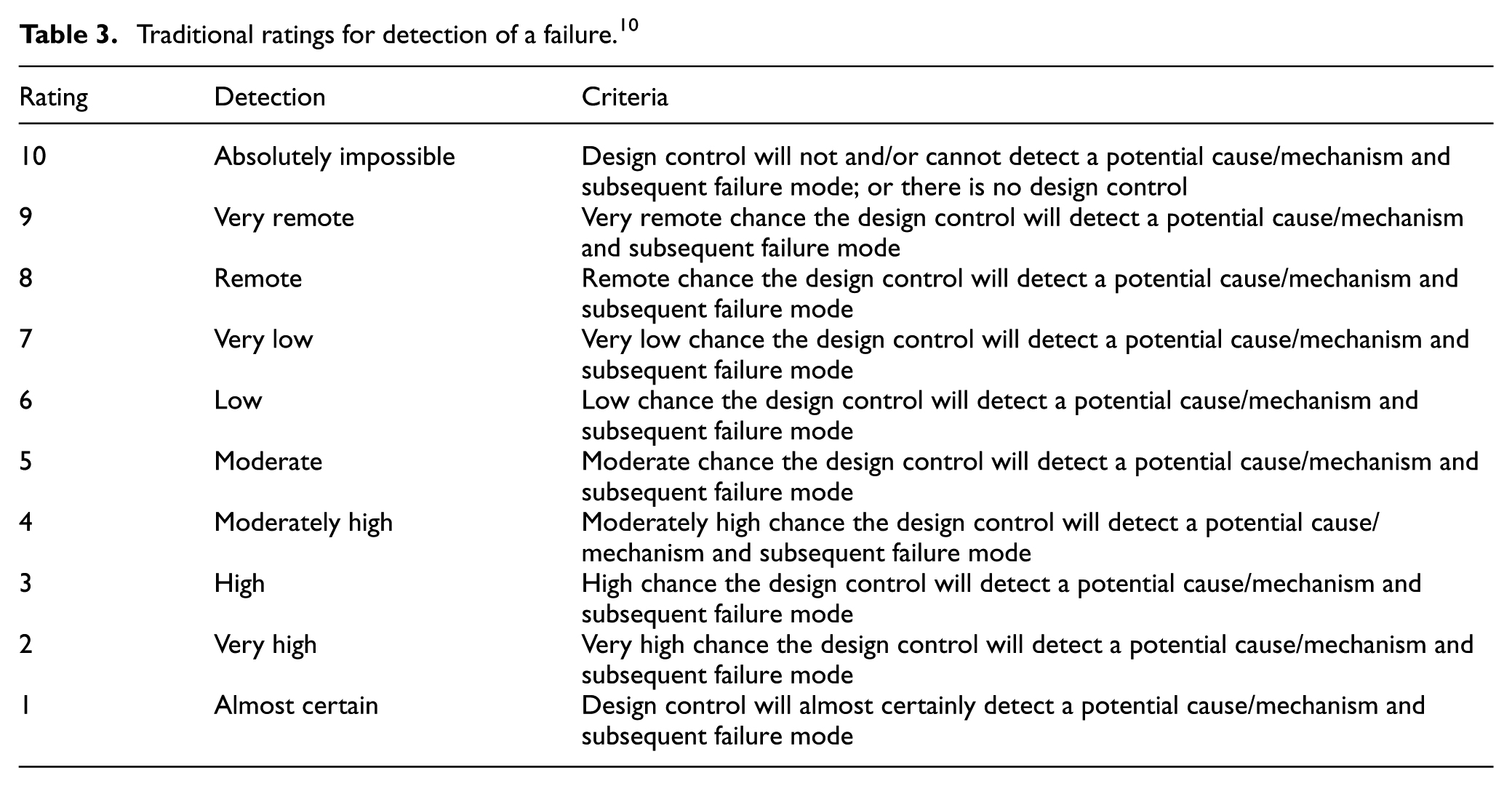
where S is the severity of a failure effect, O is the probability of occurrence of a failure mode, and D is the probability of a failure being detected. Each risk factor is rated from 1 to 10 as described in Tables 1–3.
Traditional ratings for occurrence of a failure. 10

Traditional ratings for severity of a failure. 10

Traditional ratings for detection of a failure. 10
D–S evidence theory
The D–S evidence theory, as introduced by Dempster 32 and then developed by Shafer, 33 has emerged from their works on statistical inference and uncertain reasoning. This theory is widely applied to decision-making,45–49 information fusion, 50 and uncertain information processing. 51
Definition 2.1
Let

where set

Definition 2.2
A mass function is a mapping m from

which satisfies the following condition


When m(A) > 0, A, which is a member of the power set, is called a focal element of the mass function.
Definition 2.3
In D–S evidence theory, a mass function is also called a BBA. Let us assume there are two BBAs, operating on two sets of propositions B and C, respectively, indicated by m1 and m2. The Dempster’s 32 combination rule is used to combine them as follows


In equations (7) and (8), K reflects the conflict between the two BBAs m1 and m2.
Evidence distance
The evidence distance assesses the degree of inconsistency of two evidences: the higher the conflict, the higher the value of evidence distance. If two evidences are completely opposite, the distance will be equal to 1.
Definition 2.4
Let

where
Pignistic probability transformation
Definition 2.5
Let m be a BBA on

where
Available methods
In this section, we briefly review the methods developed by Yang et al. 7 and Su et al. 28 for risk priority evaluation of a failure mode.
In Yang et al., 7 the weight of an expert is considered and the modified evidence theory is used to combine the different information from multiple experts. Their approach is shown briefly as follows:
Step 1: simplify the discernment frame as

where
Step 2: construct the belief function


where Θ = (1, 2, 3, 4, 5, 6, 7, 8, 9, 10). The function
Step 3: consider the weight and modify the BBAs, then combine the modified BBAs with evidence theory under the new discernment frame. The modified BBA is represented as


where i = O, S, D; j = 1, 2,…, N, N is the number of failure modes; l = 1, 2,…, L, L is the number of experts.
The new combination rule of D–S evidence theory can be written as

The synthetic effects of all sources of evidence from L different experts can be represented by Mij

Step 4: calculate the mean value of RPN.
The RPN is a discrete random variable with several different ratings and the corresponding probabilities. Suppose RPN has several ratings

where
Su et al. 28 modified the above described approach. If the situation cannot be figured out because different and precise values of evaluation factors are given by the experts, the BBAs may become highly conflicting evidence which cannot be fused by Dempster’s 32 combination rule. In order to solve this problem, the following modified method was developed by Su et al. 28
Definition 2.6
Assume that


The above equation defining a BBA is plotted in Figure 1. This modified method can be illustrated in the following example.

Definition of BBA from equation (20).
Example 2.1
Two experts give their opinions on the risk factor “severity of a failure effect (S)” of failure mode 1. Suppose the weight of each expert is equal, and

Suppose set
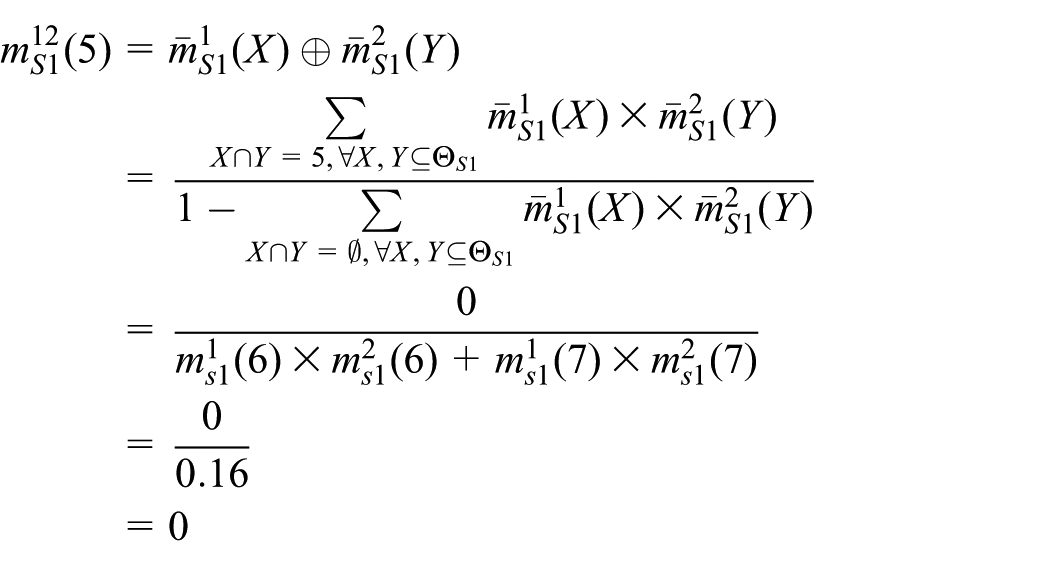
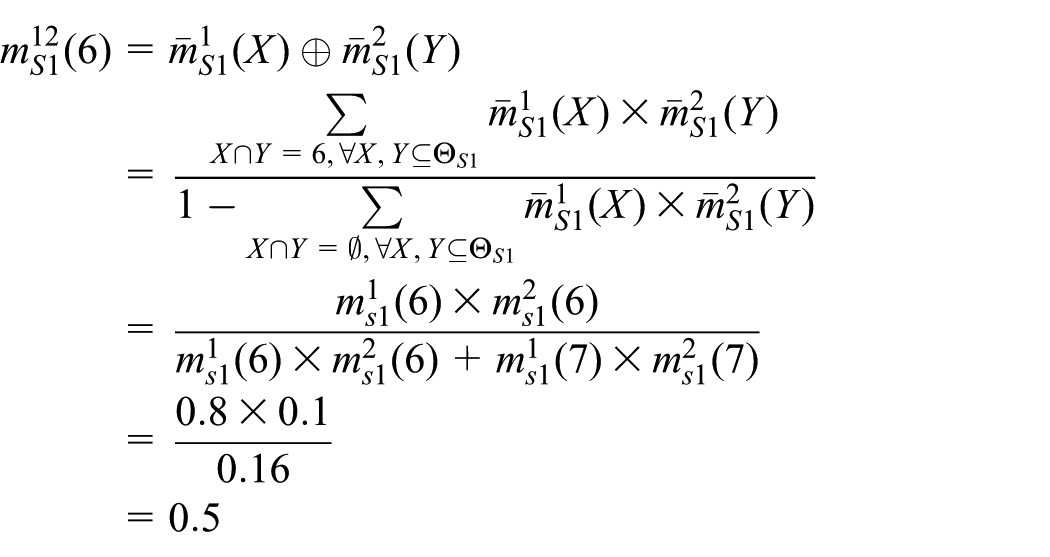


The mean value of the factor “severity of a failure effect (S)” of RPN can be determined using equation (18) as

Description of the new method for risk evaluation
The two methods described in section “Available methods” account for the weight of an expert because different experts may provide imprecise or uncertain risk evaluations for a given failure mode. However, they do not evaluate weights of different experts which are all supposed to be equal to 1. This causes the following problem: when different and precise values of the risk evaluation factors are given by the experts, the BBAs constructed by their methods may become highly conflicting evidence which cannot be fused by the Dempster’s 32 combination rule. Although some evidences can apparently be fused using the Dempster’s combination rule, the resulting BBAs are not logical; therefore, using the obtained BBAs to generate RPN lacks credibility. The following example can illustrate this case.
Example 3.1
Suppose two experts give their opinions upon the risk factor “occurrence of a failure (O)” of failure mode 1. Expert 1 evaluated it as O(6,100%) which means the probability of occurrence is “moderately high”; Expert 2 evaluated it as “very high” and can be represented as O(9,100%). The BBAs can be represented as


These two BBAs highly conflict with each other and cannot be fused by the Yang et al.’s 7 method. Although the opinions of the two experts look similar, the method developed by Su et al. 28 neither can solve the above-mentioned problem. It can be explained in Figure 2 that the BBAs constructed by Su et al.’s method are as follows


Definition of BBAs in Su et al.’s 28 method.
It can be seen that the resulting BBAs are still highly conflicting, and therefore this method cannot efficiently deal with this conflict.
The above example shows the limitations of the methods developed in Yang et al. 7 and Su et al. 28 in solving problems characterized by highly conflicting evidence associated with different experts. Since the Dempster’s combination rule cannot be applied, it is necessary to find an effective way to utilize evidence theory in FMEA.
Our modified method can be described as follows:
Step 1: simplify the discernment frame according to equation (11).
Definition 3.1
The average of evidence distance among multiple experts denoted as

Definition 3.2
k is the reliability coefficient also called discounting coefficient and it can be defined as

Since
From a mathematical point of view, the reliability coefficient k acts as a discounting coefficient, and therefore, the conflict between the evaluations of different experts can be reduced by it. Unlike
Step 3: take the reliability coefficient k into consideration to modify the belief function; Dempster’s 32 combination rule is then used for fusing multiple information.
The BBAs can be modified as follows

where i = O, S, D; l = 1, 2,…, L, L is the number of experts; j = 1, 2,…, N, N is the number of failure modes, and k is the reliability coefficient. The synthetic effects of all sources of evidence from L different experts can be represented by the
Step 4: calculate the MVRPN of the risk factors O, S, and D with equation (24).
Suppose the ith risk factor has several ratings

where q indicates the total number of rating levels involved in the evaluations.
Step 5: obtain the RPN using equation (1).
Test problems and discussion of results
Let us solve Problem 3.1 with the present methodology. The problem will be denoted as Example 4.1 in the rest of the article. The aim is to demonstrate that we are able to successfully deal with risk assessment problems characterized by highly conflicting experts’ evaluations.
Example 4.1
Suppose two experts give their opinions upon the risk factor “occurrence of a failure (O)” of failure mode 1. Expert 1 evaluated it as O(6,100%) which means the probability of occurrence is “moderately high”; Expert 2 evaluated it as “very high” and can be represented as O(9,100%). The BBAs can be represented as


According to equations (9), (21), and (22), the average evidence

Then, the new BBAs can be represented using equation (23)


Suppose set


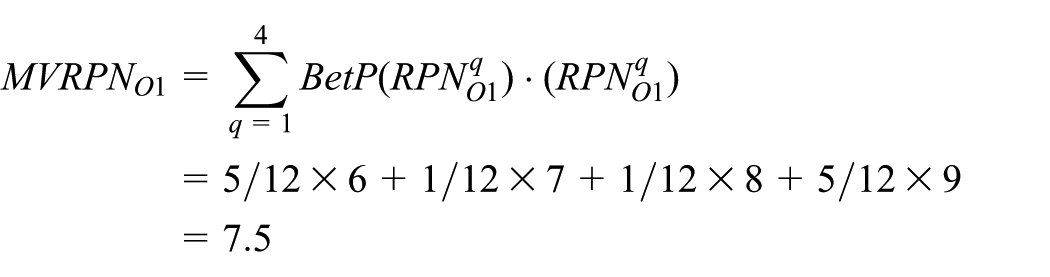
In this case, the minimum and the maximum of the rank of the failure mode 1 to risk factor O are 6 and 9, and therefore, the simplified discernment frame can be constructed as {6, 7, 8, 9} according to equation (11). Then the pignistic probability of each rating can be calculated with equation (10)


The mean value of the factor “O” of RPN can be determined using equation (24)
If the two experts give their opinions on the risk factor “occurrence of a failure (O)” of failure mode 1 and evaluate it as O(6,100%), then the BBAs can both be represented as
Example 4.1 shows how the methods developed in Yang et al.
7
and Su et al.
28
cannot solve risk assessment problems where evaluations given by different experts are highly conflicting. Actually, this situation can happen in many complicated FMEA, since it is difficult or impossible for experts to give exact numerical evaluations of practically intangible quantities associated with the risk factors. Conversely, Example 4.1 proves that the proposed method can overcome the problem highlighted by Example 3.1. Through Step 3, a nonzero value is assigned to the simplified group set
It should be noted that when conflicts between experts’ evaluations are not very evident, the Dempster’s rule can still be used in Yang et al. 7 and Su et al. 28 However, solutions may be unreasonable in some cases as it will be illustrated by Example 4.2.
Example 4.2
Suppose three experts give their opinions upon the risk factor “detection of a failure ” (D) of failure mode 1. Expert 1 evaluated it as


The reliability coefficient k can be calculated according to equations (9), (21), and (22)



Then, the modified BBAs using equation (23) is shown as follows:
Expert 1



Expert 2


Expert 3


Suppose set


Then, the final consequence is
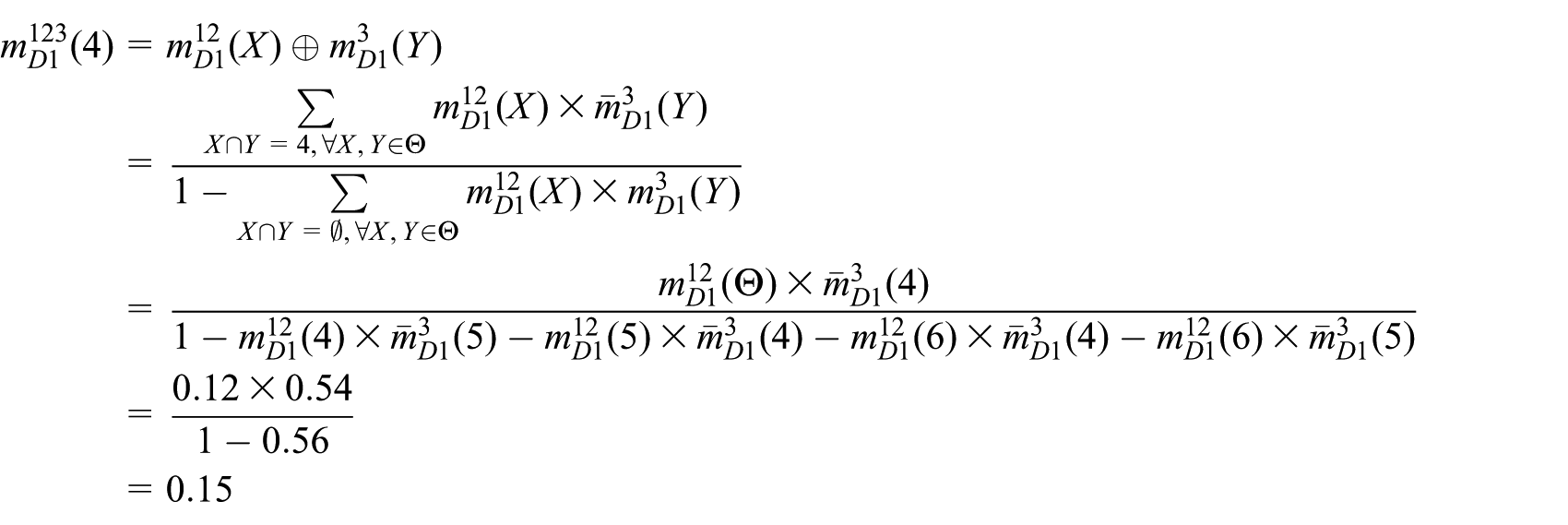


By equation (10), the pignistic probabilities can be calculated as follows



The mean value of the factor “D” of RPN can be determined using equation (24)

The combined belief function obtained with the direct application of the Dempster’s combination rule is

Therefore, the final BBA obtained from the methods described in Yang et al.
7
and Su et al.
28
is
The results obtained for Examples 4.1 and 4.2 demonstrate that the present approach improves the Yang et al.’s 7 method, thus overcoming the limitation that conflicting evidence cannot be combined by Dempster’s combination rule. The following example will prove the efficiency of the proposed method in the case of non-conflicting evidence.
Example 4.3
Suppose three experts give their opinions upon the risk factor “detection of a failure” (D) of mode 1. Expert 1 evaluated it as


The reliability coefficient k can be calculated according to equations (9), (21), and (22)


Then, the modified BBAs using equation (23) is shown as follows:
Expert 1



Expert 2


Expert 3



Suppose set


Then, the final consequence is
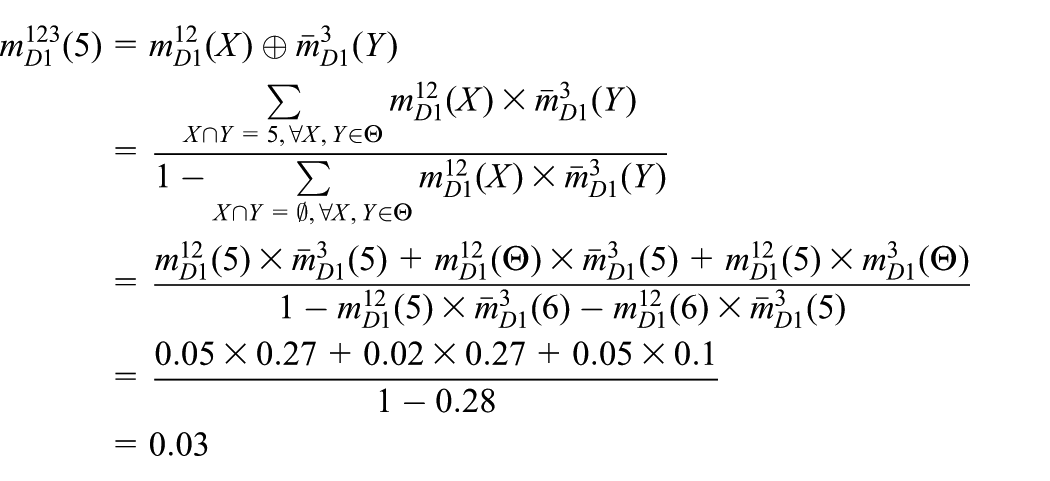
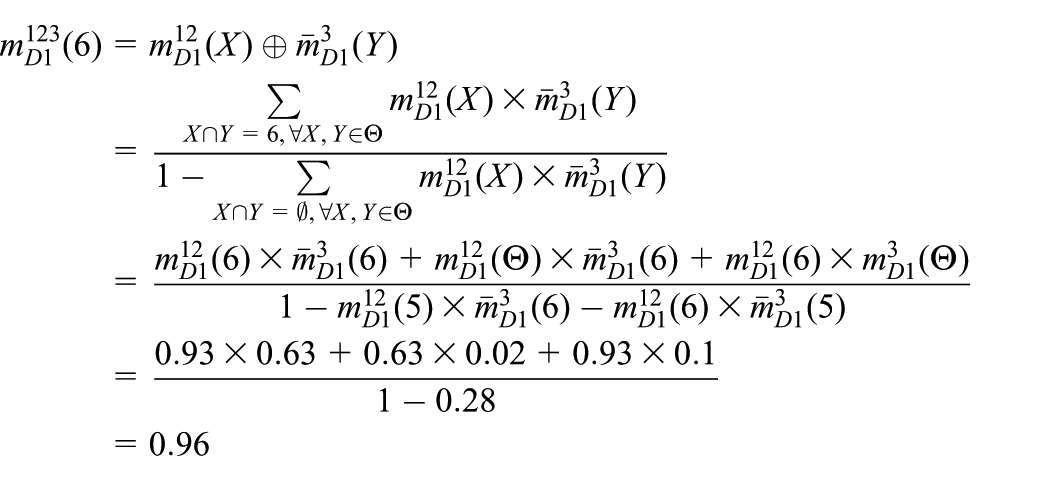

The pignistic probabilities can be obtained as follows


The mean value of the factor “D” of RPN can be determined using equation (24)

The traditional combination rule leads to the following result


Example 4.3 indicates that when experts give similar opinions on a failure mode, the BBAs and mean value of factor D are consistent with Yang et al. 7 Examples 4.1–4.3 prove that the proposed method can efficiently deal with multiple information in FMEA.
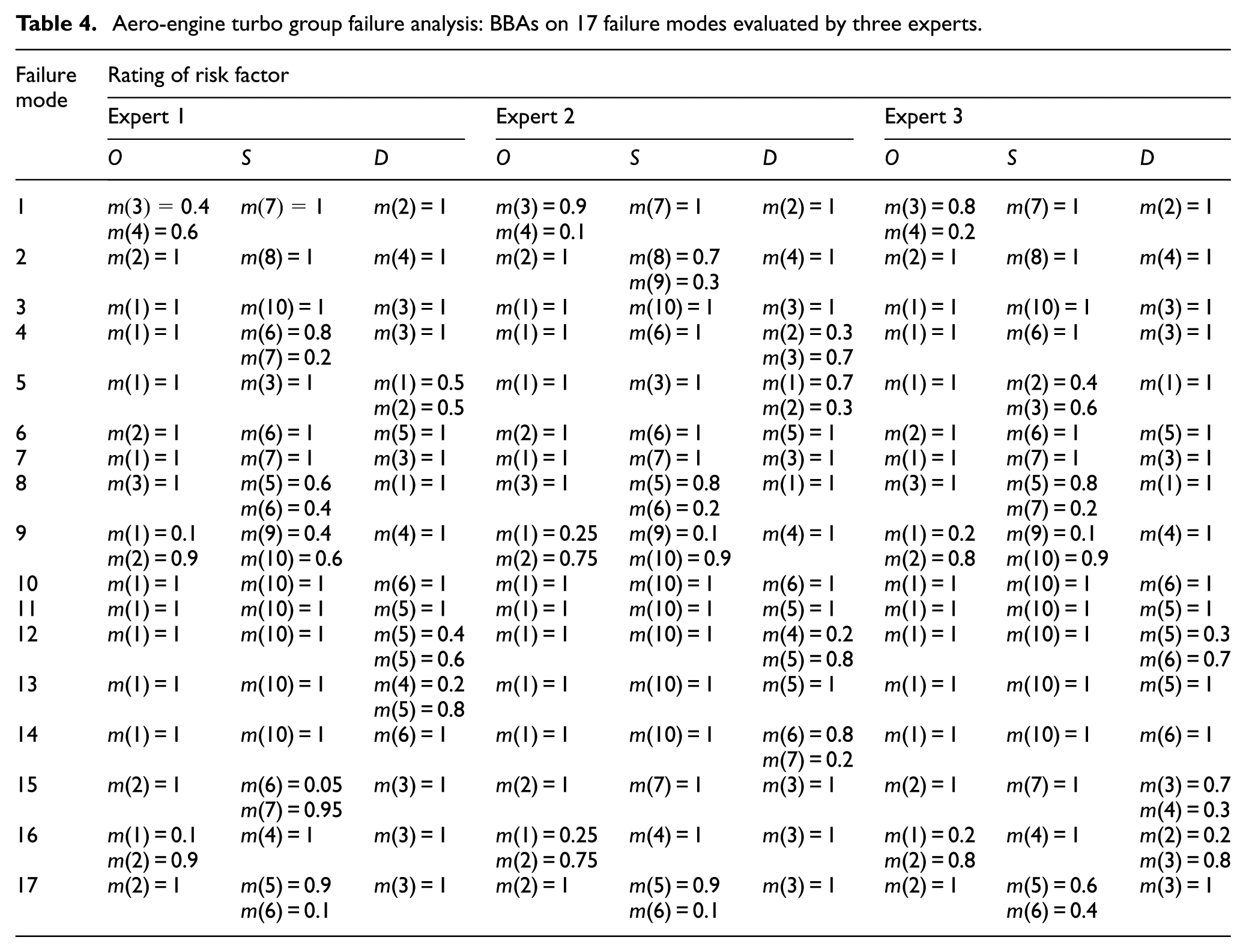
In order to demonstrate the effectiveness of the proposed method in FMEA, we use this method to solve the same problem considered in Yang et al. 7 : the risk priority evaluation of rotor blades of an aircraft engine. The BBAs on 17 failure modes evaluated by three experts are shown in Table 4. The results of the present approach are compared with the literature in Figure 3.
Aero-engine turbo group failure analysis: BBAs on 17 failure modes evaluated by three experts.

Comparison of the results by the three methods.
It can be seen that all methods obtained practically the same result. Failure mode 2 has the largest RPN in the failure modes of compressor rotor blades, followed by failure modes 6, 1, 3, 7, 4, 8, and 5. For turbine rotor blades, failure mode 9 has largest RPN in the failure modes of compressor rotor blades, followed by failure modes 10, 13, 14, 11, 12, 15, 17, and 16. The larger the RPN, the more attention should be paid to the corresponding failure mode. If the different failure modes have the same RPN, like modes 6, 10, and 14 (i.e. RPN = 60), the same risk attention should be given to them. In conclusion, the proposed approach keeps the advantage of the Yang et al.’s method and has good performance in dealing with multiple information in FMEA.
Another test problem was solved in order to prove the efficiency of the proposed method in the case of highly conflicting evidences. Table 5 shows the BBAs for four failure modes characterized by significant variations in experts’ evaluations.
Aero-engine turbo group failure analysis: highly conflicting BBAs on four failure modes evaluated by three experts.

The results shown in Table 6 clearly demonstrate the superiority of the present approach. In fact, the method developed by Yang et al.
7
cannot perform the risk-level assessment for any failure mode while the method developed by Su et al.
28
is successful for only one failure mode. Since the RPN parameter is determined as the product of the three risk factors O, S, and D, methods described in Yang et al.
7
and Su et al.
28
become invalid if experts’ evaluations on a risk factor diverge considerably. Let us consider in particular failure mode 4. Yang et al.’s method clearly shows its limits in dealing with highly conflicting evidence between O, S, and D. By turning m(X) = 1 into m(X − 1) = 0.1, m(X) = 0.8, and m(X + 1) = 0.1 (where X = 5, 6), the Su et al.’s method can determine the MVRPN of O and D but still fails to reduce the conflict in the evaluation of S. Therefore, neither this method can determine the correct value of RPN for failure mode 4. The new methodology developed in this research found instead logical values for the RPN associated with the four failure modes: 57.96, 379.03, 96.98, and 71.73, respectively, thus leading to rank the level of risk associated with the four failure modes as
Results of risk-level assessment in case of highly conflicting experts’ evaluations.
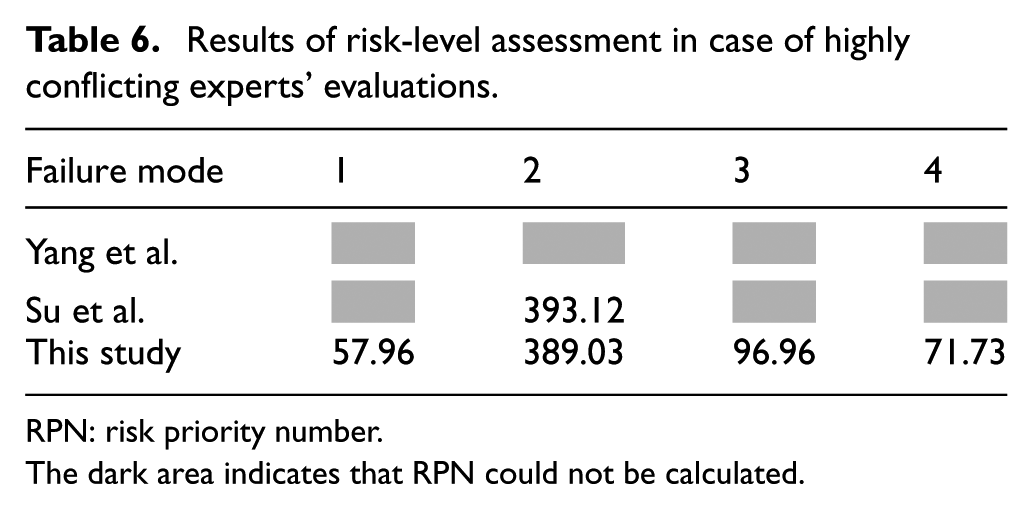
RPN: risk priority number.
The dark area indicates that RPN could not be calculated.
Conclusion
This study presented a novel method for properly evaluating the level of risk when basic belief assignments cannot be combined with the Dempster’s combination rule. The main novelty introduced in the article is the use of a reliability coefficient based on evidence distance. The results obtained in some specifically designed numerical examples and the risk analysis of real mechanical components (i.e. the turbo group of an aero-engine) demonstrate the validity of the proposed approach.
The proposed approach has been proved to be useful and practical, but can still be improved in some aspects. For example, we put emphasis on producing the weight of evidence according to the evaluations associated with different experts, while the weights of experts themselves were not accounted for in this study.
Footnotes
Acknowledgements
The authors greatly appreciate the encouragement of the editor and the anonymous reviewers’ valuable comments and suggestions to improve this article.
Academic Editor: Jia-Jang Wu
Declaration of conflicting interests
The author(s) declared no potential conflicts of interest with respect to the research, authorship, and/or publication of this article.
Funding
The author(s) disclosed receipt of the following financial support for the research, authorship, and/or publication of this article: This work was supported, in part, by a grant from National Natural Science Foundation of China (No. 60904099) and Foundation for Fundament Research of Northwestern Polytechnical University, Grant No. JC20120235.