




Abstract
The three-dimensional time-domain computational fluid dynamics approach is employed to calculate and analyze the sound attenuation behavior of water-filled perforated pipe silencers. Transmission loss predictions from the time-domain computational fluid dynamics approach and the frequency-domain finite element method agree well with each other for the straight-through and cross-flow perforated pipe silencers without flow. Then, the time-domain computational fluid dynamics approach is used to investigate the effects of flow velocity, diameter, and porosity of orifices on the sound attenuation behavior of the silencers. The numerical predictions demonstrate that the flow increases the transmission loss, especially at high frequencies. Based on the above analysis, partially plugged straight-through perforated pipe silencer is proposed to improve the sound attenuation performance by increasing the flow velocity through the orifices. In order to eliminate the pass frequency of the perforated pipe silencers and improve the sound attenuation performance in mid- to high-frequency range, a folded straight-through perforated pipe silencer is designed and its sound attenuation behavior is analyzed numerically using the time-domain computational fluid dynamics approach.
Keywords
Introduction
Silencers with perforated components are widely used in piping systems for their reliable noise attenuation performance. 1 The three-dimensional (3D) frequency-domain methods such as finite element method (FEM) and boundary element method (BEM) are the commonly used approaches for the prediction of acoustic behavior of silencers.2,3 The advantages of frequency-domain methods are the fast computation and convenient employment. However, these methods may include the potential flow effect only and excluded the influences of complex flow and viscosity on the sound propagation and attenuation in the silencers. Time-domain approach is an alternative method and may overcome these disadvantages.
Currently, the multi-dimensional time-domain computational fluid dynamics (CFD) approach has been used to predict the acoustic behavior of air-filled reactive silencers only. Middelberg et al. 4 proposed the two-dimensional (2D) axisymmetric CFD approach to calculate the acoustic characteristics of expansion chambers, and their predictions agree well with the published experimental data. Based on the impulse test technique, Broatch et al. 5 applied the 3D time-domain CFD approach to predict the transmission loss of a simple expansion chamber and a reversing chamber muffler, and the predictions match fairly well with the experiment measurements and FEM results for the case without air flow. However, the calculated transmission loss of muffler with air flow is not validated with experiment. The 3D time-domain CFD approach was extended to calculate the acoustic attenuation performance of straight-through perforated tube reactive silencers and resonators by Ji et al. 6 In the absence of air flow, their predictions are consistent with the available experimental data in the literature. As the mean flow is included in the calculation, the accuracy of the time-domain CFD method is not perfect enough. Later, the 3D time-domain CFD approach is used to investigate the effects of flow velocity and temperature on the acoustic attenuation performance of perforated tube silencers. 7 By setting the mesh size and time step more reasonably, the accuracy of 3D time-domain CFD approach is improved, and the effects of flow and temperature on the acoustic behavior of both straight-through and cross-flow perforated tube silencers are discussed.
Installation of silencer is proved to be an effective way for hydrodynamic noise control of water-filled pipes in practical engineering.8,9 To the best knowledge of the authors, few available literatures are found for the acoustic computation and analysis of water-filled piping silencers, and none of them is related to the perforated pipe silencers (PPSs). The objectives of this study are then (1) to employ the 3D time-domain CFD approach to predict the sound attenuation behavior of water-filled PPSs, (2) to examine the influence of flow velocity and parameters of perforation on the sound attenuation behavior of PPSs, and (3) to explore the structure optimum design to improve the overall sound attenuation performance, especially to extend the effective frequency range.
Time-domain CFD approach and validation
Principle and CFD computation
The time-domain CFD approach simulates the sound propagation process in piping system. The specific introduction of time-domain CFD approach could be found in the study by Liu and Ji. 7 In this work, the software FLUENT is used as the simulation tool. The main differences between the CFD computation discussed here from Liu and Ji 7 are (1) the medium in computation is changed from air to water, and the compressibility of water is simulated by the user-defined functions in FLUENT, and (2) the long straight pipe is used to accomplish the anechoic termination in both inlet and outlet of silencer, since the non-reflecting boundary condition in FLUENT is only available for air medium. 10 After many tentative calculations, the length of pipes is suggested to be 40 times the length of silencer, which would satisfy the need to get a reasonable result.
In this work, the pressure-based implicit solver with the second-order implicit time stepping is implemented. The pressure–velocity coupling schemes are Semi Implicit Method Pressure Linked Equations (SIMPLE) algorithm and Pressure Implicit with Splitting of Operators (PISO) algorithm for the steady calculation and unsteady calculation, respectively, and second-order scheme is chosen for the spatial discretization. Laminar model and realizable k-ε turbulence model are chosen for cases with stationary medium and mean flow, respectively.
The boundary conditions are set as follows:
1. The mass flow inlet boundary condition is used in the computational models. An impulse signal superimposed on a constant mass flow is prescribed at the inlet of upstream pipe. The impulse is a half period of sinusoidal wave of 10 kHz. To avoid the nonlinear effect of high sound pressure level (SPL), the set value of SPL

where
2. The pressure outlet boundary condition is applied to the outlet of computational model.
3. The walls are considered as stationary, adiabatic, and no-slip.
In the CFD computations, periodic models are used. The mesh- and time-independence studies are performed first to determine the reasonable mesh size and time step. The long pipes are discretized with structured mesh of size 3.5 mm, and the main part of silencer is discretized with hybrid mesh of size 2 mm. The perforation areas are meshed with finer size. The time step is 1 µs, and the corresponding sampling frequency is 1000 kHz, which is much higher than the maximum of the interested frequencies, thereby the sampling law is satisfied. All computations are performed on HP Z820 workstation with 16 cores (32 threads). It takes about a week to accomplish one unsteady computation. For the cases without flow, one unsteady computation may determine the transmission loss. For the cases with mean flow, a steady computation should be performed first which may take 10–12 h and then the steady computation results are used as the initial flow conditions of unsteady computations. The two unsteady computations are performed separately; one is performed with acoustic impulse added in the inlet face, while the other is performed without acoustic impulse.
The detailed data post-processing is introduced by Liu and Ji 7 and not repeated here. After the incident and transmitted pressure signals in the time-domain are transformed into the frequency-domain by fast Fourier transform (FFT), the transmission loss of silencer is determined by 1

where
Validation
To validate the computational accuracy of the 3D time-domain CFD approach for the water-filled PPSs, the straight-through PPS (Figure 1) and the cross-flow PPS (Figure 2) are considered in the present works. The dimensions of straight-through PPS are as follows:

Configuration of straight-through PPS.

Configuration of cross-flow PPS.
Figure 3 presents the time-domain signals on inlet and outlet of the straight-through PPS calculated by time-domain CFD approach. After the cutoff process of the reflected signals, incident and transmitted sound pressures are obtained and then transformed into the frequency domain by FFT as shown in Figure 4. The transmission loss of the silencer is calculated using equation (2) and presented in Figure 5.
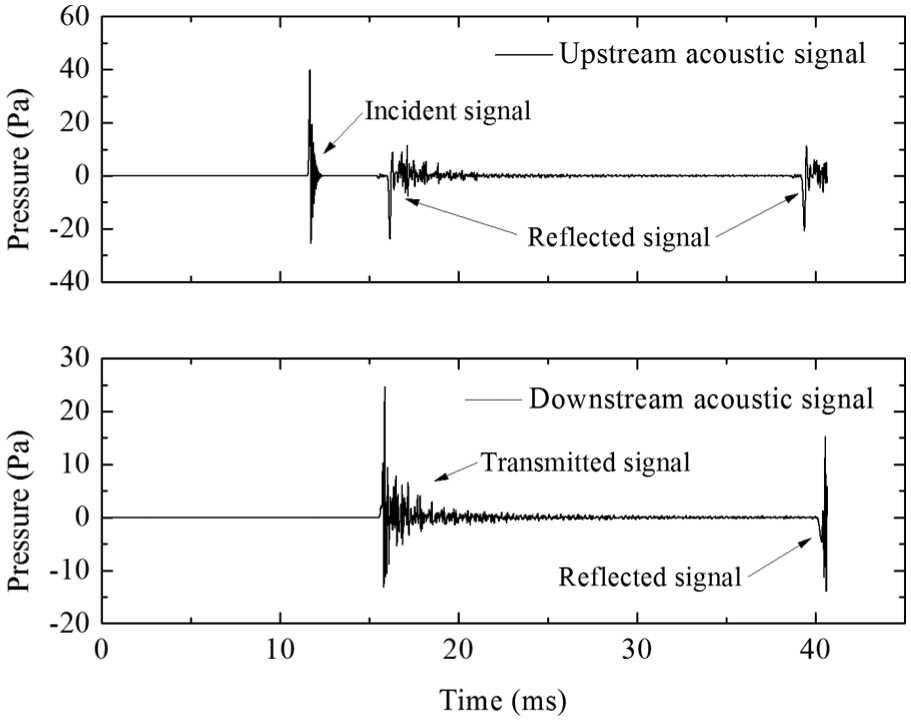
Time-domain signals on inlet and outlet of straight-through PPS (T = 293 K, v = 0 m/s).

Frequency-domain signals of incident and transmitted sound pressures of the straight-through PPS (T = 293 K, v = 0 m/s).

Comparison of transmission loss predictions of straight-through PPS (T = 293 K, v = 0 m/s).
Figures 5 and 6 compare the transmission loss predictions of the two silencers without flow from the 3D time-domain CFD approach and FEM, and good agreements are observed in the frequency range of interest. In this work, the value of sound speed in CFD computations is about 1475 m/s when temperature of water is set to be 293 K, and this value is used in FEM calculations. The perforations are built directly in FEM models instead of using a transfer matrix relation. In Figure 5, the large fluctuations of transmission loss around 3200–4400 Hz calculated by CFD approach are observed, which may be attributed to the fact that transmitted sound signals in this frequency range are relatively weak as illustrated in Figure 4; hence, the predicted transmission loss results could be affected easily by the small numerical errors in CFD computations.

Comparison of transmission loss predictions of cross-flow PPS (T = 293 K, v = 0 m/s).
PPSs mainly attenuate noise by reflecting the sound waves back toward the source. The two types of silencers appear to have similar sound attenuation behavior in low-frequency range, and the pass-through frequencies are around 1500 and 3000 Hz. However, in high-frequency range, cross-flow PPS exhibits higher sound attenuation at most frequencies than the straight-through PPS. This is strongly related to the propagation paths of sound wave. For the cross-flow PPS, sound wave has to cross the orifices at least twice before reaching the outlet of silencer, which enhances reflecting chances and sound energy dissipation in the silencer. For the straight-through PPS, part of the sound wave may pass through the perforated pipe directly to reach the outlet.
Acoustic behavior analysis
Influence of flow velocity
In order to investigate the influence of flow velocity on the sound attenuation performance of the straight-through and cross-flow PPSs, the numerical calculations for the cases with flow velocities v = 2 m/s and v = 4 m/s are conducted, and results are depicted in Figures 7 and 8, respectively. As expected, water flow increases the sound attenuation at most frequencies especially in the high-frequency range, which is explained as the increase in acoustic resistance of perforation caused by the water flow through the orifices. The main mechanism of sound absorption of the orifices is the interaction between the vortex near the orifice rim and acoustic wave. 11 The dissipative effect is enhanced as the water flow velocity increases.

Transmission loss predictions of straight-through PPS with flow (T = 293 K).
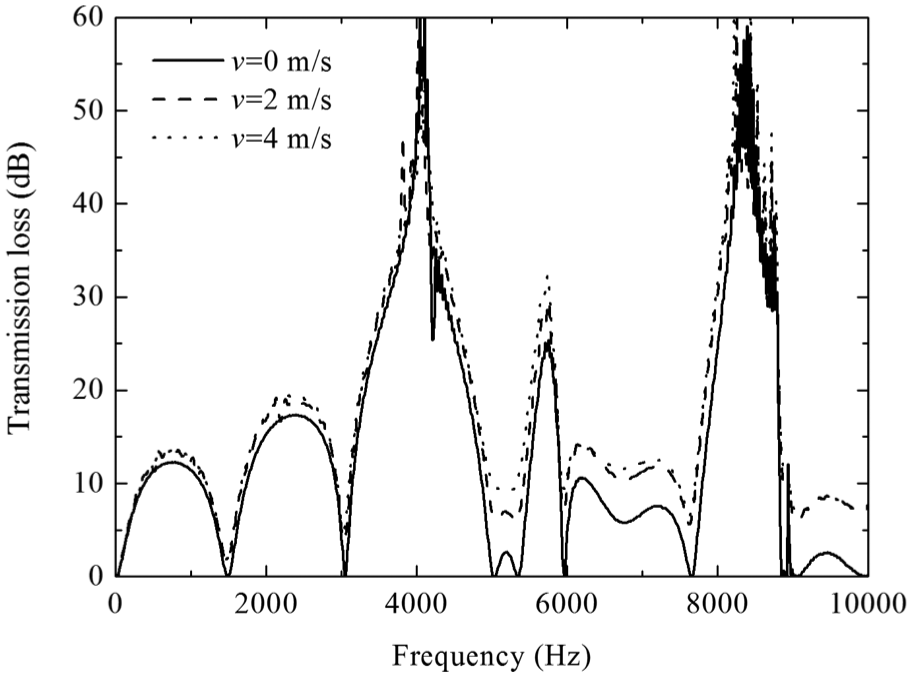
Transmission loss predictions of cross-flow PPS with flow (T = 293 K).
At the same time, flow-induced pressure fluctuations may be more severe which could affect the accuracy of predicted results. Several other tests with different mesh size and time steps are also executed in this work; however, the numerical errors would still arise in the time-domain CFD approach and lead to the fluctuations in transmission loss curve.
For the same flow velocity on the inlet, flow velocity through the orifices of cross-flow PPS is higher than the straight-through PPS, therefore leading to higher acoustic resistance of perforation and then higher sound attenuation in high-frequency range, as revealed in Figures 7 and 8. For the cross-flow PPS, the sound attenuating ability seems to be less sensitive to the flow velocity when the flow velocity rises to 2 m/s, which may be illustrated by the transmission loss predictions in Figure 9. Similar results in air-filled structures are presented by Ji and Zhao: 11 when the bias flow Mach number increases, the maximum absorption coefficient of perforated orifices increases first and then decreases. And bias flow is dominated in the perforated holes of cross-flow PPS. This may explain why the transmission loss of cross-flow PPS did not rise when inlet flow velocity increased from 2 to 4 m/s.

Transmission loss predictions of cross-flow PPS with flow (T = 293 K).
Influence of perforation diameter
To examine the influence of orifice diameter on the sound attenuation behavior of silencers, the transmission loss of the straight-through PPS and cross-flow PPS with

Transmission loss predictions with different orifice diameter (straight-through PPS, T = 293 K, v = 2 m/s).

Transmission loss predictions with different orifice diameter (cross-flow PPS, T = 293 K, v = 2 m/s).
Influence of perforation porosity
To examine the influence of porosity, the main structures of straight-through PPS and cross-flow PPS remained the same and the row of perforations is reduced from 20 to 10 in the axial direction, thus the porosity is reduced to 7.5% from 15%. Figures 12 and 13 compare the transmission loss predictions of the two silencers with different porosities. Reducing the porosity shifts the first resonance to low frequency, while the influence of porosity on acoustic behavior is minimal in the low- and high-frequency ranges for the straight-through PPS. For the cross-flow PPS, reducing the porosity of perforation lowers the resonance frequencies and affects the sound attenuation around resonance frequencies remarkably. The flow condition in orifices is tightly related to the porosity, and as the porosity decreases, the acoustic resistance of perforation increases owing to the higher flow velocity through the orifices.

Transmission loss predictions with different porosity (straight-through PPS, T = 293 K, v = 2 m/s).

Transmission loss predictions with different porosity (cross-flow PPS, T = 293 K, v = 2 m/s).
Partially plugged straight-through PPS
The study by Zhao et al. 12 indicated that increasing the grazing flow reduces the maximum sound power absorption, while the bias flow can increase the damping effect of perforates. In order to increase the flow velocity in orifices in the straight-through PPS and avoid the high pressure drop, partially plugged straight-through PPS is designed as shown in Figure 14. The partially plugged straight-through PPS has the same dimensions as the cross-flow PPS except for the center of perforated pipe. The former is partially plugged in pipe, while the latter is completely plugged in pipe. In this work, the cross-sectional area of the throttle is 50% of the pipe cross-sectional area, and the porosity of perforated pipe is equal to 15%.

Configuration of partially plugged straight-through PPS.
The transmission loss predictions of partially plugged straight-through PPS are shown in Figures 15 and 16. Similar to the former two types of silencers, the transmission loss predictions from CFD and FEM agree well with each other for the case without flow. The partially plugged straight-through PPS has a better sound attenuation ability in high-frequency range than the straight-through PPS. As the flow velocity increases, the transmission loss curve rises in high-frequency range. However, the rising amplitude of transmission loss curve is insignificant and generally the same as the straight-through PPS, which is unexpected. To find out the reason, profiles in the computational domain of three types of PPSs are built, and velocity vectors on profiles are depicted in Figure 17.

Comparison of transmission loss predictions of straight-through and partially plugged straight-through PPS (T = 293 K, v = 0 m/s,

Comparison of transmission loss predictions of straight-through and partially plugged straight-through PPS (T = 293 K,

Velocity vectors on profiles: (a) straight-through PPS, (b) cross-flow PPS, and (c) partially plugged straight-through PPS with water flow (T = 293 K, v = 4 m/s).
From Figure 17, it is evident that, for the straight-through PPS, the overall flow condition in perforations is uniform except for the last five rows of perforations near the outlet of silencer, which accounts for the revising flow from expansion chamber to pipe. For both cross-flow PPS and partially plugged straight-through PPS, the flow velocity in upstream perforations is increased by the plug; however, the flow in downstream perforations near to the plug is weakened, especially for the partially plugged straight-through PPS. The lower flow velocity in downstream perforations leads to the unexpected sound attenuation performance of partially plugged straight-through PPS in high-frequency range, in view of the fact that the acoustic resistance of perforations is tightly related to the flow passing through the orifices.
Folded straight-through PPS
Double-layer perforated structures are suggested to expand the sound absorbing frequency range and improve the sound attenuation performance in mid- to high-frequency range in air-filling silencer design.12,13 To examining this effect in water-filled silencer, a perforated pipe with inner diameter
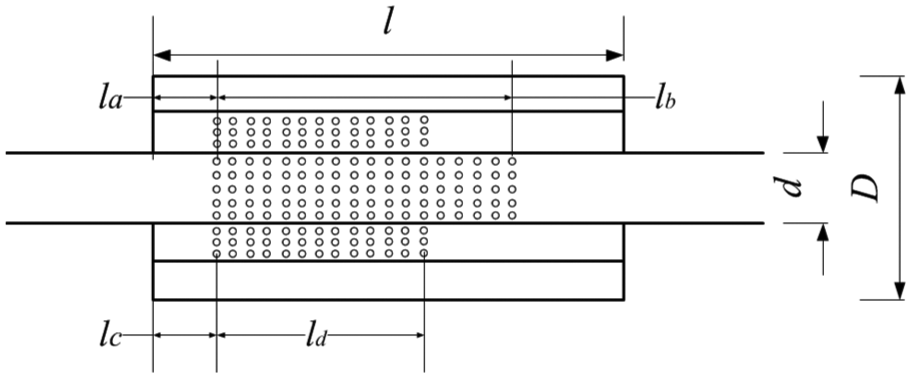
Configuration of folded straight-through PPS, and the dimensions are

Comparison of transmission loss predictions of folded straight-through PPS (T = 293 K, v = 0 m/s).

Comparison of transmission loss predictions of folded straight-through PPS with flow (T = 293 K).
Flow resistance analyses
The fluid dynamic performance of silencers is another important evaluation criterion. Table 1 lists the CFD calculated results of pressure drop through the four types of PPSs. With the same flow velocity and porosity, the pressure drops of straight-through PPS and folded straight-through PPS are close and lower than the partially plugged straight-through PPS, while the cross-flow PPS has the highest pressure drop. For the straight-through and folded straight-through PPS, most of water flow through the pipe without entering the chamber through the orifices. For the cross-flow PPS, water has to move through the orifices of upstream pipe to the chamber and flow back to the pipe through the orifices of downstream pipe. For the partially plugged straight-through PPS, the plug added in the center of perforated pipe enforces part of water enter to the chamber, and the rest part of water flow through the pipe with flow-area changed in the center, and the pressure drop is considerably high compared to the straight-through PPS.
Pressure drops of silencers.

PPS: perforated pipe silencer.
Conclusion
The 3D time-domain CFD approach is extended to calculate the transmission loss of water-filled PPSs and validated by comparing the transmission loss predictions from the present time-domain CFD approach and frequency-domain FEM. Then, the time-domain CFD approach is used to examine the influence of mean flow, perforation diameter, and porosity on the sound attenuation behaviors of straight-through and cross-flow PPSs, respectively. The numerical results demonstrated that the mean flow increases the sound attenuation of PPSs especially at high frequencies. For the straight-through PPS, as the flow velocity increases, the acoustic resistance of orifices increases and the dissipative effect of fluid gets stronger. However, for the cross-flow PPS, as the flow velocity increases, the transmission loss increases first and then is not sensitive to the velocity when the velocity value reaches 2 m/s. For the fixed porosity and flow velocity, the orifice diameter has little effect on the sound attenuation behavior, except near the resonant frequencies. With the same orifice diameter and flow velocity, the sound attenuation behavior of PPS is sensitive to the porosity, especially for the cross-flow PPS.
Based on the above discussions, a partially plugged straight-through PPS is proposed by setting a plug in the center of perforated pipe to enforce the flow passing through the orifices. However, the effect of flow on the sound attenuation at high frequencies is not evident compared to the straight-through PPS. That is for the plug set in the center of perforated pipe weakens the flow in downstream perforations near the plug. Then, a folded straight-through PPS is designed, the pass-through frequencies may be eliminated by inserting an annular perforated pipe in the chamber reasonably, and the sound attenuation performance in medium- to high-frequency range is improved.
Footnotes
Academic Editor: Jose Ramon Serrano
Declaration of conflicting interests
The author(s) declared no potential conflicts of interest with respect to the research, authorship, and/or publication of this article.
Funding
The author(s) received no financial support for the research, authorship, and/or publication of this article.