




Abstract
As technology vigorously develops and the awareness of environmental protection rises, green industry has been gradually valued by government and consumers. Customers’ needs can be satisfied with effective resource strategies as well as innovative technology of green products. Importance–performance analysis is a method incorporating the voices of customers and resource strategies of green design into the product development as well as management performance assessment by means of “importance” and “performance.” Quality function deployment can turn the voices of customers into product development and technical requirement, in order to ensure that the product can meet customers’ satisfaction. The present companies take not only customers’ demand but also their own technical limits into account. Hence, data envelopment analysis can offer firms the priority order when they carry out their improvement in the green product design. Nevertheless, many uncertainties and semantic ambiguity appear in the process of information collection for the product design. Consequently, this study comes up with importance–performance analysis, analytical network process, quality function deployment, and data envelopment analysis, to construct an evaluation mode of innovative design for green products based on intuitionistic fuzzy sets offering enterprises a practical reference for their green product design.
Keywords
Introduction
In recent years, with the rise of environmental protection awareness as well as the concept of sustainable earth, a large number of companies actively use the environmental management as their strategic policy. Thus, green product innovation has become an extremely important issue regarding modern business operation and management. According to Kammerer 1 and Qi et al., 2 apart from the pursuit of economic development, enterprises can develop sustainable green products by means of green innovation. Alternatively, they can reduce the use of poisonous substances or materials during the manufacturing process, control energy consumption and emission of waste gas, and prolong the expiration date for product use, so that they can carry out the idea of enterprise environmental protection strategy to better their image.
In addition, Pujari, 3 Gouda et al., 4 and Coskun et al. 5 thought that green innovation could bring industries and enterprises environmental performance as well as economic performance. Also, Elkington 6 and Nehrt 7 considered “green design” as a kind of “recyclable, low-pollution, and energy-saving” design; through the improvement of hardware (equipment, apparatus, and manufacturing process) as well as operation methods (material recycling and product design), environmental risk and pollution can be reduced, and the negative effects on the use of resource and energy can be diminished as well. In short, the concept of green innovation contains the following five perspectives: (1) to prolong the life cycle of the product, (2) to save energy, (3) to recycle and reuse, (4) to avoid or reduce the amount of waste and lessen its treatment problems, and (5) to cut down the use of hazardous materials, which are beneficial to the environmental protection and keep the ecosystem balanced.
In general, during the product design process, customers’ demand must be effectively adopted into the product development and design as well as the management performance evaluation, so that the customers’ demand can be met. Tseng, 8 Tseng et al., 9 and Lin et al. 10 pointed out that importance–performance analysis (IPA) is not only a technique which can compare relative positions for specific evaluation items based on two-dimensional (2D) matrixes, “importance” and “performance,” but also a method which can transfer the voices of customers into product development and management performance. Hollenhorst et al., 11 Gale, 12 Garver, 13 Deng et al., 14 Lee et al., 15 and Pan 16 all proposed the upgraded IPA method, which showed better judgment in the distribution of quality attributes. Also, Lin et al. 10 suggested that analytical network process (ANP) should be applied in IPA to solve the complicated problems of mutual reliance or feedback existing in goals of requirement, evaluation dimensions, and evaluation criteria.
Besides, according to Jia and Bai, 17 Wu, 18 and Liu and Tsai, 19 quality function deployment (QFD) can turn the voices of customers into product development as well as technical requirements to ensure that the product can meet customers’ satisfaction. Therefore, Lam, 20 Lam and Lai, 21 and Lin et al. 22 ever incorporated ANP and QFD into the green product innovation. To strengthen their entire competitiveness and consider their cost and effect, today’s enterprises will take their own technical limits into account while considering customers’ demand. Consequently, Farrell, 23 Charnes et al., 24 Banker et al., 25 Charnes and Cooper, 26 Dobos and Vörösmarty, 27 and Song et al. 28 came up with data envelopment analysis (DEA), able to offer enterprises the priority order of improvement in green product design.
Nevertheless, there are a lot of uncertainties and factors of semantic ambiguity during the process of information collection of product design. Thus, Zadeh 29 proposed a fuzzy theory using the mathematical model to describe some fuzzy concepts which cannot be defined, especially the fuzzy characteristics possessed by humans. Later, many scholars, such as Hun et al., 30 Li et al., 31 and Wai et al., 32 came up with another fuzzy theory combining the above method to deal with the problems of product design; however, the traditional fuzzy theory still cannot explain “uncertainty” of the human logic thinking, so Atanassov 33 brought up the concept of intuitionistic fuzzy sets (IFS), changing the way of expressing membership by means of numbers resulted from the traditional fuzzy theory into the proportional way of expressions, like “agree,”“disagree,” and “neutrality.” Therefore, the IFS in the aspect of semantic scale expressions can better meet the mode of human thinking logic and are frequently used in uncertainties or inaccurate information.34–36
As a result, this study applies IPA, analytic network process (ANP), QFD, and DEA to construct an IFS-based evaluation mode for green product innovation design, which can effectively control the green innovative required items advantaging enterprises and more accurately transfer customers’ voices into technical requirements; meanwhile, considering the limited resources which enterprises are confronting, we offer references for the prioritization and intensification of the resources required by products’ green innovative technical features. Finally, this study takes the fuel battery as an example explaining the application of this model, in order to offer enterprises a more precise practical evaluation mode for their green product design.
Literature review
Green innovation
According to Bar 37 (2015), green innovation means that enterprises adopt innovative products, new manufacturing processes, new services, and innovative management as well as business methods to prevent and sustainably reduce environmental risk as well as pollution and to decrease the negative effect upon the use of resource and energy. Pujari 3 and Gouda et al. 4 considered that green innovation could help industries and enterprises bring both environmental and economic achievements. The needs of environmental achievements often encourage enterprises to carry out green innovation; likewise, green innovation brings enterprises economic achievements.
In addition, Elkington 6 indicated that “green design” actually was a kind of “recyclable, low-pollution, and energy-saving” design. In view of the resource-based theory, Nehrt 7 proposed that new ways of lowering pollution included hardware (equipment, apparatuses, and manufacturing process) and operating methods (material recycling and product design). Kammerer 1 and Qi et al. 2 suggested that enterprises should consider how to reduce the influence of the green product on the entire life cycle, reduce the use of poisonous substances and materials, control energy depletion and exhaust gas emission, prolong the expiration of product use, and so on.
To conclude, the concept of green innovation includes the following five perspectives: (1) to prolong the life span of the product; (2) to save energy; (3) to recycle, reuse; and protect the limited mineral resources on Earth, in order to reasonably sustain and use them; (4) to avoid the production of waste in use and reduce the amount of waste to decrease its treatment problems; and (5) to minimize the use of hazardous materials, beneficial to the environmental protection and the maintenance of ecosystem balance.
IFS
In order to solve the problems of human thinking mode which involve subjectivity as well as ambiguity, Zadeh 29 proposed Fuzzy Theory, which adopts the membership function of different degrees from 0 to 1 via fuzzy sets and is also a type of classification which can accept ambiguity.
Besides, IFS proposed by Atanassov
33
develops the method solving the membership problem—“uncertainty”—existing in the fuzzy theory, which can express “agree,”“disagree,” and “uncertainty.” Hence, IFS can better match human thinking logic in terms of semantic expression. Based on the concepts of Atanassov
33
and Gau and Buehrer,
38
IFS is defined as a whole set,
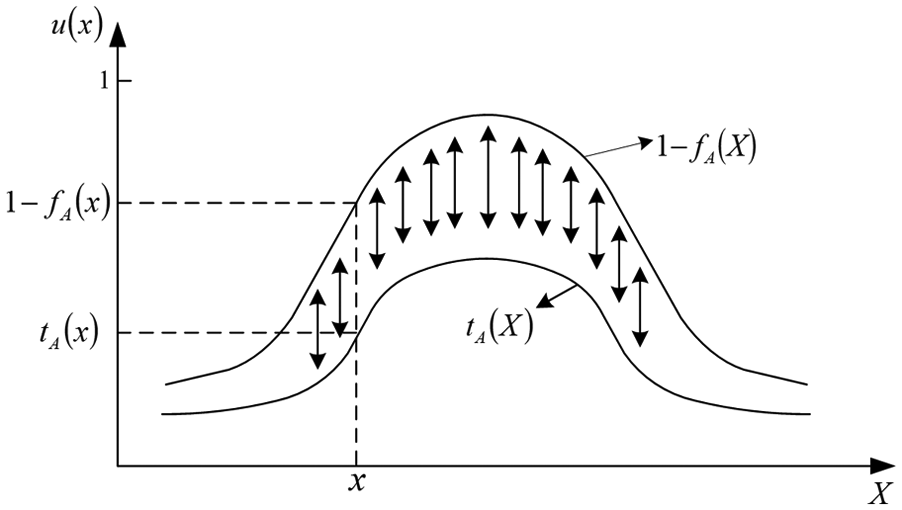
IFS geometric diagram.
Wan and Li, 39 Xu and Liao, 40 and Das et al. 41 pointed out that the IFS have been widely used, whose advantages can objectively express human real thoughts, and they can offer better performance in the aspects of dealing with uncertain information and solving multiple attribute decision-making problems.
IPA
The structure of IPA was first submitted by Martilla and James 42 whose main concept was to put the average score of importance and performance levels into a 2D matrix; after using the 2D matrix to differentiate the relative positions of different average score attributes, practical suggestions and strategic applications of specific quality attributes were further proposed. Then, Hollenhorst et al., 11 Gale, 12 Garver, 13 Deng et al., 14 Lee et al., 15 and Pan 16 all came up with the modified IPA method, which empowered the distribution status of quality attributes with more judgment power, as presented in Figure 2.

IPA analysis chart.
Because the IPA method has its advantages, such as fast and easy to use, it is widely applied in various industries, including automobile industry, tourism, hospitality industry, real estate industry, educational industry, environmental protection, and medical care.8,42–48
ANP
ANP, proposed by Saaty, 49 can solve the problems of mutual reliance and feedback existing among dimensions or criteria in the traditional analytic hierarchy process (AHP). Chung et al. 50 considered that based on AHP, ANP’s decision-making procedure could be divided into five steps:
Establish the network hierarchy structure of assessment.
Build pairwise comparison matrixes.
Compute the relative weight of each matrix. In this step, the relative weight of each matrix is computed to form unweighted supermatrix,
Compute the supermatrix. In the computing process of ANP’s supermatrix, three matrixes are included: unweighted supermatrix—

Select the best plan. Decision-makers can employ the received limit value after
QFD
QFD was first applied in the shipbuilding industry and electronic industry. Through the feature links of products or services, it can transfer customers’ voices and expectations into parameters of product design, so that the quality of the product can be enhanced and the cost of product development can be lowered. 51 According to Liu and Tsai, 19 house of quality (HOQ) comprises six major factors—demand for quality, element of quality, relationship matrix, competitive performance, weight of quality element, and correlation matrix. Applying the QFD computing process can gradually change customers’ demand into technical requirement, which can help enterprises shorten the cycle of product development and reduce the times of engineering change. Moreover, it can help decrease the cost of production effectively.
Furthermore, many scholars use fuzzy quality function deployment (fuzzy-QFD) as an assistant decision-making tool which can convert ambiguous semantics into more definite market demand or customers’ demand.17–19,52 However, because a lot of factors, such as uncertainties and semantic ambiguity, exist in the process of information collection for the product design, and the traditional fuzzy theory cannot explain the part of “uncertainty” of human logic and thinking, this study develops fuzzy-QFD to more objectively consider customers’ needs during the decision-making process of product design and development and then to achieve the goal of advancing customers’ satisfaction.
DEA
DEA originated in an assessment measurement of relative efficiency developed by Farrell 23 considering the notion of efficiency frontier, which divided the zone of over efficiency (OE) into technical efficiency (TE) and allocation efficiency (AE). OE is the product of OE and TE. By the appropriate allocation of production elements, the relationship between the lowest input cost and performance can be perceived.
On the basis of Farrell’s theory, the Charnes, Cooper and Rhodes (CCR) mode presented by Charnes et al. 24 is a general mode which measures multiple inputs and outputs built under constant returns to scale (CRS). Besides, the concept of variable returns to scale (VRS) introduced by Banker et al. 25 replaces the mathematic planning mode of CRS in the original CCR mode to match practical applications under different circumstances. This is called Banker, Charnes and Cooper (BCC) mode. These two modes are commonly recognized as the most influential modes in the field of DEA by the academia. 53
Due to DEA’s advantages in use, its excellent flexibility and its assessment on inputs and outputs of a single item or multiple items, it is widely used by many scholars to evaluate the operation performance in each professional field, including government departments, military, life insurance industry, banking industry, and environmental protection.26–28,54
Methodology
Green product innovation has become not only a critical issue for modern business operation and management decision-making but also one of the important bases of enterprise competition advantages. This study considers benchmark enterprises’ competitiveness and enterprise resource allocations, applies the intuitionistic fuzzy theory, and integrates IPA, ANP, QFD, and DEA into a mode, to construct an evaluation mode of intuitionistic fuzzy–based innovation design which can effectively control the green innovative required items advantaging enterprises and more accurately transfer customers’ voices into technical requirements; meanwhile, considering the limited resources which enterprises are confronting, we offer references for the prioritization and intensification of the resources required by products’ green innovative technical features. Its detailed procedures are described as follows:
Step 1. Develop the green innovative objective hierarchy dimension of the product. Identify the decision-making objective hierarchy structure of the study and establish the selection dimensions as well as selection criteria of the green product innovation by means of the literature collection, combining professional opinions with industrial characteristics, and customers’ demand for the green product design.
Step 2. Through the IFS-ANP computation, the importance of green product innovation selection dimension and selection criteria is received and regarded as the lateral axis (Axis X) of the IPA evaluation matrix. This study considers that the complicated relationships of mutual reliance and feedback may exist in each hierarchy objective selection dimension and selection criterion, so that it is unsuitable to use the traditional AHP method for computation. Thus, it is suggested that IFS-ANP be used as the foundation to deal with the importance weight of the decision-making, of which the relevant procedures are made as below:
Step 2.1. The expert team converts the intuitionistic fuzzy semantic rating list into intuitionistic fuzzy interval values, referring to the nine-point intuitionistic fuzzy semantic scale transfer list of Zhang and Liu, 55 as shown in Table 1. The necessary selection dimension ASi, selection criterion Cij, and each intuitionistic fuzzy pairwise comparison matrix De of feedback or mutual reliance between selection dimensions and selection criteria for developing green product innovation are separately set up and then the weight of every element is calculated. This study refers to the method proposed by Abdullan et al. 56 and the AHP theory, combines them and then extends their applications, so that formula (2) is received
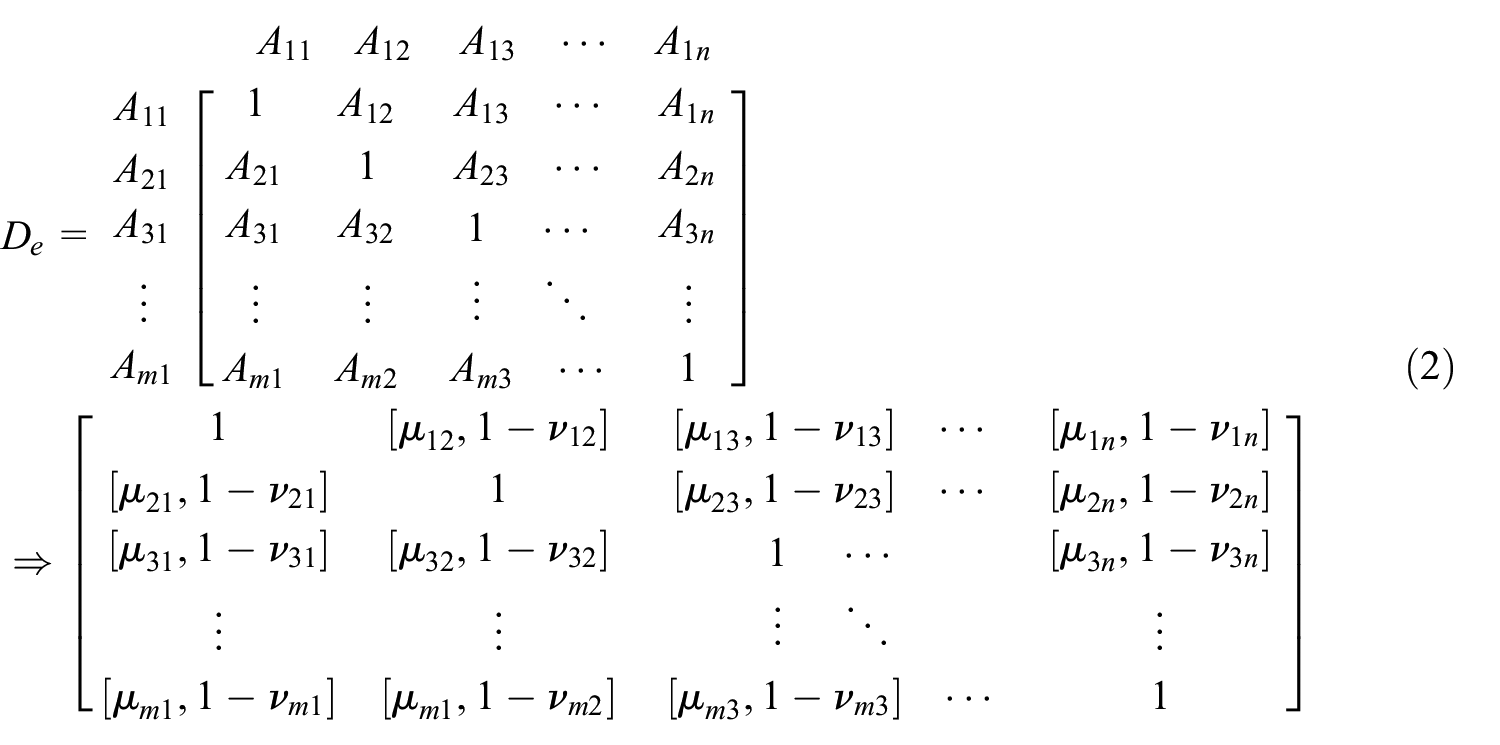
in which, the total score of each selection plan is

Intuitionist fuzzy ANP semantic scale.
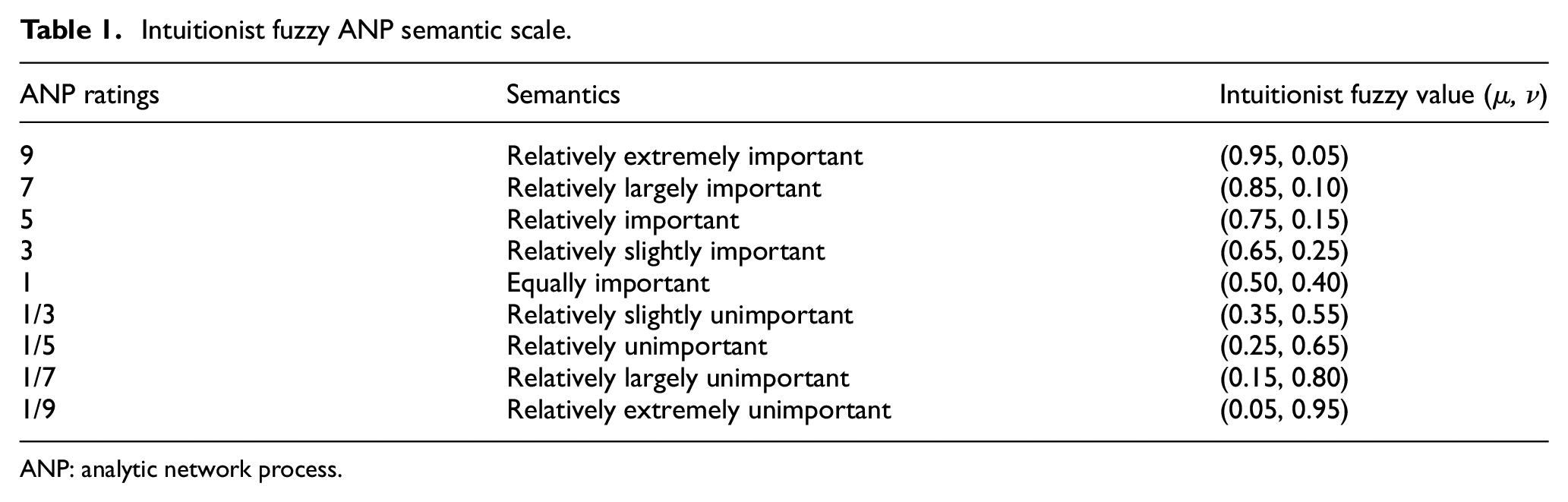
ANP: analytic network process.
In addition, in the process of group decision-making, many experts usually get together for discussions. Therefore, this study adopts the fuzzy set average computation of Klir and Yuan,
57
which unifies intuitionistic fuzzy rating values of various experts into one single intuitionistic fuzzy rating value by geometric mean, as indicated in formulas (4) and (5), in which the gathered group intuitionistic fuzzy rating values are


In the formulas,
Step 2.2. After introducing the method of defuzzification, this study refers to and expands the defuzzification method of Hung et al.,
58
assuming that personal decision-making act will be influenced by the public preference. That means when the crowd mostly tends to agreement, the people who first have no idea will have more willingness of agreement. This concept can allocate the people who have no idea into “agree” and “disagree” in proportion. The proportions of “agree” and “disagree” for each item separately represent

Step 2.3. Compute the consistency of each pairwise matrix and its identical indexes CI as well as CR, as indicated in formulas (7) and (8). According to Saaty, 59 the value of CI < 0.1 is better


Random index.

RI: random index. Not randomized super matrix is called the unweighted Super matrix (unweighted super-matrix).
Step 2.4. After the definite rating weight

In the formula, k represents the power of exponent number;
Step 3. Separately compute their performance and their performance ratio of the green product innovation selection dimension and selection criterion among the case-study enterprises and best competitors as to ratify the ordinate axis (Axis Y) of the IPA evaluation matrix.
Step 3.1. The expert team uses Table 1 to give the case-study enterprises and best competitors their performance grading values of green innovative product selection dimensions and selection criteria. Also, they apply formulas (4) and (5) to gather all experts’ interval fuzzy ratings as the group performance value,
Step 3.2. Introducing the defuzzification method, this study adopts the defuzzification method proposed by Hung et al., 58 as indicated in formula (6), to receive the definite performance value, P, for each selection dimension and selection criterion.
This study applies the modified IPA mode to calculate the satisfactory mean of each service item for the case-study enterprises and the performance ratio (PR) value of the satisfactory mean for the best competitors, as shown in formula (10). The PR value replaces the traditional IPA evaluation matrix performance standard value (Axis Y)
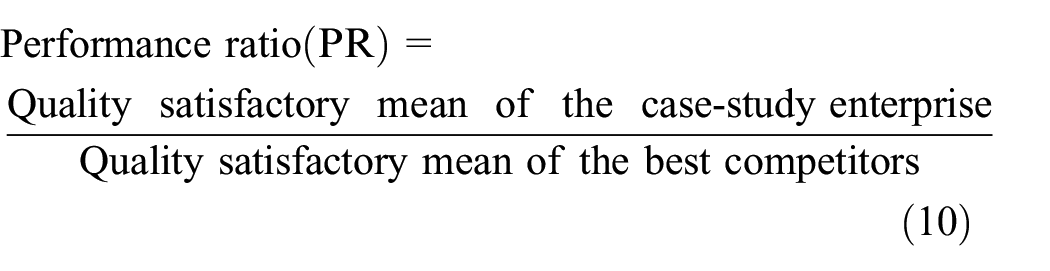
Step 4. Draw the evaluation matrix of IFS-IPA. Through Steps 2 and 3, values I and PR of the selection dimension ASi and selection criterion Cij for green product innovation are received as the lateral axis (Axis X) and the ordinate axis (Axis Y) of the IFS-IPA evaluation matrix, displaying the attribute evaluation result in the IFS-IPA performance evaluation matrix.
Step 5. Conduct the advantage and disadvantage analysis of the IFS-IPA evaluation matrix. Based on the IFS-IPA evaluation matrix graph of green product innovation in Step 4, the advantage and disadvantage analysis of the green product innovation strategy and the management connotation are conducted, in order to provide enterprises with references of the efficient business operation.
Step 6. Based on the importance rating of the IFS-IPA evaluation matrix, extract the quality attribute of the first 60% of green product innovation design as the items of CRs in HOQ.
Step 7. Through experts’ interviews, intuitionistic fuzzy semantic grading, and grade collecting, the intuitionistic fuzzy weight of each CRs is computed. According to the obtained items of CRs in Step 6, the importance weight is computed. Then, grading is conducted by means of experts’ questionnaires and the introduction of intuitionistic fuzzy concept. As to the grading standards, they can be referred to Table 1. The grading weight

In the formula,
Step 8. Induce the required item DRt for the technical importance of the green product development.
Step 9. Set up the intuitionistic fuzzy quality house, in which the expert team conducts their intuitionistic fuzzy semantic grading of the central relationship matrix. After confirming customers’ demand and technical requirements in Steps 7 and 8, the expert team conducts their intuitionistic fuzzy semantic grading of the central relationship matrix in the HOQ. This study defines that in HOQ there are z items for CRs and g items for DRt. As to the central relationship matrix of HOQ, Table 1 is adopted to convert definite values into intuitionistic fuzzy values. Subsequently, the relevant data

In the formula,
Step 10. Compute the IFS value for each DRt weight.
Step 10.1. In the dimension of satisfying customers’ need, the importance technique weight for the technical requirement,

In the formula,
Step 10.2. According to the weight

Step 11. Select the DEA mode, and define the value of IFSs for the weight of each DRs as DMU. This study introduces DEA and regards each item of DRs as each decision making unit (DMU) in the mode of DEA-CCR-I. In the established importance weight of CRs, it is expected that the minimum of the input item can effectively enhance the relevant efficiency of DMU. Therefore, this study adopts the performance evaluation mode of
Step 12. Determine the input and output items of the DEA mode. The related settings for the input and output items of the DEA mode in this study are described as below. The system feature DRt for the product design and technology is set as DMU. Cost and executing difficulty are input items while the weight
1. Input items: Use experts’ questionnaires and introduce the intuitionistic fuzzy concept to conduct grading. The grading standards are referred to Table 1. Regarding two items—enterprises’ cost and executing difficulty for the green product innovation—each expert in the project team will grade them.
2. Output item: The weight
Step 13. Select the analysis of the DEA mode and the technical importance rating for each item’s order, DRt. According to the enterprises’ project evaluation stage, usually in the fixed aim, enterprises use their resources to design green products. As a result, the input-oriented fixed scale reward CCR mode is employed to compute the corresponding efficiency value of each DMU by each input item and output item and to prioritize the valid degree of use for the resource of each DMU based on its efficiency value.
Empirical analysis
This study takes some Taiwanese listed company’s technical development requirements for the green fuel battery modularization as an empirical example. When using the items required by the green product innovation development, 4 major dimensions and 12 criteria are proposed through documentary reviews and experts’ interviews, in order to assess the innovative design and demand for the new generation fuel battery module, as illustrated in Table 3.
Hierarchy of innovative demand for green products.

IPA of IFS
This study applies the IFS-ANP method for computation to receive the importance of green product innovation selection dimensions and selection criteria as the lateral axis (Axis X) of the IPA evaluation matrix. First, the assessment criteria can be obtained through experts’ interviews, expressed in the relationship diagram of reliance and feedback between dimensions and criteria, as shown in Figure 3.

Network hierarchy relationship diagram of green product innovation goals.
Subsequently, based on Figure 3, this study constructs the corresponding position of each sub-matrix in the supermatrix and develops the pairwise comparative matrix of the selection dimension ASi (i = 1, 2, 3, 4) and selection criterion Cij (i = 1, 2, 3, 4; j = 1, 2, 3) for green product innovation, as described in Table 4.
The corresponding position of each sub-matrix in the supermatrix.

Next, the definite weight
Unweighted supermatrix M′ of mutual reliance among elements.
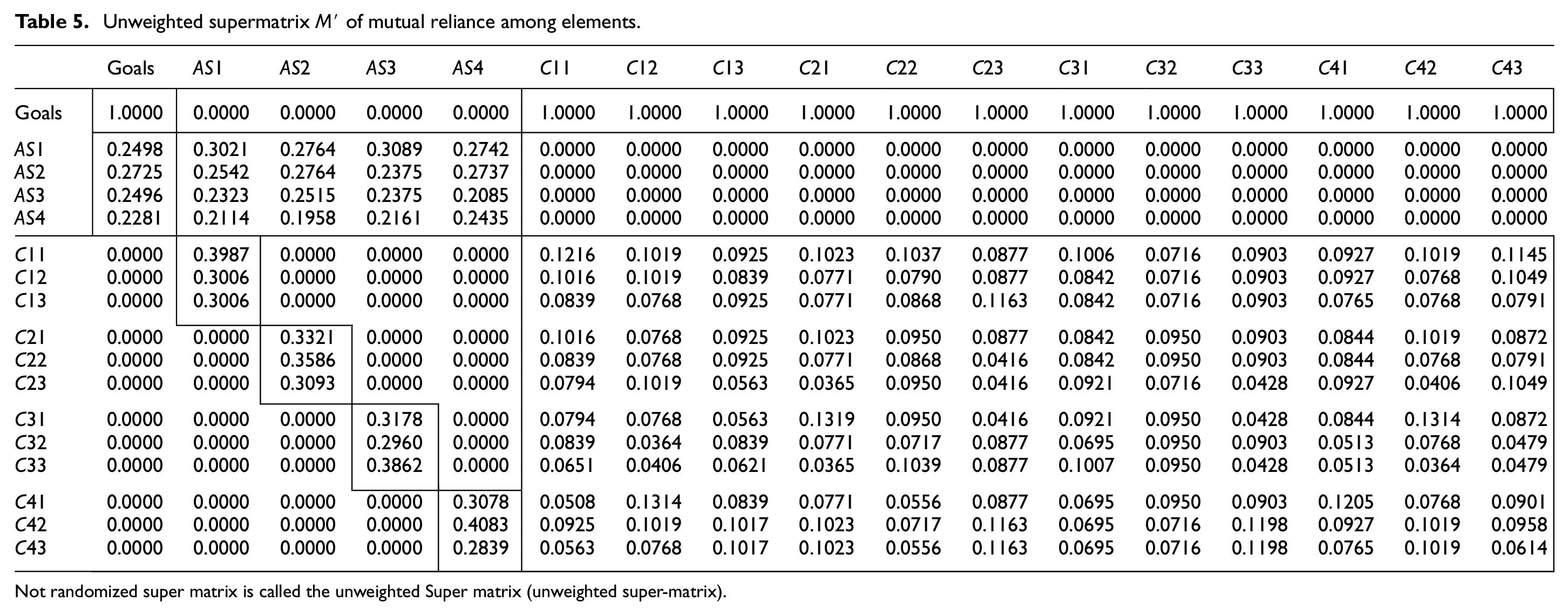
Not randomized super matrix is called the unweighted Super matrix (unweighted super-matrix).
This study discovers that the line values in M′ do not match the line random principle, so they need to be transferred into weighted supermatrix M. Also, the limiting supermatrix M* will be received using formula (9), and the importance weight I of the selection dimension ASi as well as the selection criterion Cij for green product innovation will be obtained, as shown in Table 6.
Limiting supermatrix M*.

After randomization weighting matrix is called super matrix (weighted super-matrix).
Following formulas (6) and (10) in Step 3, the individual performance standard values P and PR of the selection dimension ASi and the selection criterion Cij for the green product innovation design carried out by the case-study enterprises and benchmarking competitors will be calculated, as seen in Table 7.
Performance table for the green product innovation of the case-study enterprises and benchmarking competitors.

PR: performance ratio.
Last, this study organizes the data of importance I and performance ratio PR obtained from Step 2 and Step 3 and displays them in Table 8. Based on the data, the IFS-IPA evaluation matrix is drawn (as illustrate in Figure 4) to analyze how the case-study enterprises carry out their present innovative design for green products.
Importance and performance of the green product innovation.

PR: performance ratio.

The IFS-IPA evaluation matrix of empirical results.
QFD of IFS
Extract customers’ demand and technical requirements
To effectively provide companies with references for their resource adjustment, in the abovementioned importance of the IFS-IPA evaluation matrix for the innovative green-product design, 12 items for green product innovation extracted from the first 60% of quality attribute items as important customers’ demand items in the HOQ, as displayed in Table 9.
Extracted customers’ demand list for green product innovation.
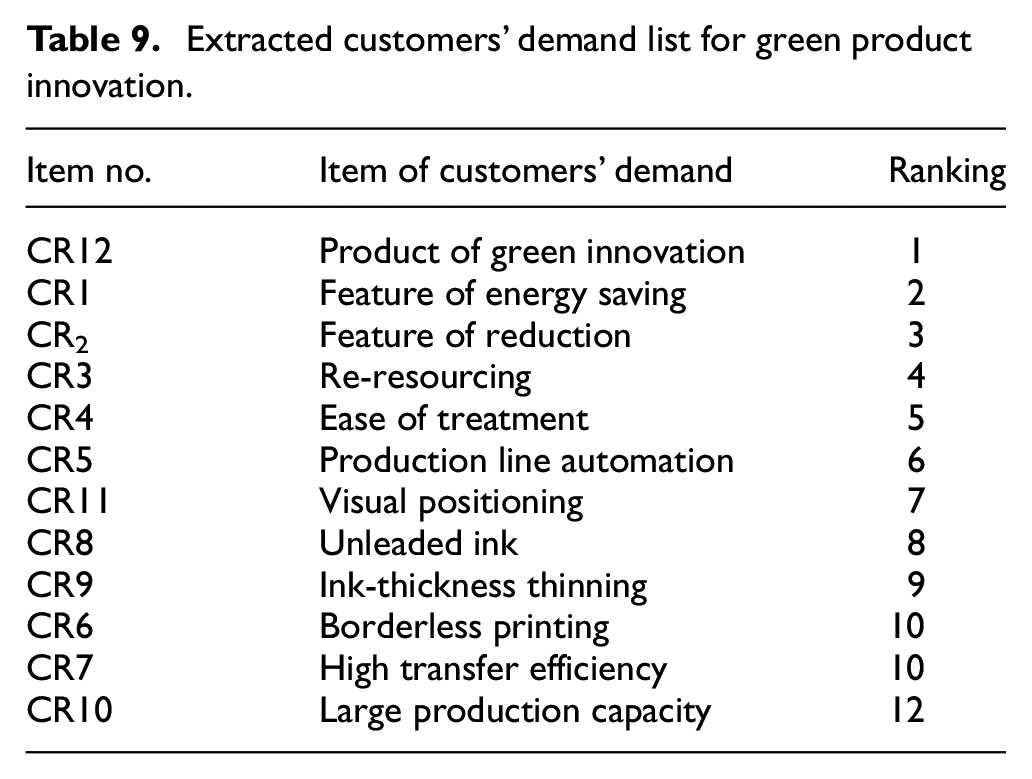
This study refers to the related researches of Pujari 3 and asks the project team for their opinions. As a result, this study sorts out nine items of green product design and technical requirements, such as “To simplify the product and reduce waste material” (DR1), as shown in Table 10.
List of green product design and technical requirements.

Build the intuitionistic fuzzy HOQ
The project team conducts the intuitionistic fuzzy semantic grading based on the intensity of HOQ relationship between the 12 items of customers’ demand and the 9 items of technical requirements. By means of formula (12), which gathers each expert’s intuitionistic fuzzy grading value
Group experts’ intuitionistic fuzzy house of quality.
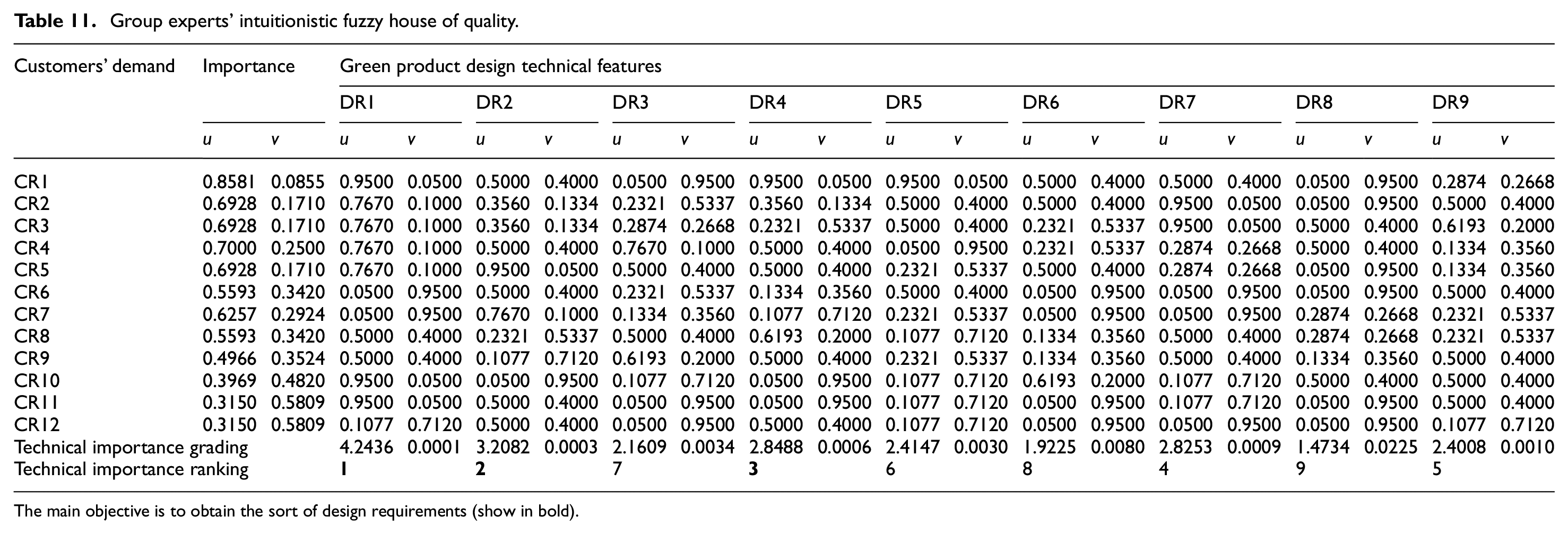
The main objective is to obtain the sort of design requirements (show in bold).
According to Table 11, the result shows that in terms of green product innovation features, “To simplify the product and reduce waste material,”“Easy-to-disassemble spare part design,” and “To reduce unnecessary paint coating” are the three items that are quite important technical features for design, so that enterprises should try to maintain these three critical technical items, in order to raise customers’ satisfaction.
DEA of IFS
Determine the input (output) items of the DEA mode
This study sets up nine items of design technical features as DMU based on the concept of incorporating the IFS with DEA. Meanwhile, through experts’ questionnaires, cost and execution difficulty set as two input items are graded with the IFS. Besides, by means of the geometric average method which collects all experts’ grades, this study can receive the sum of the intuitionistic fuzzy weight of enterprises’ green product innovation evaluated by the project team. Finally, it can also obtain the definite grading values for the two input items—cost and execution difficulty.
On the other hand, the output items of the DEA mode are of the technical grading weight
Introduce the DEA mode to analyze the efficiency value
This study adopts the minimum of the input items to help enhance the corresponding efficiency value of the decision-making unit. Thus, the DEA analysis mode is set as the CCR mode of input orientation and fixed rewards. After determining the decision-making unit, input and output items, and selecting the DEA analysis mode, this study introduces the software of DEA-Solver Pro 6.0 version into the personal computer for execution, and the entire computing result is presented in Table 12.
The computing result list of IFS-QFD + DEA.

IFSs: intuitionistic fuzzy sets.
The main objective is to consider the cost and corresponding efficiency value to obtain the final sort of design requirements (show in bold).
According to the corresponding efficiency value revealed in Table 12, the efficiency value is 1, whose three technical requirements are “To simplify the product and reduce waste material” (DR1), “To reduce unnecessary paint coating” (DR4), and “Recycling equipment of the waste” (DR7).
To sum up, this study analyzes and compares the importance ranking of the two modes, as demonstrated in Table 13. If a company considers the importance of the customers, the first three important items of technical requirements will be seen as DR1, DR2, and DR4 through the computation of IFSs-QFD. By contrast, under the fixed condition of customers’ demand, cost and execution difficulty are input as measuring factors; as a result, the first three important items of technical requirements will become DR1, DR4, and DR7 after the computation of IFSs-QFD + DEA is introduced. Additionally, comparing the total ranking in these two different modes, only DR1 and DR4 are listed in top three in each mode, and the ranking differences of DR2 and DR7 are obvious whereas those of the others are minor.
Comparison list of the computation and ranking results of IFSs-QFD and IFSs-QFD + DEA.

Bold Significance computation and ranking results of IFSs-QFD and IFSs-QFD + DEA (consider the cost and corresponding efficiency value).
It can be seen from the above empirical analysis results that the IFS proposed by this study combines the innovative mathematical modes of IPA, QFD, as well as DEA to explore the green product innovation. Not only can it help enterprises more effectively control the required items of green innovation at an advantage, but it can transfer the voices of customers into technical requirements, in order to meet the expectations of the consumers toward the green product innovation. At the same time, it can also more systematically provide enterprises with references of advantages and strength of the necessary resources for the product of green innovation technical features in the face of effective internal resources.
Conclusion
As the environmental protection awareness rises around the world, green innovation of the product as well as satisfying customers’ need has become extremely highlighted issues concerned by enterprises. Nowadays, present enterprises not only take how to enhance their competiveness and cost-effect into account but also measure their own technical limits while considering customers’ demand. However, mostly owing to the limit on the design stage of the green product, a lot of uncertainties and semantic ambiguity exist in the process of information collecting. Thus, decision makers always face non-quantification and uncertain data, so that they can hardly receive objective selection outcomes.
Therefore, this study constructs the evaluation mode of intuitionistic fuzzy green innovative design with the intuitionistic fuzzy semantic concepts—“agree,”“disagree,” and “uncertainty”—developing into intuitionistic fussy set-importance performance analysis (IFS-IPA), which converts performance ratings into intuitionistic semantic values, so that not only can the better performance be made when dealing with uncertain information and solving the problem of multiple attribute decision-making, but all of the customers’ demand as well as technical requirement rating values can be obtained more objectively. In addition, integrating ANP, QFD, and DEA methods can more accurately convert customers’ voices into technical requirement; meanwhile, considering that enterprises are facing limited resources, we can offer the references for the relative weight and prioritization of the resources required by the products’ green innovative technical features.
In the experimental stage, this study takes the product design of the green fuel battery modularization manufacturing process as an example explaining the application of this evaluation mode. In terms of product design innovation characteristics of the green fuel battery, “to simplify the product and reduce waste material,”“easy-to-disassemble spare part design,” and “to reduce unnecessary paint coating” are three important design technical features. To sum up, the proposed green innovation design evaluation mode can effectively consider enterprises’ own resource allocation, find out critical technical requirements to meet customers’ ultimate demand, strengthen enterprises’ entire competiveness, and offer enterprises references for the green product design.
Footnotes
Academic Editor: Stephen D Prior
Declaration of conflicting interests
The author(s) declared no potential conflicts of interest with respect to the research, authorship, and/or publication of this article.
Funding
The author(s) disclosed receipt of the following financial support for the research, authorship, and/or publication of this article: The authors would like to thank the Ministry of Science and Technology of the Republic of China (MOST 104-2410-H-167-004 and MOST 103-2410-H-167-002) for financially supporting this research.