




Abstract
In this article, a linear dynamic characteristic model of the recessed chamber in a gas–liquid shear coaxial injector is developed. The gaseous injector flow before the recessed chamber is considered to be steady, and we just investigate the response of pressure drop across the recessed chamber to the mass flow rate fluctuation of the liquid injector. The transfer function of the recessed chamber is obtained, considering the distribute characteristics of liquid droplets within the recessed chamber. The results show that the amplitude of pressure drop pulsation would decrease as the liquid flow pulsation frequency increases, when the variation of liquid velocity is not taken into account. While considering the variation of liquid velocity, the result is opposite. The amplitude of pressure drop oscillation on the boundary of the recessed chamber increases with the increase in liquid velocity oscillation frequency.
Keywords
Introduction
As the demand for large thrust liquid rocket engines increases, some highly effective propellant such as liquid hydrogen, liquid oxygen, and kerosene as well as some new techniques such as staged combustion cycle are widely used. The application of these new techniques facilitates the use and research of coaxial injector technique. For a gas–liquid coaxial swirl injector, the liquid propellant is injected through a center swirl injector, and the gaseous propellant is injected with high velocity through an annular gap around the center injector. The hollow cone liquid sheet ejected out of center injector impinges on the surrounding gas stream, providing better atomization and higher performance. In industrial applications, the center injector always retracts with respect to the exit surface of the outer injector, forming a recessed chamber. 1 The recessed chamber of coaxial injector can enhance the mixing of propellants, subsequently affect the stability of flame and result in favorable and stable combustion.2–5
As shown in Figure 1, the oxidant and fuel of recessed coaxial injector flow in each tube. They meet in the mixed recessed chamber, break up, mix, and eject out of the nozzle. The recessed length of oxidant nozzle outlet’s section to fuel nozzle outlet’s is the principal section which influences the interaction of propellant in the entrance section of combustion chamber, and the interaction of gas–liquid phase in the recessed chamber plays an important role in completeness and stability of combustion in the combustion chamber.
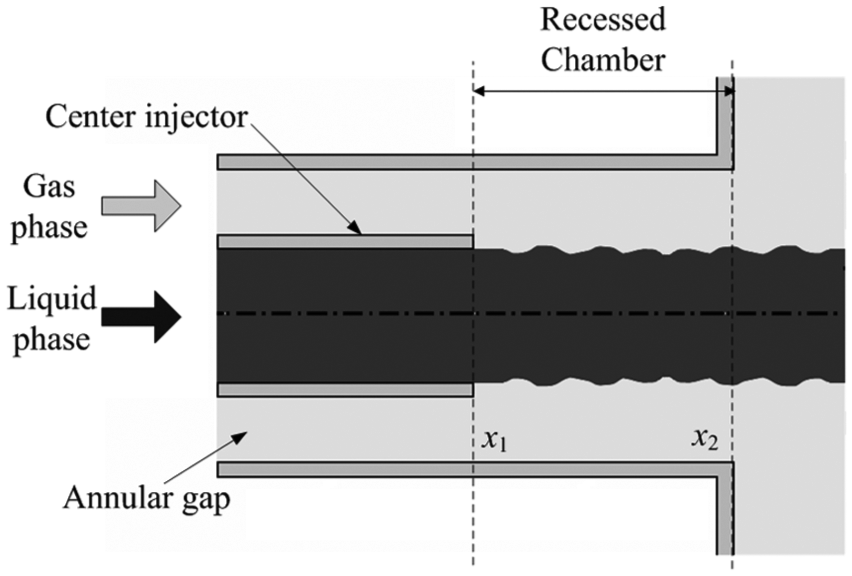
Schematic diagram of a shear coaxial injector.
There have been many studies on the spray and combustion characteristics of the coaxial swirl injector with the recess configuration;6–10 however, the dynamic characteristics of this type of injector have been less studied.
Chen et al. 11 analyzed the propagation law of fluid oscillation in the gas–liquid jet; however, the calculating work is large. Actually, frequency-domain analysis is easier than time-domain analysis while solving dynamic characteristics of the injector, which means calculating the frequency response in real frequency domain is easier than solving differential equation. When a sinusoidal input of a certain frequency is put in the injector, the amplitude ratio of the output and input and the phase shift are called frequency characteristics or frequency response. The characteristic is the manifestation of dynamic characteristics of the injector in real frequency domain, and hydromechanics equations can be transformed into frequency characteristic equations via Laplace transformation. Fu and Yang 12 developed a linear dynamic characteristics model of a gas–liquid coaxial swirl injector. They assumed the gas–liquid two-phase flow in the recessed chamber is homogeneous flow and obtained the transfer function of the recessed chamber. This article analyzes the interaction and the dynamic process of gas and liquid in the recessed chamber of gas–liquid coaxial injector linearly, and the distribution of dispersed phase within the recessed chamber is taken into account, that is, the liquid droplets within the recessed chamber are considered to be inhomogeneous.
Theoretical framework
In the recessed chamber, because the momentum of the gas is much larger than the momentum of the liquid, the liquid film within the liquid nozzle exit will break up and turn into droplets on account of aerodynamic force. The droplets will produce the medium motion-resistance force, which will cause the appearance of pressure difference in the gas in the entrance and exit. Droplet distribution within the recessed chamber is nonuniform, that is the parameters cannot be considered to be lumped in the recessed chamber when

where
Let
Supposing the velocity of liquid in the recessed chamber is constant
The pressure drop of the recessed chamber whose length is dx can be calculated as

where
The total pressure loss in the recessed chamber can be obtained by integration of dp from

Linearize equation (3) and express it through relative amount of disturbance. The velocity of the gas phase is relatively higher than that of the liquid phase. According to
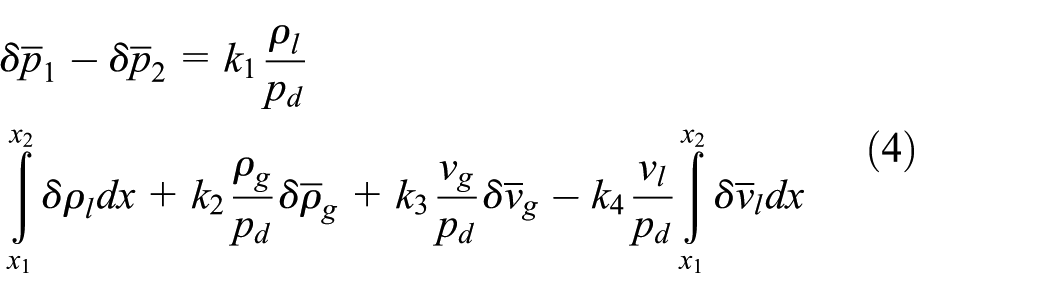
where the quantity with overbar “−” denotes the relative quantity, prefix “
Also, we can obtain equation (5) through

In consideration of equation (5), equation (4) can be expressed as
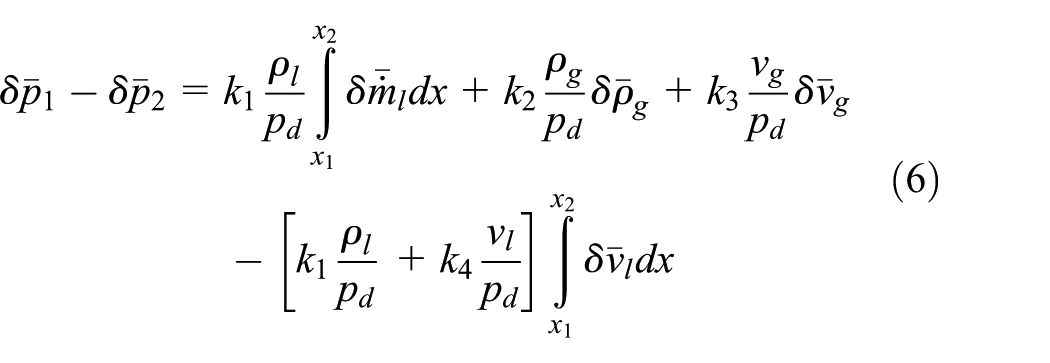
The liquid infinitesimal in section x at moment t is ejected out from the section of nozzle (x = 0) at the moment of

In the axial direction of the recessed chamber, the velocity of liquid entering the recessed chamber can be hypothesized as

When the initial conditions are zero, conduct Laplace transform with equation (8) and obtain
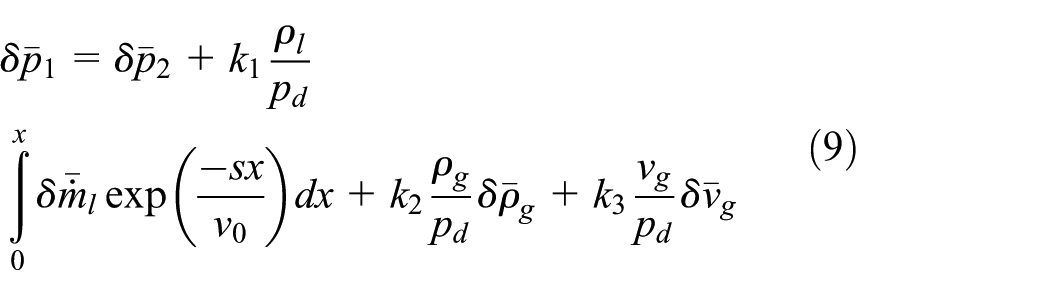
Calculate the integral term in equation (9), and we can obtain the relation of relative disturbance quantity of the parameters on the boundary of the recessed chamber

In the equation above,
Velocity of liquid in the recessed chamber changes
In actual situation, the velocity of liquid entering the recessed chamber changes. At the same time, the delay time

In this situation, for velocity fluctuating

When the initial condition is zero, we conduct Laplace transform with equation (12) and obtain

The equation above can be simplified as equation (14)

In the equation above

Equation (14) manifests that considering the oscillation of delay time, although there does not exist flow disturbance at the section of nozzle exit, there is pressure drop oscillation on the boundary of the recessed chamber. This is because, if liquid spouting velocity while entering the recessed chamber is variable, at the certain time t, the total mass of liquid at section x is not only decided by the liquid mass entering at time
Results and discussion
Figure 2(a) shows the amplitude–frequency curve of

Dynamic characteristics of the recessed chamber when the velocity change in liquid is not considered (
According to Figure 2(c), when angular frequency of disturbance increases, the module value of
Figure 3 shows the dynamic characteristics of the recessed chamber calculated using equation (15), which consider the variation of liquid velocity along the recessed chamber. It shows the dynamic respond of pressure drop to the pulsation of liquid velocity. Figure 3(a) shows the amplitude–frequency diagram of

Dynamic characteristics of the recessed chamber considering liquid velocity change (
Conclusion
The interaction of gas phase and liquid phase in the recessed chamber of gas–liquid coaxial injector is investigated with the frequency method. The dynamic response of pressure drop pulsation in the recessed chamber to the liquid flow pulsation is calculated, in the condition of considering and not considering the variation of liquid velocity. When disturbance frequency is in medium-high frequency range, the distribution characteristic of the drop in the recessed chamber must be taken into consideration. The calculation results show that when not considering the variation of liquid velocity across the recessed chamber, the amplitude of pressure drop pulsation on the boundary of the recessed chamber decreases in general, with the increase in liquid velocity oscillation frequency. At points where
Footnotes
Appendix 1
Academic Editor: Oronzio Manca
Declaration of conflicting interests
The author(s) declared no potential conflicts of interest with respect to the research, authorship, and/or publication of this article.
Funding
The author(s) disclosed receipt of the following financial support for the research, authorship, and/or publication of this article: This work was financially supported by China National Nature Science Funds (support numbers: 11525207 and 11302013).