



Abstract
This research cross-employs the information communication distribution transaction and analytic network process models to effectively institute the hierarchical evaluated model and utilizes, in specific, fuzzy theory and the grey relation analysis approaches of multiple criteria decision-making methodology into the weight measurements of expert’s questionnaires from three analytical perspectives (user’s satisfaction, corporate commitment, and social trust) of relationship quality in order to explore the niche determinants of the social media websites in the contemporarily hypercompetitive and dynamic online era. Consequently, as for the measured consequences after a series of complicated and systematical calculations, the most valuable findings in this research are (1) the technological interfaces of social media websites is a positive niche in the dynamically mobile hypercompetitive communication era and (2) the “social media websites” is in a position of becoming one of the social media mainstreams in the online technology field based on the measured weights from the detailed survey data collected from experts in this research.
Keywords
Introduction
Nowadays, with reference to the development of mobile communication technology (MCT) from initial web 1.0, web 2.0 to current web 3.0, 1 the MCT has been gradually integrated into the diversified and complementary applications of the telecommunication, global position systems (GPS), and TV technologies (such as wireless web-service, blog, Facebook, smartphone, GPS products, and online video games). 2 Furthermore, it also expanded the technology user base that includes not only the users of traditional MCT (e.g. computers) but also new members of the general public who have become comfortable with the use of various MCT interfaces (e.g. cell phones). In the process, this expansion created the information telecommunication technology (ICT) in the social media (SM) of the MCT. 3 Extensively, the ICT comprises of the traditional online technology (such as Internet technology and web-portals), the comprehensive telecommunication (such as smartphones), the consumer electronic device (such as personal digital assistants and tablets), and the television and the GPS online technologies. 4 In empirical, as a result of the newest statistics from the international telecommunication union (ITU), the rate of global Internet users from 2001 to 2011 has increased about 4.4 times (from 8% to 34.7% per 100 inhabitants). During this same period, the rate of mobile telephone subscriptions has grown 5.6 times (from 15.5% to 86.7%, per 100 inhabitants), active mobile-broadband subscriptions rate has increased from 0% to 17%, fixed (wired)-broadband subscriptions rate has expanded 14.2 times (from 0.6% to 8.5%, per 100 inhabitants), and the rate of fixed telephone lines has declined as a result of soaring use of mobile phone. 5 The majority of researches on the MCT have distinctly indicated a main conclusion that the rapid development of the MCT has not only played crucial, extensive roles in people’s lives 6 but it has also changed human behavior gradually through cross-employment among the MCT. 7 Furthermore, it is most critical to realize that the newest global developing trend relates to the interactive influences and relationships between the integration among these technologies and human behaviors of social transmission. 8 The online-technology development of ICT results in the need for enterprises to undergo vigorous tactics in confronting greater challenges to meet the desires of more discerning users and market pressures. 9 As ICT has gradually played a critically decisive role in people’s daily lives, the lifestyle of users has promptly transformed as well, especially with interactive applications among each interrelated MCT and specifically, each user is able to properly operate the cross-employed apparatuses of ICT without the traditional equipment battery. 10 As the developed tendency of ICT, the SM has appeared from social networking among the extensive users because each user can immediately download and upload the latest word-format and video-format information or news by their mobile smartphone. However, making a comprehensive survey on the relative researches, a majority of recent researches focus on the technological functions of the SM and for this reason, this research cross-employs the information communication distribution transaction (ICDT) model into the hierarchical analytic network process (ANP) model in order to identify and manifest the interactive interplays among technological interfaces of SM and users’ human behaviors of social transmission from three analytical perspectives (user’s satisfaction, corporate commitment, and social trust) of relationship quality (RQ). 11 The main reasons of this research are (1) management have difficulty in recognizing users’ demands, especially with the traditional professional online-technology users whose numbers have swelled because of the rapid development telecommunicated technologies and the generalization of mobile smartphones and (2) in statistics, the subjectivity of customers are sometimes misunderstood in the questionnaires constructed by the Likert scale because the original limitation of the selection-item designs of the SM websites. Subsequently, ICDT model is able to effectively execute the empirical analyses based on its four essential assessable dimensions, which are comprised of the virtual information space (VIS), the virtual communication space (VCS), the virtual distribution space (VDS), and the virtual transaction space (VTS). Extraordinarily, in order to uplift research reliability and validity, avoid linguistic amphiboly 12 and arise the significant degree of the questionnaires, 13 fuzzy theory (FT) and the grey relation analysis (GRA) approaches of multiple criteria decision-making (MCDM) methodology are utilized into the weight measurements of expert’s questionnaires of the ANP model. Consequently, the cross-analytical processes of the research design framework in this study are developed from four principle steps comprised of (1) identifying the research target and motive in order to define the clear research question, 14 (2) cross-employing the ICDT and ANP models, 15 (3) utilizing three measured approaches of the MCDM methodology to cross-evaluate empirical survey data, 16 and (4) integrating the overall analyses in order to inductively make conclusions and recommendations 17 in order to effectively explore the niche determinants of the SM websites in the contemporarily hypercompetitive and dynamic mobile communication era. 18
Literature review
Literatures on theoretical concepts
SM (e.g. blogs, picture-sharing, vlogs, wall-postings, email, instant messaging, and crowdsourcing) is the creative and interactive media technology that integrates six types of online interfaces comprised of (1) collaborative projects (such as Pinterest, Wikipedia, and WordPress), (2) blogs (such as Bebo, Blogger, Microblogs, MySpace, and Twitter), (3) content communities (such as YouTube), (4) social networking sites (such as Facebook), (5) virtual game worlds (such as World of Warcraft), and (6) virtual social worlds (such as Second Life). 19 In particular, SM consists of seven specific features: (1) innovative quality: the innovative quality distribution of SM substantially and narrowly covers from high-quality to low-quality online website contents; (2) easy reach: all website information and content of SM are easily and immediately obtained for the global users; (3) wide-spread accessibility: the accessible SM tools or equipments are generally available to the public with a little or no fee; (4) specific immediacy: each communication of SM is able to be capable of virtually instantaneous responses; (5) high frequency: each user is able to one-way surf and two-way edit with high-frequency times through the diversified MCT interfaces; (6) immediate usability: people are currently able to browse and record without any specifically professional information technology (IT) skills in anytime and anywhere; and (7) permanent record: SM can be altered almost instantaneously by comments or editing in the permanent virtual IT world. 20 In order to enrich the research representativeness, the analytical perspectives (user’s satisfaction, corporate commitment, and social trust) of RQ are directly considered as brief evaluated dimensions of comprehensive discussion of human behaviors of social transmission. Hence, Crosby et al. 21 invent the commitment is the critical assessable perspective of RQ because the enterprises are supposed to sacrifice some short-term commerce profits for respecting the corporate promises in order to completely establish the confident conviction for the long-term benefits. Consequently, the three brief and essential evaluated dimensions comprised of “satisfaction (customer’s perspective), trust (employee’s perspective), and commitment (corporate perspective)” are still generally employed to be appraised perspectives.
Literatures on methodology
Angehrn 22 created ICDT model to comprehensively analyze and systematically identify the operations and activities of the electronic commerce (“e-commerce”) websites in order to induce the effective strategy and the efficient processes for enterprises not only to reduce the competiveness and struck due to the rapid development of the hardware and software of IT websites sector but to discover any opportunity for making the maximum of profits. The main four segments of ICDT model have been considered as the assessed criteria groups and these are (1) VIS: new channels for economic agents or enterprises to display and access the relative information, such as marketing and advertising, regarding the products and services. It is the earliest developed of MCT; (2) VCS: new channels for economic agents or enterprises to engage in relationship, ideas, and opinion building activities (such as lobbying and negotiations). It has been not generally emphasized in the starting period of MCT development; however, VCS has the most potential benefits for the enterprises; 23 (3) VDS: new channels for economic agents or enterprises to distribute real-time text-based, voice-based, and vide-based products and services (such as digital goods and contents, software, and tele-consulting service); and (4) VTS: new channels for economic agents or enterprises to initiate and execute business-related transactions (such as orders and payments). The most critical issues consisted of the digitally transacted securities and the related government regulations were supposed to be considered in the settlement of the VTS. For this reason, in order to effectively increase reliability and validity, clearly penetrate linguistic amphiboly, and efficiently promote degree of satisfaction in the questionnaires, the analytical hierarchy process (AHP) model has become the research streamline of the related decision-making analytical fields in order to handle more complex research questions. However, other researchers further discovered a situation in which there are two kinds of relationships between criteria and sub-criteria, internal/external dependency and feedback. Hence, Saaty 24 further delivered ANP model to be the new research methodology not only to pierce out this limited hypothesis through the Delphi method25,26 and brainstorm approaches to the collect experienced experts’ questionnaires data but also to utilize the positive reciprocal matrix and supermatrix 27 and the more complex hierarchical analyses to induce the results of collection data under the comprehensive, limited-resource, and difficult-decision environment. Consequently, the typical measurements process where overall related impacted factors are categorized into four groups and then, according to the patterns of ANP evaluation model, these related impacted factor groups are decomposed as a third hierarchy of criteria of assessments. 28 The related impacted factors are also decomposed as a fourth hierarchy of sub-criteria of each criterion and the two-stage algorithm and the consistency index (CI) 29 which is exactly considered in each pairwise matrix as described
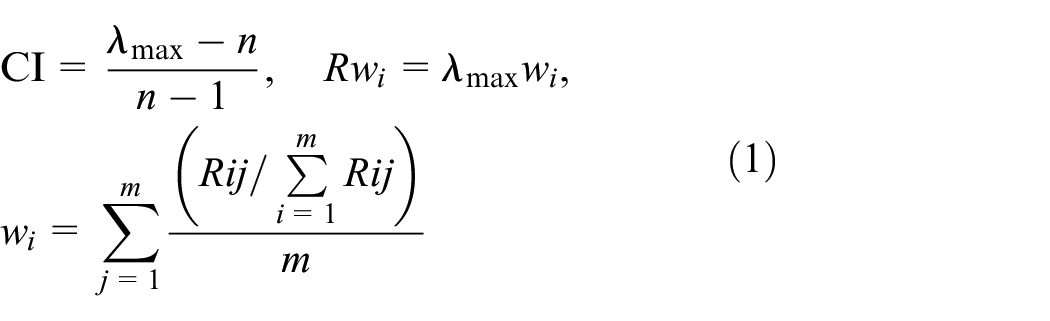
i presents the number of n interviewed questionnaires.
The consistency ratio (CR) is calculated as
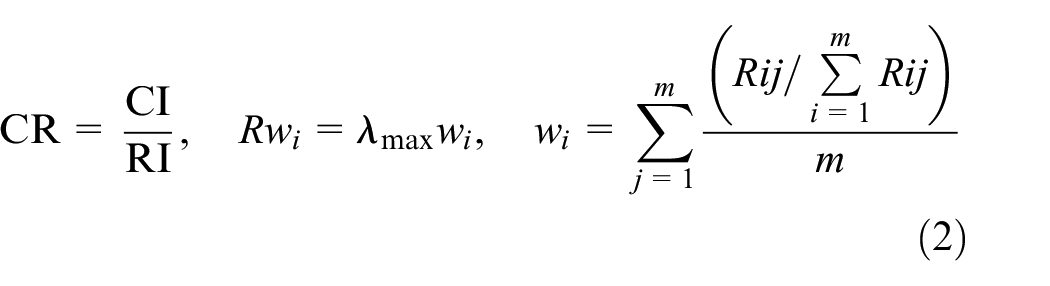
j presents the number of m interviewed questionnaires and
In particular, the pairwise comparison matrix can be accepted when the number of CR is equal or smaller than 0.01 according to the principle of CR in ANP. Subsequently, in order to effectively decrease linguistic uncertainty of surveyed questionnaire, Zadeh 30 induced the fuzzy set which was based on two characteristics (membership degree and membership function) of the fuzzy set theory for substituting the crisp set of traditional mathematics which can set up the uncertain and fuzzy research problems. In the hierarchical relations in the last level, each potential supplier has to fit match each assessable sub-criterion matched in each evaluated criterion through pairwise compared criteria of each sub-criteria following.
Hence, with respect to the integration between the ANP evaluated model and FT and the GRA assessed approaches, each expert can give the weights
Hence, in order to reflect the comparative score for the three types of corporate demand patterns, equation (3) is applied to compute the comprehensively comparative related priority weight

Particularly, as for defuzzification from the aspect of effective order, the S[A,B]
32
is utilized by carrying out the calculation of the fuzzy S[A,B]33,34 between two measured vectors (
In order to distinctly approach the linguistic experts’ comment and to comparatively emend evaluated scores, GRA approach 35 has been applied to the assessed measurements and in particular, the three brief situations have been considered into the GRA measurements as follows:
The analytical goal belongs to efficient goal and satisfies the maximized analytical goal (the larger the better, LTB,) as

The analytical goal belongs to cost goal and satisfies the minimized analytical goal (the smaller the better, STB) as

The analytical goal belongs to specific goal (nominal the best [NTB])

Consequently, this research not only utilizes the five-level quantified figures of evaluation scale between languages of interviewees of pairwise in assessment of Chen and Hwang,
36
but it also combined the GRA approach as presented in five level of importance (language powers) of grey set system in the GRA consisted of Equal is 0.091, Little Important is 0.283, Important is 0.5, Very Important is 0.717, and Extreme Important is 0.919. The measurement of the GRA approach is utilized to satisfy two analytical research situations: analytical goal belongs to efficient goal and satisfies the maximized analytical goal and analytical goal belongs to cost goal and satisfies the minimized analytical goal. Furthermore, in order to calculate the total score of these three kinds of relations in consolidation, the organized grey relation coefficient results from the calculation after transformation of the qualitative data of survey interviewees’ opinions to the quantitative data. Eventually, in the hierarchical relations in the last level, each potential candidate has to match each assessable sub-criterion matched in each evaluated criterion through computing the comprehensively comparative related priority weight

i presents the number of n interviewed questionnaires and
Research design
Research data collection
Dalkey and Helmer 37 expressed that there are the least errors of validity and reliability in the Delphi method when the collected questionnaires are, at least, over 10 professional interviewees in the total surveyed data using the Delphi method and expertise brainstorm approach. Hence, in order to effectively increase the full research representativeness in ANP evaluated model, 15 professional experts are the questionnaire interviewees and these consists of five senior SM users who have a published column in relative ICT magazines, five senior managers who have over 10 years of working experience in the related ICT industries, and five academic scholars who understand the flourishing of research and development in SM technology and human behaviors in social transmission with at least 10 years of research experience. Specifically, the questionnaire data are surveyed for the pairwise comparisons at each level and are evaluated with respect to the related interdependence and importance from equal important (1) to extreme important (5).
Research criteria
This research comprehensively employs the three analytical perspectives (user’s satisfaction, corporate commitment, and social trust) of RQ to be appraised attitudes 35 to pioneer the most influenced 17 assessable elements (sub-criteria) of technological interfaces of SM, categorized into the four assessable criteria of ICDT model in order to induce the best solutions of three potential evaluated candidates, 38 consisting of (1) the technological interfaces of SM websites is a negative niche in the dynamically mobile hypercompetitive communication era (“SMNN”), (2) the technological interfaces of SM websites is a may niche in the dynamically mobile hypercompetitive communication era (“SMMBN”), and (3) the technological interfaces of SM websites is a positive niche in the dynamically mobile hypercompetitive communication era (“SMPN”). Subsequently, the assessed criteria and evaluated sub-criteria are described as follows.
Social media information technology
This criterion was refined from the main aspect of VIS of ICDT model because the online technology developed demands are essentially considered the hardware and software of ICT. In succession, there are six sub-criteria to be contained in this criterion and these are (1) behavior targeting (BT): online ICT industries collect the preference of users in order to initiate the absorptive subject and content of websites to increase uses; (2) Web 2.0 (W2): online websites develop an interacted interface to increase users’ satisfaction because the users change from passive readers to active creators;39,40 (3) Web 3.0 (W3): online websites currently research and develop new interacted interface technology for the purpose of alluring more users (consumers), such as virtual communication interface and three digital or four digital interface technologies; (4) keyword search engine (KSE): online websites produce alluring keyword search messages in the first window search in order to attract users to search the related information; (5) augmented reality function (ARF): online websites utilize diversified functions to construct the augmented reality presentation to fascinate each user such as 3D expression; and (6) virtual cloud computing (VCC): due to the flourishing wireless service and high-speed transmission of data with the largest bandwidth, the SM is further able to deal with the large calculating, cross-applications and saving through the VCC function without the limitation of the IT operating facilities. This induces that users are able to employ any software without the consideration of the limitation of the transmission equipment. 41
Social media communication technology
This criterion was developed from the main aspect of VCS of ICDT model because the relationships, ideas, and opinions build the online-technology activities. Sequentially, there are five sub-criteria to be contained in this criterion and these are (1) rich media (RM): online websites provide various interactive online interfaces, such as JAVA, real audio, real video, and shockwave, in order to exchange media data among users such as YouTube, Google media, and Yahoo Photos; (2) really simple syndication (RSS): online websites supply the function of regular subscription to users in order to obtain the opportunities to put dynamic and static information of users to each social community member; (3) social community integration (SCI): online websites supply the “social function” to assist users to establish their owned virtual society such as Blogs, Twitter, and Facebook; 42 (4) third-party organization endorsements (TOE): online websites provide the content to be endorsed from the third-party organizations due to the exactitude and legality of the online website information; and (5) third-party privacy/security seals (TPS): online websites are supposed to secure the privacy seals of the users. 43
Social media delivery technology
This criterion resulted from the main aspect of VDS of ICDT model because GPS system is able to distribute products or services to an extensive number of users at the same time. Contiguously, there are three sub-criteria to be covered in this criterion and these are (1) wideget function (WF): SM websites create new technologies to fix with other 3C devices such as the users are able to utilize the wireless Internet function to surf the Internet and to send or to receive e-mail on their own mobile phone which results in that the online individual users’ information can be send to the users of mobile phone immediately through WF; (2) location-based service (LPS): online websites offer specific GPS guide and positioning function in order to provide local information and piloting services and express the nearest users’ location and information; 44 and (3) real-time direct messages (RDM): online social communities actively send periodical and irregular messages and information of each community member to the users through mobile online transmission service.
Social media business technology
This criterion was produced from the main aspect of VTS of ICDT model because the generalization of the mobile phone is able to offer products or services to an extensive number of users in the meanwhile. Consecutively, there are three sub-criteria to be covered in this criterion and these are (1) alternate reality games (ARG): online websites create virtual games with the aim of attracting more users in order to put advertisements of products or services or to sell the products or services of virtual games; 45 (2) application programming interface (API): online websites open the “writing and coding functions” of their programs to enhance the functionality and application of their websites in order to attract more users and then put advertisement of products or services in this interacted interface, such as Wikipedia (the free encyclopedia) and Facebook; 46 and (3) multiple mobile application (MM-APP): due to the popularization of smart mobile phones, users of such devices have commenced to request and use more entertainment-related applications such as media-play, video games, and media telecommunication. Accordingly, IT engineers devoted more research and develop in mobile APP software to meet the users’ entertainment demands.
Research hierarchy
In accordance with the cross-employment of ANP and ICDT models and MCDM methodology, the research hierarchy is expressed in Figure 1.
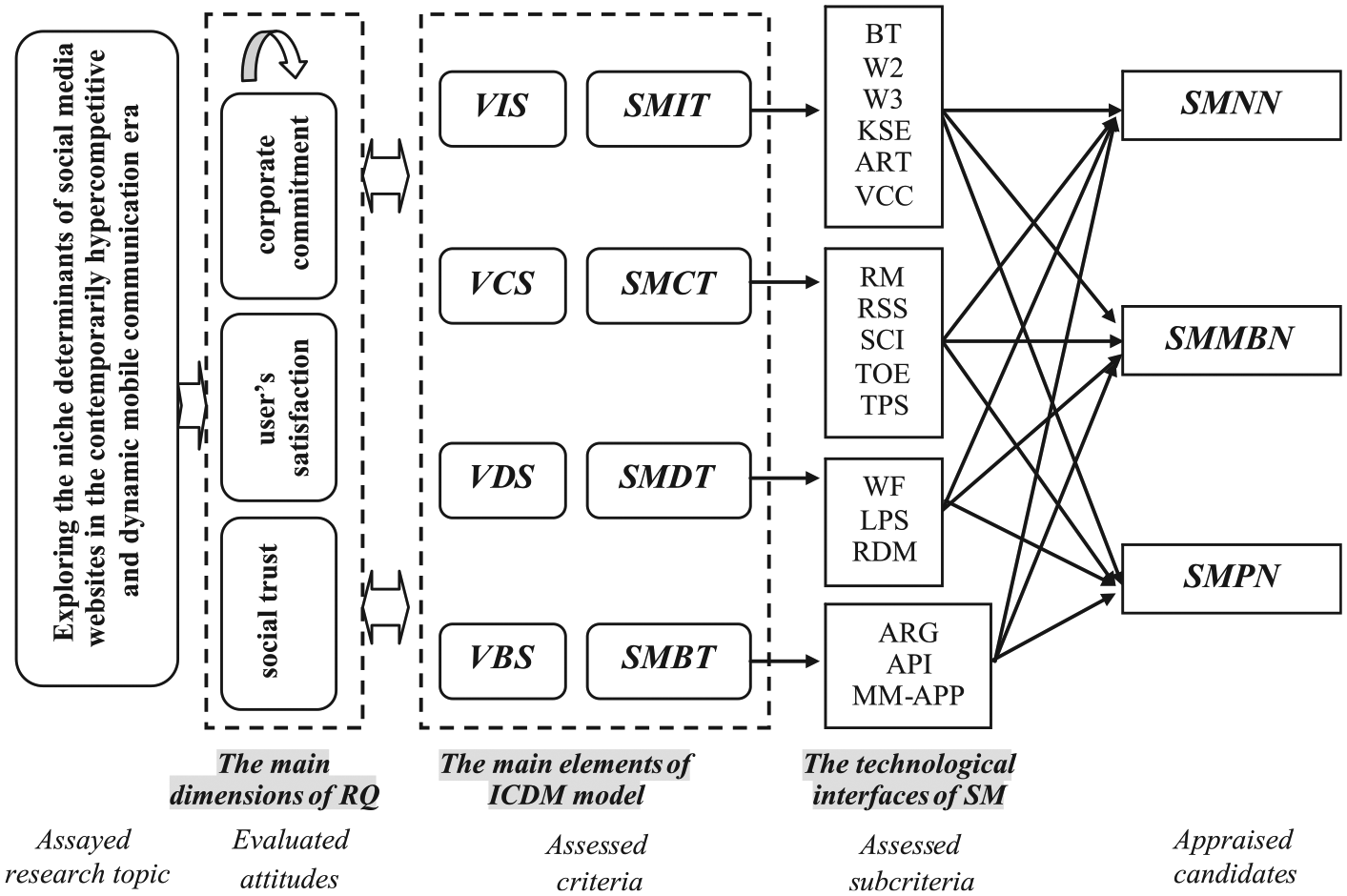
The research hierarchy.
Empirical assessment
The three assessment processes are described as follows.
First step: measuring ANP model
ANP model is first applied in the hierarchical analysis to assess the potential niche possibility of the technological interfaces of SM in the latest online-technology tendency by considering transitivity and consistency of selection among the most potential interplays and relations in the hierarchical assessments of ANP model. Consequently, Table 1 points out not only the entire evaluated hierarchies and relations but it also shows that the highest evaluated score of SMPN is 0.6666. Furthermore, the second highest evaluated SCIN score is 0.2457 which is located at SMMBN through the hierarchical combined measurements of the CR and CI.
SCIN measurement of ANP model.
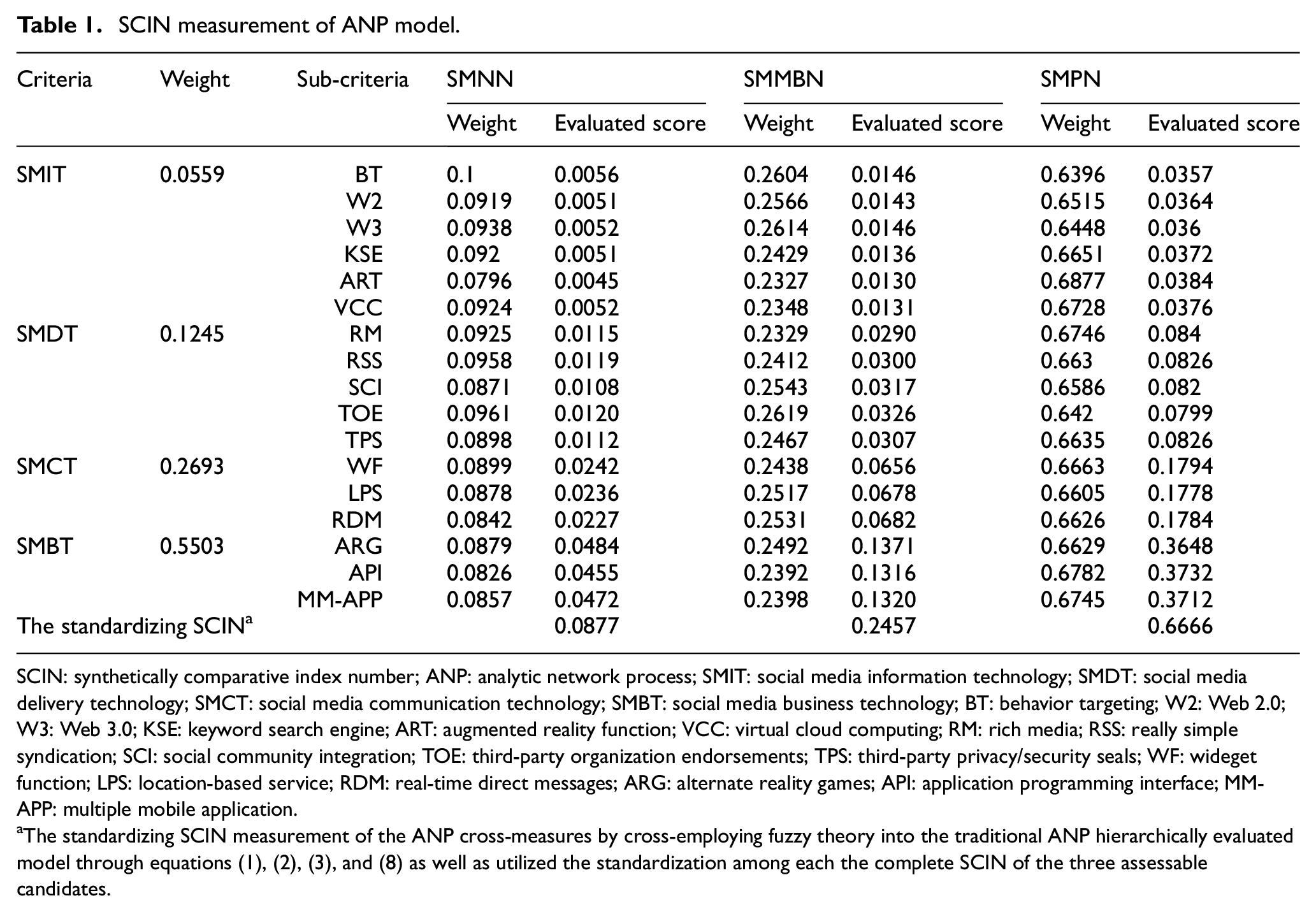
SCIN: synthetically comparative index number; ANP: analytic network process; SMIT: social media information technology; SMDT: social media delivery technology; SMCT: social media communication technology; SMBT: social media business technology; BT: behavior targeting; W2: Web 2.0; W3: Web 3.0; KSE: keyword search engine; ART: augmented reality function; VCC: virtual cloud computing; RM: rich media; RSS: really simple syndication; SCI: social community integration; TOE: third-party organization endorsements; TPS: third-party privacy/security seals; WF: wideget function; LPS: location-based service; RDM: real-time direct messages; ARG: alternate reality games; API: application programming interface; MM-APP: multiple mobile application.
The standardizing SCIN measurement of the ANP cross-measures by cross-employing fuzzy theory into the traditional ANP hierarchically evaluated model through equations (1), (2), (3), and (8) as well as utilized the standardization among each the complete SCIN of the three assessable candidates.
Second step: integrating FT approach into ANP model
In order to effectively increase the reliability and validity, clearly penetrate linguistic amphiboly, and efficiently promote degree of interviewed experts’ satisfaction in the questionnaires, FT is utilized to deeply survey the ulterior consequences of the questionnaires. In Table 2, the highest vector of SCIN is (0.7345, 0.6666, 0.6077) and the highest number of S[A,B] is 0.5521 in the SMPN. Significantly, the second higher evaluated score of the standardizing SCIN 0.2451 was SMMBN which is completely familiar with the measured results of ANP model through the amendment of the fuzzificated evaluated score and the defuzzificated equations in assaying process of the merger of ANP model and FT from the 15 experts.
The standardizing SCIN measurement of the merger of ANP and FT.

SCIN: synthetically comparative index number; ANP: analytic network process; FT: fuzzy theory; SMIT: social media information technology; SMDT: social media delivery technology; SMCT: social media communication technology; SMBT: social media business technology; BT: behavior targeting; W2: Web 2.0; W3: Web 3.0; KSE: keyword search engine; ART: augmented reality function; VCC: virtual cloud computing; RM: rich media; RSS: really simple syndication; SCI: social community integration; TOE: third-party organization endorsements; TPS: third-party privacy/security seals; WF: wideget function; LPS: location-based service; RDM: real-time direct messages; ARG: alternate reality games; API: application programming interface; MM-APP: multiple mobile application.
The standardizing SCIN measurement of the merger of the ANP and the FT cross-measures by cross-employing fuzzy theory into the traditional ANP hierarchically evaluated model as well as utilized the standardization among each the complete SCIN of the three assessable candidates.
Third step: merger GRA approach into ANP model
In order to approach the linguistic experts’ comment and to comparatively emend evaluated scores, the grey relation is the equal weights among analytical influenced and therefore these equations of GRA approach were utilized for the five times of usage: first usage time for calculating the weights of grey relation coefficients between three assessable patterns, second usage time for computing the weights of grey relation coefficients between three assessable criteria, third usage time for counting up the weights of GRA between 21 sub-criteria which matched in two criteria group, fourth usage time for figuring the weights of grey relation coefficients for the current related theories, and, finally, in fifth usage time, in order to avoid the errors, the aggregate of the weights of grey relation coefficients is divided for CSI measurement of the merger of ANP model and GRA approach as expressed in Table 3. Contiguously, the highest CSI of the merger of ANP model and GRA approach is 0.3454 which is located at SMPN and the next highest standardizing CSI is 0.3361 located at SMMBN that both are similar with the evaluated consequences of ANP model evaluations.
SCIN measurement of the merger of ANP and GRA.
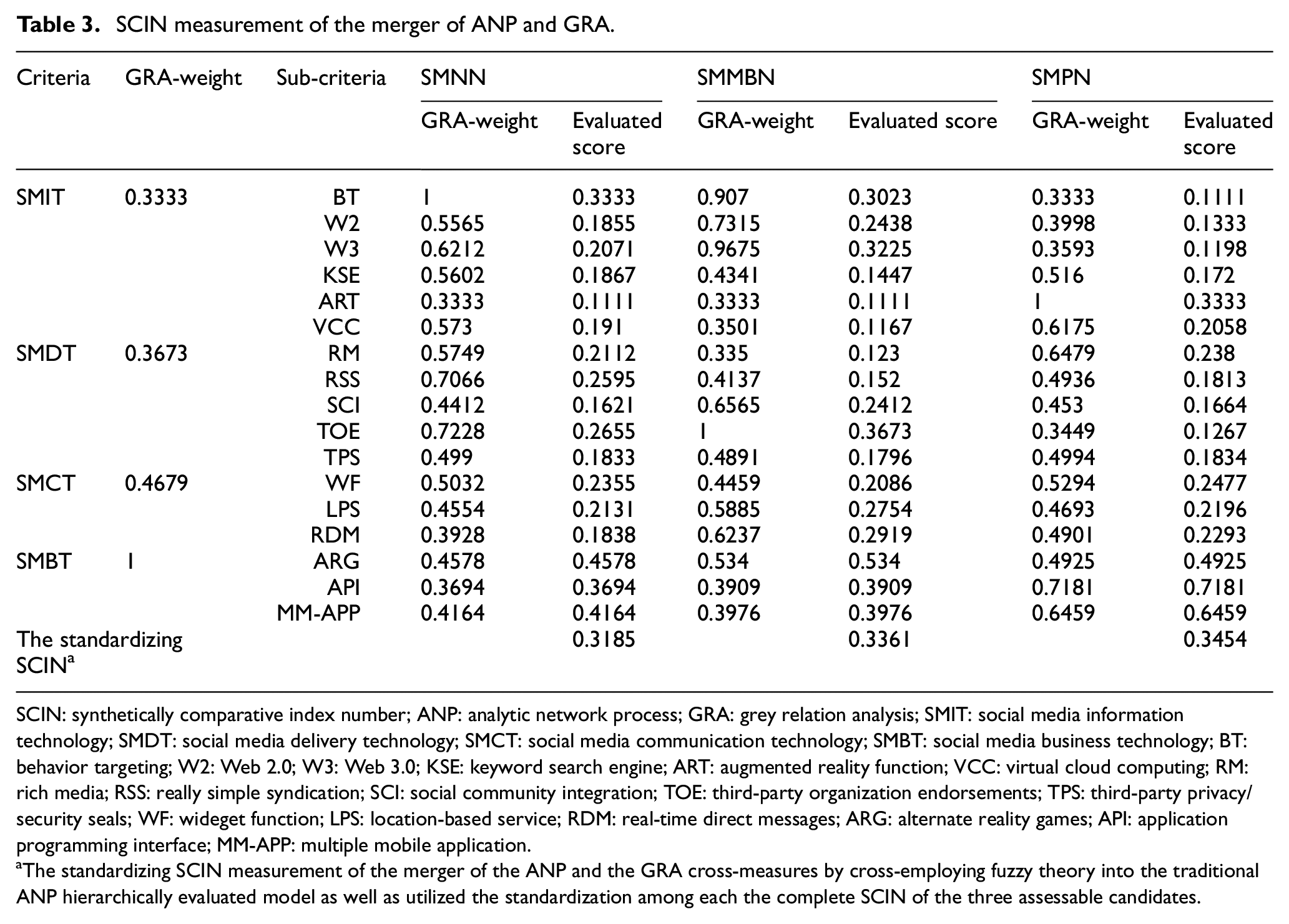
SCIN: synthetically comparative index number; ANP: analytic network process; GRA: grey relation analysis; SMIT: social media information technology; SMDT: social media delivery technology; SMCT: social media communication technology; SMBT: social media business technology; BT: behavior targeting; W2: Web 2.0; W3: Web 3.0; KSE: keyword search engine; ART: augmented reality function; VCC: virtual cloud computing; RM: rich media; RSS: really simple syndication; SCI: social community integration; TOE: third-party organization endorsements; TPS: third-party privacy/security seals; WF: wideget function; LPS: location-based service; RDM: real-time direct messages; ARG: alternate reality games; API: application programming interface; MM-APP: multiple mobile application.
The standardizing SCIN measurement of the merger of the ANP and the GRA cross-measures by cross-employing fuzzy theory into the traditional ANP hierarchically evaluated model as well as utilized the standardization among each the complete SCIN of the three assessable candidates.
Conclusion
This research attempts to comprehensively cross-employ ICDT and ANP models and MCDM methodology to directly and conscientiously construct the most comprehensive evaluated model to execute the complete cross-analyses of the interactive influences and interrelationships between the swift development of SM technology and human behaviors of social transmission through the evaluated measurements of the weights from experienced experts, empirical industrialists, and academic scholars. As a result, the most valuable contribution of this research in the relative SM research fields is that “The technological interfaces of SM websites is a positive niche in the current mobile communication era (SMPN).” This proves that the technological interfaces of SM websites are not only the virtually discussed conceptual noun that resupplies the traditional research gap in the related IT, ICT, and SM research fields but also the directional and potential benefits for empirical enterprises. Although this research has cross-employed the comprehensive evaluated theory, the assessable model, and the hierarchical measurements, there are still some more effective methodologies that are able to be applied for assaying the related SM research issues. Consequently, the recommendation beyond this research is to focus attention on collecting more factors that are more significant and critical influences in order to perceive the fluctuation tendency of the technological interfaces of SM websites in order to achieve the demands and desires of user’s human behaviors of social transmission in this most unpredictable, dynamical, complex, and hypercompetitive mobile communication era.
Footnotes
Academic Editor: Stephen D Prior
Declaration of conflicting interests
The author(s) declared no potential conflicts of interest with respect to the research, authorship, and/or publication of this article.
Funding
The author(s) received no financial support for the research, authorship, and/or publication of this article.