



Abstract
This article presents the magnetohydrodynamic flow and heat transfer of water-based nanofluid in divergent and convergent channels. Equations governing the flow are transformed to a set of ordinary differential equations by employing suitable similarity transforms. Resulting system is solved using a strong numerical procedure called Runge–Kutta–Fehlberg method. Results are compared with existing solutions available in the literature and an excellent agreement is seen. Three shapes of nanoparticles, namely, platelet-, cylinder-, and brick-shaped particles, are considered to perform the analysis. Influence of emerging parameters such as channel opening, Reynolds number, magnetic parameter, Eckert number, and the nanoparticle volume fraction are heighted with the help of graphs coupled with comprehensive discussions. The magnetic field can be used as a controlling parameter to reduce the backflow regions for the divergent channel case. Temperature of the fluid can be controlled with the help of strong magnetic field. It is also observed that platelet-shaped particles have higher temperature values as compared to cylinder- and brick-shaped particles.
Keywords
Introduction
In 1915, Jeffery 1 and Hamel 2 formulated a problem for the flow between non-parallel walls. These flows are important because of many applications in industries, medical and bio-mechanics, and engineering. Since the seminal works, many researchers have tried to extend the flows in diverging and converging channels considering various effects such as magnetohydrodynamics (MHD) and slip, and heat transfer phenomena.3–8 Newtonian nature of the fluid has been considered in most of these studies. Change in angle plays an important role in these flows as discussed in various studies. The work for non-Newtonian nature of the fluid has been presented by Hayat et al. 9 and Asadullah et al. 10 Some other related studies are available in open literature11–14 and references therein.
Nanofluids, as the name suggests, are the suspensions of nanoparticles. Due to applications in engineering, medical, and industries, nanotechnology is gaining its importance. Traditional fluids are bad conductors; to cope up with this problem, nanoparticles are added to the traditional fluids such as water, kerosene, and ethylene glycol. The addition of nanoparticles results in enhanced thermal properties of these fluids. Choi and colleagues15,16 were the first to present the idea of nanoparticles. Since these works, many additional studies were presented that gave new insight into the nanotechnology. Buongiorno 17 presented a model that incorporated the Brownian motion and thermophoresis effects. Xue 18 noted that these models consider only the spherical nature of the nanoparticles. Hamilton and Crosser 19 came up with a model that considered the shape of non-spherical particles as a parameter. Many studies are available in the literature that used all these models to investigate the flow and heat transfer of nanofluids in different geometries.20–33
Literature survey proves that there is no single study available in the literature that used Hamilton and Crosser’s model to study the flow and heat transfer of nanofluids in divergent and convergent channels. The equations governing the flow under the effect of magnetic field are transformed into non-linear system of ordinary differential equations. Due to the unlikeliness of exact solutions and complicated nature of the model for thermal conductivity, numerical solution has been obtained using Runge–Kutta–Fehlberg (RKF) method. Results obtained are plotted against the parameters involved coupled with comprehensive discussions. Comparison of current results with already existing ones proves the efficiency and authenticity of solutions.
Governing equations
Flow of nanofluid due to source or sink is considered at the intersection of two rigid plates. 2α is taken as the angle between the walls of the channels (Figure 1). Flow is assumed to be radial and symmetric in nature. Base fluid water is considered, which is saturated by copper nanoparticles. Non-spherical nature of nanoparticles is taken into account. A cross magnetic field of strength
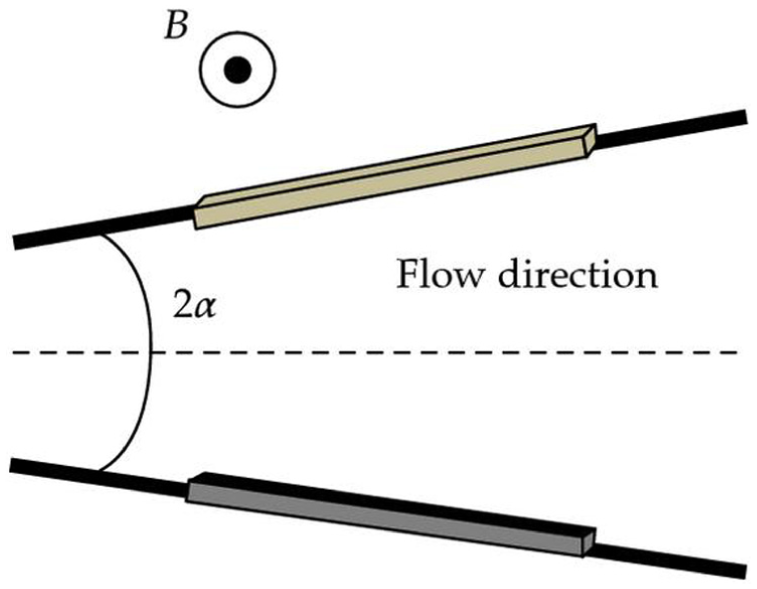
Schematic diagram of the flow problem.
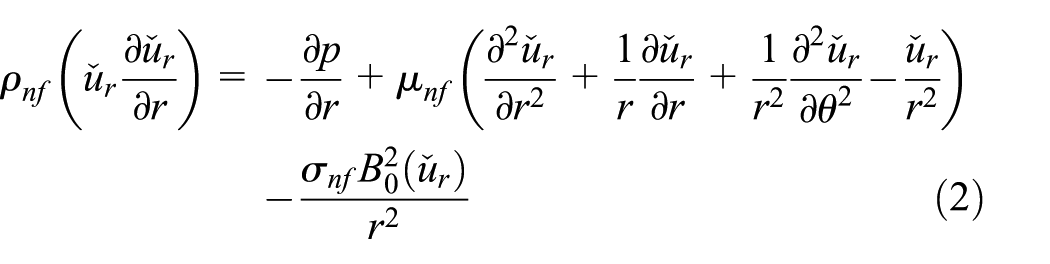
The equations governing the flow are written in the form 11



Boundary conditions for the problem are as follows

In the above equations,


Here,

Here,

Equation (1) can also be written as

Employing the similarity transform, the above equations can be reduced to the following dimensionless form

Eliminating pressure p from equations (2) and (3) and using equations (9) and (10), the non-linear ordinary differential equations representing velocity and temperature profile will reduce to
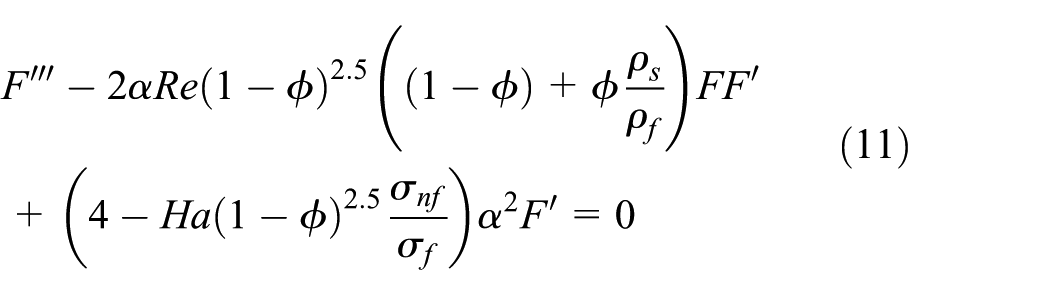
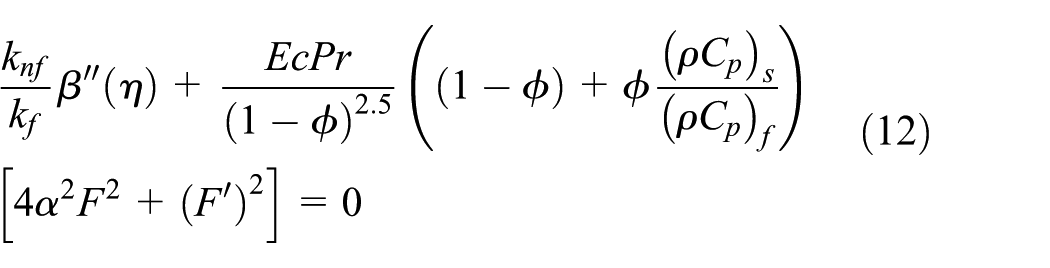
Here, prime denotes the differentiation w.r.t.

Here, Re is the Reynolds number, which is defined as

Furthermore,
Solution procedure
Equations (11) and (12) with the corresponding boundary conditions (13) are in the form of two-point boundary value problem. RKF technique is used to solve the system. Shooting method is first employed to convert the non-linear system into a set of initial value problems. Solution is then obtained with the help of RKF method. For asymptotically convergent results, a tolerance level of
Results and discussions
This section will focus on the graphical representation of the obtained results. Variations in velocity and temperature profiles for varying parameters will be plotted. Table 1 gives the numerical values of different thermophysical properties of the base fluid and nanoparticles. Throughout this article, our focus is on water-based nanofluid, and copper is taken as the nanoparticle. The model used for the effective thermal conductivity of nanofluids is Hamilton and Crosser’s model. This model considers various shapes of nanoparticles. The sphericity of different non-spherical nanoparticles is given in Table 2. It is pertinent to mention here that the shapes of nanoparticles in this article are taken as platelet, cylinder, and brick. Since water is taken as the base fluid, the value of Prandtl number Pr is fixed at 6.2 throughout this study. To highlight the effects of involved parameters on velocity and temperature profiles, this section is divided into two sub-sections. One for the divergent channel and other for the convergent channel.
Thermophysical properties of base fluid and nanoparticles. 32

Diverging channel
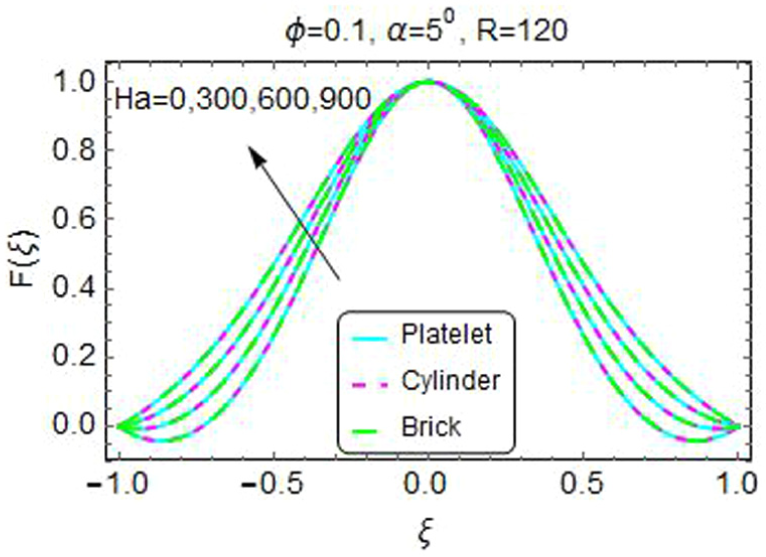
Influence of parameters involved on the velocity and temperature profile for divergent channel will be discussed in this section. For the said purpose, Figures 2–10 are portrayed. The variations in velocity for increasing values of channel opening

Velocity profile for variation in

Velocity profile for variation in Re.

Velocity profile for variation in
Velocity profile for variation in

Temperature profile for variation in
Temperature profile for variation in Re.
Temperature variation with increasing

Temperature variation with increasing Ha.

Temperature variation with increasing Ec.
Changes in velocity with the variation in solid volume fraction of nanoparticles are plotted in Figure 4. It can be observed that higher the amount of nanoparticles in the fluid, lower will be the velocity for the divergent channel. This change is prominent near the walls of the channel and becomes slower at the central portion. The way in which velocity is affected by rising values of magnetic number Ha is plotted in Figure 5. Stronger magnetic forces result in increment for the velocity profile of the fluid. Another important phenomenon is the reduction in backflow for increasing magnetic forces. Stronger magnetic forces result in accelerated flow near the walls of the channel that in return reduces the backflow. This technique is quite useful to reduce the separation for the divergent channel case. It is important to add that all the shapes of nanoparticles have identical effects on the velocity of the fluid in divergent channel case.
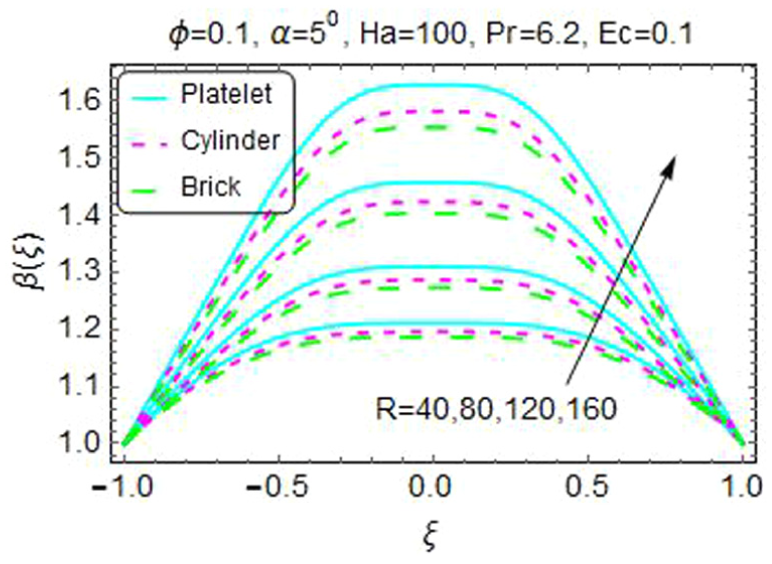
To discuss the effects of parameters like channel opening
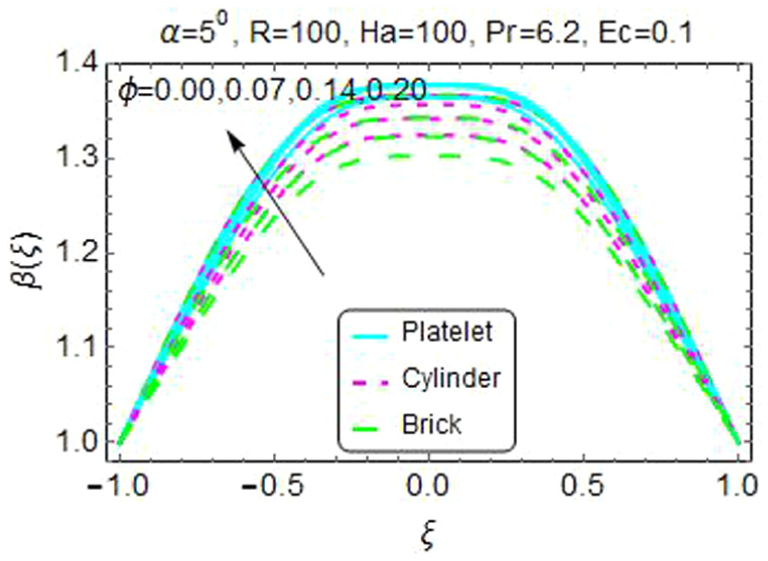
Variations in temperature with the addition of nanoparticles are plotted in Figure 8. A rise in temperature is observed. The platelet-shaped particles have highest temperature among all followed by cylinder- and brick-shaped particles. The central portion of the channel exhibits the maximum temperature while near the walls of the channel; variations in temperature are quite slower. Magnetic field effects on temperature profile with increasing magnetic number are displayed in Figure 9. Lower values of temperature are observed for rising magnetic number. This means that stronger the magnetic field, lower will be the temperature of the fluid for divergent channel case. Again, the center of the channel has the maximum temperature values. This phenomenon is very important to control the temperature of the fluid in divergent channels. The use of magnetic field can control the rising temperatures. Change in temperature with rising values of Eckert number Ec is depicted in Figure 10. Rise in temperature for higher values of Ec is observed. From this figure, it can also be verified that stronger the viscous forces, temperature of the fluid will rise in divergent channels.
Converging channel
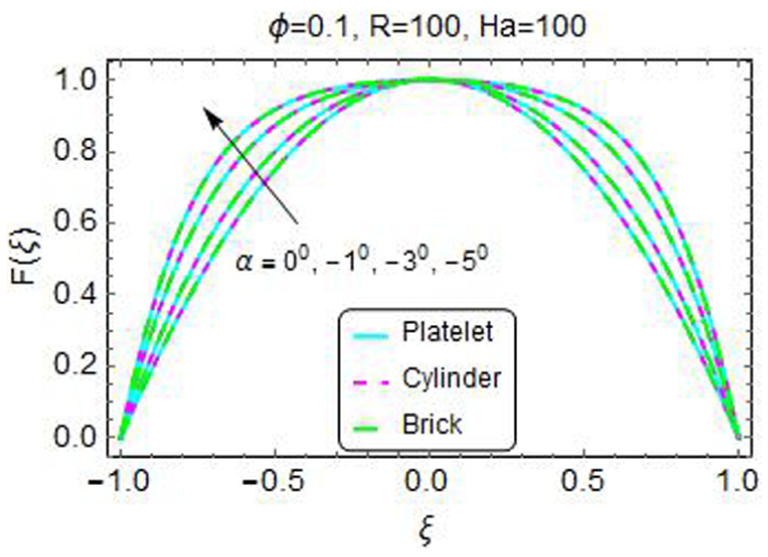
Flow behavior and temperature variations in convergent channel case are plotted in Figures 11–19. With varying value of channel opening, velocity of the fluid is seen to be increasing away from the walls of the channel, while near the walls of the channel, a more steep decrease is observed. This behavior shows a boundary layer character for the flow. Alike effects of increment in Re are clearly exhibited from Figure 12. A strong boundary layer character is observed for increasing Reynolds number. Stronger momentum forces are responsible for this type of character. Clearly, the main focus of the flow is away from the walls of channel. This behavior is quite opposite from the divergent channel case. It is also important to mention here that the shape factor does not affect the velocity of the nanofluid considered.
Velocity variation with increasing

Velocity variation with increasing Re.

Velocity variation with increasing

Temperature variation with increasing Ha.

Temperature variation with increasing
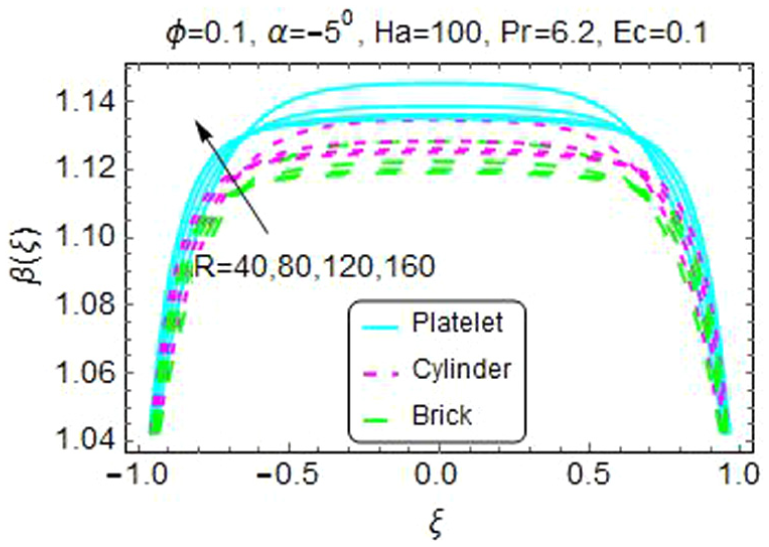
Temperature variation with increasing Re.
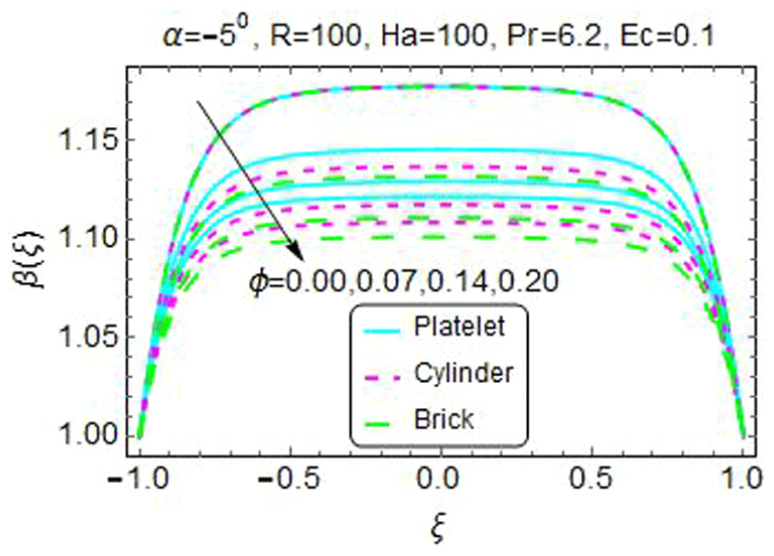
Temperature variation with increasing

Temperature variation with increasing Ha.

Temperature variation with increasing Ec.
Influence of nanoparticle volume fraction on velocity profile for convergent channel is depicted in Figure 13. Stronger nanoparticle volume fraction makes the velocity of the fluid to rise for the case of convergent channel. Near the walls of the channel, almost negligible effect is observed; however, away from the walls, an increment in the velocity is obvious. This means that nanoparticle volume fraction affects the velocity of the fluid in a quite opposite manner for divergent and convergent channels. The stronger magnetic field is responsible for the rise in velocity as seen in Figure 14. This behavior for the convergent channel is quite similar for both convergent and divergent channels. No major change in velocity profile for different shape of nanoparticles is observed for these parameters.
The variations in temperature profile for the convergent channel with variations in different parameters are painted in Figures 15–19. Interesting deviations are observed for rise in various parameters. Angle opening raises the temperature profile near the walls of the channel, while moving toward the central portion, a quite reverse behavior is seen (Figure 15), that is, temperature of the fluid starts declining. Interestingly, platelet-shaped nanoparticles have higher values of temperature followed by cylinder- and brick-shaped particles. This means that the shape factor of the nanoparticles can be used as a controlling agent for convergent channel. Higher the shape factor, lower the temperature of the fluid. Almost similar variations in temperature for increasing Re are observed from Figure 16. This behavior is somewhat different from the divergent channel. For divergent channel, temperature of the fluid remains either increasing or decreasing throughout the channel, while for convergent channel, the central portion of the channel exhibits a drop in temperature, while an increment is seen near the walls of the channel. Nanoparticle volume fraction reduces the temperature of the fluid as can be observed from Figure 17. This decrement in temperature is opposite to that for the case of divergent channel. Increasing magnetic field parameter results in lower temperature values at the central portion of the channel for convergent channel that is quite opposite from the same for divergent channel. Stronger magnetic field results in drop in temperature as depicted in Figure 18. For all these parameters, platelet-shaped particles have highest temperature values among all, while brick-shaped particles have lowest temperature. These variations in temperature with increment in Eckert number are highlighted in Figure 19. Temperature is seen to be the increasing function for increasing Ec. Central portion of the channel is again the main focus of this variation. Stronger viscous is responsible for the rise in temperature.
Comparison of current results with already existing solutions in the literature is provided in Table 3. The obtained solutions in this article are in excellent agreement with the existing solutions.
Comparison of present results with the already existing solutions in the literature for

Conclusion
In this study, Jeffery and Hamel’s flow problem is formulated for nanofluids with heat transfer effects. The model used for effective thermal conductivity of the nanofluids is presented by considering Hamilton and Crosser’s model. Three shapes of nanoparticles are considered, namely, platelet-, cylinder-, and brick-shaped particles. Water is used as base fluid, while copper is taken as nanoparticle. Obtained results are presented graphically coupled with comprehensive discussions. Comparative analysis authenticates the results obtained analytically and numerically as well. The major outcomes of this study are as follows:
Increment in channel opening and the Reynolds number results in backflow for diverging channel case;
This backflow can be reduced by employing a strong magnetic field. Magnetic number increases the velocity of the fluid for converging and diverging channels;
Temperature of the fluid can also be controlled with the help of strong magnetic field;
Nanoparticle volume fraction has opposite effects on convergent and divergent channels;
Eckert number gives rise in temperature for both the channels;
Shape factor has no effect on velocity of the fluid;
Temperature of the fluid becomes lower with higher shape factor. Platelet-shaped particles have higher temperature values followed by cylinder- and brick-shaped particles with the increment in parameters involved.
Footnotes
Academic Editor: Mohammad Mehdi Rashidi
Declaration of conflicting interests
The author(s) declared no potential conflicts of interest with respect to the research, authorship and/or publication of this article.
Funding
The author(s) disclosed receipt of the following financial support for the research, authorship and/or publication of this article: This project was supported by the King Saud University, Deanship of Scientific Research and College of Sciences Research Centre.