



Abstract
A Green’s function method is proposed to calculate transient heat flow through the building wall in this article. In order to obtain a simplified analytical solution for dynamic heat transfer problems, approximation is applied to the solution. And it can also make numerical simulation faster. The approximation solution and the exact solution got by MATLAB are compared under four different heat transfer conditions for a practical problem to verify its accuracy. Furthermore, double layer building wall analysis model is developed for practical application.
Introduction
Heat conductivity in a wall is a traditional problem, and there are different numerical methods to solve it, such as finite difference method,1,2 harmonic method,3,4 response coefficient method,5–7 Laplace’s method,8,9 and Z-transfer function.10,11 But in some way, they are not easy to use because calculating time is strongly limited by time step and mesh size, regular temperature change is required, accurate coefficients are needed, and analytical solution is not easy to get. So current researchers focus on factors of wall, such as decrement factor and time lag values, 12 static and dynamic thermal characterization, 13 and response factors (three-dimensional conduction). Green’s function can also be used to solve the problem, but the analytical solution is very hard to use. If proper approximation to the solution is applied, it can also be a powerful tool to solve the problem.
Green’s function was used in many different fields; Haji-Sheikh et al. 14 investigated a Green’s function solution of the thermal wave effect during rapid heating of pure dielectric materials. Mertiny and colleagues 15 developed a Green’s function approach, and it was used to predict the temperature distribution within polymeric substrates during flame spraying. Wang et al. 16 developed a useful method to conduct thermal analysis of insulated steel members exposed to fire. Wang et al. 17 proposed a method to investigate the heat conduction in multilayer solid walls. CAB Vasconcellos et al. 18 elaborated the numerical algorithm based on Green’s function for multilayer systems. This article describes the method in detail (including monolayer and multilayer conditions) and simplifies it based on the way of simplified integral algorithm used in the monolayer condition. This method is also appropriate for the calculation of multilayer walls, as we have tested the method in this research. In the article based on Green’s function, approximation is applied to the solution and makes it available to analysis room’s thermal properties.
Formulation of the problem
The partial heating (i.e. the wall is partly heated or a small part of space is heated) is not considered often for a constant property wall. So it can be regarded as a one-dimensional heat transfer problem. According to Figure 1, it is assumed that the initial temperature distribution of the wall is


Description of the problem.
Green’s function G is established as follows

Assuming that there is no inner heat source in the wall before time
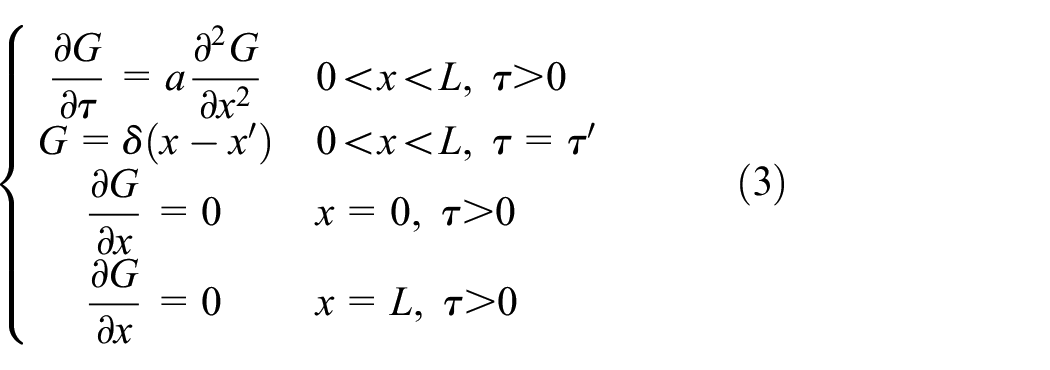
In the above equations,
Applying the method of separation of variables, coefficients of the solution can be calculated from initial conditions of the equation. Then, Green’s function of the problem can be obtained using Fourier expansion method

In this problem, the temperature distribution at time
In this problem, there is no inner heat source in the wall, so

The temperature distribution,
The effect of boundary heat flux

and

Thus, the temperature distribution caused by the boundary heat fluxes can be described as follows
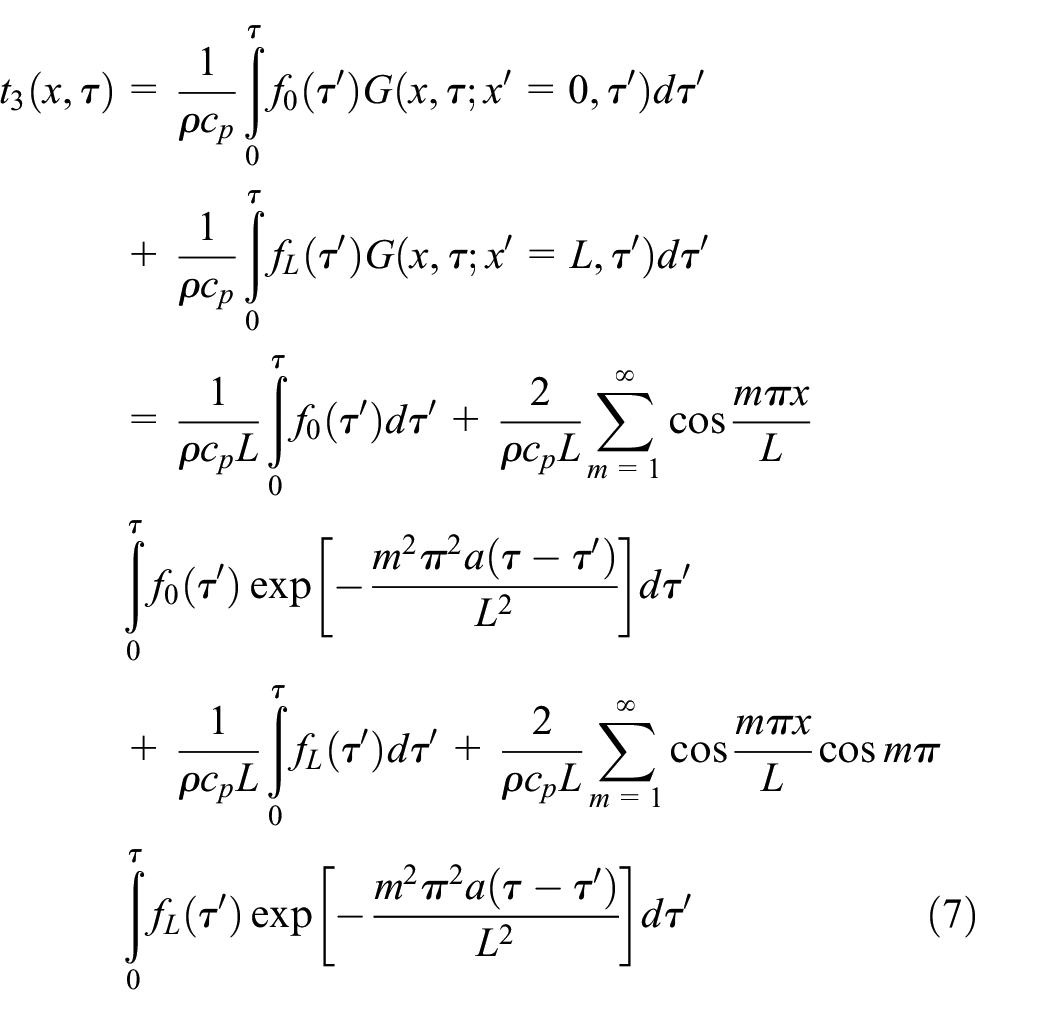
So, the temperature distribution which is a combination of three parts as commented above can be described as

According to the temperature distribution


For external building walls, the problem can be simplified as follows


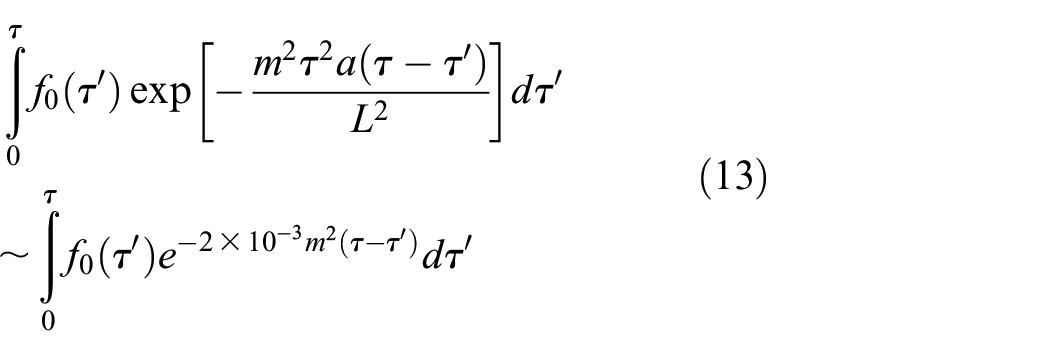
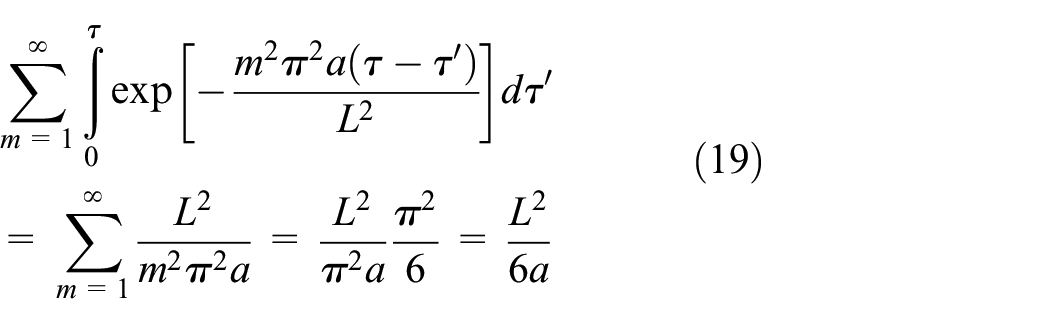
For the integration, we have

Considering the integration approximation,

When
When
When
The maximum of

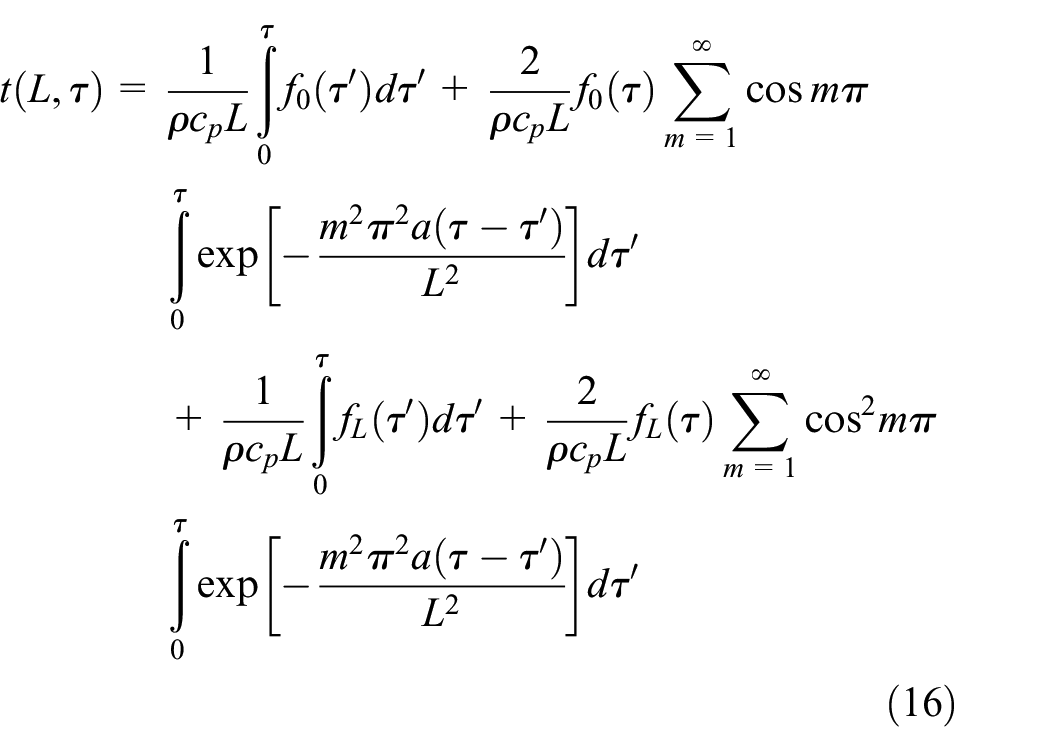
The solution of the integration is given as follows

In the simplified equation, the integration time can be assumed to be infinite

By adding the results of equations mentioned in equations (15) and (16), the solutions of the problem are listed as follows


Where

So, according to equations (19)–(22), equations (15) and (16) can be rewritten as follows


Because of that the exponent item in Green’s function method before the watch time is relatively little, the surface heat flow function can be regarded as the value at watch time when calculating equations (15) and (16). The integration result of the exponent item is only related to the watch time. Because the value of the watch time is relatively high, the exponent item (18) in the solution can be neglected.
For the usage of real circumstance, we should justify our assumption that the heat flux will not vary significantly within a short amount of time. So verification was performed in three conditions as winter, transition season, and summer testing the heat flux variation in the inner and outer surface of the envelop. Boundary conditions was given as the third kind boundary condition, outdoor temperature was set as the air temperature of winter, spring, and summer in Beijing. Convective heat transfer coefficient was set as 8.7 W/(m2 °C) for inner surface and 23 W/(m2 °C) for outer surface. Thermal conductivity, density, and specific heat capacity were set as 2 W/(m K), 2500 kg/m3, and 1000 J/(kg K), respectively. Heat flux calculation was performed on a kind of commercial software, scStream, using the finite volume method. The temperature condition and calculation result are illustrated below (Figures 2–10).
(a) Winter Temperature condition Calculation result
(b) Transition season Temperature condition Calculation result
(c) Summer Temperature condition Calculation result
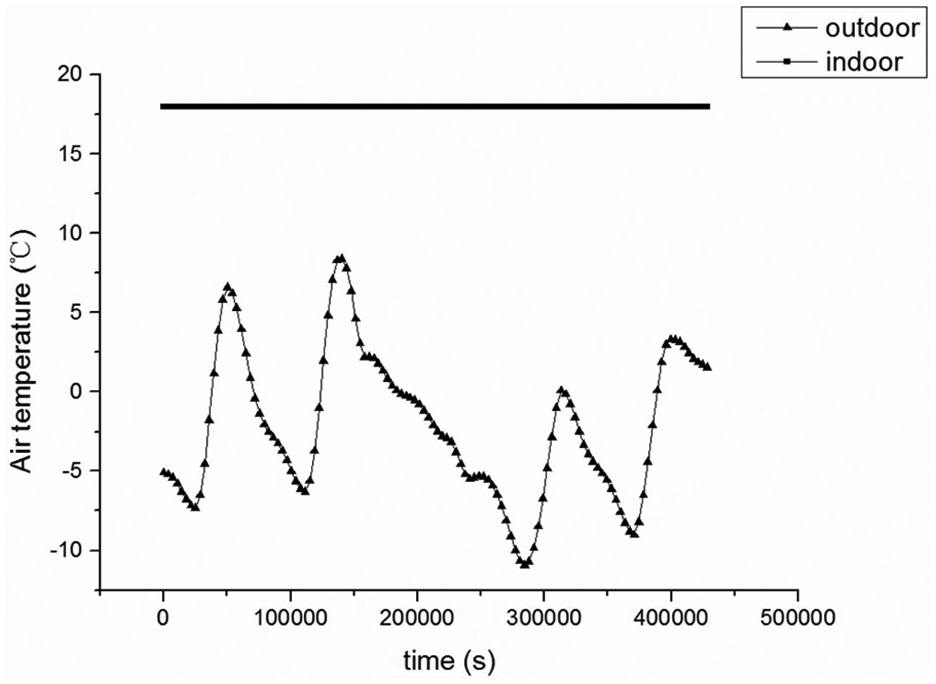
Indoor and outdoor temperature in winter.
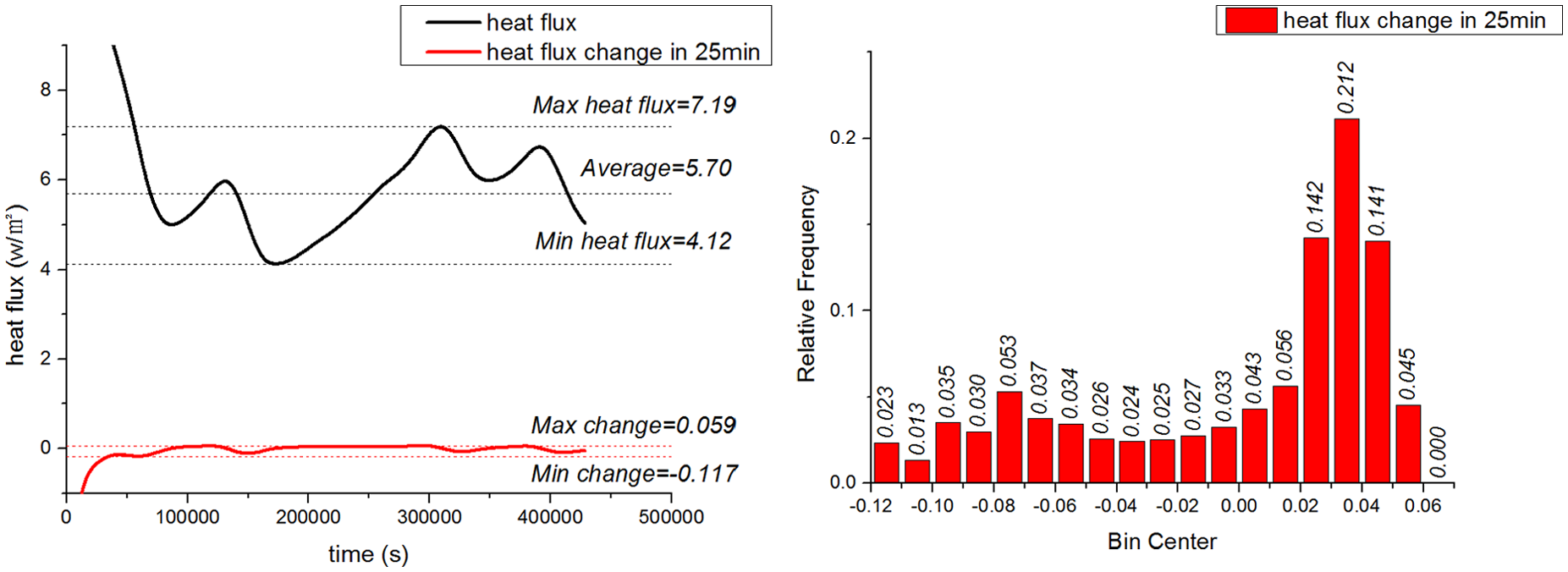
Indoor heat flux and its change in 25 min.

Outdoor heat flux and its change in 25 min.

Indoor and outdoor temperature in transition season.

Indoor heat flux and its change in 25 min.

Outdoor heat flux and its change in 25 min.
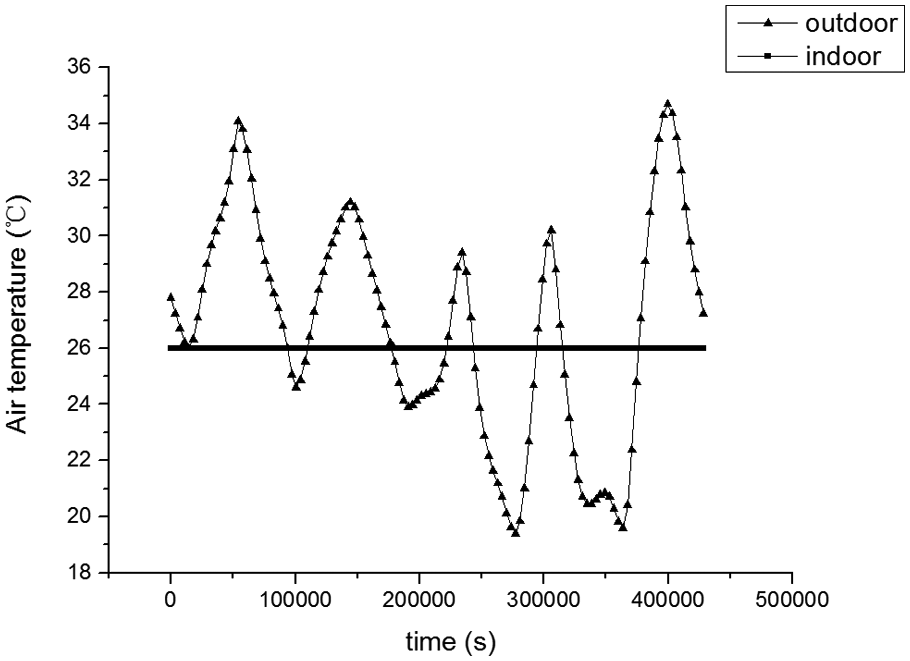
Indoor and outdoor temperature in summer.

Indoor heat flux and its change in 25 min.

Outdoor heat flux and its change in 25 min.
As is shown in the graphs, indoor wall surface has a more slighter fluctuation in the heat transfer process, variation in 25 min is 0.057, 0.078, and 0.067 times of the largest heat flux change in 5 days in winter, transition season, and summer. And for outdoor wall surface, the result is 0.282, 0.345, and 0.400 when variation in 25 min compared with largest heat flux change in 5 days. The range of change in 25 min is large, however, in winter, 83.2% of total time has a change less than ±1 W/m2 (the rate is less than 0.088 compared with the largest heat flux change in 5 days). Similarly, for transition season and summer, there are 84.9% and 88.6% of total time and the fluctuation range is less than ±1 W/m2 (rate less than 0.101 and 0.116). For most conditions in the practical use, heat flux does not vary significantly within a short amount of time, and the proposed method is valid and accurate.
Extension to double layer building wall
As we know, multilayer envelop is widely used in buildings. For practical application, Green’s function method algorithm for double layer building wall is developed based on the former single-layer working achievements.
Usually, for double layer wall in different materials, there are


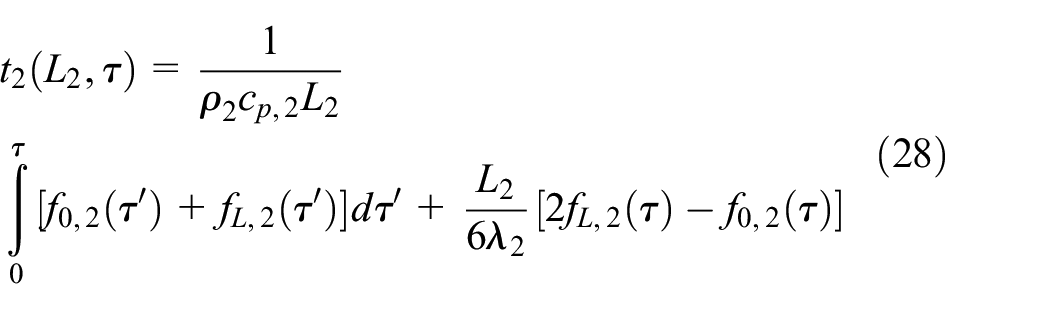
For the junction of the two layers, the temperature and the heat flow of the two layers, it is necessary to establish the following conditions


From equations (26) and (27), and using the conditions (29) and (30), one obtains
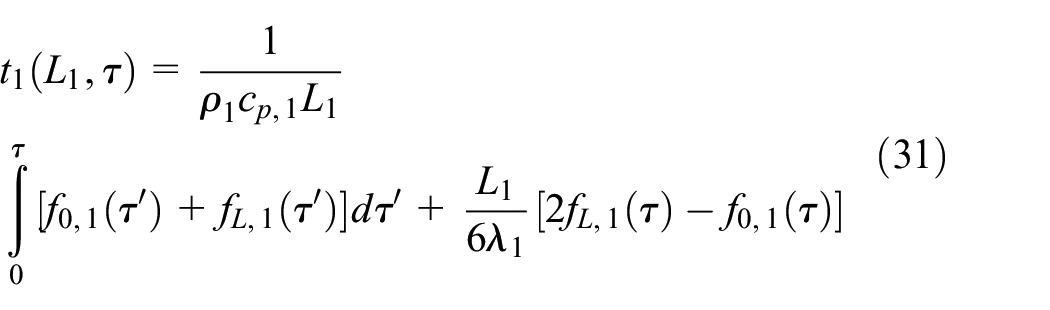


Differentiating this equation with respect to time τ

So

and
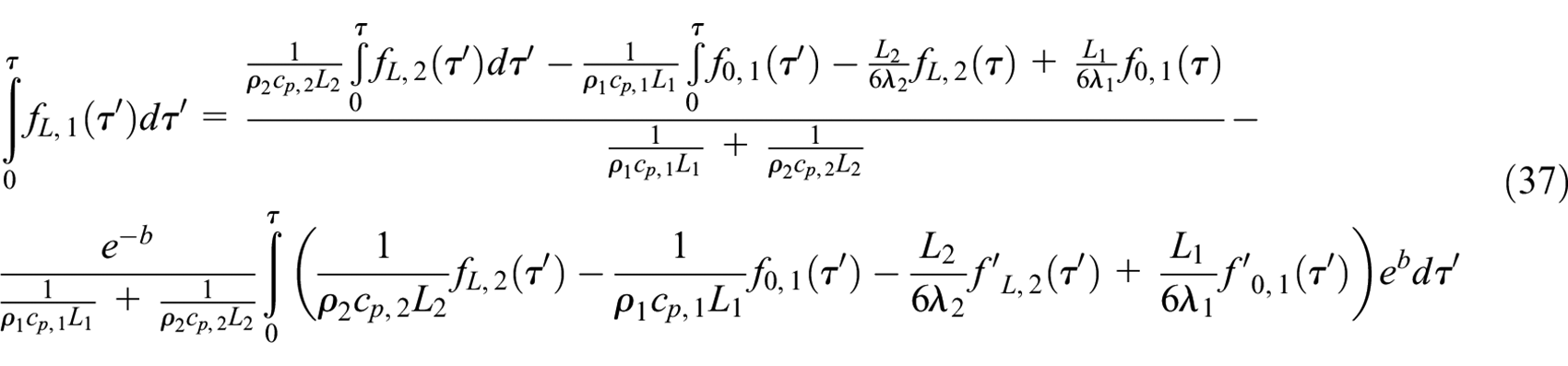
in which

Thus, with the help of equations (37) and (38), the expression of double layer surface temperature can be obtained.
Results and discussion
Simulation model
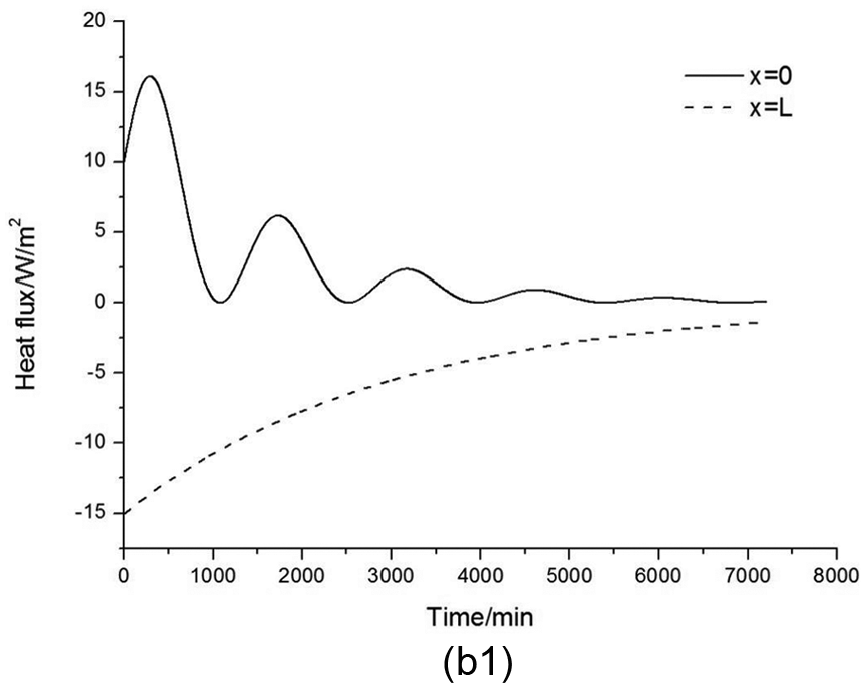
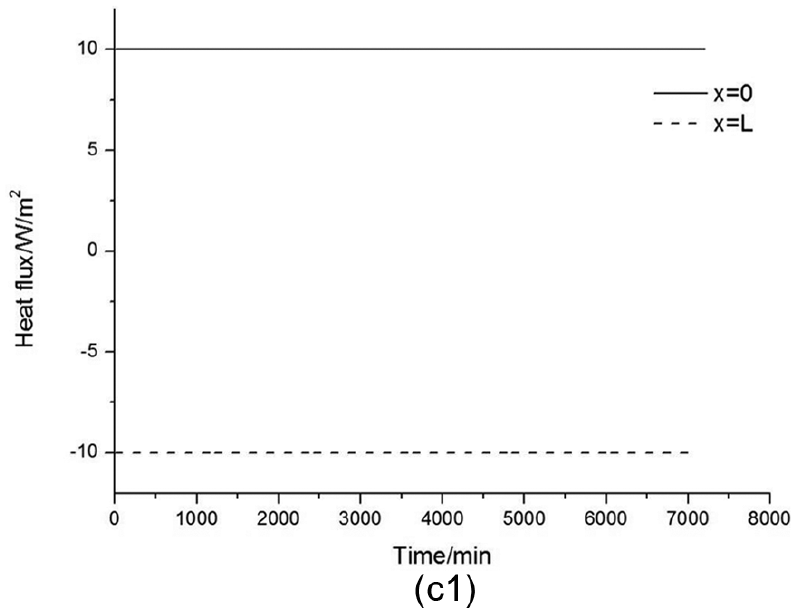
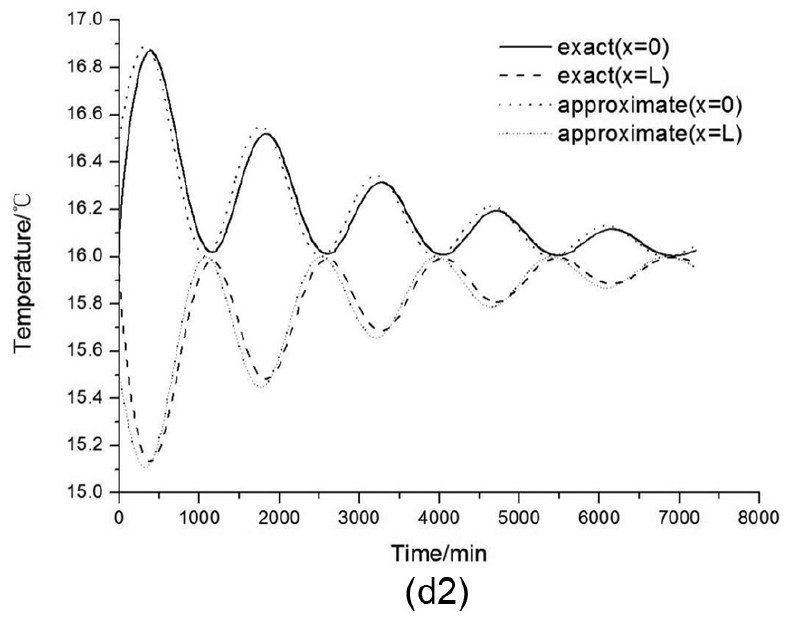
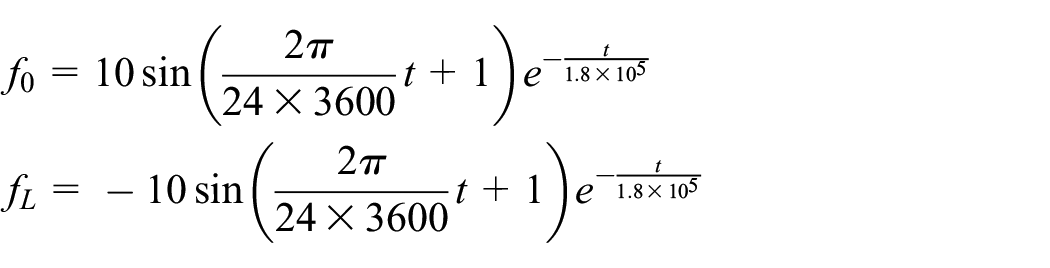
In order to verify this approximation, the numerical method by MATLAB is introduced to estimate the method error. Four cases under different kinds of boundary conditions are adopted to compare the approximate solutions by Green’s function method, equations (23) and (24), with the exact solutions by the numerical method, equations (9) and (10).
In monolayer conditions (a) to (d), the following parameters of the wall are considered: the thickness
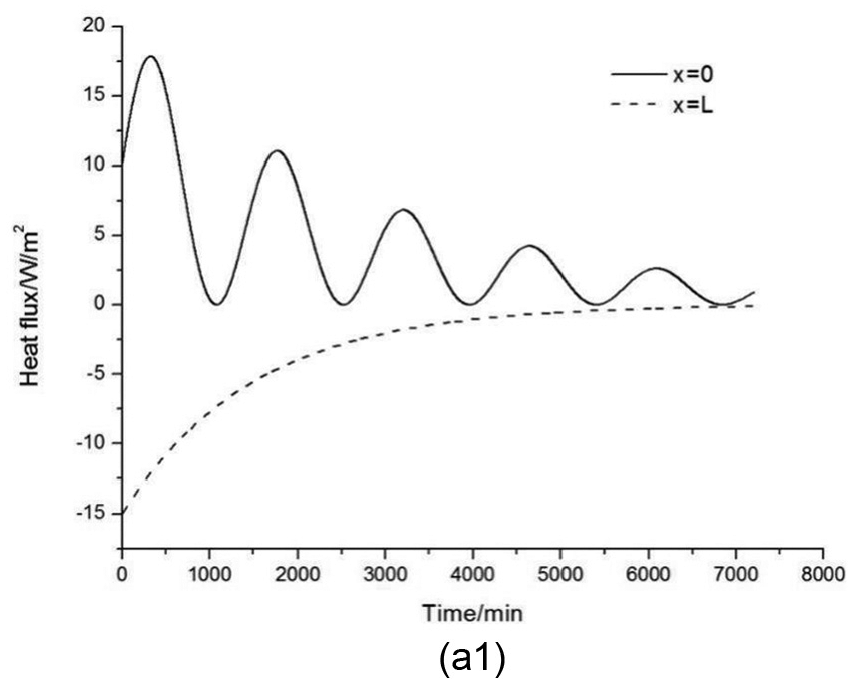
a) Heat fluxes of both surfaces of the wall.

a) Temperature of both surfaces of the wall.
b) Heat fluxes of both surfaces of the wall.

b) Temperature of both surfaces of the wall.
c) Heat fluxes of both surfaces of the wall.

c) Temperature of both surfaces of the wall.

d) Heat fluxes of both surfaces of the wall.
d) Temperature of both surfaces of the wall.

e) Heat fluxes of both surfaces of the wall.

e) Temperature of both surfaces of the wall.
Analysis of simulation results
Monolayer
Boundary condition a

Solutions
Boundary condition b

Solutions
Boundary condition c

Solutions
Boundary condition d
Solutions
Double layer
Boundary condition e

Solutions
Approximate results by Green’s function are compared with the result of numerical method above.
The results listed in Table 1 for the average relative error in the temperature were calculated as follows

The average relative error of the approximate equation.

As shown in Table 1, the maximum of the error is only 0.601%. So Green’s function method is verified to be quite effective and accurate. Thus, the original equations can be replaced by the approximate equations. And heat transfer equation of walls can be simplified sharply.
For the last calculation, the double layer wall condition, commercial software scStream was employed. The present new method used 0.184371 s while scStream spend 7 min and 10 s to solve the same problem with 6000 mesh volumes. The time step of Green’s function method is 1 s while the finite volume method (scStream) is 10 s. The new method largely reduced computer run time.
Conclusion
In this article, an analytical solution for dynamic heat transfer problems is presented and Green’s function method is put forward to simplify the heat transfer functions for the solution for the first time. In this method, the function nature and the characteristics of the dynamic heat transfer problem are considered to simplify the method with a highly accelerated calculation. Furthermore, this new method is verified by comparing the approximation solution and the exact solution under four different heat transfer conditions. The analytical solution can be obtained to analyze the building envelope heat performance by applying this method. Furthermore, the double layer building wall analysis model is developed for practical application. It is easy to use and the calculation does not cost much time. So the work in this article is valuable for building design field. Besides, this method has some limits: first, it is not appropriate when the heat flux is high, since the boundary heat flux is simplified to be very low in this model; second, the observation time varies with the building envelope materials. In equation (18), τ is assumed to be infinite. But in the starting of the calculation, especially in the starting 500 s, τ is not so large, so the approximated solution has a relatively large error.
Footnotes
Academic Editor: Takahiro Tsukahara
Declaration of conflicting interests
The author(s) declared no potential conflicts of interest with respect to the research, authorship, and/or publication of this article.
Funding
The author(s) disclosed receipt of the following financial support for the research, authorship, and/or publication of this article: This work is supported by the National Natural Science Foundation of China (Grant No. 51478008) and Beijing Natural Science Foundation (Grant No. 8152007).