




Abstract
Face gear dynamics is addressed by many scholars. However, design solutions of low-noise face gear drives without gear tooth modifications are not to be constructed. Thus, in this study, a design solution of low-noise face gear drives associated with micro-punch webs is proposed. A calculation procession of geometric parameters of micro-punch webs is constructed, an example case of a micro-punch web for a low-noise face gear drive is calculated, which is based on the proposed calculation procession, and the noise elimination effect of the example case is predicted. Meanwhile, the impacts of geometric parameters of micro-punch webs on sound resonant frequencies are discussed. Furthermore, an experiment of the example case is conducted to check the effect of micro-punch webs on noise reductions and the proposed calculation procession and design solution. The experimental results indicate that the noise reductions of face gear drives can be accomplished by micro-punch webs under the almost same dynamic response conditions, and the fidelity of the proposed calculation procession of geometric parameters of micro-punch webs and design solution of low-noise face gear drives can be accepted. These contributions would improve engineering applications of low-noise face gear drives.
Keywords
Introduction
A face gear drive is a kind of intersection gear drives, and it is insensitive to manufacture and alignment errors versus spiral bevel gear drives. Therefore, it is addressed by many scholars, and there are a vast of manuscripts to discuss face gear drives in the past decade years. Litvin et al.1–4 investigated generations, stresses, and tooth contact analysis (TCA) of face gear drives. Barone et al. 5 discussed the effects of misalignment errors and modifications on face gear drives. Guingand et al. 6 tested bending stresses of face gear drives under quasi-static torque conditions. Zanzi and Pedrero 7 probed the impact of modifications on TCA of face gear drives. According to study achievements of face gear drives, Litvin et al. 8 suggested that face gear drives could be used in first-stage gear drives of helicopter main gear boxes. Due to high rotation speed characteristics of first-stage gear drives in helicopter main gear boxes, face gear dynamics becomes one of the study focuses of face gear drives. Jin et al. 9 established a non-linear dynamic model of face gear drives. Yang et al. 10 assessed bifurcation characteristics of face gear drives. Hu et al. 11 evaluated the influence of mesh stiffness on dynamic behaviors of face gear drives. Except vibration requirements, noise control demands are raised in helicopter main gear box designs, gradually. However, design solutions of low-noise face gear drives are still not to be investigated by researchers, due to immature theories of engagement impacts and gear tooth modifications for dynamics of face gear drives caused by complex face gear tooth surfaces. Thus, in this study, a design solution of low-noise face gear drives associated with micro-punch webs is proposed, without considering any gear tooth modifications. A 4-degree-of-freedom (DOF) dynamic model is formulated, and calculation solutions of geometric parameters of micro-punch webs and noise elimination values are constructed. An acoustic radiation of an example case of face gear drives and its noise elimination prediction are simulated, and the impact of geometric parameters of micro-punch webs on sound resonant frequencies is discussed. Furthermore, an experiment of this example case is tested to verify the fidelities of the constructed calculation and design solutions. The limited experimental results in this issue indicate that under the almost same dynamic response conditions, noise of face gear drives can be reduced more than 1 dB only by micro-punch webs, and the proposed calculation and design solutions are accepted. The contributions would improve engineering applications of low-noise face gear drives.
Proposed low-noise structures and constructed design solutions
Proposed low-noise structures
According to the theory of sound absorptions by micro-punch panels proposed by Ma 12 in 1975, and structure characteristics of face gear drives, a design solution of low-noise face gear drives, as shown in Figure 1, which is not depended on gear tooth modifications, only associated with micro-punch webs, namely, face gear web structures, is constructed.
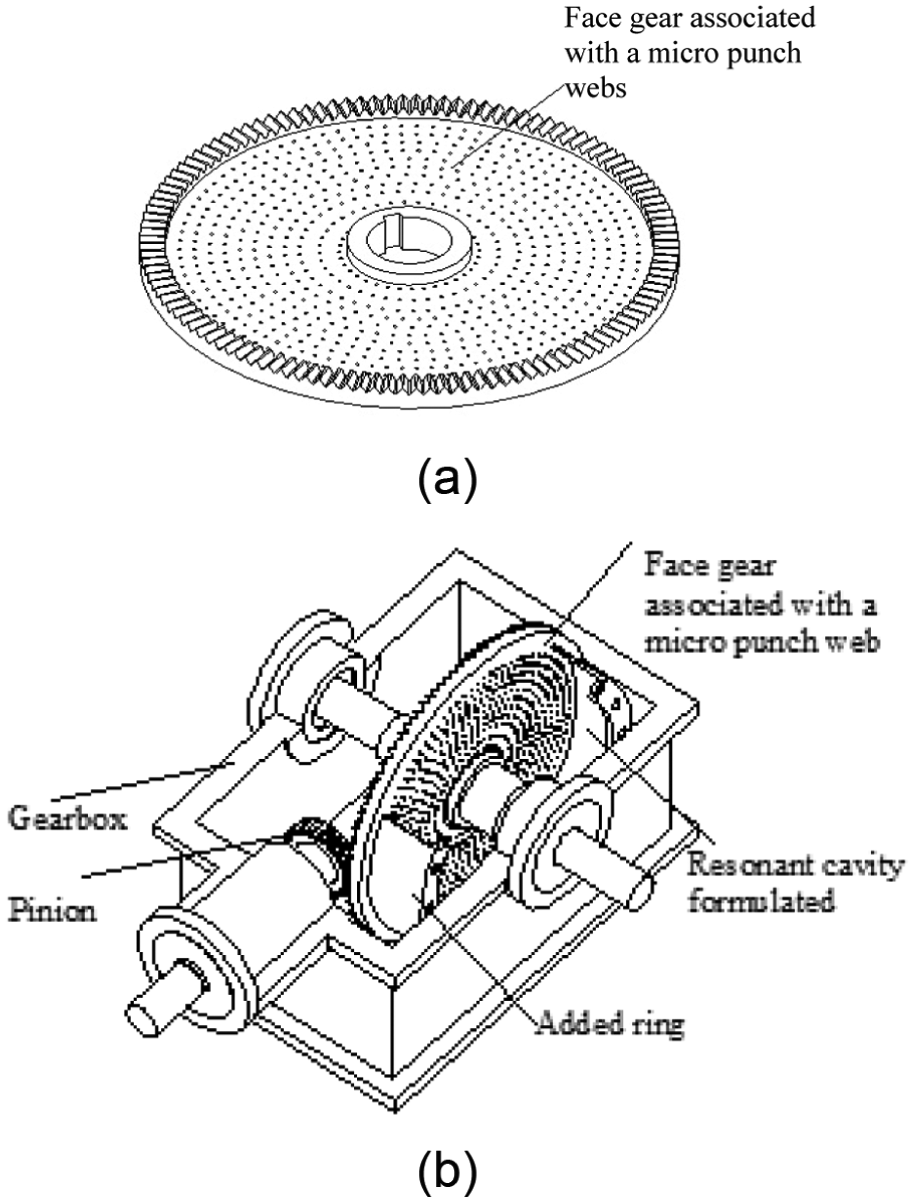
Proposed design solution of low-noise face gear drives: (a) sketch of face gears associated with a micro-punch web and (b) sketch of face gear drives associated with a micro-punch web.
As illustrated in Figure 1, the differences between the proposed face gear drives and the traditional face gear drives can be extracted as follows:
Micro-punch webs;
Added rings;
Formulated resonant cavities by added rings and face gears.
Constructed design solutions
Dynamic calculation solutions
Dynamic mesh forces are base sources of gear vibrations and noises. Thus, a 4-DOF dynamic model of face gear drives, as given in Figure 2, is established for evaluating noise radiations of face gear drives.
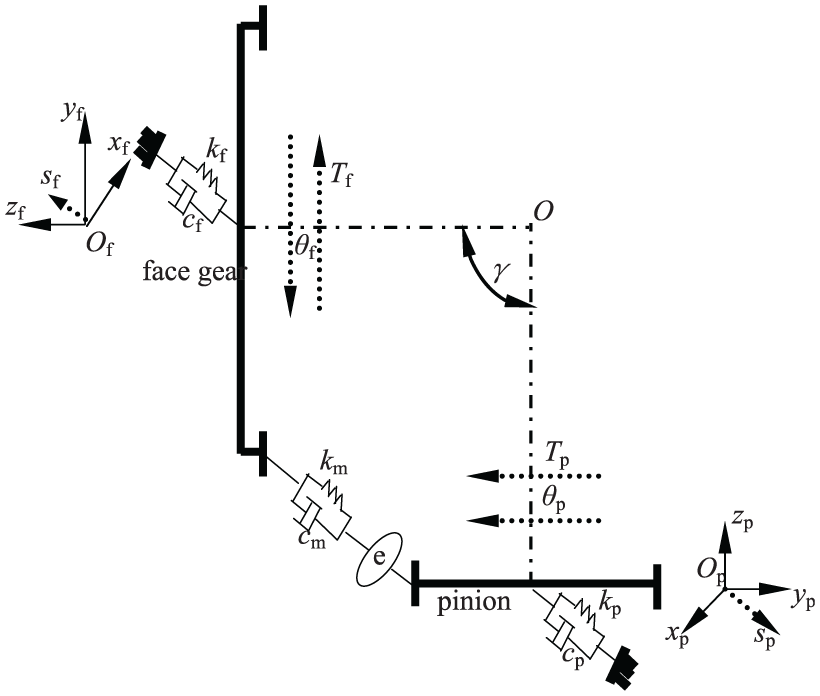
A 4-DOF dynamic model of face gear drives.
As shown in Figure 2, mathematic equations of the dynamic model can be derived by

where F can be expressed as

Calculation solutions of geometric parameters of micro-punch webs and noise elimination values
A noise radiation calculation procession, as shown in Figure 3, is formed, based on the simulations of dynamic mesh forces of face gear drives, and finite element method (FEM) and boundary element method (BEM).

Noise radiation calculation procession of face gear drives.
According to noise radiation results of face gear drives obtained by the procession in Figure 3, and Zhao 13 and Zhang and Li, 14 the geometric parameters of micro-punch webs can be derived by the follow formulas, which are listed in Table 1.
Calculation formulas of geometric parameters of micro-punch webs.

Meanwhile, based on Zhang and Li, 14 the noise elimination L can be expressed as

where symbols a and b can be written as

Simulation and analysis
Simulation
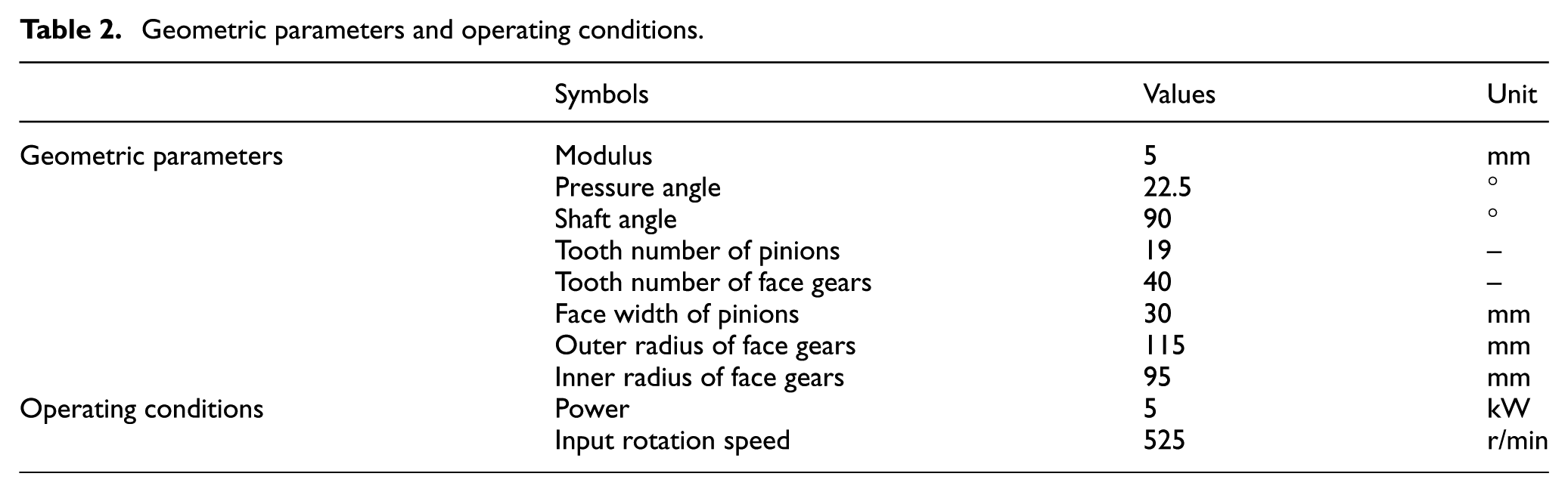
In order to evaluate the fidelity of the proposed design solution of low-noise face gear drives associated with micro-punch webs, an example case of face gear drives is simulated, and its geometric parameters and operating conditions are listed in Table 2. Moreover, in the simulation, according to Zhang and Li, 14 the value of resonant absorption coefficient αr is taken as 0.96, and the acoustic velocity in the air C0 is equal to 340 m/s.
Geometric parameters and operating conditions.
According to the geometric parameters and working conditions listed in Table 2, the mesh stiffness and static transmission error (STE) of the example case can be simulated as shown in Figure 4
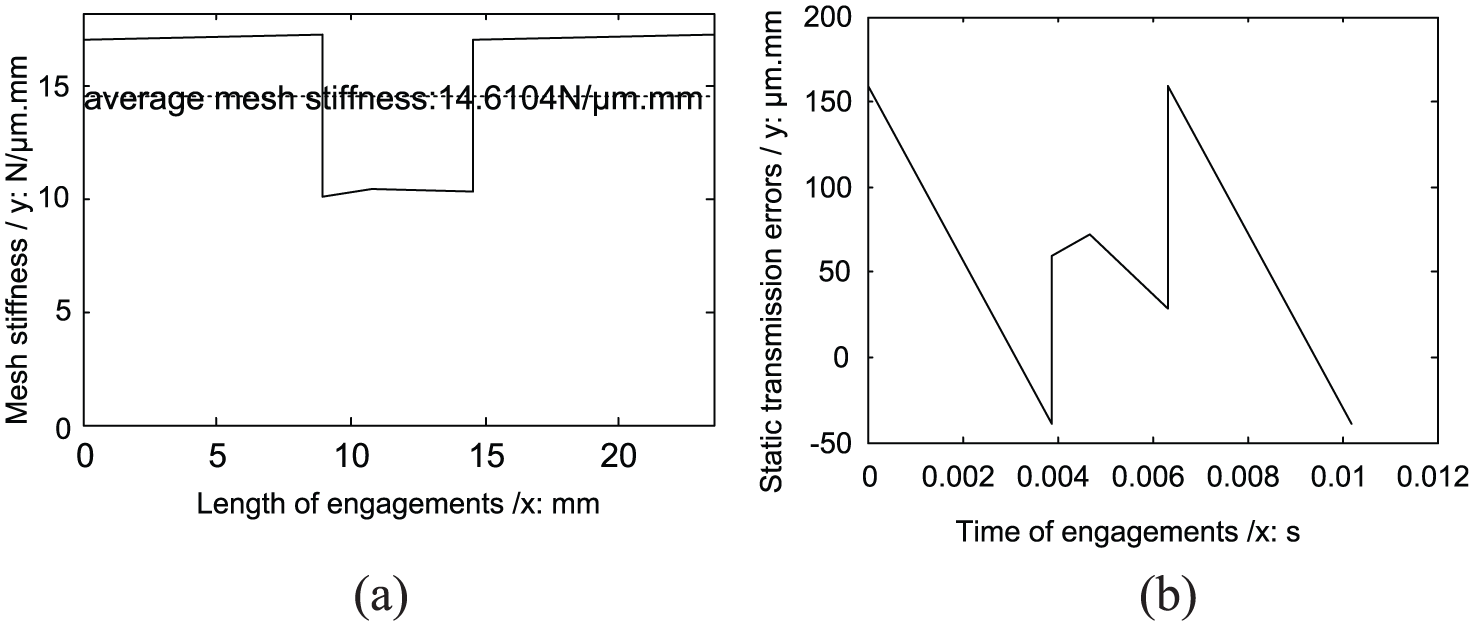
Dynamic base parameters simulated: (a) mesh stiffness simulated and (b) STE simulated.
Based on equation (1), the dynamic mesh force and bearing dynamic forces of this example case, which are caused by periodic changes of mesh stiffness and STE, as given in Figure 4, are calculated, as shown in Figures 5 and 6, respectively.

Dynamic mesh force simulated.

Dynamic forces of the bearings simulated: (a) dynamic forces of the proximal bearing of pinions, (b) dynamic forces of the distal bearing of pinions, (c) dynamic forces of the proximal bearing of face gears, and (d) dynamic forces of the distal bearing of face gears.
According to the noise radiation calculation procession in Figure 3, the note vibration velocities of the gear box can be calculated by introducing bearing dynamic forces, namely, the results in Figure 6, into the FEM model of the gear box. Then, the gear box surface acoustic pressure distributions, as shown in Figure 7, can be obtained by introducing the vibration velocities into the BEM model of the gear box, and the result of the noise radiation of the example case is given in Figure 8.

Gear box surface acoustic pressure distributions: (a) 500 Hz, (b) 1000 Hz, and (c) 5000 Hz.

Noise radiations of the example case.
As illustrated in Figure 8, the acoustic pressure peak of the example case is at 500 Hz. Thus, in the example case, taking 500 Hz as the resonant sound frequency and according to the formulas listed in Table 1, the diameter of punch and the punch ratio can be calculated with the given parameters, such as the web thickness and the resonant cavity depth, which are determined by the experiment conditions of the example case. The calculated and given geometric parameters of the micro-punch web, defined as Zhao, 13 of the example case are listed in Table 3.
Geometric parameters of the micro-punch web of the example case.
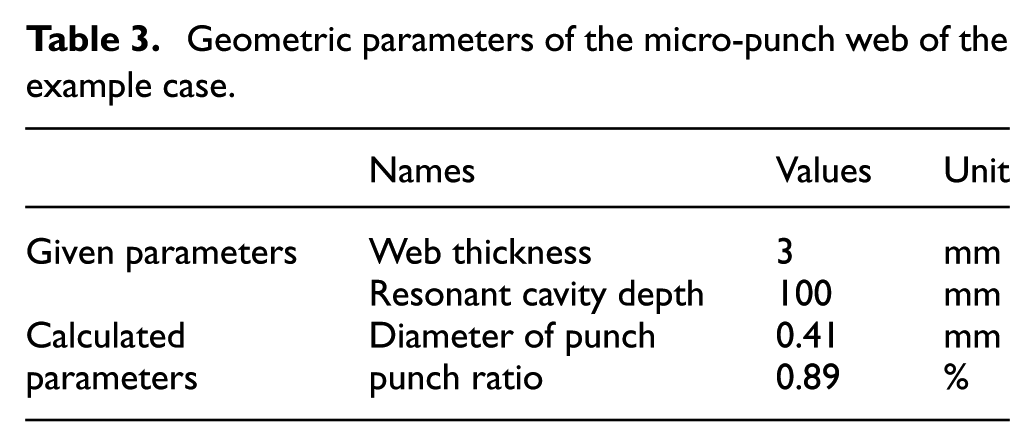
According to the geometric parameters of the micro-punch web listed in Table 3 and equation (3), the noise elimination prediction of the example case can be simulated as shown in Figure 9.

Noise elimination prediction of the example case.
An average noise elimination value can be defined as

In the case of Figure 9, and according to equation (5), the average noise elimination value of the example case is 1.2141 dB.
Impact analysis
Except the calculation of the geometric parameters of the micro-punch web, and the noise elimination prediction, the impacts of resonant cavity depths, punch ratios, and punch diameters on resonant frequencies are discussed and given in Figures 10–12, respectively. The values of impact factors are listed in Table 4, and in the analysis, the other parameters are taken as listed in Table 2.

Impact of resonant cavity depths on resonant frequencies simulated.
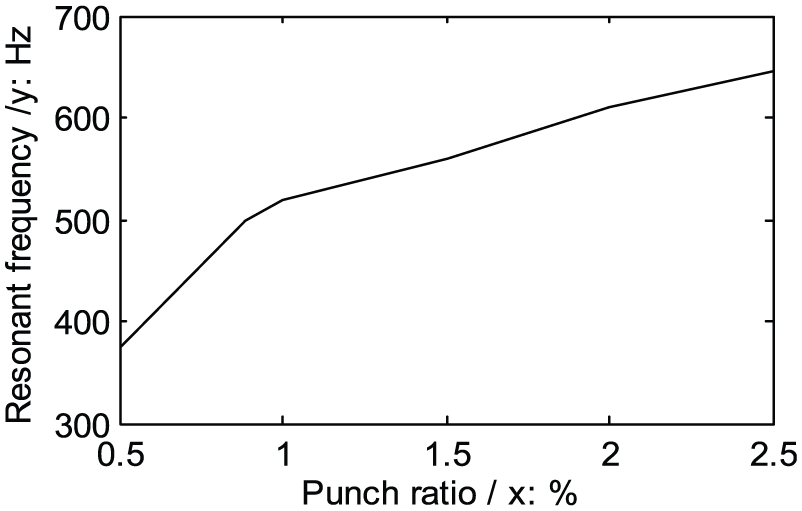
Impact of punch ratios on resonant frequencies simulated.

Impact of punch diameters on resonant frequencies simulated.
Impact factor values.

In the case of Figures 10–12, resonant frequencies of sound absorptions would be decreased with the increase in resonant cavity depths or punch diameters, and resonant frequencies of sound absorptions would be increased with the increase in punch ratios.
Experimental analysis
Description of the test bench and test articles
The purpose of the experiment is to verify the fidelity of noise reductions associated with micro-punch webs for face gear drives. Thus, in the test, the working conditions are similar to those in the simulation, and the test rig is shown in Figure 13.
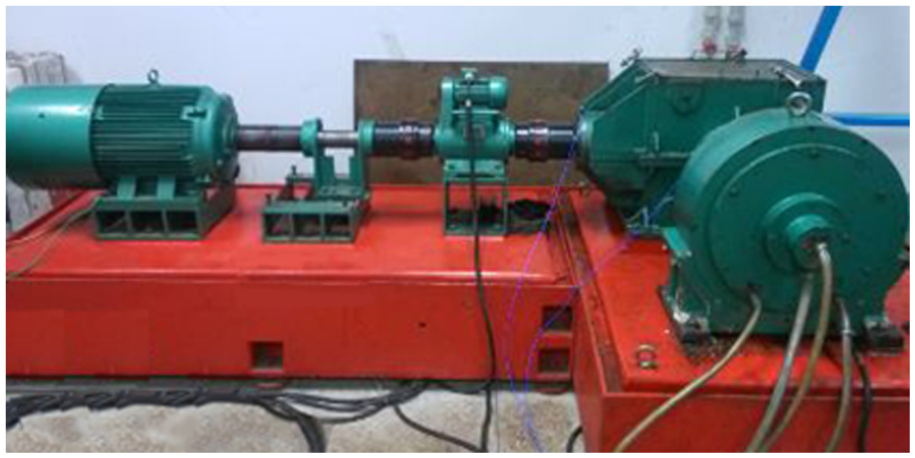
Test rig.
As illustrated in Figure 13, the power is inputted by an electrical engine, and introduced into a face gear box through a torque sensor, and used up by a magnetic powder brake, finally.
In the test, a traditional face gear test article, namely, a face gear without micro-punch webs, and a face gear associated with micro-punch webs are given in Figure 14, which takes the same geometric parameters as listed in Table 2, and the geometric parameters of the micro-punch web are designed as listed in Table 3.

Face gear test articles: (a) traditional face gear and (b) face gear associated with micro-punch web.
In addition, a cylindrical ring, constructed for the resonant cavity, whose depth is taken as listed in Table 3, is produced, as shown in Figure 15.
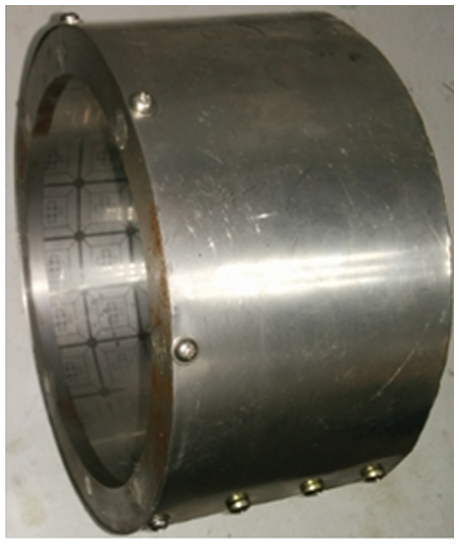
Resonant cavity part.
Dynamic response test
In order to check the effect of noise reductions by micro-punch webs, the dynamic responses of two versions of face gear drives, meaning, the traditional face gear drive and the face gear drive associated with the micro-punch web, need to be kept almost the same. In the test, the arrangement of three acceleration sensors is shown in Figure 16, and the dynamic response comparison between two versions is obtained as shown in Figure 17.
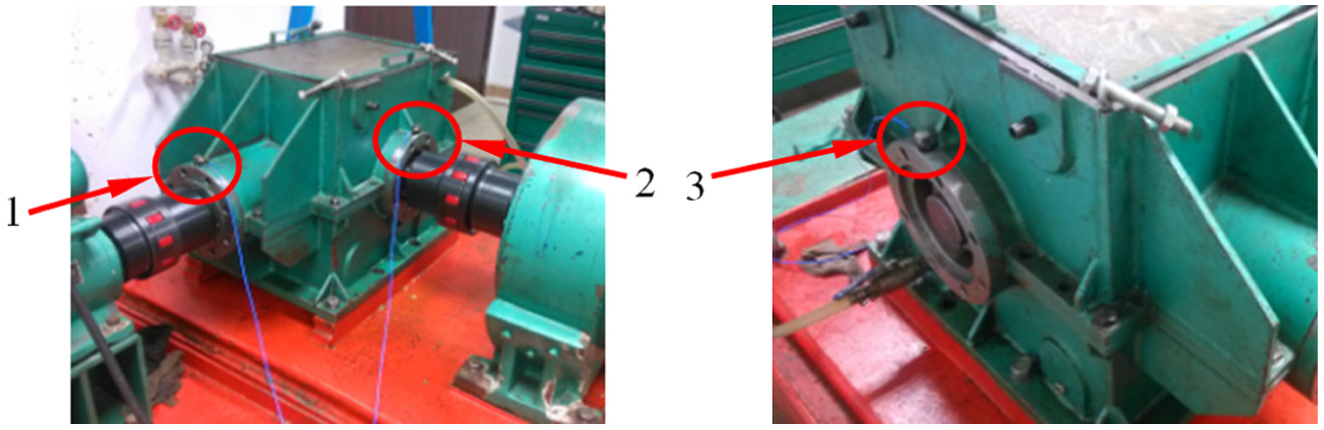
Arrangement of acceleration sensors.
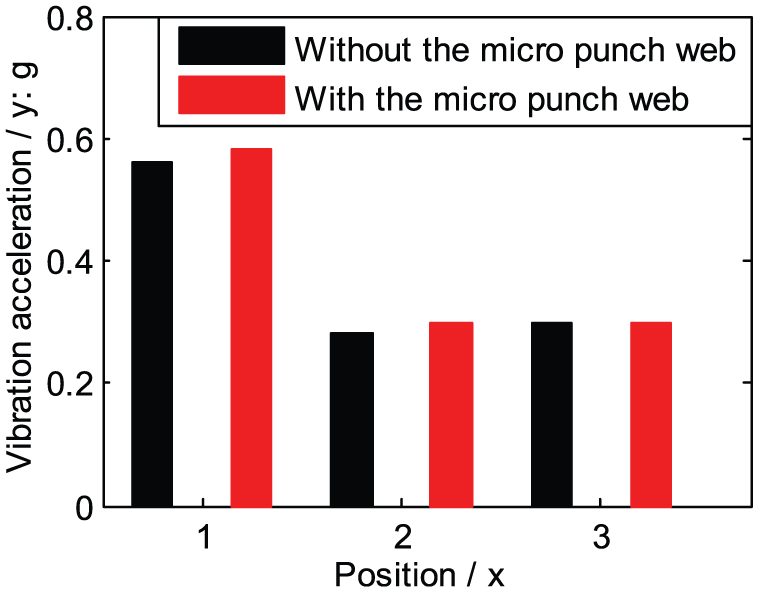
Dynamic response comparison between two versions.
As illustrated in Figure 17, under the same operating conditions as listed in Table 2, due to the unavoidable assembly differences, the dynamic responses between the two versions of face gear drives are similar, and the dynamic response of the face gear drive associated with the micro-punch web is worse than that of the traditional face gear drives, in order to show that the noise elimination effect of micro-punch webs is better.
Noise comparison
Under the similar dynamic responses of the two versions of face gear drives, the sound pressures of the two versions are tested as shown in Figure 18.
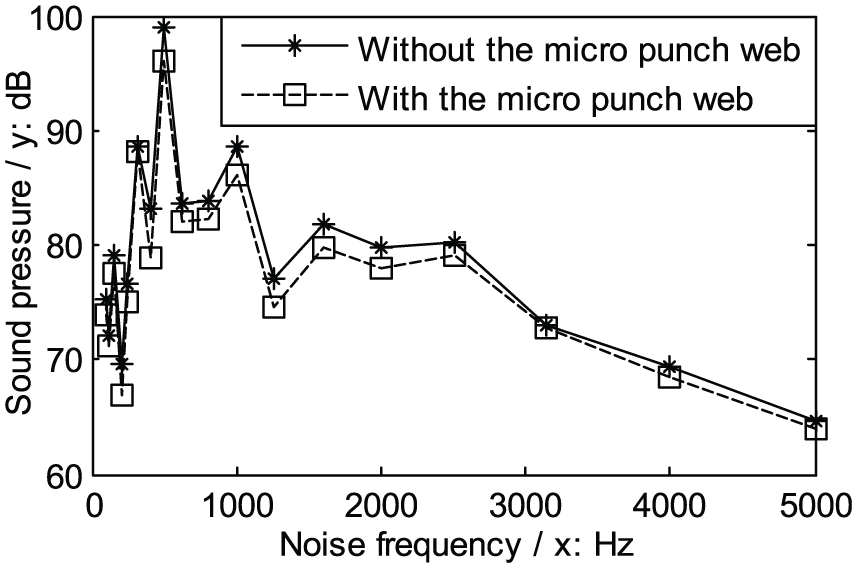
Tested sound pressures of two versions of face gear drives.
According to the tested results in Figure 18 and the simulated results in Figure 9, the noise elimination comparison between the simulation and the experiment is expressed in Figure 19.

Noise elimination comparison between the experiment and the simulation.
According to equation (5), the average noise elimination value tested is calculated and listed in Table 5.
Average noise elimination values.
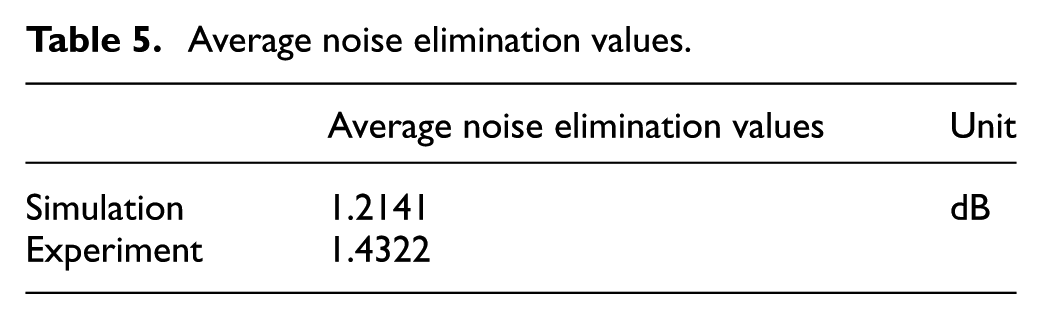
Based on the limited experimental data in the issue as shown in Figures 18 and 19 and Table 5, the results indicate that the noise of the face gear drives can be reduced more than 1 dB only by micro-punch webs under the almost same dynamic response conditions, and without considering the difference between the simulation and the experiment, namely, echo refraction effects, which are difficult to be simulated, the calculation solution of low-noise face gear drives associated with micro-punch webs can be accepted.
Conclusion
In the study, three important works can be extracted as follows:
A design solution of low-noise face gear drives associated with micro-punch webs is proposed, and a geometric parameter calculation procession of micro-punch webs is constructed.
The influence of geometric parameters of micro-punch webs, such as resonant cavity depths, punch ratios, and punch diameters, on sound resonant frequencies is discussed, and the analytic results indicate that the resonant frequencies can be decreased by the increase in resonant cavity depths or punch diameters, or can be increased by the increase in punch ratios.
The effect of micro-punch webs on noise reductions of face gear drives and the fidelity of the proposed design solution of low-noise face gear drives associated with micro-punch webs are verified by an experiment.
These contributions would be helpful to improve engineering applications of low-noise face gear drives in the future.
Footnotes
Appendix 1
Academic Editor: Ramiro Martins
Declaration of conflicting interests
The author(s) declared no potential conflicts of interest with respect to the research, authorship, and/or publication of this article.
Funding
The author(s) disclosed receipt of the following financial support for the research, authorship, and/or publication of this article: The authors are grateful for the financial support provided by the National Natural Science Foundation of China under nos 51105194 and 51375226, as well as the Fundamental Research Funds for the Central Universities under no. NS2015049.