



Abstract
This article focuses on the effect of under-frequency load shedding with renewable energy for isolated systems. Therefore, this article will apply PSS/E software to simulate the operating characteristics of an off-island system connected to battery energy storage in parallel in order to determine energy storage capacity. Wind energy operation and case analysis are used to integrate the systems that can improve under-frequency influence, in order to determine appropriate storage and AC–DC inverter capacities. First, the wind power generation data of isolated systems of 2011, 2012, and 2013 are used to estimate the storage and inverter capacities for 1, 2, 6, 12, and 24 h daily. With the above data of about 900 days, Gaussian distribution is applied to analyze the frequencies, sizes, accumulated probabilities, and other factors. Second, the annual electricity sales of isolated systems are used to determine more economic capacities for the battery storage energy and inverter. Finally, the economic analysis of the four cases is conducted, according to PSS/E software analysis, in order to determine the optimal capacity for battery energy storage devices and inverter.
Introduction
The off-island power system in Taiwan is a small isolated system, which is characterized by diesel generators and a maximum voltage of 22.8 kV. The system has two power plants at present, and Tashan Power Plant has eight diesel engines. There are four sets in Phase I, and unit capacity is about 7.9 MW. There are four sets in Phase II, and unit capacity is 8.25 MW. In addition, Branch B has six small operable sets, and unit capacity is 3.1–3.5 MW.
The island power system scale is too small, and the unit capacity of diesel of the Tashan Power Plant accounts for a high proportion of the total system load at present; thus, the under-frequency load shedding relay may be actuated and trip the feeder when any unit trips, resulting in power loss and public discontent. Especially in winter off-peak hours when the impact of unit trip is more severe. This study aims to solve under-frequency load shedding in the case of unit trip during off-peak hours.
Therefore, this article will apply PSS/E software1,2 to simulate the operating characteristics of an off-island system connected to battery energy storage in parallel in order to determine energy storage capacity3,4 and with a lot of battery energy storage system5,6 and inverter for renewable energy–related research.7–9 Finally, the appropriate capacity is determined by trip analysis cases.
Description of off-island system problems
The island power system is a stand-alone system, and it cannot be connected to Taiwan or other power systems, as it is an islanding operation power system. The off-island system uses the diesel generating sets of Plant A and Plant B as the main power supply. Plant A has eight diesel generating sets, including four sets of Phase I and four sets of Phase II. The installed capacity of each set in Phase I is 8.25 MW, and that in Phase II is 7.91 MW. Plant B has six diesel generating sets; the installed capacity of two sets is 3.168 MW, and that of four sets is 3.512 MW. The total installed capacity is 84.94 MW.
The maximum voltage of the off-island trunk stream is 22.8 kV, and the main distribution feeder is 11.4 kV. Figure 1 shows the schematic diagram of the island power system structure in 2013, including Plant A, Plant B, and main substations A, B, C, and D.
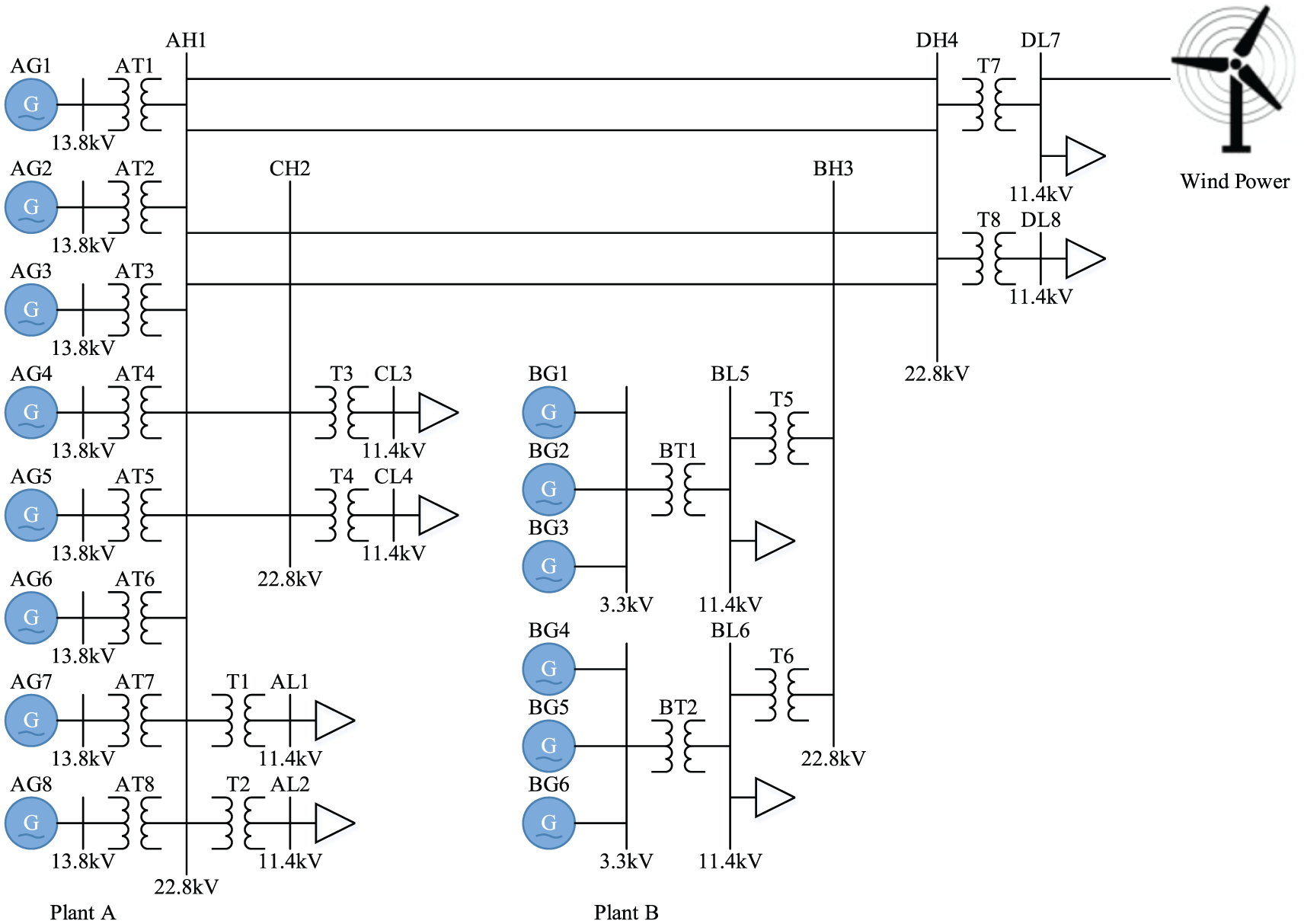
Schematic diagram of island power system.
Analysis of wind energy and review of appropriate capacity of energy storage
This study takes an existing wind farm with the total capacity of 2 MW*2 as the review case. First, the historical data of wind farm output must be obtained; including wind turbine output measured every 6 min from 1 January 2011 to 31 December 2013. A computer program is compiled to calculate and evaluate the rated capacity of energy storage and the charge–discharge capacity of the AC–DC inverter.
In this article, existing wind generating sets with appropriate energy storage (battery) are used to calculate active power capacity (MW) and electric energy capacity (MWh) in order to solve current system problems.
The performances of off-island wind power generation in 2011, 2012, and 2013, as well as the cumulative number, are used to evaluate energy storage (battery) capacity. The system operation records are collected to determine the optimal energy storage capacity in order to solve the above problems. The flow chart in Figure 2 shows the decision regarding computing optimal capacity.

Flow chart of optimal capacity.
This article will discuss wind power generation output stabilization times of 1, 2, 6 h, and all day and consider the evaluation results of wind power output during general, slight, and catastrophic fluctuations.
Wind power generation in general fluctuation
Figures 3 and 4 show the evaluation results of wind power generation stabilization times of 1 h to 1 day at a wind farm, at general wind speed, of a random day in 2011. The estimated rated capacity of energy storage is 2.036, 5.508, 16.233, and 103.451 MWh, and the maximum charge–discharge capacity is 7.39, 10.66, 13.53, and 17.58 MW.

Energy storage capacity evaluated at general wind speed in 1 and 2 h with wind power generation in general fluctuation.

Energy storage capacity evaluated at general wind speed in 6 and 24 h with wind power generation in general fluctuation.
Wind power generation in catastrophic fluctuation
Figures 5 and 6 show the evaluation results of wind power generation output stabilization time of 1 h to 1 day in a wind farm, at drastically variable wind speeds, of a random day in 2011. The estimated rated capacity of energy storage is 2.036, 5.508, 16.233, and 103.451 MWh, and the maximum charge–discharge capacity is 7.39, 10.66, 13.53, and 17.58 MW.

Energy storage capacity evaluated at general wind speed in 1 and 2 h with wind power generation in catastrophic fluctuation.
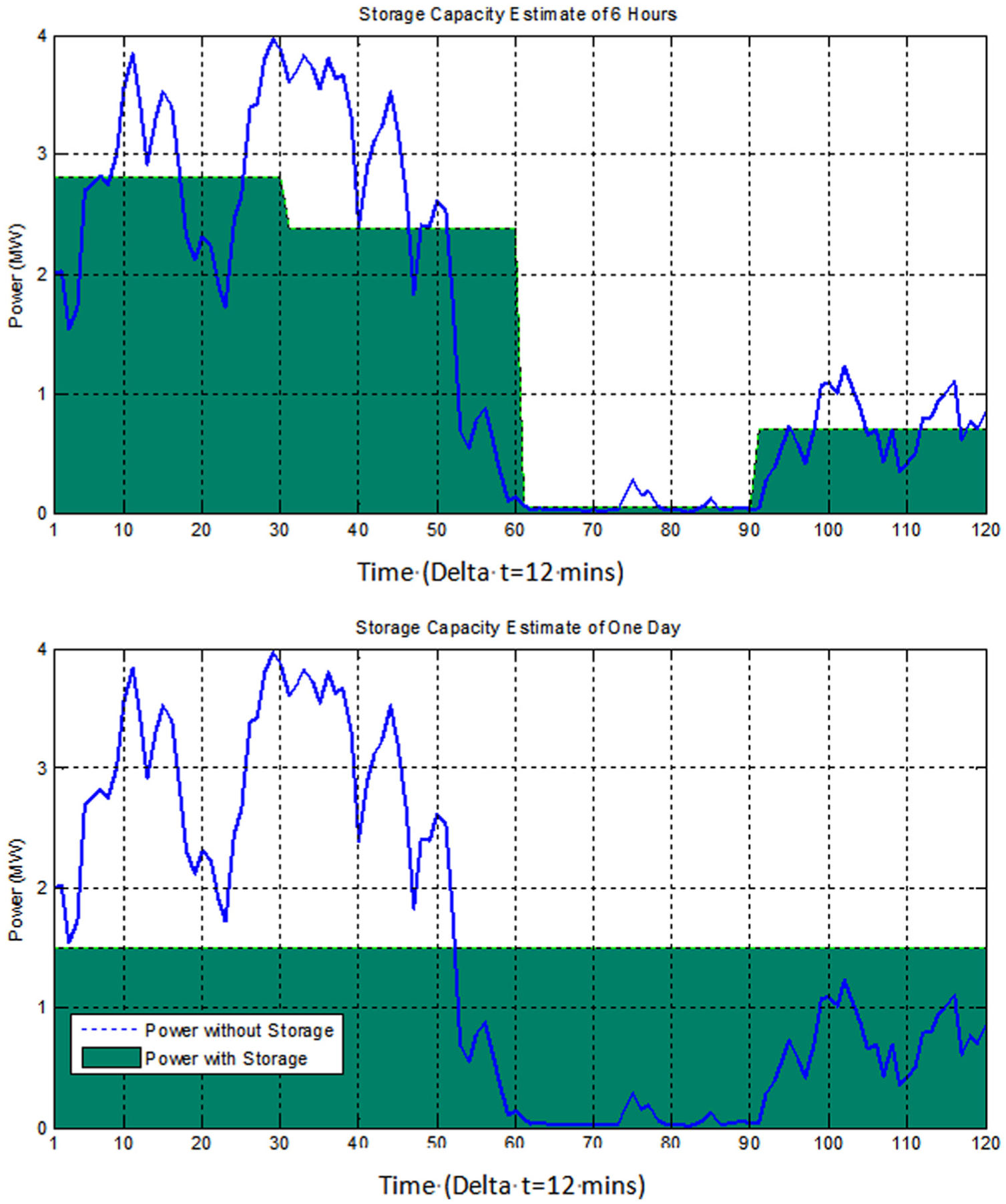
Energy storage capacity evaluated at general wind speed in 6 and 24 h with wind power generation in catastrophic fluctuation.
Analysis method
The aforesaid wind turbine performance is used to determine the daily maximum capacity of energy storage and bidirectional AC–DC inverter power in 2011, 2012, and 2013. The 150 days of wind turbine shutdown or failure are deducted in this section, with 945 days’ data, and the Gaussian distribution is implemented for the data. The energy storage capacity and cumulative probability in 1, 2, 6, and 24 h are calculated where 24 h is shown in Figure 7. The AC–DC inverter’s charging–discharging power and cumulative probability are shown in Figure 8.

24 h energy storage capacity and probability.

24 h maximum charging–discharging power and probability.
Selection of capacity with economic benefit
This section uses the analysis and statistical results of the previous section and considers wind power generation performance to design the optimal capacity, including the off-island system power consumption, battery life, and inverter capacity. The goal is minimum cost, which is equally divided into annual cost, referring to the data of the US Trojan Battery Company.
The equation is expressed as equation (1), where 1, 2, 6, and 24 h capacities are calculated, and the probability is considered. The energy is stored in a battery; the diesel engine generating cost is reduced to determine minimum f(x). The mathematical expression is equation (1)

where
The optimal capacity is designed considering wind power generation performance according to the statistical results. There are four cases of optimal benefit, Case 1–Case 4, as shown in Table 1, which are cost-effective combinations.
Benefit analysis.

The simulation results are observed by comprehensive analysis. First, the evaluated economic benefit energy storage has four combinations. Table 2 shows the under-loaded system with energy storage system improvement; Cases 1–4 show that bidirectional AC–DC inverter capacity is large, and improvement is obvious. When the off-island system load is light, and the largest unit trips, there may be under-frequency load shedding and public complaints.
Improved benefit with energy storage.

Conclusion
This article is characterized using off-island wind power generation performance (2011–2013) to evaluate appropriate battery energy storage capacity and used PSS/E software to analyze the effect of energy storage on improving the under-frequency load shedding of an off-island system. Finally, the optimal energy storage capacity is discussed, and the conclusions are described as follows.
In terms of benefits, energy storage capacity and investment amount are analyzed. An existing wind farm with a total capacity of 2 MW*2 is reviewed, the historical data of wind farm output are obtained, and wind turbine output is measured every 6 min during 1 January 2011–31 December 2013 in order to compile a computer program to calculate and evaluate the rated capacity of energy storage and bidirectional AC–DC inverter capacity. There are four cases, the bidirectional AC–DC inverter is 2.152, 1.432, 0.424, and 1.730 MW, respectively, and the battery capacity is 1.929, 2.269, 1.816, and 2.156 MWh, respectively.
In terms of technology, the under-frequency load shedding loss of an island power system during off-peak hours is analyzed. The first parameter element is used for analyzing under-frequency load shedding, where the probably influenced unloading capacity of the original case (without energy storage) is 106.504 MW, while that of the improved cases with energy storage (1–4) is 35.75 MW (optimal), 42.112 MW (excellent), and 68.431 MW (good), respectively.
Based on the above benefit and technology analyses, the off-island wind power generation is used effectively, off-island light load under-frequency load shedding is improved, and energy storage is applied to heavy loads for peak shaving. The maximum economization is taken according to the simulation analysis results, where the bidirectional AC–DC inverter capacity is 1.423 MW, and the battery energy storage capacity is 2.269 MW; thus, both benefits and technology are improved.
Footnotes
Academic Editor: Stephen D Prior
Declaration of conflicting interests
The author(s) declared no potential conflicts of interest with respect to the research, authorship, and/or publication of this article.
Funding
The author(s) disclosed receipt of the following financial support for the research, authorship, and/or publication of this article: The support of this research by the Ministry of Science and Technology of the Republic of China under grant nos MOST103-2221-E-011-077-MY2 is gratefully acknowledged.