




Abstract
The use of low-carbon evaluation indices for tourist attractions facilitates the promotion of low-carbon tourism. However, balancing tourism and environmental considerations has become critical to the development of the tourism market. Compared with road vehicles, cable cars are environmentally friendly, convenient, and economical. This study presents a framework for evaluating cable car development projects on the basis of the following aspects: (a) determining guidelines for cable car stations and route layouts, (b) establishing a logical framework for assessing the feasibility of cable car systems, (c) identifying station assessment items, and (d) evaluating the assessment items for potential routes by applying the analytic hierarchy process. These aspects can facilitate executing thorough and pragmatic assessments of cable car development projects.
Introduction
In Taiwan, tourism is flourishing and ecotourism is progressively growing, and tour itineraries are increasingly focusing on mountainous and forest regions. Low-carbon tourism is an approach to cultivating sustainable tourism associated with a low-carbon economy. The core value of low-carbon tourism is to provide a high-quality tourism experience that ensures that transportation, accommodation, sightseeing, shopping, and entertainment are associated with low-carbon emissions and reducing pollution. The use of low-carbon evaluation indices for tourist attractions facilitates the promotion of low-carbon tourism. 1 However, balancing tourism and environmental considerations has become critical to the development of the tourism market. Compared with road vehicles, cable cars are environmentally friendly, convenient, and economical.
Furthermore, cable cars can provide the following services.
Transportation alternatives and traffic alleviation. Cable car systems can overcome landscape barriers and directly connect tourist attractions and major transportation hubs. They can also be used to create new transportation routes, effectively replacing and sharing the burden of existing roads while expanding the capacity of transportation services.
Connection services between recreational hotspots. Cable cars can systematically connect hotspots and recreational resources, thus saving time and travel costs between hotspots, increasing journey flexibility, and diversifying recreational activities.
Outdoor scenery and recreation. Introducing cable cars can provide a completely new perspective for viewing scenery and enjoying recreational activities, enabling tourists to appreciate unique natural views and scenery from the air.
Therefore, numerous cable car construction plans have been proposed to concurrently develop the tourism market and address environmental protection concerns.
Frameworks for assessing cable car construction investment projects involve numerous factors such as construction technology, geology, market conditions, financing, land acquisition, environmental impacts, and traffic. Such frameworks must incorporate diverse assessment factors and evaluate them on a case-by-case basis. In this study, an assessment framework involving several dimensions and indicators was established using case examples, research reports, and expert opinions. Questionnaires were administered to selected experts to determine the weights of the evaluation dimensions and indicators. The results of this study verified the feasibility of this assessment framework and may serve as a reference in assessing the effectiveness of cable car construction projects for relevant government departments in Taiwan.
The remainder of this article is organized as follows. Section “Principles of selecting cable car stations and route layouts” describes the principles of selecting cable car stations and route layouts. Section “Framework for assessing cable car investment projects” explains the assessment procedure for the cable car investment projects, which involves establishing assessment dimensions, criteria, and weightings through the analytic hierarchy process (AHP). The results of this study can serve as a reference in feasibility assessments of cable car construction projects for relevant government departments in Taiwan.
Principles of selecting cable car stations and route layouts
This study was conducted based on approximately 40 cable car assessment projects in Taiwan. The four basic principles governing the selection of stations and route layouts are outlined as follows:
The target tourist station and its core capacity should be set as the starting station or terminal station of a route.
The exterior of cable car starting stations should have ample space to accommodate affiliated facilities as well as be a gathering place for people and cars.
The selection of cable car stations should be based on the available transportation hubs and tourist attractions.
A direct route should be selected to attain transportation utility and minimize construction costs.
Other principles for developing cable car systems are detailed as follows.
Principles of land use and development
Preserve the connection with natural forests.
Consider the flexibility of future tourism development.
Construct a high-quality recreational service environment.
Increase the number of living and recreational amenities.
Principles of station selection
Form a coherent transportation system and mitigate new traffic bottlenecks.
Exploit the advantages of transfers between different transportation modalities and minimize traffic conflicts during the construction of cable car stations.
Consider transit and parking problems when constructing the stations.
Ensure that the base station has a flat terrain.
Appropriate land of sufficient size in the surroundings of cable car stations for development. In addition to the provision of adequate space for operating, managing, and repairing cable cars, consider allocating space for passenger disembarkation, recreation, and greenery.
Consider building a barrier-free space at cable car stations.
Consider environmental protection and maintenance of scenic views to minimize the impact on the existing views.
Confirm that the base station is geologically safe.
Principles of route planning
Location setup limitations
Avoid establishing routes in the air or on the ground within 4 m of housing facilities, crowded locations, hazardous storage facilities, electrical wires, railways, roads (except for roads with light traffic), rivers, lakes, and swamps. However, exceptions may be allowed when convincing reasons are provided and when protective barriers are installed to prevent falling objects from causing damage.
Setup height
For cabins protruding from stations, maintain a minimum distance of 5 m between the cabin and the ground, but ensure that the cabin height is not excessive. Under safe circumstances with protective measures in place, the minimum distance can be reduced to 1.5 m.
Inclination of supporting and propulsion cables
The standard inclination angle of supporting and propulsion cables should be lower than 30°. If measures are implemented for strengthening cabin and steel cables, a 45° angle can be used. A standard cable inclination should be maintained between the station and the pillar closest to the station to account for the emergency braking requirements of cable cars entering the station.
Spacing for safety
To ensure safe emergency rescue operations, in principle, a 1-m distance should be maintained on both sides of the cabin (left and right); under special circumstances, a 3-m distance should be maintained between the bottom of the cabins and any obstacle (such as trees). The distance can be shortened to 2 m if no safety concerns exist.
Space should be left between the supporting and propulsion cables in both route directions, and the impact of reaction forces should be considered. For operational safety, a cabin sway space (radius × 0.2) should be provided in both the directions (or 1 m).
When a car is on a two-rail section, a 2-m minimum distance should be maintained between the rails to ensure operational safety.
Protective measures
When cable car routes cross above roads, protective measures should be installed on the roads.
Others
Dead ends should be sufficiently avoided in the route layout to ensure an efficient safety monitoring of the entire route.
Vegetation and barriers should be removed from cabin routes that are close to the ground or located in regions that may affect the electrical systems of cable cars. Basic pillars and rescue nets should also be cleared accordingly; however, clearing the parts under the protective net is unnecessary.
Framework for assessing cable car investment projects
According to the preceding basic principles, the framework for assessing cable car investment projects can be divided into the following categories:
First, to confirm the characteristic of an investment project (whether for transportation, tourism, or others), a preliminary analysis should be performed to determine whether a particular location should be included in a list of potential stations. Each hotspot within the region should be assessed according to three dimensions—namely, the current situation, demand, and social aspects—and then be designated as a starting or intermediate station.
After the execution of geological, engineering, and land assessments, potential locations for establishing stations are chosen. If a location fails on any of the three dimensions, it is removed from the list of possible locations.
The characteristics of the starting station, terminus, or intermediate station for a potential location are considered collectively to form a possible route, and an integrated evaluation is conducted on each possible route.
Initial station assessment
The initial assessment of potential stations involves conducting a situational evaluation on the three dimensions: (a) current situation (i.e. the current situation of development in the location), (b) demand (i.e. the future direction of development in the location), and (c) social aspects (i.e. the level of support from the public and government regarding the development of the location). Table 1 extrapolates these dimensions.
Initial assessment of potential stations.

Conducting evaluations according to these three dimensions provides a preliminary understanding of whether a location should be shortlisted as a potential station for assessment and whether the location being assessed can be designated as a starting or intermediate station. After further geological, engineering, and land assessments are conducted, the locations of potential stations are selected, and the stations are connected to create a possible route. This possible route undergoes an integrated assessment and selection, as described in the following section.
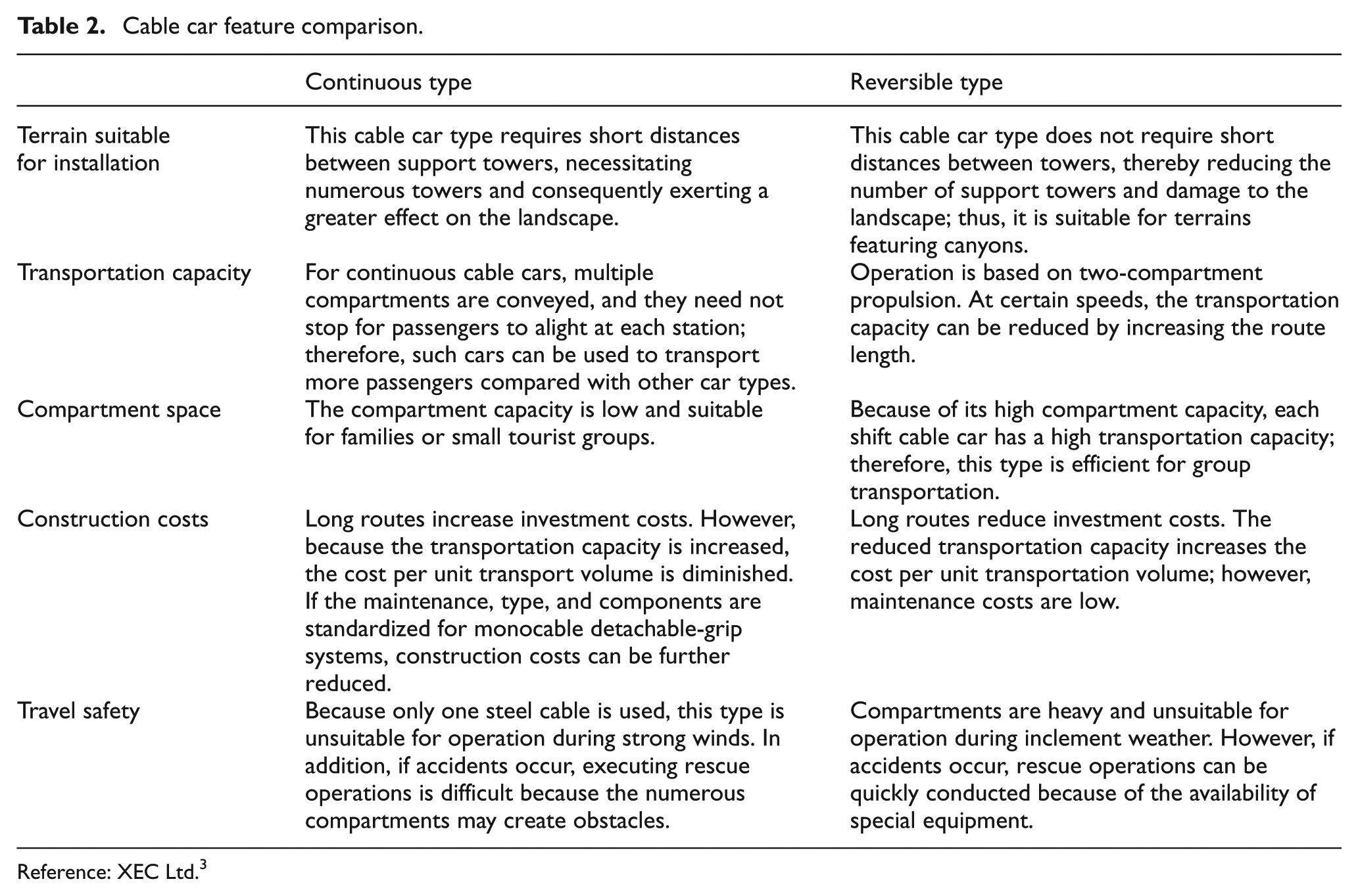
Cable car feature comparison
Over the past century, the technology for cable car systems has developed rapidly. Most cable cars have been constructed in harsh environments such as cold and snowy ski resorts (e.g. Mt Titlis in Switzerland and Chamonix Valley in France), near great waterfalls in regions that are humid all year, near the sea (e.g. Hong Kong and Singapore), in regions affected by salinity, in foggy regions (Huangshan), or at the edge of deserts (e.g. the Great Wall of China). Japan’s Hakone Ropeway is subjected to extreme environmental conditions such as hot springs and snow. To date, all these cable cars have been operated safely. Currently, more than 10,000 cable car systems have been constructed worldwide. These aerial tramways and lifts are called “ropeways” in Japan. The following sections describe these ropeway systems based on their functionality and type: 2
Functionality. General ropeways. These ropeway systems are used for conveying passengers or cargo, and their compartments contain locking doors. Special ropeways. These ropeway systems are used for conveying passengers only, and their compartments contain open seats.
Type. Reversible type. Ropeway systems in this category can be divided into mono-, bi-, and multicable (three to five cables) systems depending on the number of cables used. The most common system involves tracks containing three or four cables. A reversible conveyor style entails suspending two compartments to a track rope and using traction and balancing ropes to haul and shuttle the compartments back and forth. Continuous type. Ropeway systems in this category are primarily divided into fixed- and detachable-grip continuous systems, in which the compartments are suspended from a grip connected to cables. Fixed-grip cable car systems are propelled using a single haul rope affixed to each compartment. Detachable-grip systems suspend each compartment from a haul rope. When a compartment enters or exits the station, the grip that is fastened to the cable automatically holds or releases the haul rope to achieve continuous propulsion. Under normal circumstances, because detachable-grip systems can withstand high-traffic demand and enable rapid propulsion, they have been adopted for ropeways that can accommodate high speeds and a large transportation capacity. Fixed-grip cable cars are primarily used in small-scale transportation. Table 2 details the features of these two types of cable car.
Cable car feature comparison.
Reference: XEC Ltd. 3
Cable car project assessment dimensions and criteria establishment
Several studies have investigated numerous cable car plans and concepts proposed in Taiwan. Such studies are summarized as follows.
Sun applied the AHP and established a two-layer model structure, which entailed considering 5 evaluation factors and 13 evaluation criteria, for enhancing cable car site selection. The proposed hierarchical evaluation framework was optimized after consulting specialists. A specialist questionnaire was designed on the basis of the hierarchical framework and was used in determining the relative weight of the evaluation factors and criteria. The site selection procedure conducted for the Beitou cable car was adopted to verify the feasibility of applying the AHP in site selection. The proposed hierarchical framework and decision model can be used as a reference for future cable car site selection. 4 Chen 5 also applied the AHP to evaluate the feasibility of constructing a cable car system between Tataka and the main peak of Yushan at the Yushan National Park. Chou studied the feasibility of establishing a high-mountain cable car system and investigated the planning and evaluation procedures conducted for the Nantou cable car line, located in Ren’ai Township, Nantou County. A specialist questionnaire was administered in this study, and the AHP was employed to calculate and order the weights of evaluation factors of the cable car construction in Ren’ai, Nantou. Moreover, crucial criteria used in establishing the cable car system were compared for providing suggestions for relevant agencies. 6
Ma investigated tourist attitudes toward high-mountain cable cars and conducted a case study of the Kukuan and Mt Anma areas. The recreation opportunity spectrum, attitude theory, and relevant studies constituted the theoretical basis of this research. A questionnaire survey was administered to tourists, and independent sample t tests, the chi-square test, one-way analysis of variance, and Duncan’s new multiple-range test were used to analyze tourist attitudes toward such cable cars. 7 Tsou adopted social judgment theory (SJC) to analyze cable car construction in Kaohsiung. SJC pertains to the deviation between the subjective perceptions of decision-makers and an objective environment as well as the competing subjective perceptions among decision-makers. Tsou also discussed reasons for cognitive dissonance and examined approaches for reducing cognitive dissonance in public decision-making. Key decision-making variables obtained from interviews were implemented in an SJC-based questionnaire to clearly examine the level of cognitive dissonance among decision-makers. This examination was conducted to provide governmental departments with a reference for devising policies and response measures since they face similar disputes. 8
Lin and Chang 9 used a geographic information system to analyze various aspects of site selection for the Beitou cable car system; such aspects included recreational factors, safety, environmental influences, and impact on the lives of inhabitants of local communities. Although studies on cable car construction in Taiwan have widely adopted the AHP as an assessment method, they differed substantially in their assessment dimensions and index content. Moreover, these studies have not proposed assessment considerations of domestic cable car construction cases regarding the promotion of public participation, but they have mostly rated possible schemes and assessment indices directly. However, evaluating assessment indices is complex, and directly rating them is difficult. Therefore, in this article, we propose a revision of the hierarchical evaluation framework and a paired comparison to establish a revised evaluation mode. Accordingly, a comprehensive literature review and in-depth interview with experts were conducted. Figure 1 and Table 3 show the cable car assessment dimensions, criteria, and bases. The following sections detail the establishment of the evaluation mode.

Framework for assessing cable car investment projects.
Feasibility assessment dimensions and criteria for cable car construction.

Integrated assessment and selection of routes
Construction of assessment criteria and weightings
The AHP has been used in diverse applications, 10 including the development of transportation strategies.11–13 In this study, the AHP literature14,15 was extended by addressing the necessity of prioritizing numerous alternatives exhibiting high heterogeneity. The AHP has many advantages over other analysis methods in that it facilitates simplifying complex decision-making problems by decomposing them into hierarchies, and it is simple enough to be understood by nonprofessionals. Therefore, in this study, we examined the validity of the AHP in evaluating the sustainability of cable car construction projects. Generating priorities through an organized decision-making process entails breaking down a decision into several hierarchies according to the following steps:
Define the decision problem.
Identify the actors involved.
Establish a hierarchical framework.
Design a questionnaire: This step enables obtaining a paired comparison matrix A. If n factors are compared, then the number of paired comparisons that must be conducted is n(n − 1)/2. Because of the reciprocal property of paired comparisons, if the ratio between elements i and j is
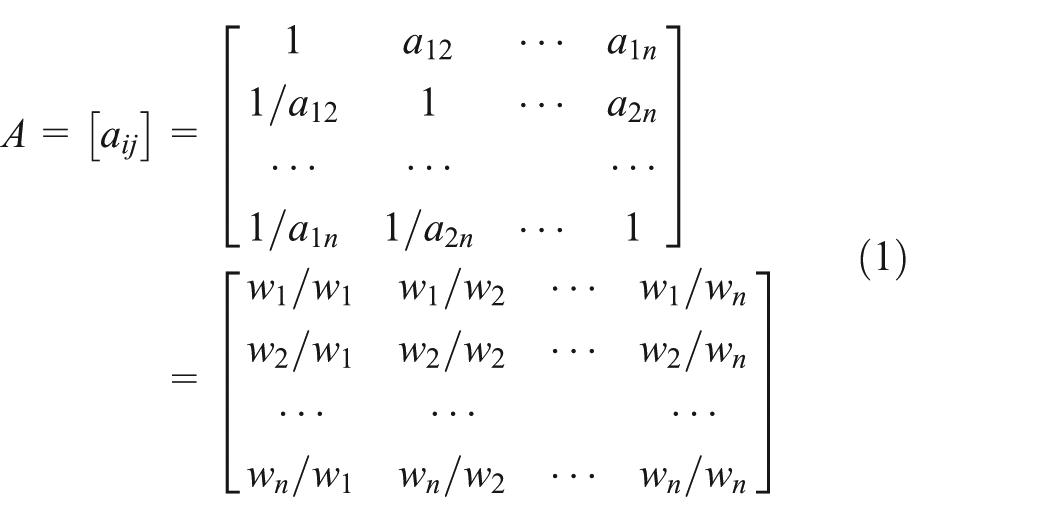
where
Calculate the eigenvalue and eigenvector: The geometric mean can be obtained by multiplying elements in every row and then normalizing the value, as expressed in equation (2)

A new eigenvector,

Execute a consistency test: This step involves conducting a consistency test to determine the consistency index (CI), as expressed in equation (4). Saaty suggested that the most satisfactory CI is <0.1 and that the highest allowable bias is CI <0.2; if the CI falls within this range, consistency is ensured. This is expressed as follows

Table 4 shows the results of the paired comparisons conducted in this study. The designed survey was completed by 14 experts (10 county government supervisors, 2 township office supervisors, and 2 construction consultancy company supervisors). The survey was used to evaluate the 8 dimensions and 24 evaluation criteria.
Cable car construction assessment dimension and criteria analysis results.

Integrated assessment and selection
When the assessment dimensions and criteria weights determined by the specialists satisfied the consistency requirements, the weights and each scheme were applied in determining the priority index (PI) in every assessment index. The PI was obtained by calculating the weight Wi and score Xij of each scheme i derived from each index

The specialists directly rated the score Xij of each scheme i obtained from each index. Because evaluating every assessment index is complex, we proposed conducting a paired comparison of the schemes. The advantage weight of each index was considered its score, and the calculation method was identical to the described weight evaluation method executed using the paired comparison matrix.
Conclusion
This study adopted a mixed design comprising literature reviews, observations, and interviews. We performed focus-group interviews for qualitatively studying and devising the assessment dimensions. A quantitative multicriteria decision analysis was also conducted. This study primarily focused on evaluating cable car construction schemes in order to establish a hierarchical evaluation framework based on the characteristics of cable car construction assessments in Taiwan. This evaluation framework incorporates diverse assessment factors weighted according to individual case differences. According to the Act for Promotion of Private Participation in Infrastructure Projects and related feasibility studies, the established framework can serve as an assessment scheme in practical applications. In addition, on the basis of the assessment indicators, we derived potential recommendations to conduct paired comparisons and rankings and calculated the scores of the various schemes. This approach avoids appraisal difficulties associated with the direct allocation of scores to various schemes using assessment indicators.
We suggest that follow-up studies extend the established framework to analyze the difference in weights associated with assessment dimensions and criteria, which are defined by experts from different units, such as the central government or local government, or experts in different areas.
In this study, the relative importance in the pairwise comparison matrix was defined as a crisp value. However, the experts mostly applied semantic expressions in their subjective assessments. Therefore, follow-up research may consider applying fuzzy semantic expressions.
Footnotes
Academic Editor: Stephen D Prior
Declaration of conflicting interests
The author(s) declared no potential conflicts of interest with respect to the research, authorship, and/or publication of this article.
Funding
The author(s) received no financial support for the research, authorship, and/or publication of this article.