




Abstract
In this study, we modify the Sumudu decomposition method and apply the method to study the singular initial value problems which are represented by Lane-Emden-type equations. We also consider both linear and nonlinear cases and provide some examples.
Introduction
The Adomian decomposition method (ADM) is an accurate and efficient method which was proposed initially with the aim of solving frontier physical problems analytically. Since then, ADM has been applied in the solution of nonlinear ordinary or partial differential equations without using linearization or perturbation process. It is also a very powerful method to handle deterministic and stochastic problems that arise in physical, biological and chemical reactions, see Adomain 1 and Duan and Rach, 2 and for the effective convergence region, see Duan et al. 3 The Sumudu Adomian decomposition method (SADM) is a combination of ADM and Sumudu transforms. This method was applied successfully to nonlinear system Volterra integro-differential equations and also used in nonlinear system of partial differential equations, see Eltayeb and colleagues.4,5 The singular differential equations for Lane–Emden type appear in many areas of mathematical physics and astrophysics in Bert and Zeng. 6 In the literature, there are several research works on the similar problems. For example, Momoniat and Harley 7 got the solution by reducing the singular equation to the first-order differential equation and applying Lie group analysis, Shawagfeh 8 gave the approximate solutions of Lane-Emden-type equations, Cantor-type cylindrical-coordinate method was used by Yang et al. 9 to investigate the family of local fractional differential operators on Cantor sets10–12 studied the variational iteration method for fractional and Zhang et al. 13 applied the exponential wavelet iterative shrinkage threshold algorithm for compressed sensing magnetic resonance imaging.
The aim of this article is to apply the modified Sumudu decomposition method to obtain the exact solutions for singular differential equation with exponential and logarithmic nonlinearities. Some examples are given to support the present method. Now let A be a space of functions as follows

then the Sumudu transform of f is defined as

Now recall the next theorem which was given in Belgacem et al. 14
Theorem 1
Let

for
In general, to study the Sumudu transform of singular differential equations, we need concepts of Sumudu transform for derivatives.
Theorem 2
Let


Proof
To prove equation (1), we use the following formula

given by Asiru. 15 Then apply

and follows that

The proof of equations (2) and (3) is similar to the proof of equation (1).
Now if we consider solving the following second-order non-homogeneous ordinary differential equations with initial conditions

where f is a real function, g is a known function and A and B are constants. In particular, if

where

using the properties of the Sumudu transform, we get

simplifying equation (8), we have

Integrating equation (9), we obtain


where

where

Equation (13) is defined as
Substituting equation (12) into equation (10), we have

The recursive relation is given by


The inverse Sumudu transform of equations (16) and (17) yields


where
Modified Sumudu decomposition method
In this section, we consider the term

Instead of the iteration procedure in equations (18) and (19), we suggest the following modification


The solution through the modified Sumudu decomposition method highly depends on the choice of
Numerical examples
In this section, we solve some singular initial value problems (IVP) of Lane–Emden type.
Example 1
Consider the singular homogeneous Lane-Emden-type equation

with initial conditions

According to the MSDM and initial conditions, we get

If S and

Consider equation (26) and substitute

Thus, the series solution is given as

The exact solution is

Example 2
Consider the singular nonlinear IVP


Applying the MSDM, we have

and then, the recursive relations


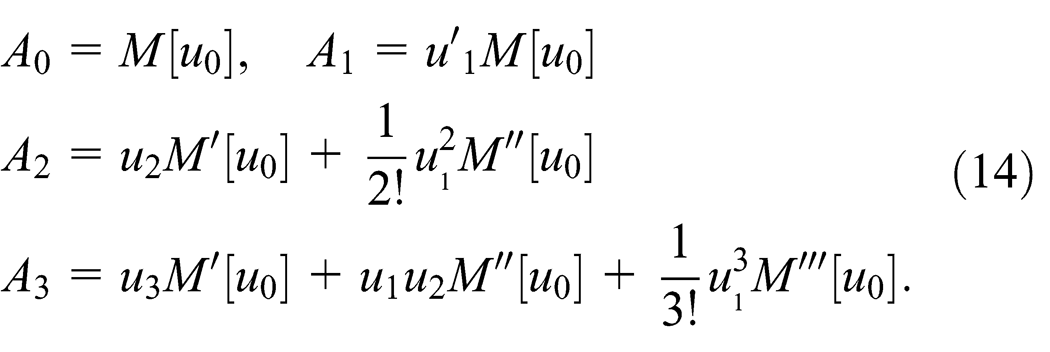
by equation (14), we have

and then applying equations (31) and (32), we have

The series solution in general is given as follows

The exact solution given by

Example 3
Consider the singular nonlinear IVP

Multiply equation (33) with t, and taking the Sumudu transform, we obtain

Integrate equation (34) and inverse transform yields

where the nonlinear operator

Substituting equation (35) into equation (36) gives the following terms

similarly, we obtain

The series solution is given as

The exact solution is

Now if
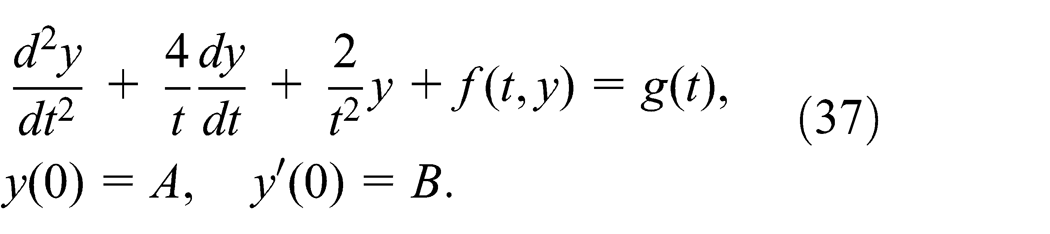
Multiplying equation (37) by

and applying the properties of the Sumudu transform, we obtain

Simplifying equation (39), we have

Integrating equation (40), we get

Taking the inverse Sumudu transform of equation (41), we obtain


Example 4
Consider the nonlinear singular IVP

Multiplying equation (44) by

then we have

Integrating equation (46) two times with respect to u, and then taking inverse transform on both sides, we get

where the nonlinear term

using equation (48) and proceeding as before yield the recursive relationship

The series solution in general is given as follows

The exact solution is

As a conclusion, we state that the proposed method can be applied to industrial fields such as image processing and fractional calculus.
Footnotes
Academic Editor: Xiao-Jun Yang
Declaration of conflicting interests
The author(s) declared no potential conflicts of interest with respect to the research, authorship and/or publication of this article.
Funding
The author(s) disclosed receipt of the following financial support for the research, authorship and/or publication of this article: The authors would like to extend their sincere appreciation to the Deanship of Scientific Research at King Saud University for funding this research (group no. RG-1435-043).